

How much does it cost to ship a car? In our real car shipping quotes, an open-trailer sedan that runs cost a median of $289 for a trip under 250 miles, $719 at 500 to 1,000 miles and $1,380 across the country (2,000 miles or more). The price per mile falls as the trip gets longer, from about $2.12 a mile on short runs to about $0.56 on the longest. SUVs cost a little more, and pickups and vans cost a lot more on long trips. This guide shows what we found on 871 real lanes in 30 states and Washington, DC, with a free car shipping calculator for your own route, whether you want to know how much to ship a car across town or across the country.
Every price below is a real quote from our platform for one vehicle on an open trailer, checked between October 6 and October 17, 2026 and updated as we add lanes. This page was last updated October 25, 2026. Enclosed transport and a car that does not run are priced as adjustments to the open quote, as explained further down.
Car shipping cost calculator
Enter your pickup and delivery ZIP codes, pick your vehicle and see an estimated price range. The estimate is fitted to the 871 real lanes behind this page, and it shows the closest real lanes so you can see what it is based on. It is an estimate, not a quote: when we checked it on lanes it had not seen, about 88% of sedan estimates landed within 25% of the real price, and the range it shows is built to cover about 8 in 10 of them.
Car shipping cost calculator
Enter two ZIP codes and your vehicle for a price range built from real car shipping quotes on our platform.
How much does it cost to ship a car by distance?
Distance is the biggest driver of the price, but the relationship is not a straight line. Each trip pays for loading, unloading and repositioning the truck whatever the length, so short trips cost the most per mile and long trips the least. Here is what we found, grouped by trip length. The ranges are the middle 80 percent of our lanes in each group (the 10th to the 90th percentile of the sedan price).
| Trip length | Lanes | Sedan (median and range) | SUV | Pickup | Van | Sedan per mile |
|---|---|---|---|---|---|---|
| Under 250 miles | 168 | $289 $142–$446 | $295 | $340 | $384 | $2.12 |
| 250 to 500 miles | 146 | $462 $332–$614 | $482 | $662 | $630 | $1.18 |
| 500 to 1,000 miles | 241 | $719 $509–$974 | $789 | $1,098 | $1,058 | $1.00 |
| 1,000 to 1,500 miles | 172 | $980 $735–$1,244 | $1,066 | $1,526 | $1,492 | $0.78 |
| 1,500 to 2,000 miles | 66 | $1,112 $957–$1,377 | $1,236 | $1,998 | $2,034 | $0.66 |
| 2,000 miles or more | 76 | $1,380 $1,186–$1,656 | $1,520 | $2,430 | $2,532 | $0.56 |
Prices are medians of the lanes in each group, for a running vehicle on an open trailer. A single lane can land well above or below its group, so use the calculator above or a live quote for your own route. As a rule of thumb for a sedan: about $2.12 a mile under 250 miles, $1.18 at 250 to 500 miles, $1.00 at 500 to 1,000 miles, $0.78 at 1,000 to 1,500 miles and $0.56 for the longest trips.
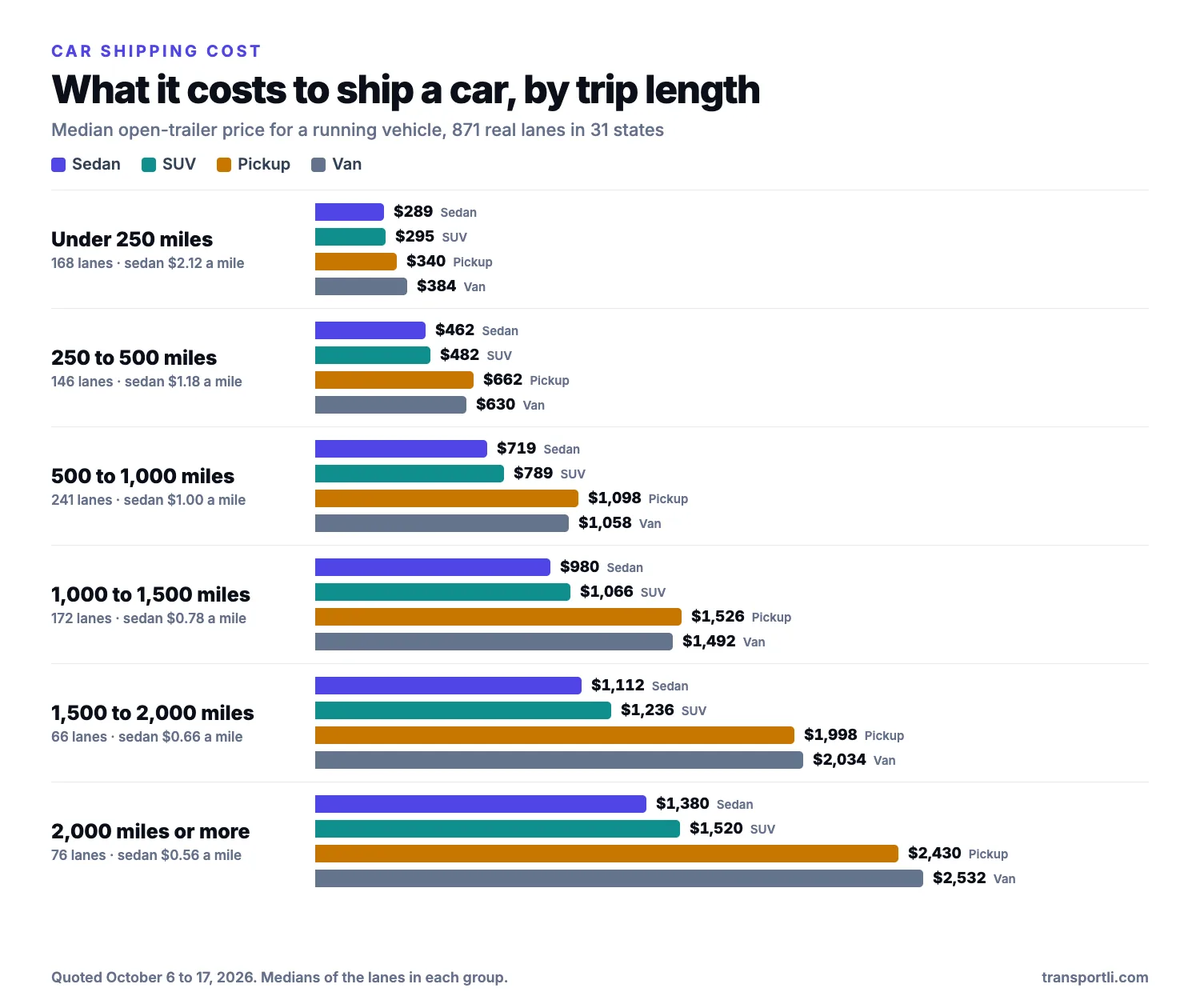
Car shipping cost by vehicle: sedan, SUV, pickup and van
Size and weight matter because a car hauler carries a limited number of vehicles by length and weight. In our data an SUV cost close to a sedan (a median of 2% to 11% more depending on trip length), while a pickup or van cost much more, and the gap grew with distance:
- Under 250 miles: a pickup cost a median of 17% more than a sedan and a van 33% more.
- 500 to 1,000 miles: a pickup cost 53% more and a van 47% more.
- 2,000 miles or more: a pickup cost 76% more than a sedan ($2,430 against $1,380) and a van 84% more ($2,532).
The SUV was not always dearer than the sedan. On 190 of our 871 lanes the SUV was priced below the sedan, so on a given route the two can swap places. A pickup is usually the most expensive of the cars, and a full-size or lifted truck, a dually or a long-wheelbase van can cost more than the standard pickup and van rows, so say exactly what you are shipping when you ask for a quote.
How much does it cost to ship a car across the country?
Coast-to-coast moves of 2,000 miles or more cost a median of $1,380 for a sedan (the middle 80% of those lanes ran from $1,186 to $1,656), or about $0.56 a mile, and $1,520 for an SUV, $2,430 for a pickup and $2,532 for a van. Typical transit for an open trailer is about 7 to 10 days, which is an industry-typical range rather than a guarantee. These are the 10 longest-distance lanes we quoted:
| Route | Distance | Sedan | SUV | Pickup | Van | Sedan per mile |
|---|---|---|---|---|---|---|
| Portland → Atlanta | 2,605 mi | $1,835 | $1,776 | $2,216 | $3,231 | $0.70 |
| Hartford → Los Angeles | 2,895 mi | $1,715 | $1,725 | $2,389 | $3,440 | $0.59 |
| Los Angeles → Portland, ME | 3,099 mi | $1,709 | $1,781 | $3,081 | $3,472 | $0.55 |
| Los Angeles → Manchester | 2,982 mi | $1,708 | $1,731 | $3,269 | $3,170 | $0.57 |
| Manchester → Los Angeles | 2,969 mi | $1,682 | $1,927 | $3,166 | $3,146 | $0.57 |
| Seattle → Miami | 3,304 mi | $1,680 | $1,818 | $2,922 | $1,699 | $0.51 |
| Portland, ME → Los Angeles | 3,090 mi | $1,668 | $2,079 | $2,409 | $3,642 | $0.54 |
| New York → Seattle | 2,867 mi | $1,668 | $1,579 | $2,863 | $1,823 | $0.58 |
| Boston → Los Angeles | 2,987 mi | $1,659 | $1,832 | $2,201 | $3,916 | $0.56 |
| San Diego → Norfolk | 2,737 mi | $1,653 | $1,502 | $3,600 | $3,111 | $0.60 |
The longest lanes are the cheapest per mile, but the totals still range widely, and the direction of the trip can swing the price by hundreds of dollars, as the next sections show.
How much does it cost to ship a car to another state?
Most moves are between states, and the price depends on the two cities more than on the state lines. Our state guides price real lanes in and out of each state, with the lanes labeled by their actual cities. For a short move to a neighboring state, expect the price to look like the 250-to-500-mile row above; for a move across several states, like the 1,000-mile rows. Here is what we found in each state we have covered so far:
We add a state guide regularly and this page updates with each one, so check back if your state is not listed yet. Hawaii and Alaska are different, because shipping there involves an ocean leg that our lower-48 lanes do not cover. See our Hawaii auto transport guide, which prices the truck leg to the Long Beach and Oakland ports and the Matson ocean rate, and our Alaska auto transport guide, which does the same for the Tacoma port and the ship to Anchorage.
Open vs. enclosed transport, and a car that does not run
The prices above are for a running vehicle on an open trailer, which is the most common and least expensive way to ship a car. Two options change the price, and on our platform they are priced as adjustments to the open quote:
- Enclosed transport adds about 75% over the open price. Enclosed trailers carry fewer cars, and fewer enclosed carriers run on any given route. Enclosed makes sense for luxury, classic and high-value cars, and for winter moves when you want the car out of road salt and slush.
- A car that does not run adds about 25% (a median of about $190 for a sedan in our latest test), because the driver needs a winch and extra time to load it. A salvage or auction vehicle that does not run is the usual case. See our inoperable vehicle transport guide.
For example, a sedan quoted at $731 open from New York to Detroit (621 miles) works out to about $1,279 enclosed, or $1,379 enclosed and not running. The inoperable and enclosed numbers are calculated from the open quote, not separately quoted, so treat them as a planning guide and confirm with a live quote.
We also checked the enclosed rule against real enclosed quotes. On October 18, 2026 we priced 12 lanes both ways for a running sedan, and the enclosed price was a median 71% higher than open (range +10% to +127%), close to the +75% rule. Short trips showed a much smaller gap. If you are shipping a classic, a collector car or a high-value vehicle, see our guide to classic car transport in enclosed trailers, with the measured lanes and 29 real classic jobs. Shipping coast to coast? See our guide to cross country car shipping, with 38 lanes of 2,000+ miles, delivery times from real jobs and a ship-or-drive comparison.
Does the direction of the trip change the price?
Yes, and often by a lot. We quoted 412 trips in both directions, and on 60% of them the two directions differed by more than 10% (on 25% by more than 25%). The price follows how many cars are moving each way on that lane, so a route into a busy market can cost more than the same route out of it. These were the biggest gaps for a sedan:
| Trip (dearer direction first) | Distance | Sedan price | Difference |
|---|---|---|---|
| Long Beach → Salt Lake City Salt Lake City → Long Beach | 703 mi | $829 vs. $400 | +107% |
| Chicago → St. Louis St. Louis → Chicago | 297 mi | $609 vs. $300 | +103% |
| Boston → Philadelphia Philadelphia → Boston | 308 mi | $636 vs. $315 | +102% |
| Long Beach → Phoenix Phoenix → Long Beach | 381 mi | $500 vs. $260 | +92% |
| New York → St. Louis St. Louis → New York | 951 mi | $976 vs. $510 | +91% |
| Detroit → Indianapolis Indianapolis → Detroit | 289 mi | $569 vs. $322 | +77% |
| Chicago → Minneapolis Minneapolis → Chicago | 409 mi | $497 vs. $300 | +66% |
| Columbus → Louisville Louisville → Columbus | 207 mi | $457 vs. $280 | +63% |
There is no single rule for which direction is cheaper, because it depends on the lane and the date. If you can drive one way and ship the other, or if your dates are flexible, it can pay to check both directions. A few quotes in this table are also less certain than the rest, so they are examples of how large the gap can be, not predictions for your trip.
Did you know?From 871 real lanes and 4 vehicle types
-
$0.56 a mile on trips of 2,000+ miles
The longer the trip, the cheaper each mile: $2.12 vs. $0.56
A sedan cost a median of $2.12 a mile under 250 miles and $0.56 a mile on trips of 2,000 miles or more, across 871 real lanes.
-
60% of two-way lanes differ by 10% or more
On 60% of lanes, the direction changes the price by more than 10%
We quoted 412 trips both ways. 25% of them differed by more than 25%.
-
190 of 871 lanes where the SUV beat the sedan
On 190 of 871 lanes the SUV was priced below the sedan
A sedan and an SUV are close in price, so on a given route they can swap places. A pickup or van is a different story.
-
1.8× a sedan's price for a pickup on 2,000+ miles
On the longest trips a pickup cost $2,430 against $1,380 for a sedan
Median prices on lanes of 2,000 miles or more. A van was $2,532.
-
107% gap between the two directions
The widest two-way gap: $829 vs. $400 on the same trip
Long Beach and Salt Lake City, about 703 miles. The price follows how many cars are moving each way.

What affects the cost of shipping a car?
Distance and vehicle type are what our data can measure. Several other things also move the price, which are general industry experience rather than findings from our lanes, so compare a live quote for your date:
- Trailer type. Open transport is the standard. Enclosed adds about 75% on our platform.
- Whether the car runs. A car that does not run adds about 25%, or a median of about $190 for a sedan.
- The route and the direction. Major corridors have more trucks and more competition, and rural pickups or delivery points far from the main routes can cost more. Direction matters, as shown above.
- Timing and season. Summer moves, the end of the school year, military moves and snowbird traffic to and from Florida, Arizona and Texas can all tighten capacity. We have no seasonal data in this study, so ask for a quote for your actual date.
- Fuel and market conditions. Fuel prices and the balance of trucks and cars on a lane change what carriers will accept.
- Flexibility. A pickup window of a few days usually gets a faster carrier match than a fixed date.
- Door-to-door vs. a terminal. Most open-trailer moves are door to door where a full-size truck can reach, and a meeting point at a large lot can help in tight neighborhoods.
How to pay less to ship a car
- Compare more than one real quote, on the same terms. Make sure each is for the same vehicle, an open or enclosed trailer and a running or non-running car, with the pickup window in writing.
- Be wary of a price far below the others, and check who you are dealing with. A low quote can mean the load will not find a driver at that price, which shows up later as delays or a price increase. Every interstate auto transporter or broker needs a USDOT number and operating authority, which you can look up on the FMCSA company snapshot.
- Be flexible on dates. A few days of flexibility gives the carrier room to fit your car into a route.
- Ship open unless you need enclosed. For a daily driver, open transport is the standard and costs about 43% less than enclosed.
- Check both directions and nearby cities. Because direction changes the price, a pickup in a nearby larger city, or a different delivery city, can be cheaper. Ask the carrier what it would cost.
- Prepare the car. Wash it, photograph it from every side, take out personal items, leave about a quarter tank of fuel and note anything that does not work. Our auto transport guide has the full checklist.
How we calculated these prices
Every figure comes from our own platform, not from a competitor’s price list. For each lane we ran a pricing lookup for one running vehicle on an open trailer, once for each vehicle type (sedan, SUV, pickup and van), between October 6 and October 17, 2026, and recorded the recommended price and the distance. Where we checked a coupe it priced the same as a sedan, so it is not listed separately. We did not use other shippers’ individual orders. The 871 lanes cover 30 states and Washington, DC; each state guide shows its lanes and the cities behind them, and many of them were quoted in both directions.
The group medians and ranges on this page are plain statistics of those lanes. The calculator fits a smooth curve of price against straight-line distance for each vehicle type, with a small adjustment for the pickup and delivery city when the route starts or ends near one of the cities in our data. We tested it by hiding each lane (and its reverse) in turn and predicting it from the rest: the typical sedan estimate was off by about 10%, and about 88% of sedan estimates landed within 25% of the real price. The range the calculator shows is built to cover about 8 in 10 real lanes. Prices change with the market, and an estimate is not a quote or an offer.
How much does it cost to ship a car: frequently asked questions
How much does it cost to ship a car?
In our real quotes, an open-trailer sedan that runs cost a median of $289 under 250 miles, $719 at 500 to 1,000 miles, $980 at 1,000 to 1,500 miles and $1,380 on trips of 2,000 miles or more. Across 871 lanes the sedan price ran from $98 to $1,976. Use the calculator on this page for your own route.
How much does it cost to ship a car across the country?
On trips of 2,000 miles or more, a sedan cost a median of $1,380 (the middle 80% ran from $1,186 to $1,656), an SUV $1,520, a pickup $2,430 and a van $2,532, on an open trailer. Typical transit is about 7 to 10 days.
How much does it cost to ship a car to another state?
It depends on the distance and the two cities. A trip of 250 to 500 miles cost a median of $462 for a sedan, 500 to 1,000 miles $719 and 1,000 to 1,500 miles $980. See our state guides for real lanes in and out of each state.
How much does it cost to ship a car per mile?
For a sedan on an open trailer the median was $2.12 a mile under 250 miles, $1.18 at 250 to 500 miles, $1.00 at 500 to 1,000 miles, $0.78 at 1,000 to 1,500 miles and $0.56 on trips of 2,000 miles or more. Short trips cost the most per mile.
How much does it cost to ship an SUV, a pickup or a van?
An SUV cost close to a sedan in our data. A pickup cost a median of 17% more than a sedan under 250 miles and 76% more on trips of 2,000 miles or more, and a van 33% and 84% more.
How much more does enclosed car shipping cost?
Enclosed transport adds about 75% over the open-trailer price on our platform, and when we priced 12 lanes both ways the enclosed sedan price was a median of 71% higher. A sedan quoted at $1,000 open works out to about $1,750 enclosed. For classic and collector cars, see our classic car transport guide.
How much extra does it cost to ship a car that does not run?
On our platform a car that does not run adds about 25% to the open-trailer price (a median of about $190 for a sedan across 20 lanes we tested), because the driver needs a winch and extra time to load it. See our inoperable vehicle transport guide.
Does the direction of the trip change the price?
Yes. On 412 trips we quoted both ways, 60% differed by more than 10% between the two directions and 25% by more than 25%. If you can ship in either direction, compare both.
How long does it take to ship a car?
Typical open-trailer transit is about 1 to 2 days for trips under 450 miles, 2 to 4 days for 650 to 900 miles, 3 to 6 days for 1,100 to 1,350 miles and 7 to 10 days coast to coast. These are industry-typical ranges, not guarantees, and the clock starts when the driver picks up the car.
How accurate is the car shipping cost calculator?
It is an estimate. When we tested it on real lanes it had not seen, the typical sedan estimate was off by about 10%, and about 88% of sedan estimates were within 25% of the real price. The range it shows is built to cover about 8 in 10 lanes. Your date, the season and how many cars are moving your way can push a real quote outside it.
Is it cheaper to ship a car or drive it?
It depends on the trip and on what your time is worth. For a sedan on a 1,000-to-1,500-mile trip we saw a median of $980 to ship. Driving adds fuel, lodging, meals and days away, plus wear on the car, so compare your own costs against a quote.
Why do car shipping quotes vary so much between companies?
Quotes can differ because of the trailer type, whether the car runs, the pickup window, the date, and whether the price will actually find a driver on that lane. A quote far below the others may not find a carrier at that price, so compare quotes on the same terms.
How much does it cost to ship a car to Hawaii, Alaska or overseas?
Get a real quote for your car
Compare live auto transport rates from vetted carriers for your exact route. Free, no account needed.
Get an auto quote →Related content
Cite this page
Cite as: Transportli, “How Much Does It Cost to Ship a Car? (2026 Prices)”, https://transportli.com/auto-transport/car-shipping-cost/, updated October 25, 2026.
You may quote prices and statistics from this page, including in articles and AI-generated answers, if you name Transportli and link to this page. Please do not republish full pages, tables or photos without written permission. Data license and terms of use