Shipping an engine is not hard, but it is unforgiving. It weighs 250 to 1,100 lb, it is full of fluid until you drain it, and the sellers who get it wrong find out when the driver refuses a leaking unit at pickup or when the buyer opens a cracked oil pan. This guide covers the whole job: the cheapest way to ship an engine, how much one weighs, how to prepare and pack it, what freight class applies after the 2025 change, what it really costs and how long it takes (using 125 real quotes), and what to do if you are selling one on eBay. Use the planner in the next section to get your own weight, size, class and checklist as you go.
The short version
- The cheapest safe way to ship most engines is LTL freight on a pallet or in a crate. Parcel services stop at about 150 lb per package, and a crated engine usually passes it.
- Real quotes on our platform for 125 lanes of 250 to 1,200 lb had a median lowest price of about $449, with the middle half between $350 and $639. The fifth-lowest quote on the same lane was typically about $148 higher, so comparing carriers pays.
- Typical transit is about 4 days for the cheapest quote (the middle half ran 2 to 5 days), and the fastest of five quotes was a median of 2 days.
- Drain every fluid, cap every opening, and fasten the engine to the base with at least 4 inches of clearance to the edge. A single leak can get the shipment refused.
- Freight class is now set by density (13-step scale, effective July 19, 2025). Older guides that say engines are “Class 70 or 85” are out of date: the class depends on the weight and size of the finished load.
- Ship to a business with a dock or forklift, or use terminal pickup, to avoid residential and liftgate fees that can add real money to the bill.
What is the cheapest way to ship an engine?
For an engine over about 150 lb, LTL (less-than-truckload) freight is almost always the cheapest safe option. Your engine rides on a shared truck and you pay for the space and weight it takes, instead of the whole trailer. If you are new to how it works, start with what LTL freight is. Here is how the main options compare:
| Option | Best for | What to know |
|---|---|---|
| LTL freight, engine bolted to a pallet | Most used and rebuilt engines going to a shop or a business address | Usually the lowest price. Some carriers prefer or require crating for engines, so ask before you book. |
| LTL freight, engine in a wood crate | Rebuilt, high-value or long-distance engines | Adds size, weight and cost to build, but protects the engine and can land in a lower freight class. |
| Terminal pickup or drop-off | Sellers and buyers who can load and unload with a forklift | Avoids residential and liftgate fees. Often the biggest single saving. |
| Local pickup by the buyer | Engines sold locally or within driving distance | No freight bill at all. Offer it on every listing. |
| Shipping marketplaces and bid sites | One-off shipments where you can wait for bids | Prices can be competitive, but quality and insurance vary by carrier. Read the carrier’s feedback and coverage. |
| UPS or FedEx parcel | Small engines under about 150 lb that fit carrier size limits | A crated engine often goes over the limit, and over-limit packages are refused or surcharged. Check the carrier’s current rules. |
| Dedicated truck or white-glove carrier | Rare, high-value or vintage engines, or several engines at once | Much more expensive than shared LTL, but handled less. |
Five ways to bring the price down without taking risk:
- Compare at least five quotes. On the engine-sized lanes in our data, the fifth-lowest quote was typically about $148 above the lowest, a median gap of about 31%.
- Ship terminal to terminal, or to a dock. A liftgate and residential delivery are accessorial charges that sit on top of the base rate.
- Use the smallest stable pallet or a snug crate. Carriers measure the outside of the load, so empty pallet space can raise the class and the price.
- Give exact weight and dimensions. Guessed numbers are the most common cause of a reweigh or reclass fee.
- Drain the engine and keep it clean. A leaking engine can be refused at pickup, and a failed pickup can still be charged.
How much does an engine weigh?
Weight is the first number every quote asks for, and engines vary more than most people expect. The figures below are typical drained weights from measured examples and published specifications. “Dressed” means the engine still has its intake, exhaust manifolds, alternator and other accessories. Definitions differ between sellers, so weigh yours on a scale before you book.
| Type of engine | Typical weight | Notes |
|---|---|---|
| Four-cylinder gas | 250 to 400 lb | Ford lists its 2.3L EcoBoost crate engine at 309 lb without the front accessory drive and flexplate. |
| Aluminum V8, dressed (LS-style) | 430 to 480 lb | A fully dressed LS1 was weighed at 474 lb (source). |
| Cast-iron V8, dressed | 500 to 650 lb | Iron truck V8s and dressed small-block Chevy engines fall in this range. |
| V8 long block (no accessories) | 300 to 420 lb | An iron small-block long block is a little over 400 lb; aluminum heads and block are lighter. |
| Short block or bare block | About 110 to 300 lb | A bare iron small-block is roughly 200 lb, a short block just under 300 lb, and an aluminum block about 110 to 140 lb. |
| Diesel, 4-cylinder class (e.g. Cummins 4BT) | 520 to 780 lb | Depends on how much is included: a 4BT is listed at about 745 to 782 lb dry (DieselHub). |
| Heavy diesel (5.9L to 6.7L six-cylinder or V8) | 975 to 1,150 lb | Listed examples: 5.9L Cummins about 975 lb with oil, 6.7L Cummins about 1,150 lb dry, 6.7L Power Stroke about 1,100 lb with oil. |
“Packed weight” adds the base: about 40 to 55 lb for a wood pallet, and roughly 15% (at least 40 lb) for a crate. Carriers bill on the weight they measure at the terminal, so the number on your bill of lading should match what a scale says.
Engine shipping planner
Pick your engine, adjust the weight and size to match yours, and choose a base. The planner shows the density and estimated freight class for a compact pallet, a standard pallet, a long pallet and a crate side by side, checks that the engine leaves about 4 inches to every pallet edge, tells you whether parcel is realistic, compares your numbers against real quotes, and gives you a tick-off checklist and a copy-ready bill of lading description.
Engine shipping planner
Pick the engine, enter its weight and size, and see how it should be packed, what freight class carriers will likely apply, whether it can go parcel, and what real LTL quotes cost for a load this heavy.
How to prepare an engine for shipping: 12 steps
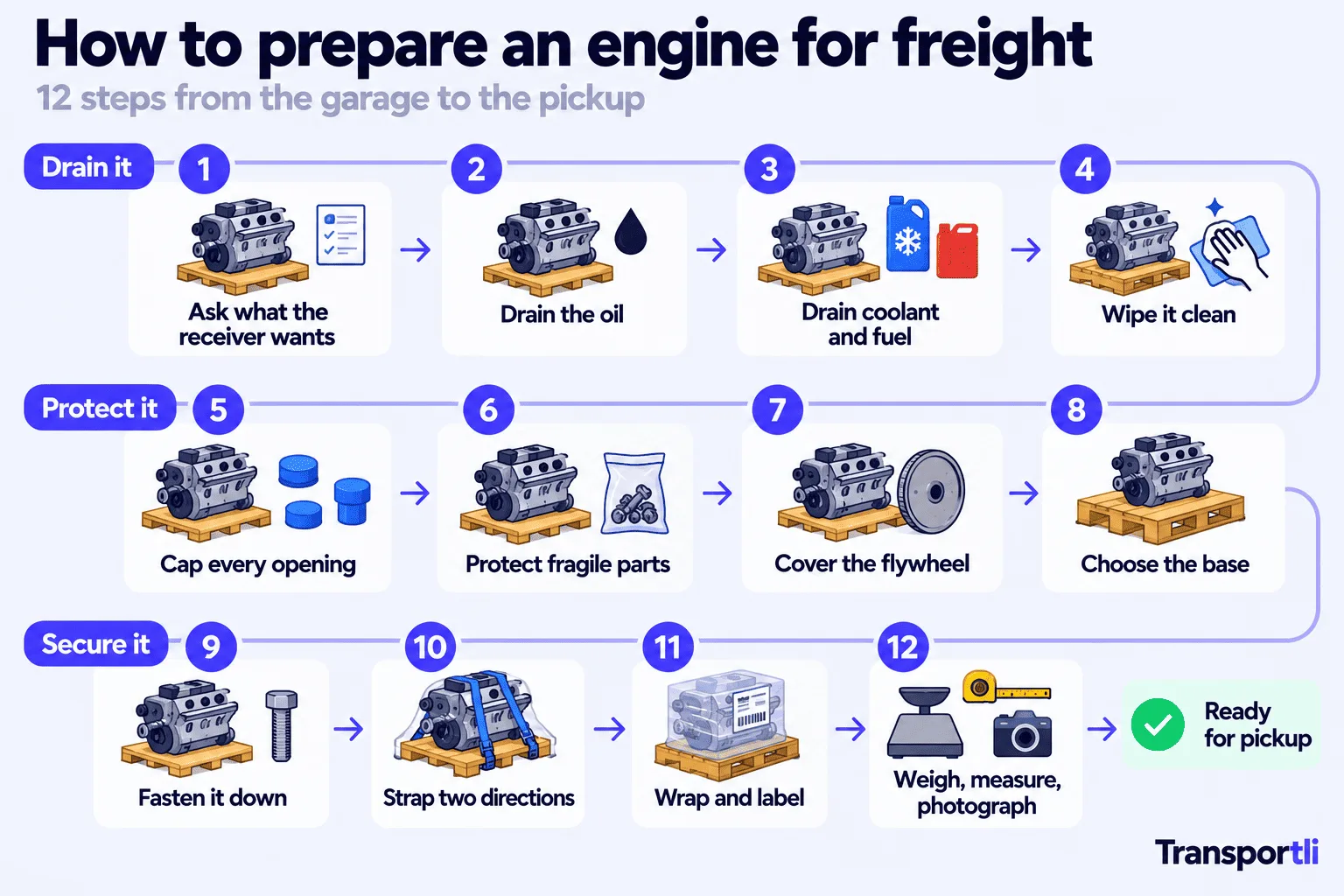
- Ask the receiver what they want. A rebuild shop may want only the long block with no accessories; a buyer may want the engine dressed. Settle this before you pack.
- Drain the oil. Pull the drain plug and the oil filter, and let it drip for several hours or overnight. Dispose of the oil properly.
- Drain the coolant, fuel and power steering fluid. Tip the engine slightly if you can to clear the water jackets and lines. Residual fluid is the top reason carriers refuse engines.
- Wipe it clean. A clean, dry engine lets the driver see there are no leaks, and it gives you clear photos if there is a claim.
- Reinstall the drain plug and oil cap, and cap every opening. Cover the intake, exhaust, fuel and coolant ports and the breather so dirt and moisture stay out.
- Remove or protect fragile accessories. Alternators, power steering pumps, sensors and plastic covers are the first things to break. Bag them, label the bag and ship it with the engine.
- Cover the flywheel or flexplate and the bellhousing face. A scrap of cardboard and tape keeps them from being dinged or contaminated.
- Choose the base. Use a sound pallet rated for the weight, or a crate. The base should leave at least 4 inches between the engine and every edge.
- Fasten the engine down. Bolt it through the mounts or a cradle, or band it to the pallet, and block it so it cannot slide. Wrap and rope alone are not a restraint.
- Strap it in two directions. Use heavy-duty ratchet straps or steel banding rated well above the engine weight, with edge protectors.
- Wrap and label. Shrink wrap the whole load, put the consignee address and weight on two sides, and mark “Do not stack”.
- Weigh, measure and photograph the finished load. Measure the outside of the pallet or crate, include the base in the weight, and photograph all sides. Those numbers go on the bill of lading.
Fluids out, plugs in
A leaking engine can be refused at pickup, and a failed pickup can still be charged.
Fastened, not just wrapped
Stretch wrap and rope do not hold a 500 lb engine through terminal transfers.
4 inches of clearance
Anything close to or past the pallet edge can be damaged, re-measured or refused.
Photos before pickup
Your best evidence if you need to file a claim.
Pallet, crate or engine stand: which should you use?
There is no single right answer, and some carriers have a preference, so ask. In general:
| Base | Best for | Watch out for |
|---|---|---|
| Standard pallet (48″ x 40″) | Most dressed engines and long blocks going to a shop or business | Easy to find and every terminal handles it, but empty pallet space is billable space and can raise the class. |
| Compact pallet (about 40″ x 40″) | Smaller engines that still leave 4 inches to every edge | Can lower the class, but only if the engine really fits inside the edges. |
| Long pallet (60″ x 40″) or custom pallet | Big diesels that do not fit a standard pallet with room to spare | Adds length and weight; confirm the carrier accepts it. |
| Wood crate | Rebuilt, high-value or long-distance engines, or carriers that ask for one | Adds weight and building cost. A snug crate can land in a lower freight class than a loose pallet. |
| Cradle or engine stand on a pallet | Engines you cannot bolt through the mounts | The engine must be fastened to the stand and the stand to the pallet, not just set on it. |
uShip’s help center warns that some carriers will not pick up a palletized engine because of damage risk, while others take them routinely. That is why asking the carrier first is cheaper than finding out at pickup.
How to ship an engine block, short block or long block
A bare block, a short block (block plus rotating assembly) and a long block (with heads, oil pan and covers) ship the same way as a complete engine, with a few extras for bare machined metal:
- Coat machined surfaces. A light film of rust-preventive oil on the deck, cylinder bores and bearing journals, then cover them, keeps rust from forming in a cold, damp trailer.
- Cover every opening. Bores, oil galleries and the crankcase should be closed with plastic or tape so packing debris cannot get in.
- Support it on the right surface. Set the block on a cradle that does not load the oil pan flange or sealing surfaces, and fasten the cradle to the pallet.
- Weigh it as shipped. A bare iron block is roughly 200 lb, a short block just under 300 lb and an aluminum block about 110 to 140 lb. Add the cradle and pallet.
- Use a crate if it is freshly machined. A rebuilt or machined block is worth the extra protection.
What freight class is an engine in 2026?
Freight class is the NMFC category carriers use to price a shipment: the higher the class, the higher the rate. On July 19, 2025 the National Motor Freight Traffic Association moved a long list of commodities, including most automobile parts, to density-based classes on a 13-step scale, set by pounds per cubic foot of the finished load. Many older guides still say an engine is “Class 70 or 85” or that a crate always earns a certain class. Today the class follows the numbers you hand the carrier. Our freight class guide explains the system in full, and the density calculator works out any shipment.
| Density (lb per cubic foot) | Freight class |
|---|---|
| Less than 1 | 400 |
| 1 to less than 2 | 300 |
| 2 to less than 4 | 250 |
| 4 to less than 6 | 175 |
| 6 to less than 8 | 125 |
| 8 to less than 10 | 100 |
| 10 to less than 12 | 92.5 |
| 12 to less than 15 | 85 |
| 15 to less than 22.5 | 70 |
| 22.5 to less than 30 | 65 |
| 30 to less than 35 | 60 |
| 35 to less than 50 | 55 |
| 50 or greater | 50 |
Worked examples, using the same math as the planner (volume = length x width x height / 1,728, using the outside size of the finished load including the base):
| Engine | Base | Load size (L x W x H) | Weight | Density (lb/cu ft) | Class |
|---|---|---|---|---|---|
| Aluminum V8, dressed (450 lb) | Compact pallet | 40″ x 40″ x 34″ (31.5 cu ft) | 490 lb | 15.5 | 70 |
| Aluminum V8, dressed (450 lb) | Standard pallet | 48″ x 40″ x 34″ (37.8 cu ft) | 495 lb | 13.1 | 85 |
| Aluminum V8, dressed (450 lb) | Wood crate | 36″ x 32″ x 36″ (24.0 cu ft) | 518 lb | 21.5 | 70 |
| Iron V8, dressed (550 lb) | Standard pallet | 48″ x 40″ x 35″ (38.9 cu ft) | 595 lb | 15.3 | 70 |
| V8 long block (400 lb) | Standard pallet | 48″ x 40″ x 32″ (35.6 cu ft) | 445 lb | 12.5 | 85 |
| 4-cylinder (320 lb) | Compact pallet | 40″ x 40″ x 32″ (29.6 cu ft) | 360 lb | 12.1 | 85 |
| 4-cylinder (320 lb) | Standard pallet | 48″ x 40″ x 32″ (35.6 cu ft) | 365 lb | 10.2 | 92.5 |
Why the base matters
The aluminum V8 is the same 450 lb engine in the first three rows. On a standard pallet it ships at class 85, on a compact 40″ x 40″ pallet it drops to class 70, and in a snug crate it is class 70 as well. Carriers measure the outside of the load, so empty pallet space is billable space. These are estimates: the carrier’s measured weight and dimensions decide the billed class, and carriers can re-weigh, re-measure and reclass a shipment.
How much does it cost to ship an engine?
Price depends on weight, distance, class, the pickup and delivery locations and any extras. To give you something better than a rule of thumb, we pulled the real quotes from the state pages on this site: for shipments of 250 to 1,200 lb, which covers most engines on a pallet or in a crate, there were 125 lanes across 44 locations. For each lane we recorded the lowest price returned and the fifth-lowest price returned on our platform. These are snapshots from our own testing, not guarantees.
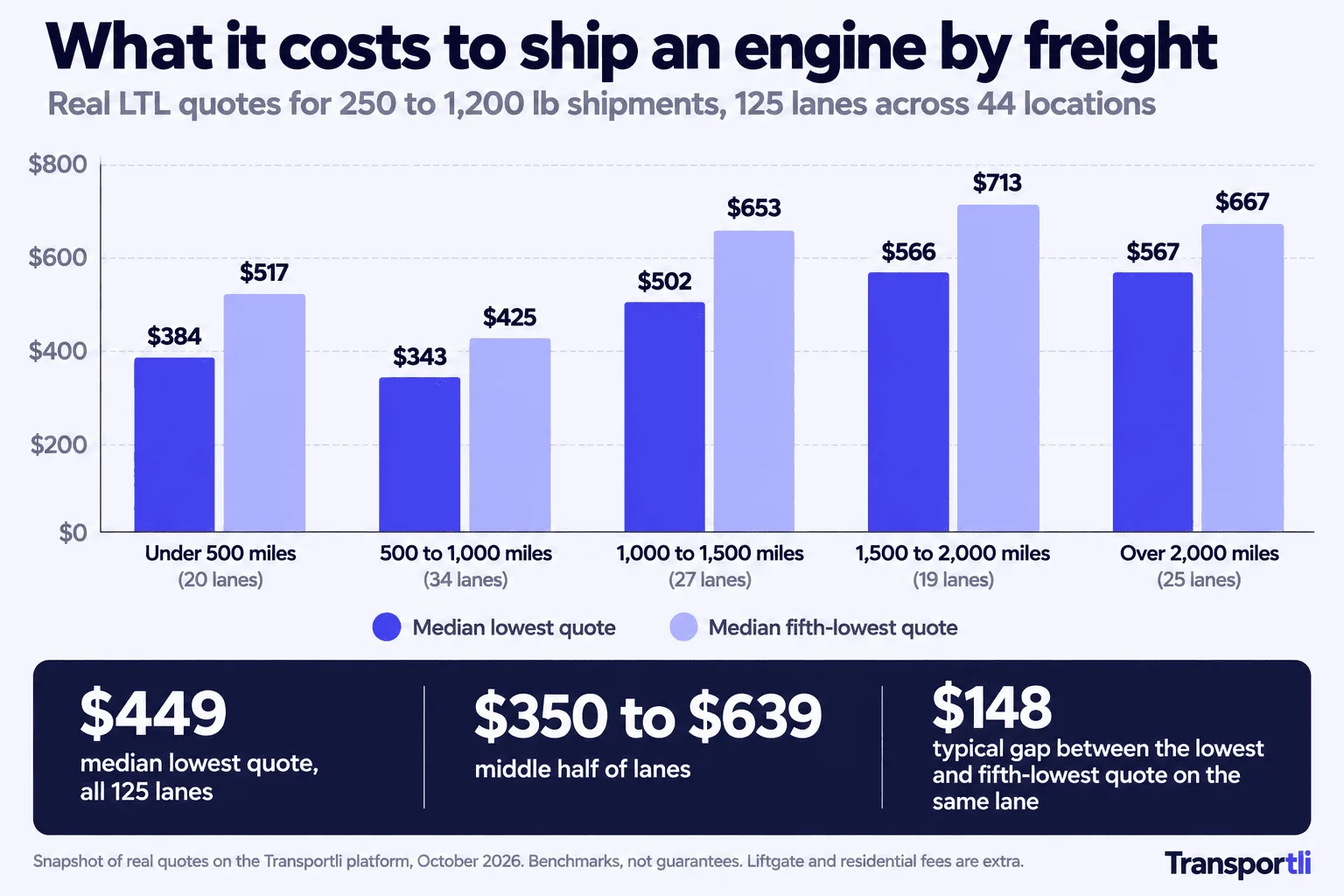
| Distance | Lanes | Median lowest quote | Middle half of lanes | Median fifth-lowest quote |
|---|---|---|---|---|
| Under 500 miles | 20 | $384 | $295 to $464 | $517 |
| 500 to 1,000 miles | 34 | $343 | $293 to $449 | $425 |
| 1,000 to 1,500 miles | 27 | $502 | $416 to $710 | $653 |
| 1,500 to 2,000 miles | 19 | $566 | $397 to $802 | $713 |
| Over 2,000 miles | 25 | $567 | $403 to $672 | $667 |
| All distances | 125 | $449 | $350 to $639 | $597 |
| Packed weight | Lanes | Median lowest quote | Middle half of lanes |
|---|---|---|---|
| 250 to 500 lb | 58 | $386 | $330 to $523 |
| 500 to 800 lb | 46 | $495 | $380 to $638 |
| 800 to 1,200 lb | 21 | $623 | $450 to $855 |
Two things stand out. First, a short or mid-distance lane (500 to 1,000 miles) was often as cheap as or cheaper than a lane under 500 miles, because a shipment like this is mostly priced by pickup, delivery and minimum charges, while the price climbs once a lane passes about 1,000 miles. Second, the spread between the lowest and fifth-lowest quote on the same lane was typically about $148. The benchmark inside the planner above lets you filter by your own weight and distance.
Extras that change the price
Liftgate, residential delivery, limited-access locations and inside delivery are charged on top of the base rate. Delivering to a shop with a dock, or picking up at the carrier’s terminal, is usually cheaper than delivering to a home.
- A residential delivery of a 400 to 1,000 lb engine almost always needs a liftgate. Ask the buyer if they have a forklift or a loading dock.
- Terminal pickup (the buyer collects from the carrier’s local terminal) can remove the delivery extras entirely.
How long does it take to ship an engine?
Freight is not overnight. In the same engine-sized lanes, the cheapest quote had a median transit of 4 days (the middle half ran 2 to 5 days), and the fastest of the five quotes on a lane was a median of 2 days. Transit is counted from pickup, and the slowest quote we saw on any lane was 10 days. Distance is the main driver:
| Distance | Median transit, cheapest quote | Median transit, fastest quote | Slowest quote seen |
|---|---|---|---|
| Under 500 miles | 1 day | 1 day | 5 days |
| 500 to 1,000 miles | 2 days | 2 days | 9 days |
| 1,000 to 1,500 miles | 4 days | 3 days | 10 days |
| 1,500 to 2,000 miles | 5 days | 4 days | 9 days |
| Over 2,000 miles | 5 days | 4 days | 10 days |
| All distances | 4 days | 2 days | 10 days |
Add a day or two for the pickup appointment and for loading, and more in winter or during a wind or flood closure on your route. If you need it faster, ask for guaranteed or expedited options, which cost more.
Standard LTL, volume LTL, expedited or truckload?
A single engine nearly always belongs in standard LTL. If you are moving several engines, a full pallet load of parts, or you are on a deadline, the answer changes. Try the quiz below.
Which shipping mode fits your freight?
Answer three quick questions to see whether standard LTL, volume LTL, expedited or truckload is the better starting point, and what to watch for at pickup and delivery.
Liftgate, residential and other fees
Accessorial charges are the extras that sit on top of the base rate. For an engine, the two that matter most are a liftgate (the truck lowers the engine to the ground) and residential delivery. Use the checker below to see what each typically adds and which ones apply to your pickup and delivery.
Accessorials that likely apply
Nothing checked yet suggests extra accessorial fees — looks like a straightforward dock-to-dock move.
Liftgate pickup
The carrier uses a hydraulic lift to load freight from ground level when there's no dock or forklift at pickup. Standard equipment on most LTL trucks, but billed as an accessorial because it adds time and handling risk.
Liftgate delivery
Same as liftgate pickup, but at the delivery end — used to lower freight to ground level when there's no dock or forklift to receive it.
Residential pickup
Freight moving from a home instead of a business address. Residential stops usually take longer and often need a smaller truck, so carriers price them higher than a commercial pickup.
Residential delivery
Same idea on the delivery side — homes don't have loading docks or staff to help unload, so residential delivery typically comes bundled with a liftgate fee too.
Limited access
Locations a standard 53' trailer can't easily reach, or that need extra coordination — schools, military bases, construction sites, farms, storage facilities, and event or trade show venues all fall into this category.
Inside delivery
Carrying freight past the dock or front door, rather than leaving it at the nearest accessible point. Because it takes extra labor and time, it's priced separately from standard curbside or dock delivery.
Appointment / delivery notification
The carrier calls ahead to schedule a delivery window instead of showing up unannounced. Common for businesses with limited receiving hours or residential deliveries where someone needs to be home.
This shows which fees commonly apply, not exact amounts — accessorial pricing varies by carrier and lane. Get a quote for a rate that already accounts for what you check above.
Ready to get a real rate for this shipment?
Get a Quote →Selling an engine on eBay or another marketplace
Freight is where many engine listings lose money. Some practical points:
- Expect freight, not a parcel label. Marketplace and shipping-software documentation says items of 150 lb or more must use a freight shipping option (SureDone), and eBay shipping labels generally do not cover freight, so the seller usually books the carrier and adds the tracking or bill of lading number to the order.
- Quote before you list. Get freight quotes to a few zip codes (near, far and a residential one) and put the price into the listing. Buyers do not like surprises, and neither does your feedback score.
- Offer local pickup and terminal pickup. Local pickup on a heavy engine often sells faster than waiting for a buyer to accept a freight charge.
- Ship to a business address when you can. A dock or forklift avoids liftgate and residential fees.
- State the shipped weight and size in the listing. It reduces disputes, and you will need them for the bill of lading anyway.
- Document everything. Photos before packing, after packing and at pickup are the evidence if a buyer claims it arrived damaged or not as described.
Describing an engine on the bill of lading
The bill of lading is the contract between you and the carrier. Accurate numbers keep you out of reweigh and reclass fees. A good description includes the condition, what it is, the number of pieces, the packaging, the true weight, the true outside dimensions and any handling note. For example:
Example description
“Used auto parts: aluminum V8 engine (drained, fluids removed), 1 pallet, 48 x 40 x 34 in, 495 lb. Do not stack.”
You can build your own in the planner above, or use the bill of lading generator to produce the full document. Include a phone number for the pickup and delivery contacts; missed appointments are a common source of redelivery fees.
Pickup day and delivery day
At pickup
- Have the engine on the ground floor or a dock, with a forklift or pallet jack available if the driver needs it (many trucks carry only a pallet jack).
- Be there, or have someone there, in the pickup window. Missed pickups can be billed.
- Hand over the bill of lading with the true weight and size. Keep your copy and take a photo of the signed one.
- Take final photos of the finished load with the driver in view if you can.
At delivery
- Inspect before you sign. Look at the pallet, wrap and straps. If anything is damaged, wet or missing, write it on the delivery receipt before signing, and take photos.
- If the packaging is intact but you suspect hidden damage, note “subject to inspection” and open it promptly.
- File a written claim with the carrier within 9 months of delivery with the invoice, photos and bill of lading. Claim rules and limits vary by carrier and by what is on the bill of lading.
Seven mistakes that cost sellers money
Shipping it wet
Residual fluid is the top reason carriers refuse or re-bill an engine.
Guessing the weight
An engine can be 100 lb heavier than the listing says once it has accessories on.
Using a bigger pallet than needed
Empty pallet space raises the class and the price.
Letting it hang off the base
Anything past the edge gets damaged, re-measured or refused.
Quoting the class from an old guide
Work it out from your real numbers instead of assuming 70 or 85.
Vague descriptions
“Auto parts” with no details is how a shipment gets reclassed.
Skipping photos
Without them, a damage claim is your word against the carrier’s.
Ready to compare freight prices for your engine?
Enter your zip codes and your weight and size, and we will show you live LTL quotes from multiple carriers in about a minute. No obligation to book.
Get an LTL quote →Frequently asked questions
How do you ship an engine?
Drain the oil, coolant, fuel and power steering fluid, cap every opening, remove or protect fragile accessories, then bolt or band the engine to a sound pallet or put it in a crate, leaving about 4 inches to every pallet edge. Strap it in two directions, shrink wrap it, weigh, measure and photograph the finished load, and book LTL freight.
What is the cheapest way to ship an engine?
For an engine over about 150 lb, LTL freight is usually the cheapest safe option. You can lower the price further by comparing at least five quotes, shipping terminal to terminal or to a business with a dock, using the smallest stable pallet or a snug crate, and giving exact weight and dimensions.
How much does it cost to ship an engine?
In real quotes on our platform for 250 to 1,200 lb shipments, the median lowest price was about $449 and the middle half of lanes ran from about $350 to $639, with the fifth-lowest quote typically about $148 higher. Price depends on distance, weight, class and extras such as liftgate or residential fees, so compare live quotes.
How long does it take to ship an engine?
In the same quotes, the cheapest option had a median transit of about 4 days and the fastest of five quotes was a median of 2 days. Short lanes under 500 miles are often 1 to 2 days, and lanes over 1,500 miles are typically 4 to 5 days, with some quotes up to 10 days.
Can you ship an engine by UPS or FedEx?
Only a small one. Parcel carriers generally cap packages at about 150 lb, and a crated engine usually goes over that, which means it is refused or surcharged and should go by LTL freight instead. Check each carrier’s current rules.
How do you ship an engine block?
Treat it like a complete engine, plus protect the bare metal: coat the deck, bores and journals with a light rust-preventive oil, cover every opening, and support the block on a cradle fastened to the pallet. A bare iron block is roughly 200 lb and a short block just under 300 lb.
How do you ship an engine by freight?
Prepare the engine, fasten it to a pallet or crate it, and request LTL quotes with the true weight and the outside dimensions of the finished load. Put the same numbers and an accurate description on the bill of lading, and ask the carrier whether it accepts palletized engines.
What freight class is an engine?
It depends on density. Since July 19, 2025, most auto parts are classed on a 13-step density scale, so an engine can land anywhere from about class 100 down to class 65 depending on its weight and the outside size of the finished load. A smaller, snug base generally lowers the class, and the carrier’s measurement decides the billed class.
Do I have to drain an engine before shipping it?
Yes. Drain the oil, coolant, fuel and power steering fluid, let it drip, and reinstall the plugs and caps. A leaking engine can be refused at pickup, can damage other freight and can trigger fees.
How do I ship an engine I sold on eBay?
Heavy items of 150 lb or more generally need a freight shipping option, and eBay shipping labels generally do not cover freight, so you book an LTL carrier yourself and add the tracking or bill of lading number to the order. Quote before you list, offer local pickup, and ship to a business address when you can.
Can you ship an engine to a residential address?
Yes, but expect residential delivery and usually liftgate fees, and the buyer needs a way to unload a heavy engine. Delivery to a shop or dock, or pickup at the carrier’s terminal, is often cheaper.
What if the engine arrives damaged?
Note the damage on the delivery receipt before you sign, photograph the freight and packaging, and tell the carrier right away. File a written claim within 9 months of delivery with the invoice and photos.