

Shipping LTL freight to or from Hawaii? Hawaii is the one state you cannot reach by truck. It sits about 2,500 miles off the West Coast, so an LTL shipment is picked up and delivered by truck like any other, but the middle of the trip is an ocean crossing, and that changes how it is routed, priced and scheduled. Hawaii has about 1.4 million residents, spread over islands that each need their own delivery, plus almost 10 million visitors a year who keep its stores, hotels and restaurants stocked. Here’s how Hawaii LTL actually works and what affects your rate.
LTL shipping rules for Hawaii
A Hawaii LTL shipment is still a domestic move, but a few rules are specific to the islands and to shipping by sea:
- The paperwork is the same as a mainland move. ArcBest notes that despite the ocean crossing, Hawaii freight is a domestic shipment, so the bill of lading is the only required document, plus hazardous materials paperwork if the freight includes hazmat.
- Container limits apply. XPO’s Hawaii service caps freight at 90 inches wide and 96 inches high, because it travels inside an ocean container, and it handles LTL and LCL only, not full container loads.
- Hazmat is restricted. XPO accepts hazardous materials for Hawaii except explosives, and limited-quantity hazmat needs a declaration with the safety data sheet. Check your carrier before booking anything regulated.
- Agricultural items are inspected. The Hawaii Department of Agriculture and Biosecurity inspects plants, soil and other regulated agricultural items arriving by sea or air, and transportation companies must make them available for inspection before release.
- Oversize and overweight loads need a state highway permit. The Hawaii Department of Transportation Highways Division lists a permit fee that varies from $5 to $25, requires a certificate of insurance on file, and says excessive loads may take at least three weeks to review. Applications go to the district office for Oahu, Maui County, Hawaii Island or Kauai.
Current rules and fees are public record:
HDOT oversize and overweight permits → Hawaii Plant Industry Division → HDOT Harbors →
How LTL freight gets to Hawaii
Because the islands have no road link to the mainland, LTL carriers combine trucking and shipping into one bill of lading:
- 1. A truck takes the freight to a California port terminal. ArcBest explains that LTL freight for Hawaii travels over the road to a coastal port facility in California, where it is inspected, sorted and loaded into ocean containers. XPO consolidates at its Santa Fe Springs service center near Los Angeles, and ArcBest at Pico Rivera.
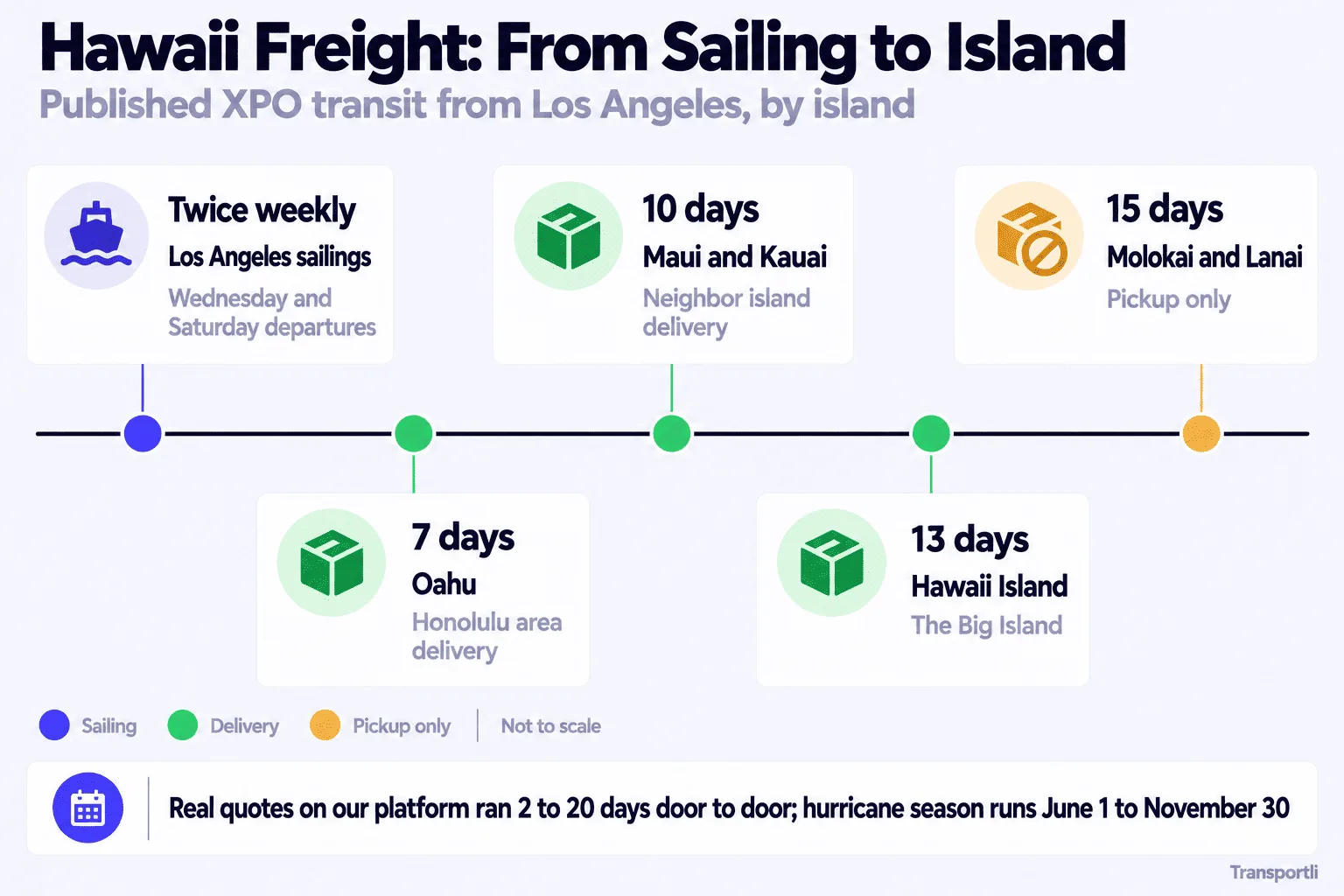
- 2. The container sails on a set schedule. XPO runs two sailings a week from Los Angeles, on Wednesdays and Saturdays, and Old Dominion also lists two departures a week. Freight has to reach the terminal before the cutoff, which XPO sets at Tuesday morning for the Wednesday sailing and Friday morning for the Saturday sailing.
- 3. A barge takes it to the outer islands. Most freight lands at Honolulu on Oahu and is transferred to an inter-island barge for delivery. Young Brothers, the inter-island carrier, runs twelve weekly roundtrip sailings from its Honolulu hub to six neighbor island ports.
- 4. A local truck delivers it. Carriers deliver to the door on each island, with liftgate service available on request and will-call at island agent facilities for places without delivery.
Two companies operate the container ships between the West Coast and Hawaii, Matson and Pasha Hawaii, because the Jones Act requires domestic ocean cargo to move on U.S.-built, U.S.-flagged vessels. Pasha Hawaii runs twice-weekly container service between California and Hawaii. LTL carriers book space on these sailings and sell the whole trip to you as a single freight bill covering the domestic, ocean and island delivery charges.
Transit times by island
Hawaii transit includes waiting for the next sailing as well as the ocean crossing, so it is longer than a mainland lane of any comparable distance. Carrier published times show the pattern:
- Oahu — about 7 days from Los Angeles on XPO’s service, and Old Dominion lists Honolulu-area deliveries within 7 days of sailing.
- Maui and Kauai — about 10 days on XPO’s service.
- Hawaii Island (the Big Island) — about 13 days on XPO’s service.
- Molokai and Lanai — about 15 days on XPO’s service, with pickup only rather than door delivery.
- Neighbor islands in general — Old Dominion says deliveries are completed within an additional 2 to 4 days after Honolulu, depending on the sailing schedule.
These are published carrier schedules for the sailing and delivery legs, not guarantees. The real quotes below show longer door-to-door times, from 2 to 20 days across six lanes, with Estes quoting the shortest transit on every lane and XPO the longest at 16 to 20 days, which is consistent with quoted days that also cover the mainland pickup and the wait for a sailing. Details are on the carrier pages: XPO Hawaii FAQ → Old Dominion Hawaii service → ArcBest: how shipping to Hawaii works →
What affects your Hawaii LTL rate
- Freight class and weight, for the truck leg — density, handling, and liability determine your NMFC class, which still sets the price of the trucking to or from the California port. See our freight class guide.
- Cubic feet, for the ocean leg — ArcBest says the ocean and island delivery charges are based on cubic feet, not weight or class, and XPO says its ocean rates depend on the cubic measurement of the freight. A light, bulky shipment can cost more to send to Hawaii than a dense heavy one. Use our density calculator to check your cubic feet.
- Destination island — Oahu is the fastest to reach, and every neighbor island adds a barge leg and days of transit, while Molokai and Lanai are pickup-only on some services.
- Sailing day and cutoff — missing a Tuesday or Friday terminal cutoff can mean waiting for the next sailing, which adds up to several days.
- Origin distance to the port — the mainland pickup is priced like a normal LTL lane to Los Angeles or Long Beach, so a shipment from Texas or Ohio costs more than one from Southern California.
- Accessorials and hazmat — liftgate, residential delivery, and hazardous materials add to the base rate, and explosives are not accepted on some services.
Where freight moves in Hawaii
Hawaii freight is organized by island, and almost everything arrives at a harbor and is then trucked or barged onward:
- Oahu — Honolulu, the state’s main harbor and the hub where Young Brothers starts its neighbor island sailings, and the island with Interstate H-1, H-2 and H-3.
- Maui — Kahului Harbor, the main cargo port for Maui, where Matson and Pasha Hawaii both call.
- Kauai — Nawiliwili Harbor on the southeast coast, the island’s main cargo port.
- Hawaii Island — two commercial ports, Hilo on the east side and Kawaihae on the west side.
- Molokai and Lanai — served by Kaunakakai Harbor and Kaumalapau Harbor, with Young Brothers the only water carrier to both and a weekly barge to Lanai.
Weather and transit reliability
Hawaii freight depends on a handful of harbors, so storms matter more here than anywhere on the mainland. The Central Pacific hurricane season runs from June 1 to November 30, and Hurricane Lowell showed what it can do in September 2026. The storm skirted the state’s western edge, and on Lanai the state Department of Transportation closed Kaumalapau Harbor as inoperable after waves and storm surge dislodged the interlocking jacks that protect it, opened a sinkhole and scattered containers. State officials said repairs would take about two weeks on an island whose barge arrives once a week, and the state arranged for Lanai Air to fly in supplies in the meantime, according to Hawaii News Now and the Associated Press. Earlier, ahead of Hurricane Douglas in July 2020, the Coast Guard closed port facilities across the state, container ships were sent out to sea, Matson diverted inbound vessels, and Young Brothers cancelled a day of deliveries and adjusted its schedule for the next two weeks, according to Hawaii Public Radio. For LTL shippers the practical advice is simple: during hurricane season, build extra transit time into any shipment to the neighbor islands, ship early for time-sensitive freight, and expect a missed sailing to add days.
Sample Hawaii LTL rates by route
Real quotes pulled from our platform for six different Hawaii lanes — same process, different carriers each time, spanning shipments from 50 lb to 1,840 lb that were bound for Oahu, Maui and Hawaii Island. Rates shift with capacity, sailing schedules and fuel costs, so treat these as a snapshot rather than a guarantee for your shipment; get an instant quote for your exact route.
Real quotes by route
Snapshot taken over recent months — carriers and pricing change daily.
| Carrier | Service | Transit | Price |
|---|---|---|---|
| ABF Freight | Standard | 12 days | $691.90 |
| XPO | Standard | 16 days | $757.64 |
| Roadrunner Freight | Standard Service | 10 days | $760.31 |
| Old Dominion Freight Line | Standard | 10 days | $806.30 |
| Estes | STD | 9 days | $818.02 |
| Carrier | Service | Transit | Price |
|---|---|---|---|
| ABF Freight | Standard | 11 days | $1,413.80 |
| Estes | LTL Standard Transit | 2 days | $1,437.67 |
| Roadrunner Freight | Standard Service | 10 days | $1,478.61 |
| XPO | Standard | 16 days | $2,128.64 |
| Forward Air | Standard | 11 days | $2,983.81 |
| Carrier | Service | Transit | Price |
|---|---|---|---|
| Roadrunner Freight | Standard Service | 11 days | $1,086.13 |
| ABF Freight | Standard | 10 days | $1,116.31 |
| Estes | LTL Standard Transit | 4 days | $1,188.09 |
| XPO | Standard | 19 days | $1,619.78 |
| Forward Air | Standard | 11 days | $4,891.11 |
| Carrier | Service | Transit | Price |
|---|---|---|---|
| Roadrunner Freight | Standard Service | 10 days | $1,295.48 |
| ABF Freight | Standard | 11 days | $1,310.89 |
| Estes | LTL Standard Transit | 4 days | $1,518.67 |
| XPO | Standard | 18 days | $1,967.42 |
| Forward Air | Standard | 10 days | $5,044.79 |
| Carrier | Service | Transit | Price |
|---|---|---|---|
| Estes | LTL Standard Transit | 5 days | $2,029.40 |
| ABF Freight | Standard | 12 days | $2,150.87 |
| Roadrunner Freight | Standard Service | 11 days | $2,172.28 |
| XPO | Standard | 19 days | $3,420.81 |
| Forward Air | Standard | 11 days | $6,940.58 |
| Carrier | Service | Transit | Price |
|---|---|---|---|
| Roadrunner Freight | Standard Service | 13 days | $1,935.68 |
| ABF Freight | Standard | 11 days | $2,066.72 |
| Estes | LTL Standard Transit | 5 days | $2,229.89 |
| XPO | Standard | 20 days | $2,851.15 |
| Forward Air | Standard | 12 days | $7,390.47 |
Rate, transit, and price-per-100-lb summary
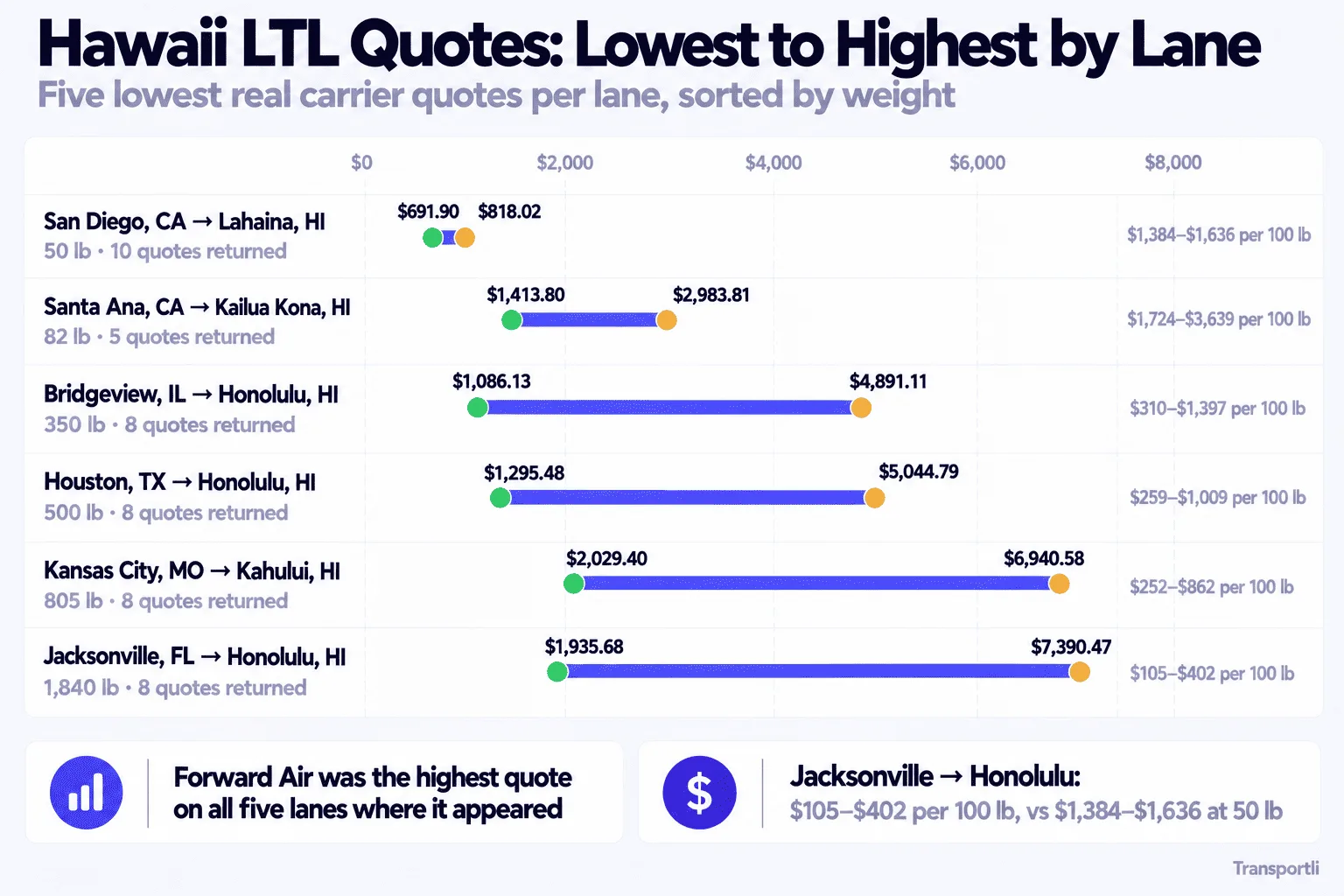
Miles do not mean much on an ocean lane, so this table compares price per 100 lb instead. Pulling the six lanes above together, weight and the carrier you pick matter more than where on the mainland the freight starts:
| Route | Weight | Quotes returned | Price range | Transit range | Price per 100 lb |
|---|---|---|---|---|---|
| San Diego, CA → Lahaina, HI | 50 lb | 10 | $692–$818 | 9–16 days | $1,384–$1,636 |
| Santa Ana, CA → Kailua Kona, HI | 82 lb | 5 | $1,414–$2,984 | 2–16 days | $1,724–$3,639 |
| Bridgeview, IL → Honolulu, HI | 350 lb | 8 | $1,086–$4,891 | 4–19 days | $310–$1,397 |
| Houston, TX → Honolulu, HI | 500 lb | 8 | $1,295–$5,045 | 4–18 days | $259–$1,009 |
| Kansas City, MO → Kahului, HI | 805 lb | 8 | $2,029–$6,941 | 5–19 days | $252–$862 |
| Jacksonville, FL → Honolulu, HI | 1,840 lb | 8 | $1,936–$7,390 | 5–20 days | $105–$402 |
Weight set the per-unit price. The lightest shipment, 50 lb from San Diego to Lahaina, cost $1,383.80–$1,636.04 per 100 lb, while the heaviest, 1,840 lb from Jacksonville to Honolulu, cost $105.20–$401.66 per 100 lb, and its lowest total of $1,935.68 was only 2.8 times the $691.90 lowest on the 50 lb lane. Destination mattered too: the 82 lb shipment from Santa Ana to Kailua Kona on Hawaii Island had a lowest quote of $1,413.80, more than the $1,086.13 lowest on the 350 lb shipment from Bridgeview, Illinois to Honolulu. Forward Air was the highest quote on all five lanes where it appeared, at 2.1 to 4.5 times the lowest, and Bridgeview to Honolulu had the widest spread, $3,804.98 or 350%, from Roadrunner Freight’s $1,086.13 to Forward Air’s $4,891.11. Speed was cheap on some lanes. On Santa Ana to Kailua Kona, Estes’s 2-day $1,437.67 cost only $23.87 more than ABF Freight’s 11-day $1,413.80, and on Kansas City to Kahului, Estes’s 5-day $2,029.40 was both the lowest and the fastest, $121.47 below ABF Freight’s 12-day $2,150.87. On Jacksonville to Honolulu, speed cost more: Estes’s 5-day $2,229.89 was $294.21 above Roadrunner Freight’s 13-day $1,935.68. XPO was the slowest on every lane at 16 to 20 days and never the cheapest, and its 19-day $3,420.81 on Kansas City to Kahului was $1,391.41 above Estes’s 5-day quote. Every lane returned only 5 to 10 carrier options, compared with 23 to 39 on the lanes on our Colorado page, which shows how few carriers serve the islands, so compare every one before you book.
What a real Hawaii LTL quote looks like
The screenshot alongside is an actual result from our platform, a 50 lb shipment from San Diego, CA to Lahaina, HI on Maui, compared across 8 real carrier options in seconds. It is the same lane as the first tab above, quoted again five days later for a Wednesday, October 7 pickup.
- 8 real carrier options compared for this single shipment, all of them standard service, not just one broker’s in-house rate. Hawaii lanes return far fewer options than mainland lanes, so seeing every carrier matters.
- $576.03–$705.62 for the four lowest quotes, with transit of 10 to 16 days. Roadrunner Freight was lowest at $576.03 on 10-day service, while Forward Air’s 11-day $1,987.95 was about 3.5 times as much.
- Prices fell in five days. Against the Friday, October 2 search, every carrier that appears in both dropped by $62.36 to $184.28 with the same transit time: Roadrunner Freight from $760.31 to $576.03, ABF Freight from $691.90 to $629.54, XPO from $757.64 to $656.79 and Old Dominion Freight Line from $806.30 to $705.62. The lowest quote fell $115.87, and the number of options went from 10 to 8.
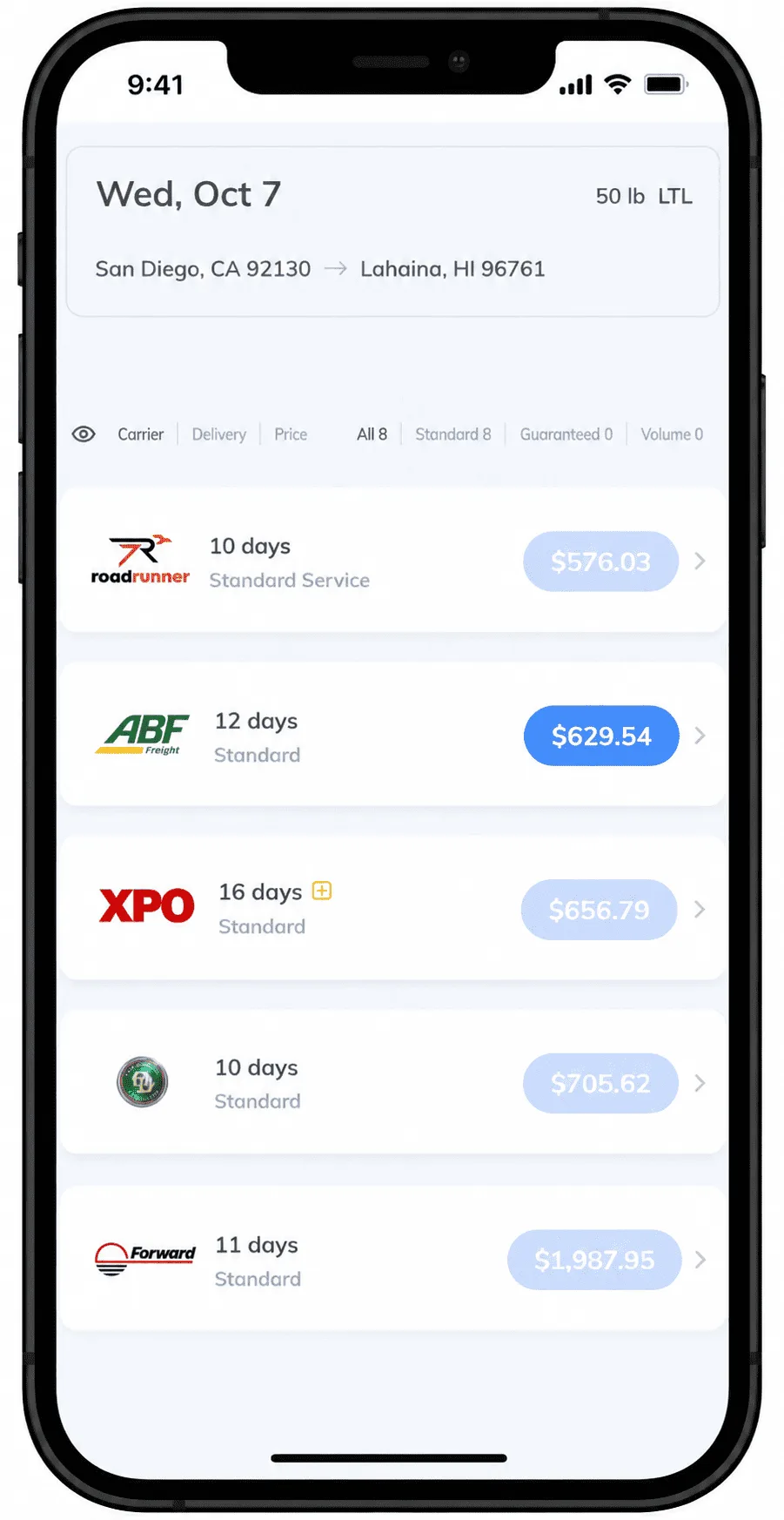
Real screenshot from a live Transportli quote for San Diego, CA to Lahaina, HI, individual results vary by shipment and date.
Major shipping hubs in Hawaii
Hawaii’s cargo moves through a small number of commercial harbors and a few mainland ports that feed them:
- Honolulu Harbor, Oahu — the main harbor and the hub for inter-island barges. Pasha Hawaii and Matson both call here, and ArcBest has said it keeps a 20,000-square-foot, 45-door facility less than half a mile from the port. See HDOT Harbors.
- Kalaeloa (Barbers Point), Oahu — the second Oahu commercial harbor, west of Honolulu.
- Kahului, Maui — the main cargo port for Maui, and a call on Pasha Hawaii’s route map.
- Hilo and Kawaihae, Hawaii Island — the two cargo ports on the Big Island.
- Nawiliwili, Kauai — the cargo port for Kauai.
- West Coast gateways — Los Angeles and Long Beach for most LTL, with Pasha Hawaii also serving Oakland, Seattle and San Diego and listing Honolulu, Maui, Hilo and Kauai on its route map.
Roads and routes serving Hawaii
Hawaii has no road link between islands, so every route ends at a harbor. On Oahu, Interstate H-1 (about 27 miles) runs east-west through Honolulu, H-2 (about 8 miles) runs north to Wahiawa, and H-3 (about 15 miles) crosses the Koolau Mountains to the windward side. The other islands rely on state highways, many of which run along the coast and can be closed by surf and surge, as West Maui’s highway was during Hurricane Lowell.
Neighbor island moves
Almost everything bound for the outer islands passes through Honolulu. Young Brothers runs twelve weekly roundtrip sailings from its Honolulu hub to six neighbor island ports, carries freight as small as a carton, and is the only water carrier serving Lanai and Molokai, so a missed barge can mean a week’s wait on those islands. See the Young Brothers service page for sailing schedules.
What Hawaii shippers move
Hawaii receives far more freight than it ships, and LTL is mostly used for the parts, equipment, retail stock and supplies that businesses on the islands need, plus return and export shipments to the mainland. Hawaii exported $395 million of goods in 2025, the 50th most of any state, led by $126 million of transportation equipment and $31 million of petroleum and coal products. Australia took $102 million, or 26% of the total, followed by Japan at $61 million, South Korea at $26 million, Germany at $25 million and Bangladesh at $21 million, according to the U.S. Trade Representative. Hawaii is also the 40th largest agricultural exporting state, shipping $344 million abroad in 2024, led by $240 million of other plant products and $44 million of tree nuts. Tourism keeps hotels, restaurants and retailers on every island dependent on regular deliveries, which is why sailing schedules and storm delays matter so much.
Hawaii LTL freight: frequently asked questions
How much does LTL shipping cost to or from Hawaii?
It depends on weight, freight class, the cubic feet of your freight, the destination island, and how far your pickup is from the California port. Real quotes on our platform for Hawaii lanes have ranged from about $105 per 100 lb on a 1,840 lb shipment from Jacksonville to Honolulu to about $1,384 to $1,636 per 100 lb on a 50 lb shipment from San Diego to Lahaina, and the lowest quote on each of six lanes was between $691.90 and $2,029.40 in total. Get an instant quote for your exact shipment.
What should I expect to pay for LTL freight to Honolulu?
In our platform quotes, the lowest price to Honolulu was $1,086.13 for 350 lb from Bridgeview, Illinois, about $1,295 for 500 lb from Houston and $1,935.68 for 1,840 lb from Jacksonville. The highest quote on those lanes was $4,891.11, about $5,045 and $7,390. Per 100 lb the lowest quotes were about $310, $259 and $105, so the price per pound falls quickly as weight rises. Each lane returned only 8 carrier options, so compare every one. Your price depends on weight, cubic feet and pickup location, so get an instant quote for your exact shipment.
What are typical LTL freight rates to Honolulu per month?
LTL carriers quote each shipment on its own, not at a monthly rate, and prices change from day to day. When we re-ran a San Diego to Lahaina search five days after the first one, every carrier that appeared in both had dropped its price by $62.36 to $184.28. If you ship to Honolulu every month, get a fresh quote close to each ship date and compare all carriers. Bundling smaller loads helps because the price per 100 lb ranged from $1,384 to $1,636 on a 50 lb shipment but only $105 to $402 on 1,840 lb.
How does LTL freight get to Hawaii?
A truck takes it to a California port terminal, where it is loaded into an ocean container. The container sails to Honolulu on a set schedule, and freight for the outer islands is moved by inter-island barge. The carrier bills the domestic, ocean and island delivery charges on one freight bill.
How long does LTL shipping to Hawaii take?
Longer than a mainland lane, because the clock starts at the sailing. XPO lists about 7 days to Oahu, 10 days to Maui and Kauai, 13 days to the Big Island and 15 days to Molokai and Lanai, and Old Dominion says Honolulu-area deliveries are made within 7 days of sailing with neighbor islands taking 2 to 4 more days. Real quotes on our platform ran from 2 to 20 days door to door.
Why is Hawaii LTL priced by cubic feet?
The ocean and island delivery portions are priced by the space your freight takes up in a container, not by weight or class. ArcBest says these fees are based on cubic feet, and XPO says its ocean rates depend on the cubic measurement of the freight, so bulky, light freight can cost more than dense freight.
Can I ship hazardous materials or plants to Hawaii?
Some hazardous materials can move, but not all. XPO accepts hazmat for Hawaii except explosives, and limited-quantity hazmat needs a declaration with the safety data sheet. Plants, soil and other agricultural items must be available for inspection by the Hawaii Department of Agriculture and Biosecurity before release.
Do oversized shipments need a permit in Hawaii?
Oversize and overweight loads on state highways need a permit from the Hawaii Department of Transportation Highways Division. The permit fee varies from $5 to $25, a certificate of insurance must be on file, and excessive loads can take at least three weeks to review. A standard LTL load within legal limits does not need one.
How do hurricanes affect LTL shipping to Hawaii?
Ports close and ships are sent out to sea when a storm approaches, so sailings are delayed and barge schedules shift. In September 2026, Hurricane Lowell put Lanai’s only cargo harbor out of operation for what the state estimated would be about two weeks. Hurricane season runs from June 1 to November 30, so build extra time into neighbor island shipments in those months.