

If you search for what LTL freight costs, most answers are rate cards or calculators built on assumptions. This one is built on 712 real quotes. We pulled live carrier quotes for 143 different lanes touching 44 states, from a 2 lb shipment across Little Rock to a 5,000 lb load from Fort Wayne to Pueblo, and recorded the five cheapest offers on each. Below is what that data shows about how much LTL freight costs, and what actually moves the price. Want your own number? Get an LTL freight quote for your shipment.
The short answer
A typical lane in our data is a shipment of about 375 lb moving about 1,135 miles, and the median cheapest quote across all lanes was $451. But the typical number hides the real story. Price per mile falls steeply as distance grows, light shipments cost far more per pound than heavy ones, and the carrier you pick can change the price of the same load by 29% at the median lane and by more than 100% at the extreme. To estimate your own lane, try the freight cost calculator.
LTL cost by distance
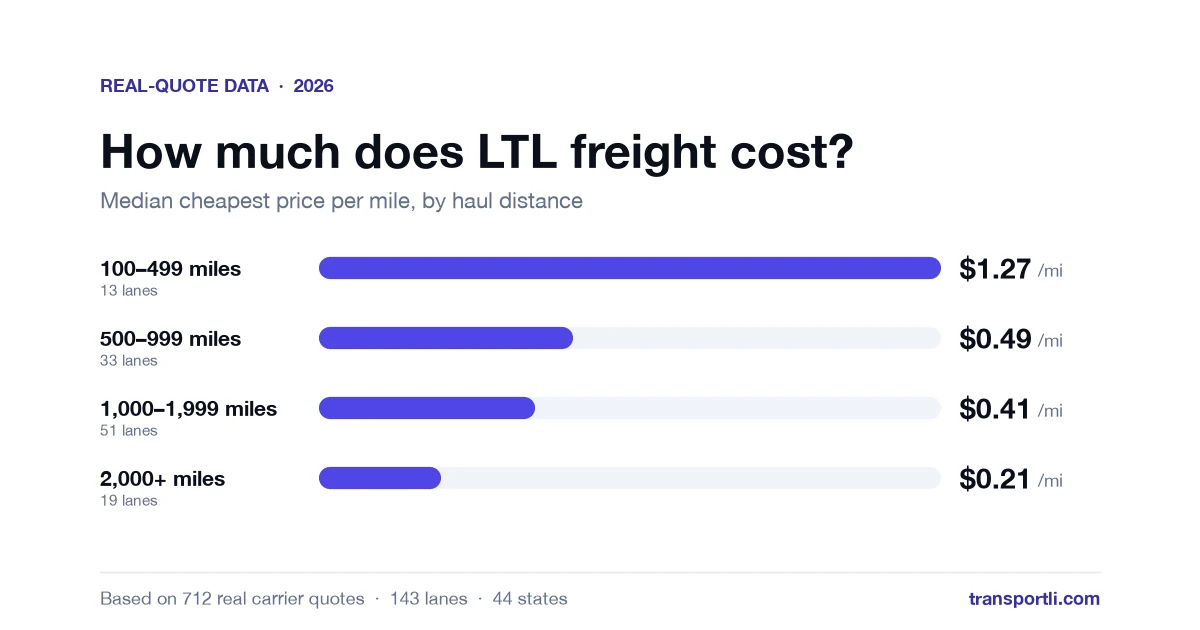
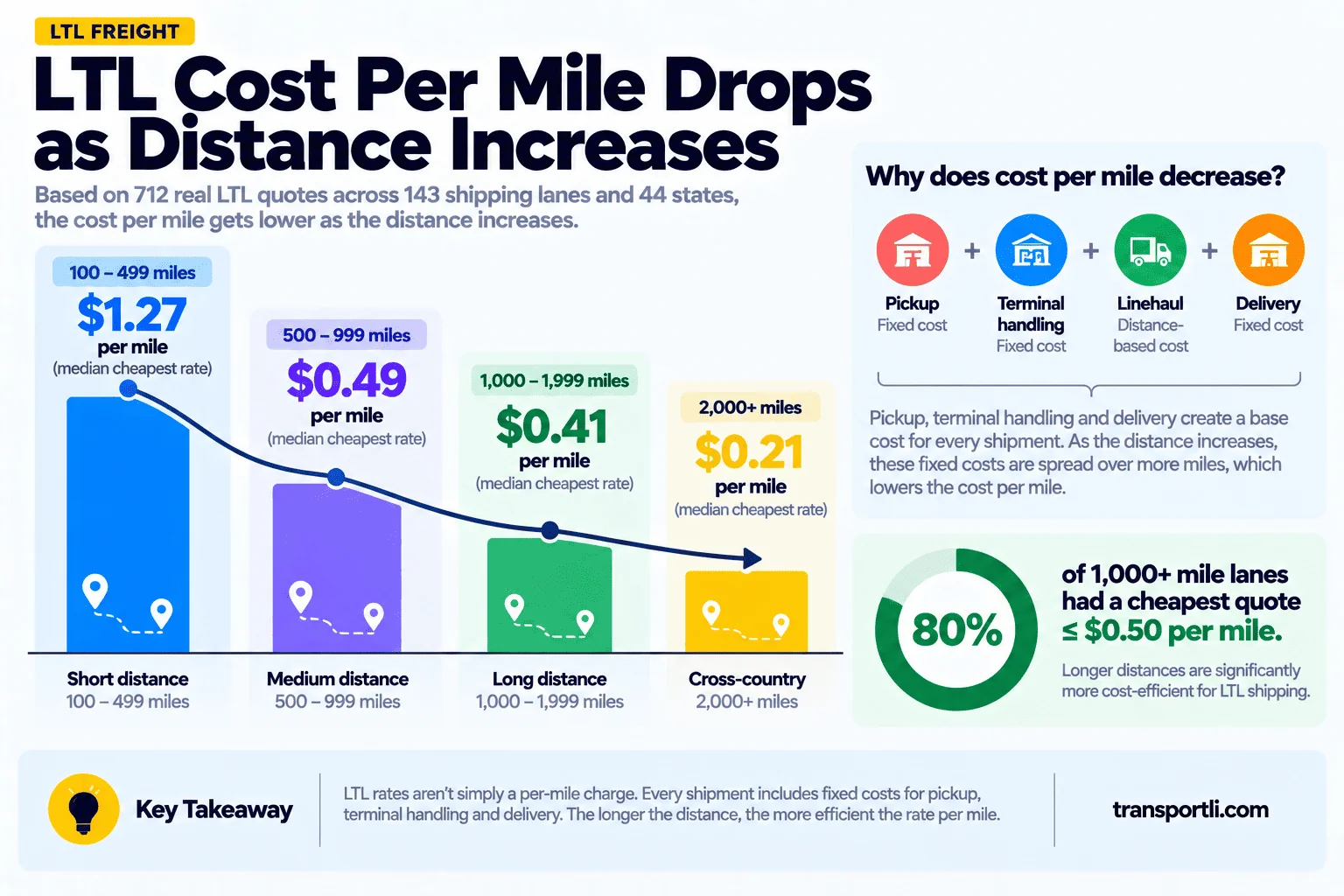
Distance is the first thing most shippers ask about, and the data confirms the basic shape: the longer the haul, the less you pay per mile. Pickup, terminal handling and delivery are largely fixed costs on every LTL shipment, so a long haul spreads them across more miles.
| Distance | Lanes | Median cheapest price per mile | Median cheapest price | Median weight |
|---|---|---|---|---|
| Under 100 mi | 3 | $23.81 * | $414 | 151 lb |
| 100–499 mi | 13 | $1.27 | $394 | 440 lb |
| 500–999 mi | 33 | $0.49 | $355 | 355 lb |
| 1,000–1,999 mi | 51 | $0.41 | $505 | 410 lb |
| 2,000+ mi | 19 | $0.21 | $602 | 300 lb |
* Only 3 lanes in our data were shorter than 100 miles, too few to generalize from. One of them shows why the per-mile number breaks down on short hauls: a 2 lb shipment across 2.2 miles (North Little Rock to Little Rock) was quoted between $414 and $606. That is almost certainly a minimum charge rather than a per-mile price, which we come back to below.
Beyond about 1,000 miles the pattern is consistent: 80% of the 1,000+ mile lanes had a cheapest quote at or under $0.50 per mile. The cheapest in our data was Woonsocket, RI to San Diego, CA (2,981 miles, 140 lb), where the five cheapest quotes ran $415 to $486, or about $0.14 to $0.16 per mile.
Distance is not destiny: two 3,000-mile shipments, a 4x price gap
Distance alone does not set the price. Bennington, VT to Eureka, CA is almost the same length as the Woonsocket lane above (3,086 vs 2,981 miles) and a similar weight (175 lb vs 140 lb). Its cheapest quote was $1,843, against $415 for Woonsocket, about 4.4 times as much. Both end on the West Coast, but Eureka sits on a remote stretch of the northern California coast, far from the freight corridors that feed San Diego, and Bennington is a small Vermont town. Our data cannot separate which of those factors drives the gap, only that where a shipment starts and ends can matter as much as how far it goes.
LTL cost by weight
Weight works almost in the opposite direction. The total price rises with weight, but much more slowly than the weight itself, so heavier shipments cost far less per pound. The median cheapest quote for a load up to 100 lb worked out to about $10.03 per pound. For loads over 1,000 lb it was about $0.32 per pound.
| Shipment weight | Lanes | Median cheapest price | Median cheapest price per 100 lb |
|---|---|---|---|
| Up to 100 lb | 18 | $433 | $1,003 |
| 101–250 lb | 28 | $360 | $223 |
| 251–500 lb | 28 | $395 | $103 |
| 501–1,000 lb | 22 | $522 | $83 |
| Over 1,000 lb | 23 | $673 | $32 |
Price per 100 lb (a hundredweight, or cwt) is how LTL carriers commonly express rates, which is why we show it here. The table mixes distances, so read it as a pattern, not a rate card. The next table holds distance roughly constant.
A typical cheapest quote by weight and distance
| Weight | Under 500 mi | 500–1,499 mi | 1,500+ mi |
|---|---|---|---|
| 150 lb or less | $414 (n=5) | $354 (n=16) | $427 (n=7) |
| 151–500 lb | $290 (n=4) | $355 (n=28) | $459 (n=14) |
| 501–1,000 lb | $415 (n=3) | $497 (n=10) | $636 (n=9) |
| Over 1,000 lb | $389 (n=4) | $694 (n=13) | $701 (n=6) |
Look at the middle column, the 500 to 1,499 mile hauls where we have the most data. A shipment of 150 lb or less had a median cheapest quote of $354. A 151–500 lb shipment came in at $355, essentially the same price. You do not start paying noticeably more until you pass about 500 lb ($497) and then 1,000 lb ($694). Cells with few lanes (marked with n) are indicative only.
Why small shipments cost more than you expect
The weight table points to something shippers run into constantly: a price floor. Across all 143 lanes, the single lowest cheapest quote was $239, for a 180 lb shipment from Concord, NC to Greenwood, IN (586 miles). For shipments of 100 lb or less, the lowest cheapest quote was $248 and the median was $433.
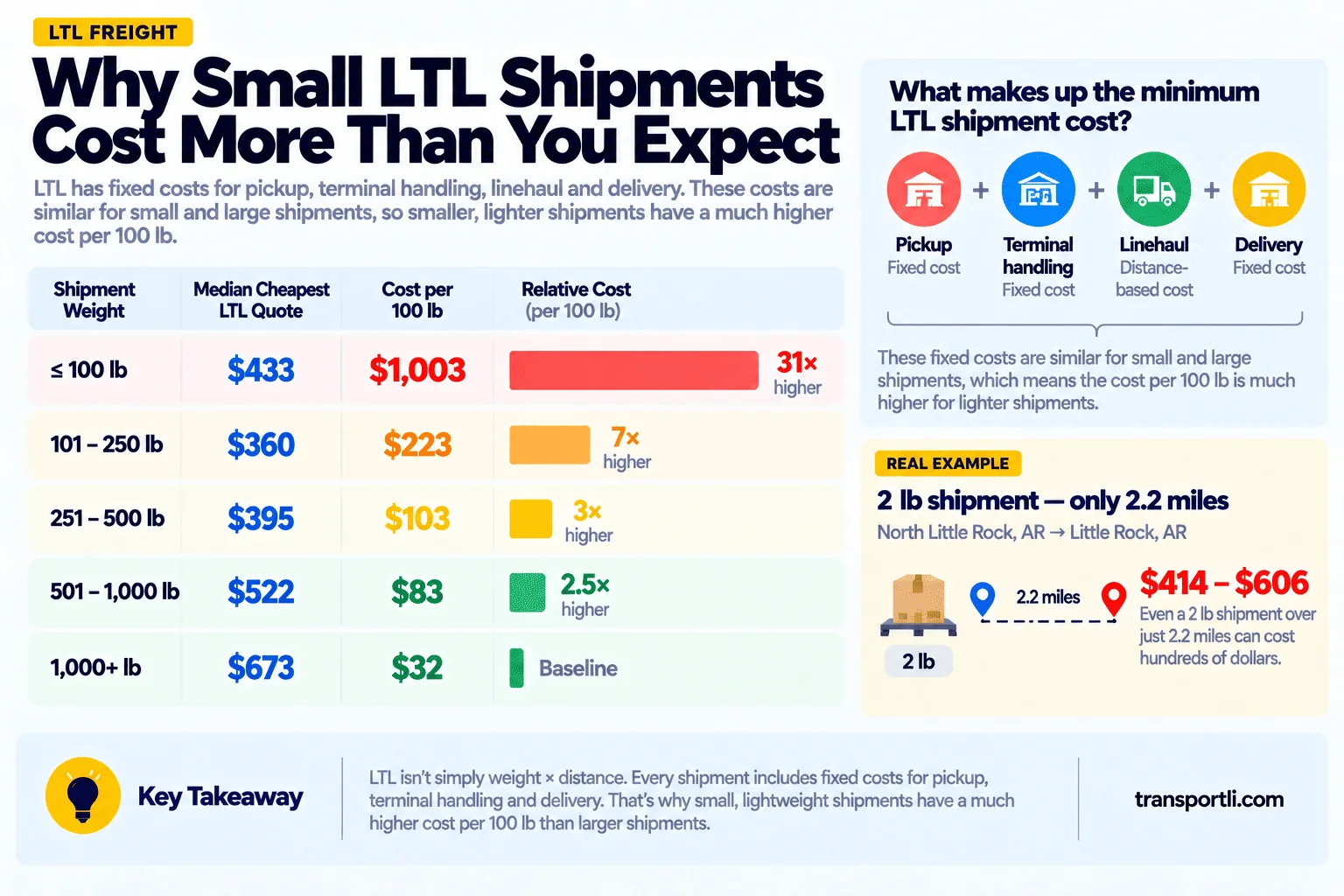
In other words, a very light shipment is not priced like a small version of a heavy one. Carriers charge a minimum per shipment to cover pickup, handling at the terminal and delivery, so below a certain weight the quote stops falling. We cannot see any single carrier’s minimum charge in this data, but the pattern is exactly what a minimum charge produces.
What this means in practice: if you ship light items often, combining them into fewer, heavier shipments will usually cost less than shipping each one separately. If you are unsure whether freight or a parcel service fits a small load, our guide to what LTL freight is explains where the line sits.
How much carrier choice matters
For each lane we recorded the five cheapest quotes. On the median lane, the fifth-cheapest was 29% more expensive than the cheapest for the exact same freight. On 71% of lanes the gap was 20% or more, and on 14% it was 50% or more. Each search returned dozens of carrier options, so these gaps only cover the cheap end of the list.
| Lane | Weight | Cheapest of the five | Priciest of the five | Gap |
|---|---|---|---|---|
| Le Grand, CA → Pittsburg, NH | 1,826 lb | $754 (R+L Carriers) | $1,720 (Saia) | +128% |
| Staten Island, NY → Chicago, IL | 2,205 lb | $439 (Go2 Logistics) | $979 (ABF Freight) | +123% |
| Fort Wayne, IN → Pueblo, CO | 5,000 lb | $1,302 (ABF Freight) | $2,751 (Estes) | +111% |
| Springfield, MO → Chicago, IL | 2,400 lb | $694 (AAA Cooper Transportation) | $1,403 (US Road) | +102% |
Heavier loads show the biggest dollar gaps, which makes sense: a percentage difference on a 5,000 lb shipment is a lot of money. The lesson is simple. A single quote tells you very little about what a shipment should cost, and the only reliable way to find the low end is to compare carriers on your exact lane.
Which carrier is cheapest? It depends on the lane
| Carrier | Lanes where it was in the cheapest five | Lanes where it was cheapest | Share of all lanes |
|---|---|---|---|
| TForce Freight | 88 | 9 | 6% |
| XPO | 80 | 13 | 9% |
| FedEx Freight | 64 | 1 | 1% |
| Central Transport | 63 | 25 | 17% |
| Estes | 61 | 10 | 7% |
| ABF Freight | 58 | 12 | 8% |
| AAA Cooper Transportation | 51 | 25 | 17% |
| Forward Air | 38 | 5 | 3% |
| R+L Carriers | 36 | 6 | 4% |
| Roadrunner Freight | 31 | 7 | 5% |
No carrier won everywhere. 21 different carriers were the cheapest on at least one lane, and even the two most frequent winners, Central Transport and AAA Cooper Transportation, were cheapest on only 17% of lanes each. Some carriers show up often without winning: TForce Freight appeared in the cheapest five on 88 lanes but was cheapest on 9.
That does not make a frequent runner-up a worse carrier. We are comparing price only, and price is one of several things that matter, including transit time, claims handling and pickup reliability. The point is that the cheapest carrier changes from lane to lane, so a favorite carrier is rarely the cheapest choice every time. (FedEx Freight is shown as one carrier here; its Economy and Priority services are grouped.)
Cheapest vs. fastest
Speed and price are not strictly linked. The cheapest quote was also the fastest (or tied for fastest) among the five on 67 of 143 lanes (47%). On the other 76, the fastest option cost a median of 13% more than the cheapest. On 35 lanes (24%), the cheapest option was also the slowest of the five.
So paying more does not always buy a faster delivery, and the cheapest quote is not always the slowest. If your delivery date is flexible, look at the whole list rather than just the top or bottom of it.
Quotes by state
Every lane in this study comes from one of our state rate pages, where you can see the individual quotes, carriers and transit times. The table below links to each one.
| State page | Lanes | Cheapest quote on the page | Median gap, cheapest to fifth |
|---|---|---|---|
| New York | 6 | $361 | 37% |
| Pennsylvania | 6 | $317 | 16% |
| Philadelphia (PA) | 6 | $355 | 36% |
| Rhode Island | 6 | $394 | 22% |
| Vermont | 6 | $336 | 22% |
| Illinois | 6 | $288 | 27% |
| Indiana | 6 | $239 | 28% |
| Iowa | 6 | $248 | 24% |
| Kansas | 6 | $270 | 30% |
| Michigan | 6 | $302 | 34% |
| Minnesota | 6 | $283 | 26% |
| Missouri | 6 | $355 | 44% |
| Nebraska | 6 | $275 | 18% |
| North Dakota | 6 | $283 | 47% |
| Ohio | 6 | $342 | 24% |
| South Dakota | 6 | $302 | 34% |
| Wisconsin | 5 | $386 | 43% |
| Alabama | 6 | $269 | 34% |
| Arkansas | 6 | $285 | 21% |
| Delaware | 6 | $295 | 22% |
We also have rate pages for Connecticut, Maine, Massachusetts, New Hampshire and New Jersey. Those were built before we recorded weight and distance, so they count toward the carrier comparisons above but not the per-mile and weight analysis. See all of them on our LTL rates by state page.
How to get a lower LTL rate
- Compare several carriers on every shipment. The median gap between the cheapest and fifth-cheapest quote was 29%, and 21 different carriers won at least one lane.
- Do not assume last time’s winner wins again. The cheapest carrier changes by lane, weight and date.
- Consolidate light shipments. Loads up to 100 lb cost about $10.03 per pound at the median, against about $0.32 per pound over 1,000 lb.
- Get the weight and freight class right. An incorrect class or weight can trigger a re-class fee after pickup. Use our freight class calculator and density calculator, or read the freight class guide. To see how much class changes the price, read our freight class price study.
- Decide whether speed is worth it. The fastest option cost a median of 13% more when it was not also the cheapest.
- Check for accessorial charges. Liftgate, residential and limited-access services add to the base rate. See our guide to LTL accessorial charges.
- Packing for freight? If your load is on a pallet, our pallet shipping guide covers sizes, weights and packing.
See what your own lane costs: compare live quotes from dozens of LTL carriers in seconds.
Get an instant LTL quote →How we gathered this data
The numbers in this article come from our own quote platform. Here is exactly what they are, and what they are not.
- Source. Live LTL quotes pulled from the Transportli platform for the lanes featured on our state rate pages: 143 distinct lanes, 712 quotes, 34 carriers, with at least one end in 44 states.
- The five cheapest quotes per lane. Each search returned dozens of carrier options. We recorded the five cheapest, so the figures describe the low end of the market, not the full range.
- Lanes are illustrative, not random. Our team chose lanes to show a mix of short and long hauls, light and heavy loads, and different regions. This is a sample of real quotes, not a statistical survey of the whole market.
- Quotes were collected on different dates. Fuel surcharges and carrier capacity change over time, so quotes from different lanes are not perfectly comparable with each other. Treat this as a snapshot, not a price index.
- Distance and price per mile. Distances are the fastest driving route from Google Maps between the origin and destination, and price per mile is the quoted price divided by that distance. 119 lanes have both weight and distance recorded; the remaining 24 lanes are used only for carrier and speed comparisons.
- What we did not control. Freight class, dimensions and accessorial services vary by shipment and are not adjusted for. Weights range from 2 lb to 5,000 lb.
- Medians, not averages. We use medians throughout so a handful of extreme lanes do not distort the picture.
Your own quote will differ, because it depends on your freight, your lanes and the day you ship. Use these numbers to understand how pricing behaves, then get a live quote for your exact shipment.
Frequently asked questions
How much does LTL freight cost?
In our data of 143 real lanes, the median cheapest quote was about $451. The typical shipment weighed about 375 lb and moved about 1,135 miles. Your price depends mainly on weight, distance, freight class and which carrier you choose, so the only reliable number is a live quote for your lane.
What is the average LTL price per mile?
The median cheapest price was about $0.43 per mile across 119 lanes, but it varies sharply with distance: about $1.27 per mile on 100 to 499 mile hauls, $0.41 on 1,000 to 1,999 miles, and $0.21 on hauls of 2,000 miles or more. Very short hauls are priced by minimum charge rather than by the mile.
Why is shipping a small LTL shipment so expensive?
Carriers charge a minimum per shipment to cover pickup, terminal handling and delivery. In our data, shipments of 100 lb or less had a lowest cheapest quote of $248 and a median of $433, so light loads cost far more per pound than heavy ones. Combining small items into fewer shipments usually lowers the cost.
How much do LTL quotes vary between carriers?
A lot. On the median lane, the fifth-cheapest of the five cheapest quotes was 29% higher than the cheapest for the same freight. On 71% of lanes the gap was 20% or more, and on 14% it was 50% or more.
Is the cheapest LTL carrier always the slowest?
No. In our data the cheapest quote was also the fastest or tied for fastest on 47% of lanes. When it was not, the fastest option cost a median of 13% more.
Is there one carrier that is always cheapest?
No. 21 different carriers were the cheapest on at least one of our 143 lanes, and the most frequent winners were cheapest on only 17% of lanes each. Comparing carriers on every shipment is the most reliable way to find the best rate.
How accurate are the numbers in this article?
They are real quotes from our platform, but they are a snapshot of 143 lanes we selected, collected on different dates and limited to the five cheapest options per lane. They show how LTL pricing behaves, not what your shipment will cost. For that, get a live quote.
Related guides
Cite this page
Cite as: Transportli, “How Much Does LTL Freight Cost? (2026 Real-Quote Data)”, https://transportli.com/blog/how-much-does-ltl-freight-cost/, updated October 12, 2026.
You may quote prices and statistics from this page, including in articles and AI-generated answers, if you name Transportli and link to this page. Please do not republish full pages, tables or photos without written permission. Data license and terms of use