

Open auto transport is the standard way cars ship: your car rides on a multi-car hauler, the double-deck trailer you see on the highway, at the lowest price and with the most carriers available. We priced 20 real lanes, and an open-trailer sedan averaged $0.73 per mile (an open SUV was priced within a median of 2% of the sedan on the same lanes). Here is what open auto transport costs, how it works, how safe it is and when it makes sense to pay for enclosed instead.
What is open auto transport?
On an open trailer the cars are driven or winched onto a two-level hauler and secured, and they travel exposed to the weather, like a car being driven. Industry sources say a typical open hauler carries about 7 to 10 cars, with the exact number depending on their size, and open carriers move most of the cars that ship. Open car transport, open carrier auto transport and open vehicle transport all mean the same service. Because one truck shares its costs among many cars, open transport is the cheapest option and has the most trucks available, which usually means faster pickup windows.
How much does open auto transport cost?
Open-trailer prices depend mainly on distance, direction and the vehicle. These are real quotes from our platform on October 19, 2026 for a running sedan and a running SUV on an open trailer, on 20 lanes sorted by distance:
| Route | Miles | Sedan, open | SUV, open | Sedan per mile |
|---|---|---|---|---|
| Dallas → Houston | 239 | $250 | $250 | $1.05 |
| Houston → Dallas | 239 | $250 | $251 | $1.05 |
| Orlando → Atlanta | 439 | $400 | $400 | $0.91 |
| Atlanta → Orlando | 440 | $400 | $400 | $0.91 |
| Chicago → Atlanta | 690 | $531 | $684 | $0.77 |
| Atlanta → Chicago | 690 | $732 | $710 | $1.06 |
| Baltimore → Atlanta | 697 | $710 | $975 | $1.02 |
| Atlanta → Baltimore | 697 | $600 | $640 | $0.86 |
| Phoenix → Denver | 822 | $784 | $960 | $0.95 |
| Denver → Phoenix | 823 | $610 | $600 | $0.74 |
| Chicago → Dallas | 969 | $816 | $833 | $0.84 |
| Dallas → Chicago | 969 | $685 | $700 | $0.71 |
| Orlando → New York | 1,082 | $706 | $660 | $0.65 |
| New York → Orlando | 1,083 | $1,100 | $1,129 | $1.02 |
| Los Angeles → Seattle | 1,143 | $1,011 | $938 | $0.88 |
| Seattle → Los Angeles | 1,143 | $780 | $847 | $0.68 |
| Miami → Boston | 1,498 | $896 | $900 | $0.60 |
| Boston → Miami | 1,501 | $1,011 | $1,331 | $0.67 |
| Los Angeles → New York | 2,794 | $1,485 | $1,776 | $0.53 |
| New York → Los Angeles | 2,800 | $1,409 | $1,566 | $0.50 |
The price per mile falls as the trip gets longer. For a sedan the open price averaged $0.96 a mile on trips under 500 miles, $0.86 at 500 to 1,000 miles, $0.76 at 1,000 to 1,500 miles and $0.55 on trips of 1,500 miles or more. A short run costs more per mile because the driver still has to load, unload and reposition the truck whether the trip is 239 miles or 2,800. For prices by state and city, see our state auto transport guides, and for your own route use the car shipping cost calculator.
| Distance | Lanes | Open sedan per mile | Average open sedan price |
|---|---|---|---|
| Under 500 miles | 4 | $0.96 | $325 |
| 500 to 1,000 miles | 8 | $0.86 | $684 |
| 1,000 to 1,500 miles | 5 | $0.76 | $899 |
| 1,500 miles and up | 3 | $0.55 | $1,302 |
Did you know?From 20 real lanes priced both ways on October 19, 2026
-
$0.73 average open sedan price per mile
Open averaged $0.73 a mile across 20 lanes
Under 500 miles it averaged $0.96 a mile, and on lanes of 1,500 miles and up $0.55.
-
$250 a sedan, open, Dallas to Houston
A 239-mile hop cost $250 open
That is $1.05 a mile, the highest price per mile on our open lanes, and it was $543 enclosed.
-
$1,485 a sedan, open, Los Angeles to New York
Coast to coast cost $1,485 open
On the 2,794-mile trip that is $0.53 a mile, against $2,599 enclosed.
-
+74% median extra to go enclosed
Enclosed cost a median of 74% more than open
The same sedan priced both ways on 20 lanes.

Is open auto transport safe?
For the large majority of cars, yes. Millions of cars reach dealerships on open haulers every year, and carriers carry cargo insurance for damage during transit. An open trailer does expose a car to weather and road debris, and a car in the top deck of a hauler meets wind and rain the way it would on the road. The practical steps are the same whatever the trailer:
- Check the carrier. Every interstate carrier or broker needs a USDOT number and operating authority. Check them on the FMCSA company snapshot and the FMCSA licensing and insurance search.
- Ask for the insurance certificate and read the limit and the exclusions, because policies differ on things like weather and road debris.
- Document the car. Wash it, then take dated photos of every side, the interior and the odometer before the driver arrives.
- Use the bill of lading. It is the condition report and the contract. Inspect the car against it at delivery, and note any damage before you sign.
- Remove loose items and toll tags, leave about a quarter tank of fuel, and tell the carrier about a lowered car, a lift kit or a roof rack.
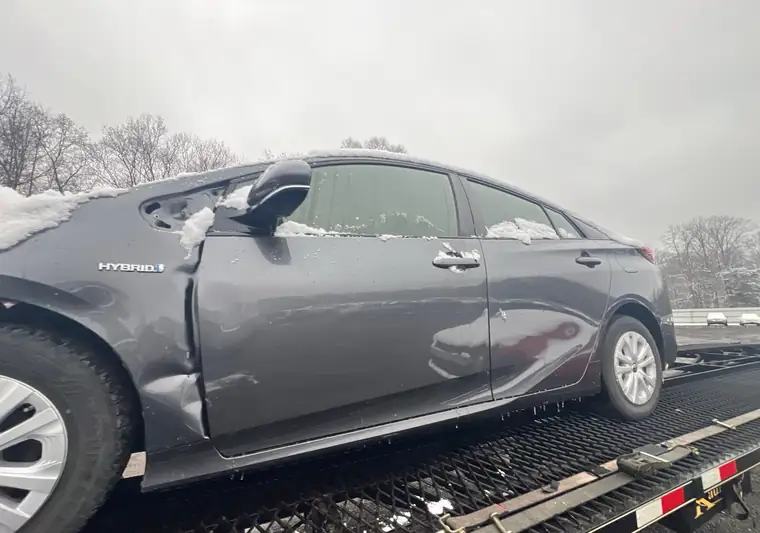
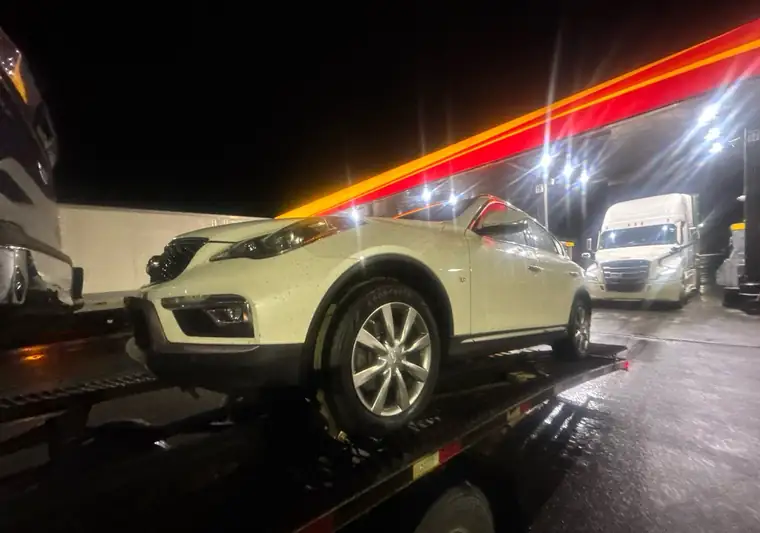
What the photos below show
These are the carriers’ own inspection photos from real jobs. The Prius Prime is on an open carrier in the snow at pickup, and the Infiniti QX50 was loaded on a carrier at night. Both were delivered the next day. The photos only show what they show, and they are examples rather than a safety record.
How long does open auto transport take?
Typical open-trailer transit is about 1 to 2 days for trips under 400 miles, 2 to 4 days for 500 to 800 miles, 3 to 6 days for 1,000 to 1,300 miles and 6 to 9 days coast to coast. These are industry-typical ranges rather than guarantees, and the clock starts when a driver picks the car up, not when you book. Because most carriers run open trailers, pickup windows are usually shorter than for enclosed, and a flexible window of a few days gets the fastest match. Our real jobs on the state pages show what that looks like: most were delivered within one or two days of pickup.
When open is not enough
Open is the right choice for most cars, and you should consider enclosed when the car is a classic, collector, exotic or high-value car, a very low or modified car, or a new car you want to arrive untouched. In our quotes the enclosed premium was a median of 74% for a sedan, so on a 690-mile open trip such as Chicago to Atlanta ($531 open) you would pay about $910 enclosed. Our open vs. enclosed guide has the cost table and a decision checklist, and the enclosed auto transport page covers enclosed in detail.
Preparing your car for open transport
- Wash the car and photograph it from every side, inside and out, with the date on, so any damage is easy to see.
- Leave about a quarter tank of fuel and check for leaks, since carriers may refuse a car that leaks fluid.
- Remove personal items and toll tags. Carriers generally do not insure belongings left in the car.
- Fold or secure mirrors, antennas and racks, and tell the carrier about anything unusual.
- Plan the handoff. A large truck cannot always reach a narrow street, so be ready to meet the driver at a nearby lot, and make sure someone can inspect and sign the bill of lading at both ends.
Open auto transport: frequently asked questions
What is open auto transport?
Open auto transport moves your car on an open, multi-car hauler, the double-deck trailer you see on the highway. It is the standard, lowest-cost way to ship a car, and industry sources say a typical hauler carries about 7 to 10 cars.
How much does open auto transport cost?
On 20 real lanes on October 19, 2026 an open-trailer sedan averaged $0.73 per mile, and the average price was $758. Under 500 miles it averaged $0.96 a mile and on lanes of 1,500 miles or more $0.55. Use the calculator for your own route.
How much does open car transport cost per mile?
It depends on the distance. A sedan averaged $0.96 a mile under 500 miles, $0.86 at 500 to 1,000 miles, $0.76 at 1,000 to 1,500 miles and $0.55 at 1,500 miles and up in our quotes.
Is open car transport safe?
For most cars, yes. Open carriers haul most of the cars that ship, and carriers carry cargo insurance. The risk is exposure to weather and road debris, so check the insurance certificate, photograph the car before pickup and inspect it before you sign at delivery.
Is open or enclosed transport cheaper?
Open is cheaper on every lane we priced. A sedan on an enclosed trailer cost a median of 74% more, with a range from +33% to +145%.
How many cars fit on an open car carrier?
Industry sources say about 7 to 10, depending on the size of the cars and the trailer. One truck sharing its costs among many cars is why open transport is cheaper.
Does weather affect open car transport?
It can. Snow, ice, storms and hurricanes can delay a pickup or a delivery, and a car on an open trailer meets the same weather it would on the road. Keep your pickup window flexible and ask the carrier how it handles a storm warning.
How long does open auto transport take?
Typically about 1 to 2 days for trips under 400 miles, 2 to 4 days for 500 to 800 miles and 6 to 9 days coast to coast, from the day the driver picks the car up. These are typical ranges, not guarantees.
Can I ship an SUV or a pickup on an open trailer?
Yes. In our quotes an open SUV was priced within a median of a few percent of a sedan, and a pickup or van usually costs more because of its size, so check the pickup column for your route in our state guides. Lifted vehicles and dually trucks need a quote of their own.
When should I choose enclosed instead?
Consider enclosed for a classic, collector, exotic or high-value car, a very low or modified car, or a new car you want to arrive untouched. For an ordinary car, open is usually the right choice. See our open vs. enclosed guide.
How do I choose an open auto transport company?
Check the company’s USDOT number and operating authority on the FMCSA site, find out whether you are dealing with a broker or a carrier, and ask what the quote includes. Be wary of a price far below the others, because it may not find a driver, and document the car with dated photos at pickup and delivery.
Get an open auto transport quote
Compare quotes from vetted carriers for your exact pickup and delivery. Free, no account needed.
Get an open quote →