

Shipping LTL freight to or from Texas? Rates depend on your specific route, freight class, and how close your pickup or delivery point is to the nearest LTL terminal. Texas is the country’s largest exporting state, with about 31.7 million residents, more than 3,200 miles of interstate and three freight engines: Port Houston on the Gulf, Laredo on the Mexican border, and the Dallas-Fort Worth rail and highway hub. Distances are long, with I-10 alone running about 877 miles across the state, and the weather can be severe, from the February 2021 deep freeze to hurricane season on the coast. Here’s what actually affects your rate. You can also compare live LTL freight rates across carriers.
LTL trucking regulations in Texas
A standard LTL tractor-trailer within legal size and weight limits does not need a permit in Texas. Permits matter for oversize or overweight freight, and Texas’s rules include a few that surprise shippers:
- Permits come from TxDMV, not TxDOT. The Texas Department of Motor Vehicles’ Motor Carrier Division issues oversize and overweight permits through its online TxPROS system, which accepts applications 24 hours a day, and many permit types can be self-issued.
- The legal limits are 8 ft 6 in wide and 14 ft high. Loads beyond either, or beyond Texas’s legal weight limits, need a permit.
- The base fee is $60. A general single-trip permit costs $60. Loads over 80,000 lbs also pay a highway maintenance fee of $150 (up to 120,000 lbs), $225 (up to 160,000 lbs), $300 (up to 200,000 lbs) or $375 (over 200,000 lbs), and loads over 200,000 lbs pay a vehicle supervision fee on top. Paying by card through Texas.gov adds $0.25 plus 2.25%.
- Oversize loads move in daylight. Permitted vehicles may travel only from 30 minutes before sunrise to 30 minutes after sunset, with exceptions: overweight-only loads, and loads on the interstate system that are no more than 10 ft wide and 100 ft long with legal overhangs, may move at night.
- Escorts start above 14 ft wide. Loads from 14 to 16 ft wide need a front escort on two-lane highways and a rear escort on divided highways, loads over 16 ft wide need front and rear escorts on all roads, and loads over 17 ft high need a front escort with a height pole.
- TxDOT can restrict routes. The state may close or limit specific routes for maintenance or construction, so check your approved route before moving.
- Tolls are common. Texas has several toll authorities, including NTTA around Dallas-Fort Worth, HCTRA around Houston and state-run toll roads such as parts of SH 130, and trucks are charged by axle count.
Current permit fees and rules are public record:
TxDMV Oversize/Overweight Permits →
What affects your Texas LTL rate
- Freight class — density, handling, and liability determine your NMFC class, the single biggest factor in your rate. See our freight class guide.
- Distance — Texas is huge: I-10 runs about 877 miles and I-20 about 636 miles across the state, so a lane from El Paso to Houston or from the Panhandle to the Rio Grande is a multi-day haul.
- Metro vs. rural — Houston, Dallas-Fort Worth, San Antonio and Austin are well served by carriers, while West Texas, the Panhandle and the Big Bend typically see fewer terminals and options.
- Terminal proximity — the more carrier terminals near your pickup or delivery point, the more quotes you see.
- Accessorials — liftgate, residential, or inside delivery add to the base rate, same as anywhere else.
Did you know?From 6 real Texas lanes and 30 quotes
-
$155 to arrive 2 days sooner
Speed has a price
On Newark, NJ to Houston, TX (1,614 miles, 1,172 lb), the cheapest quote at $390 took 5 days. The fastest, at 3 days, cost $545. On Forney, TX to Modesto, CA, 3-day delivery cost $1,317 against $1,188 for 5 days.
-
6 carriers had the lowest quote
Six different carriers won six Texas lanes
AAA Cooper, ABF Freight, Averitt, Roadrunner, Warp, and XPO each had the lowest quote on one lane. Across the lowest quotes on every lane, 13 different carriers appeared.
-
$847 from lowest to fifth-lowest
Same shipment, quotes $847 apart
For 730 lb from Forney, TX to Modesto, CA (1,679 miles), the lowest quote was $1,188 and the fifth-lowest was $2,035, a 71% gap. On Denver, CO to Austin, TX, all five quotes landed within $48 of each other.

Where freight moves in Texas
Texas freight follows its big interstates, its ports and its border:
- Houston & the Gulf Coast — Port Houston, the refineries and chemical plants of the Ship Channel, and I-10, I-45 and the loops around the city.
- Dallas-Fort Worth — where I-35E, I-35W, I-45, I-20 and I-30 meet, with BNSF’s Alliance intermodal terminal and AllianceTexas in north Fort Worth.
- San Antonio, Austin & the I-35 corridor — the route that carries Mexican trade north from Laredo through the middle of the state.
- Laredo & the border — the busiest land port for U.S.-Mexico trade, reached from San Antonio on I-35 and from Corpus Christi on I-37.
- El Paso & West Texas — I-10 and I-20 across the desert, with long runs between terminals.
- The Panhandle & Lubbock — I-40 and I-27 through Amarillo and Lubbock.
Weather and transit reliability
Texas freight is exposed to winter storms, hurricanes and border delays. In February 2021, Winter Storm Uri brought a deep freeze that the Texas Department of State Health Services later tied to 246 deaths, and icy roads produced crashes such as a 133-vehicle pileup on I-35W in Fort Worth, according to news reports. The Gulf Coast faces hurricane season each year, and Port Houston and the surrounding highways can be disrupted by storm surge, flooding and power loss. The border can also stall freight: in April 2022, extra state inspections of trucks at the Mexican border caused waits of many hours, with truckers reporting waits of 35 hours or more at one bridge, until the governor eased the inspections at Laredo on April 13. For LTL shippers the practical advice is simple: during winter storms, hurricane season and any border disruption, build extra transit time into anything headed to or through Texas.
Sample Texas LTL rates by route
Real quotes pulled from our platform for six different Texas lanes — same process, different carriers each time, spanning a range of weights and distances. Rates shift with capacity and fuel costs, so treat these as a snapshot rather than a guarantee for your shipment; get an instant quote for your exact route.
Real quotes by route
Snapshot taken over recent weeks — carriers and pricing change daily.
| Carrier | Service | Transit | Price |
|---|---|---|---|
| Averitt | Standard | 2 days | $365.84 |
| XPO | Standard | 3 days | $392.21 |
| TForce Freight | Standard | 4 days | $410.16 |
| ABF Freight | Standard | 2 days | $424.10 |
| Central Transport | Standard | 2 days | $433.54 |
| Carrier | Service | Transit | Price |
|---|---|---|---|
| XPO | Standard | 2 days | $490.88 |
| Forward Air | Standard | 2 days | $496.23 |
| ABF Freight | Standard | 3 days | $527.60 |
| AAA Cooper Transportation | Standard | 3 days | $537.02 |
| Southeastern Freight Lines | Standard | 4 days | $538.90 |
| Carrier | Service | Transit | Price |
|---|---|---|---|
| AAA Cooper Transportation | Standard | 3 days | $357.52 |
| R+L Carriers | Standard | 3 days | $407.73 |
| Central Transport | STD | 4 days | $422.29 |
| FedEx Freight Economy | Freight Economy | 5 days | $423.52 |
| TForce Freight | Standard | 4 days | $431.59 |
| Carrier | Service | Transit | Price |
|---|---|---|---|
| Warp | Standard | 5 days | $389.98 |
| Roadrunner Freight | Standard Service | 4 days | $534.66 |
| ABF Freight | Standard | 3 days | $544.96 |
| STG Logistics | Standard | 7 days | $550.71 |
| R+L Carriers | Standard | 4 days | $567.80 |
| Carrier | Service | Transit | Price |
|---|---|---|---|
| ABF Freight | Standard | 5 days | $1,187.88 |
| Roadrunner Freight | Standard Service | 3 days | $1,316.84 |
| AAA Cooper Transportation | Standard | 5 days | $1,458.01 |
| XPO | Standard | 3 days | $1,551.52 |
| FedEx Freight Economy | Freight Economy | 6 days | $2,035.36 |
| Carrier | Service | Transit | Price |
|---|---|---|---|
| Roadrunner Freight | STD | 6 days | $534.27 |
| Southeastern Freight Lines | Standard | 6 days | $576.94 |
| XPO | STD | 3 days | $591.66 |
| ABF Freight | Standard | 5 days | $612.15 |
| Forward Air | STD | 3 days | $673.99 |
Rate, transit, and price-per-mile summary
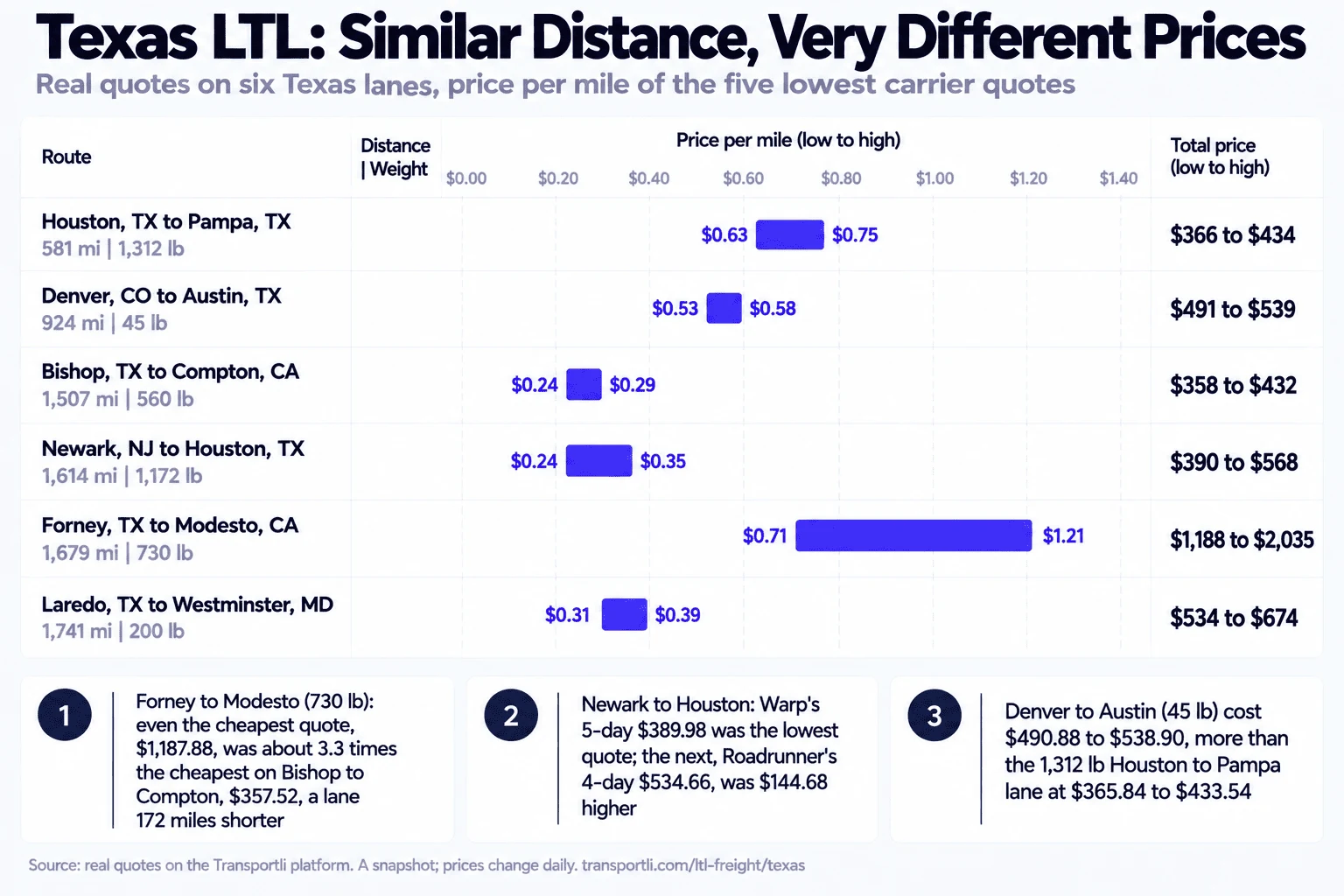
Pulling the six lanes above together, a 730 lb shipment to California stands out from everything else in the data:
| Route | Distance | Weight | Price range | Transit range | Price per mile |
|---|---|---|---|---|---|
| Houston, TX → Pampa, TX | 581 mi | 1,312 lb | $366–$434 | 2–4 days | $0.63–$0.75 |
| Denver, CO → Austin, TX | 924 mi | 45 lb | $491–$539 | 2–4 days | $0.53–$0.58 |
| Bishop, TX → Compton, CA | 1,507 mi | 560 lb | $358–$432 | 3–5 days | $0.24–$0.29 |
| Newark, NJ → Houston, TX | 1,614 mi | 1,172 lb | $390–$568 | 3–7 days | $0.24–$0.35 |
| Forney, TX → Modesto, CA | 1,679 mi | 730 lb | $1,188–$2,035 | 3–6 days | $0.71–$1.21 |
| Laredo, TX → Westminster, MD | 1,741 mi | 200 lb | $534–$674 | 3–6 days | $0.31–$0.39 |
Forney to Modesto, California (1,679 miles, 730 lb) is the outlier. Its five quotes run $1,187.88–$2,035.36, or $0.71–$1.21 per mile, a 71% spread, and even ABF Freight’s 5-day $1,187.88 is about 3.3 times the cheapest quote on Bishop to Compton, California ($357.52), a lane only 172 miles shorter with a lighter 560 lb shipment. FedEx Freight Economy’s 6-day $2,035.36 was both the slowest and the most expensive quote, while Roadrunner Freight’s 3-day $1,316.84 cost $128.96 more than ABF’s for 2 days saved. Newark to Houston shows a different pattern: Warp quoted $389.98 on 5-day service, and the next-lowest quote, Roadrunner’s 4-day $534.66, was $144.68 (about 37%) higher. Weight did not set the price. The 45 lb shipment from Denver to Austin ($490.88–$538.90) cost more than the 1,312 lb shipment from Houston to Pampa ($365.84–$433.54), though the Denver lane is about 340 miles longer. Denver to Austin was also the tightest lane, with all five quotes within $48.02 and XPO and Forward Air just $5.35 apart. On Laredo to Westminster, Maryland, Roadrunner’s 6-day $534.27 was the lowest, and XPO’s 3-day quote cost $57.39 more to arrive 3 days sooner. Bishop to Compton was the cheapest per mile, at $0.24–$0.29. The lesson is the same on every lane: compare several carriers before you book.
Price vs. speed explorer
Every dot is a real quote from the routes above. Drag the slider from cheapest to fastest and see which carrier wins on each lane, and what the speed costs.
What a real Texas LTL quote looks like
The screenshot alongside is an actual result from our platform, a 560 lb shipment from Bishop, TX to Compton, CA, compared across 59 real carrier options in seconds. It is the same lane and weight as the third rate tab above, quoted for a pickup about five weeks later.
- 59 real carrier options compared for this single shipment, 47 of them standard service and 12 guaranteed, not just one broker’s in-house rate.
- $368.46–$441.18 for the five lowest quotes, with transit of 3 to 5 days. AAA Cooper Transportation was lowest at $368.46 on 3-day service.
- The same lane cost a little more five weeks later. Four carriers appear in both searches, and each was higher: AAA Cooper rose from $357.52 to $368.46 (about 3%), R+L Carriers from $407.73 to $422.98 (about 4%), Central Transport from $422.29 to $436.37 (about 3%) and TForce Freight from $431.59 to $441.18 (about 2%). The pickup dates differ, so some of the change may be the date.
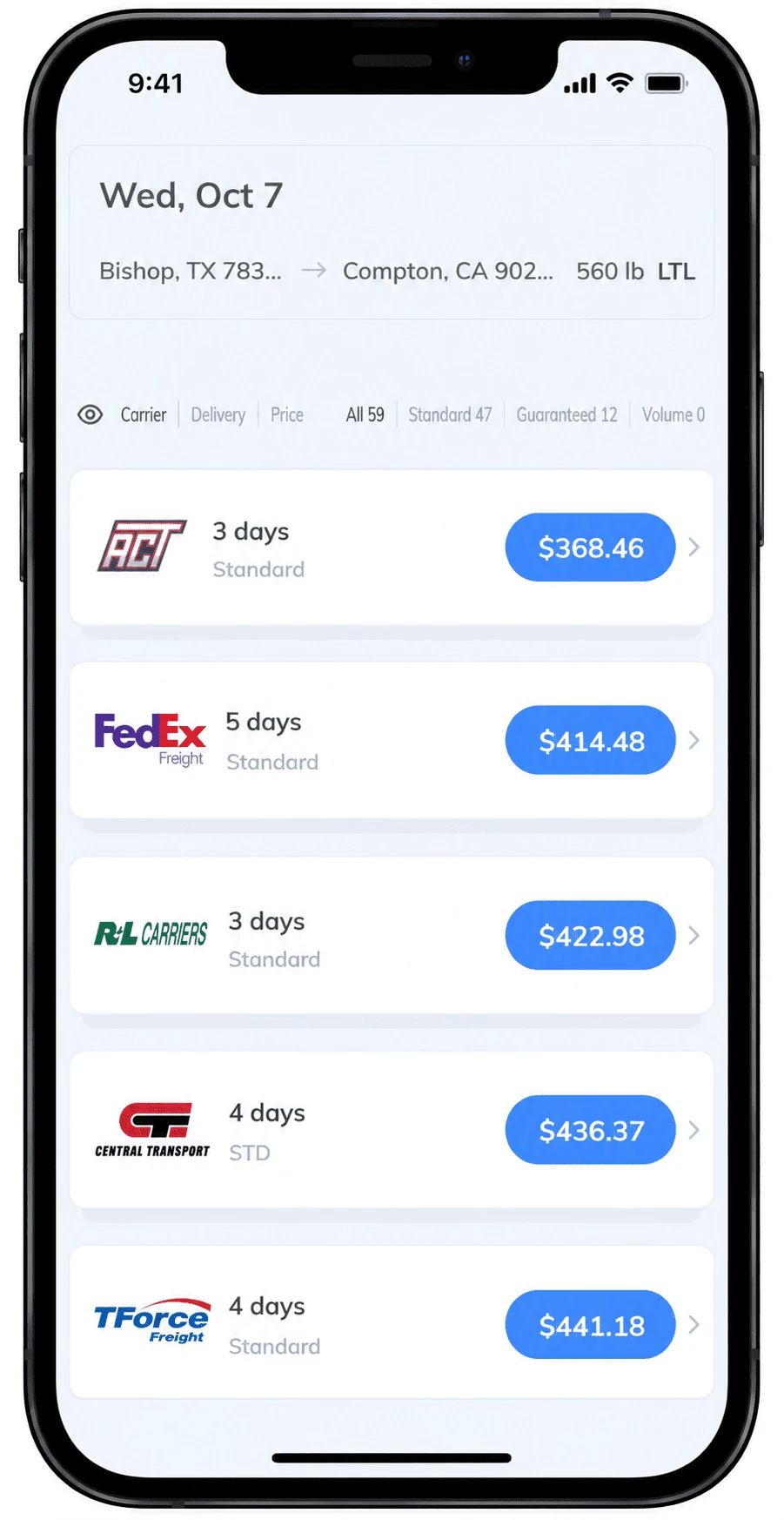
Real screenshot from a live Transportli quote for Bishop, TX to Compton, CA, individual results vary by shipment and date.
Major shipping hubs in Texas
Texas’s freight moves through a deepwater port, a border gateway and a rail hub:
- Port Houston — the largest Gulf Coast container port, handling 75% of U.S. Gulf Coast container traffic, and the first-ranked U.S. port for foreign waterborne tonnage, at 220.1 million short tons in 2024, according to the port. It reported about 4.3 million TEUs in 2025.
- Laredo — the top U.S. land port for trade with Mexico. Bureau of Transportation Statistics data show it handled about $296 billion of U.S.-Mexico freight in 2025, roughly 46% of the truck trade.
- Dallas-Fort Worth and AllianceTexas — a 27,000-acre logistics development in north Fort Worth built around BNSF’s Alliance intermodal terminal, which industry reports say handles more than a million container lifts a year.
- San Antonio and Austin — the I-35 corridor between Laredo and Dallas.
- El Paso — the I-10 and I-20 gateway to West Texas and New Mexico.
Highway corridors serving Texas
I-10 (about 877 miles in Texas) is the longest, running from El Paso through San Antonio and Houston to the Louisiana line. I-20 (about 636 miles) crosses West Texas to Dallas-Fort Worth and continues east to Louisiana. I-35 (about 500 miles) runs from Laredo through San Antonio, Austin and Waco, splitting into I-35E and I-35W at Dallas-Fort Worth before heading to Oklahoma. I-45 (about 285 miles) links Dallas and Houston, I-40 (about 177 miles) crosses the Panhandle through Amarillo, I-37 (about 143 miles) connects San Antonio to Corpus Christi, and I-27 (about 128 miles) runs from Amarillo to Lubbock.
Laredo, I-35 and the border
Most truck freight between Mexico and the central United States passes through Laredo and moves north on I-35, so a delay at the border or a closure on I-35 can ripple across the country’s freight network. The April 2022 inspection slowdown showed how quickly waits at the bridges can build.
What Texas shippers move
Texas’s freight is shaped by energy, chemicals, electronics and trade with Mexico. The state exported $450.3 billion of goods in 2025, the most of any state, led by $70.8 billion of computer and electronic products, $68.5 billion of petroleum and coal products, $55.1 billion of chemicals, $28.5 billion of transportation equipment and $26.2 billion of machinery. Mexico took $125.2 billion, or 28% of the total, followed by Canada at $34.6 billion, according to the U.S. Trade Representative. Much of this moves in full truckloads, by pipeline, by rail or by ship, but the parts, tools, supplies and finished goods around these industries are where LTL fits.
Texas LTL freight: frequently asked questions
How much does LTL shipping cost to or from Texas?
It depends on distance, weight, freight class, and how close your pickup or delivery point is to a major metro’s carrier network. Real quotes on our platform for Texas lanes have ranged from about $0.24 per mile on a 1,507-mile haul from Bishop to Compton, California to $0.71 to $1.21 per mile on a 730 lb shipment over 1,679 miles from Forney to Modesto, California, so distance alone does not predict the price. Get an instant quote for your exact shipment.
Do oversized LTL shipments need a permit in Texas?
Yes, for loads wider than 8 ft 6 in, higher than 14 ft, or over legal weight limits. TxDMV issues permits online through TxPROS. A general single-trip permit costs $60, and loads over 80,000 lbs pay a highway maintenance fee of $150 to $375 depending on weight. Permitted vehicles may travel only from 30 minutes before sunrise to 30 minutes after sunset, with limited night exceptions, and loads wider than 14 ft need escorts. A standard LTL trailer within legal limits does not need one.
Do trucks pay tolls in Texas?
Yes. Texas has several toll authorities, including NTTA around Dallas-Fort Worth, HCTRA around Houston and state-run roads such as parts of SH 130. Trucks are charged by axle count, so a five-axle tractor-trailer pays more than a two-axle vehicle.
How do winter storms affect LTL shipping in Texas?
Rare but severe freezes can close roads and shut down power. In February 2021, Winter Storm Uri was tied by the Texas Department of State Health Services to 246 deaths, and icy roads caused crashes including a 133-vehicle pileup on I-35W in Fort Worth, according to news reports. Build extra transit time into shipments during winter storms.
How does the Mexican border affect LTL shipping in Texas?
Laredo is the busiest U.S. land port for trade with Mexico, and Bureau of Transportation Statistics data show it handled about $296 billion of freight in 2025, roughly 46% of the U.S.-Mexico truck trade. Border delays can ripple north on I-35: in April 2022, extra state truck inspections caused waits of many hours until the governor eased them at Laredo on April 13.
Why is Houston a freight hub?
Port Houston is the largest Gulf Coast container port, handling 75% of U.S. Gulf Coast container traffic, and it ranks first among U.S. ports for foreign waterborne tonnage at 220.1 million short tons in 2024, according to the port. I-10 and I-45 connect it to the rest of Texas and the country.
Why is Dallas-Fort Worth a freight hub?
I-35E, I-35W, I-45, I-20 and I-30 all meet there, and AllianceTexas, a 27,000-acre logistics development in north Fort Worth, is built around BNSF’s Alliance intermodal terminal, which industry reports say handles more than a million container lifts a year.