

Shipping LTL freight to or from Alabama? Rates depend on your specific route, freight class, and how close your pickup or delivery point is to the nearest LTL terminal. Alabama is a genuinely distinctive freight state: it’s become one of the Southeast’s biggest auto-manufacturing hubs with four major assembly plants and roughly 150 suppliers, Huntsville’s rocket factories genuinely ship finished rocket boosters as oversize freight, and the state’s only deepwater port connects to a 234-mile inland waterway that shortens shipping routes by more than 800 miles. Here’s what actually affects your rate.
LTL trucking regulations in Alabama
Alabama’s oversize/overweight thresholds are close to the federal baseline, with permits issued by the Alabama Department of Transportation (ALDOT):
- An oversize permit is required for loads exceeding 8.5 feet wide (8 feet on narrower roads), 13.5 feet high, 57 feet long in combination, or 80,000 lbs gross. Single-trip permits are generally valid for five consecutive days and must be obtained before entering the state.
- Travel is restricted to daylight hours, Monday through Saturday — oversize movement is not allowed on Sundays or on major holidays, with the restriction often extending from the evening before through the morning after. Escorts are required as loads get wider or longer, with thresholds that scale with size — exact current escort requirements are best confirmed directly with ALDOT before moving an oversize load.
- Most standard LTL freight falls well within these limits — this mainly matters for the heavy manufacturing, automotive, and aerospace freight that regularly moves out of places like Huntsville and Tuscaloosa, including finished rocket boosters built in Decatur.
Current permit thresholds and axle limits are public record:
ALDOT Oversize/Overweight Permit Office →
What affects your Alabama LTL rate
- Freight class — density, handling, and liability determine your NMFC class, the single biggest factor in your rate. See our freight class guide.
- Distance — Alabama’s carrier density is concentrated along the I-65 corridor, with real gaps opening up in the rural Black Belt region.
- Terminal proximity — pickup or delivery points near Birmingham, where I-65, I-20, and I-59 converge, typically see the most carrier options and fastest transit; rural areas see noticeably fewer.
- Accessorials — liftgate, residential, or inside delivery add to the base rate, same as anywhere else.
Did you know?From 6 real Alabama lanes and 30 quotes
-
13× the cost per mile
A short, light shipment cost more per mile than a long, heavy one
A 35 lb shipment moving 199 miles (Lawrenceville, GA to Huntsville, AL) had a lowest quote of $448, or $2.25 a mile. A 350 lb shipment moving 2,402 miles (Tuscaloosa, AL to The Dalles, OR) had a lowest quote of $403, or $0.17 a mile.
-
$156 to arrive one day sooner
Saving a day is not free
On Tuscaloosa, AL to The Dalles, OR (2,402 miles, 350 lb), the cheapest quote at $403 took 6 days. The fastest, at 5 days, cost $559. On Lawrenceville, GA to Huntsville, AL, 1-day delivery cost $582 against $448 for 4 days.
-
4 carriers had the lowest quote
Four different carriers won six Alabama lanes
ABF Freight and Central Transport each had the lowest quote on two lanes. AAA Cooper and Southeastern each had the lowest quote on one lane. Across the lowest quotes on every lane, 14 different carriers appeared.
-
$194 from lowest to fifth-lowest
Same shipment, quotes $194 apart
For 35 lb from Lawrenceville, GA to Huntsville, AL (199 miles), the lowest quote was $448 and the fifth-lowest was $642, a 43% gap. On Huntsville, AL to Fontana, CA, all five quotes landed within $45 of each other.

Regional carrier coverage across Alabama
Alabama’s freight geography centers on the I-65 corridor running the length of the state, with real coverage differences elsewhere:
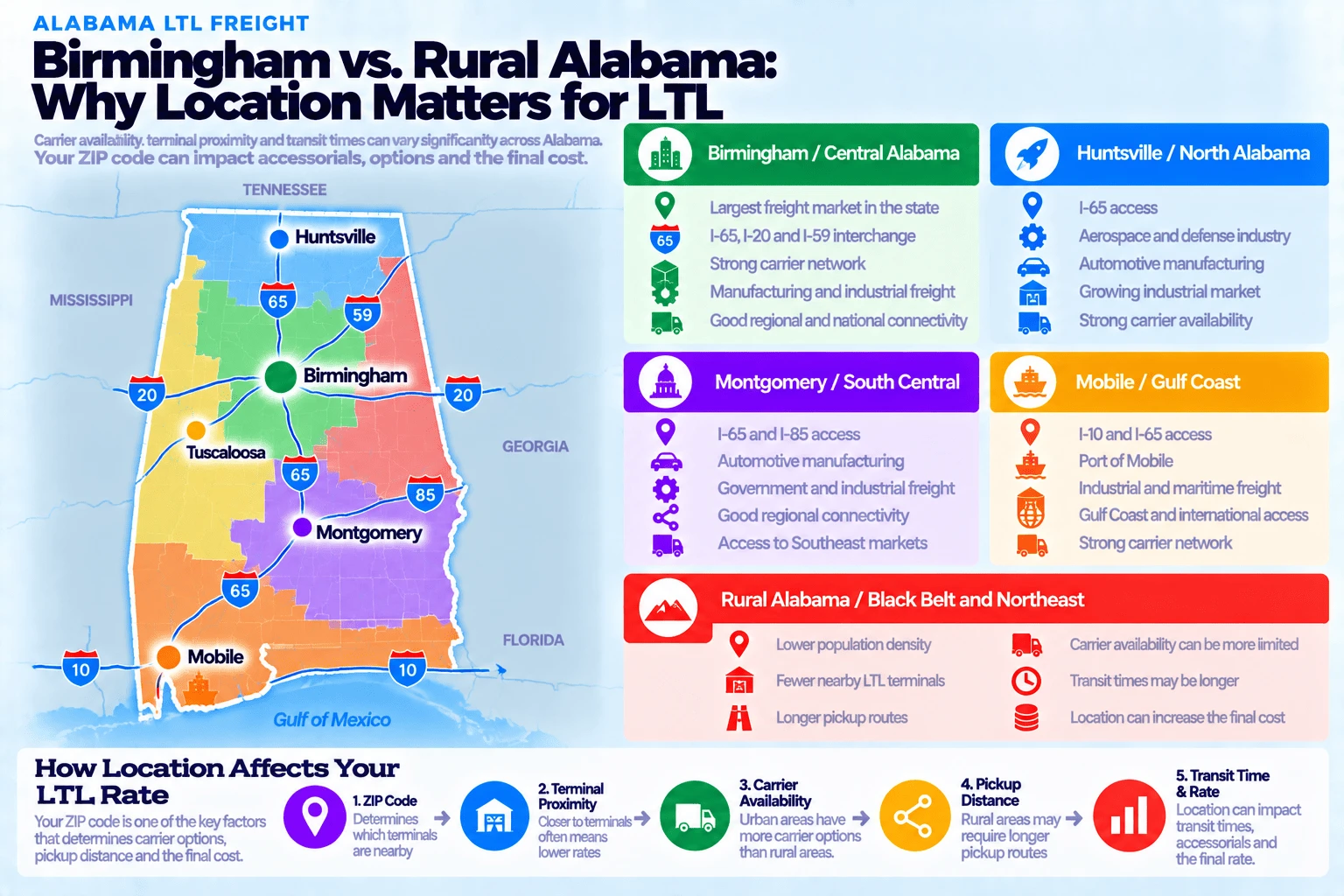
- Birmingham & central Alabama — the state’s historic industrial hub and the point where I-65, I-20, and I-59 converge, giving it the deepest carrier network in the state.
- Huntsville & north Alabama — one of the fastest-growing cities in the country, anchored by Redstone Arsenal, NASA, and a booming auto and aerospace manufacturing base.
- Mobile & the Gulf Coast — home to Alabama’s only deepwater port, with real hurricane exposure during the summer and fall.
- Montgomery — the state capital, anchored by Hyundai’s assembly plant, with solid regional coverage along I-65 and I-85.
- Rural Alabama & the Black Belt — the thinnest coverage in the state: fewer terminals, longer pickup routes, and real tornado risk that can slow transit, especially overnight.
Weather and transit reliability
Alabama sits within Dixie Alley, a secondary tornado corridor distinct from the Great Plains’ Tornado Alley, and the state consistently ranks among the top five in the nation for tornado frequency and fatalities. The risk is genuinely different here than out west: roughly 30% of Alabama’s tornadoes strike after dark, compared to about 15% in classic Tornado Alley states like Kansas and Oklahoma, and nighttime tornadoes are roughly two-and-a-half times more likely to be fatal — a real factor for overnight freight movement. The Gulf Coast around Mobile adds hurricane risk on top of that; Hurricane Sally made landfall near Gulf Shores in 2020, and Hurricane Ivan did the same in 2004, both causing significant regional disruption. Given how much of Alabama’s freight moves along the I-65 corridor, a single major storm can meaningfully slow shipments across the state.
Sample Alabama LTL rates by route
Real quotes pulled from our platform for six different Alabama lanes — same process, different carriers each time, spanning a huge range of weights and distances. Rates shift with capacity and fuel costs, so treat these as a snapshot rather than a guarantee for your shipment; get an instant quote for your exact route.
Real quotes by route
Snapshot taken over recent weeks — carriers and pricing change daily.
| Carrier | Service | Transit | Price |
|---|---|---|---|
| ABF Freight | Standard | 4 days | $505.11 |
| Warp | Standard | 5 days | $531.58 |
| AAA Cooper Transportation | Standard | 4 days | $534.89 |
| FedEx Freight Economy | Standard | 5 days | $549.96 |
| Forward Air | Standard | 4 days | $550.28 |
| Carrier | Service | Transit | Price |
|---|---|---|---|
| ABF Freight | Standard | 4 days | $447.95 |
| FedEx Freight Economy | Standard | 2 days | $553.26 |
| Southeastern Freight Lines | STD | 1 day | $582.42 |
| R+L Carriers | STD | 1 day | $584.26 |
| AAA Cooper Transportation | Standard | 1 day | $642.03 |
| Carrier | Service | Transit | Price |
|---|---|---|---|
| Central Transport | Standard | 3 days | $333.81 |
| Averitt | Standard | 3 days | $335.53 |
| FedEx Freight Economy | Standard | 3 days | $362.90 |
| Pitt Ohio | Standard | 3 days | $366.82 |
| R+L Carriers | Standard | 2 days | $372.90 |
| Carrier | Service | Transit | Price |
|---|---|---|---|
| Southeastern Freight Lines | Standard | 6 days | $402.70 |
| XPO | Standard | 7 days | $448.32 |
| AAA Cooper Transportation | Standard | 6 days | $523.31 |
| TForce Freight | Standard | 7 days | $538.39 |
| Old Dominion Freight Line | Standard | 5 days | $558.52 |
| Carrier | Service | Transit | Price |
|---|---|---|---|
| AAA Cooper Transportation | Standard | 2 days | $456.62 |
| Southeastern Freight Lines | Standard | 1 day | $502.40 |
| Estes | LTL Standard Transit | 3 days | $604.48 |
| TForce Freight | STD | 2 days | $615.27 |
| FedEx Freight Economy | Standard | 4 days | $647.71 |
| Carrier | Service | Transit | Price |
|---|---|---|---|
| Central Transport | Standard | 3 days | $268.89 |
| TForce Freight | Standard | 3 days | $293.84 |
| FedEx Freight Economy | Standard | 4 days | $342.21 |
| R+L Carriers | Standard | 2 days | $345.14 |
| Forward Air | Standard | 3 days | $348.71 |
Rate, transit, and price-per-mile summary
Pulling the six lanes above together, one short regional haul stands out from everything else in the data:
| Route | Distance | Weight | Price range | Transit range | Price per mile |
|---|---|---|---|---|---|
| Huntsville, AL → Fontana, CA | 1,961 mi | 129 lb | $505–$550 | 4–5 days | $0.26–$0.28 |
| Lawrenceville, GA → Huntsville, AL | 199 mi | 35 lb | $448–$642 | 1–4 days | $2.25–$3.23 |
| Martinsburg, WV → Brent, AL | 756 mi | 300 lb | $334–$373 | 2–3 days | $0.44–$0.49 |
| Tuscaloosa, AL → The Dalles, OR | 2,402 mi | 350 lb | $403–$559 | 5–7 days | $0.17–$0.23 |
| Hamilton, AL → Jacksonville, FL | 550 mi | 700 lb | $457–$648 | 1–4 days | $0.83–$1.18 |
| Newark, NJ → Prattville, AL | 1,027 mi | 212 lb | $269–$349 | 2–4 days | $0.26–$0.34 |
Lawrenceville to Huntsville is the extreme outlier: at just 199 miles, it’s the shortest lane in this data, yet it prices at $2.25–$3.23 per mile — by far the highest rate here, and several times higher than every other lane. At only 35 lbs, this shipment is almost certainly running into minimum-charge pricing, where a short regional hop simply can’t spread its fixed handling cost over enough miles to compete on a per-mile basis. Compare that to the opposite extreme: Tuscaloosa to The Dalles, Oregon, the single longest lane in this data at 2,402 miles, which prices at just $0.17–$0.23 per mile — the cheapest rate here by a wide margin, a clean example of long-haul efficiency. Hamilton to Jacksonville is a useful middle case: a real 700 lb shipment over 550 miles still lands at a relatively high $0.83–$1.18 per mile, showing that distance alone doesn’t explain pricing — weight, lane density, and route length all interact differently lane to lane.
What a real Alabama LTL quote looks like
The screenshot alongside is an actual result from our platform, a 129 lb shipment from Huntsville, AL to Fontana, CA, compared across 40 real carrier options in seconds, the same lane featured in the rate table above.
- 40 real carrier options compared for this single Huntsville-to-Fontana shipment, not just one broker’s in-house rate.
- $505.11–$550.28 for the exact same 129 lb load, depending on carrier, a reminder that comparing multiple carriers on every shipment is worth the time.
- 4–5 day transit across these carriers, so the cheapest option isn’t always the slowest.
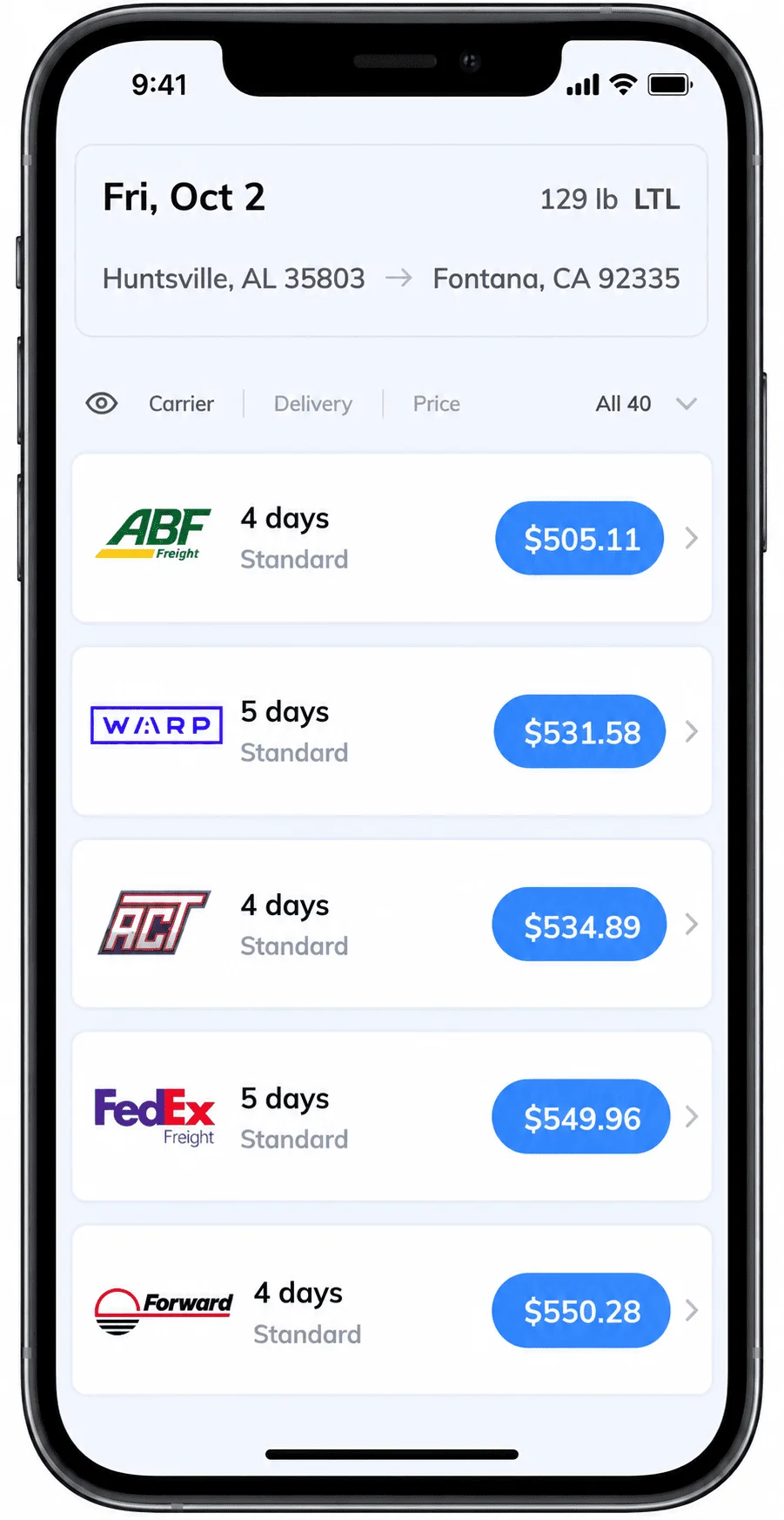
Real screenshot from a live Transportli quote for Huntsville, AL to Fontana, CA, individual results vary by shipment and date.
Major shipping hubs in Alabama
Alabama’s carrier terminal network is concentrated around a handful of metro areas, which generally means faster pickup windows and more carrier options the closer you are to one of these:
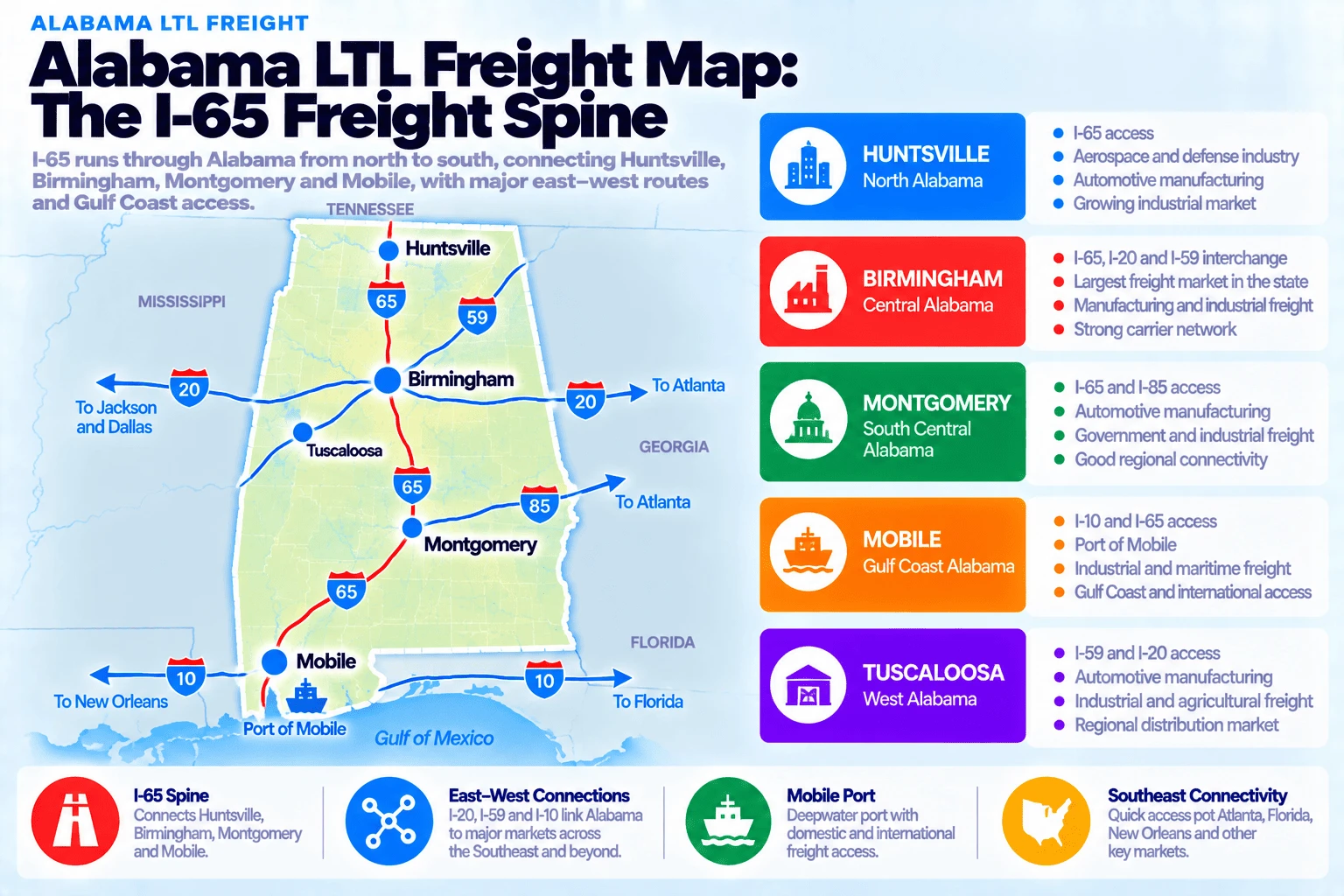
- Birmingham — Alabama’s historic steel city, founded in 1871 at one of the only places on Earth with large deposits of all three steelmaking raw materials — coal, iron ore, and limestone — within close reach of each other; today the state’s central freight interchange, where I-65, I-20, and I-59 converge.
- Huntsville — “Rocket City,” home to Redstone Arsenal and NASA’s Marshall Space Flight Center, and now Alabama’s largest city by population; a growing hub for aerospace, defense, and automotive manufacturing, including a Mazda Toyota joint-venture plant.
- Mobile — Alabama’s only deepwater port, handling container, bulk, and heavy-lift cargo, and the southern end of the Tennessee-Tombigbee Waterway.
- Montgomery — the state capital and home to Hyundai’s major assembly plant, sitting at the junction of I-65 and I-85.
- Tuscaloosa — home to Mercedes-Benz U.S. International, Mercedes’ first-ever passenger-vehicle plant built outside Germany.
Highway corridors serving Alabama
I-65 is Alabama’s primary freight spine, running the length of the state from Huntsville through Birmingham and Montgomery down to Mobile — 366 miles connecting six of the state’s ten largest cities. I-20 and I-59 run concurrently through Birmingham, with I-59 continuing toward Tuscaloosa and I-20 heading east to Atlanta. I-10 is the coastal east-west corridor through Mobile, linking the Gulf Coast to Louisiana and the Florida Panhandle. I-85 connects Montgomery to Atlanta, a key corridor for auto-supply-chain traffic. Birmingham, where I-65, I-20, and I-59 all meet, is Alabama’s single busiest freight interchange.
Why Alabama’s auto manufacturing boom matters for freight
Alabama has quietly become one of the Southeast’s biggest auto-manufacturing states. Mercedes-Benz built its first-ever passenger-vehicle plant outside Germany in Tuscaloosa County, opening in 1997 and announcing a further $4 billion investment as of early 2026; Hyundai’s Montgomery plant has built more than 6.2 million vehicles since 2005; Honda’s Lincoln plant and the Mazda Toyota joint-venture plant in Huntsville add still more capacity. Direct automotive manufacturing employment in Alabama now approaches 48,000 people, backed by roughly 150 Tier-1 suppliers and logistics firms employing another 26,000. For LTL freight, that means a genuine, sustained flow of parts, components, and supporting freight moving through the state’s interstate corridors every day.
What Alabama shippers move
Alabama’s freight mix runs from heavy manufacturing to agriculture and maritime cargo. Automotive is the standout: between Mercedes-Benz, Hyundai, Honda, and the Mazda Toyota joint venture, Alabama builds vehicles for several of the world’s major brands, backed by a deep supplier network. Huntsville’s aerospace and defense sector is just as distinctive — Redstone Arsenal and NASA’s Marshall Space Flight Center anchor a cluster that includes United Launch Alliance’s rocket factory in nearby Decatur, where finished Vulcan Centaur rocket boosters are built and shipped out as genuine oversize freight. Poultry is Alabama’s #1 agricultural industry, a $15.1 billion business employing 86,000+ people and ranking #2 nationally in birds produced. The Port of Mobile, Alabama’s only deepwater port, ranks among the nation’s top 10 by tonnage and connects to the 234-mile Tennessee-Tombigbee Waterway, which shortens shipping routes into the inland river system by more than 800 miles. And Birmingham’s steel industry, born in 1871 at one of the only places on Earth with coal, iron ore, and limestone all within reach of each other, still runs today through modern mini-mills even after the historic integrated mills closed.
Alabama LTL freight: frequently asked questions
How much does LTL shipping cost to or from Alabama?
It depends heavily on distance, weight, and how short or long the haul is. Real Alabama lanes in our data ranged from about $269 for a 1,027-mile shipment into Prattville up to $642 for a tiny 35 lb shipment running just 199 miles from Lawrenceville, GA to Huntsville — that short regional lane priced at $2.25–$3.23 per mile, by far the highest rate we saw, since minimum-charge pricing kicks in hard on short, light shipments. Get an instant quote for your exact shipment.
Do oversized LTL shipments need a permit in Alabama?
Yes, for loads exceeding 8.5 feet wide, 13.5 feet high, 57 feet long in combination, or 80,000 lbs gross. The Alabama DOT issues permits, and most standard LTL freight falls well within these limits — the main exception is oversized manufacturing, automotive, and aerospace freight moving out of places like Huntsville and Tuscaloosa.
Why does Alabama’s auto manufacturing boom matter for freight?
Alabama is now home to four major auto assembly plants — Mercedes-Benz in Tuscaloosa, Hyundai in Montgomery, Honda in Lincoln, and a Mazda Toyota joint venture in Huntsville — backed by roughly 150 Tier-1 suppliers. Direct automotive manufacturing employment approaches 48,000 people, driving a genuine, sustained flow of parts and supporting freight through the state’s interstate corridors.
Which carriers serve Alabama?
Most major national LTL carriers serve Alabama, with the deepest coverage around Birmingham, at the junction of I-65, I-20, and I-59. Rural areas and the Black Belt region see noticeably thinner coverage, and availability and pricing vary by exact route.
Is LTL service the same everywhere in Alabama?
No. Birmingham has by far the strongest LTL coverage in the state, thanks to its position at the convergence of three interstates. Huntsville, Montgomery, and Mobile see solid regional coverage, while rural Alabama and the Black Belt see meaningfully fewer carrier options and longer transit times.
Is Alabama really one of the most tornado-prone states?
Yes. Alabama sits within Dixie Alley, a secondary tornado corridor, and consistently ranks among the top five states nationally for tornado frequency and fatalities. Roughly 30% of Alabama’s tornadoes strike after dark, compared to about 15% in classic Tornado Alley states, and nighttime tornadoes are roughly two-and-a-half times more likely to be fatal — a real factor for overnight freight movement.