

Shipping LTL freight to or from Ohio? Rates depend on your specific route, freight class, and how close your pickup or delivery point is to the nearest LTL terminal. Ohio is one of the most logistics-dense states in the country — within a single day’s drive of half of North America’s population and 70% of its manufacturing capacity, anchored by a genuine inland port outside Columbus and Amazon’s global air cargo hub just across the river from Cincinnati. Here’s what actually affects your rate. You can also compare live LTL freight rates across carriers.
LTL trucking regulations in Ohio
Standard interstate trucking limits apply in Ohio: 80,000 lbs gross vehicle weight, 53 feet trailer length, 8.5 feet width, and 13.5 feet height. Most LTL shipments fall well within these limits — this mainly matters if your freight is unusually large or heavy. Like Pennsylvania and Kansas, Ohio has a real split between its state DOT and a separate turnpike authority:
- ODOT issues standard oversize/overweight permits for state and interstate highways outside the turnpike system.
- The Ohio Turnpike and Infrastructure Commission requires its own separate Special Hauling Permit for anything oversized or overweight on the turnpike itself (I-80/I-90 across northern Ohio) — issued per one-way trip only, with no annual or blanket permits available. Its dimension and weight thresholds also differ from ODOT’s: loads over 11 feet wide or 112 feet long need a pilot car and prior authorization, and gross weight up to 90,000 lbs — 10,000 lbs above the standard federal limit — is allowed with two days’ notice.
Current turnpike permit rules and fees are public record:
Ohio Turnpike Special Hauling Permit FAQ →
What affects your Ohio LTL rate
- Freight class — density, handling, and liability determine your NMFC class, the single biggest factor in your rate. See our freight class guide.
- Distance — Ohio’s three major metros (Cleveland, Columbus, Cincinnati) sit along the I-71 corridor, so a shipment can be a short regional move or a genuine cross-state haul depending on where it starts and ends.
- Terminal proximity — pickup or delivery points near Columbus, Cincinnati, or Cleveland typically see the most carrier options and fastest transit; rural southeastern Ohio addresses see fewer options and longer routes.
- Accessorials — liftgate, residential, or inside delivery add to the base rate, same as anywhere else.
Did you know?From 6 real Ohio lanes and 30 quotes
-
8× the cost per mile
A short, light shipment cost more per mile than a long, heavy one
A 16 lb shipment moving 347 miles (Goshen, OH to Palatine, IL) had a lowest quote of $441, or $1.27 a mile. A 530 lb shipment moving 2,408 miles (Monroe, WA to Wadsworth, OH) had a lowest quote of $380, or $0.16 a mile.
-
$120 to arrive one day sooner
Saving a day is not free
On Monroe, WA to Wadsworth, OH (2,408 miles, 530 lb), the cheapest quote at $380 took 5 days. The fastest, at 4 days, cost $500. On Goshen, OH to Palatine, IL, 1-day delivery cost $511 against $441 for 2 days.
-
6 carriers had the lowest quote
Six different carriers won six Ohio lanes
ABF Freight, Central Transport, Forward Air, R+L Carriers, Roadrunner, and Saia each had the lowest quote on one lane. Across the lowest quotes on every lane, 15 different carriers appeared.
-
$388 from lowest to fifth-lowest
Same shipment, quotes $388 apart
For 1,750 lb from Missoula, MT to Alliance, OH (1,979 miles), the lowest quote was $596 and the fifth-lowest was $984, a 65% gap. On Ennis, TX to Canal Winchester, OH, all five quotes landed within $19 of each other.

Regional carrier coverage across Ohio
Ohio’s freight geography centers on its “3-C” corridor — Cleveland, Columbus, and Cincinnati — with real coverage differences elsewhere:
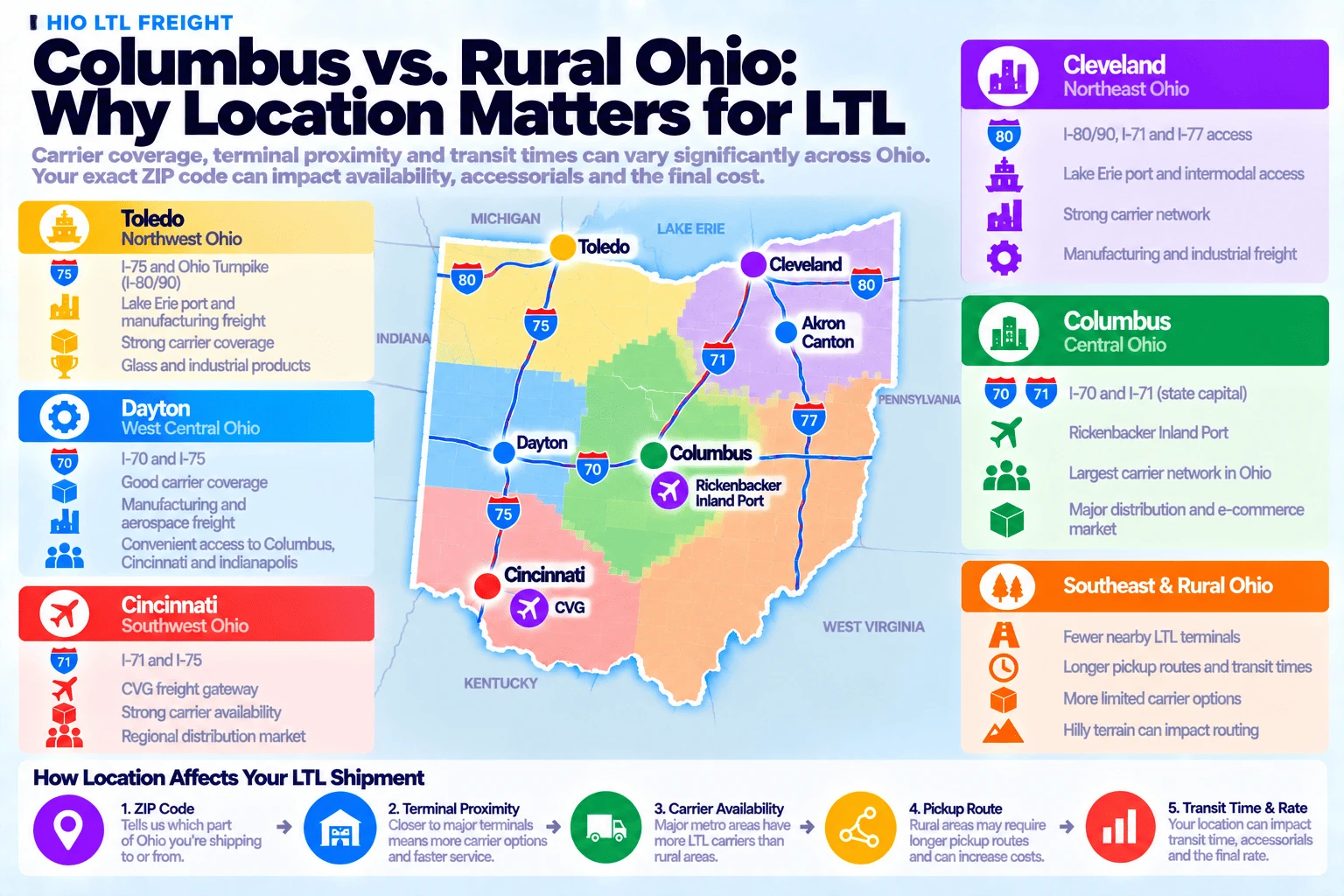
- Columbus & Central Ohio — the deepest carrier network in the state, anchored by the Rickenbacker Inland Port, one of the largest logistics and distribution hubs in the Midwest.
- Cincinnati & Southwest Ohio — a strong second market driven by Amazon’s global air cargo hub just across the Ohio River, with dense carrier coverage.
- Cleveland & Northeast Ohio — a real Great Lakes port market with strong manufacturing freight and direct access to the Ohio Turnpike.
- Toledo & Northwest Ohio — a secondary Great Lakes port market with solid carrier coverage tied to manufacturing and glass industry freight.
- Rural southeastern Ohio — the thinnest coverage in the state: fewer terminals, longer pickup routes, and transit times that can run behind the 3-C corridor.
Weather and transit reliability
Northern Ohio, especially the Cleveland and Toledo areas along Lake Erie, sits in a real lake-effect snow belt each winter, capable of dumping heavy localized snow totals with little warning. The Ohio Turnpike sees routine winter slowdowns and occasional closures during major lake-effect events. Southern Ohio sees less lake-effect snow but real severe thunderstorm and tornado risk in spring, particularly in the Miami Valley around Dayton. Build in extra buffer time for winter shipments moving along the Turnpike or through the Cleveland-Toledo corridor specifically.
Sample Ohio LTL rates by route
Real quotes pulled from our platform for six different Ohio lanes — same process, different carriers each time, spanning a huge range of weights and distances. Rates shift with capacity and fuel costs, so treat these as a snapshot rather than a guarantee for your shipment; get an instant quote for your exact route.
Real quotes by route
Snapshot taken over recent weeks — carriers and pricing change daily.
| Carrier | Service | Transit | Price |
|---|---|---|---|
| Central Transport | STD | 3 days | $341.60 |
| Roadrunner Freight | STD | 3 days | $349.54 |
| FedEx Freight Economy | Standard | 6 days | $352.47 |
| Daylight Transport | STD | 3 days | $358.24 |
| R+L Carriers | STD | 2 days | $360.82 |
| Carrier | Service | Transit | Price |
|---|---|---|---|
| Forward Air | Standard | 3 days | $557.78 |
| Estes | LTL Standard Transit | 2 days | $599.02 |
| ABF Freight | Standard | 5 days | $604.48 |
| XPO | STD | 3 days | $612.59 |
| TForce Freight | STD | 7 days | $637.52 |
| Carrier | Service | Transit | Price |
|---|---|---|---|
| Saia | Standard | 4 days | $596.11 |
| Old Dominion Freight Line | Standard | 5 days | $706.74 |
| FedEx Freight Economy | Standard | 4 days | $811.48 |
| Estes | LTL Standard Transit | 5 days | $893.93 |
| XPO | Standard | 4 days | $983.98 |
| Carrier | Service | Transit | Price |
|---|---|---|---|
| R+L Carriers | Standard | 2 days | $390.00 |
| Southeastern Freight Lines | Standard | 3 days | $431.04 |
| Central Transport | Standard | 3 days | $461.62 |
| TForce Freight | STD | 5 days | $463.32 |
| ABF Freight | Standard | 3 days | $465.97 |
| Carrier | Service | Transit | Price |
|---|---|---|---|
| Roadrunner Freight | STD | 5 days | $379.74 |
| TForce Freight | STD | 5 days | $442.54 |
| Central Transport | STD | 6 days | $467.62 |
| Estes | LTL Standard Transit | 5 days | $498.20 |
| XPO | Standard | 4 days | $499.58 |
| Carrier | Service | Transit | Price |
|---|---|---|---|
| ABF Freight | Standard | 2 days | $441.28 |
| Estes | LTL Standard Transit | 1 day | $510.86 |
| Roadrunner Freight | Standard Service | 2 days | $536.76 |
| Pitt Ohio | Standard | 1 day | $542.68 |
| Ward Transport & Logistics | Standard | 1 day | $569.59 |
Rate, transit, and price-per-mile summary
Pulling the six lanes above together, distance is the clearest driver of price per mile in this data — more than weight, and by a wide margin:
| Route | Distance | Weight | Price range | Transit range | Price per mile |
|---|---|---|---|---|---|
| Ennis, TX → Canal Winchester, OH | 1,077 mi | 125 lb | $342–$361 | 2–6 days | $0.32–$0.34 |
| Columbus, OH → Navarre, FL | 831 mi | 91 lb | $558–$638 | 2–7 days | $0.67–$0.77 |
| Missoula, MT → Alliance, OH | 1,979 mi | 1,750 lb | $596–$984 | 4–5 days | $0.30–$0.50 |
| North Augusta, SC → Fredericksburg, OH | 620 mi | 2,310 lb | $390–$466 | 2–5 days | $0.63–$0.75 |
| Monroe, WA → Wadsworth, OH | 2,408 mi | 530 lb | $380–$500 | 4–6 days | $0.16–$0.21 |
| Goshen, OH → Palatine, IL | 347 mi | 16 lb | $441–$570 | 1–2 days | $1.27–$1.64 |
Line these six lanes up by distance and the price-per-mile pattern is almost perfectly ordered: the shortest lane, Goshen to Palatine at 347 miles, is the most expensive per mile at $1.27-$1.64, despite carrying just 16 lbs — about as light as LTL freight gets. The longest lane, Monroe to Wadsworth at 2,408 miles, is the cheapest at $0.16-$0.21 per mile, even though it’s carrying over 30 times more weight. Weight alone doesn’t explain the middle of the table either: North Augusta to Fredericksburg is the heaviest lane here at 2,310 lbs, but at a relatively short 620 miles it still prices in the same $0.63-$0.75 range as the much lighter, similarly-short Columbus-to-Navarre lane. The clear read is that in this data, how far a shipment travels predicts its price per mile far more reliably than how much it weighs — short Ohio lanes carry a real minimum-charge premium regardless of what’s on the pallet.
Major shipping hubs in Ohio
Ohio’s carrier terminal network is concentrated around a handful of metro areas, which generally means faster pickup windows and more carrier options the closer you are to one of these:
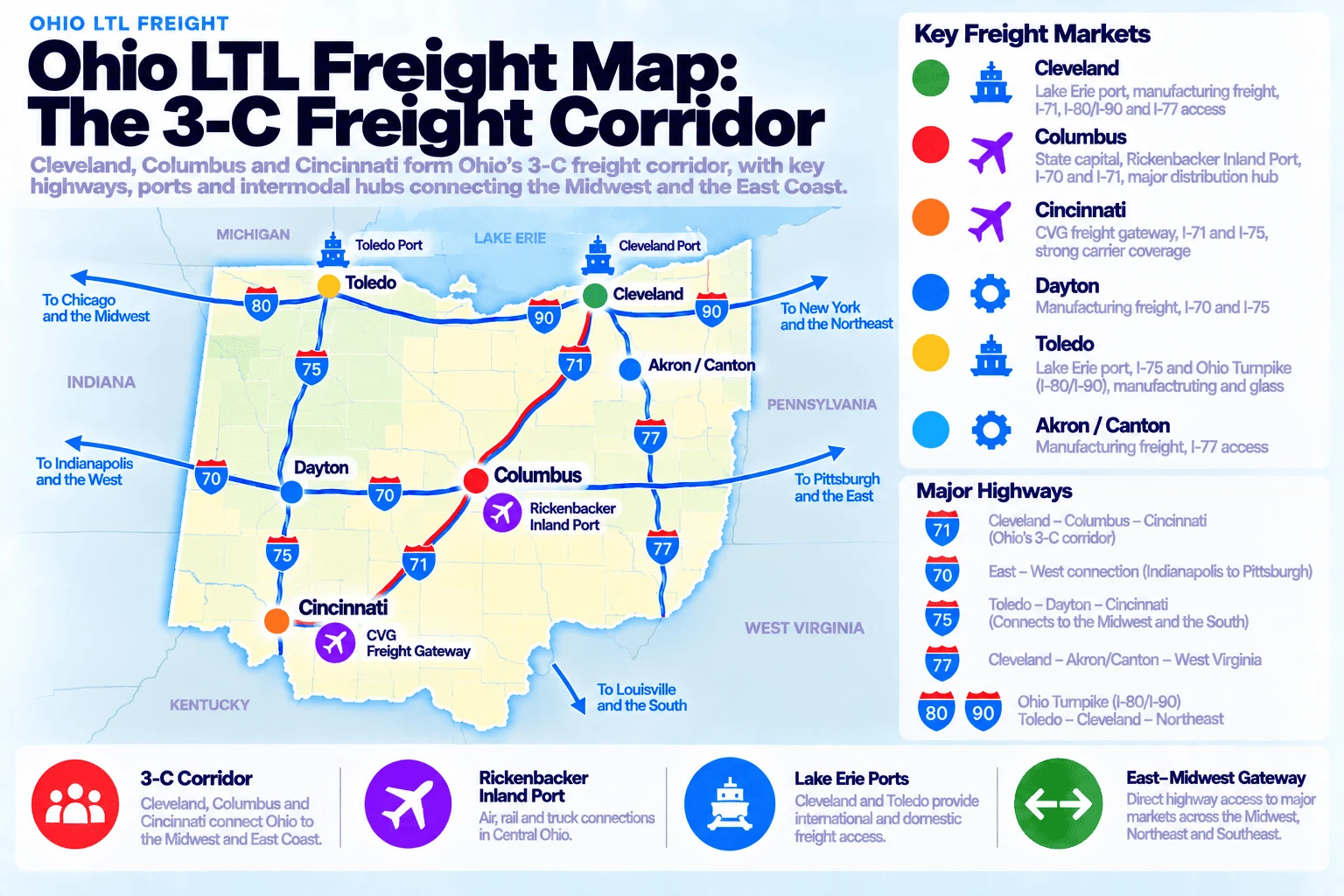
- Columbus — the state’s primary freight gateway, home to the Rickenbacker Inland Port, a genuine hybrid hub combining one of the only cargo-dedicated airports in the world with Norfolk Southern’s 175-acre intermodal terminal (400,000+ containers a year) and CSX’s 671-acre Rickenbacker South Industrial Rail Park.
- Cincinnati — home to Amazon Air’s global cargo hub, a $1.5 billion, 800,000 sq ft facility just across the Ohio River at CVG airport, ranked the 6th-largest cargo airport in North America by the FAA.
- Cleveland — a major Great Lakes port on Lake Erie with a deep manufacturing base and direct Ohio Turnpike access.
- Toledo — another real Great Lakes port, historically known as the “Glass City” for its concentration of glass manufacturers.
- Akron — the historic “Rubber Capital of the World,” birthplace of Goodyear and still home to major tire and polymer manufacturing.
Highway corridors serving Ohio
I-71 is Ohio’s primary freight spine, connecting Cleveland, Columbus, and Cincinnati in a straight diagonal line across the state. The Ohio Turnpike (I-80/I-90) crosses the entire northern part of the state, carrying freight between Chicago and the Northeast. I-70 runs east-west through Columbus and Dayton, connecting Pittsburgh to Indianapolis. I-75 runs north-south through Toledo, Dayton, and Cincinnati, part of the larger Michigan-to-Florida corridor. I-77 connects Cleveland south through Akron and Canton toward West Virginia. Ohio has the nation’s 10th-largest highway network, and nearly every major East-Midwest freight route touches the state somewhere.
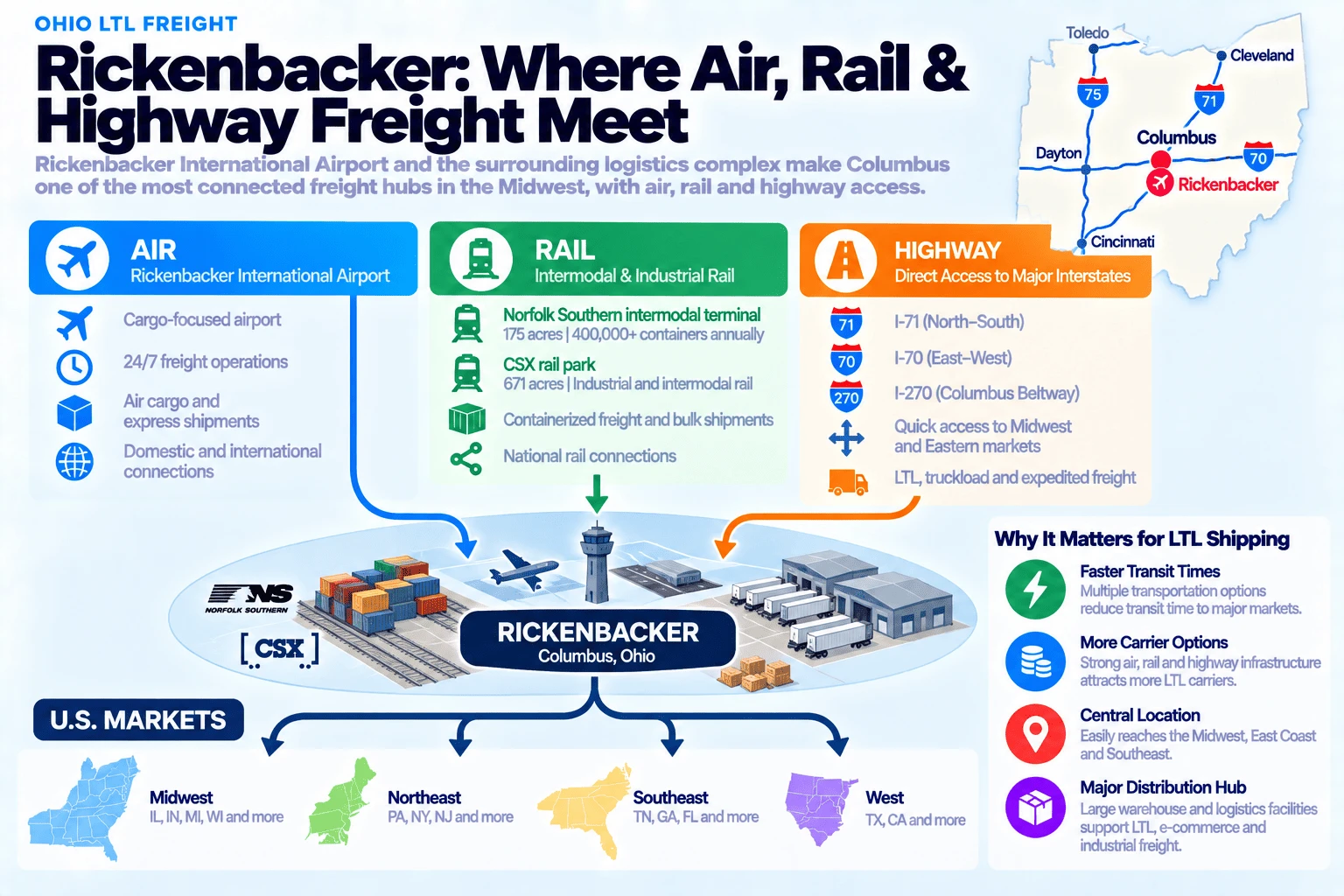
Why Rickenbacker makes Columbus a genuine inland port
Rickenbacker International Airport is one of the only cargo-dedicated airports in the world — no passenger terminal, just freight, around the clock. Around it, Norfolk Southern operates a 175-acre intermodal terminal handling more than 400,000 containers a year, with room to grow the surrounding industrial base to 70 million square feet, while CSX runs a separate 671-acre rail park next door. Combined, the Rickenbacker area is Ohio’s largest industrial submarket and accounts for roughly a quarter of all of Columbus’s industrial real estate. The whole complex sits within a one-day truck drive of nearly half of North America’s population and a third of Canada’s, which is exactly why Foreign Trade Zone 138 moved over $10 billion in goods through the area in a single recent year. For Ohio LTL freight, that means genuine air-rail-highway convergence in one place — a combination few other Midwest metros can match.
What Ohio shippers move
Ohio’s freight mix reflects a genuinely diverse, logistics-heavy economy. Columbus’s Rickenbacker Inland Port drives enormous volumes of e-commerce, retail, and consumer-goods distribution freight, while Cincinnati’s Amazon Air hub adds a real air-cargo dimension just across the river. Ohio’s Lake Erie ports at Cleveland and Toledo generate steady manufacturing and bulk freight, and the state’s industrial heritage still runs deep: Akron remains a center of tire and polymer manufacturing as the historic “Rubber Capital of the World,” and Toledo’s glass industry — Owens Corning, Owens-Illinois, and Libbey Glass are all still headquartered there — keeps specialized glass and industrial freight moving. Add in Ohio’s overall status as one of the most logistics-central states in the country, within a day’s drive of half the US population, and the state generates freight demand that runs well beyond what any single industry could explain.
Quick facts
- Goshen, OH to Palatine, IL priced $1.27–$1.64 per mile — the highest rate in our data, despite being the shortest lane at just 347 miles
- Monroe, WA to Wadsworth, OH priced as low as $0.16 per mile over 2,408 miles — the clearest long-haul efficiency example in our Ohio data
- Distance, more than weight, was the single biggest driver of price per mile across all six real Ohio lanes we quoted
Ohio LTL freight: frequently asked questions
How much does LTL shipping cost to or from Ohio?
It depends heavily on distance — more than weight. Real Ohio lanes in our data ranged from about $342 for a long-haul shipment out of Texas up to $984 for a heavier haul from Montana, but the priciest lane per mile was actually the shortest one, a 16 lb shipment covering just 347 miles to Illinois, since minimum handling charges apply regardless of distance or how little the shipment weighs. Get an instant quote for your exact shipment.
Do oversized LTL shipments need a permit in Ohio?
Only if your load exceeds the standard interstate limits (80,000 lbs, 53 feet long, 8.5 feet wide, 13.5 feet tall). Ohio requires separate permits from two authorities: ODOT for state highways, and the Ohio Turnpike and Infrastructure Commission for the turnpike system (I-80/I-90), which issues single-trip-only permits and allows gross weights up to 90,000 lbs with two days’ notice.
Why is Ohio such an important freight state?
Ohio sits within a single day’s drive of 50% of North America’s population and 70% of its manufacturing capacity, anchored by Columbus’s Rickenbacker Inland Port (one of the only cargo-dedicated airports in the world, paired with major Norfolk Southern and CSX intermodal terminals) and Cincinnati’s Amazon Air global cargo hub.
Which carriers serve Ohio?
Most major national LTL carriers serve Ohio, with the deepest coverage around Columbus, Cincinnati, and Cleveland — availability and pricing vary by exact route.
Is LTL service the same everywhere in Ohio?
No. Columbus, Cincinnati, and Cleveland all have strong carrier coverage along the 3-C corridor, but rural southeastern Ohio sees meaningfully fewer carrier options and longer transit times.
What makes Rickenbacker such a big deal for Ohio freight?
Rickenbacker International Airport is one of the only cargo-dedicated airports in the world, paired with a 175-acre Norfolk Southern intermodal terminal handling over 400,000 containers a year and a separate 671-acre CSX rail park. That air-rail-highway combination, within a day’s drive of half of North America, makes it Ohio’s largest industrial submarket.