

Shipping LTL freight to or from Arkansas? Rates depend on your specific route, freight class, and how close your pickup or delivery point is to the nearest LTL terminal. Arkansas is a genuinely distinctive freight state: it’s home to the headquarters of Walmart, the world’s largest retailer, alongside three major national trucking companies — J.B. Hunt, ArcBest/ABF Freight, and PAM Transport — all within about 150 miles of each other. Arkansas also grows roughly half of all the rice produced in the United States, and a 2021 crack in a single Mississippi River bridge near West Memphis backed up over 1,000 barges and disrupted national freight for two months. Here’s what actually affects your rate. You can also compare live LTL freight rates across carriers.
LTL trucking regulations in Arkansas
Arkansas’s oversize/overweight thresholds are close to the federal baseline, with permits issued by the Arkansas Department of Transportation (ArDOT):
- An oversize permit is required for loads exceeding 8.5 feet wide, 13.5 feet high, or 80,000 lbs gross (with standard axle weight caps). Unlike some states, most Arkansas permits cover a single continuous movement rather than a fixed number of days, so plan your route before applying.
- Travel is generally restricted to daylight hours for oversize or overheight loads, though overweight-only loads that stay within standard width and height limits can move around the clock. Escorts are required as loads get wider, taller, or longer, with thresholds that scale by size — exact current escort requirements are best confirmed directly with ArDOT before moving an oversize load.
- Most standard LTL freight falls well within these limits — this mainly matters for the heavy manufacturing and steel freight that regularly moves out of places like Blytheville and the Fort Smith area.
Current permit thresholds and axle limits are public record:
ARDOT Oversize and Overweight Permits →
What affects your Arkansas LTL rate
- Freight class — density, handling, and liability determine your NMFC class, the single biggest factor in your rate. See our freight class guide.
- Distance — Arkansas’s carrier density is heavily concentrated in the northwest corner and along I-40, with real gaps opening up in the eastern Delta and rural south.
- Terminal proximity — pickup or delivery points near Little Rock or Northwest Arkansas typically see the most carrier options and fastest transit; rural areas see noticeably fewer.
- Accessorials — liftgate, residential, or inside delivery add to the base rate, same as anywhere else.
Did you know?From 5 real Arkansas lanes and 25 quotes
-
4× the cost per mile
A short, light shipment cost more per mile than a long, heavy one
A 400 lb shipment moving 502 miles (Lepanto, AR to Orange, TX) had a lowest quote of $570, or $1.13 a mile. A 534 lb shipment moving 972 miles (Montgomery, AL to Little Rock, AR) had a lowest quote of $285, or $0.29 a mile.
-
$66 to arrive one day sooner
Saving a day is not free
On Montgomery, AL to Little Rock, AR (972 miles, 534 lb), the cheapest quote at $285 took 2 days. The fastest, at 1 day, cost $352.
-
$192 from lowest to fifth-lowest
Same shipment, quotes $192 apart
For 2 lb from North Little Rock, AR to Little Rock, AR (582 miles), the lowest quote was $414 and the fifth-lowest was $606, a 46% gap. On White Bluff, TN to Fayetteville, AR, all five quotes landed within $40 of each other.

Regional carrier coverage across Arkansas
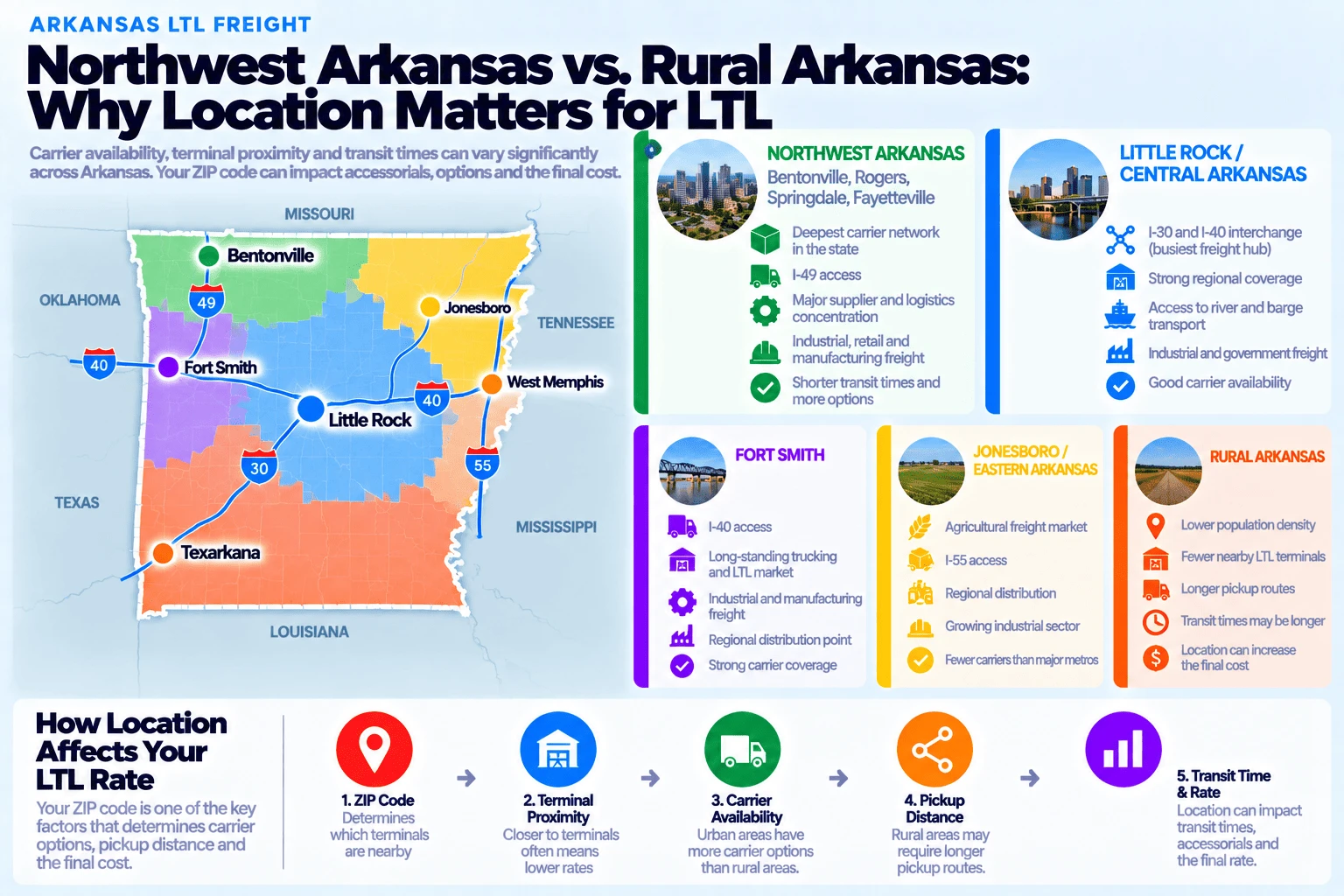
Arkansas’s freight geography splits between the booming northwest corner and the rest of the state, with real coverage differences elsewhere:
- Northwest Arkansas (Bentonville, Rogers, Springdale, Fayetteville) — home to Walmart’s global headquarters and one of the fastest-growing metros in the country; the deepest carrier network in the state, driven by thousands of supplier and logistics companies that need to be near Walmart’s buyers.
- Little Rock & central Arkansas — the state capital and largest metro, sitting at the junction of I-30 and I-40, with strong regional coverage and barge access via the McClellan-Kerr Arkansas River Navigation System.
- Fort Smith — headquarters of ArcBest and its ABF Freight subsidiary, one of the oldest national LTL carriers; solid regional coverage along I-40.
- Jonesboro & the eastern Delta — a regional hub for eastern Arkansas agriculture, with real flood risk from the Mississippi and White Rivers that can disrupt transit.
- Rural south Arkansas & Texarkana — the thinnest coverage in the state: fewer terminals and longer pickup routes outside the I-30 corridor.
Weather and transit reliability
Arkansas sits within Dixie Alley, a secondary tornado corridor that stretches across the mid-South, averaging roughly 33 tornadoes a year with an increasing trend over recent decades. Like much of the Dixie Alley region, a disproportionate share of Arkansas tornadoes strike at night, when they’re roughly two-and-a-half times more likely to be fatal. Eastern Arkansas carries real flood risk too: record White River flooding in May 2011 forced a 23-mile closure of I-40 between Brinkley and Hazen, turning a normal 2-hour Little Rock-to-Memphis run into a roughly 9-hour detour. And freight disruption doesn’t always come from weather — in May 2021, a structural crack in the Hernando de Soto Bridge, one of only two Mississippi River crossings in the Memphis area, shut the bridge to both vehicle and barge traffic for about two months, backing up more than 1,000 barges at its peak. Given how much of Arkansas’s freight funnels through a handful of river crossings and interstate corridors, a single closure — weather or infrastructure — can ripple across the whole region.
Sample Arkansas LTL rates by route
Real quotes pulled from our platform for six different Arkansas lanes — same process, different carriers each time, spanning a huge range of weights and distances. Rates shift with capacity and fuel costs, so treat these as a snapshot rather than a guarantee for your shipment; get an instant quote for your exact route.
Real quotes by route
Snapshot taken over recent weeks — carriers and pricing change daily.
| Carrier | Service | Transit | Price |
|---|---|---|---|
| AAA Cooper Transportation | Standard | 2 days | $365.42 |
| R+L Carriers | STD | 2 days | $396.23 |
| Southeastern Freight Lines | Standard | 2 days | $402.86 |
| Estes | LTL Standard Transit | 2 days | $421.80 |
| XPO | STD | 2 days | $431.84 |
| Carrier | Service | Transit | Price |
|---|---|---|---|
| ABF Freight | Standard | 1 day | $414.15 |
| Estes | LTL Standard Transit | 1 day | $499.53 |
| Forward Air | Standard | 1 day | $516.52 |
| AAA Cooper Transportation | Standard | 1 day | $574.49 |
| Old Dominion Freight Line | Standard | 1 day | $605.89 |
| Carrier | Service | Transit | Price |
|---|---|---|---|
| ABF Freight | Standard | 2 days | $569.63 |
| AAA Cooper Transportation | Standard | 2 days | $598.60 |
| XPO | STD | 3 days | $611.63 |
| Estes | LTL Standard Transit | 3 days | $619.51 |
| TForce Freight | Standard | 3 days | $698.98 |
| Carrier | Service | Transit | Price |
|---|---|---|---|
| AAA Cooper Transportation | Standard | 2 days | $379.02 |
| Central Transport | STD | 3 days | $380.47 |
| XPO | Standard | 2 days | $406.59 |
| FedEx Freight Economy | Standard | 3 days | $414.90 |
| Southeastern Freight Lines | Standard | 2 days | $418.54 |
| Carrier | Service | Transit | Price |
|---|---|---|---|
| AAA Cooper Transportation | Standard | 2 days | $285.46 |
| Southeastern Freight Lines | Standard | 2 days | $326.58 |
| Central Transport | Standard | 3 days | $340.30 |
| FedEx Freight Priority | Freight Priority | 1 day | $351.93 |
| TForce Freight | STD | 3 days | $363.23 |
| Carrier | Service | Transit | Price |
|---|---|---|---|
| AAA Cooper Transportation | Standard | 3 days | $490.61 |
| ABF Freight | Standard | 2 days | $517.31 |
| TForce Freight | STD | 3 days | $574.79 |
| Central Transport | Standard | 3 days | $579.49 |
| FedEx Freight Economy | Standard | 3 days | $588.90 |
Rate, transit, and price-per-mile summary
Pulling the six lanes above together, one ultra-short regional hop stands out from everything else in the data:
| Route | Distance | Weight | Price range | Transit range | Price per mile |
|---|---|---|---|---|---|
| Little Rock, AR → San Antonio, TX | 593 mi | 127 lb | $365–$432 | 2 days | $0.62–$0.73 |
| North Little Rock, AR → Little Rock, AR | 2.2 mi | 2 lb | $414–$606 | 1 day | $188.25–$275.40 |
| Lepanto, AR → Orange, TX | 582 mi | 400 lb | $570–$699 | 2–3 days | $0.98–$1.20 |
| White Bluff, TN → Fayetteville, AR | 502 mi | 1,500 lb | $379–$419 | 2–3 days | $0.75–$0.83 |
| Montgomery, AL → Little Rock, AR | 469 mi | 534 lb | $285–$363 | 1–3 days | $0.61–$0.77 |
| Jacksonville, AR → Denver, CO | 972 mi | 600 lb | $491–$589 | 2–3 days | $0.50–$0.61 |
North Little Rock to Little Rock is the extreme outlier: at just 2.2 miles, it’s barely a cross-town delivery, yet it prices at $188–$275 per mile — a figure that only makes sense once you realize it’s not really being priced by the mile at all. A 2 lb shipment this short runs entirely on minimum-charge pricing, where a carrier’s fixed cost to dispatch a truck and driver has to be covered no matter how little distance is driven. Compare that to the opposite extreme: Jacksonville, Arkansas to Denver, a real 972-mile haul that prices at just $0.50–$0.61 per mile — the cheapest rate in this data by a wide margin, and a clean example of long-haul efficiency on a dense interstate corridor. Lepanto to Orange, Texas sits at the high end of the normal-distance lanes at $0.98–$1.20 per mile, a reminder that rural origin points without heavy carrier density can still price higher than a longer, better-served lane like Jacksonville to Denver.
What a real Arkansas LTL quote looks like
The screenshot alongside is an actual result from our platform, a 127 lb shipment from Little Rock, AR to San Antonio, TX, compared across 41 real carrier options in seconds, the same lane featured in the rate table above.
- 41 real carrier options compared for this single Little Rock-to-San Antonio shipment, not just one broker’s in-house rate.
- $365.42–$431.84 for the exact same 127 lb load, depending on carrier, a reminder that comparing multiple carriers on every shipment is worth the time.
- 2-day transit across all five of the top carriers, so the cheapest option here isn’t a slower tradeoff.
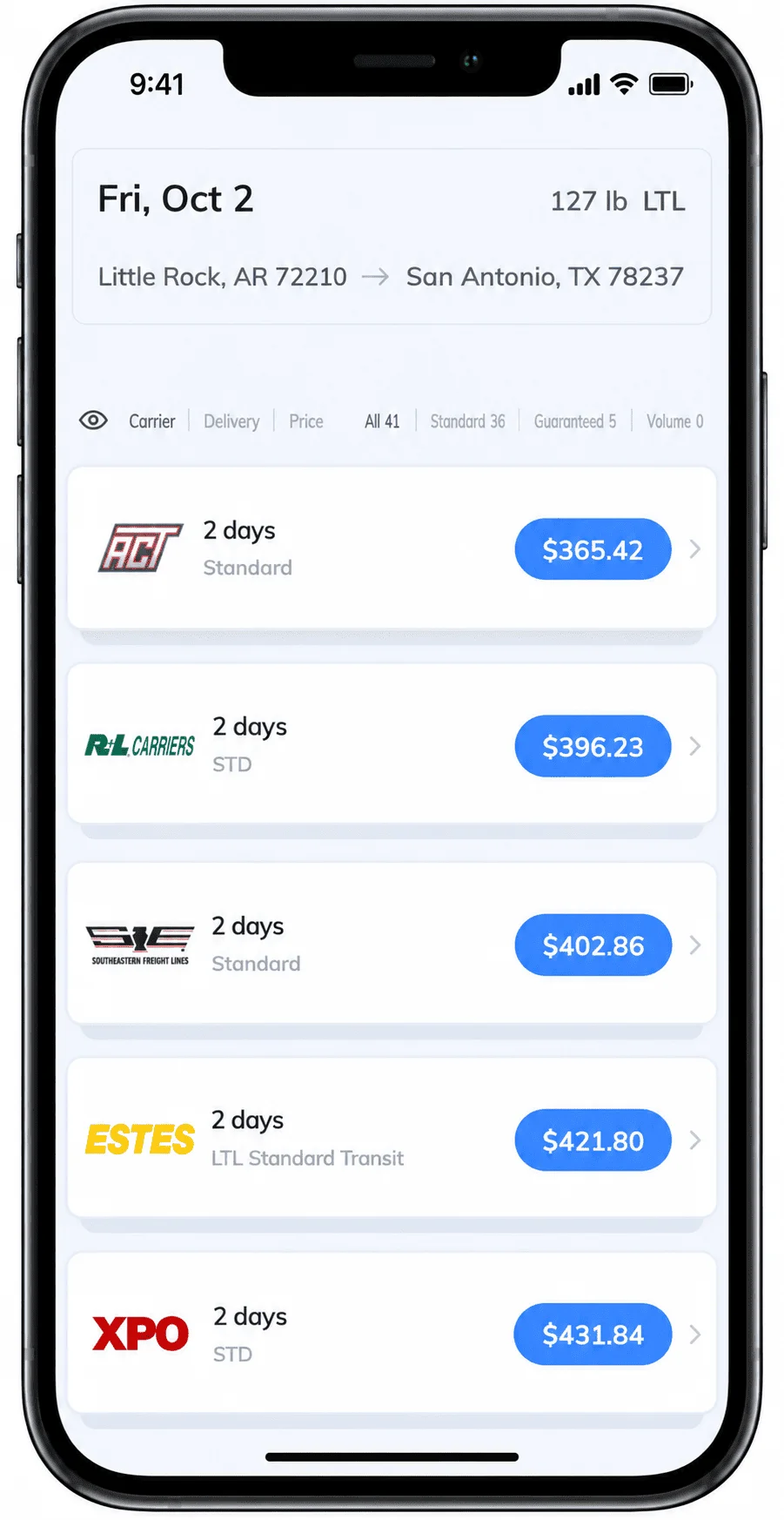
Real screenshot from a live Transportli quote for Little Rock, AR to San Antonio, TX, individual results vary by shipment and date.
Major shipping hubs in Arkansas
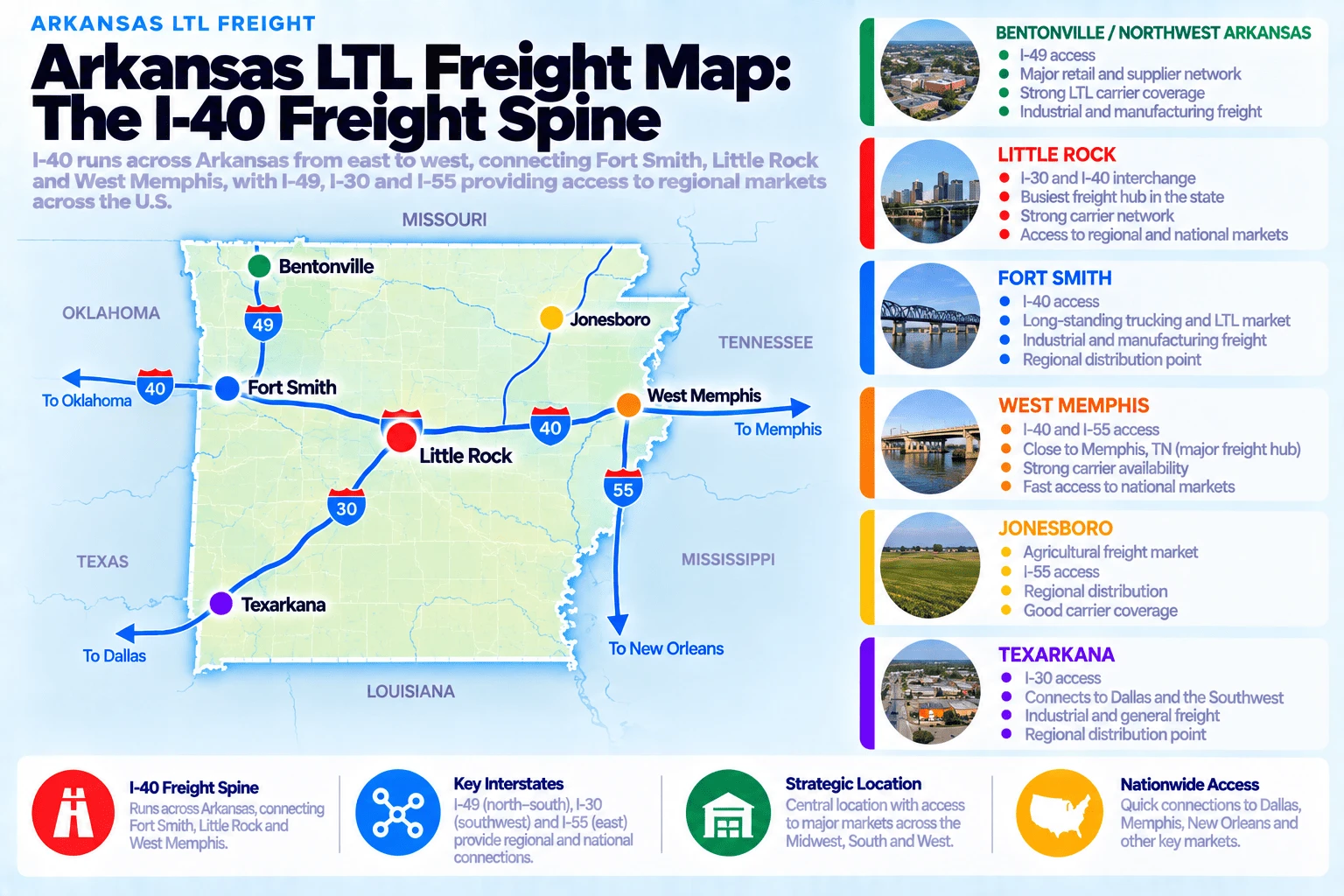
Arkansas’s carrier terminal network is concentrated around a handful of metro areas, which generally means faster pickup windows and more carrier options the closer you are to one of these:
- Bentonville & Northwest Arkansas — home to Walmart’s global headquarters, with well over a thousand supplier and vendor offices clustered nearby to service the relationship; also home to J.B. Hunt Transport Services in neighboring Lowell and Tyson Foods in Springdale.
- Little Rock — the state capital and largest metro, where I-30 and I-40 converge, with barge access to the Mississippi River system via the Port of Little Rock.
- Fort Smith — headquarters of ArcBest Corporation and its ABF Freight subsidiary, founded in 1923 and one of the oldest continuously operating LTL carriers in the country.
- Jonesboro — the commercial center of northeast Arkansas’s agricultural Delta region.
- Texarkana — a genuine interstate gateway city split across the Arkansas-Texas state line, sitting at the junction of I-30 and I-49.
Highway corridors serving Arkansas
I-40 is Arkansas’s primary east-west freight spine, running through Little Rock and Fort Smith and connecting Memphis, Tennessee to Oklahoma City. I-30 runs from North Little Rock southwest to Texarkana and on to Dallas. I-55 covers the eastern Delta, overlapping I-40 briefly at West Memphis on its way to the Mississippi River crossing into Memphis. I-49 is Northwest Arkansas’s newer interstate, running north from I-40 near Alma through Fayetteville, Springdale, Rogers, and Bentonville toward Missouri, with a separate southern segment serving Texarkana. Little Rock, where I-30 and I-40 meet, is Arkansas’s busiest freight interchange.
Why Arkansas has more trucking company headquarters than almost any other state
For a state of about 3 million people, Arkansas has an unusually dense concentration of major trucking companies. J.B. Hunt Transport Services, one of the largest trucking and logistics companies in the country with more than $12 billion in annual revenue, is headquartered in Lowell. ArcBest Corporation and its ABF Freight subsidiary — a major national LTL carrier founded in 1923 — are headquartered in Fort Smith. PAM Transport runs out of Tontitown, also in Northwest Arkansas. All three sit within roughly 150 miles of Walmart’s headquarters in Bentonville and Tyson Foods’ headquarters in Springdale, the same corridor that drew over a thousand Walmart supplier offices to the region. For LTL freight, that means genuine, deep-rooted carrier density in the northwest part of the state that few other regions can match.
What Arkansas shippers move
Arkansas’s freight mix runs from world-leading agriculture to heavy industry. It’s the #1 rice-producing state in the country by a wide margin, growing roughly half of all U.S. rice on its own. Poultry is a major industry too — Tyson Foods, the largest meat company in America, is headquartered in Springdale, and Arkansas ranks among the top handful of broiler-producing states nationally, though Georgia remains the overall leader. Steel is a real freight generator in the northeast corner: Nucor-Yamato Steel in Blytheville has made Mississippi County the single largest steel-producing county in the entire United States. Timber and forestry remain significant too, with Arkansas ranking among the states most economically dependent on forestry and roughly 19 million acres of productive timberland. And the Port of Little Rock, sitting on the 445-mile McClellan-Kerr Arkansas River Navigation System, moves more than 10 million tons of freight a year by barge — a single loaded barge tow can carry roughly as much cargo as 400 semi-trucks.
Get an Arkansas LTL quote
Compare live rates from vetted carriers serving Arkansas.
Get an LTL quote →Arkansas LTL freight: frequently asked questions
How much does LTL shipping cost to or from Arkansas?
It depends on distance, weight, freight class, and how close your pickup or delivery point is to Northwest Arkansas or Little Rock’s deep carrier networks. Real quotes on our platform for normal-distance Arkansas lanes have ranged from about $0.50 to $1.20 per mile, with long interstate hauls pricing cheapest per mile and short regional hops often running into carrier minimum charges instead. Freight moving through the I-40 and I-49 corridors generally prices better than freight into the more remote eastern Delta or rural south. Get an instant quote for your exact shipment.
Do oversized LTL shipments need a permit in Arkansas?
Yes, for loads exceeding 8.5 feet wide, 13.5 feet high, or 80,000 lbs gross. The Arkansas DOT (ArDOT) issues permits, typically covering a single continuous movement rather than a fixed number of days. Most standard LTL freight falls well within these limits.
Why does Arkansas have so many trucking company headquarters?
J.B. Hunt Transport Services (Lowell), ArcBest and ABF Freight (Fort Smith), and PAM Transport (Tontitown) are all headquartered in Arkansas, all within roughly 150 miles of Walmart’s headquarters in Bentonville. That proximity to one of the country’s largest retail supply chains has helped make Northwest Arkansas a genuine trucking and logistics hub.
Which carriers serve Arkansas?
Most major national LTL carriers serve Arkansas, with the deepest coverage around Northwest Arkansas and Little Rock. Rural areas and the eastern Delta see noticeably thinner coverage, and availability and pricing vary by exact route.
Is LTL service the same everywhere in Arkansas?
No. Northwest Arkansas and Little Rock have by far the strongest LTL coverage in the state, backed by major carrier headquarters and dense supplier networks. Fort Smith sees solid regional coverage, while the eastern Delta and rural south see meaningfully fewer carrier options and longer transit times.
Is Arkansas really the top rice-producing state?
Yes, by a wide margin. Arkansas grows roughly 49% of all rice produced in the United States, nearly half the entire national crop, making it the clear #1 rice-producing state in the country.