

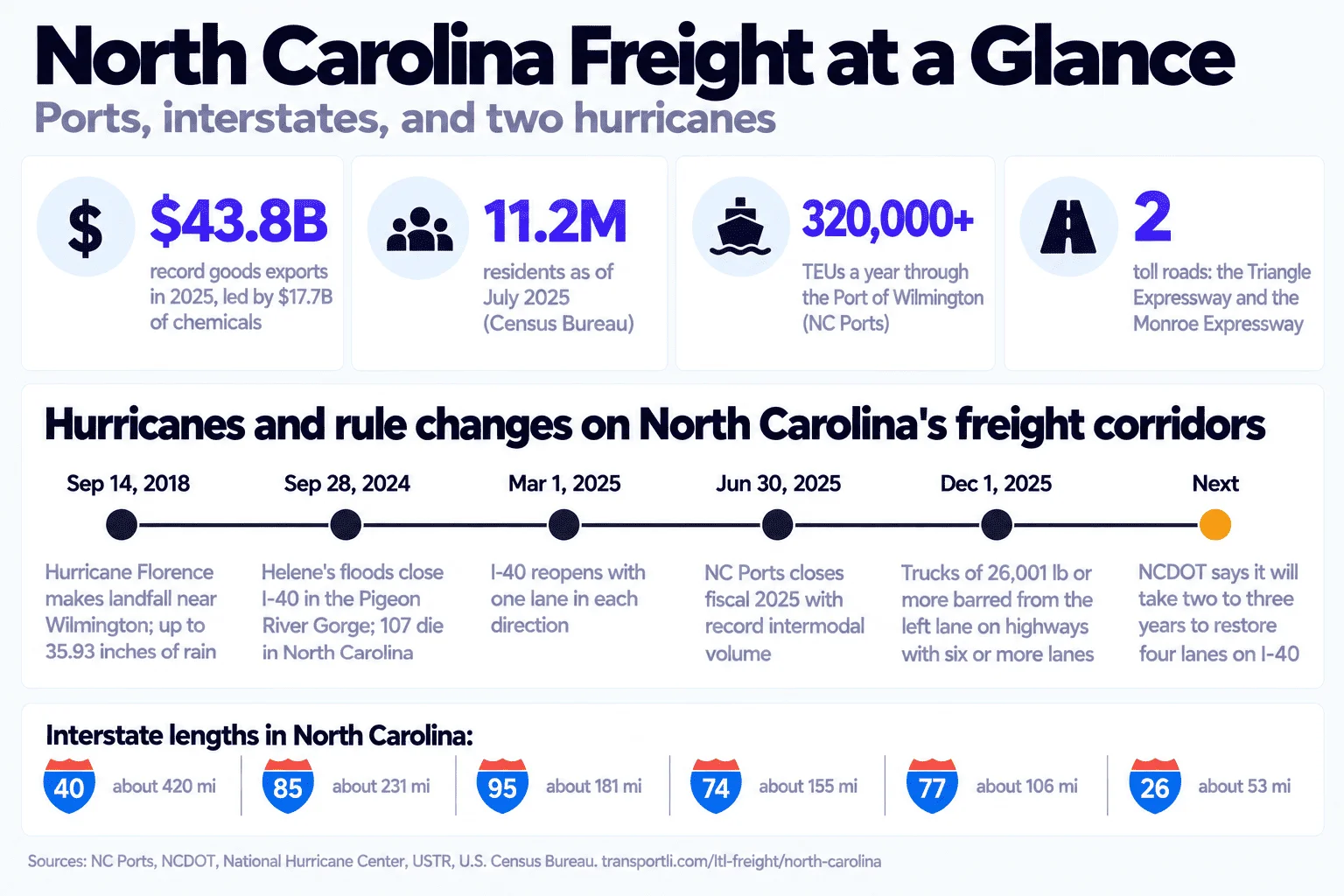
Shipping LTL freight to or from North Carolina? Rates depend on your specific route, freight class, and how close your pickup or delivery point is to the nearest LTL terminal. North Carolina is one of the fastest-growing freight states in the country. It has about 11.2 million residents, exported a record $43.8 billion of goods in 2025, and runs two deep-water ports at Wilmington and Morehead City, an inland port terminal in Charlotte, and the FedEx Express hub at Greensboro. Its interstates, I-40, I-85, I-95, I-77 and I-74, carry freight between the Southeast and the Northeast, and its weather has closed them more than once: Hurricane Helene shut I-40 through the Pigeon River Gorge for about five months. Here’s what actually affects your rate.
LTL trucking regulations in North Carolina
A standard LTL tractor-trailer within legal size and weight limits does not need a permit in North Carolina. Permits matter for oversize or overweight freight, and North Carolina has several rules that are new or unusual:
- Permits come from NCDOT. The Department of Transportation’s Central Permit Office issues oversize and overweight permits. Gross weight is set by the federal bridge formula, with an 80,000 lb maximum on the interstate, and the legal axle limits are 20,000 lbs on a single axle and 38,000 lbs on a tandem axle.
- Single-trip fees are set by statute. NCDOT’s state fee is $12 to $48, plus $3 per 1,000 lbs above 132,000 lbs gross weight. A single-trip permit is valid for 10 calendar days.
- Permit loads move in daylight, Monday to Saturday. NCDOT’s handbook allows general commodities and self-propelled equipment to travel from sunrise to sunset, Monday through Saturday, with no Sunday travel unless the permit says otherwise.
- A new truck left-lane law took effect December 1, 2025. Under House Bill 864 (also Section 17 of Session Law 2025-47), vehicles with a gross vehicle weight rating of 26,001 lbs or more may not use the leftmost lane of a controlled-access highway with six or more lanes, with exceptions for entering or exiting, avoiding a hazard or passing. A violation is an infraction.
- Tractor-trailers cannot use the I-77 Express Lanes in Charlotte. Vehicles with trailers or more than two axles are prohibited from the lanes, so LTL trucks use the general-purpose lanes.
- Tolls are limited to two expressways. The Triangle Expressway (NC 540) near Raleigh-Durham and the Monroe Expressway (Toll US 74) near Charlotte are North Carolina’s toll roads. For a 2-axle vehicle with an NC Quick Pass, a full trip on the original Triangle Expressway costs $4.17 as of January 1, 2026, and a full trip on the Monroe Expressway costs $2.96. Trucks with more axles pay a multiple of those rates.
- Weigh stations. The State Highway Patrol’s Motor Carrier Enforcement section operates 11 interstate weigh stations.
Current permit rules and the handbook are public record:
NCDOT Oversize/Overweight Permit Handbook →
What affects your North Carolina LTL rate
- Freight class — density, handling, and liability determine your NMFC class, the single biggest factor in your rate. See our freight class guide.
- Distance — North Carolina stretches from the Atlantic coast to the Tennessee line, and I-40 alone runs about 420 miles across it, so an in-state lane can take most of a day.
- Mountains vs. piedmont vs. coast — the Charlotte, Triad and Triangle metros are well served by carriers, while the western mountains and the eastern coastal plain typically see fewer terminals and options.
- Terminal proximity — the more carrier terminals near your pickup or delivery point, the more quotes you see.
- Accessorials — liftgate, residential, or inside delivery add to the base rate, same as anywhere else.
Did you know?From 5 real North Carolina lanes and 25 quotes
-
5× the cost per mile
The shorter haul cost far more per mile
A 638 lb shipment moving 569 miles (Bellaire, OH to Brevard, NC) had a lowest quote of $450, or $0.79 a mile. A 40 lb shipment moving 2,045 miles (West End, NC to Salem, NH) had a lowest quote of $332, or $0.16 a mile.
-
$87 to arrive 2 days sooner
Speed has a price
On Leesburg, FL to Salisbury, NC (790 miles, 630 lb), the cheapest quote at $447 took 3 days. The fastest, at 1 day, cost $534.
-
4 carriers had the lowest quote
Four different carriers won five North Carolina lanes
ABF Freight had the lowest quote on two lanes. Central Transport, Warp, and XPO each had the lowest quote on one lane. Across the lowest quotes on every lane, 12 different carriers appeared.
-
$365 from lowest to fifth-lowest
Same shipment, quotes $365 apart
For 1,300 lb from Mooresville, NC to Ogden, UT (2,965 miles), the lowest quote was $1,027 and the fifth-lowest was $1,392, a 36% gap. On West End, NC to Salem, NH, all five quotes landed within $38 of each other.

Where freight moves in North Carolina
North Carolina’s freight geography runs along its interstates:
- Charlotte — the I-77, I-85 and I-485 junctions and the NC Ports inland terminal, connected to the Port of Wilmington by CSX and Norfolk Southern rail.
- The Triad (Greensboro, High Point, Winston-Salem) — the FedEx Express hub at Piedmont Triad International Airport, and High Point, a global furniture center.
- The Triangle (Raleigh, Durham, Research Triangle Park) — a pharmaceutical and technology corridor on I-40 and I-85, with the Triangle Expressway toll road.
- Wilmington & the coast — the Port of Wilmington and the Port of Morehead City.
- Eastern North Carolina — the I-95 corridor and the farms and food processors of the coastal plain.
- Western North Carolina (Asheville) — reached by I-40 and I-26 through the mountains, and the area hit hardest by Hurricane Helene.
Weather and transit reliability
North Carolina’s weather risks are mostly water. Hurricane Helene in late September 2024 dropped up to 30.78 inches of rain on the western mountains, according to the National Hurricane Center, and the flooding collapsed stretches of I-40 into the Pigeon River in Haywood County. The interstate closed on September 28, 2024, a link that carries trucks between East Coast ports and the Midwest, and it did not reopen until March 1, 2025, with just one lane in each direction. Reports at the time estimated that about 27,000 vehicles a day were detoured. Temporary repairs cost more than $15 million, and NCDOT said it would take two to three years to restore the four-lane highway. Helene killed 107 people in North Carolina. Hurricane Florence made landfall near Wilmington on September 14, 2018 and stalled over the Carolinas, dropping as much as 35.93 inches of rain in North Carolina and closing large sections of I-40 and I-95. For LTL shippers the practical advice is simple: during hurricane season, build extra transit time into anything headed to or through North Carolina.
Sample North Carolina LTL rates by route
Real quotes pulled from our platform for six different North Carolina lanes — same process, different carriers each time, spanning a huge range of weights and distances. Rates shift with capacity and fuel costs, so treat these as a snapshot rather than a guarantee for your shipment; get an instant quote for your exact route.
Real quotes by route
Snapshot taken over recent weeks — carriers and pricing change daily.
| Carrier | Service | Transit | Price |
|---|---|---|---|
| ABF Freight | Standard | 1 day | $390.40 |
| XPO | Standard | 1 day | $494.36 |
| Forward Air | Standard | 1 day | $509.58 |
| Estes | LTL Standard Transit | 1 day | $566.73 |
| AAA Cooper Transportation | Standard | 1 day | $589.41 |
| Carrier | Service | Transit | Price |
|---|---|---|---|
| XPO | Standard | 2 days | $449.99 |
| Southeastern Freight Lines | Standard | 2 days | $482.02 |
| TForce Freight | STD | 2 days | $500.56 |
| ABF Freight | Standard | 2 days | $522.67 |
| Pitt Ohio | Standard | 2 days | $524.23 |
| Carrier | Service | Transit | Price |
|---|---|---|---|
| Warp | Standard | 3 days | $446.99 |
| Estes | LTL Standard Transit | 1 day | $534.03 |
| XPO | Standard | 1 day | $536.50 |
| ABF Freight | Standard | 2 days | $541.90 |
| AAA Cooper Transportation | Standard | 2 days | $599.67 |
| Carrier | Service | Transit | Price |
|---|---|---|---|
| Central Transport | STD | 3 days | $331.52 |
| FedEx Freight Economy | Freight Economy | 4 days | $357.32 |
| TForce Freight | STD | 3 days | $369.46 |
| XPO | Standard | 2 days | $369.93 |
| Estes | Standard | 2 days | $369.96 |
| Carrier | Service | Transit | Price |
|---|---|---|---|
| ABF Freight | Standard | 7 days | $1,026.87 |
| Roadrunner Freight | Standard Service | 4 days | $1,041.79 |
| Forward Air | STD | 4 days | $1,244.48 |
| AAA Cooper Transportation | Standard | 4 days | $1,288.92 |
| XPO | STD | 4 days | $1,391.67 |
| Carrier | Service | Transit | Price |
|---|---|---|---|
| Warp | Standard | 5 days | $556.62 |
| XPO | Standard | 5 days | $875.08 |
| Forward Air | Standard | 7 days | $901.07 |
| Ward Transport & Logistics | STD | 7 days | $937.80 |
| Estes | LTL Standard Transit | 5 days | $948.60 |
Rate, transit, and price-per-mile summary
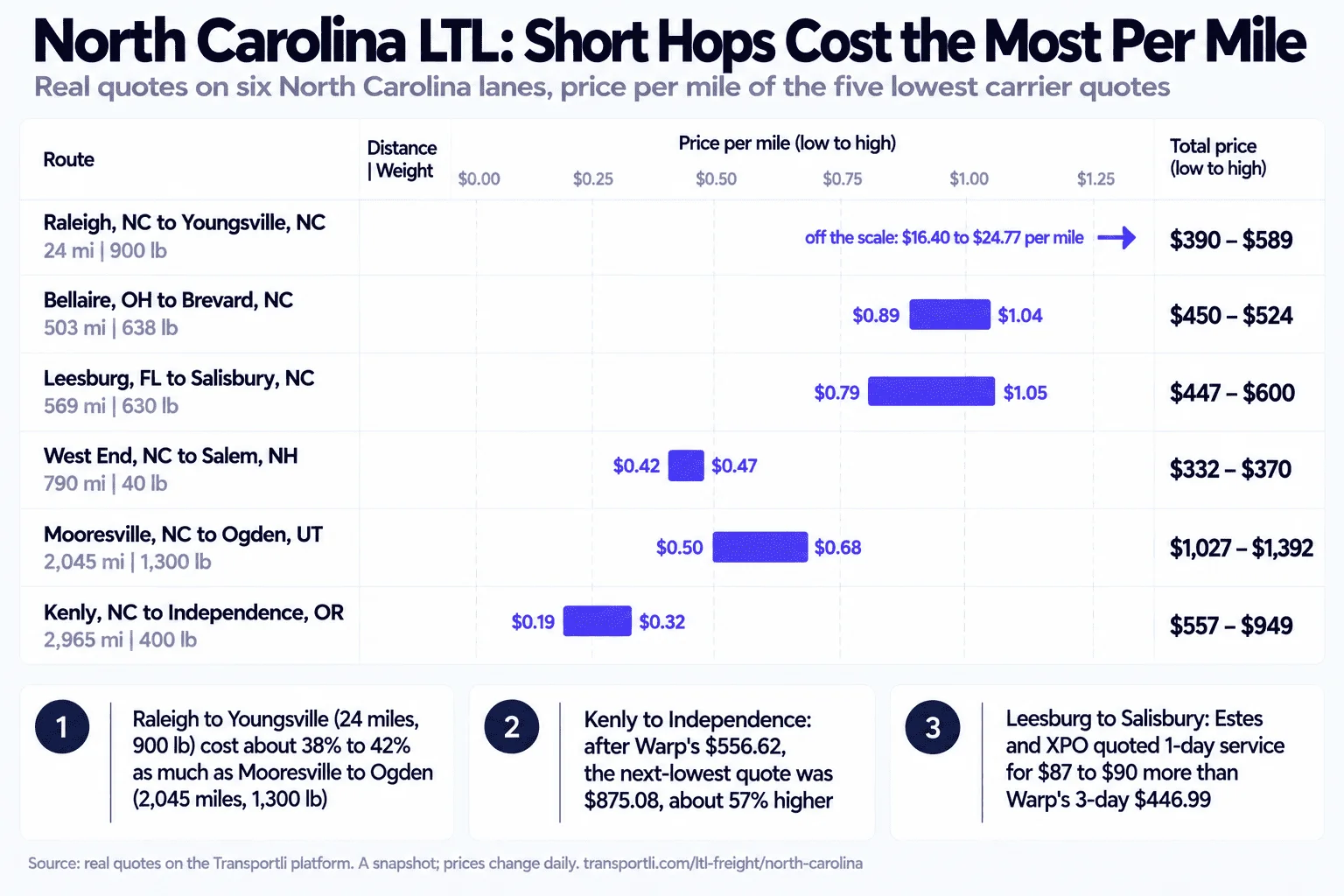
Pulling the six lanes above together, a short in-state hop stands out from everything else in the data:
| Route | Distance | Weight | Price range | Transit range | Price per mile |
|---|---|---|---|---|---|
| Raleigh, NC → Youngsville, NC | 23.8 mi | 900 lb | $390–$589 | 1 day | $16.40–$24.77 |
| Bellaire, OH → Brevard, NC | 503 mi | 638 lb | $450–$524 | 2 days | $0.89–$1.04 |
| Leesburg, FL → Salisbury, NC | 569 mi | 630 lb | $447–$600 | 1–3 days | $0.79–$1.05 |
| West End, NC → Salem, NH | 790 mi | 40 lb | $332–$370 | 2–4 days | $0.42–$0.47 |
| Mooresville, NC → Ogden, UT | 2,045 mi | 1,300 lb | $1,027–$1,392 | 4–7 days | $0.50–$0.68 |
| Kenly, NC → Independence, OR | 2,965 mi | 400 lb | $557–$949 | 5–7 days | $0.19–$0.32 |
The 24-mile in-state hop from Raleigh to Youngsville is the outlier. At $16.40–$24.77 per mile it is not priced by the mile at all, yet its five quotes of $390.40–$589.41 for 900 lb cost about 38% to 42% as much as the 1,300 lb run of 2,045 miles from Mooresville to Ogden, Utah ($1,026.87–$1,391.67). On the short lane every carrier quoted 1-day service, and ABF Freight’s $390.40 was about 27% below the next-lowest quote, $494.36 from XPO. The longest lane, Kenly, North Carolina to Independence, Oregon (2,965 miles), has the widest spread: Warp quoted $556.62, and the next-lowest quote, $875.08 from XPO, was about 57% higher, though all five of its lowest quotes still ran just $0.19–$0.32 per mile. The cheapest quote is often the slowest. Warp’s $446.99 from Leesburg, Florida to Salisbury took 3 days, while Estes and XPO quoted 1-day service for $534.03 and $536.50, $87 to $90 more. On Mooresville to Ogden, though, Roadrunner’s 4-day quote cost only $14.92 more than ABF’s 7-day $1,026.87. The lightest shipment, 40 lb from West End, North Carolina to Salem, New Hampshire, shows how tightly some carriers cluster: TForce, XPO and Estes quoted $369.46, $369.93 and $369.96, within 50 cents of each other, with Central Transport lowest at $331.52. And into the western mountains, all five of the lowest quotes from Bellaire, Ohio to Brevard were 2-day service ($449.99–$524.23). The lesson is the same on every lane: compare several carriers before you book.
What a real North Carolina LTL quote looks like
The screenshot alongside is an actual result from our platform, a 300 lb shipment from Raleigh, NC to Youngsville, NC, compared across 58 real carrier options in seconds. It is the same short in-state lane as the first rate tab above, quoted at one-third of the weight (300 lb against 900 lb) for a pickup about two weeks later.
- 58 real carrier options compared for this single shipment, 46 of them standard service, not just one broker’s in-house rate.
- $243.53–$310.36 for the five lowest quotes, all with 1-day transit.
- A third of the weight did not cut the price by a third. The lowest quote fell from $390.40 to $243.53, about 38% lower. ABF Freight was about 20% lower ($390.40 to $310.36), Forward Air about 40% lower ($509.58 to $305.80) and AAA Cooper about 51% lower ($589.41 to $290.48). The pickup dates differ, so some of the change may be the date.
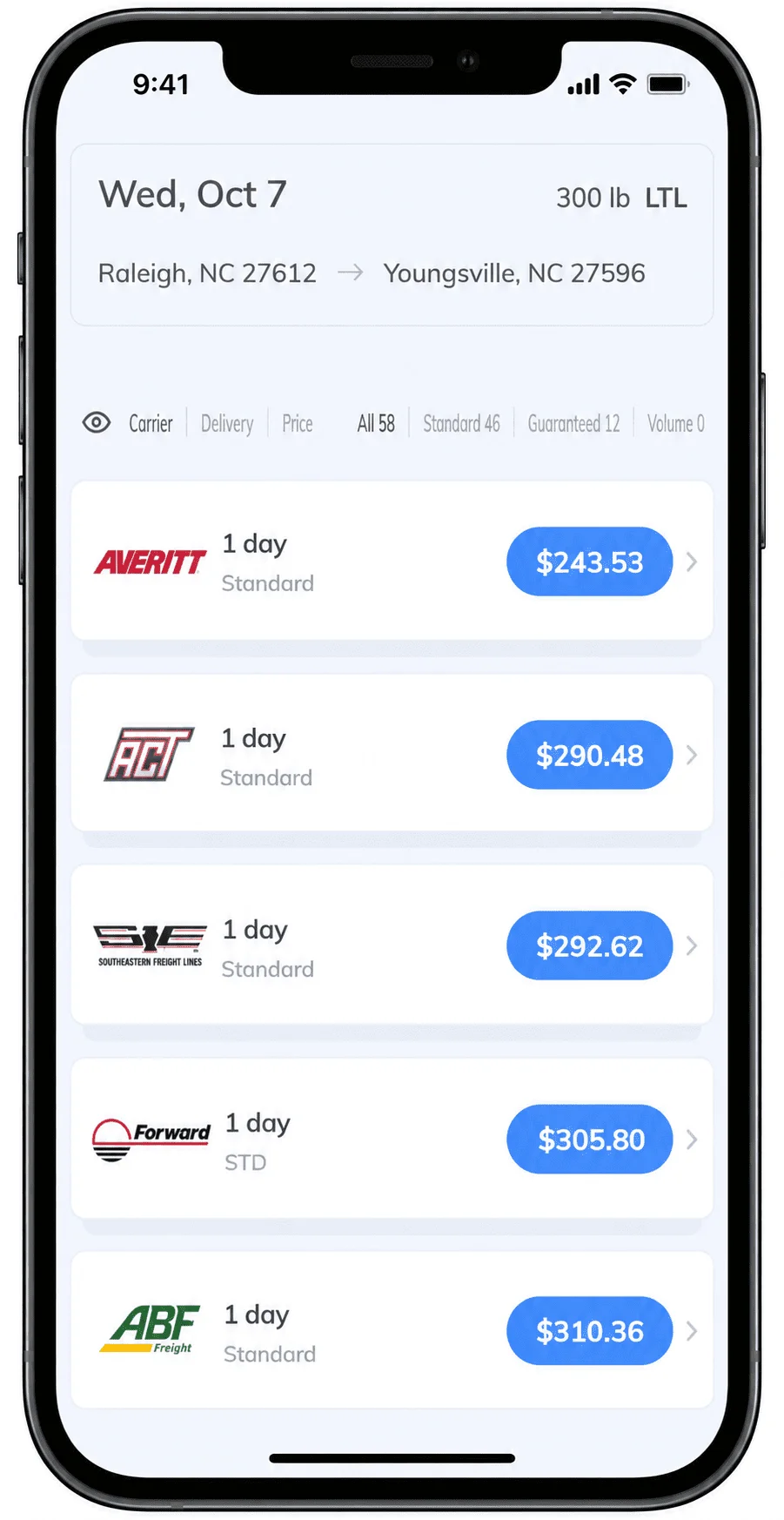
Real screenshot from a live Transportli quote for Raleigh, NC to Youngsville, NC, individual results vary by shipment and date.
Major shipping hubs in North Carolina
North Carolina’s freight moves through its ports, an air-cargo hub and the major interstate junctions:
- Port of Wilmington — the state’s container port. NC Ports reports more than 320,000 TEUs a year through Wilmington, more than 4 million tons of general cargo a year across its ports, and about 1,000 ship calls a year. For the fiscal year ending June 30, 2025, NC Ports reported record intermodal volume.
- Port of Morehead City — the second deep-water port, which handles breakbulk and bulk cargo.
- Charlotte Inland Terminal — NC Ports’ inland terminal, with access to CSX and Norfolk Southern rail.
- Piedmont Triad International Airport (Greensboro) — the FedEx Express hub, which handled about 194 million pounds of cargo in 2025.
- Research Triangle Park — a large research park for pharmaceutical, biotechnology and technology companies.
Highway corridors serving North Carolina
I-40 (about 420 miles in North Carolina) runs from the Tennessee line through Asheville, Greensboro, the Triangle and on to Wilmington. I-85 (about 231 miles) links Charlotte, Greensboro and Durham, and I-95 (about 181 miles) is the East Coast corridor through Fayetteville and Rocky Mount. I-74 (about 155 miles) and I-77 (about 106 miles) cross the Piedmont and the northwest, and I-26 (about 53 miles) runs from Asheville to South Carolina. I-485 circles Charlotte, and the Triangle Expressway is the toll alternative around Raleigh-Durham.
I-40 through the Pigeon River Gorge
The Pigeon River Gorge stretch of I-40 between Exit 7 in North Carolina and the Tennessee line is the main truck route across the mountains between the two states. After Helene, I-26 through Unicoi County, Tennessee, the usual detour, was also damaged, so there was briefly no direct interstate link between the two states. The road reopened on March 1, 2025 with two lanes squeezed between concrete barriers, one in each direction, and permanent repairs are still under way. Standard-size trucks can use it, but reports said oversize loads could not. Expect delays and extra transit time on any lane that crosses the western mountains.
What North Carolina shippers move
North Carolina’s freight is shaped by manufacturing, life sciences and agriculture. The state exported a record $43.8 billion of goods in 2025, led by $17.7 billion of chemicals, with machinery at $3.9 billion, transportation equipment at $3.4 billion, and computer and electronic products at $2.3 billion. Canada was the top destination at $8.6 billion, about 20% of exports. High Point is a global center for furniture, and the state is among the top producers of hogs and poultry and the nation’s leading sweet potato grower. Most of this moves in full truckloads or by ship, but the parts, samples, supplies and finished goods around these industries are where LTL fits.
Get a North Carolina LTL quote
Compare live rates from vetted carriers serving North Carolina.
Get an LTL quote →North Carolina LTL freight: frequently asked questions
How much does LTL shipping cost to or from North Carolina?
It depends on distance, weight, freight class, and how close your pickup or delivery point is to a major metro’s carrier network. Real quotes on our platform for North Carolina lanes have ranged from about $0.19 per mile on a 2,965-mile haul to Independence, Oregon to $0.79 to $1.05 per mile on a 630 lb shipment from Leesburg, Florida to Salisbury, and a 24-mile in-state hop with 900 lb cost $390 to $589, so distance alone does not predict the price. Get an instant quote for your exact shipment.
Do oversized LTL shipments need a permit in North Carolina?
Yes, for loads over North Carolina’s legal dimensions or weight limits (20,000 lbs on a single axle and 38,000 lbs on a tandem axle, with gross weight set by the federal bridge formula). NCDOT’s Central Permit Office issues permits. A single-trip permit carries a state fee of $12 to $48, plus $3 per 1,000 lbs over 132,000 lbs gross, and is valid for 10 calendar days. Permit loads travel sunrise to sunset, Monday through Saturday, with no Sunday travel unless the permit says otherwise. A standard LTL trailer within legal limits does not need one.
Do trucks pay tolls in North Carolina?
Only on the Triangle Expressway (NC 540) and the Monroe Expressway (Toll US 74). For a 2-axle vehicle with an NC Quick Pass, a full trip is $4.17 on the original Triangle Expressway and $2.96 on the Monroe Expressway as of January 1, 2026, and trucks with more axles pay more. LTL trucks cannot use the I-77 Express Lanes in Charlotte.
Can trucks use the left lane in North Carolina?
Not on controlled-access highways with six or more lanes. Since December 1, 2025, vehicles with a gross vehicle weight rating of 26,001 lbs or more may not use the leftmost lane there, except when entering or exiting, avoiding a hazard or passing.
What happened to I-40 after Hurricane Helene?
Flooding collapsed stretches of I-40 in the Pigeon River Gorge in Haywood County, closing it on September 28, 2024. It reopened on March 1, 2025 with one lane in each direction, and NCDOT said permanent repairs would take two to three years. Reports said standard-size trucks could use it but oversize loads could not.
How big is the Port of Wilmington?
NC Ports reports more than 320,000 TEUs a year through the Port of Wilmington, with more than 4 million tons of general cargo a year across its ports and about 1,000 ship calls. For the fiscal year ending June 30, 2025, it reported record intermodal volume.
How do hurricanes affect LTL shipping in North Carolina?
They can close the main interstates for days or months. Florence in 2018 dropped as much as 35.93 inches of rain and closed large sections of I-40 and I-95, and Helene in 2024 closed I-40 in the mountains for about five months. Build extra transit time into shipments during hurricane season.