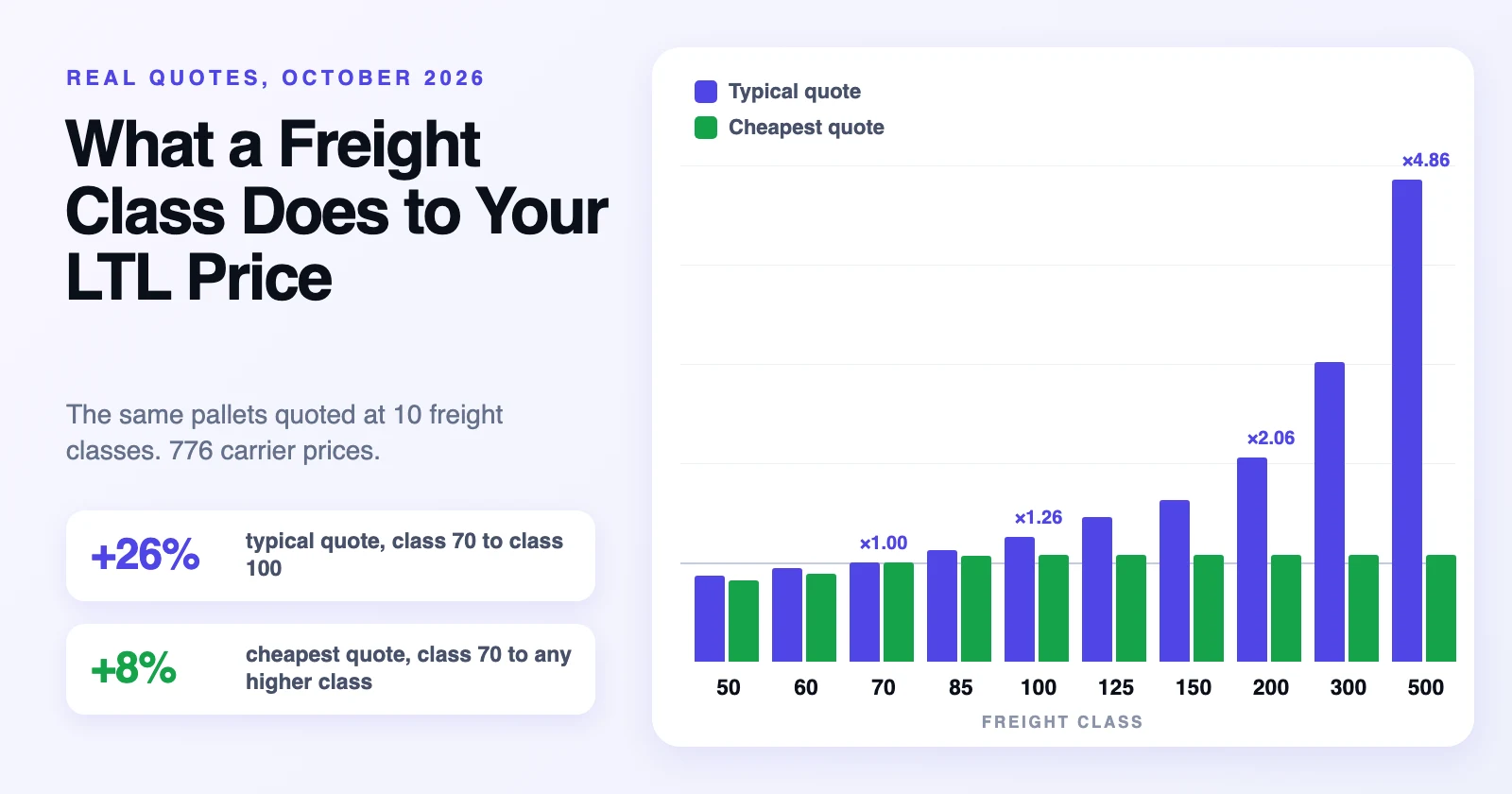
Freight class is one of the first things an LTL quote asks for, and one of the least understood. Everyone agrees a higher class costs more. Few sources show how much more. So we ran the experiment: the same pallets, on the same lanes, quoted at ten different freight classes from 50 to 500, with live rates from the carriers on our platform. That is 40 quote runs and 776 carrier prices. Below is what the class number actually did to the price, which carriers ignore it, and what a wrong class could cost you.
The short answer
For the pallets we tested, which sit at class 70 by density, the typical quote (the median across carriers) rose about 26% at class 100, 63% at class 150, 106% at class 200 and nearly fivefold at class 500. But the cheapest quote hardly moved, because six carriers priced our pallets the same at every class and one of them set the floor. The takeaway is that a wrong class does the most damage when you only ask one carrier that prices by class, and the least when you compare carriers.
Freight class in one minute
Freight class is a number from 50 to 500 that the National Motor Freight Classification (NMFC) assigns to a type of freight. It is meant to describe how costly the freight is to move, based on its density, how easy it is to stow and handle, and how much liability it carries. A low class is dense, durable freight. A high class is light, bulky or fragile freight. Carriers rate LTL shipments partly on that number, so the same pallet at a different class can get a different price. Our freight class guide covers the full system.
For general palletized freight, density does most of the work. Weight divided by cubic feet gives pounds per cubic foot, and the NMFC density bands turn that into a class. Our density calculator and freight class calculator do the maths for you. The pallets in this study are 48 x 40 x 48 inches and weigh 1,000 lb each. That is 18.75 lb per cubic foot, which falls in the 15 to 22.5 band, and that band is class 70.
How we ran the test
We built four benchmark shipments, then asked the carriers on our quoting platform to price each one at ten freight classes: 50, 60, 70, 85, 100, 125, 150, 200, 300 and 500. Nothing else changed between runs. Same pickup date, same addresses, same pallets, no accessorials.
| Shipment | Freight | Lane |
|---|---|---|
| 1 | 1 pallet, 1,000 lb | Staten Island, NY to Chicago, IL |
| 2 | 3 pallets, 3,000 lb | Staten Island, NY to Chicago, IL |
| 3 | 1 pallet, 1,000 lb | Newark, NJ to Houston, TX |
| 4 | 3 pallets, 3,000 lb | Newark, NJ to Houston, TX |
Each run returned prices from 17 to 21 carriers. For every carrier we kept its lowest standard quote and ignored guaranteed and expedited options, so the numbers are comparable from class to class. The full method, including what we excluded, is in the methodology section below, and you can download the data as a CSV if you want to check our work.
What the typical quote did
Across all four shipments the median quote climbed with every step up in class. The chart shows the average of the four shipments, as a multiple of the class 70 price (class 70 is the correct density class for these pallets).
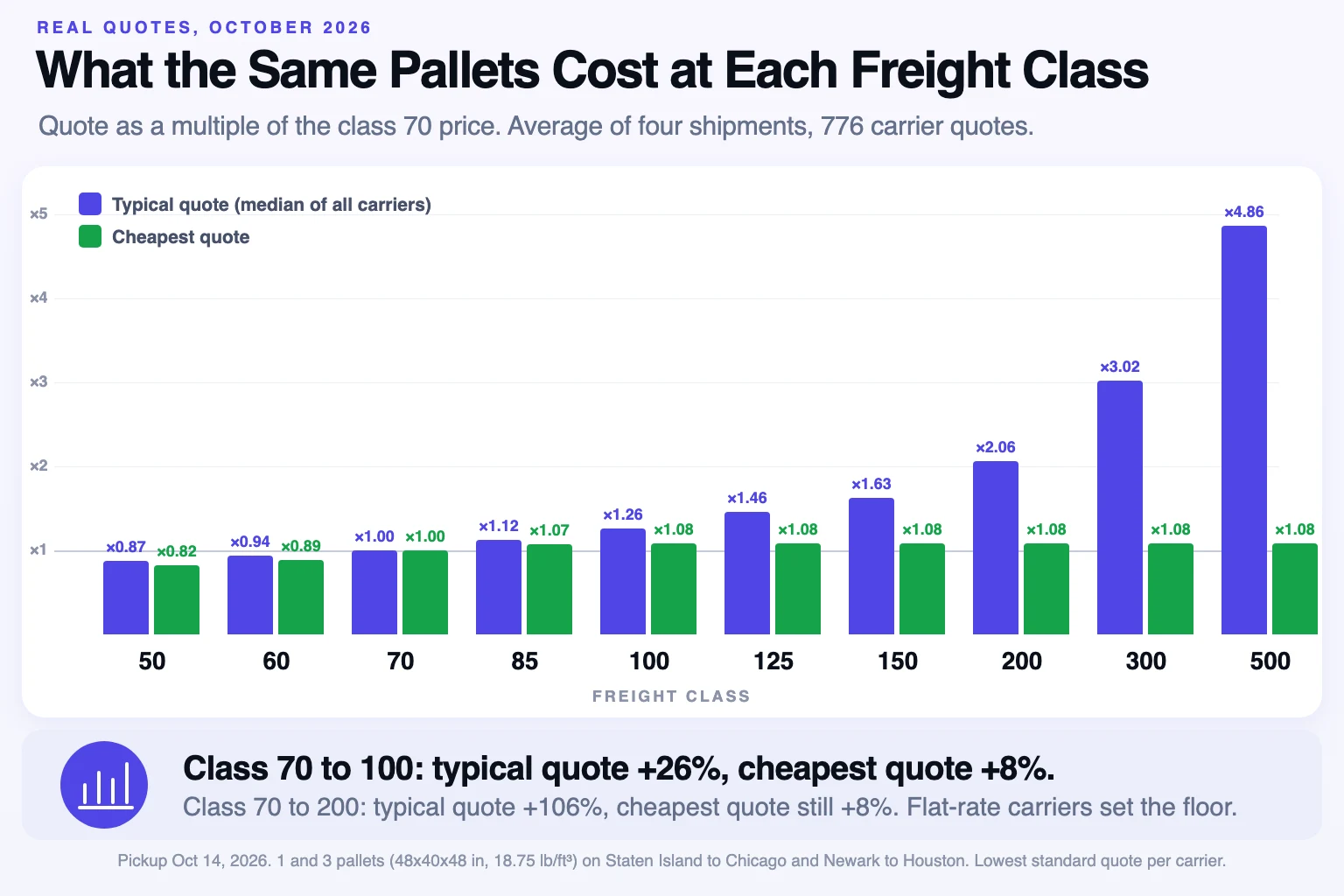
| Freight class | 1 pallet, Staten Island to Chicago | 3 pallets, Staten Island to Chicago | 1 pallet, Newark to Houston | 3 pallets, Newark to Houston | Average vs class 70 |
|---|---|---|---|---|---|
| 50 | $548 | $1,113 | $513 | $1,058 | x0.87 |
| 60 | $568 | $1,222 | $552 | $1,169 | x0.94 |
| 70 | $609 | $1,291 | $608 | $1,198 | x1.00 |
| 85 | $673 | $1,401 | $681 | $1,384 | x1.12 |
| 100 | $747 | $1,596 | $744 | $1,620 | x1.26 |
| 125 | $890 | $1,945 | $850 | $1,757 | x1.46 |
| 150 | $961 | $2,244 | $884 | $2,080 | x1.63 |
| 200 | $1,156 | $2,892 | $1,114 | $2,742 | x2.06 |
| 300 | $1,643 | $4,076 | $1,651 | $4,188 | x3.02 |
| 500 | $2,617 | $6,190 | $2,738 | $7,013 | x4.86 |
Three things stand out.
- The climb is close to proportional above class 100. Going from class 100 to class 200 raised the typical quote by about 63%, and going from class 100 to class 500 multiplied it by about 3.9.
- Going down in class saves less than you might expect. Class 50 was only about 13% below class 70 at the median, because six carriers do not change their price at all and the others discount only about 16% on average.
- Size changes the dollar amount, not the pattern. Going from one pallet to three pallets raised the typical quote to between 2 and 2.6 times at every class, and the same percentage rise from a wrong class costs more on a larger shipment.
Want a quote at the class that really applies to your freight? Compare live LTL rates from dozens of carriers in seconds.
Get an instant LTL quote →What a wrong class would add
Most class mistakes show up after pickup. The carrier weighs and measures the freight, decides the class on your bill of lading is wrong, and rebills at the corrected class. Carriers often add an administrative fee on top; we did not collect those, so the figures below are only the difference in the base price. They assume the corrected bill matches the quote you would have received at the corrected class.
| Quoted at to billed at | Typical cause | Typical quote changes by | Cheapest quote changes by |
|---|---|---|---|
| 50 to 70 | Class set too low, corrected to the density class | +15% | +22% |
| 60 to 85 | Class set slightly low | +19% | +20% |
| 70 to 100 | Class one step up | +26% | +8% |
| 85 to 125 | Freight is lighter or bulkier than estimated | +30% | +1% |
| 70 to 150 | Freight is much lighter than estimated | +63% | +8% |
| 100 to 200 | Very light, bulky freight | +63% | No change |
| 70 to 200 | Class doubled | +106% | +8% |
The pattern is consistent: a correction from class 70 to 100 adds about a quarter to the typical quote, 70 to 150 adds about 60%, and the gap grows quickly from there. Our freight class guide explains how carriers inspect freight, and our guide to LTL accessorial charges covers the other fees that can appear on a bill.
Which carriers care about class
Not every carrier prices the same way. Sixteen of the 22 carriers in our data raised their price as the class went up. Six returned exactly the same price at every class we tried, on every shipment where they quoted: ArcBest, Averitt, Go2, Old Dominion, Southeastern and Warp. We cannot see how those carriers rate a shipment, so we do not know why the class we entered made no difference. They may rate on weight, pallet count or linear feet, or have their own classification. Averitt returned no quote at classes 50 and 60 on some shipments.
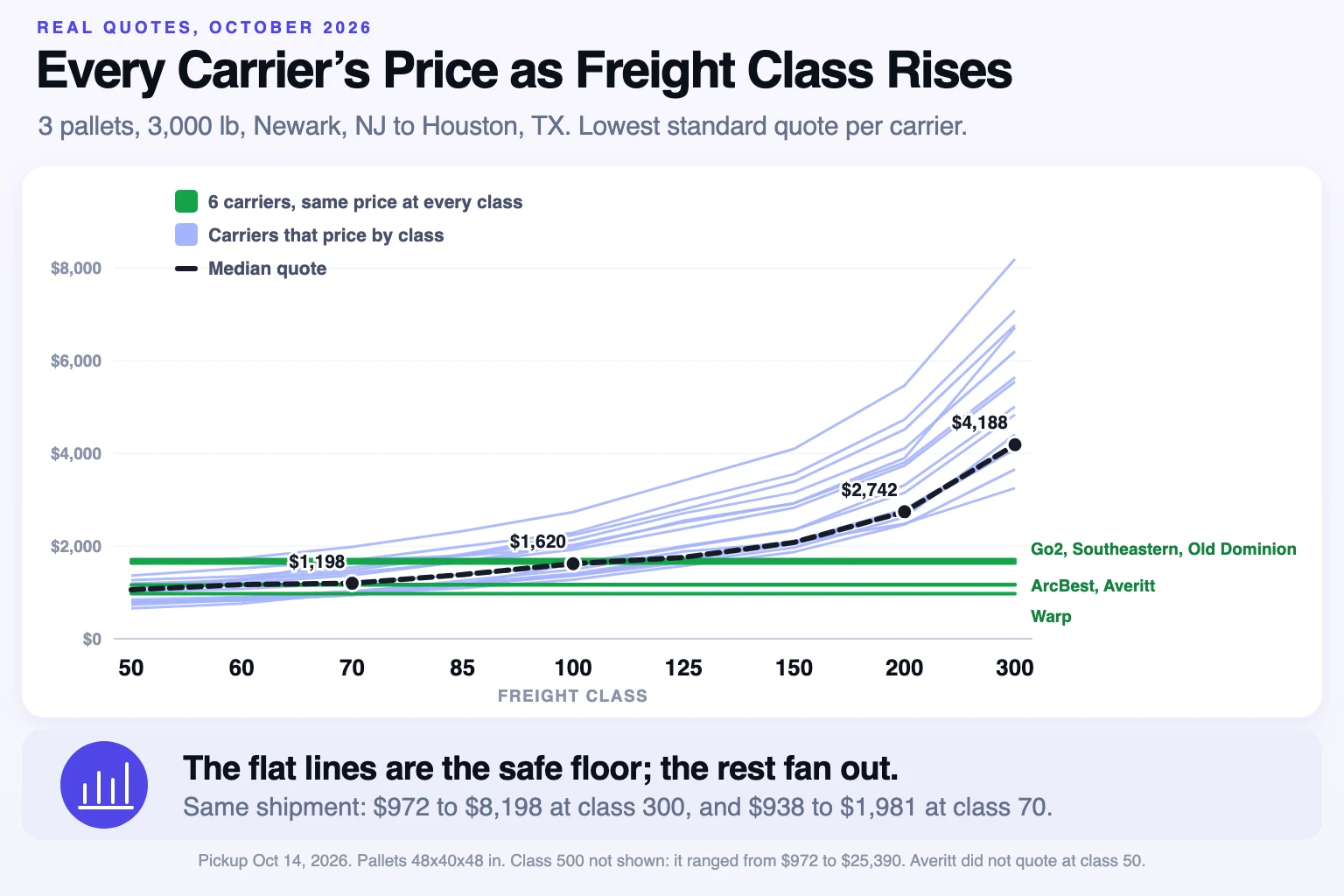
| Carrier | Pricing | Class 50 | Class 100 | Class 150 | Class 200 | Class 300 | Class 500 | Shipments quoted |
|---|---|---|---|---|---|---|---|---|
| Warp | Flat | x1.00 | x1.00 | x1.00 | x1.00 | x1.00 | x1.00 | 4 |
| ArcBest | Flat | x1.00 | x1.00 | x1.00 | x1.00 | x1.00 | x1.00 | 4 |
| Old Dominion | Flat | x1.00 | x1.00 | x1.00 | x1.00 | x1.00 | x1.00 | 4 |
| Go2 | Flat | x1.00 | x1.00 | x1.00 | x1.00 | x1.00 | x1.00 | 4 |
| Averitt | Flat | x1.00 | x1.00 | x1.00 | x1.00 | x1.00 | x1.00 | 4 |
| Southeastern | Flat | x1.00 | x1.00 | x1.00 | x1.00 | x1.00 | x1.00 | 2 |
| Estes | By class | x0.89 | x1.21 | x1.63 | x2.08 | x3.05 | x5.12 | 4 |
| Forward Air | By class | x0.76 | x1.12 | x1.60 | x2.11 | x3.50 | x13.44 | 4 |
| STG | By class | x0.90 | x1.23 | x1.72 | x2.23 | x3.27 | x5.36 | 4 |
| Pitt Ohio | By class | x0.88 | x1.26 | x1.75 | x2.24 | x3.24 | x5.22 | 4 |
| Saia | By class | x0.87 | x1.33 | x1.88 | x2.43 | x3.52 | x5.69 | 4 |
| Ward | By class | x0.87 | x1.30 | x1.87 | x2.46 | x3.66 | x6.05 | 4 |
| A Duie Pyle | By class | x0.81 | x1.30 | x1.89 | x2.47 | x3.64 | x5.98 | 2 |
| FedEx Economy | By class | x0.82 | x1.35 | x1.92 | x2.47 | x3.63 | x6.65 | 4 |
| Roadrunner | By class | x0.76 | x1.48 | x2.03 | x2.49 | x3.10 | x3.14 | 2 |
| Central Transport | By class | x0.86 | x1.32 | x1.90 | x2.50 | x3.75 | x6.23 | 4 |
| R+L | By class | x0.83 | x1.34 | x1.93 | x2.55 | x4.06 | x6.74 | 4 |
| FedEx Priority | By class | x0.81 | x1.34 | x1.93 | x2.58 | x3.67 | x7.14 | 4 |
| TForce | By class | x0.82 | x1.33 | x1.95 | x2.59 | x3.85 | x5.80 | 4 |
| Daylight | By class | x0.83 | x1.32 | x2.05 | x2.72 | x4.07 | x6.32 | 2 |
| SMT | By class | x0.84 | x1.37 | x2.05 | x2.73 | x4.10 | x6.84 | 2 |
| XPO | By class | x0.82 | x1.58 | x2.23 | x3.18 | x4.75 | x7.91 | 4 |
“Flat” means the carrier returned the same price at every class. Each figure is the carrier’s price at that class divided by its own class 70 price, averaged across the shipments where it quoted. A value of x2.00 means the carrier charged twice as much as it did at class 70. Roadrunner stopped rising after class 300 in our data, so its class 500 figure is lower than the carriers around it. Forward Air’s class 500 quotes were unusually high, at about 13 times its class 70 price.
A flat quote is not a guarantee. A carrier that quoted the same price at every class can still inspect your freight and rebill if the weight, dimensions or description on the bill of lading are wrong. Enter the real class and the real measurements every time. The point is that flat-rate carriers are a useful comparison, not that class stops mattering.
Why the cheapest quote barely moves
If you compare carriers, the class you enter has a much smaller effect than the median suggests. At classes 50 to 85 the cheapest quote was usually from a carrier that prices by class and offers a discount at low classes. From class 85 or 100 upward, a flat-rate carrier became the cheapest option on all four shipments and stayed there, so the cheapest quote did not change from class 100 to class 500.
| Shipment | Cheapest at class 50 | Cheapest at class 70 | Cheapest at class 100 | Cheapest at class 500 | Class 70 to 100 |
|---|---|---|---|---|---|
| 1 pallet, Staten Island to Chicago | $339 (Central Transport) | $379 (Central Transport) | $442 (Warp) | $442 (Warp) | +17% |
| 3 pallets, Staten Island to Chicago | $641 (Central Transport) | $798 (Central Transport) | $873 (ArcBest) | $873 (ArcBest) | +9% |
| 1 pallet, Newark to Houston | $386 (Roadrunner) | $429 (XPO) | $436 (Warp) | $436 (Warp) | +2% |
| 3 pallets, Newark to Houston | $656 (Roadrunner) | $938 (XPO) | $972 (Warp) | $972 (Warp) | +4% |
The gap between the cheapest and most expensive quote tells the same story. For these shipments, the most expensive carrier charged 2.1 to 2.8 times the cheapest at class 70, and 21 to 26 times the cheapest at class 500. A wrong class does not hurt every carrier equally, so it makes choosing the carrier matter more.
Try it: what if the class is wrong?
Pick one of the four shipments, the class you were quoted at and the class the carrier ends up billing. The tool shows the change in the typical quote, the cheapest quote and the price from every carrier we quoted. It uses the real quotes behind this article, not a formula.
What if the freight class is wrong?
Pick a shipment, the class you were quoted at and the class the carrier ends up billing. See what that would do to the typical quote, to the cheapest quote and to every carrier we quoted.
What to do with this
- Work out the class from density, not from a guess. Measure the packed pallet, weigh it, and run it through the density calculator or the freight class calculator. If your commodity has its own NMFC item, its class may apply instead.
- Do not enter a low class to get a better quote. A quote at class 50 for freight that is class 70 can look about 15% cheaper at the median, and then the carrier corrects it after pickup.
- Compare carriers on every shipment. In our data a flat-rate carrier set the cheapest price from class 100 up, and the spread between carriers got much wider as class rose.
- Keep the bill of lading consistent with the quote. Class, weight, pallet count and dimensions should all match what you quoted. Our bill of lading generator helps you fill it in.
- Pack to reduce class. Class follows density, so a tighter pallet with no wasted height can drop the class. Our pallet shipping guide covers sizes and packing.
- Check the other charges. Class is only one part of the bill. Liftgate, residential and limited-access services add more, and our liftgate delivery guide and accessorial charge guide show what they cost.
See what your own shipment costs at the right class: compare live LTL quotes from dozens of carriers.
Get an instant LTL quote →Methodology and limits
The numbers in this article come from our own quoting platform. Here is exactly what they are, and what they are not.
- Source. Live LTL quotes collected on October 12, 2026 for pickup on Wednesday, October 14, 2026. Four benchmark shipments, each quoted at ten freight classes, for 40 runs and 776 carrier prices from 22 carriers.
- The shipments. One pallet at 1,000 lb and three pallets at 3,000 lb, each pallet 48 x 40 x 48 inches (18.75 lb per cubic foot), from Staten Island, NY to Chicago, IL and from Newark, NJ to Houston, TX. Pickup and delivery were both dock to dock, with no accessorial services.
- One price per carrier. Where a carrier returned several standard quotes, we kept its lowest. We left out guaranteed and expedited services, and we left out a carrier’s separate pallet-rated option when it appeared alongside its regular quote.
- One carrier removed. AAA Cooper returned prices tens of times higher than the rest on every run, so we excluded it from every average and median. The remaining 22 carriers are shown in full.
- Medians and indexes. The typical quote is the median across the carriers that quoted. Indexes divide a price by the same shipment’s price at class 70, then average the four shipments (and, in the carrier table, the shipments each carrier quoted).
- What the class means here. Our test pallets are class 70 by density. Classes 50 and 60 describe much denser freight than these pallets, and classes 300 and 500 describe very light freight, so the classes other than 70 show what the quote engine returns when that number is entered, not what a real bill for these pallets would be.
- What we did not measure. Reclassification and reweigh fees, other lanes and dates, other pallet sizes, partial-weight shipments and accessorials. Quotes also change daily with fuel and capacity.
Your own quote will differ, because it depends on your freight, your lanes and the day you ship. Use this study to understand how class affects pricing, then get a live quote for your exact shipment. You can download the quote data as a CSV. For broader price data, see our study of how much LTL freight costs.
Frequently asked questions
How much does freight class affect LTL price?
In our test of four shipments quoted at ten classes, the typical quote was about 26% higher at class 100 than at class 70, about 106% higher at class 200 and nearly five times higher at class 500. The effect depends on the carrier: 16 of 22 raised their price as class rose, while 6 charged the same at every class.
Does a higher freight class always cost more?
For most carriers, yes. Sixteen of the 22 carriers we quoted charged more as the class went up. Six carriers charged the same at every class we tried, so comparing carriers can reduce the effect of class on your price.
What happens if my freight class is wrong?
The carrier can weigh, measure and inspect the freight, correct the class and rebill you, often with an administrative fee. In our data, a correction from class 70 to class 100 would add about 26% to the typical quote, and from class 70 to class 150 about 63%, before any fee.
Why do some carriers quote the same price at every class?
We cannot see how carriers rate shipments. ArcBest, Averitt, Go2, Old Dominion, Southeastern and Warp returned identical prices at every class, which suggests they price those quotes on something other than the class entered, such as weight or pallet count. Check the quote terms, because a carrier can still inspect and rebill if the details on the bill of lading are wrong.
What freight class is a 1,000 lb pallet?
It depends on the pallet’s size and the commodity. A pallet 48 x 40 x 48 inches at 1,000 lb is 18.75 lb per cubic foot, which is class 70 by density. A lighter or bulkier pallet gets a higher class, and some commodities have their own NMFC class. Use a density calculator and check the NMFC item for your product.
Does freight class change the cheapest LTL quote?
Only slightly in our test. The cheapest quote rose between 2% and 17% (8% on average) from class 70 to any higher class, because a flat-rate carrier became the cheapest option from class 85 or 100 up and stayed there.
How accurate are the numbers in this article?
They are real quotes from our platform, but they come from four shipments on two lanes for one pickup date. They show how class affects price, not what your shipment will cost, and they do not include reclass or reweigh fees. For your own number, get a live quote.