

Shipping LTL freight to or from New Mexico? Rates depend on your specific route, freight class, and how close your pickup or delivery point is to the nearest LTL terminal. New Mexico has about 2.1 million residents, so most of the state is open country between a few cities. I-25 runs about 462 miles north to south through Albuquerque and Santa Fe, I-40 about 374 miles across the middle, and I-10 about 164 miles across the south, past Las Cruces and on toward the Texas and Mexico borders. New Mexico also has a rule that surprises shippers from other states: commercial trucks are required to stop at its ports of entry. Here’s what actually affects your rate. You can also compare live LTL freight rates across carriers.
LTL trucking regulations in New Mexico
A standard LTL tractor-trailer within legal size and weight limits does not need a special permit in New Mexico. Permits and route rules matter for oversize or overweight freight, and New Mexico has a few that surprise shippers:
- Ports of entry are real stops. The New Mexico Department of Transportation (NMDOT) lists twelve ports of entry, including Anthony and Lordsburg on I-10, Gallup and San Jon on I-40, Raton on I-25 and Santa Teresa at the Mexican border. Four of them, Anthony, Gallup, Lordsburg and San Jon, are open 24 hours a day, seven days a week, and state law has long required commercial vehicles to use designated highways and stop at ports of entry for clearance.
- There is a weight-distance tax. New Mexico charges heavy trucks a weight-distance tax through its Taxation and Revenue Department, and a vehicle registered in New Mexico and subject to the tax must show its weight-distance tax permit when it passes through a port of entry. NMDOT can also collect delinquent tax there.
- Permits come from NMDOT. NMDOT offers online single-trip permits and oversize and overweight permits, and its truck permits office can be reached at 505-476-2475. For superloads of 200,000 pounds and above, the NMDOT Bridge Section handles the request at 505-795-4317.
- The border has its own heavier-load zone. According to New Mexico’s Economic Development Department, a twelve-mile overweight cargo zone around the Santa Teresa and Columbus ports of entry lets trucks entering from Mexico carry up to 96,000 pounds even with a reducible load, under a permit of $250 a year per truck.
Current rules and contacts are public record:
NMDOT ports of entry and permits → New Mexico Borderplex →
What affects your New Mexico LTL rate
- Freight class — density, handling, and liability determine your NMFC class, the single biggest factor in your rate. See our freight class guide.
- Distance — New Mexico is large and open: I-25 alone runs about 462 miles and US 285 about 407 miles, so a lane from Las Cruces to Farmington or from Albuquerque to Hobbs is a long haul with few towns in between.
- Metro vs. rural — Albuquerque, Santa Fe, Las Cruces and Rio Rancho are the main carrier markets, while the northwest, the eastern plains and the southwest bootheel typically see fewer terminals and options.
- Terminal proximity — the more carrier terminals near your pickup or delivery point, the more quotes you see, and in rural New Mexico the nearest terminal can be 100 miles or more away.
- Accessorials — liftgate, residential, or inside delivery add to the base rate, same as anywhere else, and ranch, oilfield and tribal-land deliveries often need a limited-access or liftgate service.
Did you know?From 6 real New Mexico lanes and 30 quotes
-
4× the cost per mile
The shorter haul cost far more per mile
A 250 lb shipment moving 399 miles (Albuquerque, NM to Peyton, CO) had a lowest quote of $350, or $0.88 a mile. A 100 lb shipment moving 1,235 miles (Saint Cloud, MN to Corrales, NM) had a lowest quote of $289, or $0.23 a mile.
-
$373 to arrive one day sooner
Saving a day is not free
On Albuquerque, NM to Richmond, CA (1,084 miles, 3,200 lb), the cheapest quote at $947 took 4 days. The fastest, at 3 days, cost $1,321. On Saint Cloud, MN to Corrales, NM, 3-day delivery cost $373 against $289 for 5 days.
-
6 carriers had the lowest quote
Six different carriers won six New Mexico lanes
ABF Freight, Central Transport, FedEx Freight, Forward Air, R+L Carriers, and TForce Freight each had the lowest quote on one lane. Across the lowest quotes on every lane, 12 different carriers appeared.
-
$615 from lowest to fifth-lowest
Same shipment, quotes $615 apart
For 3,200 lb from Albuquerque, NM to Richmond, CA (1,084 miles), the lowest quote was $947 and the fifth-lowest was $1,562, a 65% gap.

Where freight moves in New Mexico
New Mexico freight follows its three interstates and the border:
- Albuquerque & the Rio Grande corridor — where I-25 and I-40 cross, with Albuquerque at about 560,000 residents and Rio Rancho at about 113,000 in the Census Bureau’s 2024 estimates reported by KRQE.
- Santa Fe & northern New Mexico — I-25 and US 285 north to Colorado, and US 550 to Farmington and the Four Corners.
- Las Cruces & the southern border — I-10 and I-25 at Las Cruces, which had about 117,000 residents, and the Santa Teresa port of entry nearby.
- Eastern New Mexico — Roswell, Hobbs and Carlsbad along US 285 and US 62, the oil and gas region, and Clovis and Tucumcari along I-40 and US 60.
- Western New Mexico — Gallup and Grants on I-40 toward Arizona, and Lordsburg on I-10.
Weather and transit reliability
New Mexico freight is exposed to dust, wind and winter storms on a few long highway links. On March 18, 2025, blowing dust cut visibility to almost zero in places and prompted NMDOT to close a 130-mile stretch of I-10 from the Arizona state line to the outskirts of Las Cruces, along with state highways near Deming. I-25 was briefly closed near Cochiti Pueblo, and high winds closed roads near Roswell and Carlsbad, according to the Associated Press via AZ Family. The I-10 stretch around Lordsburg has a history of closures when dust blows across vacant desert land. For LTL shippers the practical advice is simple: during spring wind season and winter storms, build extra transit time into anything on I-10, I-40 or I-25, and check NMRoads before a tight delivery.
Sample New Mexico LTL rates by route
Real quotes pulled from our platform for six different New Mexico lanes — same process, different carriers each time, all starting or ending in New Mexico and spanning a range of weights and distances. Rates shift with capacity and fuel costs, so treat these as a snapshot rather than a guarantee for your shipment; get an instant quote for your exact route.
Real quotes by route
Snapshot taken over recent months — carriers and pricing change daily.
| Carrier | Service | Transit | Price |
|---|---|---|---|
| R+L Carriers | STD | 3 days | $350.38 |
| TForce Freight | Standard | 2 days | $350.41 |
| AAA Cooper Transportation | Standard | 2 days | $351.18 |
| FedEx Freight Economy | Freight Economy | 2 days | $364.82 |
| Saia | Standard | 2 days | $404.78 |
| Carrier | Service | Transit | Price |
|---|---|---|---|
| Forward Air | Standard | 5 days | $434.07 |
| AAA Cooper Transportation | Standard | 2 days | $437.93 |
| Estes | LTL Standard Transit | 3 days | $466.82 |
| ABF Freight | Standard | 3 days | $476.64 |
| Old Dominion Freight Line | Standard | 2 days | $516.94 |
| Carrier | Service | Transit | Price |
|---|---|---|---|
| ABF Freight | Standard | 4 days | $947.27 |
| CrossCountry Freight Solutions | Standard | 4 days | $1,237.93 |
| Central Transport | Standard | 4 days | $1,306.79 |
| XPO | Standard | 3 days | $1,320.71 |
| TForce Freight | Standard | 3 days | $1,562.46 |
| Carrier | Service | Transit | Price |
|---|---|---|---|
| Central Transport | Standard | 5 days | $289.03 |
| FedEx Freight Economy | Freight Economy | 4 days | $333.81 |
| Forward Air | Standard | 4 days | $361.44 |
| R+L Carriers | STD | 3 days | $372.77 |
| XPO | Standard | 3 days | $392.97 |
| Carrier | Service | Transit | Price |
|---|---|---|---|
| TForce Freight | Standard | 4 days | $395.43 |
| AAA Cooper Transportation | Standard | 3 days | $420.78 |
| Central Transport | Standard | 4 days | $428.94 |
| FedEx Freight Economy | Standard | 4 days | $456.07 |
| R+L Carriers | STD | 3 days | $470.27 |
| Carrier | Service | Transit | Price |
|---|---|---|---|
| FedEx Freight Economy | Freight Economy | 6 days | $555.50 |
| Old Dominion Freight Line | Standard | 5 days | $599.37 |
| ABF Freight | Standard | 5 days | $632.90 |
| CrossCountry Freight Solutions | Standard | 5 days | $698.08 |
| Estes | LTL Standard Transit | 5 days | $743.29 |
Rate, transit, and price-per-mile summary
Pulling the six lanes above together, a 25 lb shipment from Santa Fe to Houston stands out from everything else in the data:
| Route | Distance | Weight | Price range | Transit range | Price per mile |
|---|---|---|---|---|---|
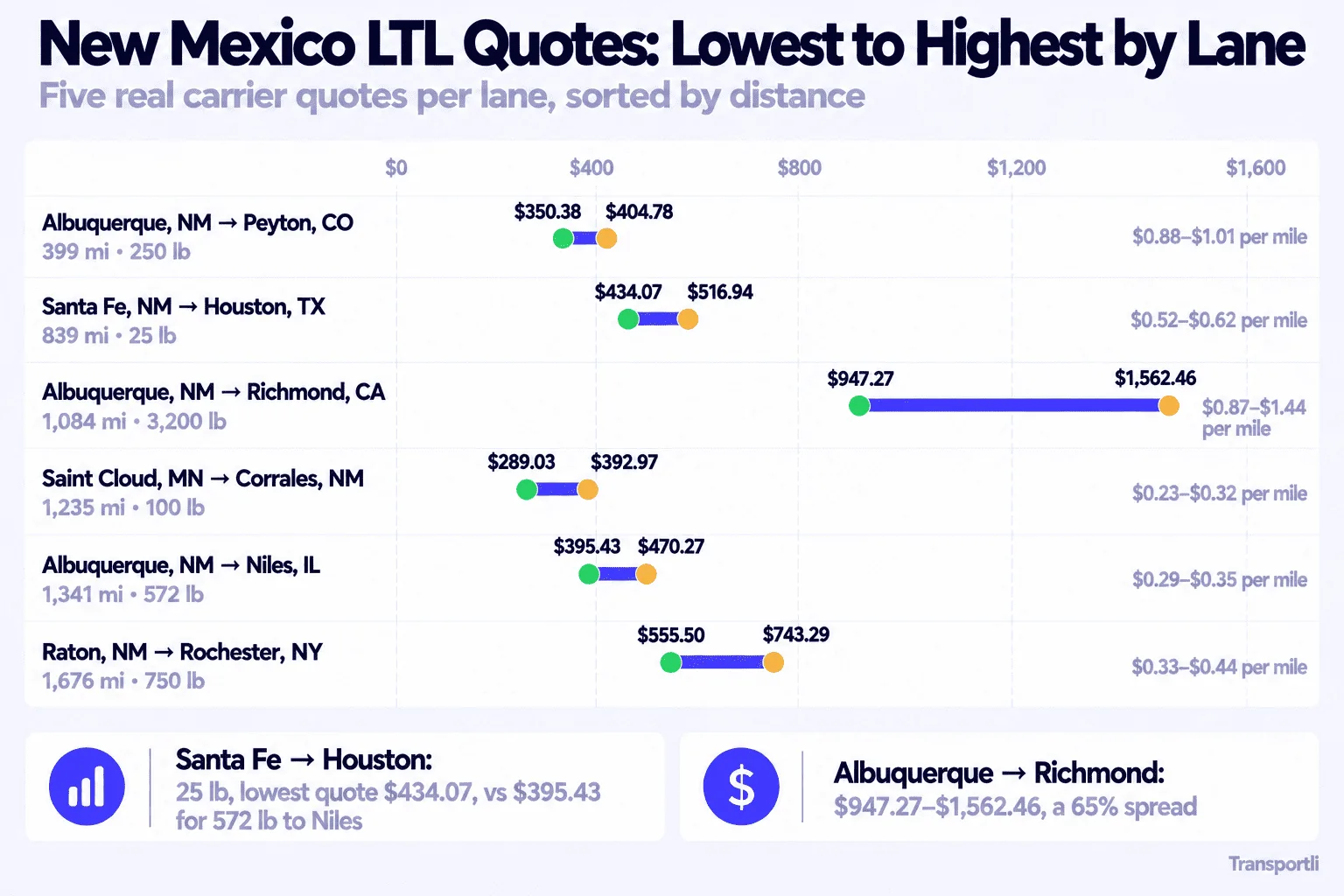
| Albuquerque, NM → Peyton, CO | 399 mi | 250 lb | $350–$405 | 2–3 days | $0.88–$1.01 |
| Santa Fe, NM → Houston, TX | 839 mi | 25 lb | $434–$517 | 2–5 days | $0.52–$0.62 |
| Albuquerque, NM → Richmond, CA | 1,084 mi | 3,200 lb | $947–$1,562 | 3–4 days | $0.87–$1.44 |
| Saint Cloud, MN → Corrales, NM | 1,235 mi | 100 lb | $289–$393 | 3–5 days | $0.23–$0.32 |
| Albuquerque, NM → Niles, IL | 1,341 mi | 572 lb | $395–$470 | 3–4 days | $0.29–$0.35 |
| Raton, NM → Rochester, NY | 1,676 mi | 750 lb | $556–$743 | 5–6 days | $0.33–$0.44 |
Santa Fe to Houston (839 miles, 25 lb) ran $434.07–$516.94, and its lowest quote was $38.64 higher than the lowest on Albuquerque to Niles, Illinois ($395.43), a lane 502 miles longer that carried 572 lb. At the other end, the 3,200 lb shipment from Albuquerque to Richmond, California ran $947.27–$1,562.46, only 2.2 times the lowest Houston quote for 128 times the weight. On Santa Fe to Houston, AAA Cooper’s 2-day $437.93 cost just $3.86 more than Forward Air’s 5-day $434.07, and Old Dominion Freight Line’s 2-day $516.94 was $79.01 above AAA Cooper for the same two days. Albuquerque to Richmond was the lane with the widest spread, $615.19 or 65%: ABF Freight’s 4-day $947.27 was $290.66 below the next quote, and XPO’s 3-day $1,320.71 cost only $13.92 more than Central Transport’s 4-day $1,306.79. On Albuquerque to Peyton, Colorado, three quotes sat within 80 cents of each other, and TForce Freight’s 2-day $350.41 cost three cents more than R+L Carriers’ 3-day $350.38. The inbound lane from Saint Cloud, Minnesota to Corrales was the cheapest per mile at $0.23–$0.32, and R+L Carriers’ 3-day $372.77 cost $83.74 more than Central Transport’s 5-day $289.03 for two fewer days. On Albuquerque to Niles, AAA Cooper’s 3-day $420.78 cost $25.35 more than TForce Freight’s 4-day $395.43. On Raton to Rochester, New York, all five quotes were 5- or 6-day service, and Estes’s 5-day $743.29 was $143.92 above Old Dominion Freight Line’s 5-day $599.37. The lesson is the same on every lane: compare several carriers before you book.
What a real New Mexico LTL quote looks like
The screenshot alongside is an actual result from our platform, a 250 lb shipment from Albuquerque, NM to Peyton, CO, compared across 47 real carrier options in seconds. It is the same lane as the first tab above, quoted again about four months later for a Friday, October 9 pickup.
- 47 real carrier options compared for this single shipment, 35 of them standard service and 12 guaranteed, up from 41 options in the June search, not just one broker’s in-house rate.
- $365.27–$394.10 for the five lowest quotes, with transit of 2 to 3 days. AAA Cooper Transportation was lowest at $365.27 on 2-day service, and TForce Freight’s 2-day $367.33 cost only $2.06 more.
- Prices crept up, and speed got cheaper. Against the Thursday, June 18 search, AAA Cooper rose $14.09, TForce Freight $16.92 and FedEx Freight $10.81, all on the same 2-day service. R+L Carriers moved from a 3-day $350.38 quote to a 2-day $383.18, and the lowest quote overall rose $14.89, about 4%. Today the top four quotes are all 2-day service, within $17.91 of each other.
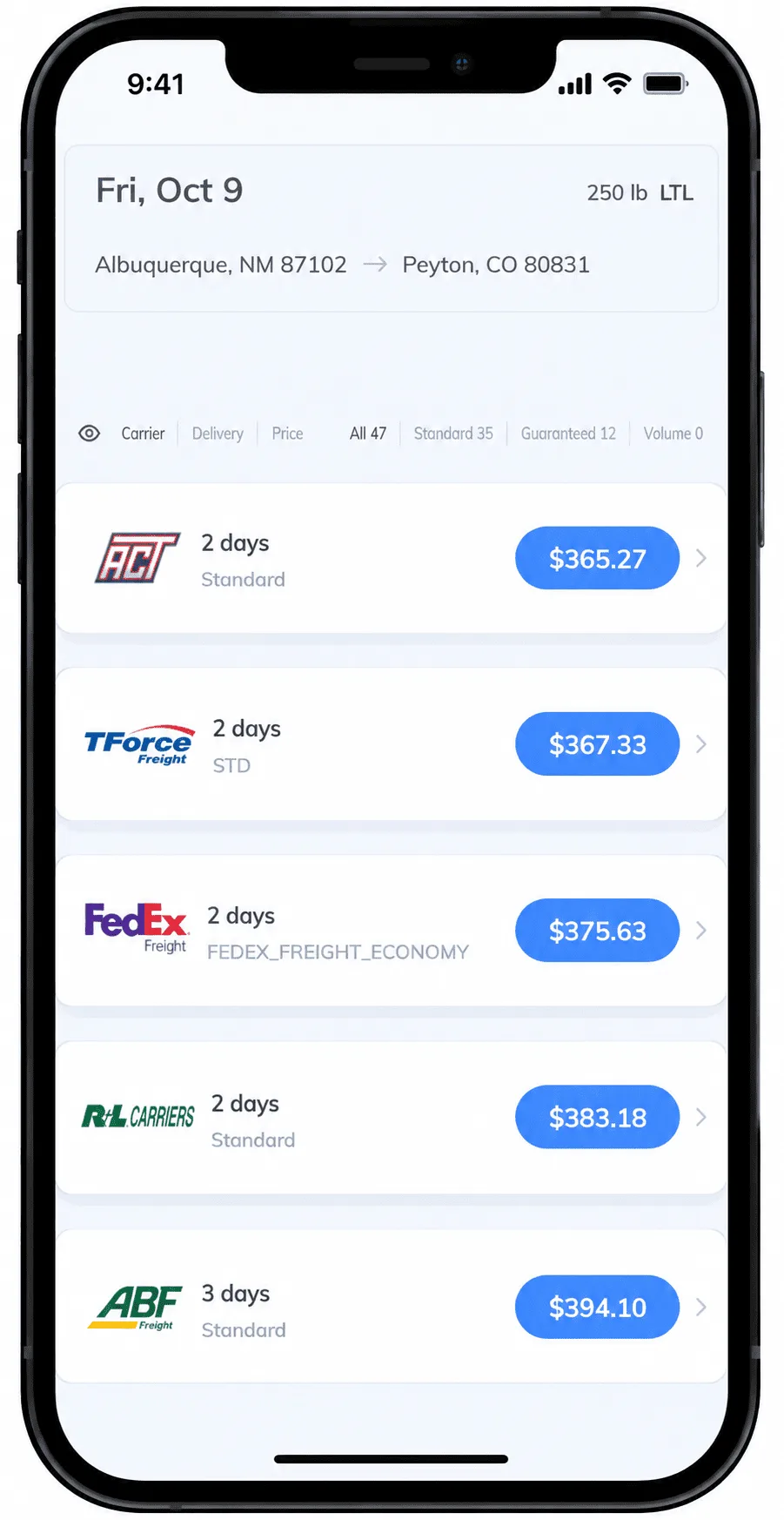
Real screenshot from a live Transportli quote for Albuquerque, NM to Peyton, CO, individual results vary by shipment and date.
Major shipping hubs in New Mexico
New Mexico’s freight moves through a few metro areas and one of the busiest inland trade points on the Mexican border:
- Albuquerque & Rio Rancho — the state’s largest market, at the crossing of I-25 and I-40, and the main carrier and warehouse hub.
- Santa Fe — the state capital, on I-25 northeast of Albuquerque.
- Santa Teresa — the port of entry that opened in 1993 across from Chihuahua, which New Mexico’s Economic Development Department says facilitates over $31 billion in trade a year. A Union Pacific intermodal facility sits on its Los Angeles to Houston route, and Doña Ana County is the state’s only countywide Foreign Trade Zone (#197). See the Borderplex report.
- Las Cruces — the southern hub on I-10 and I-25, near the Santa Teresa port of entry.
- Roswell, Hobbs & Carlsbad — the eastern oil and gas hubs, with NMDOT ports of entry at Hobbs and Carlsbad.
Highway corridors serving New Mexico
I-25 (about 462 miles in New Mexico) is the main north-south route, from I-10 at Las Cruces through Albuquerque and Santa Fe to Colorado at Raton Pass. I-40 (about 374 miles) crosses the middle of the state from Texas through Tucumcari, Albuquerque and Gallup to Arizona, and I-10 (about 164 miles) crosses the south from Arizona through Lordsburg and Las Cruces to Texas. US 285 (about 407 miles) runs north-south through the east and US 54 (about 356 miles) runs through the east and southeast, while US 550 (about 305 miles) links Albuquerque to the Four Corners.
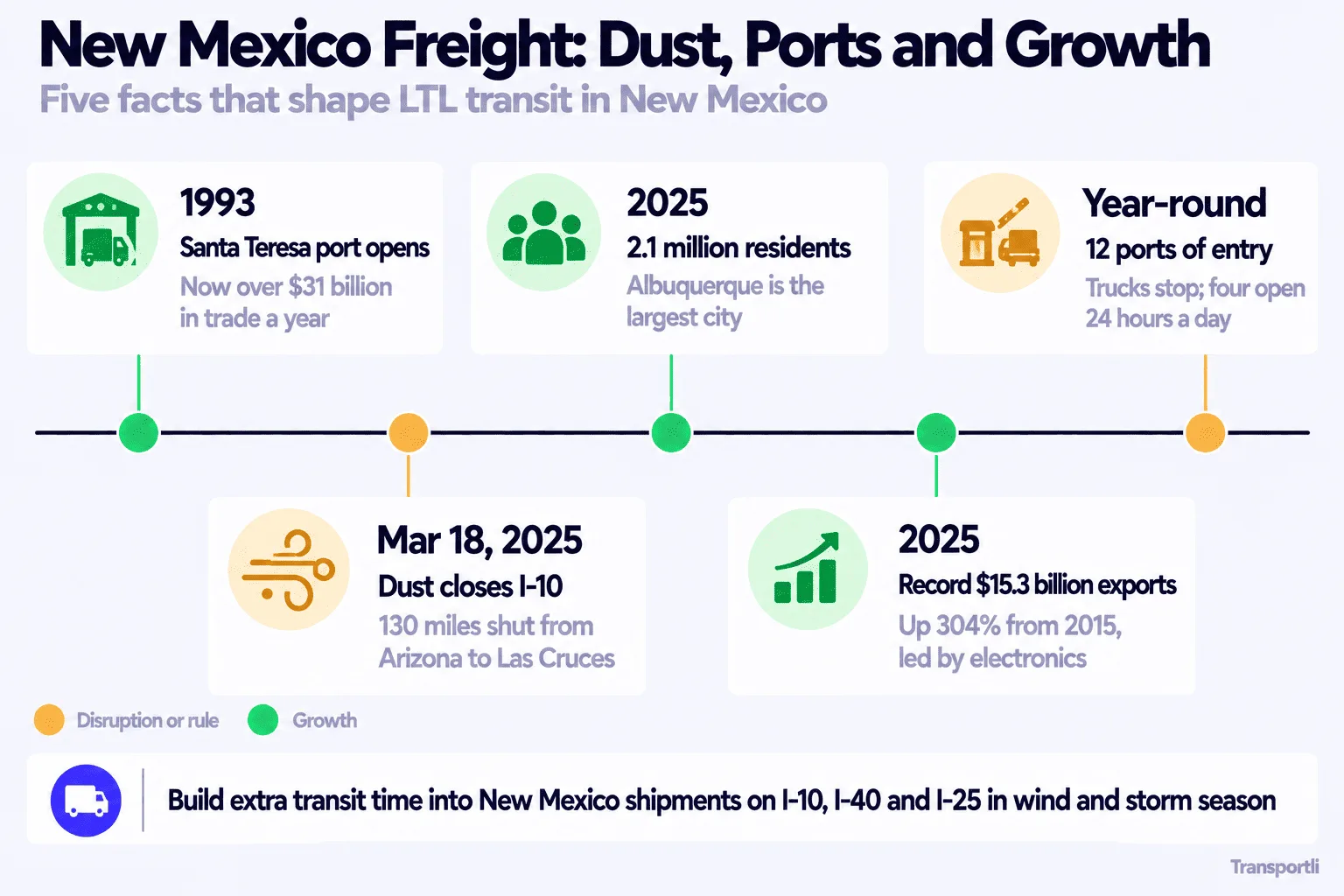
Ports of entry on New Mexico’s main routes
NMDOT lists these twelve ports of entry: Anthony (I-10 westbound, mile marker 159), Carlsbad, Clayton (US 87), Gallup (I-40 eastbound, mile marker 12), Hobbs, Lordsburg (I-10 eastbound, mile marker 23), Oro Grande (US 54 northbound), Nara Visa (US 54 westbound), Raton (I-25, exit 460), San Jon (I-40 westbound, mile marker 357), Santa Teresa and Texico (US 60 westbound). Hours vary, with four open 24 hours a day. See the NMDOT ports of entry page for hours and phone numbers.
What New Mexico shippers move
New Mexico’s freight is shaped by semiconductors, energy and farming. The state exported a record $15.3 billion of goods in 2025, the 30th most of any state and up 304% from 2015, led by $12.9 billion of computer and electronic products, with $480 million of electrical equipment, $342 million of chemicals, $269 million of machinery and $259 million of food products. Mexico took $7.1 billion, or 47% of the total, followed by China at $3.1 billion, Malaysia at $2.8 billion, Vietnam at $775 million and Japan at $254 million, according to the U.S. Trade Representative. New Mexico is also the 35th largest agricultural exporting state, shipping $912 million abroad in 2024, led by $204 million of dairy products, $176 million of beef and veal and $175 million of tree nuts. Much of this moves in full truckloads, by rail or by pipeline, but the parts, tools, supplies and finished goods around these industries are where LTL fits.
Get a New Mexico LTL quote
Compare live rates from vetted carriers serving New Mexico.
Get an LTL quote →New Mexico LTL freight: frequently asked questions
How much does LTL shipping cost to or from New Mexico?
It depends on distance, weight, freight class, and how close your pickup or delivery point is to a major metro’s carrier network. Real quotes on our platform for New Mexico lanes have ranged from about $0.23 per mile on a 100 lb shipment over 1,235 miles from Saint Cloud, Minnesota to Corrales, New Mexico to $0.87 to $1.44 per mile on a 3,200 lb shipment over 1,084 miles from Albuquerque to Richmond, California, so distance alone does not predict the price. Get an instant quote for your exact shipment.
Do oversized LTL shipments need a permit in New Mexico?
Yes, for loads over the legal limits. NMDOT issues online single-trip permits and oversize and overweight permits, and its truck permits office is at 505-476-2475. For superloads of 200,000 pounds and above, call the NMDOT Bridge Section at 505-795-4317. A standard LTL trailer within legal limits does not need one.
Do trucks have to stop at New Mexico ports of entry?
Commercial vehicles generally do. NMDOT lists twelve ports of entry, and state law has long required commercial vehicles to stop at ports for clearance. Four of them, Anthony, Gallup, Lordsburg and San Jon, are open 24 hours a day, while others have weekday hours, so check NMDOT for current hours.
What is New Mexico’s weight-distance tax?
It is a tax on heavy trucks that is handled through the New Mexico Taxation and Revenue Department. A vehicle registered in New Mexico and subject to the tax must show its weight-distance tax permit when it passes through a port of entry, and NMDOT can collect delinquent tax there.
How do dust storms and wind affect LTL shipping in New Mexico?
On March 18, 2025, blowing dust prompted NMDOT to close a 130-mile stretch of I-10 from the Arizona line to the outskirts of Las Cruces, and I-25 was briefly closed near Cochiti Pueblo. Build extra transit time into shipments on I-10, I-40 and I-25 during wind and storm season, and check NMRoads before a tight delivery.
What roads connect New Mexico’s main cities?
I-25 runs north-south through Las Cruces, Albuquerque and Santa Fe to Colorado, I-40 crosses the middle of the state through Tucumcari, Albuquerque and Gallup, and I-10 crosses the south through Lordsburg and Las Cruces. US 285 and US 54 serve the east, and US 550 links Albuquerque to the Four Corners.
Why is Santa Teresa important for freight?
It is a port of entry on the Mexican border, opened in 1993, that New Mexico’s Economic Development Department says facilitates over $31 billion in trade a year. A Union Pacific intermodal facility sits nearby, and Dona Ana County is the state’s only countywide Foreign Trade Zone.