

Shipping LTL freight to or from Illinois? Rates depend on your specific route, freight class, and how close your pickup or delivery point is to the nearest LTL terminal. Illinois isn’t just another Midwest state — Chicago is the only place in North America where all six major Class I railroads meet, handling roughly a quarter of all US rail freight, and the Chicago area is home to the continent’s single largest inland port. Here’s what actually affects your rate.
LTL trucking regulations in Illinois
Standard interstate trucking limits apply in Illinois: 80,000 lbs gross vehicle weight, 53 feet trailer length, 8.5 feet width, and 13.5 feet height. Most LTL shipments fall well within these limits — this mainly matters if your freight is unusually large or heavy.
Loads that exceed the standard limits need a Special Hauling Permit — and like several other states, Illinois splits that requirement across two authorities:
- IDOT issues oversize/overweight permits for state highways, and an IDOT permit number is actually a prerequisite for applying for a tollway permit.
- The Illinois Tollway (the Illinois State Toll Highway Authority, which operates I-90, I-94, I-88, I-294, and I-355 in the Chicago area) requires its own separate permit for oversize/overweight vehicles on toll routes — though the two agencies run a cooperative process for IDOT-permitted loads that need to cross a tollway route.
Exact current requirements and applications are available directly from IDOT:
IDOT Oversize and Overweight Permits →
What affects your Illinois LTL rate
- Freight class — density, handling, and liability determine your NMFC class, the single biggest factor in your rate. See our freight class guide.
- Distance — Illinois spans nearly 400 miles from Chicago to its southern tip, so a shipment can be a short Chicagoland move or a genuine cross-state haul.
- Terminal proximity — pickup or delivery points in or near Chicago, Joliet, or Rockford see the deepest carrier options and fastest transit; addresses in southern or rural central Illinois see fewer options and longer routes.
- Accessorials — liftgate, residential, or inside delivery add to the base rate, same as anywhere else.
Did you know?From 6 real Illinois lanes and 30 quotes
-
$88 to arrive one day sooner
Saving a day is not free
On Wauregan, CT to Lombard, IL (993 miles, 522 lb), the cheapest quote at $297 took 3 days. The fastest, at 2 days, cost $386.
-
6 carriers had the lowest quote
Six different carriers won six Illinois lanes
AAA Cooper, Central Transport, Go2 Logistics, Roadrunner, Warp, and XPO each had the lowest quote on one lane. Across the lowest quotes on every lane, 13 different carriers appeared.
-
$540 from lowest to fifth-lowest
Same shipment, quotes $540 apart
For 2,205 lb from Staten Island, NY to Chicago, IL (799 miles), the lowest quote was $439 and the fifth-lowest was $979, a 123% gap. On Chicago, IL to Lancaster, CA, all five quotes landed within $70 of each other.

Regional carrier coverage across Illinois
Illinois’s freight geography is dominated by one metro area, but real coverage differences exist across the rest of the state:
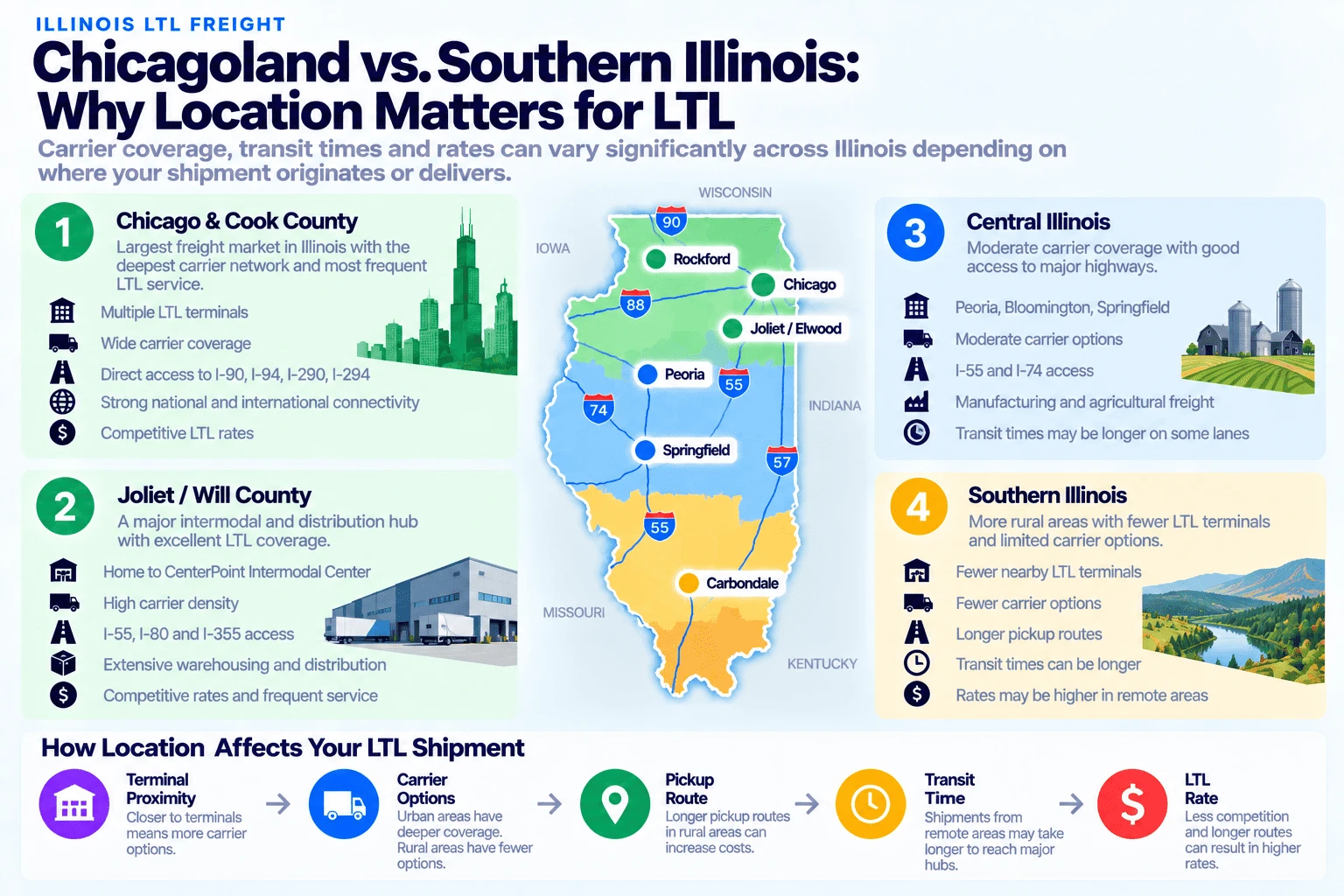
- Chicago & Cook County — by far the deepest carrier network in the Midwest, anchored by the nation’s busiest rail interchange and O’Hare International Airport.
- Will County (Joliet/Elwood) — a genuine freight hub in its own right, home to North America’s largest inland port; carrier density here rivals Chicago proper for anything moving through intermodal channels.
- Rockford & north-central Illinois — a real secondary hub built around UPS’s second-largest North American air cargo hub and a growing Amazon Air gateway.
- Central Illinois (Peoria, Bloomington, Springfield) — moderate coverage tied to agriculture and manufacturing, with reasonable I-55/I-74 access.
- Southern Illinois — the thinnest coverage in the state: fewer terminals, longer pickup routes, and transit times that can run a day or more behind Chicagoland.
Weather and transit reliability
Illinois sees a genuinely wide range of weather risk across its length. Chicago and the north deal with lake-effect snow bands off Lake Michigan and routine winter ice storms, mainly November through March. Central and southern Illinois see a different seasonal risk: spring severe thunderstorm and tornado activity, typically peaking April through June, which can shut down highways with little warning. Southern Illinois, along the Mississippi and Illinois River valleys, also carries real flood risk in wet years — river flooding has closed sections of I-55 and other river-crossing routes in past flood years. Build in extra buffer time for shipments crossing the state during either winter storm season up north or severe weather season down south.
Sample Illinois LTL rates by route
Real quotes pulled from our platform for six different Illinois lanes — same process, different carriers each time, spanning both directions and the length of the country. Rates shift with capacity and fuel costs, so treat these as a snapshot rather than a guarantee for your shipment; get an instant quote for your exact route.
Real quotes by route
Snapshot taken over recent weeks — carriers and pricing change daily.
| Carrier | Service | Transit | Price |
|---|---|---|---|
| AAA Cooper Transportation | Standard | 2 days | $288.00 |
| Central Transport | STD | 2 days | $370.16 |
| XPO | Standard | 2 days | $401.54 |
| Estes | LTL Standard Transit | 3 days | $426.37 |
| Forward Air | STD | 3 days | $426.82 |
| Carrier | Service | Transit | Price |
|---|---|---|---|
| Go2 Logistics | LTL Standard Transit | 2 days | $438.66 |
| Central Transport | Standard | 3 days | $636.76 |
| Estes | LTL Standard Transit | 2 days | $776.36 |
| STG Logistics | Standard | 5 days | $810.29 |
| ABF Freight | Standard | 3 days | $978.85 |
| Carrier | Service | Transit | Price |
|---|---|---|---|
| Warp | STD | 3 days | $513.28 |
| Forward Air | Standard | 5 days | $538.13 |
| Estes | LTL Standard Transit | 4 days | $565.87 |
| Roadrunner Freight | Standard Service | 5 days | $582.78 |
| ABF Freight | Standard | 4 days | $583.25 |
| Carrier | Service | Transit | Price |
|---|---|---|---|
| XPO | Standard | 4 days | $566.14 |
| TForce Freight | STD | 6 days | $575.91 |
| AAA Cooper Transportation | Standard | 4 days | $632.99 |
| Forward Air | Standard | 4 days | $667.89 |
| Central Transport | Standard | 5 days | $704.70 |
| Carrier | Service | Transit | Price |
|---|---|---|---|
| Roadrunner Freight | Standard Service | 3 days | $429.18 |
| TForce Freight | STD | 5 days | $429.79 |
| STG Logistics | Standard | 10 days | $453.33 |
| AAA Cooper Transportation | Standard | 5 days | $491.30 |
| Warp | Standard | 5 days | $504.77 |
| Carrier | Service | Transit | Price |
|---|---|---|---|
| Central Transport | STD | 3 days | $297.23 |
| Roadrunner Freight | Standard Service | 3 days | $347.59 |
| R+L Carriers | STD | 3 days | $375.00 |
| TForce Freight | Standard | 3 days | $384.08 |
| Saia | Standard | 2 days | $385.68 |
Rate, transit, and price-per-mile summary
Pulling the six lanes above together shows how much distance and shipment weight actually drive Illinois LTL pricing:
| Route | Distance | Weight | Price range | Transit range | Price per mile |
|---|---|---|---|---|---|
| Huntsville, TN → Lombard, IL | 536 mi | 355 lb | $288–$427 | 2–3 days | $0.54–$0.80 |
| Staten Island, NY → Chicago, IL | 799 mi | 2,205 lb | $439–$979 | 2–5 days | $0.55–$1.23 |
| Chicago, IL → Lancaster, CA | 1,997 mi | 200 lb | $513–$583 | 3–5 days | $0.26–$0.29 |
| Rock Falls, IL → Nampa, ID | 1,597 mi | 600 lb | $566–$705 | 4–6 days | $0.35–$0.44 |
| Romeoville, IL → Lynnwood, WA | 2,084 mi | 540 lb | $429–$521 | 3–10 days | $0.21–$0.25 |
| Wauregan, CT → Lombard, IL | 993 mi | 522 lb | $297–$386 | 2–3 days | $0.30–$0.39 |
The familiar pattern holds for most of these lanes: our two longest hauls (to Washington and California, both 2,000 miles) settle into the cheapest per-mile range, around $0.21–$0.29/mile. The outlier is Staten Island to Chicago — at just 799 miles it’s the most expensive lane per mile by far, but that’s a weight story, not a distance one: at 2,205 lbs, it’s more than four times heavier than any other lane in this batch, and LTL pricing scales with density and weight as much as it does with mileage. For a typical shipment under 600 lbs, Illinois rates track distance closely; heavier freight breaks that pattern fast.
Major shipping hubs in Illinois
Illinois’s carrier terminal network is concentrated around a handful of metro areas, which generally means faster pickup windows and more carrier options the closer you are to one of these:
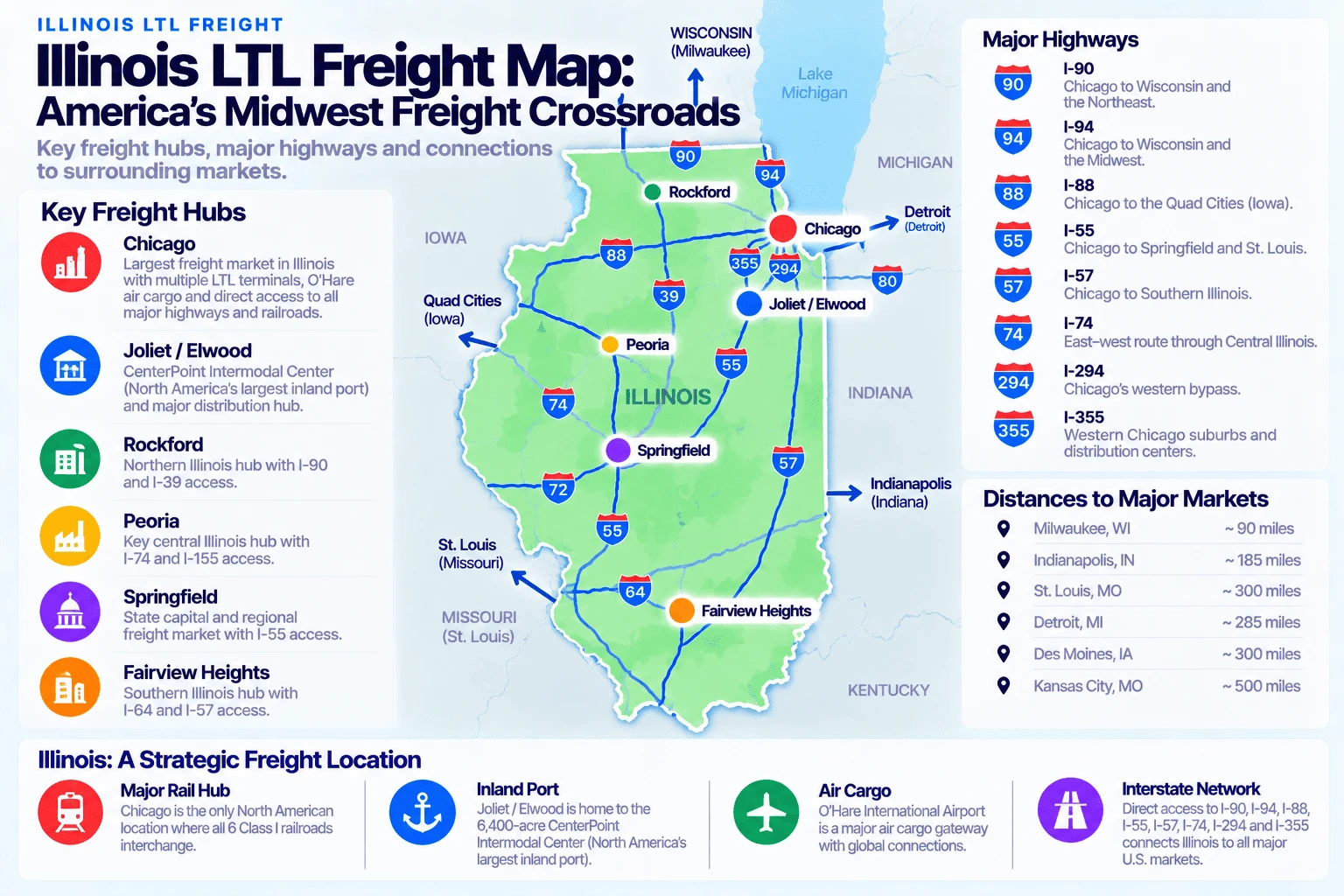
- Chicago — the state’s primary freight gateway and arguably the most important freight city in North America. Chicago is the only place where all six major Class I railroads interchange, handling over 500 freight trains a day and an estimated quarter of all US rail freight.
- Joliet & Elwood (Will County) — home to the CenterPoint Intermodal Center, a 6,400-acre complex that’s North America’s largest inland port, anchored by Union Pacific’s 835-acre Joliet Intermodal Terminal and BNSF’s 770-acre Logistics Park Chicago, with direct rail service to every major West Coast port.
- O’Hare International Airport — handled over 2.2 million metric tons of air cargo in 2025 and ranked #1 globally for aircraft movements that same year.
- Rockford — home to UPS’s second-largest North American air cargo hub (after Louisville) and a growing regional gateway for Amazon Air, making it a real secondary freight hub in its own right.
- Peoria & Central Illinois — a manufacturing and agricultural hub with moderate carrier coverage along I-55/I-74.
Highway corridors serving Illinois
Illinois’s freight network radiates out from Chicago’s dense interstate web: I-90 and I-94 carry freight north toward Wisconsin and the Pacific Northwest, I-88 runs west toward the Quad Cities and Iowa, and I-294 and I-355 form the tollway bypass around the city. I-55 runs the length of the state from Chicago through Springfield down to St. Louis, while I-57 heads south through central Illinois toward Memphis. I-80 crosses the state east-west through Joliet, directly serving the CenterPoint intermodal complex, and I-39 connects Rockford south toward Bloomington. Nearly all of these routes converge on or near Chicago, which is exactly why the metro area anchors freight movement for the entire state.
Why Chicago is a freight superhub
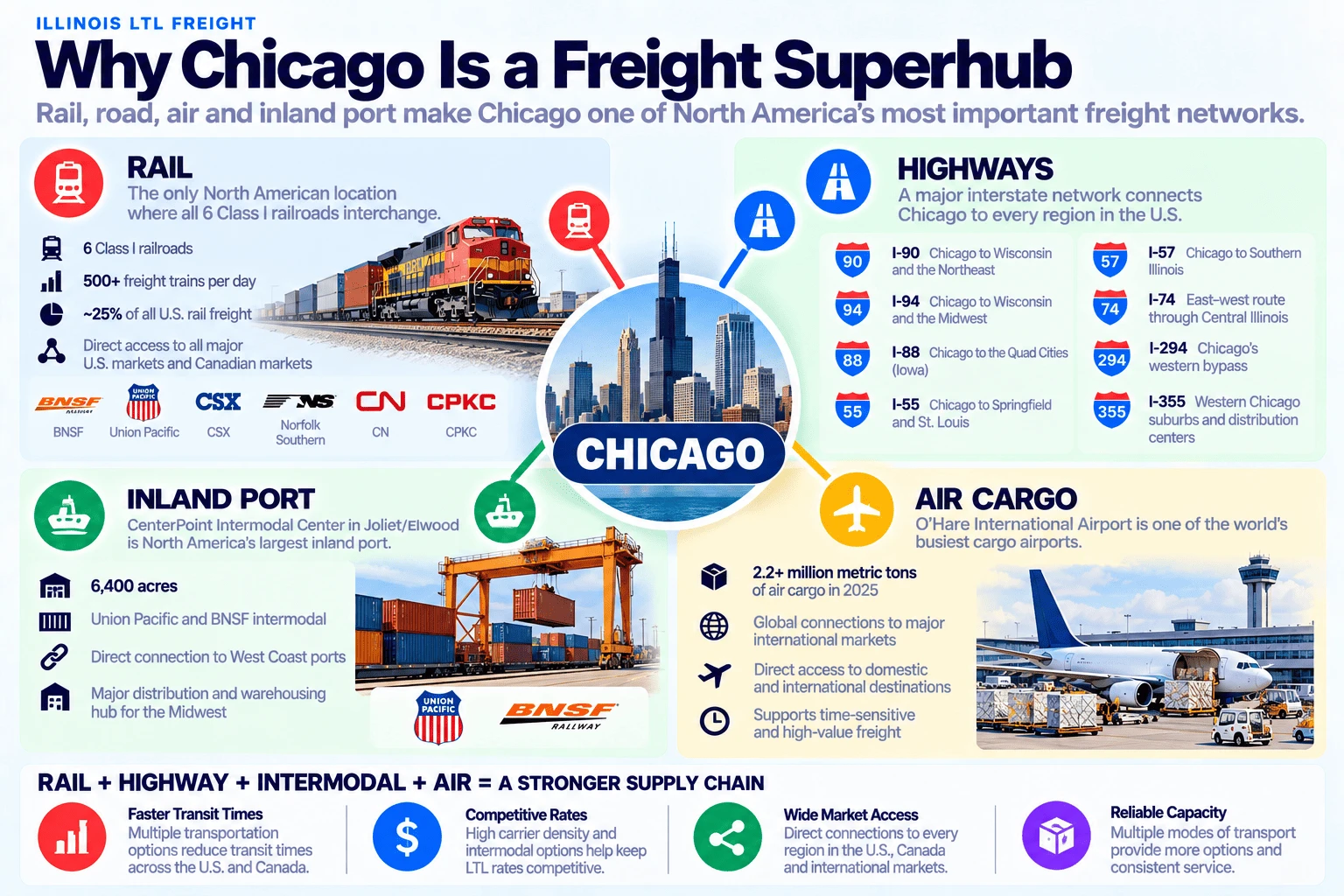
No other US metro combines all four freight modes the way Chicago does. Rail is the anchor — the only North American location where all six Class I railroads (BNSF, Union Pacific, CSX, Norfolk Southern, CN, and CPKC) physically interchange, moving over 500 freight trains a day and an estimated 25% of all US rail freight. Highways radiate out in every direction, with direct interstate access to every major US region. The CenterPoint Intermodal Center in Joliet/Elwood adds a genuine inland port to the mix, and O’Hare rounds it out with over 2.2 million metric tons of air cargo a year. That combination — rail, highway, inland port, and air, all in the same metro area — is exactly why Chicago-area carrier density and rate competitiveness are hard to match anywhere else in the country.
What Illinois shippers move
Illinois’s freight mix starts with freight itself: Chicago’s rail and intermodal complex is a genuine industry, moving containerized goods between West Coast ports and the rest of the country, with the CenterPoint Intermodal Center in Joliet alone representing one of the largest concentrations of warehouse and distribution space in the country. Agriculture is the other pillar — Illinois was the nation’s top soybean-producing state in 2025 (over 639 million bushels) and the second-largest corn producer (2.35 billion bushels, behind Iowa), generating steady grain, feed, and food-processing freight. Archer-Daniels-Midland, one of the world’s largest agricultural processors, is headquartered in Chicago. Manufacturing remains a real driver too — Deere & Company, one of the world’s largest makers of agricultural equipment, is headquartered in Moline. Add in O’Hare’s air cargo volume and Rockford’s UPS/Amazon Air hub, and Illinois generates freight demand through nearly every mode there is.
Get an Illinois LTL quote
Compare live rates from vetted carriers serving Illinois.
Get an LTL quote →Illinois LTL freight: frequently asked questions
How much does LTL shipping cost to or from Illinois?
It depends heavily on distance, weight, and freight class. Real Illinois lanes in our data ranged from about $288 for a light regional shipment out of Tennessee up to $979 for a much heavier haul from New York — weight matters as much as distance here, since our priciest lane per mile wasn’t the shortest one, it was the heaviest at over 2,200 lbs. Get an instant quote for your exact shipment.
Do oversized LTL shipments need a permit in Illinois?
Only if your load exceeds the standard interstate limits (80,000 lbs, 53 feet long, 8.5 feet wide, 13.5 feet tall). Illinois requires separate permits from two authorities: IDOT for state highways, and the Illinois Tollway for oversize/overweight vehicles on toll routes (I-90, I-94, I-88, I-294, I-355) — an IDOT permit number is required before you can even apply for a tollway permit.
Why is Illinois such an important freight state?
Chicago is the only place in North America where all six major Class I railroads interchange, moving an estimated quarter of all US rail freight through over 500 trains a day. Add in the CenterPoint Intermodal Center in Joliet — North America’s largest inland port — plus O’Hare’s 2.2 million metric tons of annual air cargo and Rockford’s status as UPS’s second-largest North American hub, and Illinois is arguably the single most important freight state in the country by volume of freight passing through it.
Which carriers serve Illinois?
Virtually every national LTL carrier serves Illinois, with the deepest coverage around Chicago, Joliet, and Rockford — availability and pricing vary by exact route, and southern Illinois sees noticeably fewer options.
Is LTL service the same everywhere in Illinois?
No. Chicago, Joliet, and Rockford have by far the strongest carrier coverage in the state. Central Illinois has moderate coverage, while southern Illinois sees meaningfully fewer carrier options and longer transit times.
What is the CenterPoint Intermodal Center and why does it matter for LTL shipping?
It’s a 6,400-acre logistics complex in Joliet and Elwood, about 40 miles southwest of Chicago, that’s recognized as North America’s largest inland port. It includes major rail terminals from both Union Pacific and BNSF with direct service to every major West Coast port, which is why the Will County area has carrier density that rivals Chicago itself for freight moving through intermodal channels.