

Shipping LTL freight to or from South Dakota? Rates depend on your specific route, freight class, and how close your pickup or delivery point is to the nearest LTL terminal. South Dakota is a genuinely distinctive freight state: Sioux Falls became the nation’s consumer-credit-card capital after the state abolished its interest-rate cap in 1980, the same tax-friendly rules now put more than $360 billion in trust assets under management there, and every August a town of a few thousand people hosts well over half a million visitors for the Sturgis Motorcycle Rally. Here’s what actually affects your rate.
LTL trucking regulations in South Dakota
South Dakota’s oversize/overweight thresholds are close to the federal baseline, but the Black Hills region adds a distinctive local escort rule that matters if you’re moving anything wide through Rapid City:
- An oversize permit is required for loads exceeding 8.5 feet wide, 14 feet high, or 80,000 lbs gross on the Interstate system. Permits are issued by South Dakota Highway Patrol Motor Carrier Services through the state’s online SDAPS permit system, and single-trip permits cover a short window meant for one trip only.
- Travel is generally restricted to daylight hours — roughly a half hour before sunrise to a half hour after sunset — though loads under 10 feet wide, 14.5 feet high, and 110 feet long can move around the clock on Interstates. Escorts are required for loads over 16 feet wide on Interstates or 20 feet wide on state highways, but in the Black Hills region around Rapid City, any load over just 10 feet wide requires a front escort on state highways — a stricter local rule tied to the area’s mountain terrain.
- Most standard LTL freight falls well within these limits — this mainly matters for oversized equipment and machinery moving through the Black Hills and the ongoing construction buildout at Ellsworth Air Force Base near Rapid City.
Current permit thresholds and axle limits are public record:
South Dakota Vehicle Permits and Applications →
What affects your South Dakota LTL rate
- Freight class — density, handling, and liability determine your NMFC class, the single biggest factor in your rate. See our freight class guide.
- Distance — South Dakota is thinly populated outside its two main metros and spread across a huge geographic area, with real gaps in coverage between them.
- Terminal proximity — pickup or delivery points near Sioux Falls, at the state’s only interstate-to-interstate interchange, typically see the most carrier options and fastest transit; the more remote Black Hills region around Rapid City sees noticeably fewer.
- Accessorials — liftgate, residential, or inside delivery add to the base rate, same as anywhere else.
Did you know?From 6 real South Dakota lanes and 30 quotes
-
4× the cost per mile
Cost per mile varied widely on South Dakota lanes
A 4,900 lb shipment moving 1,483 miles (Ontario, CA to Platte, SD) had a lowest quote of $1,762, or $1.19 a mile. A 220 lb shipment moving 1,102 miles (Fremont, MI to Eagle Butte, SD) had a lowest quote of $349, or $0.32 a mile.
-
$600 to arrive 3 days sooner
Speed has a price
On Ontario, CA to Platte, SD (1,483 miles, 4,900 lb), the cheapest quote at $1,762 took 6 days. The fastest, at 3 days, cost $2,363. On Sioux Falls, SD to Houston, TX, 2-day delivery cost $528 against $396 for 3 days.
-
3 carriers had the lowest quote
Three different carriers won six South Dakota lanes
AAA Cooper had the lowest quote on three lanes. Pitt Ohio had the lowest quote on two lanes. Central Transport had the lowest quote on one lane. Across the lowest quotes on every lane, 13 different carriers appeared.
-
$600 from lowest to fifth-lowest
Same shipment, quotes $600 apart
For 4,900 lb from Ontario, CA to Platte, SD (1,483 miles), the lowest quote was $1,762 and the fifth-lowest was $2,363, a 34% gap.

Regional carrier coverage across South Dakota
South Dakota’s freight geography splits sharply between the fast-growing east, anchored by Sioux Falls, and the more remote west-river region around Rapid City and the Black Hills, with real coverage differences between them:
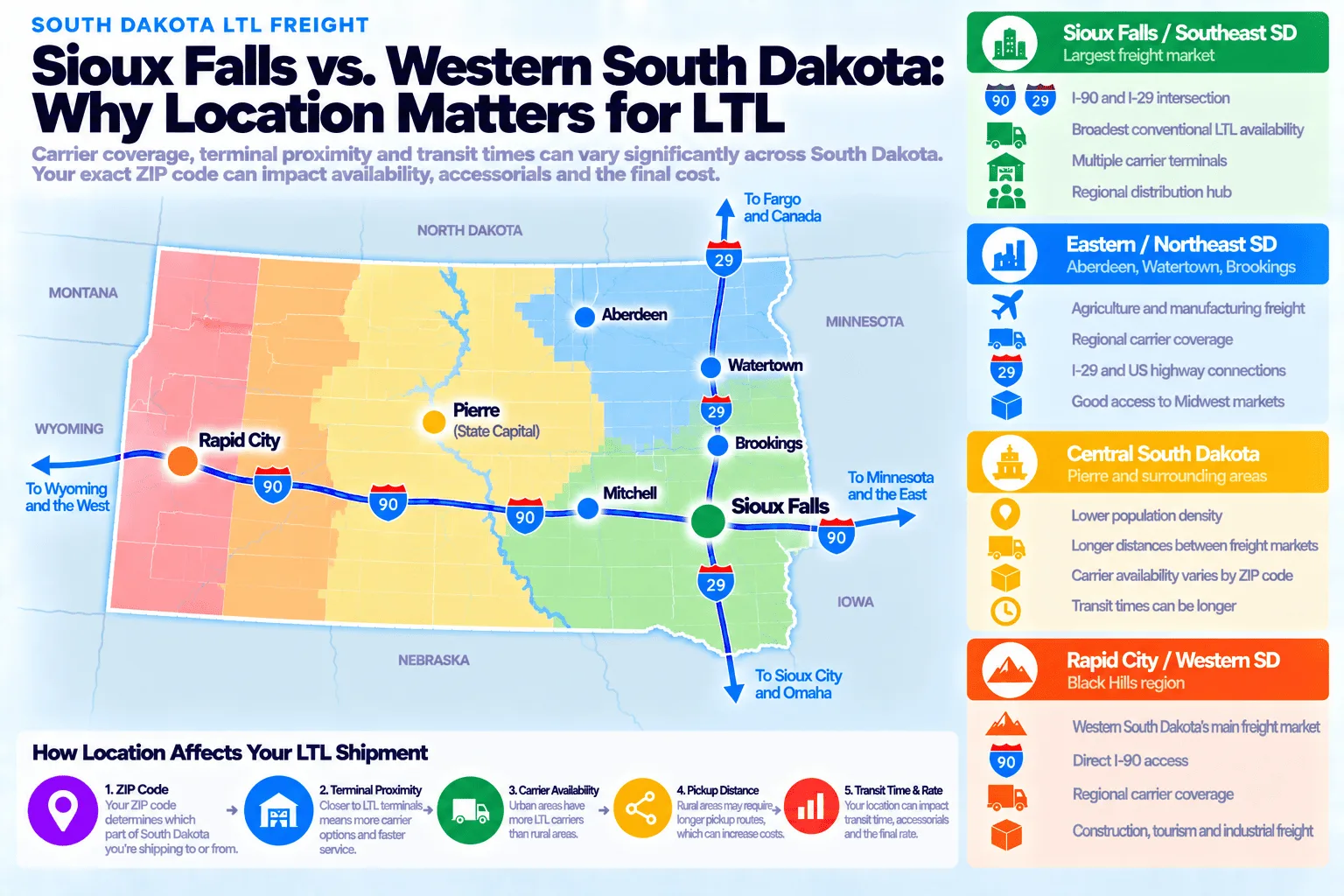
- Sioux Falls & the I-29/I-90 corridor — South Dakota’s largest city by a wide margin, sitting at the state’s only true interstate-to-interstate interchange, gives it the deepest carrier network and the most shipping options in the state.
- Rapid City & the Black Hills — gateway to Mount Rushmore and home to Ellsworth Air Force Base, currently in the middle of a multibillion-dollar construction buildout; solid regional coverage but noticeably thinner than Sioux Falls.
- Aberdeen & Watertown — secondary hubs in the northeast along or near I-29, serving the state’s grain and livestock belt.
- Pierre — the state capital, sitting roughly 30 miles north of I-90 and one of the few state capitals not directly on an interstate; modest carrier coverage given its size.
- West-river and rural South Dakota — the thinnest coverage in the state: fewer terminals, longer pickup routes, and transit times that can run well behind the I-29 corridor.
Weather and transit reliability
South Dakota sits squarely on the northern Great Plains storm track, seeing both severe winter weather and real tornado risk. Winters bring routine blizzards severe enough that the state DOT regularly closes stretches of I-29 and I-90 outright — both interstates were shut down for a multi-day winter storm in March 2026, following a similar statewide closure in February 2023. Summer brings its own risk: South Dakota averages roughly 36 tornadoes a year, a meaningful count for a state this size, concentrated mostly east of the Missouri River. Given how much of the state’s freight moves along just two interstates, a single storm closure can delay shipments across a wide area with few practical alternate routes.
Sample South Dakota LTL rates by route
Real quotes pulled from our platform for six different South Dakota lanes — same process, different carriers each time, spanning a huge range of weights and distances. Rates shift with capacity and fuel costs, so treat these as a snapshot rather than a guarantee for your shipment; get an instant quote for your exact route.
Real quotes by route
Snapshot taken over recent weeks — carriers and pricing change daily.
| Carrier | Service | Transit | Price |
|---|---|---|---|
| AAA Cooper Transportation | Standard | 3 days | $395.73 |
| XPO | STD | 2 days | $527.70 |
| Southeastern Freight Lines | Standard | 4 days | $569.43 |
| FedEx Freight Economy | Standard | 3 days | $572.61 |
| Forward Air | Standard | 4 days | $596.71 |
| Carrier | Service | Transit | Price |
|---|---|---|---|
| AAA Cooper Transportation | Standard | 3 days | $482.28 |
| Estes | LTL Standard Transit | 5 days | $484.58 |
| FedEx Freight | Standard | 4 days | $608.57 |
| Central Transport | Standard | 5 days | $608.57 |
| XPO | Standard | 4 days | $624.96 |
| Carrier | Service | Transit | Price |
|---|---|---|---|
| Pitt Ohio | Standard | 9 days | $348.99 |
| AAA Cooper Transportation | Standard | 7 days | $358.81 |
| TForce Freight | STD | 7 days | $419.84 |
| Saia | Standard | 3 days | $430.46 |
| Old Dominion Freight Line | Standard | 6 days | $489.88 |
| Carrier | Service | Transit | Price |
|---|---|---|---|
| AAA Cooper Transportation | Standard | 6 days | $1,762.26 |
| TForce Freight | STD | 8 days | $1,898.11 |
| Central Transport | Standard | 5 days | $2,076.98 |
| Saia | Standard | 4 days | $2,253.69 |
| FedEx Freight – Freight Priority | FEDEX_FREIGHT_PRIORITY | 3 days | $2,362.66 |
| Carrier | Service | Transit | Price |
|---|---|---|---|
| Central Transport | Standard | 2 days | $302.34 |
| AAA Cooper Transportation | Standard | 2 days | $353.92 |
| FedEx Freight Economy | Standard | 3 days | $384.23 |
| Dayton Freight | Standard | 3 days | $384.83 |
| TForce Freight | STD | 6 days | $402.86 |
| Carrier | Service | Transit | Price |
|---|---|---|---|
| Pitt Ohio | Standard | 8 days | $672.68 |
| Central Transport | Standard | 3 days | $684.18 |
| TForce Freight | STD | 5 days | $746.24 |
| ABF Freight | Standard | 4 days | $795.11 |
| Estes | LTL Standard Transit | 8 days | $850.16 |
Rate, transit, and price-per-mile summary
Pulling the six lanes above together, one lane tells the real South Dakota story — not a price spike, but a transit-time spike:
| Route | Distance | Weight | Price range | Transit range | Price per mile |
|---|---|---|---|---|---|
| Sioux Falls, SD → Houston, TX | 1,091 mi | 550 lb | $396–$597 | 2–4 days | $0.36–$0.55 |
| Rapid City, SD → Burien, WA | 1,145 mi | 7 lb | $482–$625 | 3–5 days | $0.42–$0.55 |
| Fremont, MI → Eagle Butte, SD | 1,102 mi | 220 lb | $349–$490 | 3–9 days | $0.32–$0.44 |
| Ontario, CA → Platte, SD | 1,483 mi | 4,900 lb | $1,762–$2,363 | 3–6 days | $1.19–$1.59 |
| Memphis, TN → Sioux Falls, SD | 820 mi | 350 lb | $302–$403 | 2–6 days | $0.37–$0.49 |
| Webster, NY → Milbank, SD | 1,219 mi | 1,600 lb | $673–$850 | 3–8 days | $0.55–$0.70 |
Fremont, Michigan to Eagle Butte is the standout, and not for the reason you’d expect. At just 220 lbs over a fairly typical 1,102 miles, it actually prices as the cheapest lane in this data per mile — $0.32–$0.44. What jumps out instead is the transit spread: the cheapest carrier quoted 9 days, more than triple the fastest carrier’s 3 days, and easily the widest transit range of any lane here. Eagle Butte sits deep in Dewey County on the Cheyenne River Reservation, right in the west-river and rural region flagged earlier in this guide as having the thinnest LTL coverage in the state — and this lane shows exactly what that looks like in practice: it’s not that carriers won’t serve it, it’s that getting there reliably fast is a genuinely harder problem than price alone suggests. Compare that to Rapid City to Burien, Washington: a shipment of just 7 lbs, small enough that pricing is essentially governed by a flat minimum charge rather than actual freight weight, yet it still lands in the same $0.42–$0.55 per-mile range as much heavier lanes. And Ontario, California to Platte is the clear outlier on price, not because of distance but because of weight — at 4,900 lbs, it’s more than eight times heavier than any other lane in this data, which is exactly why it prices at $1.19–$1.59 per mile even on a route that isn’t unusually remote.
Major shipping hubs in South Dakota
South Dakota’s carrier terminal network is concentrated around two very different centers — the fast-growing east and the more remote Black Hills — which generally means faster pickup windows and more carrier options the closer you are to one of these:
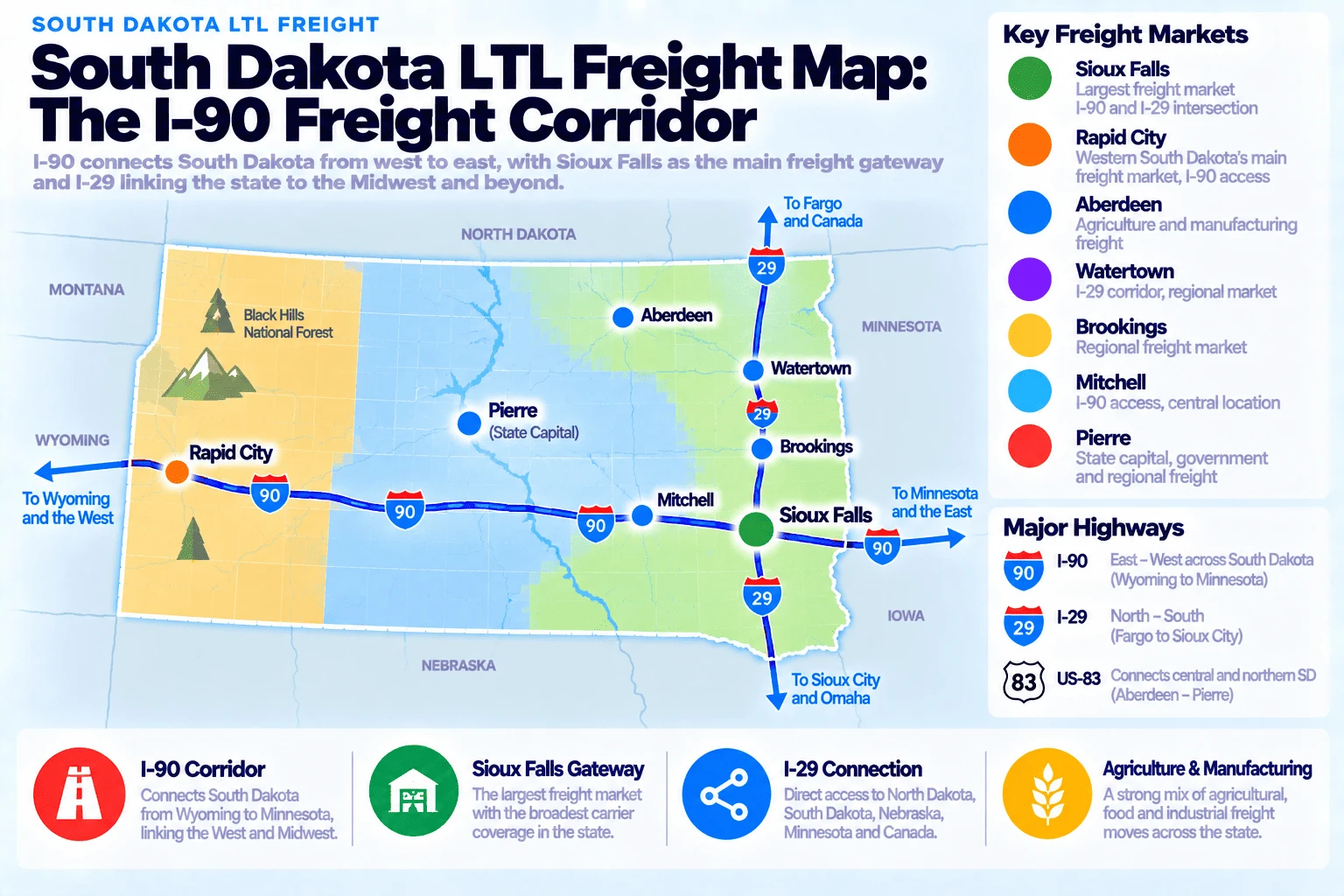
- Sioux Falls — South Dakota’s largest city by a wide margin at roughly 225,000 residents, up more than 12% since 2020, and the nation’s consumer-banking capital: Citibank relocated its national credit-card operation here in 1980 after South Dakota abolished its interest-rate cap, and Wells Fargo, HSBC, and Target Card followed. The financial-services sector alone now employs more than 8,000 people.
- Rapid City — gateway to the Black Hills and Mount Rushmore, and home to Ellsworth Air Force Base, selected in 2021 as the first main operating base for the Air Force’s new B-21 Raider stealth bomber — a build-out now driving well over a billion dollars in active military construction.
- Aberdeen — a regional hub in the northeast, serving the state’s grain and livestock belt.
- Watertown — another northeast hub along I-29, close to the Minnesota border.
- Mitchell — home of the famous Corn Palace, sitting directly on I-90 between Sioux Falls and Rapid City.
Highway corridors serving South Dakota
I-90 is South Dakota’s primary east-west freight artery, entering from Wyoming near Spearfish, running through Rapid City, Mitchell, and Sioux Falls before crossing into Minnesota — a route that also crosses the Missouri River at Chamberlain, near the 50-foot Dignity sculpture overlooking the river from a rest stop. I-29 runs north-south along the state’s eastern edge, connecting Sioux Falls to Fargo, North Dakota to the north and Sioux City, Iowa and Omaha, Nebraska to the south, largely tracing the agricultural Big Sioux River valley. I-229 is an 11-mile loop around Sioux Falls connecting I-29 to I-90 on the city’s south and east sides. I-90 and I-29 meet at Sioux Falls, the state’s only true interstate-to-interstate interchange, which is exactly why Sioux Falls, not the capital Pierre, is South Dakota’s real freight center.
Why the Ellsworth Air Force Base buildout matters for South Dakota freight
In June 2021, Ellsworth Air Force Base near Rapid City was selected as the first main operating base and formal training unit for the Air Force’s new B-21 Raider stealth bomber, replacing the aging B-1B Lancer fleet. The first B-21 delivery to Ellsworth is on track for 2027, backed by a facility-improvement program estimated well over a billion dollars — a sustained construction and materials-freight driver for the Rapid City region that shows no sign of slowing. For South Dakota LTL freight, that means real, current demand for construction materials, equipment, and industrial supplies moving through a market that’s otherwise much thinner than Sioux Falls.
What South Dakota shippers move
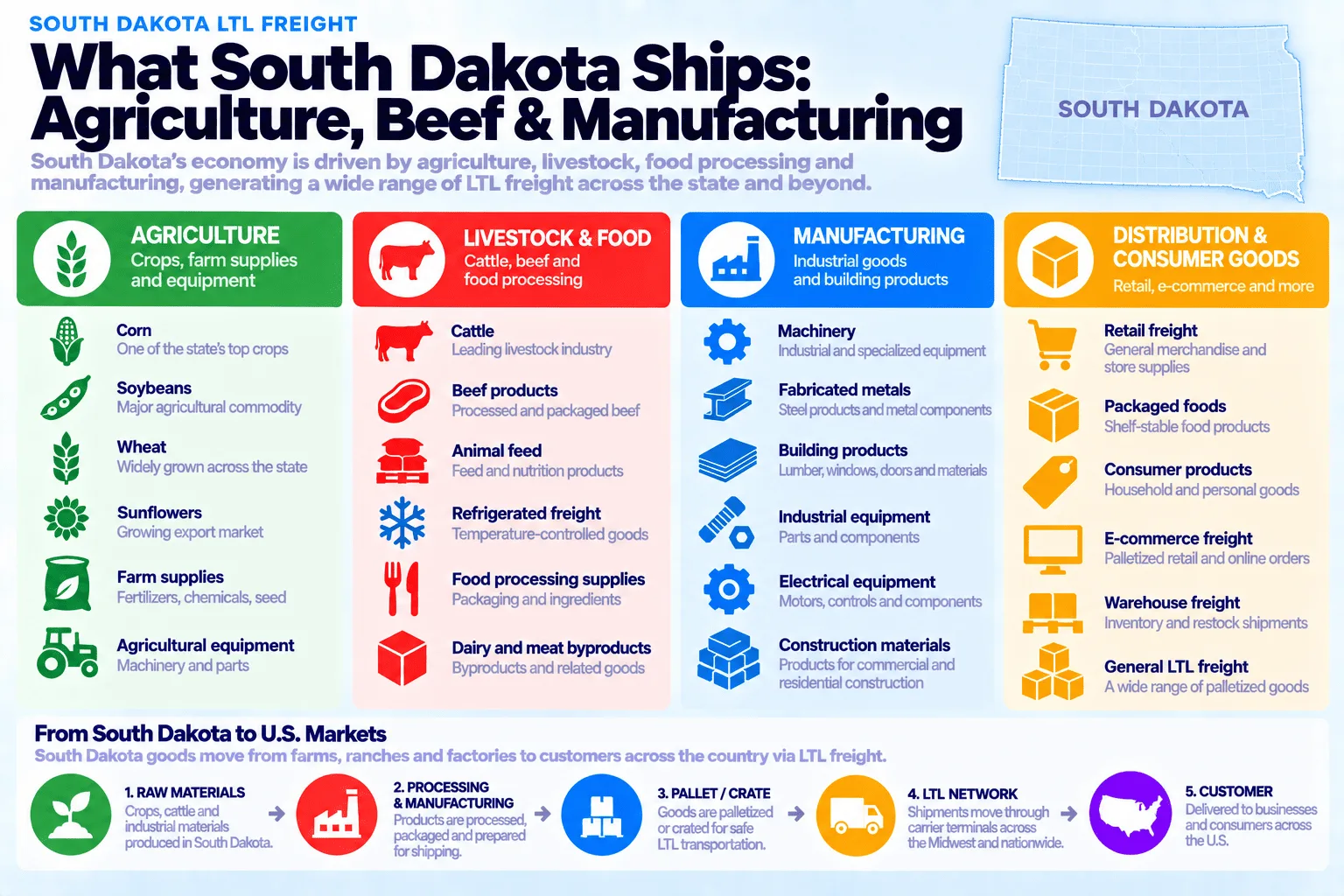
South Dakota’s freight mix runs from heavy agriculture to an outsized financial-services sector. Corn and soybeans dominate the east: 2024 was a record year for South Dakota corn at 857 million bushels, and soybean production topped 254 million bushels. Cattle matter just as much — South Dakota ranks 5th nationally in beef cow inventory and 7th in cattle-on-feed — and the state is the nation’s 5th-largest fuel-ethanol producer, with 16 plants turning out roughly 1.5 billion gallons a year. Sioux Falls’ financial sector, built on the state’s 1980 repeal of its interest-rate cap, now oversees more than $360 billion in trust assets through dozens of chartered trust companies, a direct byproduct of South Dakota having no state income tax, no corporate income tax, and no capital gains or inheritance tax. And every August, the Sturgis Motorcycle Rally briefly multiplies a town of a few thousand people into an event drawing well over half a million visits and hundreds of millions of dollars in economic impact — a real, if temporary, spike in freight for fuel, food and beverage, and vendor merchandise.
Quick facts
- Real South Dakota lanes in our data ranged from $302 to $2,363, depending on distance and vehicle weight
- A 7 lb shipment from Rapid City still priced at $482+ — real proof that minimum charges, not distance, often set small-shipment pricing
- Fremont, MI to Eagle Butte, SD took up to 9 days despite a fairly ordinary ~1,100-mile distance — real evidence of thinner carrier coverage in west-river South Dakota
Get a South Dakota LTL quote
Compare live rates from vetted carriers serving South Dakota.
Get an LTL quote →South Dakota LTL freight: frequently asked questions
How much does LTL shipping cost to or from South Dakota?
It depends heavily on distance, weight, and how remote your pickup or delivery point is. Real South Dakota lanes in our data ranged from about $302 for a short regional haul into Sioux Falls up to $2,363 for a nearly 5,000 lb shipment out of California — and a lightweight 220 lb shipment into Eagle Butte, in the state’s remote west-river region, still took as long as 9 days with the cheapest carrier despite a fairly typical distance. Get an instant quote for your exact shipment.
Do oversized LTL shipments need a permit in South Dakota?
Yes, for loads exceeding 8.5 feet wide, 14 feet high, or 80,000 lbs gross on the Interstate system. South Dakota Highway Patrol Motor Carrier Services issues permits through the state’s SDAPS system. Most standard LTL freight falls well within these limits — the main exception is oversized equipment moving through the Black Hills, where any load over 10 feet wide needs a front escort on state highways.
Why does the Ellsworth Air Force Base buildout matter for South Dakota freight?
Ellsworth, near Rapid City, was selected in 2021 as the first main operating base for the Air Force’s new B-21 Raider stealth bomber, with the first delivery on track for 2027. The facility-improvement program tied to that buildout is estimated well over a billion dollars, generating sustained demand for construction materials and equipment freight in and around Rapid City.
Which carriers serve South Dakota?
Most major national LTL carriers serve South Dakota, with the deepest coverage around Sioux Falls, at the junction of I-29 and I-90. Rapid City and the Black Hills see solid but noticeably thinner coverage, and availability and pricing vary by exact route.
Is LTL service the same everywhere in South Dakota?
No. Sioux Falls has by far the strongest LTL coverage in the state, thanks to its position at South Dakota’s only interstate-to-interstate interchange. Rapid City and the Black Hills have solid regional coverage, while west-river and rural areas see meaningfully fewer carrier options and longer transit times.
Why is Sioux Falls such a major banking hub, and does that affect freight?
South Dakota abolished its interest-rate cap in 1980, prompting Citibank to relocate its national credit-card operation to Sioux Falls; Wells Fargo, HSBC, and other major issuers followed. That same tax-friendly environment, with no state income tax and no corporate income tax, now supports more than $360 billion in trust assets managed out of Sioux Falls. The resulting office and business growth is a real driver of the general freight demand that makes Sioux Falls the state’s deepest carrier market.