

Shipping less-than-truckload (LTL) freight to or from Pennsylvania? Rates depend on your specific route, freight class, and how close your pickup or delivery point is to the nearest LTL terminal. Pennsylvania isn’t just another state on the map — the I-78/I-81 corridor across central Pennsylvania puts carriers within a single day’s drive of roughly 40% of the US population, which is exactly why the state has become one of the country’s biggest warehousing and distribution hubs. Here’s what actually affects your rate.
LTL trucking regulations in Pennsylvania
Standard interstate trucking limits apply in Pennsylvania: 80,000 lbs gross vehicle weight, 53 feet trailer length, 8.5 feet width, and 13.5 feet height. Most LTL shipments fall well within these limits — this mainly matters if your freight is unusually large or heavy.
Loads that exceed the standard limits need a Special Hauling Permit — and like several other states, Pennsylvania splits that requirement across two separate authorities:
- PennDOT issues Special Hauling Permits for state highways under its jurisdiction.
- The Pennsylvania Turnpike Commission requires its own, separate Special Hauling Permit for the Turnpike system (I-76, I-276, I-476, and related toll roads) — a PennDOT permit alone does not cover Turnpike travel. Turnpike permits carry a $37 flat fee plus a per-ton-mile fee on weight over 80,000 lbs, and oversize/overweight moves are further restricted to daytime travel windows around Memorial Day, Labor Day, and other major holidays.
Exact current requirements and applications are available directly from the Pennsylvania Turnpike Commission:
PA Turnpike Special Hauling Permits →
What affects your Pennsylvania LTL rate
- Freight class — density, handling, and liability determine your NMFC class, the single biggest factor in your rate. See our freight class guide.
- Distance — Pennsylvania spans over 300 miles from Philadelphia to Pittsburgh, so a shipment can be a short regional move within the same metro area or a genuine cross-state haul.
- Terminal proximity — pickup or delivery points near Philadelphia, the Lehigh Valley, Harrisburg, or Pittsburgh typically see the most carrier options and fastest transit; addresses in the state’s rural northern and central counties see fewer options and longer routes.
- Accessorials — liftgate, residential, or inside delivery add to the base rate, same as anywhere else.
Did you know?From 6 real Pennsylvania lanes and 30 quotes
-
11× the cost per mile
A short, light shipment cost more per mile than a long, heavy one
A 525 lb shipment moving 161 miles (Bloomsburg, PA to Flushing, NY) had a lowest quote of $415, or $2.58 a mile. A 1,500 lb shipment moving 2,729 miles (San Marcos, CA to Doylestown, PA) had a lowest quote of $645, or $0.24 a mile.
-
$102 to arrive 4 days sooner
Speed has a price
On San Marcos, CA to Doylestown, PA (2,729 miles, 1,500 lb), the cheapest quote at $645 took 8 days. The fastest, at 4 days, cost $747.
-
5 carriers had the lowest quote
Five different carriers won six Pennsylvania lanes
R+L Carriers had the lowest quote on two lanes. Estes, STG Logistics, Southeastern, and Warp each had the lowest quote on one lane. Across the lowest quotes on every lane, 15 different carriers appeared.
-
$321 from lowest to fifth-lowest
Same shipment, quotes $321 apart
For 525 lb from Bloomsburg, PA to Flushing, NY (161 miles), the lowest quote was $415 and the fifth-lowest was $736, a 77% gap. On Orlando, FL to Ephrata, PA, all five quotes landed within $24 of each other.

Regional carrier coverage across Pennsylvania
Pennsylvania’s freight geography splits into distinct regions, each with a very different carrier landscape:
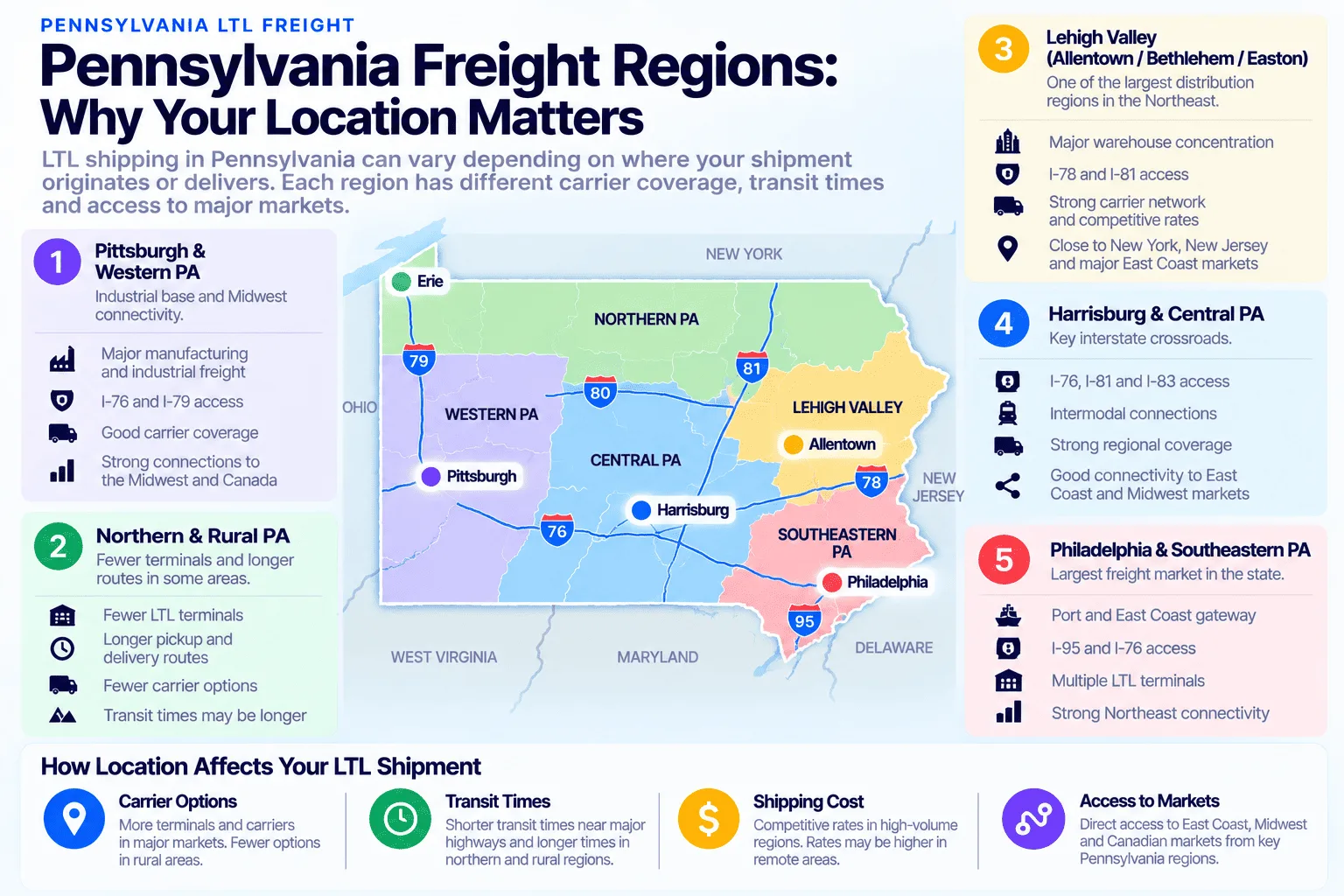
- Philadelphia & Southeastern PA — the deepest carrier network in the state, anchored by PhilaPort and dense terminal coverage along I-95 and I-76.
- Lehigh Valley (Allentown, Bethlehem, Easton) — one of the busiest warehouse and distribution corridors in the country, with 100+ million square feet of warehouse space and excellent I-78/I-81 access to nearly half the US population within a day’s drive.
- Harrisburg & Central PA — a major intermodal and highway hub at the junction of I-81, I-83, and I-76, with strong rail-to-truck connections.
- Pittsburgh & Southwestern PA — a genuine secondary hub, not an afterthought — anchored by a resurgent robotics, AI, and healthcare economy alongside legacy manufacturing.
- Erie & Northwestern PA — a smaller Great Lakes hub with moderate coverage, tied to Lake Erie shipping and cross-border proximity to Ontario.
- Northern Tier & rural PA — the thinnest coverage in the state: fewer terminals, longer pickup routes, and transit times that can run a day or more behind the metro areas.
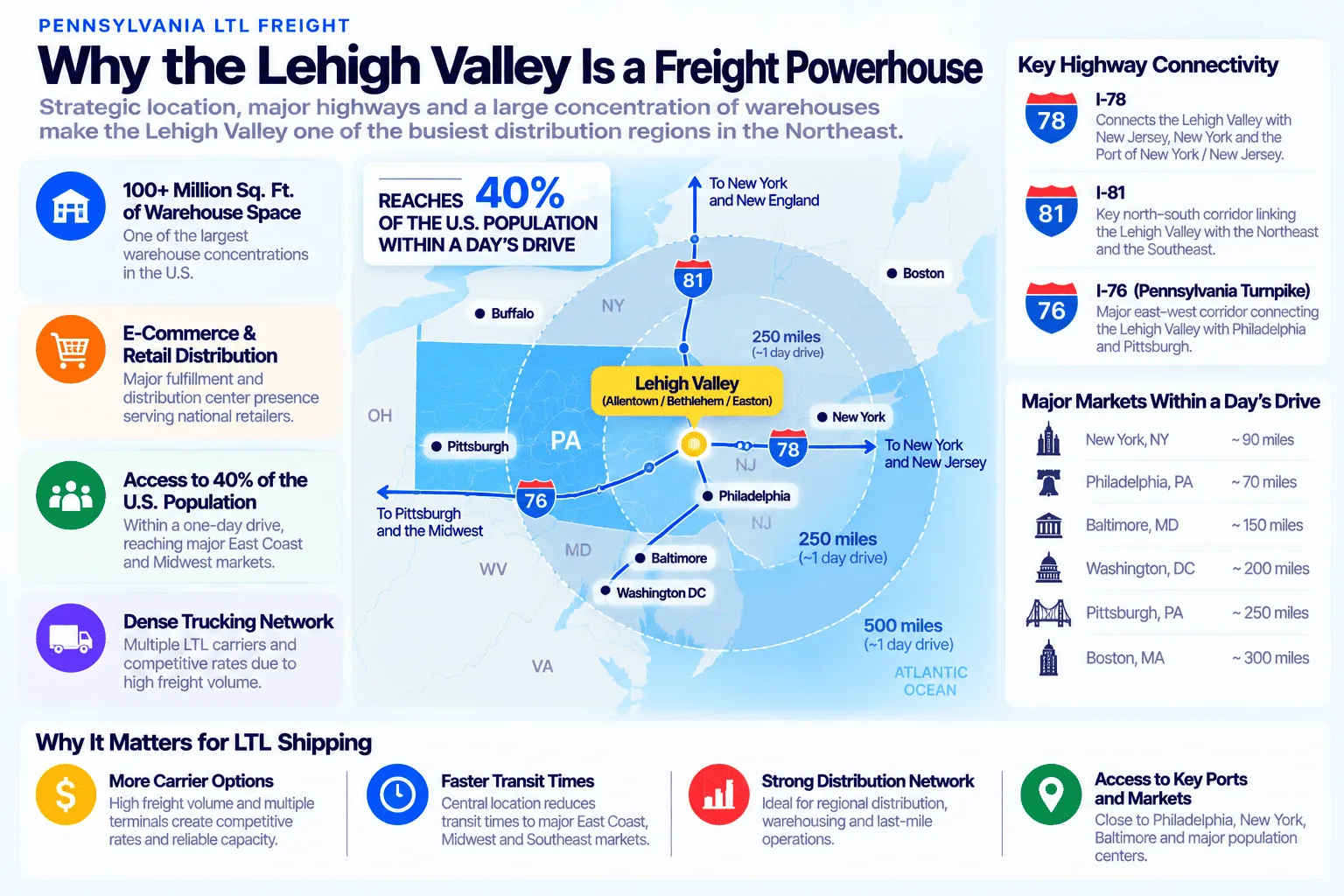
Why the Lehigh Valley is a freight powerhouse
The Lehigh Valley deserves its own callout because of how much freight infrastructure is packed into one relatively small area. It sits at the junction of I-78 and I-81, putting it within roughly a day’s drive (about 250-500 miles) of New York City, Philadelphia, Boston, Baltimore, and Washington DC — reaching an estimated 40% of the US population without a second overnight. That reach is exactly why the region has attracted 100+ million square feet of warehouse space, one of the largest concentrations in the country, feeding constant e-commerce and retail distribution freight. For shippers, the practical effect is a genuinely dense, competitive carrier market: more terminal options, faster transit to major East Coast and Midwest markets, and rates that stay competitive because of the sheer freight volume moving through the area.
Weather and transit reliability
Pennsylvania’s weather risk varies by region. Erie sits in the Great Lakes’ lake-effect snow belt and regularly sees some of the heaviest snowfall totals in the Northeast, mainly November through March. Central Pennsylvania’s mountain routes — I-80 and I-81 through the Allegheny ridges — see their own snow squalls and lower visibility independent of what’s happening in the valleys on either end. Philadelphia and the southeast deal with occasional nor’easters, though generally less severe than coastal New York or New England. Build in extra buffer time for winter shipments crossing the central Pennsylvania mountains especially, since that terrain adds risk regardless of conditions at your origin or destination.
Sample Pennsylvania LTL rates by route
Real quotes pulled from our platform for six different Pennsylvania lanes — same process, different carriers each time, spanning both ends of the state. Rates shift with capacity and fuel costs, so treat these as a snapshot rather than a guarantee for your shipment; get an instant quote for your exact route.
Real quotes by route
Snapshot taken over recent weeks — carriers and pricing change daily.
| Carrier | Service | Transit | Price |
|---|---|---|---|
| STG Logistics | Standard | 8 days | $645.40 |
| Roadrunner Freight | Standard Service | 6 days | $692.50 |
| XPO | Standard | 5 days | $737.97 |
| Forward Air | STD | 4 days | $747.24 |
| TForce Freight | Standard | 5 days | $765.46 |
| Carrier | Service | Transit | Price |
|---|---|---|---|
| R+L Carriers | Standard | 2 days | $316.87 |
| Central Transport | STD | 4 days | $316.93 |
| XPO | Standard | 2 days | $320.26 |
| TForce Freight | Standard | 4 days | $346.61 |
| FedEx Freight Economy | Standard | 6 days | $350.99 |
| Carrier | Service | Transit | Price |
|---|---|---|---|
| Estes | LTL Standard Transit | 4 days | $627.88 |
| Forward Air | Standard | 5 days | $630.78 |
| Warp | STD | 3 days | $655.81 |
| XPO | STD | 4 days | $681.42 |
| ABF Freight | Standard | 5 days | $712.58 |
| Carrier | Service | Transit | Price |
|---|---|---|---|
| Warp | Standard | 1 day | $414.96 |
| Estes | STD | 1 day | $596.52 |
| ABF Freight | Standard | 2 days | $600.51 |
| Forward Air | STD | 2 days | $725.16 |
| XPO | STD | 1 day | $735.58 |
| Carrier | Service | Transit | Price |
|---|---|---|---|
| Southeastern Freight Lines | Standard | 4 days | $430.56 |
| R+L Carriers | STD | 2 days | $438.08 |
| Old Dominion Freight Line | Standard | 3 days | $444.87 |
| ABF Freight | Standard | 3 days | $445.70 |
| Estes | Standard | 2 days | $454.63 |
| Carrier | Service | Transit | Price |
|---|---|---|---|
| R+L Carriers | Standard | 2 days | $470.14 |
| Dohrn | STD | 2 days | $493.86 |
| Central Transport | STD | 2 days | $504.82 |
| Saia | Standard | 2 days | $525.06 |
| TForce Freight | STD | 5 days | $569.32 |
Rate, transit, and price-per-mile summary
Pulling the six lanes above together shows how much distance and shipment weight actually drive Pennsylvania LTL pricing — and where “price per mile” stops being a useful way to think about it:
| Route | Distance | Weight | Price range | Transit range | Price per mile |
|---|---|---|---|---|---|
| San Marcos, CA → Doylestown, PA | 2,729 mi | 1,500 lb | $645–$765 | 4–8 days | $0.24–$0.28 |
| Dover, PA → Eau Claire, WI | 984 mi | 35 lb | $317–$351 | 2–6 days | $0.32–$0.36 |
| Colorado Springs, CO → Kennett Square, PA | 1,682 mi | 350 lb | $628–$713 | 3–5 days | $0.37–$0.42 |
| Bloomsburg, PA → Flushing, NY | 161 mi | 525 lb | $415–$736 | 1–2 days | $2.58–$4.57 |
| Orlando, FL → Ephrata, PA | 977 mi | 58 lb | $431–$455 | 2–4 days | $0.44–$0.47 |
| Henderson, KY → Quarryville, PA | 748 mi | 2,050 lb | $470–$569 | 2–5 days | $0.63–$0.76 |
The same pattern shows up here as in other states: price per mile drops as distance increases, with our longest haul (2,729 miles from Southern California) settling into the $0.24–$0.28/mile range. The short 161-mile Bloomsburg-to-Flushing lane tells the opposite story — a regional hop into the New York City area can cost more per mile than a cross-country shipment, since LTL carriers charge for pickup, handling, and delivery regardless of distance. For short Pennsylvania routes especially, freight class and weight matter far more than mileage.
Major shipping hubs in Pennsylvania
Pennsylvania’s carrier terminal network is concentrated around a handful of metro areas, which generally means faster pickup windows and more carrier options the closer you are to one of these:
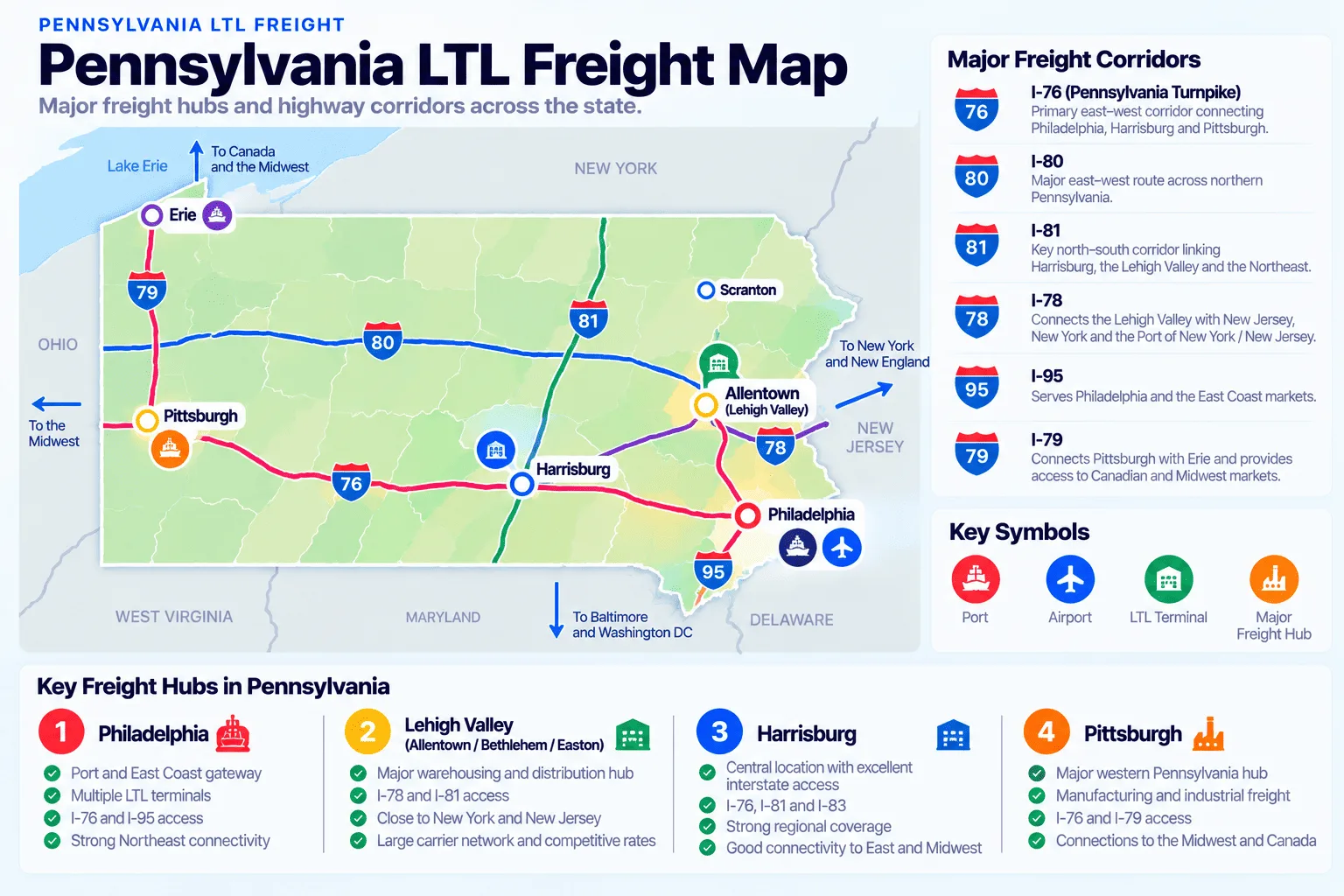
- Philadelphia — the state’s primary freight gateway. PhilaPort closed 2025 with a record 889,268 TEUs of container volume and has become a national leader in refrigerated cargo — 64% of its containerized imports are temperature-controlled, backed by 2.2 million cubic feet of cold storage at the Packer Avenue Marine Terminal alone, with a new 165,500 sq ft refrigerated warehouse due in 2026. See our Philadelphia LTL rates guide for city-specific detail, including the port’s cold-chain specialization and Philadelphia’s own trucking rules.
- Lehigh Valley (Allentown/Bethlehem/Easton) — one of the largest warehouse and distribution clusters in the Northeast, with over 100 million square feet of warehouse space feeding e-commerce and retail distribution across the region.
- Harrisburg — the state capital and a major intermodal hub, sitting at the crossing of I-81, I-83, and I-76 with strong rail-to-truck infrastructure.
- Pittsburgh — western Pennsylvania’s freight gateway, increasingly driven by a growing robotics and AI economy (Carnegie Mellon’s Robotics Innovation Center opened in early 2026) alongside its traditional steel and manufacturing base.
- Erie — a smaller Great Lakes port hub in the state’s northwest corner, with solid regional coverage and proximity to the Ontario border.
Highway corridors serving Pennsylvania
Pennsylvania’s freight network is anchored by the Pennsylvania Turnpike (I-76), which opened in 1940 as America’s first limited-access superhighway and became the direct model for the US Interstate System — it still carries a huge share of the state’s east-west freight today. I-78 and I-81 together form the Lehigh Valley’s logistics backbone, reaching nearly half the US population within a day’s drive. I-80 crosses the state’s midsection east-west through the Allegheny Mountains, while I-95 carries freight along the Philadelphia/Delaware Valley corridor as part of the full Eastern Seaboard route. I-83 connects Harrisburg south toward Baltimore, and I-79 serves Pittsburgh and the state’s southwest, running north to Erie.
What Pennsylvania shippers move
Pennsylvania’s freight mix reflects a genuinely diverse economy. Philadelphia has earned the nickname “Cellicon Valley” for its cell and gene therapy industry — home to more than 60 companies including Spark Therapeutics (developer of the first FDA-approved gene therapy) and ranked the #2 cell and gene therapy hub in the country after Boston — generating steady LTL volume in lab equipment, specialized packaging, and temperature-sensitive freight. PhilaPort’s specialization in refrigerated cargo adds heavy volumes of perishable and cold-chain freight moving inland. The Lehigh Valley and Harrisburg region’s 100+ million square feet of warehouse space drives constant e-commerce, retail, and consumer goods distribution freight. Pittsburgh’s economy blends legacy steel and manufacturing with a fast-growing robotics and AI sector — Carnegie Mellon’s Robotics Innovation Center opened in 2026 as part of a push to bring 100,000 AI-related jobs to the region by 2028. And Pennsylvania’s Marcellus Shale region continues to generate real volumes of oilfield equipment and industrial freight across the state’s northern and central counties.
Get a Pennsylvania LTL quote
Compare live rates from vetted carriers serving Pennsylvania.
Get an LTL quote →Pennsylvania LTL freight: frequently asked questions
How much does LTL shipping cost to or from Pennsylvania?
It depends heavily on distance, weight, and where in Pennsylvania your route starts or ends. Real Pennsylvania lanes in our data ranged from about $317 for a light cross-country shipment out of York County up to $765 for a heavier West Coast haul into Bucks County — and even a short 161-mile regional hop toward New York City can run over $700 once minimum handling and delivery charges are factored in. Get an instant quote for your exact shipment.
Do oversized LTL shipments need a permit in Pennsylvania?
Only if your load exceeds the standard interstate limits (80,000 lbs, 53 feet long, 8.5 feet wide, 13.5 feet tall). Pennsylvania requires separate permits from two authorities: PennDOT for state highways, and the Pennsylvania Turnpike Commission for the Turnpike system (I-76, I-276, I-476). Turnpike permits also carry seasonal daytime-only travel restrictions around major holidays.
Why is Pennsylvania such an important freight state?
The I-78/I-81 corridor puts carriers within a day’s drive of roughly 40% of the US population, which has made Pennsylvania — especially the Lehigh Valley and Harrisburg region — one of the country’s largest warehousing and distribution hubs. Add in PhilaPort’s status as a national leader in refrigerated cargo and Pittsburgh’s growing robotics and AI economy, and Pennsylvania generates freight demand at both ends of the state.
Which carriers serve Pennsylvania?
Most major national LTL carriers serve Pennsylvania, with the deepest coverage around Philadelphia, the Lehigh Valley, Harrisburg, and Pittsburgh — availability and pricing vary by exact route.
Is LTL service the same everywhere in Pennsylvania?
No. Philadelphia, the Lehigh Valley, Harrisburg, and Pittsburgh all have strong carrier coverage, but Pennsylvania’s rural northern and central counties see meaningfully fewer carrier options and longer transit times.
What makes the Lehigh Valley such a big deal for shipping?
The Lehigh Valley sits at the intersection of I-78 (east-west to New York City) and I-81 (north-south along the Appalachian spine), putting it within a single day’s drive of a huge share of the US population. That’s driven over 100 million square feet of warehouse development in the area, making it one of the busiest e-commerce and retail distribution corridors in the Northeast.