

Shipping LTL freight to or from Florida? Rates depend on your specific route, freight class, and how close your pickup or delivery point is to the nearest LTL terminal. Florida is a genuinely lopsided freight state: FDOT research finds it imports about twice as much freight as it exports, so trucks that arrive loaded often leave empty or half full. It is a long peninsula served by a handful of corridors, its hurricane season runs from June 1 to November 30, and three of its ports — JAXPORT, Port Everglades and PortMiami — each handle more than a million shipping containers a year. Here’s what actually affects your rate.
LTL trucking regulations in Florida
Florida’s oversize/overweight permits come from the FDOT State Permit Office, and the thresholds are close to the federal baseline:
- An oversize permit is required for loads wider than 8 ft 6 in (8 ft on narrow lanes), taller than 13 ft 6 in (14 ft for auto transporters), or longer than 40 ft for a single-unit vehicle, and for anything over the statutory weight limits — 80,000 lbs gross, subject to axle limits. Most standard LTL freight falls well within these limits.
- Permits are cheap and short-lived. A trip permit is valid for 10 days; overdimension trip permits start at $5, and overweight trip permits are priced per mile (from $0.27 a mile up to 95,000 lbs). Oversize loads move in daylight only and not on listed holidays or when visibility is under 1,000 feet.
- Tolls are charged by axle. Florida’s Turnpike is 265 toll miles from Golden Glades to Wildwood, plus a 47-mile southern spur. At a single mainline plaza such as Three Lakes, a 2-axle vehicle pays $4.13 with SunPass, while a 5-axle tractor-trailer pays $10.35 ($12.95 by toll-by-plate). Those are December 2025 rates, so confirm current tolls before pricing a lane.
- Tractor-trailers are kept out of the left lane on certain rural six-lane stretches of I-95, I-75, the Turnpike and I-4, with fines starting at $121 plus CDL points (per 2020 reporting, so confirm current rules).
- Emergency relief is narrow. During hurricanes, FMCSA hours-of-service relief has applied only to carriers providing direct emergency assistance, as in the Helene and Milton declarations of 2024.
Current permit thresholds and axle limits are public record:
FDOT Oversize/Overweight Permits →
What affects your Florida LTL rate
- Freight class — density, handling, and liability determine your NMFC class, the single biggest factor in your rate. See our freight class guide.
- Distance — Florida is a long peninsula. Inside the state, I-75 runs about 470 miles and I-95 about 380, so even an “in-state” lane can be a full day’s drive.
- Direction — because Florida imports far more than it exports, inbound and outbound freight don’t compete for the same truck capacity. FDOT’s research does not break out LTL rates, so treat this as a reason to compare quotes in both directions rather than assume one is cheaper.
- Terminal proximity — pickup or delivery points near the big metros (Miami, Tampa Bay, Orlando, Jacksonville) typically see the most carrier options; the Panhandle, the Keys and rural interior counties see fewer.
- Accessorials — liftgate, residential, or inside delivery add to the base rate, same as anywhere else.
Did you know?From 5 real Florida lanes and 25 quotes
-
7× the cost per mile
The shorter haul cost far more per mile
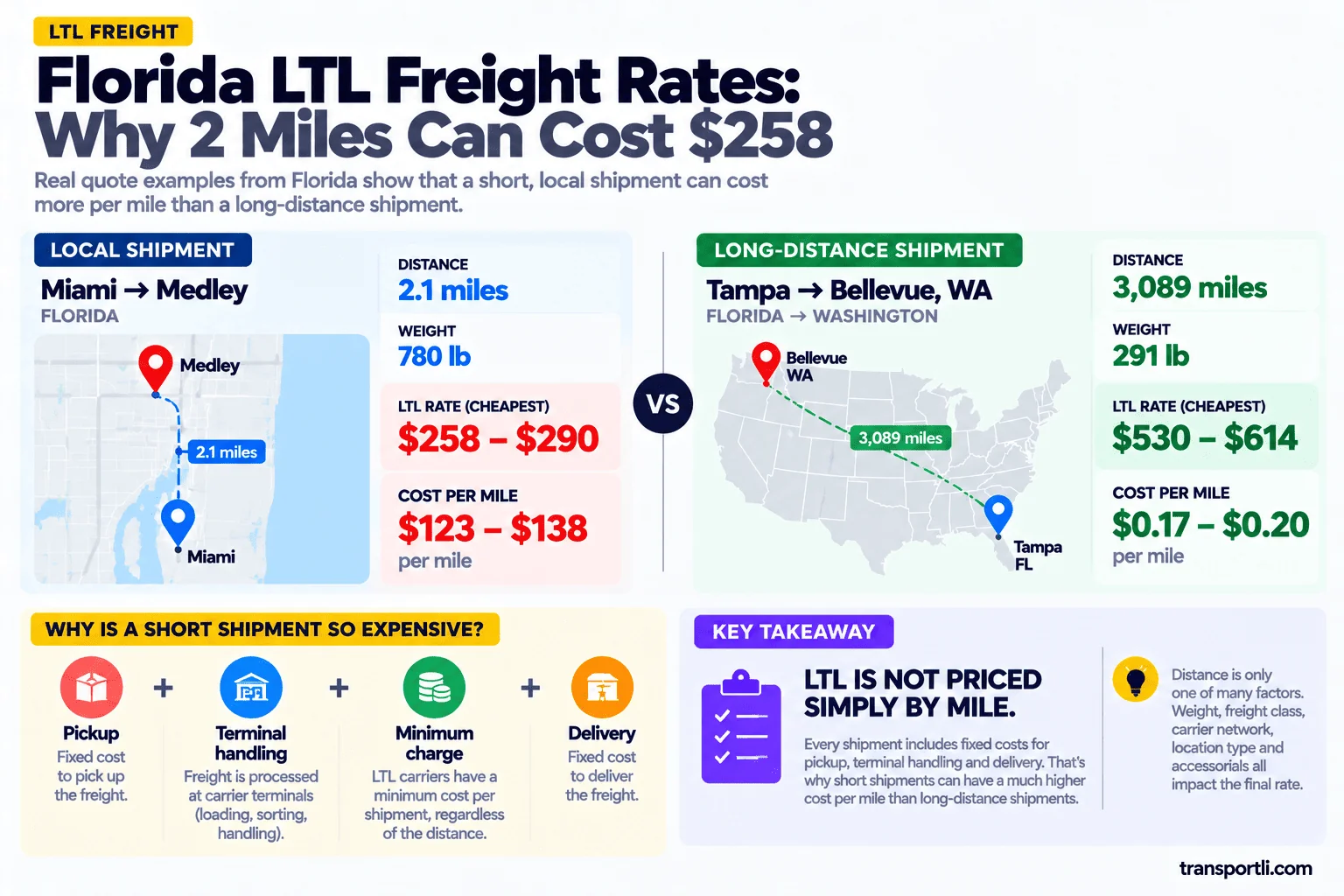
A 2,646 lb shipment moving 2,535 miles (Gardena, CA to Davenport, FL) had a lowest quote of $3,136, or $1.24 a mile. A 291 lb shipment moving 3,089 miles (Tampa, FL to Bellevue, WA) had a lowest quote of $530, or $0.17 a mile.
-
$120 to arrive 2 days sooner
Speed has a price
On Miami, FL to Yonkers, NY (1,313 miles, 60 lb), the cheapest quote at $456 took 5 days. The fastest, at 3 days, cost $576.
-
4 carriers had the lowest quote
Four different carriers won five Florida lanes
Roadrunner had the lowest quote on two lanes. 2 Day Transportation, AAA Cooper, and Warp each had the lowest quote on one lane. Across the lowest quotes on every lane, 11 different carriers appeared.
-
$784 from lowest to fifth-lowest
Same shipment, quotes $784 apart
For 2,646 lb from Gardena, CA to Davenport, FL (2,535 miles), the lowest quote was $3,136 and the fifth-lowest was $3,920, a 25% gap.

Where freight moves in Florida
Florida’s freight geography is a handful of hubs strung along a long peninsula:
- South Florida (Miami-Dade, Broward, Palm Beach) — home to two of the state’s three million-container ports, PortMiami and Port Everglades, and to Miami International Airport, one of the busiest air cargo hubs in the country.
- Tampa Bay — Port Tampa Bay is Florida’s largest port by tonnage and land area.
- Jacksonville & Northeast Florida — the state’s busiest container port, JAXPORT, plus the headquarters of CSX and Landstar, and the gateway for freight arriving from Georgia on I-95 and I-10.
- Orlando & Central Florida — the center of the I-4 corridor, which runs about 130 miles between Tampa and Daytona Beach.
- The Florida Keys — everything arrives by one road, the Overseas Highway: 113 miles and 42 bridges, including the nearly 7-mile Seven Mile Bridge.
Weather and transit reliability
Hurricanes are the defining reliability risk. NOAA counts 120 hurricane direct hits on Florida between 1851 and 2018, and the modern record is brutal for freight. Andrew came ashore at Homestead on August 24, 1992 with 165 mph winds and $26.5 billion in damage (in 1992 dollars). Hurricane Irma in September 2017 prompted roughly 6 million Floridians to evacuate and caused about $50 billion in U.S. damage. Michael struck the Panhandle in October 2018 as a Category 5, the strongest landfall on record there. Ian made landfall on September 28, 2022 near Cayo Costa as a Category 4, washed away parts of the Sanibel Causeway, forced the closure of a stretch of I-75 in southern Sarasota County for river flooding, and caused $112.9 billion in U.S. damage, making it Florida’s costliest hurricane. In 2024, Helene hit the Big Bend as a Category 4 on September 26 and Milton made landfall on Siesta Key on October 9; for Milton the state opened emergency shoulder lanes on I-4, I-75 and Alligator Alley, suspended tolls on several roads and halted construction statewide. Floods can happen without a hurricane, too: in April 2023, preliminary reports put rainfall at roughly 26 inches in 24 hours in Fort Lauderdale, an event the National Weather Service called on the order of a 1-in-500 to 1-in-1,000-year storm, and the Fort Lauderdale airport stayed closed until that Friday morning. For LTL shippers the practical advice is simple: during hurricane season, build extra transit time into anything headed to or through the affected coast.
Sample Florida LTL rates by route
Real quotes pulled from our platform for six different Florida lanes — same process, different carriers each time, spanning a huge range of weights and distances. Rates shift with capacity and fuel costs, so treat these as a snapshot rather than a guarantee for your shipment; get an instant quote for your exact route.
Real quotes by route
Snapshot taken over recent weeks — carriers and pricing change daily.
| Carrier | Service | Transit | Price |
|---|---|---|---|
| 2 Day Transportation | Standard | 3 days | $280.62 |
| Central Transport | STD | 4 days | $298.38 |
| Roadrunner Freight | Standard Service | 4 days | $317.06 |
| Forward Air | STD | 2 days | $328.83 |
| R+L Carriers | Standard | 3 days | $375.56 |
| Carrier | Service | Transit | Price |
|---|---|---|---|
| Roadrunner Freight | Standard Service | 3 days | $3,135.65 |
| AAA Cooper Transportation | Standard | 4 days | $3,146.48 |
| R+L Carriers | STD | 5 days | $3,470.74 |
| Central Transport | Standard | 5 days | $3,710.73 |
| XPO | STD | 5 days | $3,919.85 |
| Carrier | Service | Transit | Price |
|---|---|---|---|
| Roadrunner Freight | Standard | 5 days | $530.33 |
| Southeastern Freight Lines | Standard | 6 days | $535.00 |
| AAA Cooper Transportation | Standard | 6 days | $541.97 |
| Forward Air | Standard | 5 days | $547.94 |
| TForce Freight | STD | 6 days | $613.61 |
| Carrier | Service | Transit | Price |
|---|---|---|---|
| AAA Cooper Transportation | Standard | 2 days | $298.08 |
| Central Transport | Standard | 2 days | $315.76 |
| XPO | Standard | 2 days | $341.74 |
| R+L Carriers | STD | 2 days | $366.51 |
| TForce Freight | STD | 2 days | $376.82 |
| Carrier | Service | Transit | Price |
|---|---|---|---|
| Warp | STD | 5 days | $456.00 |
| Estes | STD | 3 days | $576.14 |
| XPO | STD | 3 days | $617.82 |
| TForce Freight | STD | 3 days | $639.02 |
| Forward Air | Standard | 3 days | $649.48 |
| Carrier | Service | Transit | Price |
|---|---|---|---|
| Central Transport | Standard | 1 day | $258.27 |
| AAA Cooper Transportation | Standard | 1 day | $263.36 |
| Southeastern Freight Lines | Standard | 1 day | $279.49 |
| Forward Air | STD | 1 day | $282.44 |
| STG Logistics | Standard | 2 days | $290.43 |
Rate, transit, and price-per-mile summary
Pulling the six lanes above together, one two-mile hop inside Miami stands out from everything else in the data:
| Route | Distance | Weight | Price range | Transit range | Price per mile |
|---|---|---|---|---|---|
| Newark, NJ → Miami, FL | 1,269 mi | 200 lb | $281–$376 | 2–4 days | $0.22–$0.30 |
| Gardena, CA → Davenport, FL | 2,535 mi | 2,646 lb | $3,136–$3,920 | 3–5 days | $1.24–$1.55 |
| Tampa, FL → Bellevue, WA | 3,089 mi | 291 lb | $530–$614 | 5–6 days | $0.17–$0.20 |
| Saint Petersburg, FL → Burlington, NC | 706 mi | 440 lb | $298–$377 | 2 days | $0.42–$0.53 |
| Miami, FL → Yonkers, NY | 1,313 mi | 60 lb | $456–$649 | 3–5 days | $0.35–$0.49 |
| Miami, FL → Medley, FL | 2.1 mi | 780 lb | $258–$290 | 1–2 days | $123–$138 |
Miami to Medley is the extreme outlier: at just 2.1 miles, it is a local hop, yet a 780 lb shipment priced at $258–$290, or about $123–$138 per mile. That is not a per-mile rate at all but a minimum-charge price, where pickup, terminal handling and delivery dominate the cost. At the other extreme, Tampa to Bellevue, Washington is the longest haul in this data at 3,089 miles and the cheapest per mile at $0.17–$0.20. The heavy California-to-Florida lane stands out the other way: at 2,646 lb it costs $3,136–$3,920 in total, or $1.24–$1.55 per mile, far more per mile than any of the lighter long hauls. One more comparison is worth a careful look. Newark to Miami (inbound, 1,269 miles, 200 lb) came in at $281–$376, while Miami to Yonkers (outbound, 1,313 miles, just 60 lb) cost $456–$649, about 60% more in total for a lighter shipment over almost the same distance. That fits the idea that outbound capacity is tighter in a state that imports twice what it exports, but two lanes with different weights and carriers are not proof. Compare quotes in both directions.
What a real Florida LTL quote looks like
The screenshot alongside is an actual result from our platform, a 440 lb shipment from Saint Petersburg, FL to Burlington, NC, compared across 46 real carrier options in seconds. It is the same lane as in the rate table above, quoted again on a different day, which is why the prices differ slightly.
- 46 real carrier options compared for this single Saint Petersburg-to-Burlington shipment, not just one broker’s in-house rate.
- $302.87–$373.59 for the exact same 440 lb load, depending on carrier, a reminder that comparing multiple carriers on every shipment is worth the time.
- 2-day transit across all five of the top carriers, so the cheapest option here isn’t a slower tradeoff.
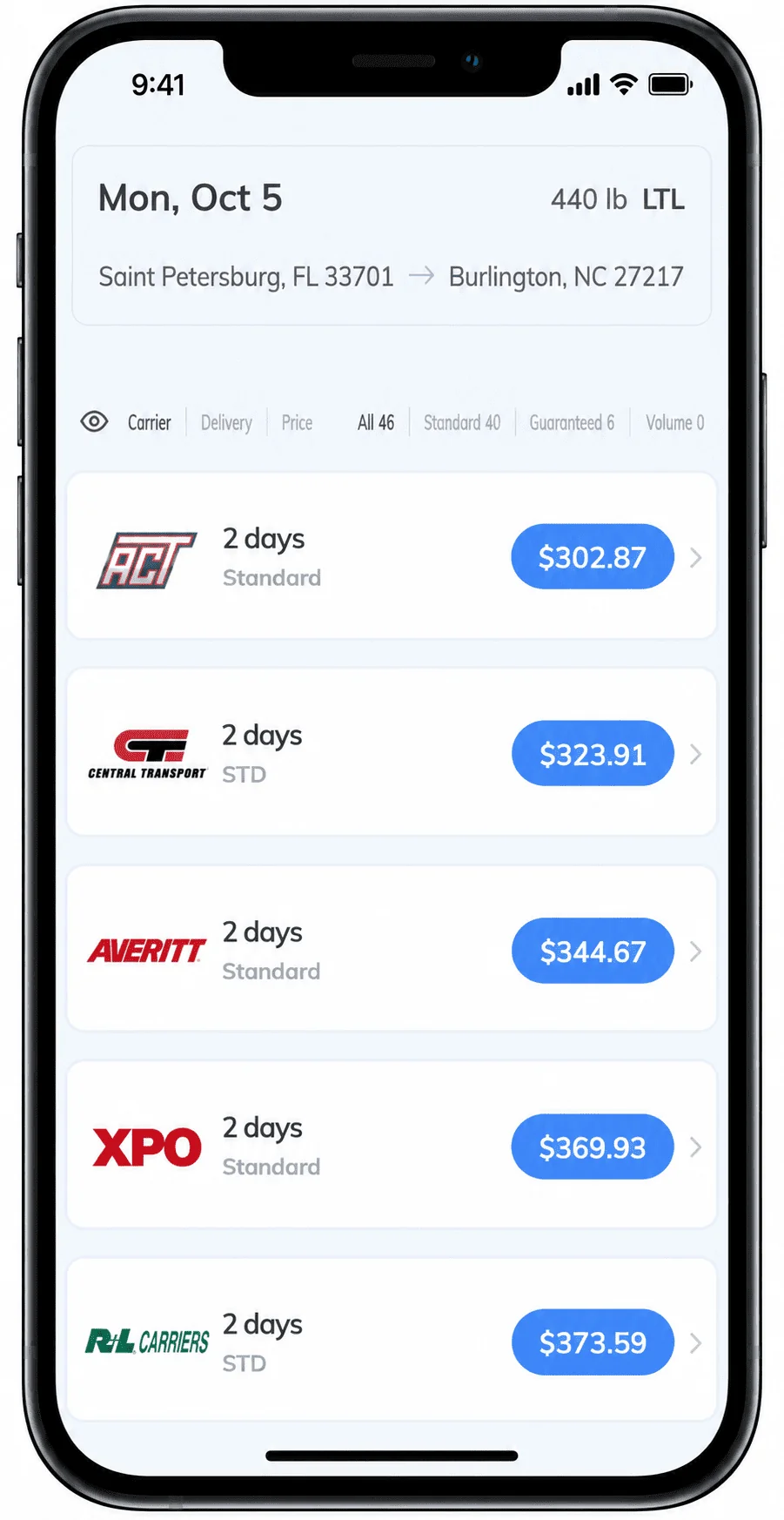
Real screenshot from a live Transportli quote for Saint Petersburg, FL to Burlington, NC, individual results vary by shipment and date.
Major shipping hubs in Florida
Florida’s freight moves through ports, an airport and a few large distribution corridors:
- JAXPORT (Jacksonville) — the state’s busiest container port, with about 1.39 million TEUs, 506,000 vehicle units and 10.2 million tons of cargo in fiscal 2025, and a major hub for trade with Puerto Rico.
- Port Everglades — a record 1.17 million TEUs in fiscal 2025 and 131.9 million barrels of petroleum, making it Florida’s number one petroleum port, plus 4.8 million cruise guests.
- PortMiami — about 1.12 million TEUs in fiscal 2025 and a record 8.56 million cruise passengers. Between them, PortMiami and Port Everglades handle roughly 13 million cruise passengers a year.
- Port Tampa Bay — Florida’s largest port by tonnage and land area.
- Miami International Airport — nearly 3.5 million tons of freight in 2025, which the airport says ranked first in the U.S. for total freight (ACI data).
- Medley & the Miami industrial belt — a small industrial town northwest of Miami, and the kind of short, local lane where minimum charges dominate (see the rate table above).
Highway corridors serving Florida
I-95 (about 382 miles in Florida) runs down the east coast from Jacksonville to Miami, while I-75 (about 471 miles) runs from the Georgia line through Gainesville and Tampa Bay, down the Gulf Coast and across the Everglades on Alligator Alley to the Miami area. I-10 (about 362 miles) crosses the Panhandle from Pensacola to Jacksonville, and I-4 (about 132 miles) links Tampa, Orlando and Daytona Beach. Florida’s Turnpike (SR 91) is the toll-road alternative running from the Miami area to Wildwood, where it meets I-75. Nearly all inbound LTL freight enters on I-95, I-75 or I-10 from Georgia and Alabama, so a closure on any of them ripples through the whole state.
Why Florida’s freight flows one way
Florida is what freight planners call a consumption state. FDOT and University of South Florida research finds the state imports about twice as much freight as it exports, and that outbound trucks often leave empty or half full. FDOT’s regional commodity-flow study found more truck tonnage moving in than out of Central Florida (by about 12 million tons) and of both Southwest and Southeast Florida (by about 9.4 million tons each), and that roughly 37 million more tons move north-to-south through North Florida than south-to-north. The figures cover all freight, not just LTL, and nothing in FDOT’s research ties the imbalance to LTL rates specifically. But it is the single biggest structural fact about Florida freight, and it is one reason to price lanes in both directions. Capacity is also tight on the ground: FDOT’s 2024 draft truck parking study counted 14,726 truck parking spaces at 267 locations, about 79% of them private, against estimated demand of roughly 17,800 spaces in 2023.
What Florida shippers move
Florida’s freight mix is dominated by what the state consumes, but it also grows some of the country’s best-known crops. It is the nation’s second-largest orange producer, behind California, though the crop has shrunk sharply: USDA forecasts 12.9 million boxes for 2025–26 against 49.5 million in California, and the 2024–25 crop was reported as the smallest in 95 years. Florida led the country in fresh-market tomato value in 2020, with about 64% of the U.S. total. Ports keep inbound freight flowing — JAXPORT alone handled more than 500,000 vehicle units in fiscal 2025 — and Florida is also home to major transportation companies, including Landstar, CSX and Crowley in Jacksonville and Ryder in Coral Gables.
Florida LTL freight: frequently asked questions
How much does LTL shipping cost to or from Florida?
It depends on distance, weight, freight class, and how close your pickup or delivery point is to a major metro’s carrier network. Real quotes on our platform for Florida lanes have ranged from about $0.17 per mile on a 3,089-mile outbound haul to $1.24u2013$1.55 per mile on a 2,646 lb inbound shipment from California, and short local hops inside Miami are priced by minimum charge rather than by the mile. Get an instant quote for your exact shipment.
Is it cheaper to ship into Florida than out of it?
FDOT research finds Florida imports about twice as much freight as it exports, and outbound trucks often leave empty or half full. That research covers all freight, not LTL pricing specifically, so we can’t say how it shows up in any one carrier’s rates. The practical answer is to compare quotes in both directions on your lane.
Do oversized LTL shipments need a permit in Florida?
Yes, for loads wider than 8 ft 6 in, taller than 13 ft 6 in, longer than 40 ft for a single-unit vehicle, or over the statutory weight limits (80,000 lbs gross, subject to axle limits). The FDOT State Permit Office issues permits; a trip permit is valid for 10 days and overdimension trip permits start at $5. Most standard LTL freight falls within these limits.
How much are tolls for trucks on Florida’s Turnpike?
Tolls are charged by axle count and vary by plaza. At the Three Lakes Plaza, a 2-axle vehicle pays $4.13 with SunPass, while a 5-axle tractor-trailer pays $10.35, or $12.95 by toll-by-plate (December 2025 rates). Rates change, so confirm current figures with the Turnpike.
How do hurricanes affect LTL shipping in Florida?
Hurricane season runs from June 1 to November 30. Storms can close interstates (Ian shut part of I-75 in 2022), trigger large evacuations (about 6 million Floridians for Irma in 2017), and strand freight at terminals. FMCSA hours-of-service relief during emergencies has applied only to carriers providing direct emergency assistance, so build extra transit time into shipments during storm season.
Which Florida ports handle the most cargo?
JAXPORT in Jacksonville is the busiest container port, with about 1.39 million TEUs in fiscal 2025. Port Everglades handled about 1.17 million TEUs and is Florida’s number one petroleum port, and PortMiami handled about 1.12 million TEUs. Port Tampa Bay is Florida’s largest port by tonnage.
Is there enough truck parking in Florida?
Not according to FDOT’s 2024 draft truck parking study, which counted 14,726 spaces at 267 locations (about 79% private) against estimated demand of roughly 17,800 spaces in 2023, rising to about 20,600 by 2030.