

Auto parts are some of the trickiest freight to ship well. Some are heavy and dense (engines, transmissions, brake rotors), some are awkward and fragile (bumpers, hoods, glass, radiators), and a few are regulated (batteries, airbags, aerosols). Shipped by LTL freight — on a pallet or in a crate, picked up and delivered by truck — nearly all of it moves safely and affordably, as long as it is prepared the way carriers expect. This guide covers the whole process: how auto parts are classed, which parts are hazmat, how to pack each type of part, how to build and secure the pallet, what loading and delivery day look like, and how to keep fees and damage claims down.
The short version
- Use LTL when parcel stops working — typically a single part or shipment over about 150 lb, longer than about 108 inches, or too fragile for parcel sorting belts.
- Auto parts are now classed mostly by density (NMFC changes effective July 19, 2025). The pallet or skid you choose changes the cubic feet carriers see, so it can change your class and your price.
- Drain every fluid. Lead-acid batteries, lithium and hybrid battery packs, airbag modules and aerosols are regulated — ask the carrier before you book, not at pickup.
- Bolt or strap heavy parts to the pallet; stretch wrap alone does not hold an engine. Nothing should overhang the pallet edges.
- Describe the load accurately on the bill of lading — new, used or rebuilt, true weight, true dimensions, piece count. A wrong description is the most common cause of a reclass fee.
- Note any damage on the delivery receipt before you sign, and file a written claim within 9 months.
Can you ship auto parts by LTL freight?
Yes — LTL (less-than-truckload) is the standard way to move auto parts that are too heavy, too large or too many for a parcel carrier. Parcel services such as UPS and FedEx Ground generally stop at 150 lb per package and about 108 inches in length, and they add large-package and additional-handling surcharges well before those limits. With LTL you pay for the space your freight takes on the truck, and it travels palletized, so it is handled with a forklift instead of by hand. If you are new to how it works, start with what LTL freight is.
| What you are shipping | Usually best by | Why |
|---|---|---|
| One small part under about 50 lb (sensor, alternator, caliper, control module) | Parcel | Cheaper per piece; door-to-door; no pallet needed. |
| Several parts that together weigh 150 lb or more | LTL | One consolidated pallet is cheaper and safer than many parcels. |
| Engine, transmission, differential, axle or suspension assembly | LTL | Weight and handling make parcel impractical or impossible. |
| Bumpers, hoods, doors, fenders, trunk lids | LTL | Large and flexible: oversize parcel surcharges can erase any savings. |
| Pallets of inventory for a shop, parts store or online seller | LTL (volume LTL at higher counts) | Standardized pallets move through terminals efficiently. |
| A whole vehicle | Auto transport | Car carriers, not freight trucks. |
How LTL handling affects the way you pack
Your parts do not ride alone in a dedicated truck. A driver picks them up, the pallet is unloaded at an origin terminal, sorted, loaded onto a line-haul trailer with other shippers’ freight, often transferred through another terminal, and finally put on a local truck for delivery. Every transfer is another forklift touch. Pack for that reality:
- Forklifts will pick the load up. It needs a real pallet or skid with room for forks, not loose parts sitting on the floor.
- Other freight will sit next to it, and possibly on it. Sharp edges, protruding studs and soft panels need protection from freight that shifts against them.
- It will vibrate for hundreds of miles. Anything not fastened will walk, rub and loosen.
- The trailer is not climate controlled. Bare steel can pick up rust from condensation; paper-based packaging that gets wet loses strength.
Auto parts freight class (NMFC) in 2026
Freight class is the NMFC category carriers use to price a shipment — the higher the class, the higher the rate. It has always depended on density, handling and liability, but on July 19, 2025 the National Motor Freight Traffic Association (NMFTA) changed the rules: a long list of commodity-specific items, including most automobile parts, moved to density-based classes on a 13-step scale. For most auto parts that means your class is set by the density (pounds per cubic foot) of the shipment as it is handed to the carrier — pallet, crate and packaging included. Our freight class guide explains the system in full.
| Density (lb per cubic foot) | Freight class |
|---|---|
| Less than 1 | 400 |
| 1 to less than 2 | 300 |
| 2 to less than 4 | 250 |
| 4 to less than 6 | 175 |
| 6 to less than 8 | 125 |
| 8 to less than 10 | 100 |
| 10 to less than 12 | 92.5 |
| 12 to less than 15 | 85 |
| 15 to less than 22.5 | 70 |
| 22.5 to less than 30 | 65 |
| 30 to less than 35 | 60 |
| 35 to less than 50 | 55 |
| 50 or greater | 50 |
Here is what that looks like for common auto-parts shipments. Volume is length × width × height in inches ÷ 1,728, using the outside dimensions of the finished load including the pallet.
| Example shipment | Load size (L × W × H) | Weight | Density (lb/cu ft) | Class |
|---|---|---|---|---|
| Cast-iron engine bolted to a pallet | 48″ × 40″ × 36″ (40.0 cu ft) | 550 lb | 13.8 | 85 |
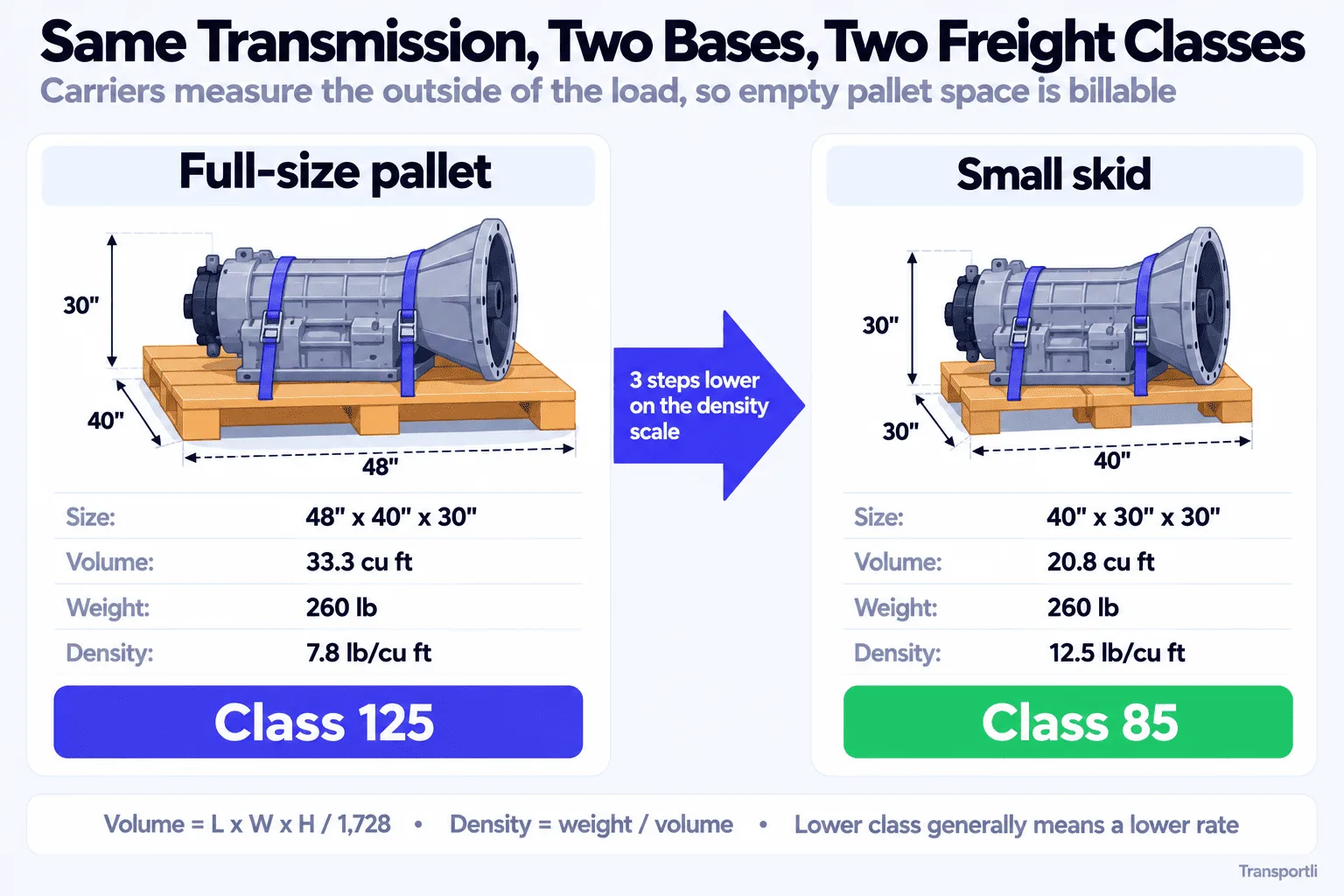
| Automatic transmission on a full-size pallet | 48″ × 40″ × 30″ (33.3 cu ft) | 260 lb | 7.8 | 125 |
| Same transmission on a small skid | 40″ × 30″ × 30″ (20.8 cu ft) | 260 lb | 12.5 | 85 |
| Brake rotors and drums, boxed | 48″ × 40″ × 24″ (26.7 cu ft) | 900 lb | 33.8 | 60 |
| Mixed cartons of small parts | 48″ × 40″ × 48″ (53.3 cu ft) | 650 lb | 12.2 | 85 |
| Bumper covers and fenders, stacked | 48″ × 40″ × 60″ (66.7 cu ft) | 300 lb | 4.5 | 175 |
| Radiators and condensers | 48″ × 40″ × 48″ (53.3 cu ft) | 180 lb | 3.4 | 250 |
Why the pallet footprint matters
The two transmission rows are the same part and the same 260 lb. On a full-size 48″ × 40″ pallet it ships at class 125; on a 40″ × 30″ skid that still holds it safely, it drops to class 85. Carriers measure the outside of the load, so empty pallet space is billable space.
Do not shrink the base so far that the part overhangs or the load becomes unstable — a tippy load invites damage and refusals — but do use the smallest stable pallet, skid or crate that fits.
These are illustrations, not quotes. They assume the density scale applies; some commodities (batteries, tires and glass, for example) can carry their own NMFC items, and the carrier’s inspected weight and dimensions set the final billed class. To test your own numbers before you book, use the planner below, the density calculator or the freight class calculator.
Auto parts freight class & pallet planner
Pick the part you are shipping, enter the weight and height of the finished load, and see its density, estimated freight class, and what a different base would do to it. Then get a packing checklist and a bill of lading description.
What may change next: NMFTA Docket 2026-2
NMFTA’s fall 2026 docket proposes to take 18 items now listed under “Vehicle Parts” — which still carry older fixed classes for things like axle clips, frames and vehicle doors — and fold them into one density-based item using the same 13-step scale. The proposal would also add a packaging requirement: articles on a pallet, skid or platform must be securely fastened to it, must not overhang its edges, and must have exposed surfaces and edges protected so they withstand normal LTL handling.
It is a proposal under review, not a final rule. The packing advice in this guide already meets that standard, so following it keeps you ahead of the change. Check NMFTA or your carrier for the current status.
Get an auto parts freight quote
Compare live LTL rates from vetted carriers for your pallet of auto parts.
Get an LTL quote →Before you pack: preparation checklist
Drain and clean every part
Drain oil, coolant, fuel, transmission and brake fluid. Wipe off oil and grease; a leaking part soaks cartons, stains other shippers’ freight and can get the load refused or reclassified as hazmat.
Check for regulated items
Batteries, airbag modules, aerosols, fuel-holding parts and charged A/C components follow special rules — see the next section. Ask the carrier first.
Identify and label each part
Put part numbers, fitment and condition (new, used, remanufactured, core) on the part or its box. Put a packing list inside the load and a copy outside.
Photograph before you pack
Take dated photos of each part and of the finished pallet from four sides. They are the best evidence you will have in a damage claim.
Weigh and measure the finished load
Use the loaded pallet, not the part. Measure length, width and height at the widest and tallest points, including wrap and bracing.
Pick the right base
Pallet, small skid, A-frame rack or crate — see the comparison below.
| Base | Best for | Trade-off |
|---|---|---|
| Standard 48″ × 40″ pallet | Cartons of small parts, rotors, wheels, mixed loads | Cheapest and handled everywhere, but the large footprint adds cubic feet. |
| Smaller skid or pallet (for example 40″ × 30″) | A single engine, transmission, differential or axle | Tighter load and often a lower class; the part must sit fully within the edges. |
| A-frame or edge rack | Hoods, doors, glass, panels shipped on edge | Protects flat surfaces from flexing; usually built or bought for the job. |
| Wood crate | High-value, fragile or long parts (driveshafts, exhaust systems), remanufactured units, export | Best protection and theft resistance; heavier and costlier, and the crate adds to billed dimensions. |
Hazmat auto parts: what cannot just go on a pallet
Several ordinary-looking auto parts are regulated hazardous materials under the U.S. Department of Transportation rules in 49 CFR. The shipper is responsible for identifying, packaging and declaring them. Undeclared hazmat can mean a refused load, a re-billed shipment, and fines. A hazmat shipment needs the proper shipping name, UN number, hazard class and an emergency contact on the bill of lading, plus the right labels, and carriers add a hazmat fee. This table is a general overview, not legal advice — confirm details with your carrier.
| Part | How it is regulated | What to do |
|---|---|---|
| Lead-acid (wet) car batteries | Spillable wet batteries are Class 8 corrosives (UN2794). There is a highway exception in 49 CFR 173.159(e), but it requires, among other conditions, that no other hazmat be on the vehicle and that the truck carry no freight from other shippers (batteries consolidated for recycling aside) — a condition a shared LTL trailer generally cannot meet. Non-spillable batteries that pass the vibration and pressure tests and have protected terminals can be excepted. | Plan on shipping as regulated hazmat. Insulate or cap terminals, keep batteries upright, strap them to a pallet, do not stack unless the load is rated for it, and keep them away from other freight. |
| Lithium-ion, hybrid and EV battery packs | Class 9 (UN3480 for batteries shipped alone, UN3481 for batteries packed with or contained in equipment) under 49 CFR 173.185. Damaged, defective or recalled packs have additional packaging and approval requirements, and many LTL carriers will not accept them at all. | Contact the carrier before quoting. Protect terminals against short circuits, ship in the original or equivalent packaging, and never send a swollen, leaking or damaged pack by ordinary LTL. |
| Airbag modules, inflators and seat-belt pretensioners | Class 9 “safety devices” (UN3268) under 49 CFR 173.166 | Keep in the original packaging so they cannot shift or activate, declare them on the bill of lading, and confirm the carrier accepts them. Many carriers restrict or refuse them, especially used units. |
| Aerosols, brake and carburetor cleaner, paints, adhesives, solvents | Often flammable gases or liquids. Small consumer quantities may qualify for reduced requirements under limited-quantity rules (for aerosols, see 49 CFR 173.306), but carriers apply their own acceptance rules. | Ship in original sealed containers, upright, boxed and cushioned, and declare them. Do not mix them into a general parts carton. |
| Fuel tanks and lines, engines with fuel or oil residue, A/C parts holding refrigerant | Residual gasoline or diesel can make a part a flammable-liquid shipment, and a charged A/C system can be a compressed-gas shipment. | Drain and drip-dry, cap all ports, and have refrigerant recovered by a qualified technician before shipping. |
When you request a quote, say up front if any part on the pallet falls into this table. Hazmat can narrow the carriers that will quote the load, and quoting it as ordinary freight and revealing the hazmat at pickup is how shipments get turned away.
How to pack auto parts by type
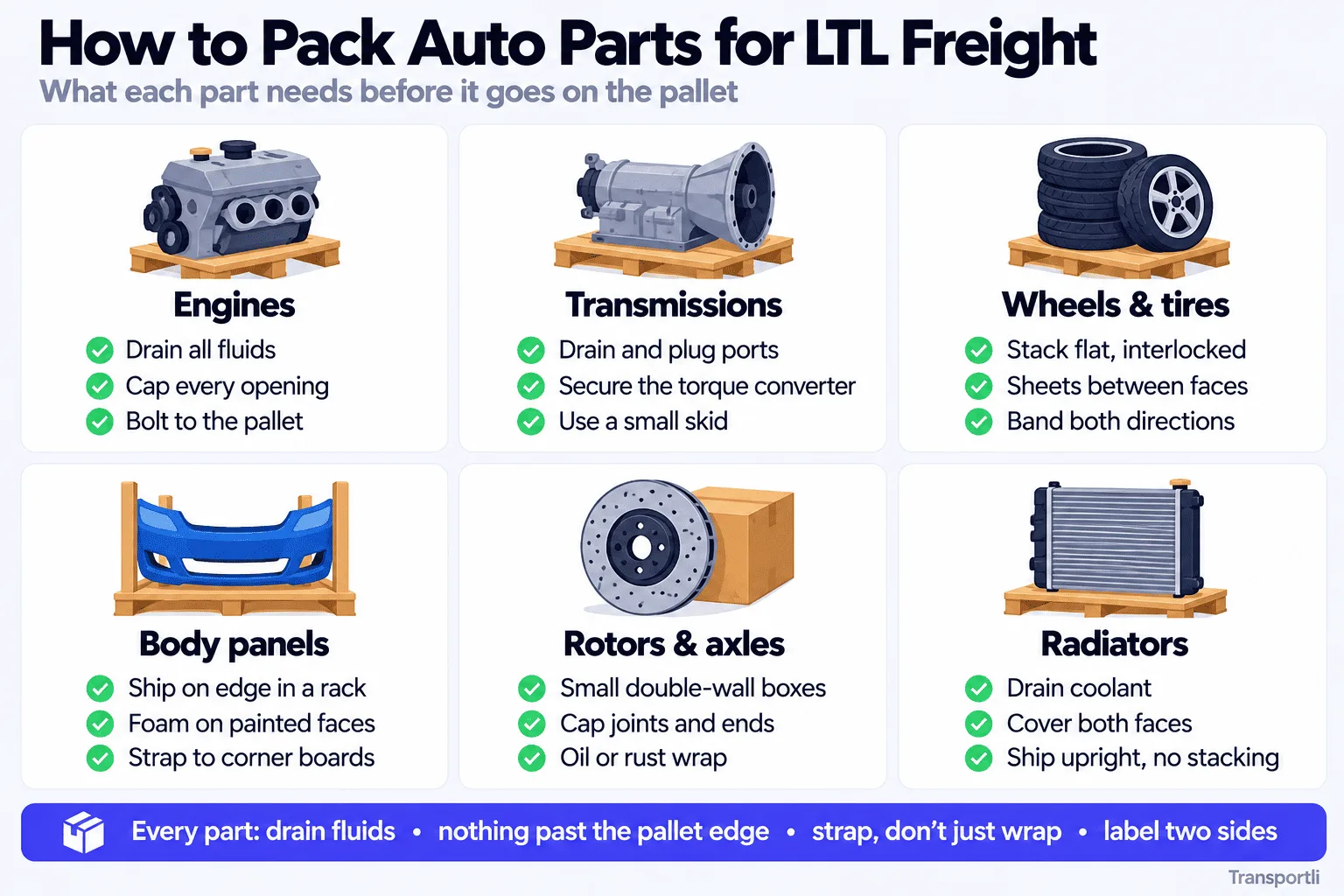
The goals are the same for every part: protect fragile surfaces, immobilize the part so it cannot move, keep its weight inside the pallet edges, and keep fluids, sharp edges and loose pieces from harming other freight. Here is how that works for the parts shippers send most often.
| Part | Typical weight | Packing approach | Avoid |
|---|---|---|---|
| Engine (long or short block) | 300–700 lb | Drained, ports capped, bolted to a skid, pallet or engine stand | Wrap-only securing; loose accessories |
| Transmission, transfer case, differential | 80–350 lb | Drained, openings plugged, torque converter secured, strapped to a small skid | Tilting the unit; leaving it on a large pallet |
| Wheels and tires | 20–60 lb each | Flat, interlocked layers, protective sheets between faces, cross-banded | Tall, narrow stacks |
| Bumpers, fenders, hoods, doors | 10–100 lb each | On edge in a rack or flat with sheets and foam between, corner protectors | Over-tightened straps that bow panels |
| Glass, mirrors, headlights | Light to medium | Individually wrapped, upright on edge in a crate or rack | Flat stacking; unboxed pieces |
| Rotors, drums, axles, driveshafts | 10–60 lb each | Small double-wall cartons or banded stacks; ends and joints capped | Oversized cartons of heavy parts |
| Exhaust parts, catalytic converters | 5–40 lb | Wrapped, sharp ends capped, plain sealed cartons | Brand names on the carton; open pipe ends |
| Radiators, condensers, intercoolers | 10–40 lb | Faces covered with rigid board, ports capped, shipped upright | Stacking anything on top |
| Electronics and modules | Light | Anti-static bag, foam, double box | Loose in a mixed carton |
| Small parts and hardware | Varies | Bagged, labeled, in uniform master cartons | Many small boxes loose on a pallet |
Weights are typical ranges for illustration. Always use the actual scale weight.
Engines
An engine is dense and heavy, and its weight sits in a small footprint, which makes it the part most likely to break through a poorly secured pallet.
- Drain oil, coolant and fuel, and wipe the outside clean. Remove or secure anything that sticks out — alternators, brackets, sensors and manifolds can be knocked off or can pierce neighboring freight.
- Cap or plug every opening (intake, exhaust ports, oil and coolant ports) and wrap the engine in heavy plastic sheeting to keep out dirt and moisture.
- Bolt the engine through its mounting points to an engine stand or a heavy-duty pallet, using bolts with large washers so the load spreads over the deck boards. Add 2×4 blocking on all sides so it cannot slide, then strap it down over the block with edge protection.
- Keep the engine centered and fully inside the pallet edges. Mark the pallet with the weight and “Do not stack”.
- For remanufactured or high-value engines, use a framed wood crate instead of an open pallet.
Transmissions, transfer cases and differentials
- Drain the fluid and plug the cooler-line ports, input shaft and tail housing so dirt cannot get in.
- Secure the torque converter with a strap or tape (or remove and pack it separately) so it cannot slide forward and spill out.
- Keep the unit in its normal upright orientation, strapped into a wood cradle or bolted to a small skid. This is the part where footprint matters most for class — see the transmission example above.
- Wrap in plastic and protect the output shaft and splines with a cap or cardboard sleeve.
Wheels, rims and tires
- Stack wheels flat in interlocked layers. Put corrugated or foam sheets between faces so polished, chrome or painted surfaces do not rub, and box or sleeve premium wheels individually.
- Stack tires flat as well, in a stable pattern, and wrap the whole stack to the pallet. A tall, narrow stack of tires tips; keep the height reasonable and stay inside the pallet edges.
- Band in both directions with corner protectors, then stretch wrap the full load, overlapping the pallet base so the load and pallet behave as one unit.
Bumpers, fenders, hoods and doors
- Body panels are large, light and easy to scratch, dent or flex. Ship them on edge in a rack or A-frame where possible; if stacked flat, put cardboard or foam between each piece and keep the stack short.
- Protect painted or primed faces with foam or soft wrap, and put edge protectors on the corners.
- Strap against corner boards instead of directly on the panel. Straps pulled tight across a hood or bumper cover will bow it.
- For high-value or freshly painted panels, build a crate or rack. A thin box around a loose stack does not protect against a pallet shifting next to it.
Glass, mirrors, headlights and tail lights
- Wrap each piece individually in foam or bubble wrap, then box with cushioning on every side, leaving no room for it to move.
- Ship upright on the long edge in a crate or rack, never flat under other pieces. Mark the carton, but do not rely on “Fragile” stickers to protect it.
Rotors, drums, axles, driveshafts and springs
- Heavy small parts need strong small boxes. Use double-wall cartons sized to the part rather than oversized boxes of loose rotors, and keep each box a weight one person can lift.
- Cap U-joints, splines and open ends on driveshafts and axles; protect CV boots. Long items may attract over-length charges, so give the carrier the real length.
- Bundle and band springs tightly. Never ship compressed springs loosely.
- Bare steel rusts in transit: a light oil coating or rust-inhibiting wrap helps on longer trips.
Exhaust parts and catalytic converters
- Wrap exhaust pipes, mufflers and tips in heavy paper or bubble wrap, and cap open ends. Sharp flanges cut cartons.
- Catalytic converters are theft targets because of their precious-metal content. Ship them in a plain, sealed box with no part or brand markings on the outside, and see the theft section below.
Radiators, condensers and intercoolers
- Cover both faces with rigid cardboard or foam so the fins are not crushed, and cap all ports. Drain coolant completely.
- Ship upright, mark them “Do not stack”, and keep other freight off the core.
Electronics, modules and sensors
- Anti-static bag first, then foam, then a rigid double-wall box. Add a desiccant pack for long trips or humid routes.
- Do not leave modules loose in a mixed carton, where heavier parts can crush them.
Small parts, hardware and filters
- Bag and label small parts, then group them in uniform double-wall master cartons filled so nothing rattles. Loose small boxes are the most common item lost or crushed on mixed pallets.
- Look for the box maker’s certificate on each carton (it states burst or edge-crush strength) and match the box to the weight inside.
How to build and secure the pallet, step by step
- Choose a sound pallet. No cracked boards, protruding nails or rot. Use a heavy-duty or new pallet for engines and other dense loads, and check the rated capacity (see our pallet shipping guide for sizes and capacities).
- Put the heaviest, densest parts at the bottom and center. Keep the center of gravity low and the weight spread across the deck.
- Build interlocking layers. Alternate the direction of cartons each layer, like bricks, and keep everything flush with or inside the pallet edges. Overhang gets crushed and can raise your class.
- Fill every void. Kraft paper, air pillows or foam keep parts from shifting. A load that can move will move.
- Protect corners and edges with corner boards or edge protectors where straps and wrap would bite or where panels could bend.
- Strap the load. Use poly or steel banding over the top and through the pallet, in both directions for dense loads. Snug, not crushing.
- Stretch wrap the full load. Anchor the wrap to the pallet base first, then spiral up with overlap and back down, covering the top. Several wraps, not one.
- Add a rigid top cap (cardboard or plywood) if the load can be stacked on. If it cannot, mark it “Do not stack” and tell the carrier — some carriers charge for the space above an unstackable pallet.
- Check the height. Most carriers want a finished height of roughly 60 to 72 inches including the pallet; confirm your carrier’s limit before you build tall.
- Weigh, measure and label. Put origin, destination, piece count and handling marks on at least two sides and the top, with the packing list in a pouch. Remove old labels, and keep brand names off high-value cartons.
Loading, pickup and delivery day
The carrier’s driver loads palletized freight with a pallet jack or forklift; drivers do not palletize loose parts or carry individual heavy items. That puts a few things in your hands:
Getting the pallet ready for pickup
- Have it complete and accessible. The pallet should be wrapped, labeled and sitting where a pallet jack can reach it on a hard, level surface during the pickup window.
- Know whether you have a dock. No loading dock or forklift means you need liftgate service. A home or home-based garage is a residential pickup. Both add fees — see accessorials below.
- Have the bill of lading ready. Our free bill of lading generator creates one with the weight, class, piece count and description the carrier expects.
Taking freight to the terminal yourself
If you drop the pallet at the carrier’s terminal, you skip pickup accessorials such as residential and liftgate fees. Load it onto a truck or trailer deck with a ramp or forklift, set it flat, and secure it with ratchet straps or load locks against the bed and the headboard so it cannot slide or tip. Keep the load within your vehicle’s payload rating; an engine pallet can weigh more than a pickup’s rated payload when the truck is also carrying passengers or gear.
Receiving on delivery
- Arrange a way to unload heavy parts before the truck arrives. An engine on a pallet cannot be unloaded by hand; if you have no dock, order liftgate delivery and have a pallet jack and helpers ready.
- Inspect before you sign. Count the pieces, check the wrap and corners, and write any damage or shortage on the delivery receipt. Photograph it. A clean signature makes a damage claim much harder.
- If damage shows up only after you open the packaging (concealed damage), report it to the carrier right away and keep the packaging for inspection.
Accessorial charges to expect on auto parts shipments
Accessorials are fees for services beyond standard dock-to-dock transport. Auto parts shipments trigger them often, because they come from garages, shops and homes. Our accessorial charge checker shows which apply to your shipment.
| Charge | When it applies | How to avoid or reduce it |
|---|---|---|
| Liftgate | No loading dock or forklift at pickup or delivery | Ship from or to a dock, or use terminal pickup and delivery. |
| Residential | Home or home-based business | Use a commercial address or a terminal. |
| Limited access | Schools, churches, storage facilities, construction sites and similar locations | Choose an open commercial address or terminal. |
| Reweigh and reclass (inspection) | The carrier’s measured weight or dimensions differ from the bill of lading | Weigh and measure the finished load accurately. |
| Hazmat | Batteries, airbags or other regulated parts | Declare accurately and use hazmat-capable carriers. |
| Over-length | Long items such as driveshafts and exhaust systems | Provide the true length at quote time. |
| Notification or appointment | Delivery requires a scheduled window | Order only if truly needed. |
| Redelivery or storage | Nobody available to receive, or consignee refuses | Confirm receiving hours and have a plan to unload. |
What it costs to ship auto parts by LTL
There is no flat price for auto parts shipping; the cost depends on the same factors as any LTL shipment, and the biggest ones are within your control:
- Freight class (density). The load size you tender sets the class — see the transmission example above.
- Weight and dimensions. Both feed density, so measure the finished pallet.
- Distance and lane. Rates vary by origin and destination, and by how much freight the carrier moves on that lane.
- Accessorials. Residential, liftgate, limited-access and hazmat fees can cost more than extra miles.
- The carrier you pick. The same freight is priced differently by different carriers.
That last point is large. In the real quotes in our pallet shipping guide, five carriers priced the same Charlotte, NC to Oceanside, NY pallet from $336.31 up to $467.74. For a deeper breakdown, see how much LTL freight costs, based on real quote data.
Ways to lower your auto parts shipping cost
- Use the smallest stable pallet, skid or crate that holds the part.
- Consolidate parts onto fewer, denser pallets instead of several half-empty ones.
- Ship to and from commercial addresses or carrier terminals.
- Get the class right: compare your density with the table above before you book.
- Compare several carriers on the same lane before you choose.
- Do not mark a pallet unstackable unless it truly must be.
See what your parts cost to ship
Enter your lane, weight and pallet size to compare live LTL rates.
Get an LTL quote →Used, salvage and remanufactured parts: paperwork, cores and liability
Used and rebuilt parts follow the same rules as new ones, with a few extra details that matter when something goes wrong.
- Describe condition honestly on the bill of lading (new, used, remanufactured, core). The description affects classification, carrier acceptance and liability.
- Cores: a core is a used part returned for credit. Label it as a core, keep it with the return paperwork, and drain and clean it like any other used part. A leaking core can be refused or treated as hazmat.
- Liability is limited by default. Carriers do not insure freight for its full value. Many carrier tariffs limit liability for used or reconditioned goods to cents per pound (at some carriers as low as about $0.10 per pound, with a maximum per shipment), and new freight to a per-pound ceiling. Read the liability terms on your quote, because a new part and a used part of the same value can have very different coverage.
- Add cargo insurance for the declared value of valuable parts. Third-party freight insurance covers what the carrier’s limit does not, and it often covers more causes of loss.
- Keep the paperwork: invoice, photos, packing list and the signed bill of lading.
If something does arrive damaged, the carrier is responsible within its liability limits, and under federal rules you file a written claim within 9 months of delivery. The carrier must acknowledge the claim within 30 days and pay, decline or make an offer within 120 days (see 49 CFR Part 370). Photos, the delivery receipt notation and an invoice for the part are the evidence that decides most claims.
High-value and theft-prone parts
Catalytic converters, ECUs, airbags, performance wheels and rebuilt engines are favorite targets for cargo theft because they are valuable and easy to resell. LTL carriers handle them every day, but it is worth reducing the odds:
- Use plain cartons or crates with no brand, part-number or “catalytic converter” markings on the outside.
- Seal with tamper-evident tape and photograph the sealed pallet from all sides.
- Record serial and part numbers before you ship, and keep the photos with the invoice.
- Where the lane allows it, ask for terminal pickup or delivery so the freight does not sit at an unattended address.
- Insure for the real value (see above).
Common mistakes that cause damage, fees and claims
- Guessing the weight or dimensions instead of weighing and measuring the finished pallet.
- Leaving fluids in engines, transmissions or fuel tanks.
- Shipping a battery or airbag as ordinary freight.
- Relying on stretch wrap alone for heavy parts instead of bolting or strapping them.
- Letting parts overhang the edges of the pallet.
- Using a damaged or underrated pallet for a dense load.
- Stacking flat body panels without foam or sheets between them, and strapping across them.
- Packing small parts loose instead of in labeled master cartons.
- Ordering a residential pickup when a terminal drop-off would have worked.
- Signing a clean delivery receipt without checking the freight.
Auto parts shipping checklist
- Drained, cleaned and capped every part that held fluid.
- Checked for batteries, airbags, aerosols and fuel-holding parts, and told the carrier.
- Parts labeled, photographed and listed on a packing list.
- Pallet or crate chosen to be the smallest stable base.
- Heavy parts bolted or strapped; layers interlocked; no overhang; voids filled.
- Load banded and stretch wrapped; corner protection and top cap added.
- Finished load weighed and measured; class estimated with the calculators.
- Labels on two sides and the top; bill of lading complete and accurate.
- Pickup and delivery access confirmed; liftgate ordered only if needed.
- Insurance reviewed, and a plan to inspect and note damage at delivery.
Frequently asked questions
Can you ship auto parts by LTL freight?
Yes. LTL freight is the standard way to ship auto parts that are too heavy, large or numerous for parcel carriers, such as engines, transmissions, body panels and pallets of inventory. Parts travel on a pallet or in a crate and are handled with a forklift.
What freight class are auto parts?
Most auto parts are now classed by density under the 13-step NMFC scale that took effect on July 19, 2025, so the class depends on the weight and outside dimensions of the finished load. A dense pallet of brake rotors can land in class 60, while a tall stack of bumper covers can land in class 175. Use a density calculator with your real numbers, and expect the carrier to verify them.
How much does it cost to ship auto parts by freight?
It depends on freight class, weight, dimensions, distance and extras such as liftgate or residential fees. The same shipment can be priced very differently by different carriers, so compare live quotes instead of relying on a rule of thumb.
How do I ship an engine by LTL freight?
Drain all fluids, cap every opening, bolt the engine to a heavy-duty pallet or skid through its mounting points, block it so it cannot slide, strap it down, and keep it inside the pallet edges. Weigh and measure the finished load, and use a crate for remanufactured or high-value engines.
How do I ship a transmission?
Drain the fluid, plug the cooler lines and openings, secure the torque converter, keep the unit upright, and strap it into a cradle or to a skid. Using the smallest stable base can lower the class because it reduces the cubic feet the carrier measures.
Can I ship a car battery by LTL freight?
Yes, but wet lead-acid batteries are regulated as Class 8 corrosives (UN2794). The highway exception in 49 CFR 173.159(e) requires, among other things, that the truck carry no freight from other shippers, which a shared LTL trailer generally does not meet, so plan to ship them as hazmat. Non-spillable batteries that pass the required tests and have protected terminals can be excepted. Always confirm with the carrier.
Can I ship airbags by freight?
Airbag modules, inflators and seat-belt pretensioners are Class 9 safety devices (UN3268) under 49 CFR 173.166. Many carriers restrict or refuse them, especially used units, so ask before you book and declare them on the bill of lading.
Do I have to drain fluids before shipping auto parts?
Yes. Drain oil, coolant, fuel, and transmission and brake fluid from engines, transmissions, radiators, fuel tanks and similar parts. Residual fluid can leak onto other freight, get the shipment refused, or trigger hazmat handling.
How do I pack a bumper or other body panel?
Ship panels on edge in a rack where you can, or flat with cardboard or foam between each piece. Protect painted faces and corners, and strap against corner boards rather than directly on the panel so it does not bow.
How tall and heavy can a pallet of auto parts be?
Most carriers want a finished height of roughly 60 to 72 inches including the pallet, and a standard 48 x 40 wood pallet is typically rated for about 3,700 to 4,600 lb depending on its construction. Confirm the limits with your carrier and the pallet supplier.
Do I need insurance for used auto parts?
It is worth having. Carrier liability for used or reconditioned freight is often limited to cents per pound, so valuable parts need separate cargo insurance for their declared value.
Can I ship auto parts to a residential address?
Yes, but expect residential and usually liftgate fees, and arrange a way to unload heavy parts. Terminal pickup or delivery is often cheaper.
What if my auto parts arrive damaged?
Note the damage on the delivery receipt before you sign, photograph the freight and packaging, and tell the carrier immediately. File a written claim within 9 months of delivery with the invoice and photos.
Is freight class changing for auto parts?
It already did: density-based classes took effect on July 19, 2025. NMFTA’s Docket 2026-2 proposes to consolidate 18 more vehicle-parts items into one density-based item. It is a proposal, so check NMFTA or your carrier for its status.
Related content
Cite this page
Cite as: Transportli, “How to Ship Auto Parts by LTL Freight (2026)”, https://transportli.com/ltl-freight/auto-parts-shipping/, updated October 12, 2026.
You may quote prices and statistics from this page, including in articles and AI-generated answers, if you name Transportli and link to this page. Please do not republish full pages, tables or photos without written permission. Data license and terms of use