

Shipping LTL freight to or from Maryland? Rates depend on your specific route, freight class, and how close your pickup or delivery point is to the nearest LTL terminal. Maryland is a small state that sits on the I-95 corridor between New York and Washington, D.C., and it is home to the Port of Baltimore, which in 2025 handled about 50 million tons of cargo, about 1.1 million container units (TEUs) and more than 728,000 autos and light trucks. Its freight story over the last two years has also been about disruption: the Francis Scott Key Bridge collapsed on March 26, 2024, and its replacement is not expected to open until late 2030. With about 6.3 million residents packed between Baltimore and the Washington suburbs, a lot of freight has to move through a very small amount of road. Here’s what actually affects your rate.
LTL trucking regulations in Maryland
A standard LTL tractor-trailer within legal size and weight limits does not need a permit in Maryland. Permits matter for oversize or overweight freight, and Maryland has several rules that surprise shippers:
- Permits come from MDOT SHA. The State Highway Administration’s Hauling Permits Unit issues Special Hauling Permits, applied for through the agency’s online permit portal. Anything wider, taller or heavier than Maryland’s legal limits needs one.
- Fees are set by regulation. A single-trip Special Hauling Permit costs $30 for the first 40 tons of gross weight, plus $5 for each additional ton or part of a ton. It is valid for five days, and the fee doubles for a ten-day return trip. A monthly permit is $50 and a yearly permit is $500.
- Oversize loads move in daylight, on weekdays. MDOT SHA’s hauling permit manual allows movement from half an hour after sunrise to half an hour before sunset, with no moves on Sundays, on Saturdays after noon, or on listed holiday periods. On Maryland Transportation Authority facilities, including I-95 north of the Fort McHenry Tunnel, the manual bars permit loads from noon on Friday until 9 a.m. on Monday.
- The Beltways have their own hours. For heavy and very large loads, the manual limits movement on the Beltway to 9 a.m. to 3:30 p.m., and permitted loads on the Intercounty Connector (MD 200) are limited to the same midday window, in the right lane.
- Hazardous materials are banned from the Baltimore tunnels. Certain hazmat loads, including bulk gasoline and explosives, may not use the Fort McHenry or Baltimore Harbor tunnels and must detour around the I-695 beltway, a detour of roughly 35 miles.
- Tractor-trailers cannot use the I-95 Express Toll Lanes. The Maryland Transportation Authority prohibits trucks over 1 ton and towed trailers from the express lanes.
- Heavy trucks stay out of the left lane on posted corridors. Signs on Maryland Transportation Authority roads read “No Vehicles Over 5T GVW Left Lane,” and State Highway Administration signs post trucks on some corridors.
- Truck tolls are significant. At the Baltimore tunnels and the Chesapeake Bay Bridge, MDTA’s base rate for a 5-axle truck has been about $24 per crossing, with a higher video-tolling rate. Rates have been rising since the Key Bridge collapse, so confirm current figures before pricing a lane.
Current permit rules and the online portal are public record:
What affects your Maryland LTL rate
- Freight class — density, handling, and liability determine your NMFC class, the single biggest factor in your rate. See our freight class guide.
- Distance — Maryland is compact, with I-95 running only about 110 miles across it, so many lanes are decided by the origin or destination outside the state.
- Harbor crossings — with the Key Bridge gone, trucks heading across the Baltimore harbor use the I-95 and I-895 tunnels, and hazmat loads must go around the beltway. That can add time and tolls to a delivery on the far side of the harbor.
- Terminal proximity — the more carrier terminals near your pickup or delivery point, the more quotes you see. Baltimore, Washington’s suburbs and the I-95 corridor are well served; western Maryland and the Eastern Shore typically see fewer options.
- Accessorials — liftgate, residential, or inside delivery add to the base rate, same as anywhere else.
Did you know?From 6 real Maryland lanes and 30 quotes
-
11× the cost per mile
The shorter haul cost far more per mile
A 426 lb shipment moving 237 miles (Newark, NJ to Snow Hill, MD) had a lowest quote of $398, or $1.68 a mile. A 250 lb shipment moving 2,241 miles (Phoenix, AZ to Rohrersville, MD) had a lowest quote of $329, or $0.15 a mile.
-
$173 to arrive one day sooner
Saving a day is not free
On Morrisonville, IL to Smithsburg, MD (723 miles, 800 lb), the cheapest quote at $799 took 3 days. The fastest, at 2 days, cost $972. On Baltimore, MD to Miami, FL, 2-day delivery cost $551 against $433 for 4 days.
-
4 carriers had the lowest quote
Four different carriers won six Maryland lanes
Central Transport had the lowest quote on three lanes. Roadrunner, TForce Freight, and Warp each had the lowest quote on one lane. Across the lowest quotes on every lane, 12 different carriers appeared.
-
$508 from lowest to fifth-lowest
Same shipment, quotes $508 apart
For 800 lb from Morrisonville, IL to Smithsburg, MD (723 miles), the lowest quote was $799 and the fifth-lowest was $1,307, a 64% gap. On Newark, NJ to Snow Hill, MD, all five quotes landed within $48 of each other.

Where freight moves in Maryland
Maryland’s freight geography has a few clear centers:
- Baltimore — the port, the I-95, I-695, I-83 and I-97 junctions, and the tunnels under the harbor.
- The Washington suburbs — Montgomery and Prince George’s counties, linked by the Capital Beltway (I-495) and the I-270 corridor to Frederick. See also our Washington, D.C. LTL page.
- Western Maryland — Hagerstown, where I-70 and I-81 meet, and Cumberland on I-68.
- The Eastern Shore — reached across the tolled Chesapeake Bay Bridge on US 50/301.
- Sparrows Point — the former steel site southeast of Baltimore, now the Tradepoint Atlantic industrial park and the location of a planned container terminal.
Weather and transit reliability
Maryland’s biggest freight disruption in recent years was not weather but a ship. On March 26, 2024, the container ship Dali struck the Francis Scott Key Bridge on I-695, killing six workers and closing the Port of Baltimore’s main channel until June 10, 2024, when it reopened at its full 700 feet wide and 50 feet deep. Weather has its own record. In February 2010, back-to-back “Snowmageddon” storms made it the snowiest month in Baltimore’s history, with 50 inches. Hurricane Isabel in September 2003 brought the highest Chesapeake Bay flooding in recent memory. Flash floods are a risk in the hills: on July 30, 2016, more than 6 inches of rain fell in two hours in Ellicott City, an event the National Weather Service said was expected about once in 1,000 years, and on May 27, 2018, more than 8 inches fell in two hours. More recently, Governor Wes Moore declared a state of emergency on January 23, 2026 ahead of a major winter storm, and the Maryland Transportation Authority temporarily closed the I-95 Express Toll Lanes in Baltimore to prioritize snow removal. For LTL shippers the practical advice is simple: during winter storms and flash-flood warnings, build extra transit time into anything headed to or through Maryland.
Sample Maryland LTL rates by route
Real quotes pulled from our platform for six different Maryland lanes — same process, different carriers each time, spanning a huge range of weights and distances. Rates shift with capacity and fuel costs, so treat these as a snapshot rather than a guarantee for your shipment; get an instant quote for your exact route.
Real quotes by route
Snapshot taken over recent weeks — carriers and pricing change daily.
| Carrier | Service | Transit | Price |
|---|---|---|---|
| Warp | STD | 1 day | $295.23 |
| Pitt Ohio | Standard | 1 day | $378.68 |
| XPO | STD | 1 day | $386.76 |
| R+L Carriers | Standard | 1 day | $407.34 |
| TForce Freight | STD | 1 day | $464.51 |
| Carrier | Service | Transit | Price |
|---|---|---|---|
| TForce Freight | STD | Same day | $397.93 |
| FedEx Freight Economy | Standard | 2 days | $406.67 |
| Ward Transport & Logistics | Standard | 2 days | $419.04 |
| Estes | LTL Standard Transit | 1 day | $425.93 |
| R+L Carriers | STD | 2 days | $446.21 |
| Carrier | Service | Transit | Price |
|---|---|---|---|
| Central Transport | Standard | 3 days | $799.01 |
| ABF Freight | Standard | 2 days | $971.92 |
| R+L Carriers | STD | 2 days | $974.01 |
| Estes | Standard | 2 days | $1,240.64 |
| XPO | Standard | 2 days | $1,307.34 |
| Carrier | Service | Transit | Price |
|---|---|---|---|
| Central Transport | Standard | 4 days | $433.22 |
| TForce Freight | STD | 3 days | $486.76 |
| Warp | STD | 3 days | $488.09 |
| Ward Transport & Logistics | Standard | 4 days | $515.16 |
| XPO | Standard | 2 days | $550.92 |
| Carrier | Service | Transit | Price |
|---|---|---|---|
| Central Transport | Standard | 5 days | $328.54 |
| FedEx Freight Economy | Freight Economy | 7 days | $378.43 |
| TForce Freight | Standard | 5 days | $382.50 |
| Roadrunner Freight | STD | 6 days | $393.24 |
| Forward Air | Standard | 5 days | $402.42 |
| Carrier | Service | Transit | Price |
|---|---|---|---|
| Roadrunner Freight | Standard Service | 6 days | $420.68 |
| Forward Air | Standard | 6 days | $462.76 |
| R+L Carriers | Standard | 5 days | $476.66 |
| Ward Transport & Logistics | Standard | 4 days | $480.68 |
| XPO | Standard | 5 days | $490.39 |
Rate, transit, and price-per-mile summary
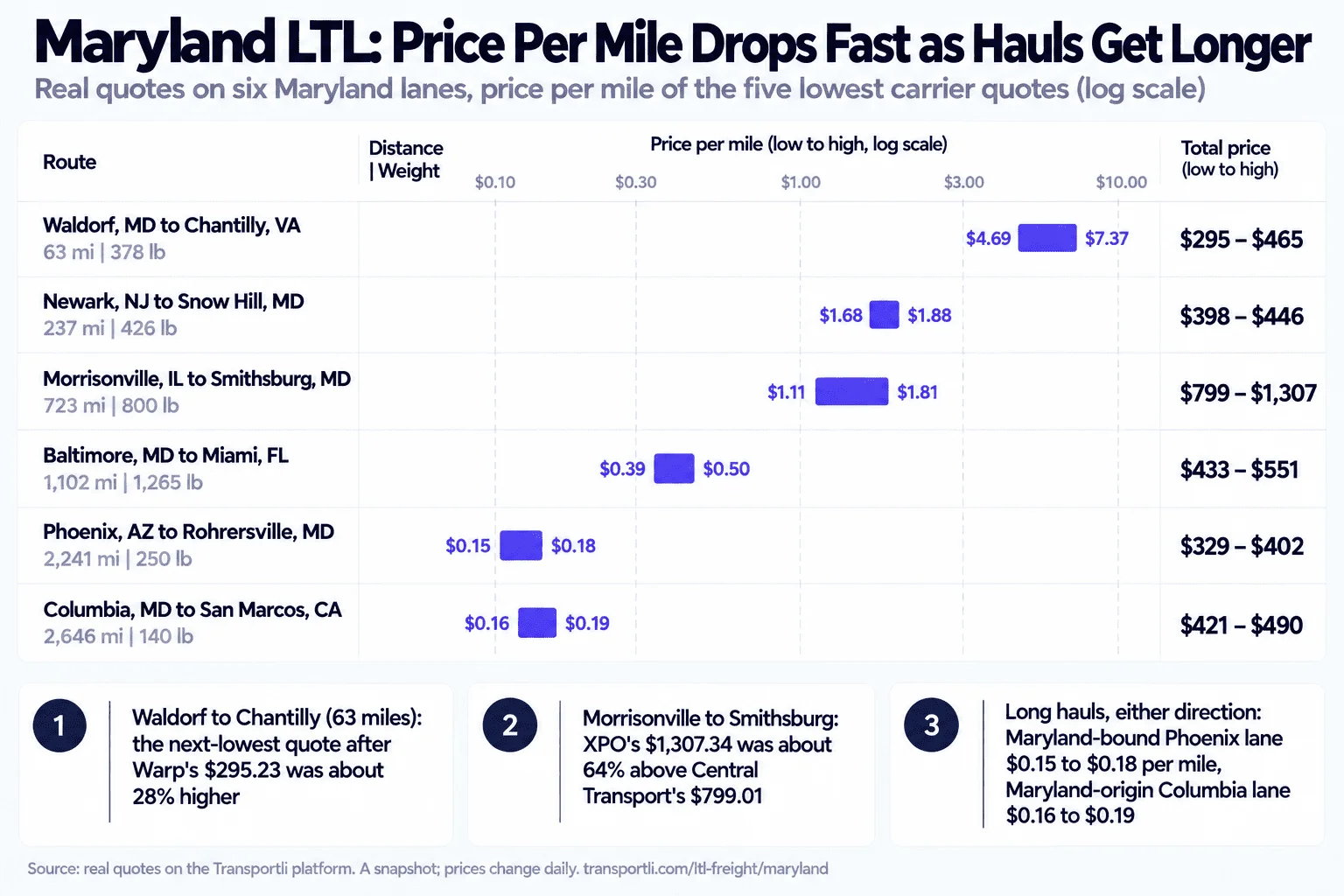
Pulling the six lanes above together, price per mile collapses as the haul gets longer:
| Route | Distance | Weight | Price range | Transit range | Price per mile |
|---|---|---|---|---|---|
| Waldorf, MD → Chantilly, VA | 63 mi | 378 lb | $295–$465 | 1 day | $4.69–$7.37 |
| Newark, NJ → Snow Hill, MD | 237 mi | 426 lb | $398–$446 | Same day–2 days | $1.68–$1.88 |
| Morrisonville, IL → Smithsburg, MD | 723 mi | 800 lb | $799–$1,307 | 2–3 days | $1.11–$1.81 |
| Baltimore, MD → Miami, FL | 1,102 mi | 1,265 lb | $433–$551 | 2–4 days | $0.39–$0.50 |
| Phoenix, AZ → Rohrersville, MD | 2,241 mi | 250 lb | $329–$402 | 5–7 days | $0.15–$0.18 |
| Columbia, MD → San Marcos, CA | 2,646 mi | 140 lb | $421–$490 | 4–6 days | $0.16–$0.19 |
Price per mile spans about a fifty-fold range in this data, from $0.15–$0.18 on the 2,241-mile haul from Phoenix to Rohrersville, Maryland to $4.69–$7.37 on the 63-mile hop from Waldorf, Maryland to Chantilly, Virginia. That short lane is not priced by the mile at all: every carrier quoted one-day transit, the five quotes run from $295.23 to $464.51, and the next-lowest quote after Warp’s $295.23, from Pitt Ohio, was about 28% higher, so carrier choice matters more than the road. The two longest lanes show how little direction mattered here: Phoenix to Rohrersville (Maryland-bound, 250 lb) cost $0.15–$0.18 per mile and Columbia, Maryland to San Marcos, California (Maryland-origin, 140 lb) cost $0.16–$0.19, although the weights and pickup dates differ. The widest carrier spread is Morrisonville, Illinois to Smithsburg: Central Transport quoted $799.01 for 3-day service, ABF Freight and R+L Carriers came within $2.09 of each other at about $972, and XPO’s $1,307.34 was about 64% above Central’s. On that lane and on Baltimore to Miami, the cheapest quote was also the slowest or tied for slowest: Central Transport’s $433.22 to Miami took 4 days, while XPO’s 2-day quote cost $550.92, or $117.70 more. The lesson is the same on every lane: compare several carriers before you book.
What a real Maryland LTL quote looks like
The screenshot alongside is an actual result from our platform, a 426 lb shipment from Newark, NJ to Snow Hill, MD on the Eastern Shore, compared across 38 real carrier options in seconds. It is the same quote shown in the second rate tab above, as it appears in the app.
- 38 real carrier options compared for this single shipment, 35 of them standard service, not just one broker’s in-house rate.
- $397.93–$446.21 for the five lowest quotes, a spread of about 12%, so on this lane the choice of carrier moves the price less than on most.
- Cheapest and fastest are the same carrier here. TForce Freight quoted $397.93 with same-day transit, while Estes was 1 day at $425.93, about 7% more.
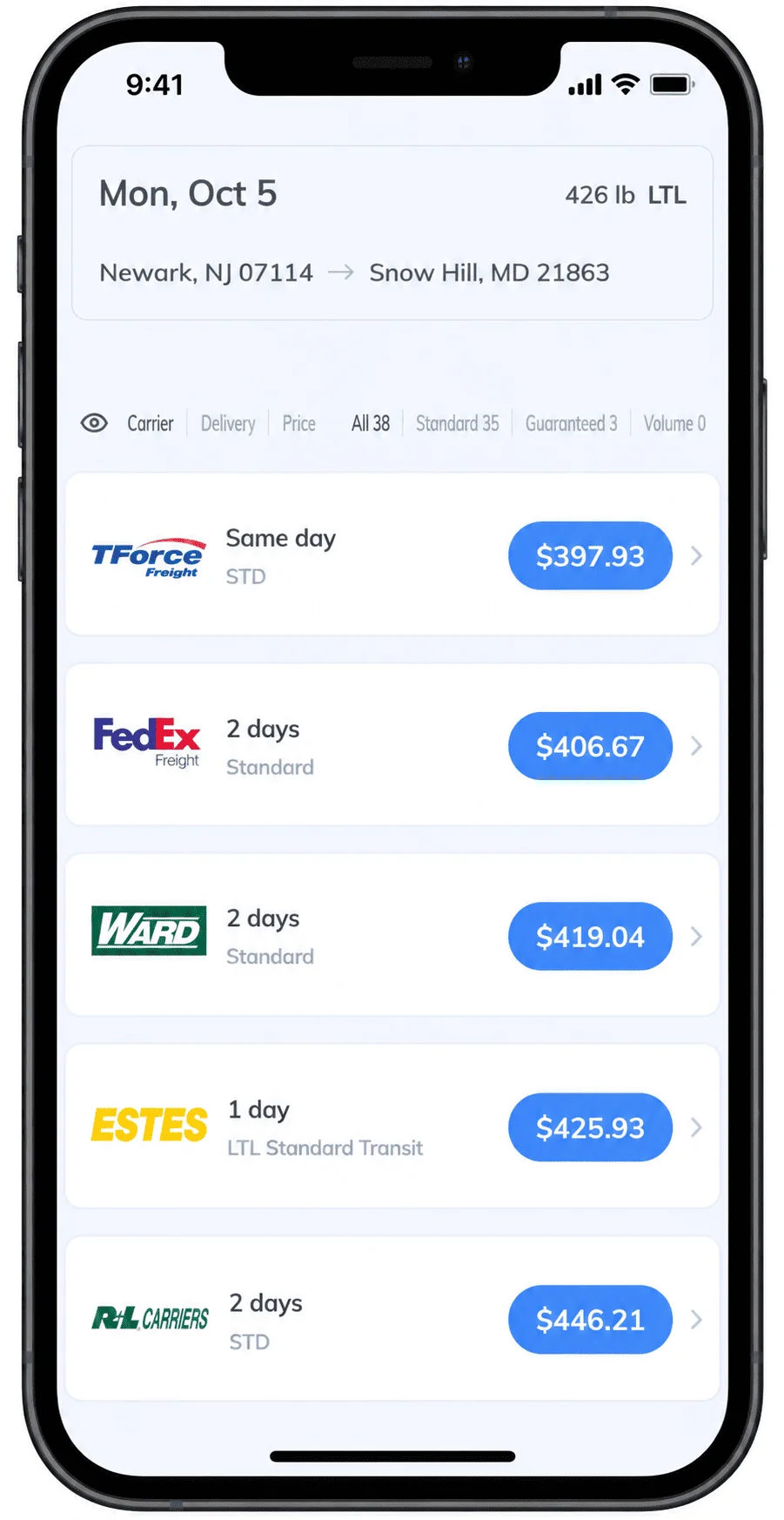
Real screenshot from a live Transportli quote for Newark, NJ to Snow Hill, MD, individual results vary by shipment and date.
Major shipping hubs in Maryland
Maryland’s freight moves through one major port, one airport and a few large industrial sites:
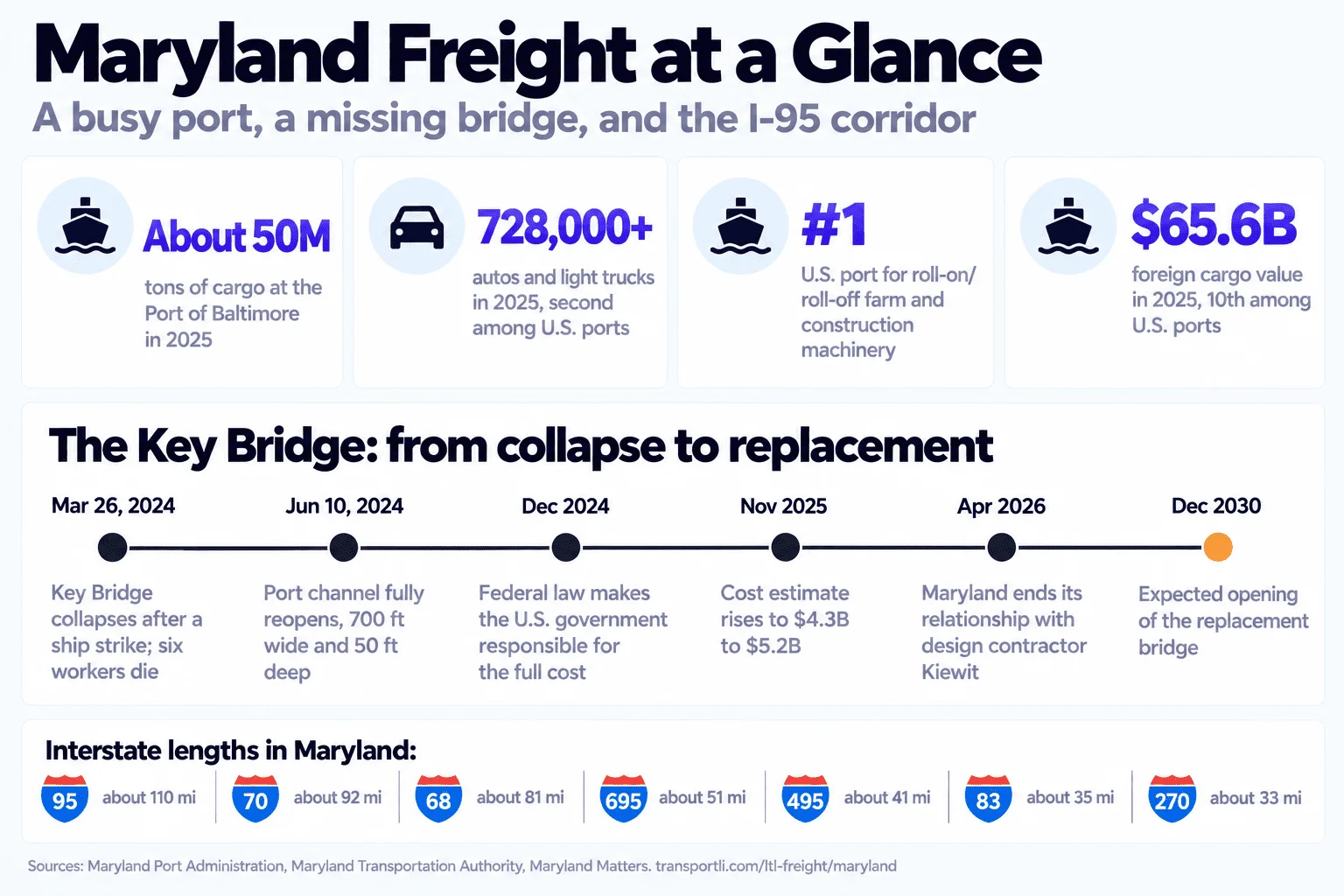
- Port of Baltimore — about 50 million tons of cargo in 2025, the second-highest total in its history behind 2023’s 52.3 million. It ranked 10th among U.S. ports for foreign cargo value ($65.6 billion) and 11th for foreign cargo tonnage.
- Seagirt Marine Terminal — about 1.1 million container units (TEUs) in 2025, edging past the 2023 record, from 2,223 vessel visits, a 21% increase over 2024.
- Autos and machinery — more than 728,000 autos and light trucks in 2025, second among U.S. ports and the 13th straight year above 700,000, and first nationally for roll-on/roll-off farm and construction machinery.
- BWI Thurgood Marshall Airport — about 257,000 metric tons of cargo in 2025, or more than 566 million pounds.
- Sparrows Point container terminal — a planned 168-acre terminal at Tradepoint Atlantic that its backers say will handle about 1 million containers a year and add about 70% to the port’s container capacity.
Highway corridors serving Maryland
I-95 (about 110 miles in Maryland) is the state’s main corridor, running from the Virginia line past Washington, through Baltimore and its tunnels, to Delaware. I-70 (about 92 miles) runs from Baltimore west through Frederick and Hagerstown to Pennsylvania, I-68 (about 81 miles) crosses western Maryland through Cumberland, and I-81 (about 12 miles) clips the state at Hagerstown. Around the cities, I-695 (about 51 miles) circles Baltimore and I-495 (about 41 miles in Maryland) circles Washington, with I-270 (about 33 miles), I-83 (about 35 miles) and I-97 (about 18 miles) as the main spurs. Because these corridors carry so much of the state’s traffic, a closure on any of them can ripple through the whole region.
The Key Bridge replacement
The Key Bridge carried I-695 across the Patapsco River and was part of the Baltimore Beltway. Its loss pushed harbor-crossing traffic into the I-95 and I-895 tunnels, where hazardous materials are banned. Maryland unveiled a cable-stayed replacement design with a 1,600-foot main span in February 2025. By November 2025 the estimated cost had more than doubled to $4.3 billion to $5.2 billion, with opening delayed to December 2030, and by June 2026 officials put the figure at about $5.2 billion. Under a December 2024 law the federal government is responsible for the full cost. In April 2026 the state ended its relationship with the design contractor, Kiewit, after what its executive director described as an impasse over cost and design. Until the new bridge opens, expect the Baltimore harbor crossings to stay tight.
What Maryland shippers move
Maryland’s freight is shaped by its port. Baltimore is the top U.S. port for roll-on/roll-off farm and construction machinery and for forest products (about 1.1 million tons), and second for autos and light trucks. It also handles a growing volume of containers, a record of about 1.1 million TEUs in 2025. Most of that moves by ship, rail or full truckload, but the parts, equipment and supplies around it, and the freight serving the roughly 6.3 million people living between Baltimore and Washington, is where LTL fits.
Get a Maryland LTL quote
Compare live rates from vetted carriers serving Maryland.
Get an LTL quote →Maryland LTL freight: frequently asked questions
How much does LTL shipping cost to or from Maryland?
It depends on distance, weight, freight class, and how close your pickup or delivery point is to a major metro’s carrier network. Real quotes on our platform for Maryland lanes have ranged from about $0.15 per mile on a 2,241-mile haul from Phoenix to $4.69 to $7.37 per mile on a 63-mile, 378 lb shipment from Waldorf to Chantilly, Virginia, so distance alone does not predict the price. Get an instant quote for your exact shipment.
Do oversized LTL shipments need a permit in Maryland?
Yes, for loads wider, taller or heavier than Maryland’s legal limits. The State Highway Administration’s Hauling Permits Unit issues Special Hauling Permits. A single-trip permit costs $30 for the first 40 tons plus $5 for each additional ton, and is valid for five days. A yearly permit is $500. Permit loads move in daylight, not on Sundays, and not on Saturdays after noon. A standard LTL trailer within legal limits does not need one.
Do trucks pay tolls in Maryland?
Yes, at several facilities, including the Fort McHenry and Baltimore Harbor tunnels and the Chesapeake Bay Bridge. MDTA’s base rate for a 5-axle truck has been about $24 per crossing, with a higher rate for video tolling. Rates have been rising since the Key Bridge collapse, so confirm current figures with MDTA.
Can hazmat freight use the Baltimore tunnels?
No. Certain hazardous materials, including bulk gasoline and explosives, are banned from the Fort McHenry and Baltimore Harbor tunnels and must use the I-695 beltway, a detour of roughly 35 miles. Since the Key Bridge collapse, the western section of the beltway is the route around the harbor for those loads.
What is the status of the Key Bridge replacement?
The bridge collapsed on March 26, 2024. Its replacement is estimated at about $5.2 billion, with opening expected in December 2030. The federal government is responsible for the full cost under a December 2024 law. The Port of Baltimore’s channel fully reopened on June 10, 2024.
How big is the Port of Baltimore?
It handled about 50 million tons of cargo in 2025, the second-highest total in its history, including about 1.1 million TEUs and more than 728,000 autos and light trucks. It ranked 10th among U.S. ports for foreign cargo value and first for roll-on/roll-off farm and construction machinery.
How does weather affect LTL shipping in Maryland?
Winter storms, flash floods and coastal flooding can all disrupt freight. February 2010 was the snowiest month in Baltimore’s history at 50 inches, the Ellicott City floods dropped more than 6 inches of rain in two hours in 2016 and more than 8 inches in 2018, and a January 2026 storm prompted a state of emergency and a temporary closure of the I-95 Express Toll Lanes. Build extra transit time into shipments during storm season.