

Shipping LTL freight to or from Colorado? Rates depend on your specific route, freight class, and how close your pickup or delivery point is to the nearest LTL terminal. Colorado had about 6.0 million residents in 2025, most of them along the Front Range from Fort Collins to Pueblo, with the Rocky Mountains separating that corridor from the Western Slope. That geography shapes freight: I-25 and I-76 carry the plains traffic, while almost everything crossing the mountains goes over I-70, past the Eisenhower Tunnel at 11,158 feet. Here’s what actually affects your rate.
LTL trucking regulations in Colorado
A standard LTL tractor-trailer within legal size and weight limits does not need a permit in Colorado. Permits and route rules matter for oversize or overweight freight, and Colorado has a few mountain rules that surprise shippers:
- Permits come from CDOT, online. The Colorado Department of Transportation issues oversize and overweight permits through its COOPR system, and the permit has to be bought before the load enters the state or moves. A standard load is limited to 8 ft 6 in wide and 80,000 lbs gross on the interstate, and CDOT’s legal-dimensions sheet allows a single trailer up to 57 ft 4 in with no overall length limit.
- Permit fees are modest, but read the total. CDOT lists a $15 single-trip oversize permit, with $5 more per axle if the load is overweight, and an annual oversize permit at $250 per power unit. Single-trip and special permits also carry a surcharge equal to the permit fee under Colorado law, which is why some third-party sites show $30, or $10 per axle, for the same permit.
- Chains are required on I-70 in winter. CDOT says Colorado law requires truckers to carry chains from September 1 to May 31 when traveling on I-70 between Morrison and Dotsero, a stretch that covers the Front Range foothills, the Continental Divide and Vail Pass.
- Hazmat has its own tunnel rules. Under CDOT’s tunnel rules, vehicles carrying placarded hazardous materials must use Loveland Pass (US 6) when it is open, and some placarded materials are never allowed through the Eisenhower-Johnson Memorial Tunnels. A shipment with a hazmat component can add miles and hours to a lane across the Divide.
Current permit fees and rules are public record:
CDOT commercial vehicle permits → CDOT commercial vehicle information → Colorado tunnel rules (2 CCR 601-8) →
What affects your Colorado LTL rate
- Freight class — density, handling, and liability determine your NMFC class, the single biggest factor in your rate. See our freight class guide.
- Distance — I-70 runs about 450 miles across Colorado and I-25 about 299 miles, so a lane from Denver to Grand Junction or from Fort Collins to Pueblo is a long haul, and most of the state’s neighbors are a day or more away.
- Metro vs. mountain — Denver, Colorado Springs, Fort Collins and the Front Range are well served by carriers, while mountain resort towns and the Western Slope typically see fewer terminals and options, and a delivery up a mountain pass can add transit time.
- Terminal proximity — the more carrier terminals near your pickup or delivery point, the more quotes you see.
- Accessorials — liftgate, residential, or inside delivery add to the base rate, same as anywhere else, and resort and mountain deliveries often need a limited-access or liftgate service.
Did you know?From 6 real Colorado lanes and 30 quotes
-
4× the cost per mile
Cost per mile varied widely on Colorado lanes
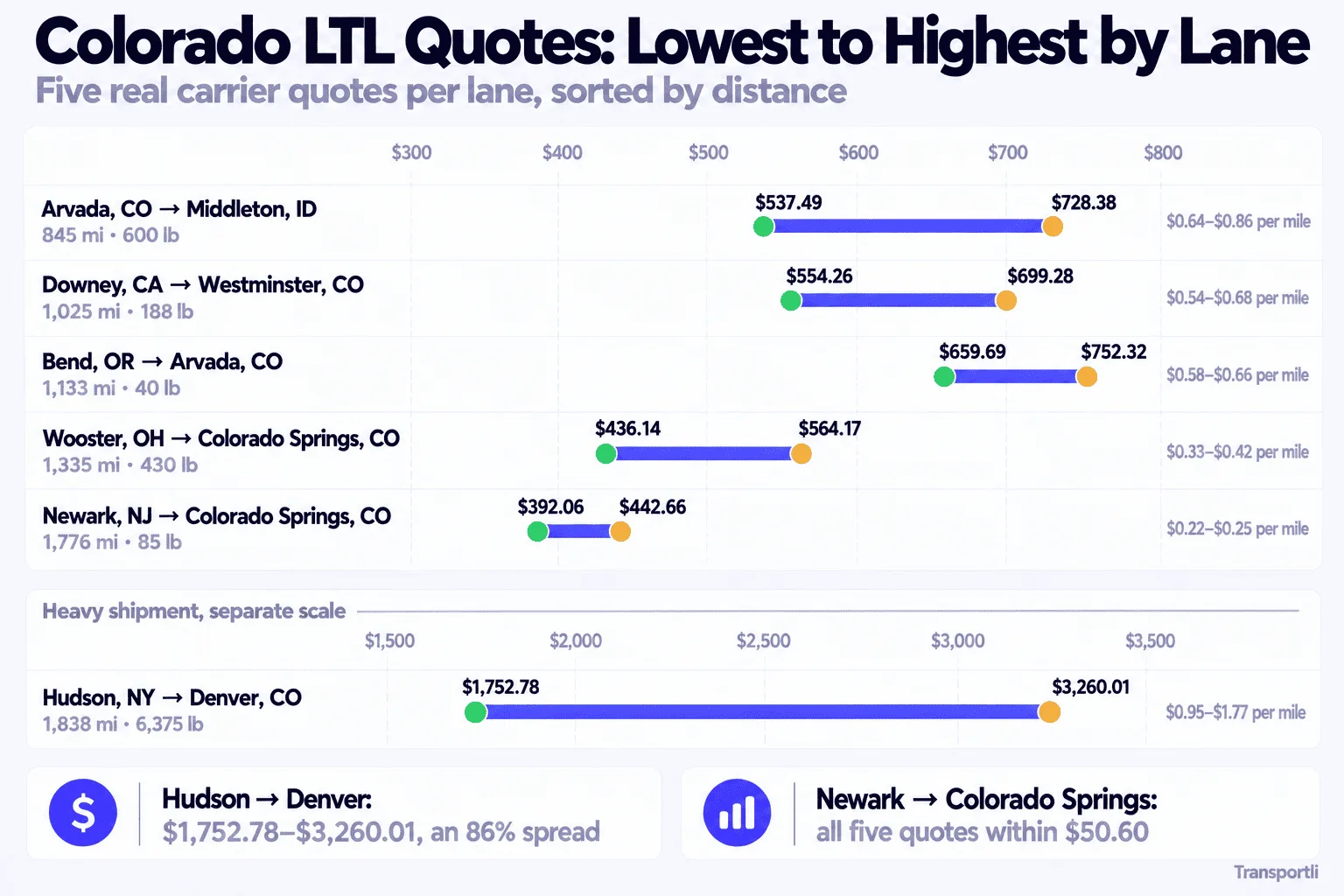
A 6,375 lb shipment moving 1,838 miles (Hudson, NY to Denver, CO) had a lowest quote of $1,753, or $0.95 a mile. A 85 lb shipment moving 1,776 miles (Newark, NJ to Colorado Springs, CO) had a lowest quote of $392, or $0.22 a mile.
-
$123 to arrive 4 days sooner
Speed has a price
On Hudson, NY to Denver, CO (1,838 miles, 6,375 lb), the cheapest quote at $1,753 took 8 days. The fastest, at 4 days, cost $1,876. On Downey, CA to Westminster, CO, 2-day delivery cost $675 against $554 for 3 days.
-
5 carriers had the lowest quote
Five different carriers won six Colorado lanes
ABF Freight had the lowest quote on two lanes. Estes, FedEx Freight, Forward Air, and XPO each had the lowest quote on one lane. Across the lowest quotes on every lane, 14 different carriers appeared.
-
$1,507 from lowest to fifth-lowest
Same shipment, quotes $1,507 apart
For 6,375 lb from Hudson, NY to Denver, CO (1,838 miles), the lowest quote was $1,753 and the fifth-lowest was $3,260, an 86% gap. On Newark, NJ to Colorado Springs, CO, all five quotes landed within $51 of each other.

Where freight moves in Colorado
Colorado freight follows the Front Range corridor, the I-70 mountain crossing and the plains routes to the east:
- Denver metro — where I-25, I-70, I-76 and I-225 meet, with the Denver-Aurora-Centennial area recording $5.6 billion of goods exports in 2024, according to the U.S. Trade Representative.
- Northern Front Range — Fort Collins, Greeley and Boulder along I-25 and US 85, with Greeley recording $2.0 billion of exports, Boulder $1.7 billion and Fort Collins-Loveland $1.2 billion in 2024.
- Colorado Springs & Pueblo — I-25 south of Denver, with Colorado Springs recording $1.1 billion of exports and Pueblo $207.3 million in 2024.
- The I-70 mountain corridor — the route over the Continental Divide through the Eisenhower Tunnel, Vail Pass and Glenwood Canyon, linking Denver with the resort towns and the Western Slope.
- Grand Junction & the Western Slope — I-70 and US 50 at the Utah end of the state, with Grand Junction recording $155.2 million of exports in 2024.
- The eastern plains — I-76 northeast from Denver to Nebraska, and US 287, US 50 and US 160 across farm country.
Weather and transit reliability
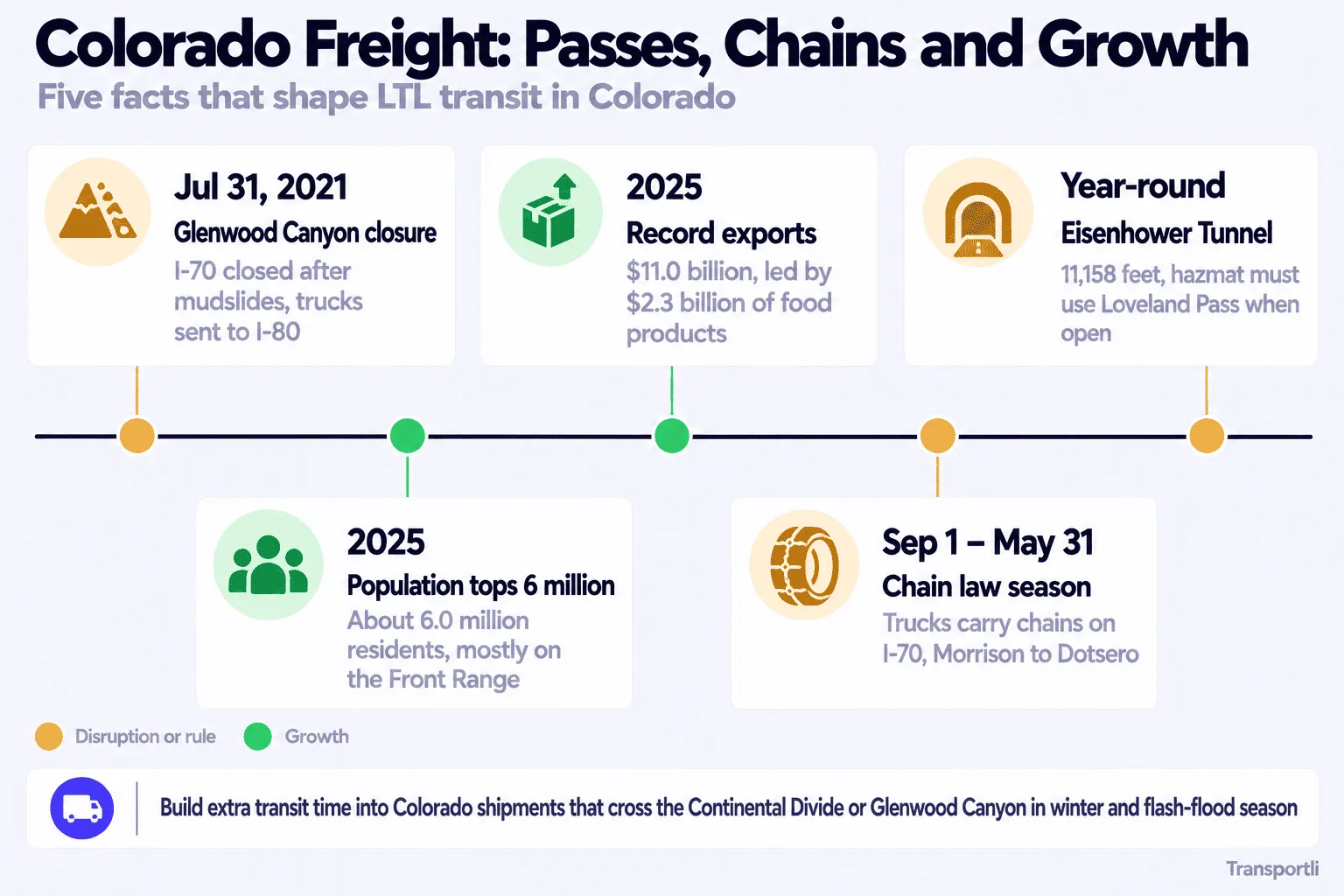
Colorado freight is exposed to heavy mountain snow, rockslides and flash floods on a handful of passes with few alternatives. The clearest example is Glenwood Canyon on I-70: after heavy rain and flooding on the night of July 31, 2021, CDOT described viaduct damage that crews had not seen before, kept the interstate closed, and recommended that trucks planning to travel through Colorado take I-80 through Wyoming instead, while cars were routed north via CO 9, US 40 and CO 13. That detour is the kind of closure that can add a day to a lane between the Front Range and the Western Slope. Winter is the other constant, which is why Colorado requires trucks to carry chains on I-70 from September 1 to May 31. For LTL shippers the practical advice is simple: during winter storms and summer flash-flood season, build extra transit time into anything that crosses the Divide, and check COtrip before a tight delivery.
Sample Colorado LTL rates by route
Real quotes pulled from our platform for six different Colorado lanes — same process, different carriers each time, spanning a range of weights and distances. Rates shift with capacity and fuel costs, so treat these as a snapshot rather than a guarantee for your shipment; get an instant quote for your exact route.
Real quotes by route
Snapshot taken over recent weeks — carriers and pricing change daily.
| Carrier | Service | Transit | Price |
|---|---|---|---|
| ABF Freight | Standard | 5 days | $537.49 |
| AAA Cooper Transportation | Standard | 2 days | $630.69 |
| XPO | Standard | 2 days | $648.93 |
| Forward Air | Standard | 2 days | $709.91 |
| Estes | LTL Standard Transit | 2 days | $728.38 |
| Carrier | Service | Transit | Price |
|---|---|---|---|
| Forward Air | Standard | 3 days | $554.26 |
| Roadrunner Freight | Standard Service | 4 days | $584.08 |
| TForce Freight | STD | 2 days | $675.16 |
| Estes | LTL Standard Transit | 2 days | $694.60 |
| XPO | STD | 2 days | $699.28 |
| Carrier | Service | Transit | Price |
|---|---|---|---|
| Estes | LTL Standard Transit | 3 days | $659.69 |
| XPO | STD | 3 days | $682.71 |
| Old Dominion Freight Line | Standard | 2 days | $687.83 |
| TForce Freight | STD | 3 days | $718.27 |
| FedEx Freight Economy | Freight Economy | 3 days | $752.32 |
| Carrier | Service | Transit | Price |
|---|---|---|---|
| XPO | STD | 3 days | $436.14 |
| TForce Freight | Standard | 4 days | $507.87 |
| R+L Carriers | STD | 3 days | $513.79 |
| Pitt Ohio | Standard | 4 days | $515.77 |
| Ward Transport & Logistics | STD | 6 days | $564.17 |
| Carrier | Service | Transit | Price |
|---|---|---|---|
| FedEx Freight Economy | Freight Economy | 6 days | $392.06 |
| Estes | Standard | 4 days | $394.22 |
| Forward Air | Standard | 4 days | $395.63 |
| TForce Freight | Standard | 5 days | $430.80 |
| Daylight Transport | Standard | 4 days | $442.66 |
| Carrier | Service | Transit | Price |
|---|---|---|---|
| ABF Freight | Standard | 8 days | $1,752.78 |
| TForce Freight | STD | 4 days | $1,875.60 |
| Magnum | Standard | 5 days | $3,177.12 |
| Estes | STD | 4 days | $3,188.61 |
| Ward Transport & Logistics | STD | 7 days | $3,260.01 |
Rate, transit, and price-per-mile summary
Pulling the six lanes above together, a heavy 6,375 lb move from Hudson, New York to Denver stands out from everything else in the data:
| Route | Distance | Weight | Price range | Transit range | Price per mile |
|---|---|---|---|---|---|
| Arvada, CO → Middleton, ID | 845 mi | 600 lb | $537–$728 | 2–5 days | $0.64–$0.86 |
| Downey, CA → Westminster, CO | 1,025 mi | 188 lb | $554–$699 | 2–4 days | $0.54–$0.68 |
| Bend, OR → Arvada, CO | 1,133 mi | 40 lb | $660–$752 | 2–3 days | $0.58–$0.66 |
| Wooster, OH → Colorado Springs, CO | 1,335 mi | 430 lb | $436–$564 | 3–6 days | $0.33–$0.42 |
| Newark, NJ → Colorado Springs, CO | 1,776 mi | 85 lb | $392–$443 | 4–6 days | $0.22–$0.25 |
| Hudson, NY → Denver, CO | 1,838 mi | 6,375 lb | $1,753–$3,260 | 4–8 days | $0.95–$1.77 |
Hudson to Denver (1,838 miles, 6,375 lb) is the outlier per mile, and it is the only lane that splits into two price tiers. ABF Freight’s 8-day $1,752.78 and TForce Freight’s 4-day $1,875.60 sit together, then the next three quotes jump to $3,177.12–$3,260.01, a gap of $1,301.52 between TForce and Magnum, so the lane spread is $1,507.23 or 86%. TForce’s 4-day $1,875.60 cost just $122.82 more than ABF’s 8-day $1,752.78 for half the transit time. Weight did not set the price on the light lanes. The 40 lb shipment from Bend, Oregon to Arvada (1,133 miles) ran $659.69–$752.32, more than the 85 lb shipment from Newark, New Jersey to Colorado Springs ($392.06–$442.66), though the Newark lane is 643 miles longer, and Newark to Colorado Springs was the cheapest per mile at $0.22–$0.25. On Wooster, Ohio to Colorado Springs, XPO’s 3-day $436.14 was $71.73 below the next quote, and Ward Transport & Logistics’s 6-day $564.17 cost $128.03 more than XPO for twice the transit time. On Arvada to Middleton, Idaho, AAA Cooper’s 2-day $630.69 cost $93.20 more than ABF Freight’s 5-day $537.49 for three days less. Downey, California to Westminster was the lane where speed cost the most: Forward Air’s 3-day $554.26 was the lowest, while every 2-day quote started at $675.16, $120.90 higher. Newark to Colorado Springs was the tightest lane, with all five quotes within $50.60, and Estes’s 4-day $394.22 cost just $2.16 more than FedEx Freight Economy’s 6-day $392.06. On Bend to Arvada, Old Dominion Freight Line’s 2-day $687.83 cost $28.14 more than Estes’s 3-day $659.69. The lesson is the same on every lane: compare several carriers before you book.
What a real Colorado LTL quote looks like
The screenshot alongside is an actual result from our platform, a 140 lb shipment from Denver, CO to Austin, TX, compared across 55 real carrier options in seconds. It is a Colorado-origin lane that we also break down in our Texas guide, quoted again for a later date and a different weight.
- 55 real carrier options compared for this single shipment, 44 of them standard service and 11 guaranteed, not just one broker’s in-house rate.
- $319.22–$355.50 for the five lowest quotes, with transit of 2 to 3 days. AAA Cooper Transportation was lowest at $319.22 on 3-day service, and XPO’s 2-day $347.30 cost $28.08 more to save a day.
- The lighter shipment cost more. A 45 lb shipment on the same two ZIP codes, quoted earlier for a September 21 pickup, ran $490.88–$538.90 for its five lowest quotes, $171.66 above the lowest quote for 140 lb here. Weight alone does not set the price, because the date, the carriers bidding and the weight break all move the number.
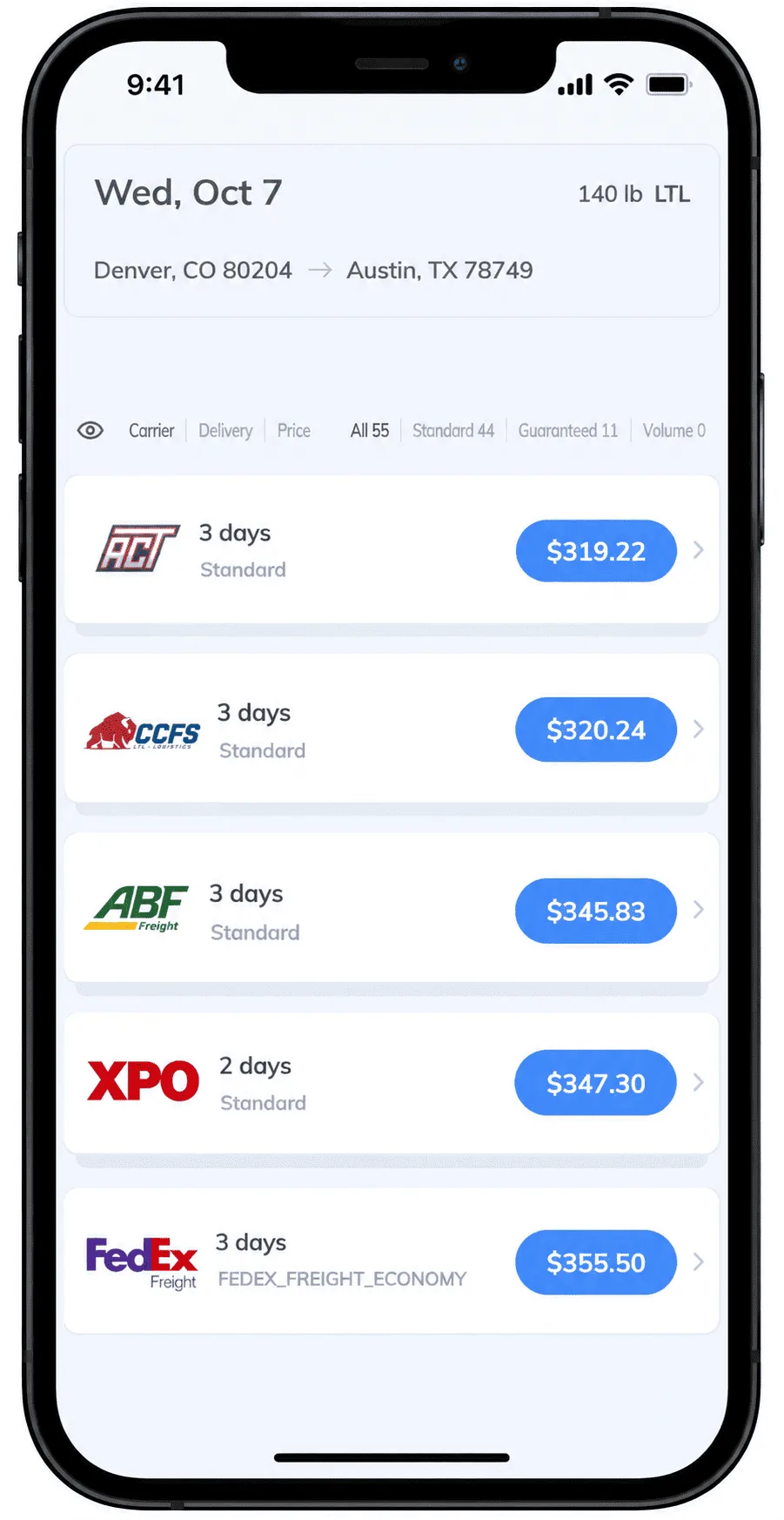
Real screenshot from a live Transportli quote for Denver, CO to Austin, TX, individual results vary by shipment and date.
Major shipping hubs in Colorado
Colorado’s freight network is centered on Denver, with a chain of smaller metros along the Front Range:
- Denver — the state’s freight crossroads, where I-25 meets I-70 and I-76, home to Denver International Airport and the largest concentration of carrier terminals and warehouses.
- Fort Collins & Greeley — the northern Front Range, with Greeley recording $2.0 billion of goods exports and Fort Collins-Loveland $1.2 billion in 2024, reflecting its food and agricultural base.
- Boulder — a technology and science hub that recorded $1.7 billion of goods exports in 2024.
- Colorado Springs & Pueblo — the southern anchors of I-25, with $1.1 billion and $207.3 million of exports in 2024.
- Grand Junction — the main freight stop on the Western Slope, reached from Denver by about 250 miles of I-70 through the mountains.
Highway corridors serving Colorado
I-25 (about 299 miles in Colorado) is the main north-south route, from the New Mexico line near Raton through Pueblo, Colorado Springs and Denver to Wyoming. I-70 (about 450 miles) crosses the state from Utah to Kansas through the Rocky Mountains and Denver, and is the only interstate over the Continental Divide. I-76 (about 187 miles, almost all in Colorado) runs northeast from Arvada to Nebraska. US 50 (about 468 miles) links Grand Junction, Gunnison, Pueblo and the Arkansas Valley, and US 285 (about 264 miles) crosses the mountains southwest of Denver.
The Eisenhower Tunnel and Glenwood Canyon
Most truck freight between Denver and the Western Slope funnels through two choke points: the Eisenhower Tunnel, the highest point on the Interstate Highway System at 11,158 feet, and Glenwood Canyon, where I-70 follows the Colorado River on a narrow viaduct. A closure at either one, from snow, a crash or a mudslide, can push trucks onto much longer detours. Check COtrip before a tight delivery.
What Colorado shippers move
Colorado’s freight is shaped by food, technology and manufacturing. The state exported a record $11.0 billion of goods in 2025, the 34th most of any state, led by $2.3 billion of food products, $2.1 billion of computer and electronic products, $1.3 billion of chemicals, $1.1 billion of machinery and $707 million of fabricated metal products. Mexico took $1.7 billion, or 15% of the total, followed by Canada at $1.6 billion, Switzerland at $751 million, South Korea at $663 million and Italy at $655 million, according to the U.S. Trade Representative. Colorado is also the 27th largest agricultural exporting state, shipping $2.0 billion abroad in 2024, led by $499 million of beef and veal. Much of this moves in full truckloads, by container, by air or by rail, but the parts, tools, supplies and finished goods around these industries are where LTL fits.
Get a Colorado LTL quote
Compare live rates from vetted carriers serving Colorado.
Get an LTL quote →Colorado LTL freight: frequently asked questions
How much does LTL shipping cost to or from Colorado?
It depends on distance, weight, freight class, and how close your pickup or delivery point is to a major metro’s carrier network. Real quotes on our platform for Colorado lanes have ranged from about $0.22 per mile on an 85 lb shipment over 1,776 miles from Newark, New Jersey to Colorado Springs to $0.95 to $1.77 per mile on a 6,375 lb shipment over 1,838 miles from Hudson, New York to Denver, so weight and origin matter as much as distance. Get an instant quote for your exact shipment.
Do oversized LTL shipments need a permit in Colorado?
Yes, for loads wider than 8 ft 6 in or heavier than 80,000 lbs on the interstate, or otherwise over the legal limits. CDOT issues permits online through COOPR, and the permit must be bought before the load enters the state. CDOT lists $15 for a single-trip oversize permit plus $5 per axle if overweight, and single-trip permits also carry a surcharge equal to the fee. A standard LTL trailer within legal limits does not need one.
Do trucks need chains on I-70 in Colorado?
Yes. CDOT says Colorado law requires truckers to carry chains from September 1 to May 31 when traveling on I-70 between Morrison and Dotsero.
Can hazardous materials go through the Eisenhower Tunnel?
Not freely. Under CDOT’s tunnel rules, vehicles carrying placarded quantities of hazardous materials must use Loveland Pass (US 6) when it is open, certain materials are prohibited from the Eisenhower-Johnson Memorial Tunnels at all times, and others may use the tunnels only when the pass is closed.
How do snow and closures affect LTL shipping in Colorado?
Mountain passes are the main risk. In 2021, mudslides and flooding closed I-70 through Glenwood Canyon, and CDOT recommended that trucks use I-80 through Wyoming. Build extra transit time into shipments that cross the Continental Divide or the canyon, especially in winter and during summer flash-flood season, and check COtrip before a tight delivery.
Why is Denver important for freight?
Denver is where I-25, I-70 and I-76 meet, so it is the state’s main carrier and warehouse hub. The Denver-Aurora-Centennial area recorded $5.6 billion of goods exports in 2024, the most of any Colorado metro area, according to the U.S. Trade Representative.
What roads connect Colorado’s main cities?
I-25 runs north-south through Pueblo, Colorado Springs, Denver and Fort Collins, I-70 crosses the state from Utah to Kansas through the mountains and Denver, and I-76 links Denver to Nebraska. US 50 and US 285 serve the mountain and southern routes.