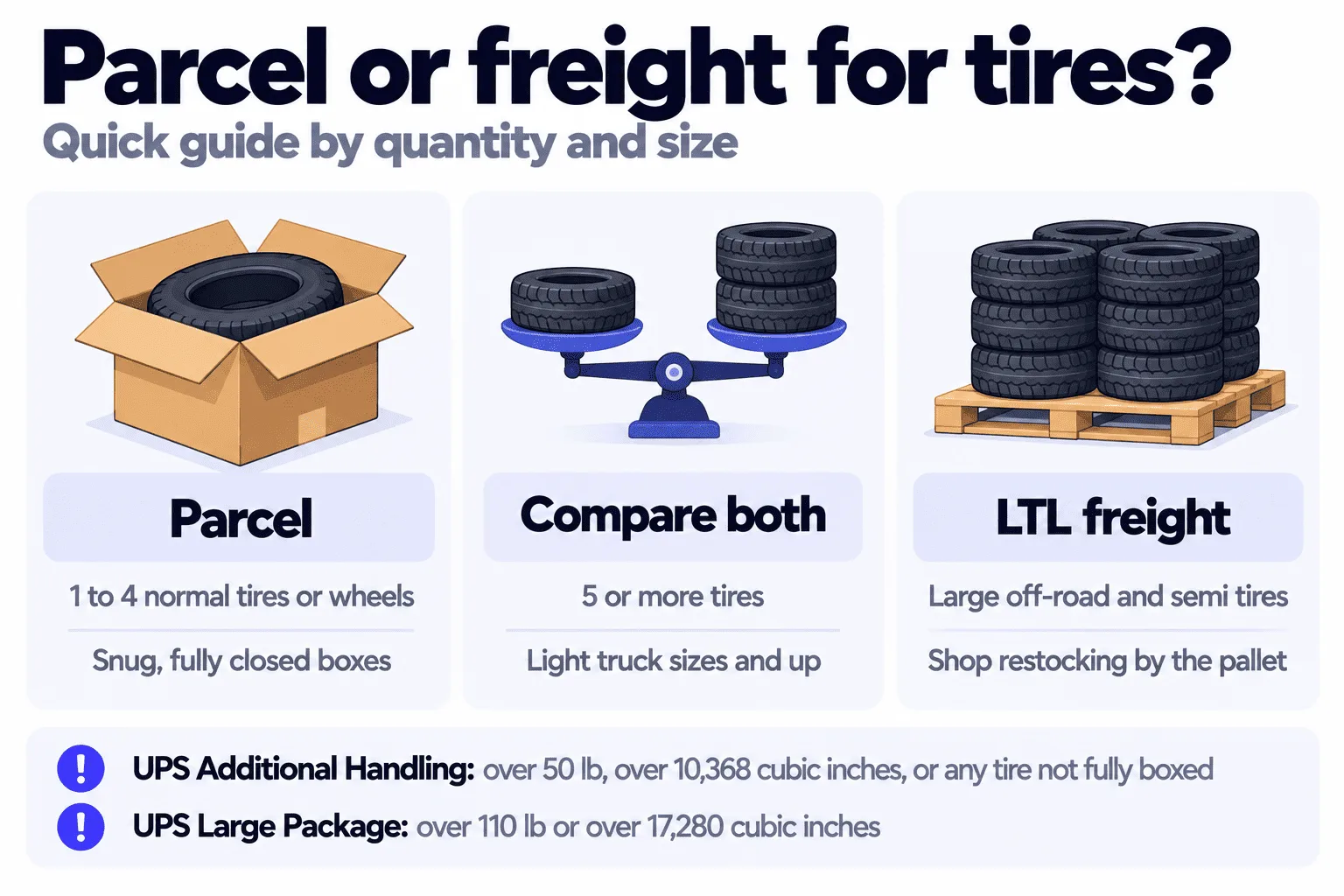
If you are shipping one to four tires or wheels, the answer is almost always parcel: box each one snugly and send it by UPS or FedEx Ground. Freight on a pallet starts to make sense at about five or more tires, with big truck or off-road tires, or when parcel surcharges pile up. The trick is knowing where that line sits for your tires, because carriers charge extra for tires that are not fully boxed or that pass certain sizes.
This guide covers parcel or freight, which tires trigger carrier surcharges, how to pack and palletize, what real freight quotes cost, and how to ship wheels and rims. The planner below checks your own tires. It is written for both individuals shipping a set of wheels and sellers or tire shops moving tires in volume.
The short version
- 1 to 4 normal tires or wheels: ship by parcel, each in its own snug, fully closed box. Most passenger tires stay under the carriers’ standard limits.
- Do not ship a tire unboxed. UPS charges Additional Handling for any tire that is not fully encased in a corrugated cardboard box.
- Size and weight set the surcharges. A boxed tire that is over 10,368 cubic inches or 50 lb gets Additional Handling at UPS, and over 17,280 cubic inches or 110 lb it becomes a Large Package. Light truck tires and larger cross the first line, and some mid-size passenger tires do too.
- Five or more tires, or any large tire: compare LTL freight on a pallet. Real quotes on our platform for 100 to 1,300 lb shipments had a median lowest price of about $430, with the middle half between about $350 and $610.
- Pallet class varies. Carriers commonly rate palletized tires in freight class 50 to 100, depending on how the pallet is built. Ask for a pre-rate and measure the finished pallet.
Should you ship tires by parcel or freight?
Parcel pricing is per box, so cost grows with every tire. Freight pricing is per pallet, so it is mostly a fixed cost for the shipment, and it gets cheaper per tire the fuller the pallet is. Guides give different breakeven points (some say 5 tires, some say 10 or more, some say a truck tire over 60 lb), so use this table as a starting point and get both prices when you are near the line.
| What you are shipping | Usually best by | Why |
|---|---|---|
| 1 to 4 passenger tires or wheels | Parcel | Each boxed tire fits standard limits, and one pallet costs more than a few boxes. |
| A set of 4 mounted wheels and tires | Parcel, but check weight | Each package is usually 40 to 100 lb, so many will be over the 50 lb Additional Handling line. |
| Light truck or SUV tires (about 31 to 33 in tall) | Parcel, then compare at 4 or more | Each boxed tire passes the 10,368 cubic inch line, so each one gets a surcharge. |
| 5 to 8 or more passenger tires | Compare parcel and LTL | One pallet holds about 10 passenger tires, so freight can beat 5 or more separate boxes. |
| Large off-road tires (35 in and up) or semi tires | LTL freight | Boxed, they become Large Packages (billed at 90 lb minimum) or exceed parcel limits. |
| A shop restocking tires every week | LTL freight to a dock | Pallets are cheaper per tire and avoid parcel surcharges. |
Which tires trigger parcel surcharges?
The surcharges come from a few published rules. These are UPS’s current domestic rules, taken from UPS’s shipping-charge guide:
- Additional Handling applies when the longest side is over 48 in, the second-longest side is over 30 in, the package weighs over 50 lb, or its cubic size is over 10,368 cubic inches. It also applies to any tire that is not fully encased in a corrugated cardboard box.
- Large Package applies when length plus girth is over 130 in, the longest side is over 96 in, the cubic size is over 17,280 cubic inches, or the weight is over 110 lb. Large Packages are billed at a minimum of 90 lb, and Additional Handling is not charged on top.
- Over maximum limits are 150 lb, 108 in long, and 165 in length plus girth. Packages beyond them are subject to an Over Maximum Limits charge.
FedEx uses a similar cubic-size trigger (10,368 cubic inches for its Additional Handling Surcharge, and 17,280 cubic inches or 110 lb for its Oversize Charge, according to its 2026 surcharge notice), and both carriers add demand surcharges on oversize and additional-handling packages in peak season. Check FedEx’s current rate and surcharge pages before you ship.
Cubic size is length × width × height of the finished box. A tire needs a box about as wide as its outside diameter, so the diameter decides the surcharge. This table works it out for common sizes with a snug box (1 in of padding on each side):
| Tire size | Outside diameter | Boxed size | Cubic inches | UPS category |
|---|---|---|---|---|
| 195/65R15 | about 25.0 in | 27″ × 27″ × 10″ | 7,044 | Standard |
| 225/45R17 | about 25.0 in | 27″ × 27″ × 11″ | 7,900 | Standard |
| 235/65R17 | about 29.0 in | 31″ × 31″ × 11″ | 10,832 | Additional Handling |
| 265/70R17 (light truck) | about 31.6 in | 34″ × 34″ × 12″ | 14,042 | Additional Handling |
| 275/60R20 | about 33.0 in | 35″ × 35″ × 13″ | 15,706 | Large Package (length plus girth) |
| 285/75R16 (33 in) | about 32.8 in | 35″ × 35″ × 13″ | 16,039 | Large Package (length plus girth) |
| 35×12.50R17 | about 35.0 in | 37″ × 37″ × 14″ | 19,850 | Large Package |
| 11R22.5 (semi) | about 42.0 in | 44″ × 44″ × 13″ | 25,168 | Large Package (also over 110 lb) |
Two sizes sit close to the length-plus-girth line, so a bit more padding would tip them over. Diameters come from the standard tire-size formula (rim diameter plus twice the sidewall height). A heavier tire can cross the weight lines first: 50 lb for Additional Handling and 110 lb for a Large Package. Extra padding makes the box bigger.
How to pack tires for parcel shipping
- Use a fully closed corrugated box that fits the tire snugly. Every extra inch adds cubic size, and an unboxed or wrapped-only tire draws Additional Handling.
- Weigh the packed box and round up. If it is over 50 lb, expect Additional Handling even if the box is small.
- Protect the tread and sidewall with cardboard or paper so the tape and the box do not mark the rubber.
- For wheels or rims, protect the face and lip. Cover the rim face with foam or heavy cardboard and keep the tire’s sidewall from pressing on it. Use double-wall boxes, because wheels and tires are heavy.
- Label the box on two sides and keep the receipt and photos of the packed box in case of a claim.
- Enter the true size and weight when you book. Wrong dimensions are corrected after delivery, and the correction costs more.
How to palletize tires for LTL freight
Palletizing is what makes freight work: one stable, banded unit that a forklift can move. The carrier measures the outside of your finished pallet, so a neat, tight stack is cheaper than a loose or leaning one.
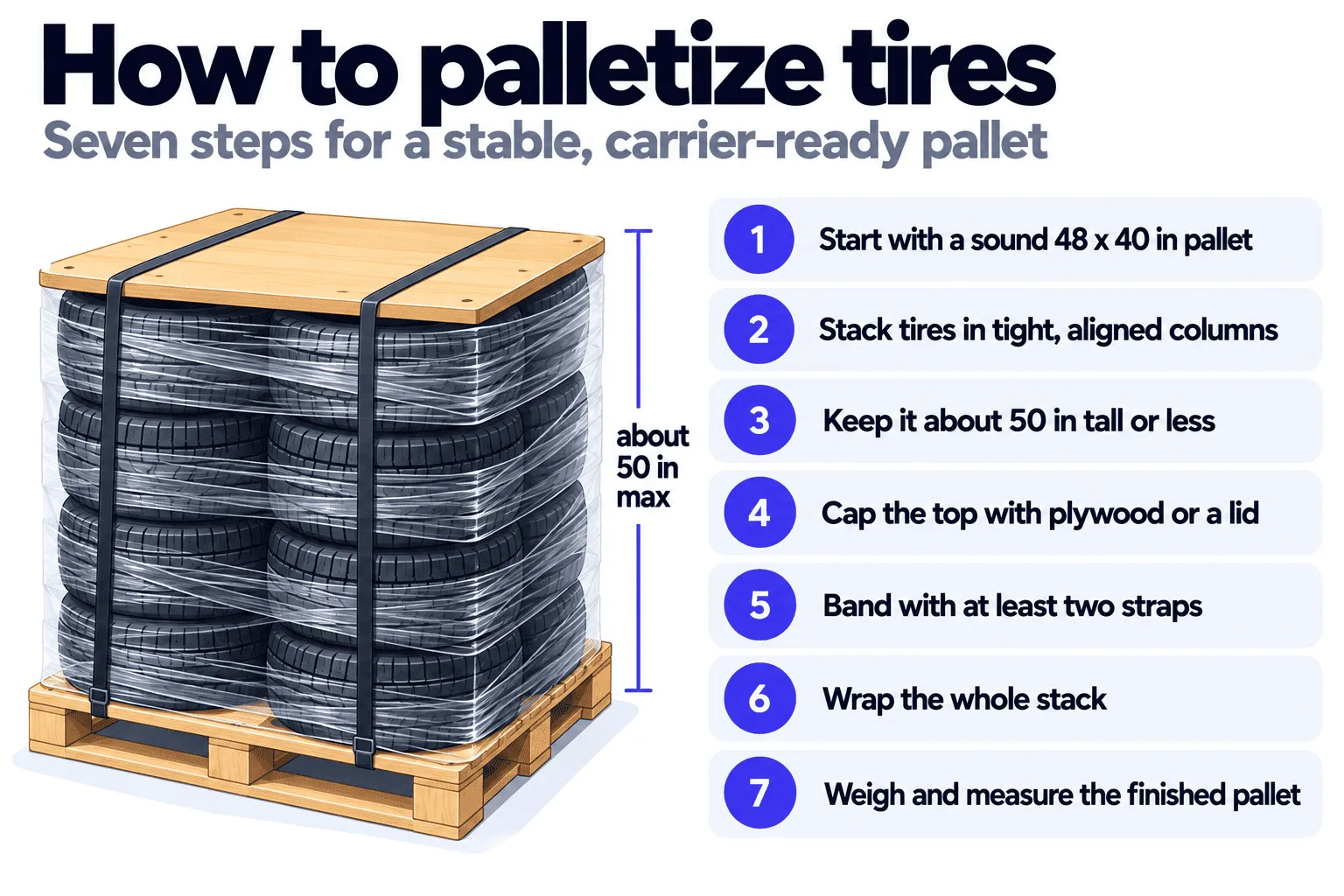
- Start with a sound 48 × 40 in pallet. Do not ship loose tires or tires on a broken pallet.
- Stack tires in tight, aligned columns. Keep overhang small, because the carrier bills the measured outer size.
- Keep the pallet about 50 in tall or less so it can be stacked and fits standard trailers. Weight is usually under 2,000 lb per pallet.
- Add a cap on top, such as plywood or a pallet lid, so the strap does not cut into the top tire.
- Band it with at least two steel or heavy poly straps through the center of the stack and around the pallet deck.
- Wrap the stack in several layers of stretch or shrink wrap to keep dirt and water off, especially for used or take-off tires.
- Weigh and measure the finished pallet and use those numbers on the bill of lading.
Guides disagree on one point. Some say stack tires flat in columns, some say stand them upright in rows. Flat columns usually fit more passenger tires on a pallet, while upright rows can protect sidewalls on heavy tires. Either can work if the pallet is stable and banded, so ask your carrier or broker what they prefer.
Tire and wheel shipping planner
Pick your tire or wheel, adjust the size and weight to match yours, and enter how many you have. The planner shows which UPS category one boxed tire falls into, how many fit on a pallet, and what real LTL quotes cost for a load this heavy.
Tire and wheel shipping planner
Pick your tire or wheel, enter the size, weight and quantity, and see whether it ships as a normal parcel, triggers carrier surcharges, or belongs on a pallet.
Freight class and weight for palletized tires
Freight class is set by the carrier from the measured weight and size of your pallet, and tires have their own listing in the freight classification (NMFC). Sources vary on the class, so treat any single number with caution:
- Tightly stacked passenger and light truck tires are commonly described as class 50 to 77.5.
- Loose tires, used take-offs, and large off-road tires with trapped air can rate higher, up to about class 92.5 to 100.
- The class a carrier applies depends on how the pallet is built, so ask for a pre-rate and measure the finished pallet.
Tires are bulky for their weight: ten passenger tires on a pallet weigh roughly 275 lb in about 58 cubic feet. That is a low density, and it is why a pallet of a few tires is not cheap per pound. Our density calculator shows how density sets the class, and the freight class guide explains the 2025 density-based scale.
What does it cost to ship tires by LTL freight?
We looked at 184 real LTL quotes on our platform for shipments between 100 and 1,300 lb, the weight of one to several pallets of tires. The lowest quote on each lane was:
| Shipment weight | Lanes | Median lowest quote | Middle half |
|---|---|---|---|
| 100 to 250 lb | 57 | $415 | $329 to $526 |
| 250 to 500 lb | 58 | $386 | $330 to $523 |
| 500 to 1,000 lb | 57 | $503 | $380 to $699 |
| 1,000 to 1,300 lb | 12 | $556 | $446 to $918 |
Two things stand out. First, the price barely rises with weight in this range, so a full pallet is much cheaper per tire than a half-empty one. Second, the spread is wide: the cheapest lane was about $235 and the highest over $1,800, depending on distance and carriers. The fifth-lowest quote on the same lanes was typically about $120 above the lowest, so comparing several carriers is worth it.
Benchmark, not a quote. It is based on real lanes from the state pages on this site (snapshot, October 2026). Liftgate, residential delivery, limited access and other add-ons are priced separately. See our accessorial charge checker.
How to ship wheels, rims and mounted sets
- Wheels without tires are smaller (about 17 to 20 in across for common sizes) and usually ship as standard parcels, but they are heavy for their size, so use double-wall boxes.
- Mounted wheel and tire sets weigh roughly 40 to 100 lb each, so weight, not size, often triggers the 50 lb Additional Handling line.
- Protect the rim. Put foam or heavy cardboard over the face and lip, and do not let a rim press against another wheel.
- A set of four mounted wheels can go as four parcels or as one small pallet. At about 200 to 350 lb, one pallet is worth pricing against four surcharged boxes.
Truck, off-road, ATV and motorcycle tires
Large tires change the answer. A semi tire (11R22.5) is about 42 in across and weighs around 100 lb or more, so it exceeds parcel Large Package limits once boxed. Off-road tires at 35 in or more are also Large Packages. For these, palletize and ship LTL, or use a freight carrier for tires that are too big to box. Smaller ATV, UTV and motorcycle tires are much closer to passenger tires and usually ship by parcel in a snug box.
Tips for tire shops and online sellers
- Use parcel for single orders and pallets for restocking. Build one standard pallet layout per tire size so quotes are quick.
- Ship to a dock when you can. Residential delivery and liftgate service add charges, and a tire shop with a dock avoids both.
- Declare value and photograph every pallet at pickup. It makes a damage claim straightforward.
- Weigh and measure each shipment. Carriers re-weigh and re-measure, and a wrong class or size is corrected with a fee.
Shipping five or more tires, or a pallet of wheels?
Enter your zip codes and your weight and size, and we will show you live LTL quotes from multiple carriers in about a minute. No obligation to book.
Get an LTL quote →Tire and wheel shipping: frequently asked questions
How do you ship tires?
For one to four tires, box each one snugly in a fully closed corrugated box and ship by UPS or FedEx Ground. For five or more tires, or for large truck and off-road tires, stack them on a 48 by 40 inch pallet, band and wrap the stack, and ship by LTL freight.
How much does it cost to ship a tire?
It depends on size, weight and distance. A standard boxed passenger tire usually avoids surcharges, while light truck tires and larger draw an Additional Handling or Large Package charge per tire. Get a parcel quote with your real box size and weight, and compare a pallet for larger shipments.
What is the cheapest way to ship tires?
One to four normal tires are usually cheapest by parcel in snug boxes. Once you reach about five or more tires, or each tire triggers a surcharge, one pallet by LTL can be cheaper. Compare both with your real weights and sizes.
Does UPS charge extra to ship tires?
It can. UPS charges Additional Handling for any tire that is not fully encased in a corrugated cardboard box, and for boxes over 50 lb, over 10,368 cubic inches, or longer than 48 inches. Boxes over 17,280 cubic inches or 110 lb are Large Packages.
Can you ship tires by FedEx?
Yes. FedEx ships tires and wheels, and uses similar size and weight triggers for its Additional Handling and Oversize charges. Check its current Service Guide for the exact limits.
How many tires fit on a pallet?
It depends on the tire. A standard 48 by 40 inch pallet holds about 10 passenger tires in two flat stacks of five, but only about 4 semi tires or 3 large off-road tires. Weight is usually under 2,000 lb per pallet.
What freight class are tires?
Carriers commonly rate palletized tires in freight class 50 to 100, depending on the NMFC listing, the density of the pallet and how it is built. Ask your carrier for a pre-rate and use the measured weight and size on the bill of lading.
Can you ship wheels with the tires mounted?
Yes. Mounted wheels and tires weigh about 40 to 100 lb each, so they usually exceed the 50 lb Additional Handling line. Protect the rim, box each one, or pallet a full set.
How do you ship rims?
Rims are smaller and ship as standard parcels in double-wall boxes. Cover the face and lip with foam or heavy cardboard so they cannot scratch each other.
Can you ship tires without a box?
You can, but UPS charges Additional Handling for a tire that is not fully inside a corrugated box. Boxing the tire is usually cheaper than paying the surcharge.
How long does LTL freight take for tires?
LTL transit depends on distance and carriers, and it is typically slower than parcel. Our real quotes show the estimated days for each carrier before you book.
Can I get a freight quote for tires?
Yes. Enter your zip codes and the weight and size of your pallet and compare live LTL quotes from multiple carriers.