

Shipping less-than-truckload (LTL) freight to or from Virginia? Rates depend on your specific route, freight class, and how close your pickup or delivery point is to the nearest LTL terminal. Virginia has about 8.9 million residents, 1,118 miles of interstate and one of the East Coast’s biggest container ports at Hampton Roads. I-81 runs about 325 miles through the Shenandoah Valley and Southwest Virginia, I-95 carries the Washington-to-Richmond corridor, and I-64 links the coast to the mountains. Winter can shut the main routes down: in January 2022 a snowstorm stranded hundreds of drivers on I-95. Here’s what actually affects your rate.
LTL trucking regulations in Virginia
A standard LTL tractor-trailer within legal size and weight limits does not need a permit in Virginia. Permits matter for oversize or overweight freight, and Virginia’s rules include a few that surprise shippers:
- Permits come from the DMV. The Virginia Department of Motor Vehicles issues hauling permits through its EZ Haul system, which handles routing and lets some permit types be self-issued.
- The legal limits are 8 ft 6 in wide and 13 ft 6 in high. Trailers may be up to 48 ft, and 53-foot trailers are allowed on the interstate system. A load that still exceeds these after being reduced to its smallest dimensions needs a permit.
- Fees are low. A single-trip permit costs $20, plus 30 cents a mile if the load is overweight or the configuration cannot be licensed in Virginia. A blanket permit costs $100 for one year or $200 for two, and a superload permit costs $30 plus the mileage and damage fees.
- Oversize loads move sunrise to sunset. Under Virginia’s hauling permit regulation, normal travel for permitted loads is sunrise to sunset, and DMV may restrict days and times further.
- Cities have rush-hour bans. No permitted travel is allowed within the limits of cities or towns from 7 to 9 a.m. and 4 to 6 p.m., except for loads that are only overweight or only overlength (up to 85 ft including rear overhang).
- Six holidays are off limits. Permitted loads may not travel on New Year’s Day, Memorial Day, Independence Day, Labor Day, Thanksgiving Day or Christmas Day.
- Express lanes close to big trucks. According to VDOT, trucks with more than two axles may not use the I-95, I-395 or I-495 Express Lanes, and tractor-trailers may not use I-66 inside the Beltway’s HOV lanes.
- Trucks have lower speed limits. DMV’s Size, Weight and Equipment guide (July 2024 edition) limits trucks to 65 mph on interstates where designated and 55 mph on other roads.
Current permit fees and rules are public record:
Virginia DMV Hauling Permits →
What affects your Virginia LTL rate
- Freight class — density, handling, and liability determine your NMFC class, the single biggest factor in your rate. See our freight class guide.
- Distance — I-81 runs about 325 miles and I-64 about 301 miles across Virginia, so a lane from Hampton Roads to the far southwest is a long haul inside a single state.
- Metro vs. rural — Northern Virginia, Richmond, Hampton Roads and Roanoke are well served by carriers, while Southwest Virginia, Southside and the Eastern Shore typically see fewer terminals and options.
- Terminal proximity — the more carrier terminals near your pickup or delivery point, the more quotes you see.
- Accessorials — liftgate, residential, or inside delivery add to the base rate, same as anywhere else.
Did you know?From 6 real Virginia lanes and 30 quotes
-
4× the cost per mile
The shorter haul cost far more per mile
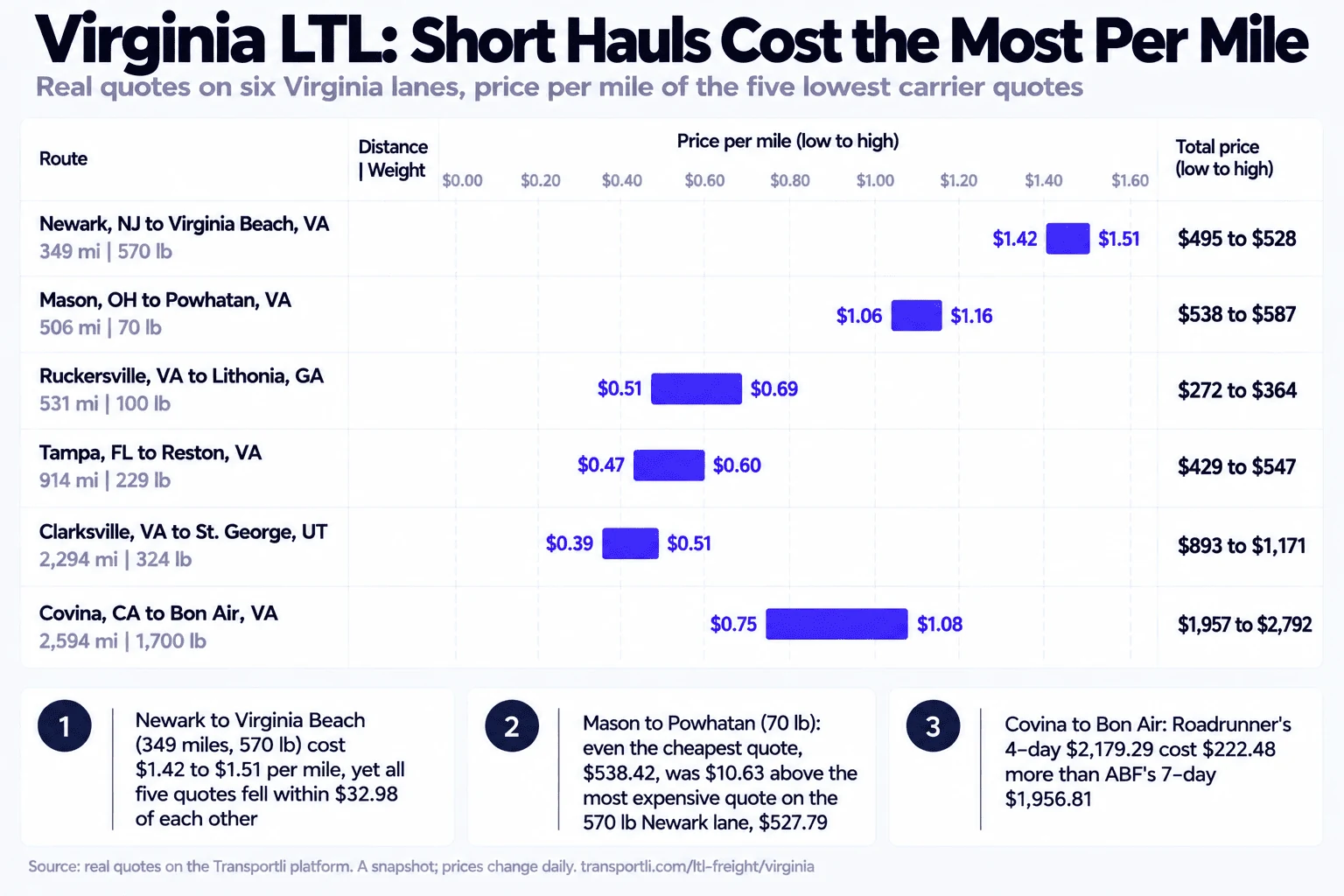
A 570 lb shipment moving 349 miles (Newark, NJ to Virginia Beach, VA) had a lowest quote of $495, or $1.42 a mile. A 324 lb shipment moving 2,294 miles (Clarksville, VA to St. George, UT) had a lowest quote of $893, or $0.39 a mile.
-
$279 to arrive 2 days sooner
Speed has a price
On Clarksville, VA to St. George, UT (2,294 miles, 324 lb), the cheapest quote at $893 took 6 days. The fastest, at 4 days, cost $1,171. On Covina, CA to Bon Air, VA, 4-day delivery cost $2,179 against $1,957 for 7 days.
-
5 carriers had the lowest quote
Five different carriers won six Virginia lanes
Central Transport had the lowest quote on two lanes. ABF Freight, Estes, Southeastern, and Warp each had the lowest quote on one lane. Across the lowest quotes on every lane, 13 different carriers appeared.
-
$835 from lowest to fifth-lowest
Same shipment, quotes $835 apart
For 1,700 lb from Covina, CA to Bon Air, VA (2,594 miles), the lowest quote was $1,957 and the fifth-lowest was $2,792, a 43% gap. On Newark, NJ to Virginia Beach, VA, all five quotes landed within $33 of each other.

Where freight moves in Virginia
Virginia’s freight geography follows its interstates and its port:
- Northern Virginia — I-95, I-395, I-66 and the Capital Beltway (I-495) around Washington, D.C., with Dulles Airport.
- Richmond — where I-95, I-64 and the I-295 bypass meet in the state capital.
- Hampton Roads — the Port of Virginia, I-64, I-264 and the tunnels and bridges around Norfolk, Portsmouth, Newport News and Virginia Beach.
- The Shenandoah Valley & Southwest Virginia — I-81 from Winchester through Roanoke to Bristol, with the Virginia Inland Port at Front Royal.
- Southside — I-85 and I-95 toward North Carolina.
Weather and transit reliability
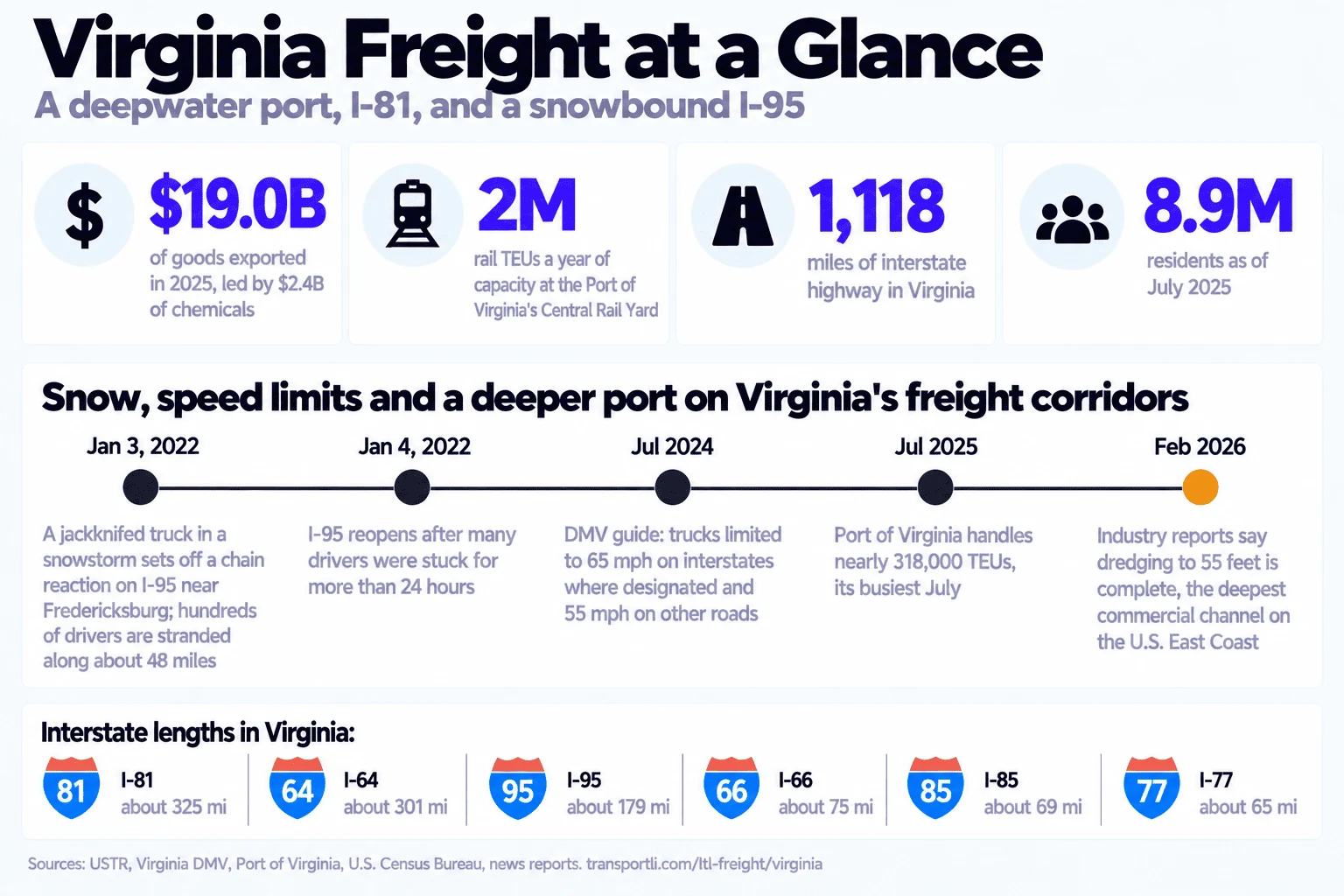
Virginia’s biggest freight risks are winter storms and the mountain and coastal chokepoints. On January 3, 2022, a jackknifed truck during a snowstorm set off a chain reaction on I-95 near Fredericksburg that left hundreds of drivers stranded along about 48 miles, many for more than 24 hours, before the interstate reopened on January 4, according to news reports. Authorities said rain before the snow had kept crews from pretreating the road. Hampton Roads depends on a handful of bridges and tunnels, so a single closure there can back up traffic across the region, and I-81 through the mountains slows quickly when a crash blocks both lanes. For LTL shippers the practical advice is simple: during winter weather and any time a major crossing or I-81 is restricted, build extra transit time into anything headed to or through Virginia.
Sample Virginia LTL rates by route
Real quotes pulled from our platform for six different Virginia lanes — same process, different carriers each time, spanning a range of weights and distances. Rates shift with capacity and fuel costs, so treat these as a snapshot rather than a guarantee for your shipment; get an instant quote for your exact route.
Real quotes by route
Snapshot taken over recent weeks — carriers and pricing change daily.
| Carrier | Service | Transit | Price |
|---|---|---|---|
| Estes | LTL Standard Transit | 1 day | $494.81 |
| ABF Freight | Standard | 2 days | $495.38 |
| R+L Carriers | Standard | 1 day | $500.58 |
| TForce Freight | Standard | 2 days | $509.80 |
| XPO | Standard | 2 days | $527.79 |
| Carrier | Service | Transit | Price |
|---|---|---|---|
| Warp | STD | 5 days | $538.42 |
| Estes | LTL Standard Transit | 2 days | $550.00 |
| XPO | Standard | 2 days | $558.31 |
| Forward Air | Standard | 3 days | $575.31 |
| ABF Freight | Standard | 3 days | $587.19 |
| Carrier | Service | Transit | Price |
|---|---|---|---|
| Central Transport | Standard | 2 days | $271.99 |
| Southeastern Freight Lines | Standard | 2 days | $318.91 |
| Estes | Standard | 1 day | $333.09 |
| FedEx Freight Economy | Freight Economy | 2 days | $353.70 |
| Pitt Ohio | Standard | 2 days | $364.04 |
| Carrier | Service | Transit | Price |
|---|---|---|---|
| Southeastern Freight Lines | Standard | 2 days | $428.67 |
| Estes | LTL Standard Transit | 2 days | $491.41 |
| TForce Freight | STD | 3 days | $496.92 |
| XPO | Standard | 3 days | $528.68 |
| Roadrunner Freight | Standard Service | 5 days | $546.70 |
| Carrier | Service | Transit | Price |
|---|---|---|---|
| Central Transport | Standard | 6 days | $892.93 |
| TForce Freight | Standard | 5 days | $1,004.12 |
| Pitt Ohio | Standard | 6 days | $1,027.04 |
| XPO | Standard | 5 days | $1,098.95 |
| Estes | LTL Standard Transit | 4 days | $1,171.49 |
| Carrier | Service | Transit | Price |
|---|---|---|---|
| ABF Freight | Standard | 7 days | $1,956.81 |
| STG Logistics | Standard | 8 days | $2,036.24 |
| Roadrunner Freight | Standard | 4 days | $2,179.29 |
| TForce Freight | Standard | 6 days | $2,537.95 |
| XPO | Standard | 5 days | $2,792.04 |
Rate, transit, and price-per-mile summary
Pulling the six lanes above together, a short run to the coast stands out from everything else in the data:
| Route | Distance | Weight | Price range | Transit range | Price per mile |
|---|---|---|---|---|---|
| Newark, NJ → Virginia Beach, VA | 349 mi | 570 lb | $495–$528 | 1–2 days | $1.42–$1.51 |
| Mason, OH → Powhatan, VA | 506 mi | 70 lb | $538–$587 | 2–5 days | $1.06–$1.16 |
| Ruckersville, VA → Lithonia, GA | 531 mi | 100 lb | $272–$364 | 1–2 days | $0.51–$0.69 |
| Tampa, FL → Reston, VA | 914 mi | 229 lb | $429–$547 | 2–5 days | $0.47–$0.60 |
| Clarksville, VA → St. George, UT | 2,294 mi | 324 lb | $893–$1,171 | 4–6 days | $0.39–$0.51 |
| Covina, CA → Bon Air, VA | 2,594 mi | 1,700 lb | $1,957–$2,792 | 4–8 days | $0.75–$1.08 |
Newark, New Jersey to Virginia Beach (349 miles, 570 lb) is the outlier. At $1.42–$1.51 per mile it is the most expensive lane in the set, yet its five quotes of $494.81–$527.79 sit within $32.98 of each other, and 1-day service from Estes ($494.81) and R+L Carriers ($500.58) was among the cheapest options, with ABF Freight’s 2-day $495.38 just 57 cents above Estes. Weight did not set the price. The 70 lb shipment from Mason, Ohio to Powhatan (506 miles) quoted $538.42–$587.19, and even its cheapest quote was $10.63 above the most expensive quote on the 570 lb Newark lane. Warp’s 5-day $538.42 was only $11.58 below Estes’ 2-day $550.00. Ruckersville, Virginia to Lithonia, Georgia (531 miles, 100 lb) cost far less, $271.99–$364.04, with Central Transport lowest and Southeastern Freight Lines’ next quote $46.92 (about 17%) higher; Estes’ 1-day service cost $61.10 more than Central’s 2-day. On Tampa to Reston, Southeastern’s 2-day $428.67 was the lowest quote, $62.74 below Estes at the same speed, while Roadrunner Freight’s 5-day $546.70 was the slowest and the most expensive. On the long hauls the speed premium is clearer. Clarksville to St. George, Utah (2,294 miles) ran $0.39–$0.51 per mile, and Estes’ 4-day quote cost $278.56 more than Central Transport’s 6-day $892.93. Covina, California to Bon Air (2,594 miles, 1,700 lb) was the heaviest and widest in spread, with ABF Freight’s 7-day $1,956.81 lowest and Roadrunner Freight’s 4-day $2,179.29 costing $222.48 more to arrive 3 days sooner. The lesson is the same on every lane: compare several carriers before you book.
What a real Virginia LTL quote looks like
The screenshot alongside is an actual result from our platform, a 100 lb shipment from Ruckersville, VA to Lithonia, GA, compared across 54 real carrier options in seconds. It is the same lane and weight as the third rate tab above, quoted for a pickup about three weeks later.
- 54 real carrier options compared for this single shipment, 44 of them standard service and 10 guaranteed, not just one broker’s in-house rate.
- $327.23–$351.52 for the five lowest quotes, with transit of 1 to 2 days. Averitt was lowest at $327.23 on 2-day service, and Estes’ 1-day quote was only $10.23 higher at $337.46.
- The cheapest quote rose about 20%. In the earlier search Central Transport led at $271.99; this time Central quoted $338.39, up $66.40 (about 24%). Southeastern Freight Lines rose $11.15 (about 3%, $318.91 to $330.06) and Estes $4.37 (about 1%, $333.09 to $337.46). The pickup dates differ, so some of the change may be the date.
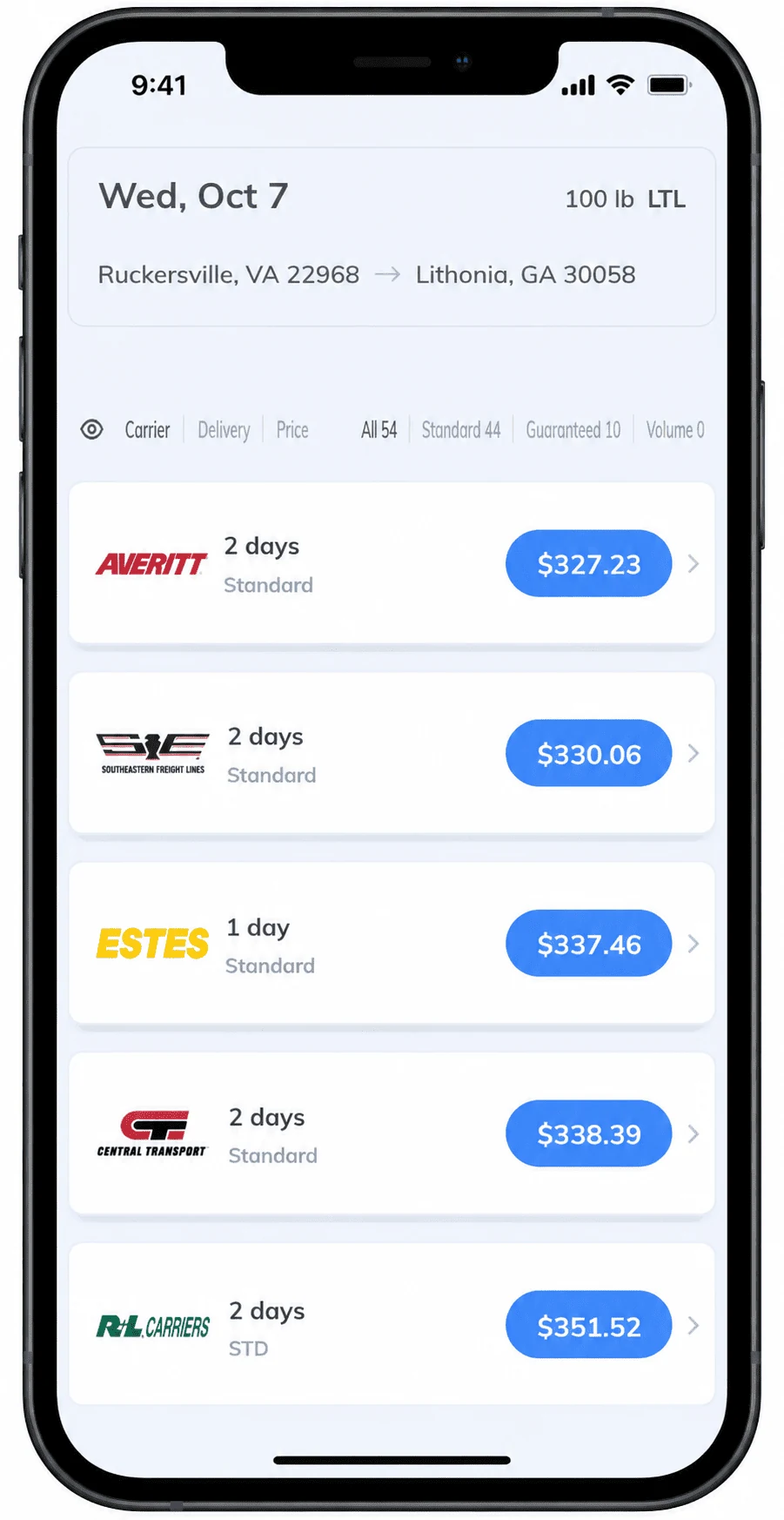
Real screenshot from a live Transportli quote for Ruckersville, VA to Lithonia, GA, individual results vary by shipment and date.
Major shipping hubs in Virginia
Virginia’s freight moves through a deepwater port, an inland rail port and four metro areas:
- The Port of Virginia — industry reports say dredging to 55 feet was completed in February 2026, making Norfolk Harbor the deepest commercial channel on the U.S. East Coast. The port’s Central Rail Yard can process 2 million rail TEUs a year, and in July 2025 it handled nearly 318,000 TEUs, its busiest July.
- Virginia Inland Port — a rail-served terminal at Front Royal in the Shenandoah Valley with capacity for about 78,000 TEUs.
- Northern Virginia — the I-95, I-395, I-66 and I-495 network around Washington, D.C., plus Dulles Airport.
- Richmond — the I-95, I-64 and I-295 junction in the middle of the state.
- Roanoke and Southwest Virginia — I-81, I-77 and I-581 through the mountains.
Highway corridors serving Virginia
I-81 (about 325 miles in Virginia) is the state’s longest interstate, running from the Tennessee line at Bristol through Roanoke and the Shenandoah Valley to the West Virginia line near Winchester. I-64 (about 301 miles) crosses the state from West Virginia through Richmond to Hampton Roads, and I-95 (about 179 miles) runs from North Carolina through Richmond and Fredericksburg to Washington, D.C. I-66 (about 75 miles) links the Shenandoah Valley to the D.C. suburbs, I-85 (about 69 miles) runs from North Carolina to Petersburg, and I-77 (about 65 miles) crosses the southwest. I-295 (about 53 miles) bypasses Richmond, and I-264 (about 13 miles) runs through Hampton Roads.
I-81, Virginia’s trucking spine
I-81 runs about 325 miles through Virginia, longer than in any other state it crosses, and it is the main north-south truck route for the Shenandoah Valley and Southwest Virginia. When a crash or winter weather closes it, there is often no good alternate nearby, so delays can spread quickly.
What Virginia shippers move
Virginia’s freight is shaped by chemicals, electronics, transportation equipment and the port. The state exported $19.0 billion of goods in 2025, the 25th-largest total among the states, led by $2.4 billion of chemicals, $2.2 billion of computer and electronic products, $2.1 billion of transportation equipment, $1.3 billion of machinery and $1.2 billion of food products. Canada was the biggest market at $2.9 billion, followed by Mexico at $1.4 billion, according to the U.S. Trade Representative. Much of this moves in full truckloads, by rail or by ship, but the parts, tools, supplies and finished goods around these industries are where LTL fits.
Get a Virginia LTL quote
Compare live rates from vetted carriers serving Virginia.
Get an LTL quote →Virginia LTL freight: frequently asked questions
How much does LTL shipping cost to or from Virginia?
It depends on distance, weight, freight class, and how close your pickup or delivery point is to a major metro’s carrier network. Real quotes on our platform for Virginia lanes have ranged from about $0.39 per mile on a 2,294-mile haul from Clarksville to St. George, Utah to $1.42 to $1.51 per mile on a 570 lb shipment over 349 miles from Newark to Virginia Beach, so distance alone does not predict the price. Get an instant quote for your exact shipment.
Do oversized LTL shipments need a permit in Virginia?
Yes, for loads wider than 8 ft 6 in, higher than 13 ft 6 in, or over legal weight limits. The Virginia DMV issues hauling permits through its EZ Haul system. A single-trip permit costs $20, plus 30 cents a mile if the load is overweight. Permitted loads normally travel from sunrise to sunset, may not travel within city or town limits from 7 to 9 a.m. or 4 to 6 p.m. unless they are only overweight or overlength, and may not travel on six state holidays. A standard LTL trailer within legal limits does not need one.
Do trucks pay tolls in Virginia, and where are they restricted?
Yes. Virginia has express lanes, tunnels and bridges that charge tolls, including the Elizabeth River tunnels and the Chesapeake Bay Bridge-Tunnel. According to VDOT, trucks with more than two axles may not use the I-95, I-395 or I-495 Express Lanes, and tractor-trailers may not use I-66 inside the Beltway’s HOV lanes.
How did the January 2022 snowstorm affect freight on I-95?
On January 3, 2022, a jackknifed truck during a snowstorm set off a chain reaction on I-95 near Fredericksburg that stranded hundreds of drivers along about 48 miles, many for more than 24 hours, before the interstate reopened on January 4, according to news reports. Build extra transit time into shipments during winter weather.
What is the Port of Virginia?
The Port of Virginia is the container port at Hampton Roads. Industry reports say its dredging to 55 feet was completed in February 2026, making Norfolk Harbor the deepest commercial channel on the U.S. East Coast. Its Central Rail Yard can process 2 million rail TEUs a year, and the Virginia Inland Port at Front Royal extends its reach by rail.
Why is I-81 important for freight in Virginia?
I-81 is Virginia’s longest interstate at about 325 miles and runs through the Shenandoah Valley and Southwest Virginia, longer than I-81 in any other state. It is the main north-south truck route there, and a closure can leave few good alternatives.
What is the speed limit for trucks in Virginia?
According to the Virginia DMV’s Size, Weight and Equipment guide (July 2024 edition), trucks are limited to 65 mph on interstates where designated and 55 mph on other roads.