A Mercedes-Benz Sprinter cargo van is about 19 ft 6 in to 24 ft 2 in long, 7 ft 8 in wide with mirrors, and 8 ft to 9 ft tall, depending on the wheelbase and roof. Inside, the cargo area is 11 ft 1 in to 15 ft 9 in long and 5 ft 10 in wide, with 5 ft 8 in or 6 ft 7 in of standing height. Every measurement below is in inches and in feet and inches.
If you are thinking about buying a van for expedited freight work, this page also compares the Sprinter with the Ford Transit and Ram ProMaster, lists the pros and cons of each, and has a buyer’s tool that checks which van fits your typical load and works out your cost per mile. Sprinter figures come from Mercedes-Benz’s 2026 specification page. Specs checked October 2026.
Sprinter dimensions at a glance
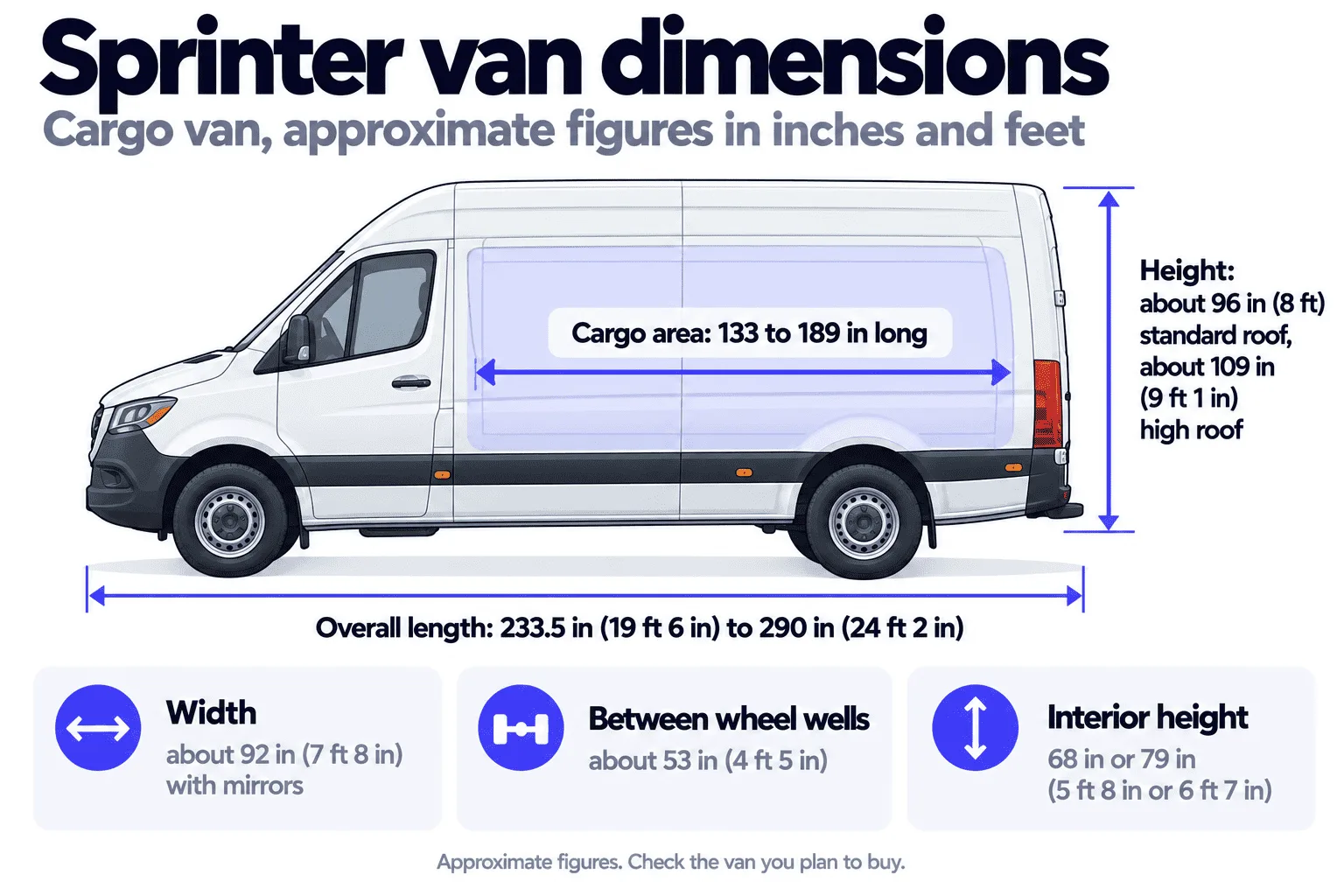
- Overall length: 233.5 in (19 ft 6 in) on the 144″ wheelbase, 274 in (22 ft 10 in) on the 170″, 290 in (24 ft 2 in) on the 170″ extended.
- Overall width: about 92 in (7 ft 8 in) with mirrors, and about 80 in (6 ft 8 in) without them.
- Overall height: about 96 in (8 ft) with a standard roof and about 109 in (9 ft 1 in) with a high roof.
- Cargo area: 133 to 189 in long, about 70 in wide at the widest point, 53 in between the wheel wells, and 68 or 79 in tall.
- Cargo volume: about 319 to 533 cubic feet. Pallets: 3 or 4 standard 48 × 40 in pallets in a single row.
- Weight ratings: GVWR from about 9,050 lb (2500) to 12,125 lb (4500). Models rated above 10,000 lb bring USDOT number and hours-of-service rules.
Cargo van buyer's tool
Planning to buy a van for expedited freight? Check which vans fit your typical load, then work out your cost per mile and break-even rate with your own numbers.
Sprinter van exterior dimensions: length, width and height
The Sprinter cargo van comes in three lengths and two roof heights. The length depends on the wheelbase (the distance between the front and rear axles), and the height depends on the roof.
| Version | Overall length | Overall height | Width (with mirrors) |
|---|---|---|---|
| 144″ wheelbase, standard roof | 233.5 in (19 ft 6 in) | about 96 in (8 ft) | about 92 in (7 ft 8 in) |
| 170″ wheelbase, high roof | 274 in (22 ft 10 in) | about 109 in (9 ft 1 in) | about 92 in (7 ft 8 in) |
| 170″ extended, high roof | 290 in (24 ft 2 in) | about 109 in (9 ft 1 in) | about 92 in (7 ft 8 in) |
The 144″ high roof is about as tall as the 170″ high roof. Overall height varies a little between sources and trims, so measure the van you plan to buy if you are parking it under a low roof or in a garage. A standard roof is about 8 ft tall, which is why many garages and parking structures take it, and a high roof is about 9 ft tall, which many do not.
Sprinter van interior and cargo dimensions
| Version | Cargo length | Width at floor (widest) | Between wheel wells | Interior height | Cargo volume |
|---|---|---|---|---|---|
| 144″, standard roof | 133 in (11 ft 1 in) | 70 in (5 ft 10 in) | 53 in (4 ft 5 in) | 68 in (5 ft 8 in) | about 319 cu ft |
| 144″, high roof | 133 in (11 ft 1 in) | 70 in (5 ft 10 in) | 53 in (4 ft 5 in) | 79 in (6 ft 7 in) | about 374 cu ft |
| 170″, high roof | 173 in (14 ft 5 in) | 70 in (5 ft 10 in) | 53 in (4 ft 5 in) | 79 in (6 ft 7 in) | about 488 cu ft |
| 170″ extended, high roof | 189 in (15 ft 9 in) | 70 in (5 ft 10 in) | 53 in (4 ft 5 in) | 79 in (6 ft 7 in) | about 533 cu ft |
Wheel wells matter. The floor is about 70 in wide at its widest point, but only about 53 in wide between the wheel wells on the 2500. A standard 48 in pallet fits between them, and a pallet turned the other way (40 in) does too. On the 3500 and 4500 models the wheel wells are wider, and the space between them is narrower (about 39 in per Mercedes-Benz), so check before you plan pallets.
Figures are the cargo van (not the crew or passenger van, where seats shorten the cargo area). They are for the 2500 series from Mercedes-Benz’s 2026 page, which has a few inconsistencies, so confirm exact figures for the van you buy.
Sprinter van weight, payload and GVWR
Weight is set by the model number, not the body. The 2500, 3500, 3500XD and 4500 are rating levels of the same family:
| Model | GVWR (max) | Max payload (up to about) | Why it matters |
|---|---|---|---|
| 2500 | 9,050 lb | 4,200 lb | Under 10,001 lb GVWR |
| 3500 | 9,990 lb | 4,700 lb | Just under 10,001 lb GVWR |
| 3500XD (dual rear wheels) | 11,030 lb | 5,700 lb | Over 10,000 lb: USDOT number and hours-of-service rules apply |
| 4500 (dual rear wheels) | 12,125 lb | 6,800 lb | Over 10,000 lb: USDOT number and hours-of-service rules apply |
GVWR is the maximum the van is rated to weigh when loaded, including the van, fuel, driver, options and cargo. Payload is what is left for people and cargo, and it drops with a longer wheelbase, all-wheel drive, a high roof and added equipment. The door-jamb sticker on your van shows its exact payload. The maximum payloads above are the highest listed for each model, so expect lower on most configurations.
For for-hire interstate work, FMCSA requires a USDOT number once a vehicle or combination is rated 10,001 lb or more, and a CDL is only needed at 26,001 lb or more, so no Sprinter needs a CDL. (FMCSA: Do I need a USDOT number?)
Sprinter van sizes explained: 144 vs. 170, standard vs. high roof
- 144″ wheelbase is the shortest and easiest to park and maneuver. It carries about 3 standard pallets.
- 170″ wheelbase adds about 40 in of cargo length, which is room for a fourth pallet or longer items.
- 170″ extended adds another 16 in at the back, for the longest loads and the most volume.
- Standard roof (about 68 in inside) is lower and easier to park. High roof (about 79 in inside) lets you stand up, stack freight and carry taller pallets.
- Cargo vs. crew vs. passenger. The cargo van has an open cargo area. Crew and passenger versions put seats in the back and shorten the cargo area.
How many pallets fit in a Sprinter van?
Pallets sit in a single row because the floor is only about 53 in wide between the wheel wells. With standard 48 × 40 in pallets turned so the 40 in side runs along the van, a 144″ van holds about 3 and a 170″ van holds about 4. Weight usually limits you first, since three loaded pallets can already be close to 3,000 lb. Use the tool above to check your own load, or see our Sprinter van delivery page for how Sprinter capacity works for shippers.
Sprinter vs. Ford Transit vs. Ram ProMaster
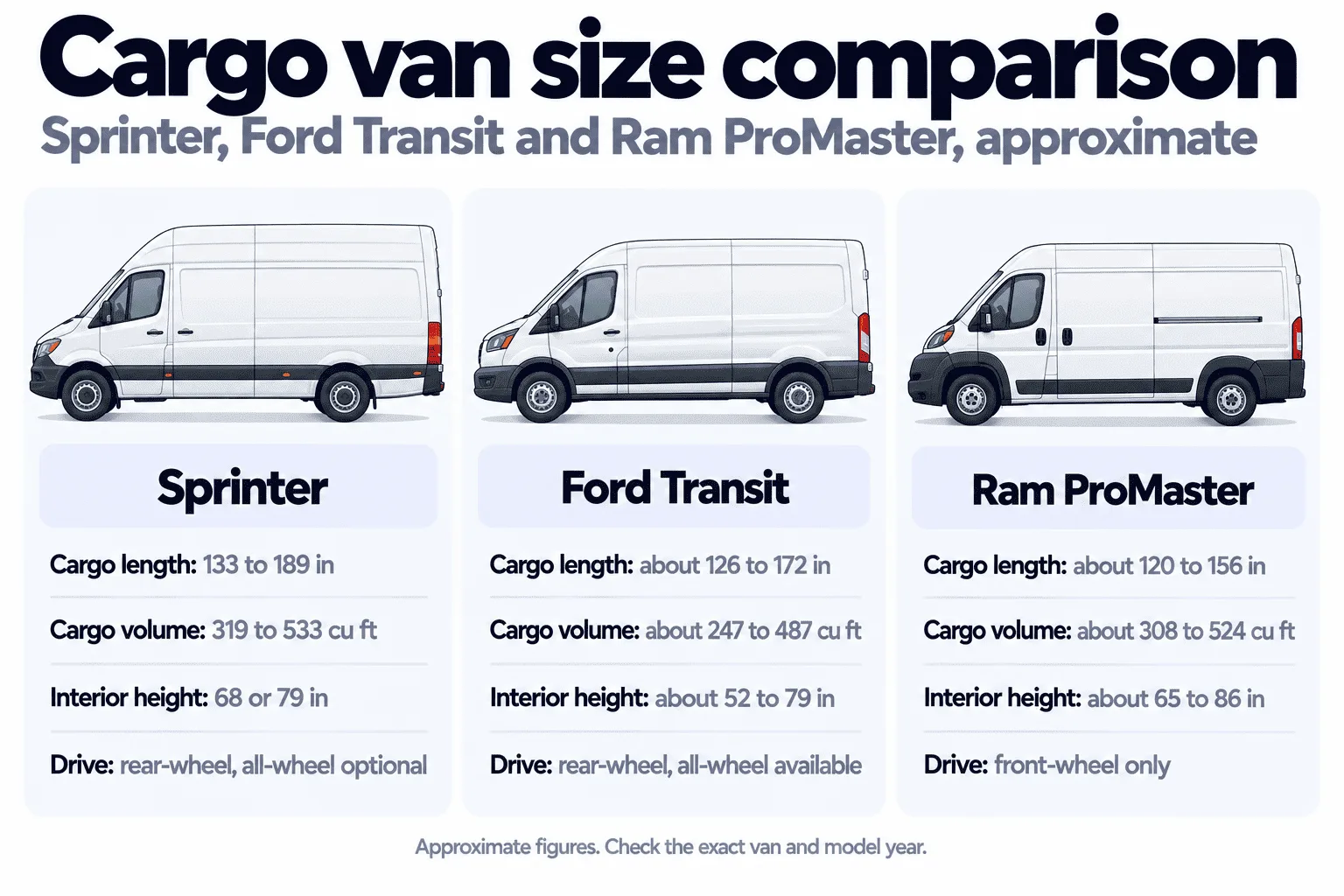
The Sprinter is not the only full-size cargo van. The Ford Transit and Ram ProMaster are the other two big names, and the sizes overlap. These figures are approximate: manufacturer pages and dealer listings disagree, so the lower figure is used where they conflict. Always check the van you plan to buy.
| Mercedes-Benz Sprinter | Ford Transit | Ram ProMaster | |
|---|---|---|---|
| Drive | Rear-wheel drive; 4MATIC all-wheel drive optional | Rear-wheel drive; all-wheel drive available | Front-wheel drive only |
| Cargo length | 133 to 189 in | about 126 to 172 in | about 120 to 156 in |
| Cargo volume | about 319 to 533 cu ft | about 247 to 487 cu ft | about 308 to 524 cu ft |
| Width between wheel wells | about 53 in | about 54 in | about 56 in |
| Interior height | 68 or 79 in | about 52, 70 or 79 in | about 65, 76 or 86 in |
| Payload (typical max) | up to about 4,200 lb (2500) | up to roughly 3,500 to 4,500 lb | roughly 4,000 lb and up |
| GVWR range | about 9,050 to 12,125 lb | about 8,700 to 11,000 lb | about 8,500 to 9,000+ lb |
Pros and cons of each van for expedited freight
| Van | Pros | Cons |
|---|---|---|
| Mercedes-Benz Sprinter | The longest and tallest options (up to 189 in and 79 in), the most cargo volume at the top end, available all-wheel drive, and a diesel engine. | Larger ratings (3500XD and 4500) cross 10,000 lb GVWR and add USDOT and hours-of-service rules. It usually costs more to buy than the others, so compare current quotes and insurance. |
| Ford Transit | Many body, roof and length options, and all-wheel drive available. | The shortest and lowest base version (about 126 in and 52 in inside) holds less, and maximum cargo length is below the Sprinter’s. |
| Ram ProMaster | A very low load floor (about 21 in) for easy loading, the widest interior (about 75 in), and a super-high roof option (about 86 in inside). | Front-wheel drive only, no all-wheel drive option, a single gas engine, and shorter maximum cargo length than the Sprinter. |
The “usually costs more” comment is general and based on current dealer listings; prices change, so get quotes. Engines, drivetrain and payload vary by model year and trim.
Buying a van for expedited freight: what to check
- Start with your freight. List your most common loads: how many pallets, how heavy, how tall. A van that fits 90% of them is better than one sized for the rare 10%. The tool above does this check.
- Check the payload, not just the volume. Heavy freight runs out of payload before it runs out of space. Read the door-jamb sticker on the exact van, since options and equipment reduce payload.
- Know the weight line. Vans rated 10,001 lb GVWR or more need a USDOT number for interstate for-hire work and fall under hours-of-service rules. Many buyers stay under it. A CDL is not needed unless the rating reaches 26,001 lb.
- Decide how you will operate. Some owner-operators get their own operating authority and insurance. Others lease on to a carrier and run under its authority. Both change your costs and paperwork, so decide before you buy.
- Get insurance quotes first. Commercial auto and cargo coverage vary a lot by driver, van and state. Put a real quote in the cost calculator.
- Pick a roof height for what you carry. A high roof lets you stack and stand, but it will not fit many garages. A standard roof is easier to park.
- Think about the total cost. The payment is only part of it. Fuel, tires, maintenance, insurance, depreciation, downtime between loads and empty miles all matter. The tool above turns your own numbers into a cost per mile and a break-even rate.
- Plan where loads come from. Load boards, brokers and dispatch services each work differently, and none guarantees steady freight.
Drive with Transportli
Run your own Sprinter van, cargo van, box truck or hot shot rig? Apply to Transportli Drivers and we email the next steps, usually within 2–3 hours.
Shipping something in a Sprinter van?
If you need freight moved rather than a van bought, a Sprinter-class van is one of the fastest ways to move 1 to 4 pallets directly. See typical prices by distance, what fits, and how dispatch works on our Sprinter van delivery service page, or compare it with a cargo van and a hot shot rig.
Need a Sprinter van delivery?
Tell us about your load and your deadline, and we will dispatch a vetted driver, usually within 1–2 hours.
Get a Sprinter van quote →Sprinter van dimensions: frequently asked questions
How long is a Sprinter van?
A Sprinter cargo van is 233.5 in (19 ft 6 in) long on the 144″ wheelbase, about 274 in (22 ft 10 in) on the 170″, and about 290 in (24 ft 2 in) on the 170″ extended.
How tall is a Sprinter van?
About 96 in (8 ft) with a standard roof and about 109 in (9 ft 1 in) with a high roof. Measure the van you plan to buy if clearance matters.
How wide is a Sprinter van?
About 80 in (6 ft 8 in) without mirrors and about 92 in (7 ft 8 in) with mirrors. Inside, the cargo floor is about 70 in wide at its widest and about 53 in between the wheel wells.
What are the interior cargo dimensions of a Sprinter van?
The cargo area is about 133 in (11 ft 1 in) long on the 144″, 173 in (14 ft 5 in) on the 170″, and 189 in (15 ft 9 in) on the 170″ extended. Standing height is about 68 in (standard roof) or 79 in (high roof).
How much cargo space does a Sprinter van have?
About 319 cubic feet on the 144″ standard roof, 374 on the 144″ high roof, 488 on the 170″ high roof, and 533 on the 170″ extended high roof.
How many pallets fit in a Sprinter van?
About 3 standard 48 by 40 inch pallets in a 144″ van and about 4 in a 170″ van, in a single row. Weight usually limits the count first.
How much does a Sprinter van weigh and carry?
GVWR ranges from about 9,050 lb (2500) to 12,125 lb (4500). Maximum payload is up to about 4,200 lb on the 2500 and up to about 6,800 lb on the 4500, and it drops with a longer wheelbase, all-wheel drive and a high roof. Check the door-jamb sticker for exact payload.
What is the difference between the 144 and 170 Sprinter?
The 170″ wheelbase is about 40 inches longer overall and adds about 40 inches of cargo length, which is room for a fourth pallet. The 144″ is shorter and easier to park and maneuver.
Standard roof or high roof Sprinter?
A high roof gives about 79 inches of standing height instead of about 68, so you can stand up and stack freight. A standard roof is about 8 feet tall and fits more garages and parking structures.
Do you need a CDL to drive a Sprinter van?
No. A CDL is required at 26,001 lb GVWR or more, and no Sprinter is rated that high. Models rated above 10,000 lb GVWR do need a USDOT number for interstate for-hire work.
Will a Sprinter van fit in my garage?
A standard-roof Sprinter is about 8 ft (96 in) tall and a high roof is about 9 ft (109 in). Many garage doors are 7 ft, so measure your door opening and the van you plan to buy.
Is the Sprinter bigger than a Ford Transit or Ram ProMaster?
At the top end, yes: the Sprinter reaches about 189 inches of cargo length and 533 cubic feet, against about 172 inches and 487 cubic feet for the Transit and about 156 inches and 524 cubic feet for the ProMaster. The ProMaster has the widest interior and lowest load floor.
Which cargo van is best for expedited freight?
It depends on your loads. Look for enough payload and pallet space for your most common freight, a roof height that suits where you park, and a total cost you can cover. Use the tool above to check your own load and numbers.
How much does a Sprinter van cost?
It depends on the model, wheelbase, roof, options and whether it is new or used. Prices change often, so get current quotes from dealers and enter them in the cost calculator above.