

Shipping LTL freight to or from Oregon? Rates depend on your specific route, freight class, and how close your pickup or delivery point is to the nearest LTL terminal. Oregon has about 4.3 million residents, and most of the freight activity sits in a narrow band: the Portland metro area and the Willamette Valley along I-5, with long, thinly populated stretches to the east and south. I-5 runs about 308 miles through the state from California to Washington, and I-84 runs about 375 miles from Portland up the Columbia River Gorge and across eastern Oregon to Idaho. Mountain passes, winter chain rules and a few well-known weather closures are a bigger part of Oregon freight than in most states. Here’s what actually affects your rate.
LTL trucking regulations in Oregon
A standard LTL tractor-trailer within legal size and weight limits does not need a special permit in Oregon. The rules that matter to shippers are the ones that shape what carriers do on the road, plus permits for oversize or overweight freight:
- Weight-mile tax. Oregon charges heavy trucks a weight-mile tax instead of a diesel fuel tax, and it generally applies to commercial vehicles with a registered or combined weight over 26,000 pounds. Carriers either hold an account with ODOT’s Commerce and Compliance Division (CCD) and file tax reports, or buy a temporary pass before entering the state, as described on ODOT’s weight-mile temporary pass page. The LTL carrier handles this and builds it into its rate, so as a shipper you never pay it directly.
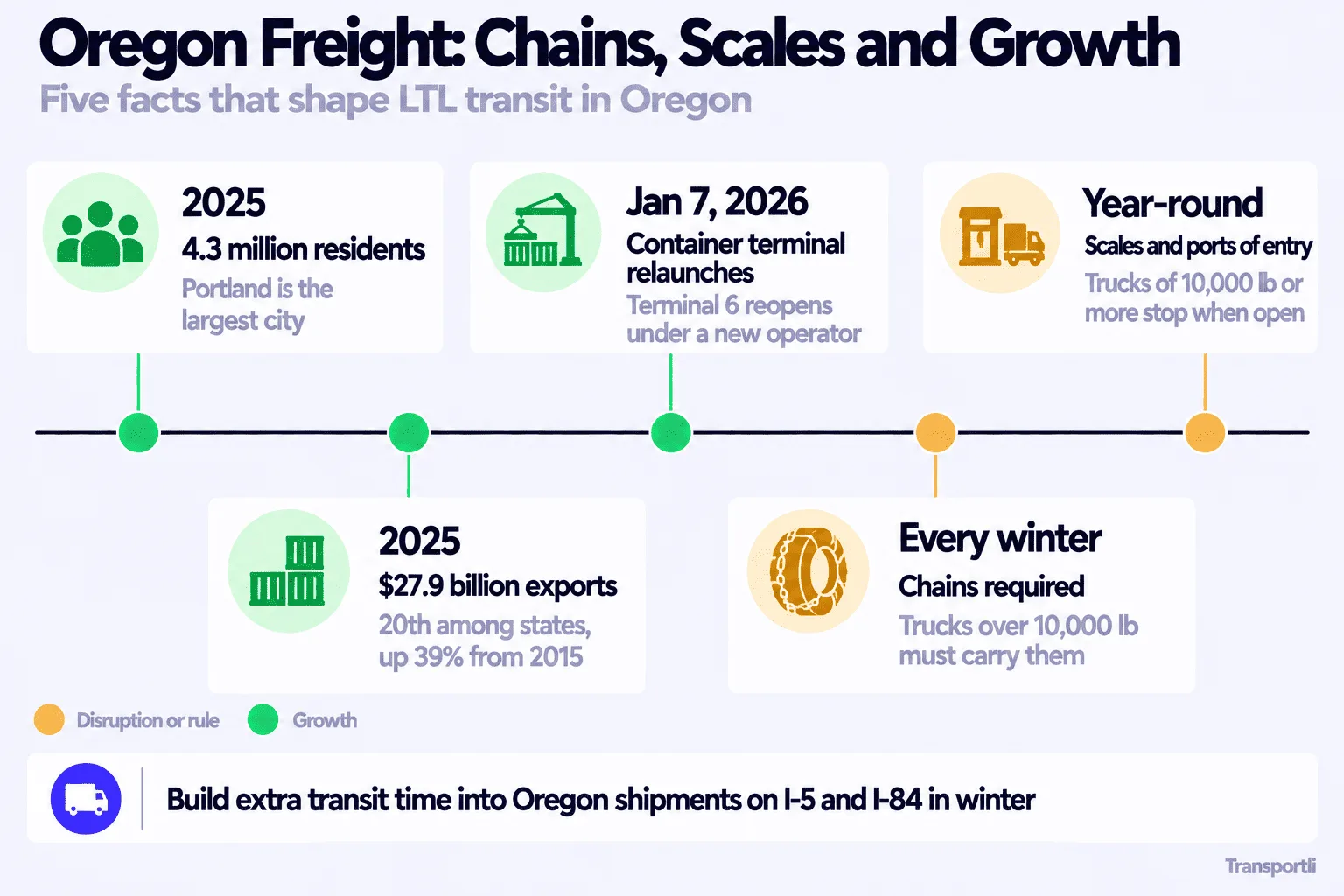
- Scales and ports of entry. ODOT says commercial vehicles with a gross vehicle weight of 10,000 pounds or more must stop at an open scale, and trucks over 20,000 pounds must stop whenever a sign says so. Oregon also runs a free, voluntary Green Light preclearance program that checks size, weight, registration and safety records while trucks drive past, and ODOT notes that oversize and heavy-haul loads must stop even with a green light. See ODOT’s weigh station page.
- Winter chain law. Oregon requires commercial vehicles over 10,000 pounds gross vehicle weight to carry chains when conditions call for them and Snow Zone signs are posted, and the fine for a truck that fails to chain up was raised to $880 in 2021. See ODOT’s winter guidance for commercial vehicles.
- Oversize and overweight permits. ODOT’s over-dimension permit unit issues single-trip permits through its online ORION system and by phone at 503-373-0000, and it also handles annual permits. Details, hours and fees are on the over-dimension operations page. A standard LTL trailer within legal limits does not need one.
Current rules and contacts are public record: ODOT motor carrier requirements → TripCheck road conditions →
What affects your Oregon LTL rate
- Freight class — density, handling, and liability determine your NMFC class, the single biggest factor in your rate. See our freight class guide.
- Distance — Oregon is wide: from Portland to Ontario on the Idaho line is about 375 miles on I-84, and from Portland to Ashland on the California line is just under 300 miles on I-5, so a lane to the east or south is a long haul with few terminals in between.
- Metro vs. rural — Portland, Salem, Eugene and Medford sit along I-5 and have the deepest carrier networks, while Central and Eastern Oregon, the coast and the southeast typically see fewer terminals and fewer options.
- Terminal proximity — the more carrier terminals near your pickup or delivery point, the more quotes you see, and in rural Oregon the nearest terminal can be 100 miles or more away.
- Mountain and winter exposure — lanes over the Siskiyous on I-5, through the Columbia River Gorge on I-84 or across the Cascades can pick up delays in winter, and carriers price some of that uncertainty into transit time.
- Accessorials — liftgate, residential, or inside delivery add to the base rate, same as anywhere else, and farm, winery and timber-country deliveries often need a limited-access or liftgate service.
Did you know?From 6 real Oregon lanes and 30 quotes
-
4× the cost per mile
The shorter haul cost far more per mile
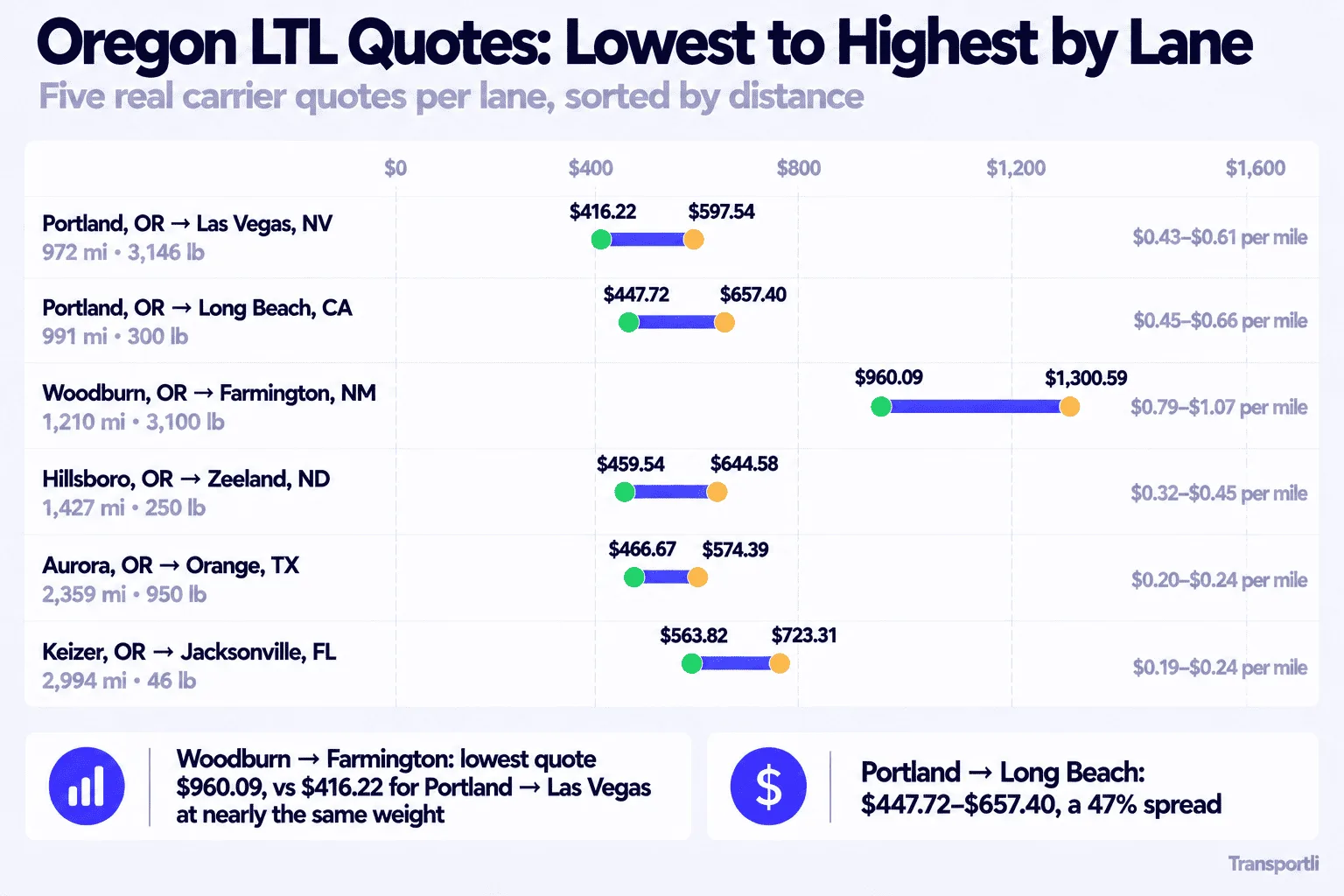
A 3,100 lb shipment moving 1,210 miles (Woodburn, OR to Farmington, NM) had a lowest quote of $960, or $0.79 a mile. A 46 lb shipment moving 2,994 miles (Keizer, OR to Jacksonville, FL) had a lowest quote of $564, or $0.19 a mile.
-
$165 to arrive 2 days sooner
Speed has a price
On Woodburn, OR to Farmington, NM (1,210 miles, 3,100 lb), the cheapest quote at $960 took 6 days. The fastest, at 4 days, cost $1,125. On Hillsboro, OR to Zeeland, ND, 1-day delivery cost $564 against $460 for 7 days.
-
6 carriers had the lowest quote
Six different carriers won six Oregon lanes
AAA Cooper, R+L Carriers, Roadrunner, TForce Freight, Warp, and XPO each had the lowest quote on one lane. Across the lowest quotes on every lane, 14 different carriers appeared.
-
$340 from lowest to fifth-lowest
Same shipment, quotes $340 apart
For 3,100 lb from Woodburn, OR to Farmington, NM (1,210 miles), the lowest quote was $960 and the fifth-lowest was $1,301, a 35% gap.

Where freight moves in Oregon
Oregon freight follows I-5, the Columbia River and a few east-west links:
- Portland metro — where I-5, I-84, I-205 and I-405 meet, with Portland at about 635,000 residents and Gresham and Hillsboro each at about 111,000 in the Census Bureau’s July 2025 estimates, as compiled by CityPopulation.
- Willamette Valley — Salem, at about 182,000, and Eugene, at about 179,000, along I-5 south of Portland, with Corvallis, Albany and Woodburn in between.
- Southern Oregon — Medford, Grants Pass and Ashland on I-5 toward California, with Klamath Falls to the east on US 97.
- Central Oregon — Bend, at about 107,000 residents, and Redmond along US 97 and US 20, one of the state’s faster-growing areas.
- Eastern Oregon & the Columbia Plateau — Hermiston, Umatilla, Pendleton, La Grande and Ontario along I-84 and I-82, the farm and food-processing belt.
- The coast — Astoria, Tillamook, Newport, Coos Bay and Brookings on US 101, reached by a handful of mountain highways from the valley.
Weather and transit reliability
Oregon freight is exposed to snow, ice and chain requirements on a few well-known mountain links. The I-5 Siskiyou Summit near the California line, the I-84 Columbia River Gorge east of Portland, and the Cabbage Hill grade on I-84 near Pendleton are the three that most often make headlines. News reports describe winter episodes where ODOT required chains or closed long stretches of I-84, including a January 2024 closure in the Gorge, and truck crashes on Cabbage Hill that shut I-84 in the Pendleton area. In the Portland area, ODOT has also announced multi-week I-5 lane closures at the Rose Quarter, with detours via I-405 and I-205 (OPB). For LTL shippers the practical advice is simple: during winter and any announced work zone, build extra transit time into anything on I-5 or I-84, and check TripCheck before a tight delivery.
Sample Oregon LTL rates by route
Real quotes pulled from our platform for six different Oregon lanes — same process, different carriers each time, all starting in Oregon and spanning a range of weights and distances. Rates shift with capacity and fuel costs, so treat these as a snapshot rather than a guarantee for your shipment; get an instant quote for your exact route.
Real quotes by route
Snapshot taken over recent months — carriers and pricing change daily.
| Carrier | Service | Transit | Price |
|---|---|---|---|
| R+L Carriers | Standard | 2 days | $416.22 |
| Forward Air | STD | 3 days | $486.79 |
| AAA Cooper Transportation | Standard | 3 days | $558.08 |
| XPO | Standard | 3 days | $561.66 |
| ABF Freight | Standard | 3 days | $597.54 |
| Carrier | Service | Transit | Price |
|---|---|---|---|
| Warp | STD | 4 days | $447.72 |
| Forward Air | Standard | 2 days | $551.83 |
| Roadrunner Freight | Standard | 3 days | $572.61 |
| Estes | LTL Standard Transit | 2 days | $617.91 |
| ABF Freight | Standard | 3 days | $657.40 |
| Carrier | Service | Transit | Price |
|---|---|---|---|
| TForce Freight | STD | 6 days | $960.09 |
| XPO | STD | 4 days | $1,125.13 |
| Central Transport | Standard | 7 days | $1,199.21 |
| FedEx Freight Economy | Freight Economy | 4 days | $1,209.32 |
| Saia | Standard | 4 days | $1,300.59 |
| Carrier | Service | Transit | Price |
|---|---|---|---|
| AAA Cooper Transportation | Standard | 7 days | $459.54 |
| TForce Freight | STD | 8 days | $525.99 |
| FedEx Freight Economy | Freight Economy | 4 days | $544.87 |
| Peninsula Truck Lines | Standard | 1 day | $563.73 |
| Estes | LTL Standard Transit | 8 days | $644.58 |
| Carrier | Service | Transit | Price |
|---|---|---|---|
| XPO | STD | 6 days | $466.67 |
| R+L Carriers | STD | 4 days | $470.59 |
| AAA Cooper Transportation | Standard | 5 days | $530.71 |
| Central Transport | Standard | 6 days | $551.71 |
| Old Dominion Freight Line | Standard | 4 days | $574.39 |
| Carrier | Service | Transit | Price |
|---|---|---|---|
| Roadrunner Freight | Standard | 7 days | $563.82 |
| Estes | STD | 5 days | $591.71 |
| Forward Air | Standard | 5 days | $610.21 |
| AAA Cooper Transportation | Standard | 5 days | $654.97 |
| TForce Freight | STD | 6 days | $723.31 |
Rate, transit, and price-per-mile summary
Pulling the six lanes above together, a 46 lb shipment from Keizer to Jacksonville stands out from everything else in the data:
| Route | Distance | Weight | Price range | Transit range | Price per mile |
|---|---|---|---|---|---|
| Portland, OR → Las Vegas, NV | 972 mi | 3,146 lb | $416–$598 | 2–3 days | $0.43–$0.61 |
| Portland, OR → Long Beach, CA | 991 mi | 300 lb | $448–$657 | 2–4 days | $0.45–$0.66 |
| Woodburn, OR → Farmington, NM | 1,210 mi | 3,100 lb | $960–$1,301 | 4–7 days | $0.79–$1.07 |
| Hillsboro, OR → Zeeland, ND | 1,427 mi | 250 lb | $460–$645 | 1–8 days | $0.32–$0.45 |
| Aurora, OR → Orange, TX | 2,359 mi | 950 lb | $467–$574 | 4–6 days | $0.20–$0.24 |
| Keizer, OR → Jacksonville, FL | 2,994 mi | 46 lb | $564–$723 | 5–7 days | $0.19–$0.24 |
Keizer to Jacksonville (2,994 miles, 46 lb) ran $563.82–$723.31, and its lowest quote was $147.60 above the lowest on Portland to Las Vegas ($416.22), a lane that carried 3,146 lb, roughly 68 times the weight. The two heaviest lanes show how much the route matters: Woodburn to Farmington, New Mexico (3,100 lb, 1,210 miles) ran $960.09–$1,300.59, while Portland to Las Vegas (3,146 lb, 972 miles) ran $416.22–$597.54, so the Farmington lane cost 2.3 times as much at the low end for 238 more miles. Portland to Long Beach had the widest spread, $209.68 or 47%: Warp’s 4-day $447.72 was $104.11 below Forward Air’s 2-day $551.83, which is the price of two days. Aurora to Orange, Texas, at 2,359 miles, ran $0.20–$0.24 per mile, among the cheapest in the data, and had the tightest spread, 23%, with XPO’s 6-day $466.67 and R+L Carriers’ 4-day $470.59 only $3.92 apart. On Woodburn to Farmington, FedEx Freight Economy’s 4-day $1,209.32 cost only $10.11 more than Central Transport’s 7-day $1,199.21, three days faster. On Hillsboro to Zeeland, North Dakota, AAA Cooper’s 7-day $459.54 sat $85.33 below FedEx Freight Economy’s 4-day $544.87. On Keizer to Jacksonville, Estes’s 5-day $591.71 cost $27.89 more than Roadrunner Freight’s 7-day $563.82. On Portland to Las Vegas, R+L Carriers was both the lowest and the fastest at $416.22 on 2-day service, $70.57 below Forward Air. The lesson is the same on every lane: compare several carriers before you book.
What a real Oregon LTL quote looks like
The screenshot alongside is an actual result from our platform, a 450 lb shipment from Portland, OR to Las Vegas, NV, compared across 57 real carrier options in seconds. It is the same route as the first tab above, quoted for a much lighter load.
- 57 real carrier options compared for this single shipment, 46 of them standard service and 11 guaranteed, not just one broker’s in-house rate.
- $338.22–$455.48 for the five lowest quotes, with transit of 2 to 4 days. AAA Cooper Transportation was lowest at $338.22 on 3-day service, and XPO’s 3-day $387.20 cost $48.98 more.
- Weight changes the price less than you would expect. The 3,146 lb shipment on the same route in the first tab started at $416.22, only $78.00 more than this 450 lb quote, for seven times the weight. The fastest option here, Oak Harbor Freight Lines at 2 days, cost $117.26 more than the lowest quote.
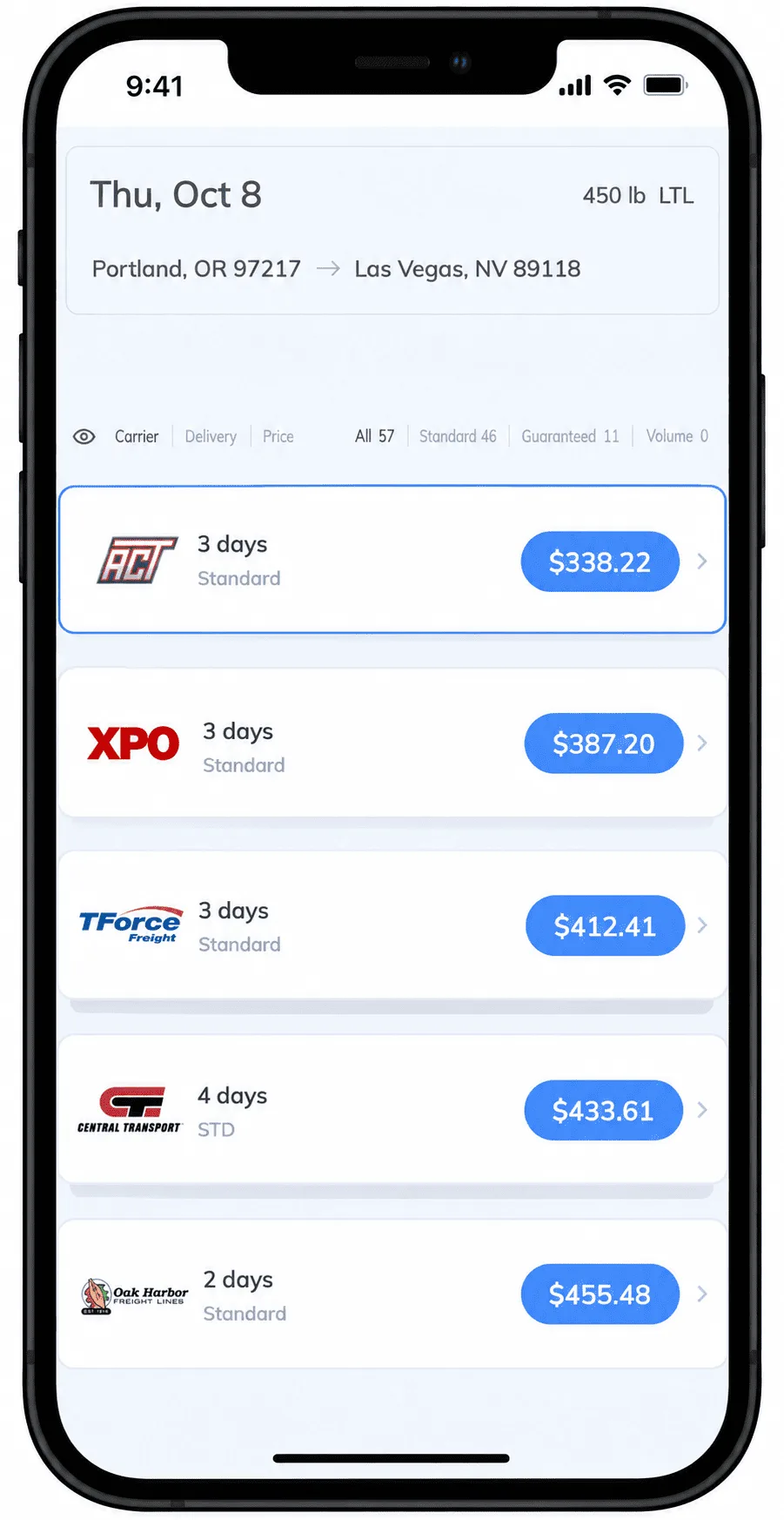
Real screenshot from a live Transportli quote for Portland, OR to Las Vegas, NV, individual results vary by shipment and date.
Major shipping hubs in Oregon
Oregon’s freight moves through a handful of metro areas and one inland port system:
- Portland, Gresham & Hillsboro — the state’s largest market and the main carrier, warehouse and distribution hub, with semiconductor and electronics manufacturing in the Hillsboro area.
- Port of Portland — the Columbia River port system, whose Terminal 6 is the state’s only international container terminal. The Oregon Container Terminal was officially launched there on January 7, 2026, under a new operator (OPB).
- Salem — the state capital, on I-5 south of Portland, with food processing and distribution.
- Eugene & Springfield — the southern Willamette Valley hub, with wood products and distribution.
- Medford — the main hub in southern Oregon, on I-5 near the California line.
- Bend — the Central Oregon hub, with US 97 and US 20 in and out.
- Umatilla & Hermiston — the eastern Oregon food-processing and farm corridor along I-84 and I-82, with an ODOT port of entry at Umatilla.
Highway corridors serving Oregon
I-5 (about 308 miles in Oregon) is the main north-south route, from the California line at Ashland through Medford, Eugene, Salem and Portland to Washington. I-84 (about 375 miles) runs from Portland up the Columbia River Gorge and across eastern Oregon through The Dalles, Pendleton, La Grande and Ontario to Idaho, I-205 (about 37 miles) is the eastern bypass around Portland, and I-82 (about 11 miles) links I-84 at Umatilla to Washington. US 97 runs north-south through Central Oregon and Klamath Falls, and US 26, US 20 and US 101 serve the Cascades, the high desert and the coast.
Ports of entry and scales on Oregon’s main routes
ODOT runs permanent truck inspection sites that it calls ports of entry, including Ashland (I-5 northbound at the California line), Cascade Locks (I-84 eastbound), Farewell Bend (I-84 westbound at the Idaho line), Klamath Falls (US 97 northbound) and Umatilla, plus many scales and weigh-in-motion sites on interstates and secondary highways. ODOT says its scale decks are open 24 hours a day for public use. See the ODOT weigh station page and the TripCheck trucking center for the current list and map.
What Oregon shippers move
Oregon’s freight is shaped by electronics, equipment and farming. The state exported $27.9 billion of goods in 2025, the 20th most of any state and up 39% from 2015, led by $11.3 billion of computer and electronic products, with $4.1 billion of transportation equipment, $3.3 billion of machinery, $2.6 billion of chemicals and $583 million of electrical equipment. China took $5.4 billion, Mexico $4.5 billion, Malaysia $3.4 billion, Canada $2.3 billion and Japan $1.3 billion, according to the U.S. Trade Representative. Semiconductors are the state’s top exported goods by value, according to the Portland Metro Chamber. Agriculture is also large, with $2.5 billion of exports in 2024, including $170 million of tree nuts, $167 million of wheat, $148 million of processed vegetables and $138 million of beef and veal. Much of this moves in full truckloads, by rail or by barge, but the parts, tools, supplies, wine, nursery stock and finished goods around these industries are where LTL fits.
Oregon LTL freight: frequently asked questions
How much does LTL shipping cost to or from Oregon?
It depends on distance, weight, freight class, and how close your pickup or delivery point is to a major metro’s carrier network. Real quotes on our platform for Oregon lanes have ranged from about $0.19 to $0.24 per mile on a 46 lb shipment over 2,994 miles from Keizer, Oregon to Jacksonville, Florida to $0.79 to $1.07 per mile on a 3,100 lb shipment over 1,210 miles from Woodburn, Oregon to Farmington, New Mexico, so distance alone does not predict the price. Get an instant quote for your exact shipment.
Do oversized LTL shipments need a permit in Oregon?
Yes, for loads over the legal limits. ODOT’s Commerce and Compliance Division issues over-dimension permits, and single-trip permits can be requested online through its ORION system or by phone at 503-373-0000. A standard LTL trailer within legal limits does not need one.
What is Oregon’s weight-mile tax?
It is a tax on heavy trucks, generally those over 26,000 pounds, based on weight and the miles driven in Oregon, and it is handled through ODOT’s Commerce and Compliance Division. Carriers either hold an account and file tax reports or buy a temporary pass. The LTL carrier pays it and builds it into the rate, so shippers do not pay it directly.
Do trucks have to stop at Oregon weigh stations?
Commercial vehicles with a gross weight of 10,000 pounds or more must stop at an open scale, and trucks over 20,000 pounds must stop whenever a sign directs them to. Oregon’s Green Light program lets pre-cleared trucks bypass, but oversize and heavy-haul loads must stop even with a green light.
Do trucks need chains in Oregon?
Commercial vehicles over 10,000 pounds gross vehicle weight must carry chains when conditions call for them and Snow Zone signs are posted, and the fine for failing to chain up was raised to $880 in 2021. Check TripCheck before any trip through the Siskiyous, the Columbia River Gorge or the Cascades in winter.
What roads connect Oregon’s main cities?
I-5 runs north-south through Ashland, Medford, Eugene, Salem and Portland, I-84 runs from Portland through the Columbia River Gorge and eastern Oregon to Idaho, and I-205 bypasses Portland on the east. US 97 serves Central Oregon and Klamath Falls, and US 101 serves the coast.
Why is the Port of Portland important for freight?
Its Terminal 6 is the state’s only international container terminal, and it was officially relaunched as the Oregon Container Terminal under a new operator on January 7, 2026. Agricultural products make up a large share of the containers that leave through it.