

Shipping LTL freight to or from Vermont? Rates depend on your specific route, freight class, and how close your pickup or delivery point is to the nearest LTL terminal. Vermont is small, rural, and mountainous — but it’s also home to the largest private employer in the state, a semiconductor fab that accounts for 43% of Vermont’s exports, alongside a dairy and maple syrup industry that genuinely leads the nation. Here’s what actually affects your rate.
LTL trucking regulations in Vermont
Standard interstate trucking limits generally apply in Vermont: 80,000 lbs gross vehicle weight, with state highway permits unavailable above 108,000 lbs, 12 feet wide, or 100 feet long. Most LTL shipments fall well within these limits — this mainly matters if your freight is unusually large or heavy.
Unlike several other states we cover, Vermont doesn’t split oversize/overweight permitting across a separate turnpike or bridge authority — there’s no toll road system to worry about. The Vermont DMV’s Commercial Vehicle Operations division is the sole permitting authority, issuing permits online through the state’s “VT Haul Pass” system. Two Vermont-specific quirks are worth knowing:
- Frost and mud season restrictions — during spring thaw, VTrans posts reduced weight limits on affected state highways, and a standard oversize/overweight permit does not override a road posting. If you’re shipping through Vermont in March or April, check current road postings before you count on a route being open at full weight.
- A dairy-specific exemption — trucks hauling unprocessed milk can run up to 90,000 lbs gross on state highways without a standard OS/OW permit, a rule that exists because of how central the dairy industry is to Vermont’s economy.
The full current rules are published in the Vermont Code of Rules for Overweight and Overdimension Vehicle Permits:
Vermont Overweight and Overdimension Vehicle Permit Rules →
What affects your Vermont LTL rate
- Freight class — density, handling, and liability determine your NMFC class, the single biggest factor in your rate. See our freight class guide.
- Distance — Vermont has no major interstate ports or air cargo hubs of its own, so most freight either originates from or is destined for somewhere else — Boston, Montreal, or Albany are typical gateway points.
- Terminal proximity — pickup or delivery points in or near Burlington and Chittenden County see the most carrier options and fastest transit; addresses in the Northeast Kingdom or other rural counties see meaningfully fewer options and longer routes.
- Accessorials — liftgate, residential, or inside delivery add to the base rate, same as anywhere else. Seasonal weight-restricted roads during mud season can also add routing complexity for rural deliveries.
Did you know?From 6 real Vermont lanes and 30 quotes
-
3× the cost per mile
The shorter haul cost far more per mile
A 750 lb shipment moving 879 miles (Okeana, OH to Irasburg, VT) had a lowest quote of $639, or $0.73 a mile. A 500 lb shipment moving 2,913 miles (Van Nuys, CA to Burlington, VT) had a lowest quote of $614, or $0.21 a mile.
-
$205 to arrive 4 days sooner
Speed has a price
On Bennington, VT to Eureka, CA (3,086 miles, 175 lb), the cheapest quote at $1,843 took 9 days. The fastest, at 5 days, cost $2,048. On Okeana, OH to Irasburg, VT, 2-day delivery cost $793 against $639 for 5 days.
-
5 carriers had the lowest quote
Five different carriers won six Vermont lanes
ABF Freight had the lowest quote on two lanes. STG Logistics, Saia, TForce Freight, and XPO each had the lowest quote on one lane. Across the lowest quotes on every lane, 12 different carriers appeared.
-
$366 from lowest to fifth-lowest
Same shipment, quotes $366 apart
For 175 lb from Bennington, VT to Eureka, CA (3,086 miles), the lowest quote was $1,843 and the fifth-lowest was $2,210, a 20% gap. On Bridport, VT to Whitestown, IN, all five quotes landed within $41 of each other.

Regional carrier coverage across Vermont
Vermont doesn’t have the dense multi-hub geography of larger states, but real coverage differences still exist between its regions:
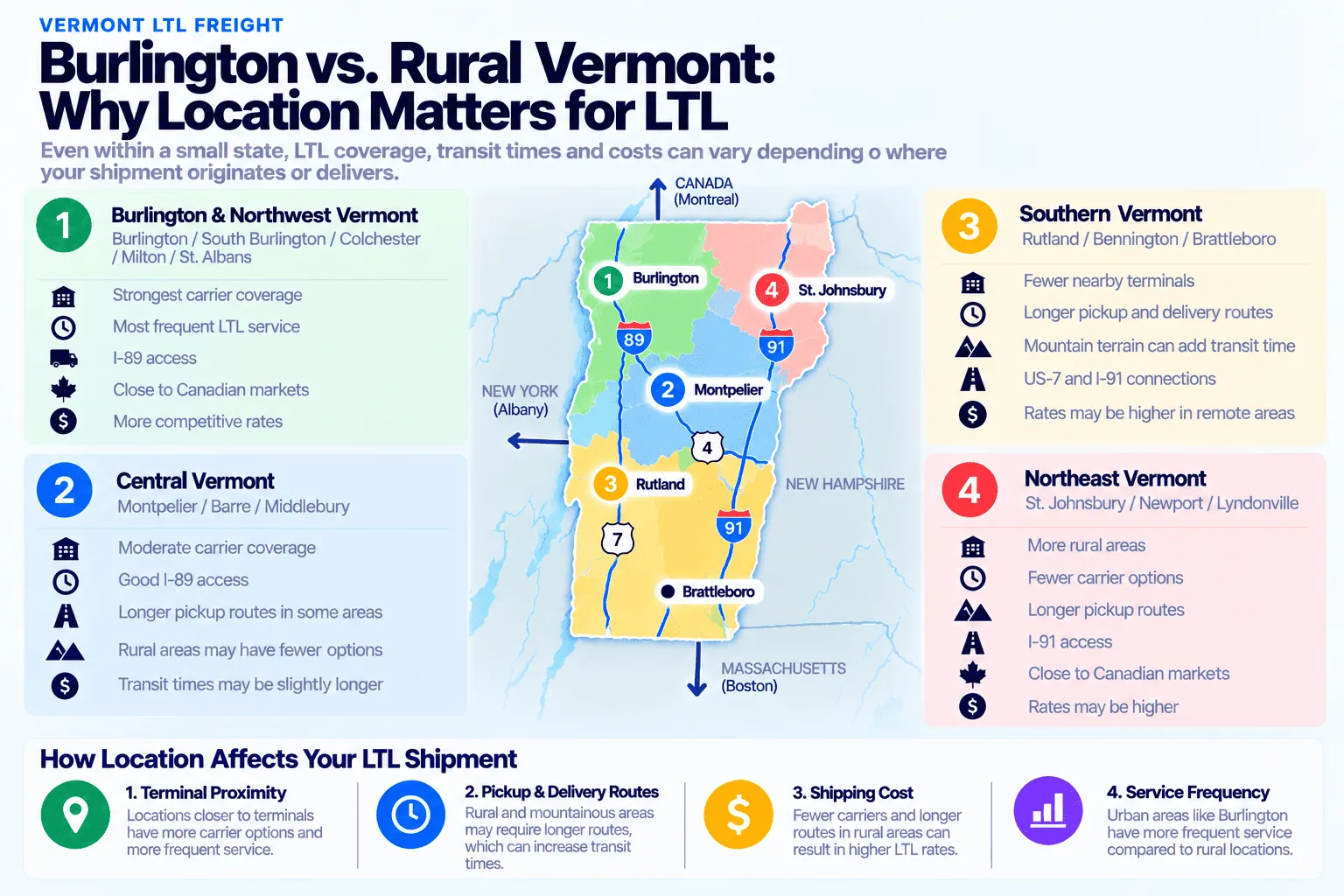
- Chittenden County (Burlington area) — Vermont’s only real metro area and by far its deepest carrier network, anchored by I-89 access and Burlington International Airport.
- Central Vermont (Montpelier, Barre) — moderate coverage around the state capital, with reasonable I-89 access.
- Southern Vermont (Brattleboro, Bennington) — benefits from proximity to Massachusetts, Connecticut, and New York carrier networks via I-91 and Route 7.
- Northeast Kingdom & rural Vermont — the thinnest coverage in the state by a wide margin: fewer terminals, longer pickup routes, and transit times that can run well behind Chittenden County.
Weather and transit reliability
Vermont’s Green Mountains add real weather risk on top of ordinary New England winters. Mountain routes on I-89 and I-91 see heavier, more persistent snow than valley routes, and rural roads off the interstates can be slower to plow. Then there’s “mud season” — every spring, as frost comes out of the ground, VTrans posts reduced weight limits on affected roads, and a standard oversize/overweight permit does not override that posting. It’s a genuinely Vermont-specific factor that doesn’t show up in most other states: if your shipment needs to move through rural Vermont in March or April, build in extra time and confirm current road postings before you count on a route being open at full weight.
Sample Vermont LTL rates by route
Real quotes pulled from our platform for six different Vermont lanes — same process, different carriers each time, spanning both ends of the country. Rates shift with capacity and fuel costs, so treat these as a snapshot rather than a guarantee for your shipment; get an instant quote for your exact route.
Real quotes by route
Snapshot taken over recent weeks — carriers and pricing change daily.
| Carrier | Service | Transit | Price |
|---|---|---|---|
| ABF Freight | Standard | 9 days | $1,843.09 |
| XPO | STD | 6 days | $1,857.40 |
| FedEx Freight Priority | Standard | 5 days | $2,047.67 |
| TForce Freight | STD | 6 days | $2,052.71 |
| Estes | LTL Standard Transit | 5 days | $2,209.58 |
| Carrier | Service | Transit | Price |
|---|---|---|---|
| STG Logistics | Standard | 8 days | $613.58 |
| TForce Freight | Standard | 5 days | $616.44 |
| XPO | Standard | 5 days | $673.59 |
| Central Transport | Standard | 7 days | $699.94 |
| FedEx Freight Economy | Standard | 6 days | $828.30 |
| Carrier | Service | Transit | Price |
|---|---|---|---|
| XPO | STD | 4 days | $602.31 |
| Estes | STD | 6 days | $612.64 |
| TForce Freight | STD | 10 days | $649.19 |
| Central Transport | Standard | 7 days | $741.53 |
| FedEx Freight Economy | Standard | 4 days | $752.32 |
| Carrier | Service | Transit | Price |
|---|---|---|---|
| ABF Freight | Standard | 5 days | $638.69 |
| Ward Transport & Logistics | Standard | 5 days | $696.48 |
| Dayton Freight | STD | 3 days | $718.48 |
| TForce Freight | STD | 4 days | $784.81 |
| XPO | STD | 2 days | $793.01 |
| Carrier | Service | Transit | Price |
|---|---|---|---|
| TForce Freight | Standard | 2 days | $335.50 |
| Estes | Standard | 3 days | $348.98 |
| R+L Carriers | STD | 3 days | $354.62 |
| Pitt Ohio | Standard | 3 days | $375.42 |
| Saia | Standard | 3 days | $376.19 |
| Carrier | Service | Transit | Price |
|---|---|---|---|
| Saia | Standard | 2 days | $387.30 |
| Estes | LTL Standard Transit | 5 days | $399.96 |
| XPO | Standard | 2 days | $425.98 |
| TForce Freight | STD | 2 days | $431.13 |
| ABF Freight | Standard | 3 days | $452.96 |
Rate, transit, and price-per-mile summary
Pulling the six lanes above together shows something a little different from most other states we cover: in Vermont, it’s rural coverage — not just short distance — that drives up effective cost per mile.
| Route | Distance | Weight | Price range | Transit range | Price per mile |
|---|---|---|---|---|---|
| Bennington, VT → Eureka, CA | 3,086 mi | 175 lb | $1,843–$2,210 | 5–9 days | $0.60–$0.72 |
| Van Nuys, CA → Burlington, VT | 2,913 mi | 500 lb | $614–$828 | 5–8 days | $0.21–$0.28 |
| South Burlington, VT → Bozeman, MT | 2,286 mi | 92 lb | $602–$752 | 4–10 days | $0.26–$0.33 |
| Okeana, OH → Irasburg, VT | 879 mi | 750 lb | $639–$793 | 2–5 days | $0.73–$0.90 |
| Bridport, VT → Whitestown, IN | 874 mi | 234 lb | $336–$376 | 2–3 days | $0.38–$0.43 |
| Vernon, VT → Nashville, TN | 1,070 mi | 430 lb | $387–$453 | 2–5 days | $0.36–$0.42 |
Notice that our longest haul by far — 3,086 miles to Eureka, California — actually has the highest price per mile of the six, not the lowest. The lane that stands out even more is Okeana, Ohio to Irasburg, Vermont: at just 879 miles, it runs $0.73–$0.90 a mile, nearly triple the rate on the similar-distance Bridport-to-Indiana lane. Both of those expensive lanes share something in common — Eureka and Irasburg are genuinely rural, thin-coverage endpoints, exactly the kind of location the “regional coverage” section above describes. In Vermont specifically, it’s less about how far your shipment travels and more about whether either end sits in a market with real carrier competition.
Major shipping hubs in Vermont
Vermont’s carrier terminal network is concentrated around a handful of towns, which generally means faster pickup windows and more carrier options the closer you are to one of these:
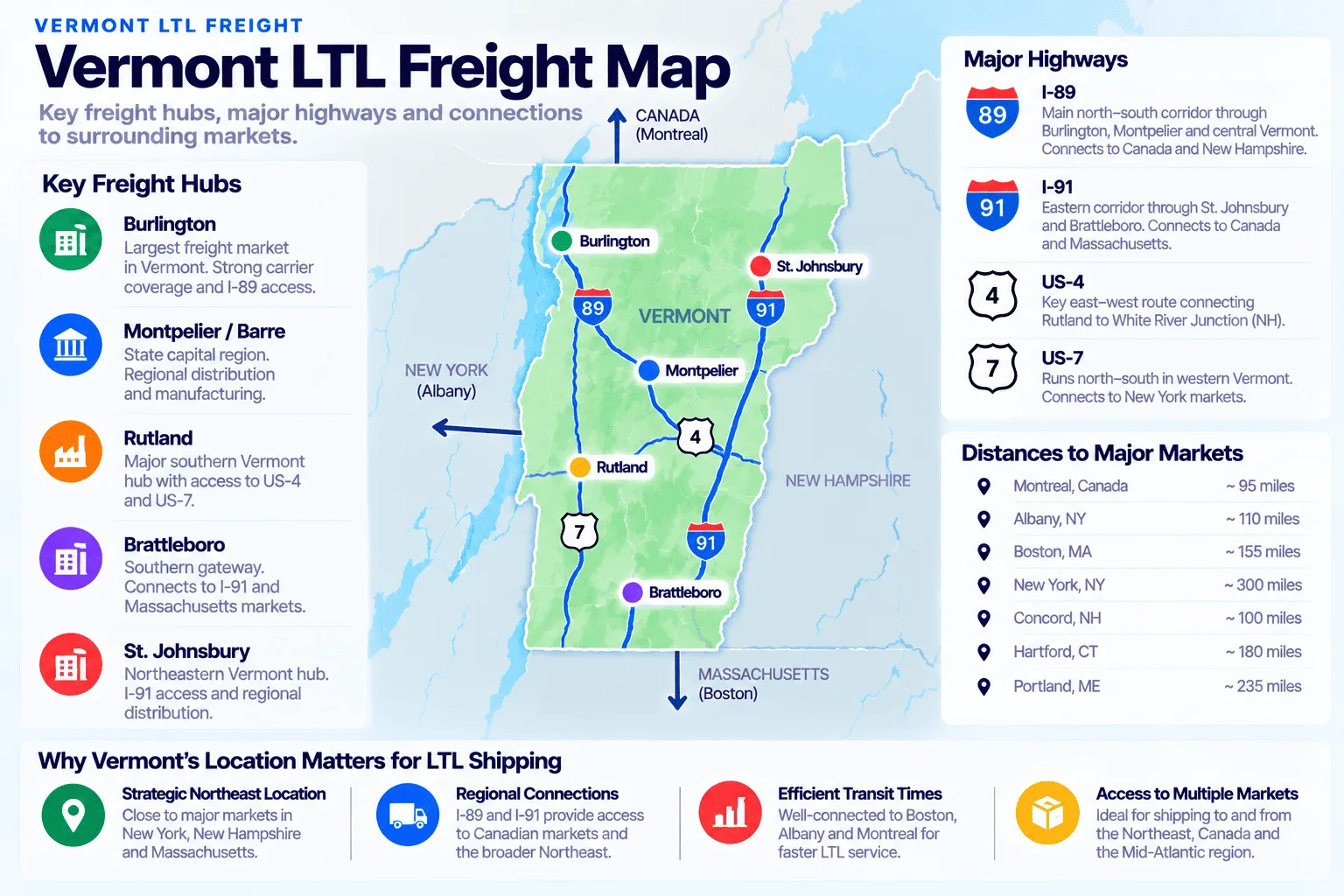
- Burlington & Essex Junction — Vermont’s largest metro area and primary freight gateway, home to Burlington International Airport and GlobalFoundries’ Essex Junction semiconductor fab — the largest private employer in the state, accounting for an estimated 43% of Vermont’s total exports.
- Montpelier & Barre — the state capital region, with moderate carrier coverage and reasonable I-89 access.
- Rutland — a secondary hub in western Vermont along Route 7, serving the state’s southwestern counties.
- Brattleboro — Vermont’s southern gateway on I-91, benefiting from proximity to the Massachusetts and Connecticut carrier networks.
Highway corridors serving Vermont
I-89 is Vermont’s primary freight corridor, running from the New Hampshire border through Montpelier and Burlington up to the Canadian border at Highgate Springs — a real commercial crossing into Quebec. I-91 runs the length of the state along the Connecticut River valley, from the Massachusetts border at Brattleboro north to the Canadian border at Derby Line. Route 7 is the main north-south route through western Vermont, connecting Bennington, Rutland, and Burlington outside the interstate system. Freight moving to or from Canada through either border crossing needs the usual cross-border documentation on top of standard domestic requirements.
What Vermont shippers move
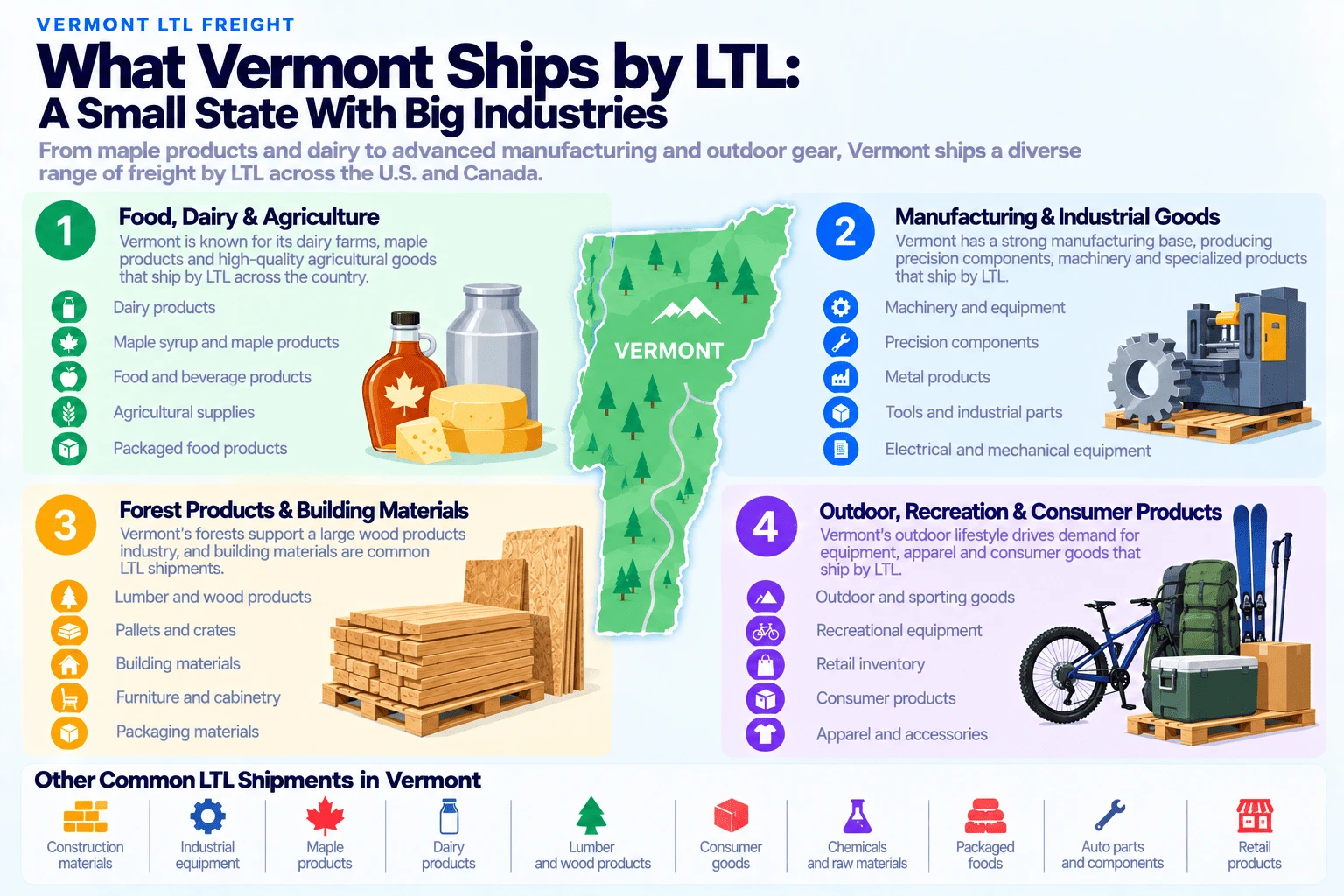
Vermont’s freight mix is small in volume but punches well above its weight in a few specific categories. GlobalFoundries’ Essex Junction fab — one of the largest 200mm semiconductor cleanrooms in the world — is the single biggest driver, generating specialized freight tied to an estimated 43% of the state’s exports and a $16 billion multi-state investment (alongside its New York operations) to add next-generation gallium nitride semiconductor manufacturing for EVs, 5G, and data centers. Dairy is the other pillar: Vermont’s raw milk haulers get their own weight exemption, and cooperatives like the St. Albans Cooperative Creamery supply the state’s food manufacturers — including Ben & Jerry’s, whose Waterbury factory alone can produce up to 350,000 pints of ice cream a day, with a second plant in St. Albans. Vermont also leads the nation in maple syrup, producing over 50% of all US maple syrup — more than 3 million gallons in 2026 from over 8 million taps — generating real seasonal packaging and distribution freight. Add in a ski and tourism economy that drives seasonal freight of its own, and Vermont’s freight mix is genuinely distinctive for a state this size.
Vermont LTL freight: frequently asked questions
How much does LTL shipping cost to or from Vermont?
It depends on your route, freight class, weight, and accessorials — and in Vermont, whether either end of your route sits in a well-covered market matters more than raw distance. Real Vermont lanes in our data ranged from about $336 for a regional Midwest move up to $2,210 for a lighter shipment to a rural part of California, with a route into rural Northeast Kingdom Vermont costing nearly triple per mile of a similar-distance lane elsewhere. Get an instant quote for your exact shipment.
Do oversized LTL shipments need a permit in Vermont?
Only if your load exceeds the standard limits (generally 80,000 lbs, with permits unavailable above 108,000 lbs, 12 feet wide, or 100 feet long on state highways). Unlike many other states, Vermont has a single permitting authority — the Vermont DMV, through its online VT Haul Pass system — since the state has no separate turnpike or bridge authority. Watch for seasonal frost/mud-season weight postings each spring, which a standard permit does not override.
Why is Vermont an important freight state despite its small size?
Vermont’s GlobalFoundries semiconductor fab in Essex Junction is the state’s largest private employer and accounts for an estimated 43% of Vermont’s exports, part of a $16 billion multi-state investment in next-generation chip manufacturing. Add in a dairy and maple syrup industry that genuinely leads the nation — Vermont produces over half of all US maple syrup — and the state generates real, specific freight demand well beyond what its population would suggest.
What is mud season and how does it affect Vermont freight?
Every spring, as frost comes out of the ground, VTrans posts reduced weight limits on affected state highways to protect the road surface — and a standard oversize/overweight permit does not override that posting. It mainly affects rural routes and typically runs through March and April. If you’re shipping into rural Vermont during that window, build in extra time and confirm current road postings.
Which carriers serve Vermont?
Most major national LTL carriers serve Vermont, with the deepest coverage around Burlington and Chittenden County — availability and pricing vary significantly by exact route, and rural counties see noticeably fewer options.
Is LTL service the same everywhere in Vermont?
No. Burlington and Chittenden County have by far the strongest carrier coverage in the state. Central and southern Vermont have moderate coverage, while the Northeast Kingdom and other rural areas see meaningfully fewer carrier options and longer transit times.