

Pallet shipping is the most common form of LTL freight — goods stacked and secured on a standard pallet, shipped by the pallet rather than by the individual box. What it costs depends less on weight alone than most shippers expect, and more on how much trailer space the pallet actually takes up. When you are ready to price your pallets, request an LTL freight quote and compare carriers side by side.
Standard pallet sizes
The most common pallet in U.S. freight is the 48″ × 40″ GMA pallet (named for the Grocery Manufacturers Association) — it’s the default size most carriers, forklifts, and warehouse racking are built around. A handful of other sizes show up regularly depending on the industry:
| Size (W × L) | Common name | Typical use |
|---|---|---|
| 48″ × 40″ | GMA pallet | General freight, grocery, retail — the default |
| 42″ × 42″ | — | Paint, chemicals, drums |
| 48″ × 48″ | — | Beverages, dairy |
| 40″ × 40″ | — | Building materials |
| 44″ × 44″ | — | Drums, cylindrical loads |
A standard 48″ × 40″ wood pallet is typically rated to carry somewhere in the 3,700–4,600 lb range, though the exact capacity depends on the pallet’s construction and condition — always confirm with the pallet manufacturer or your carrier rather than assuming a number. Most carriers also cap stacked height around 60 inches including the pallet itself, though this varies by carrier.
Types of shipping pallets
Material and construction affect both cost and what your freight is protected from:
- Wood — the most common and least expensive option, strong enough for most general freight. Splinters and nails can be a concern for food-grade or sensitive shipments.
- Plastic — moisture- and pest-resistant, washable, and lighter than wood. Common in food, pharmaceutical, and export shipments where sanitation matters. Costs more upfront than wood.
- Metal — built for heavy, repeated industrial use rather than one-way shipping. Rare outside specific heavy-manufacturing contexts because of weight and cost.
- Cardboard/corrugated — lightweight and recyclable, used for lighter loads where the pallet itself doesn’t need to survive multiple trips.
Within wood pallets, you’ll also see stringer construction (solid wood boards running underneath, usually entered by forklift from two sides) and block construction (cylindrical wood or plastic blocks between the deck boards, allowing forklift entry from all four sides). Block pallets generally handle more weight and are easier to maneuver in a warehouse; stringer pallets are cheaper and more common for standard freight.
Why density matters more than weight
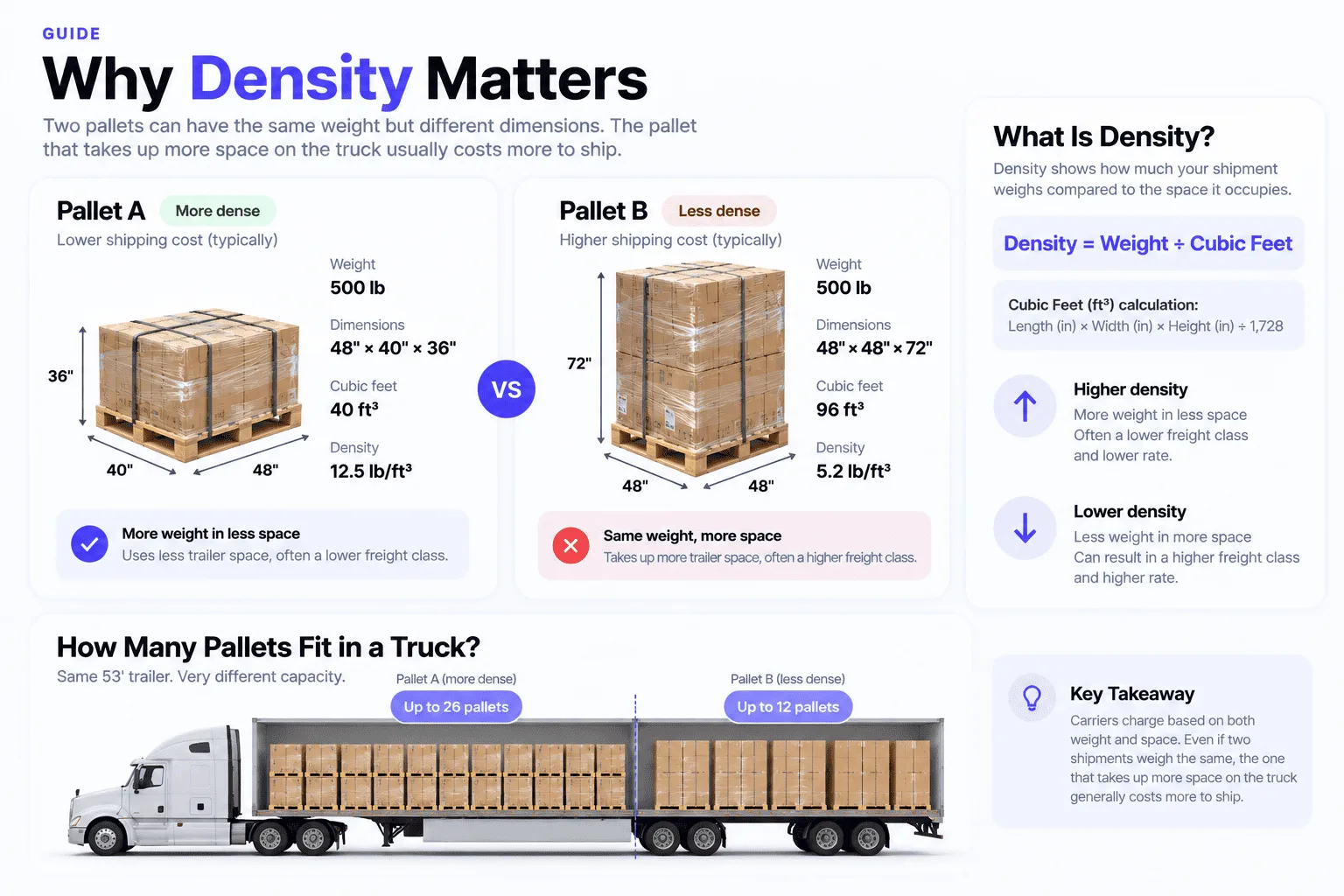
Carriers price freight by density — weight relative to volume — not just total weight. The same 500 lbs can cost very differently depending on whether it’s packed onto one dense pallet or spread loosely across four. A denser pallet takes up less trailer space for the same weight, which typically earns a lower freight class and a lower rate. Use our freight class calculator to estimate your class before you book.
What affects pallet shipping cost
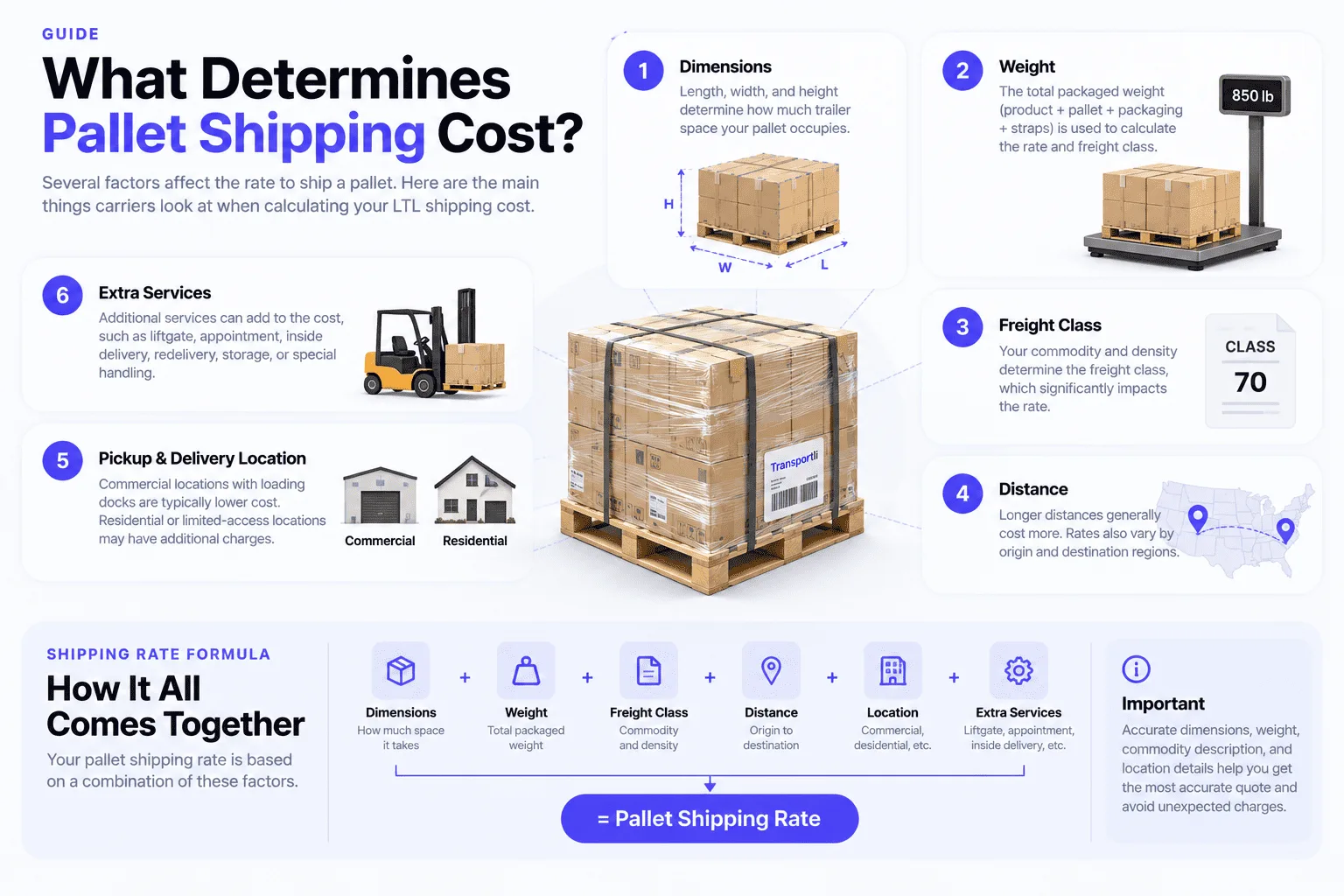
- Freight class — determined by density, handling difficulty, and liability risk.
- Dimensions and weight — both are needed to calculate density and confirm the class.
- Distance — same as any freight shipment, a core driver of total cost.
- Accessorials — liftgate service, inside delivery, and residential pickup all add cost if needed. See our accessorial charge checker to see what applies to your shipment.
Consolidating onto fewer, denser pallets — or avoiding unnecessary crating — often lowers your freight class and your rate. If you’re regularly shipping six or more pallets on the same lane, ask for volume LTL quotes as well as standard LTL. On some lanes volume LTL was the cheapest option in our samples, and on others it was not, so compare both (see LTL vs. FTL).
How to prepare and pack your pallet for shipping
Good pallet prep protects your freight and helps you avoid a reclass at the carrier’s dock.
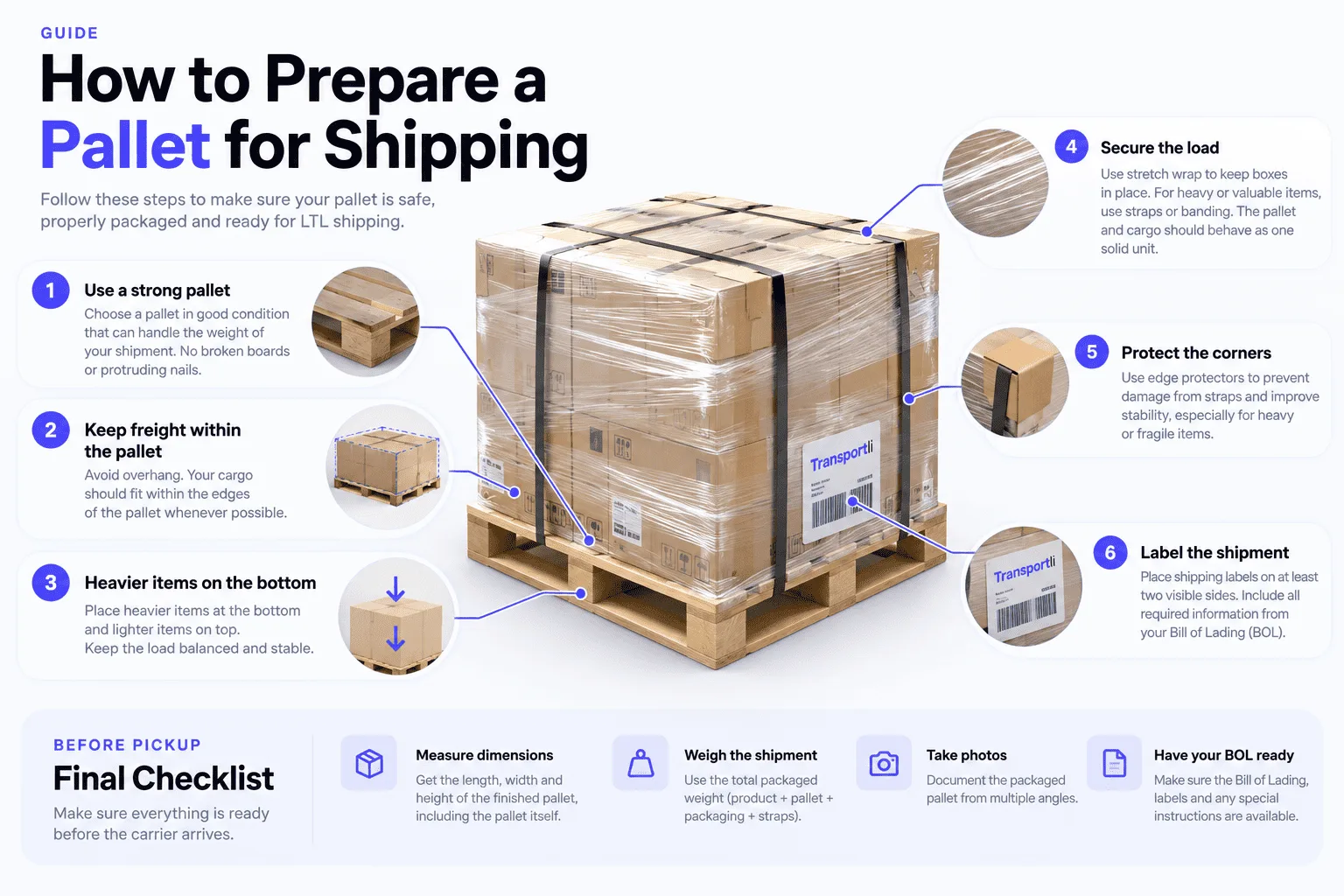
Start with a sound pallet
No cracked boards, protruding nails, or rot. A damaged pallet can be refused at pickup or fail mid-transit.
Stack for even weight distribution
Heavier items on the bottom, weight centered over the pallet — not overhanging the edges, which most carriers won’t accept.
Secure the load
Stretch wrap (multiple wraps, top to bottom), banding, or strapping to keep everything from shifting. Corner boards or edge protectors help if straps could crush the contents.
Label clearly
Origin and destination address, piece count, weight, and any handling instructions (fragile, this-side-up) visible on at least two sides.
How many pallets fit in a truck
A standard 53′ dry van can hold up to about 26 standard 48″ × 40″ pallets single-stacked, or more if your freight can safely double-stack. With LTL, you’re only paying for the trailer space your pallets actually use — not the whole truck — which is what makes it cheaper than a dedicated truck for smaller shipments. Once you’re regularly running six or more pallets on the same lane, it’s worth asking about volume LTL or full truckload pricing, which can beat standard LTL rates for that volume.
Get a pallet shipping quote
Compare live LTL rates from vetted carriers for your pallet shipment.
Get an LTL quote →Sample pallet shipping rates by route
Real quotes pulled from our platform for six different lanes — same process, different carriers each time. Rates shift with capacity and fuel costs, so treat these as a snapshot rather than a guarantee for your shipment; get an instant quote for your exact route and pallet count.
Real quotes by route
Snapshot taken the week of September 22 — carriers and pricing change daily.
| Carrier | Service | Transit | Price |
|---|---|---|---|
| Central Transport | Standard | 2 days | $336.31 |
| TForce Freight | Standard | 2 days | $354.17 |
| FedEx Freight | Freight Priority | 2 days | $433.67 |
| Old Dominion Freight Line | Standard | 2 days | $457.02 |
| Roadrunner Freight | Standard Service | 3 days | $467.74 |
| Carrier | Service | Transit | Price |
|---|---|---|---|
| STG Logistics | Standard | 8 days | $645.40 |
| XPO | Standard | 5 days | $692.10 |
| Roadrunner Freight | Standard Service | 6 days | $692.50 |
| Forward Air | Standard | 4 days | $747.24 |
| TForce Freight | Standard | 5 days | $765.46 |
| Carrier | Service | Transit | Price |
|---|---|---|---|
| ABF Freight (ArcBest) | Standard | 4 days | $447.95 |
| FedEx Freight | Freight Economy | 2 days | $553.26 |
| Southeastern Freight Lines | Standard | 1 day | $582.42 |
| R+L Carriers | Standard | 1 day | $584.26 |
| ACT (AAA Cooper) | Standard | 1 day | $642.03 |
| Carrier | Service | Transit | Price |
|---|---|---|---|
| Roadrunner Freight | Standard Service | 5 days | $694.84 |
| ABF Freight (ArcBest) | Standard | 4 days | $787.18 |
| FedEx Freight | Freight Economy | 6 days | $799.92 |
| Southeastern Freight Lines | Standard | 4 days | $835.18 |
| ACT (AAA Cooper) | Standard | 6 days | $1,073.33 |
| Carrier | Service | Transit | Price |
|---|---|---|---|
| Central Transport | Standard | 4 days | $529.53 |
| ABF Freight (ArcBest) | Standard | 5 days | $600.25 |
| FedEx Freight | Freight Economy | 3 days | $732.61 |
| Forward Air | Standard | 3 days | $768.43 |
| Southeastern Freight Lines | Standard | 4 days | $787.28 |
| Carrier | Service | Transit | Price |
|---|---|---|---|
| Warp | Standard | 1 day | $287.71 |
| JP Express | Standard | 1 day | $295.49 |
| A. Duie Pyle | Standard | 1 day | $311.16 |
| 2 Day Transportation | Standard | 1 day | $323.76 |
| R+L Carriers | Standard | 1 day | $325.43 |
Frequently asked questions
How much does it cost to ship a pallet?
It depends on the pallet’s freight class, weight, dimensions, and the distance it’s traveling. Density — weight relative to volume — is often a bigger factor than total weight alone.
What’s the standard pallet size for LTL shipping?
The most common standard is 48 x 40 inches (a “GMA pallet”), though carriers can accommodate other sizes — just confirm exact dimensions when requesting a quote.
How much weight can a standard pallet hold?
A standard 48 x 40 wood pallet is typically rated for roughly 3,700–4,600 lbs, depending on its construction and condition. Confirm the rated capacity with your pallet supplier or carrier rather than assuming a number — it affects both safety and how the shipment is classed.
Does packaging affect my shipping cost?
Yes. Consolidating freight onto fewer, denser pallets or avoiding unnecessary crating can lower your freight class and reduce your rate.
Do I need to label my pallet?
Yes — carriers expect origin and destination address, piece count, weight, and any handling instructions clearly visible on at least two sides of the load. Missing or unclear labels are a common cause of delivery delays.
What is volume LTL?
Volume LTL is a pricing tier for larger shipments — typically six or more pallets on one lane — priced closer to truckload rates. It can save considerably over standard LTL pricing for the same freight.
What happens if my pallet is damaged when it arrives?
Note any damage on the delivery receipt before you sign — signing a clean receipt without noting damage can make a claim difficult to pursue. Photograph the damage and contact your carrier or broker right away to start a claim.