

Shipping LTL freight to or from Wisconsin? Rates depend on your specific route, freight class, and how close your pickup or delivery point is to the nearest LTL terminal. Wisconsin is a genuinely distinctive freight state: it’s been America’s #1 cheese producer for over a century and supplies more than 60% of the nation’s cranberries, a booming Amazon-and-Uline logistics corridor has reshaped freight near Kenosha, and just north of Madison sits one of only two places in the entire U.S. Interstate System where three interstates run together on the same pavement. Here’s what actually affects your rate.
LTL trucking regulations in Wisconsin
Wisconsin’s oversize/overweight thresholds are close to the federal baseline, with permits issued by the Wisconsin Department of Transportation:
- An oversize permit is required for loads exceeding 8.5 feet wide, 13.5 feet high, 75 feet long (combination), or 80,000 lbs gross. WisDOT also offers annual permits valid 3–12 months for frequent oversize movers, good on all state roadways subject to local bridge postings.
- Travel is generally unrestricted for loads under about 12 feet wide, but the Madison and Milwaukee metro counties (Columbia, Dane, Milwaukee, Rock, and Waukesha) add summer weekend travel restrictions during peak holiday traffic. Escorts are required as loads get wider, with both a law-enforcement and private escort required on the widest loads — exact current thresholds are best confirmed directly with WisDOT before moving an oversize load.
- Most standard LTL freight falls well within these limits — this mainly matters for the heavy manufacturing and specialty-vehicle freight that regularly moves out of places like Oshkosh and Milwaukee.
Current permit thresholds and axle limits are public record:
WisDOT Oversize/Overweight Single-Trip Permits →
What affects your Wisconsin LTL rate
- Freight class — density, handling, and liability determine your NMFC class, the single biggest factor in your rate. See our freight class guide.
- Distance — Wisconsin’s carrier density is heavily concentrated in the southeast, with real gaps opening up toward the north woods.
- Terminal proximity — pickup or delivery points near Milwaukee or the booming Kenosha/Racine logistics corridor typically see the most carrier options and fastest transit; far-northern Wisconsin sees noticeably fewer.
- Accessorials — liftgate, residential, or inside delivery add to the base rate, same as anywhere else.
Did you know?From 6 real Wisconsin lanes and 30 quotes
-
7× the cost per mile
The shorter haul cost far more per mile
A 2,032 lb shipment moving 872 miles (Newark, NJ to Franklin, WI) had a lowest quote of $1,086, or $1.25 a mile. A 250 lb shipment moving 2,056 miles (Waukesha, WI to Bakersfield, CA) had a lowest quote of $386, or $0.19 a mile.
-
$526 to arrive 3 days sooner
Speed has a price
On Newark, NJ to Franklin, WI (872 miles, 2,032 lb), the cheapest quote at $1,086 took 5 days. The fastest, at 2 days, cost $1,612. On Cobb, WI to Klamath Falls, OR, 4-day delivery cost $477 against $401 for 6 days.
-
6 carriers had the lowest quote
Six different carriers won six Wisconsin lanes
ABF Freight, FedEx Freight, R+L Carriers, Roadrunner, TForce Freight, and Warp each had the lowest quote on one lane. Across the lowest quotes on every lane, 12 different carriers appeared.
-
$543 from lowest to fifth-lowest
Same shipment, quotes $543 apart
For 2,032 lb from Newark, NJ to Franklin, WI (872 miles), the lowest quote was $1,086 and the fifth-lowest was $1,629, a 50% gap. On Dover, PA to Eau Claire, WI, all five quotes landed within $34 of each other.

Regional carrier coverage across Wisconsin
Wisconsin’s freight geography centers on the southeastern corridor between Milwaukee and the Illinois border, with real coverage differences elsewhere:
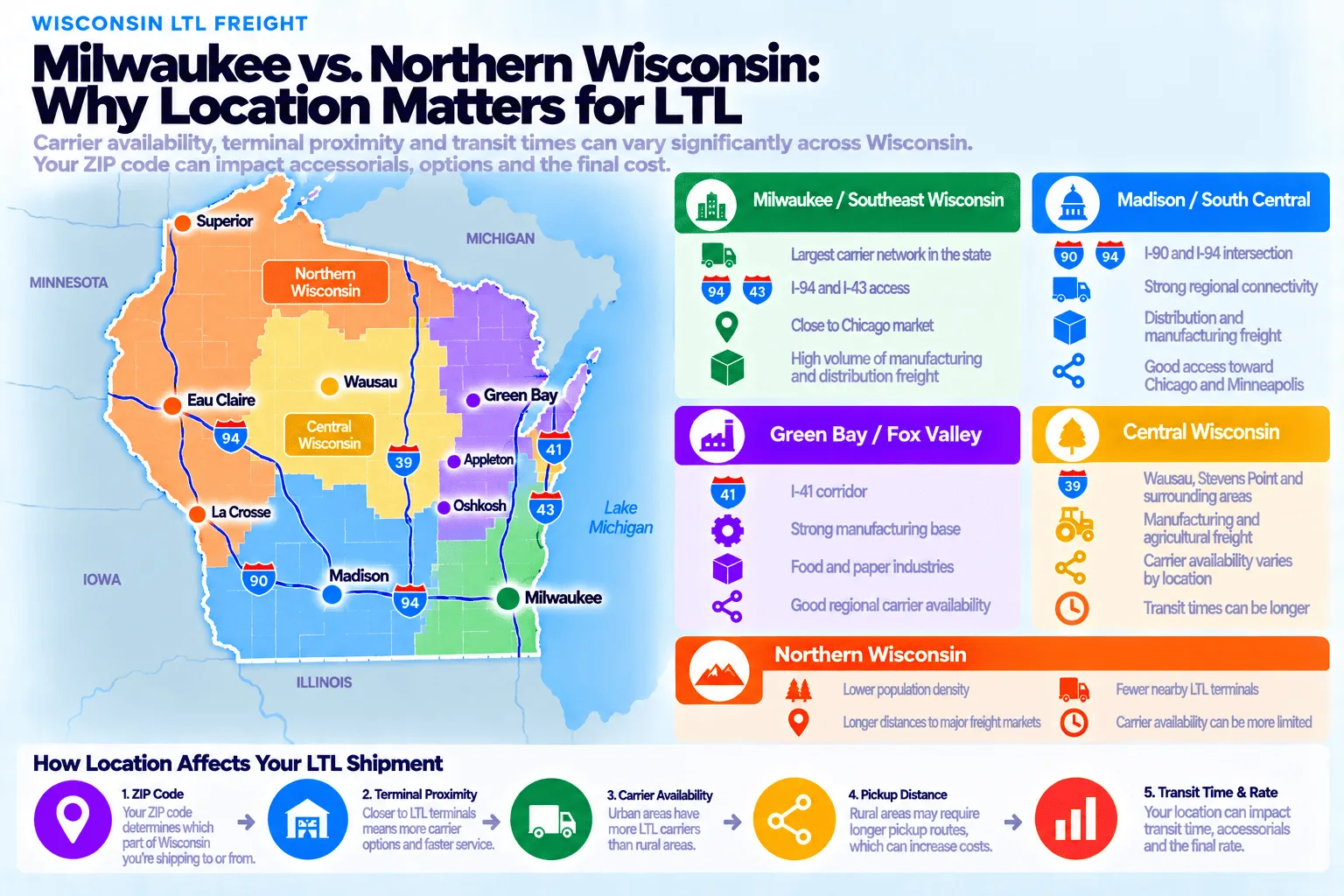
- Milwaukee & southeastern Wisconsin — the state’s largest city and deepest carrier network, anchored by Port Milwaukee and the fast-growing Kenosha/Racine distribution corridor along I-94.
- Madison — the state capital, sitting near the I-90/I-94/I-39 interchange, with solid regional coverage.
- Green Bay & the Fox Valley — anchored by the Port of Green Bay and Wisconsin’s historic paper-mill corridor; decent regional coverage tied to that industrial base.
- Eau Claire & western Wisconsin — a secondary hub for the Chippewa Valley, with moderate coverage supporting regional manufacturers.
- Northern and rural Wisconsin — the thinnest coverage in the state: fewer terminals, longer pickup routes, and a real lake-effect snowbelt that can slow transit for weeks at a time in winter.
Weather and transit reliability
Wisconsin sees two distinct lake-effect snow patterns depending on wind direction: northerly winds dump heavy snow downwind of Lake Superior in the far north, while easterly winds do the same along the Lake Michigan shoreline in the east. The Lake Superior snowbelt is genuinely extreme — Hurley averages close to 200 inches of snow a year, and several nearby towns top 90 inches, well above the statewide average. Southern Wisconsin sees milder winters but isn’t immune to severe summer weather either: the August 2020 derecho and the May 2022 Midwest derecho both produced damaging winds and tornadoes across the state. Given how concentrated Wisconsin’s freight network is around the I-94 corridor, a single major storm can meaningfully slow shipments statewide.
Sample Wisconsin LTL rates by route
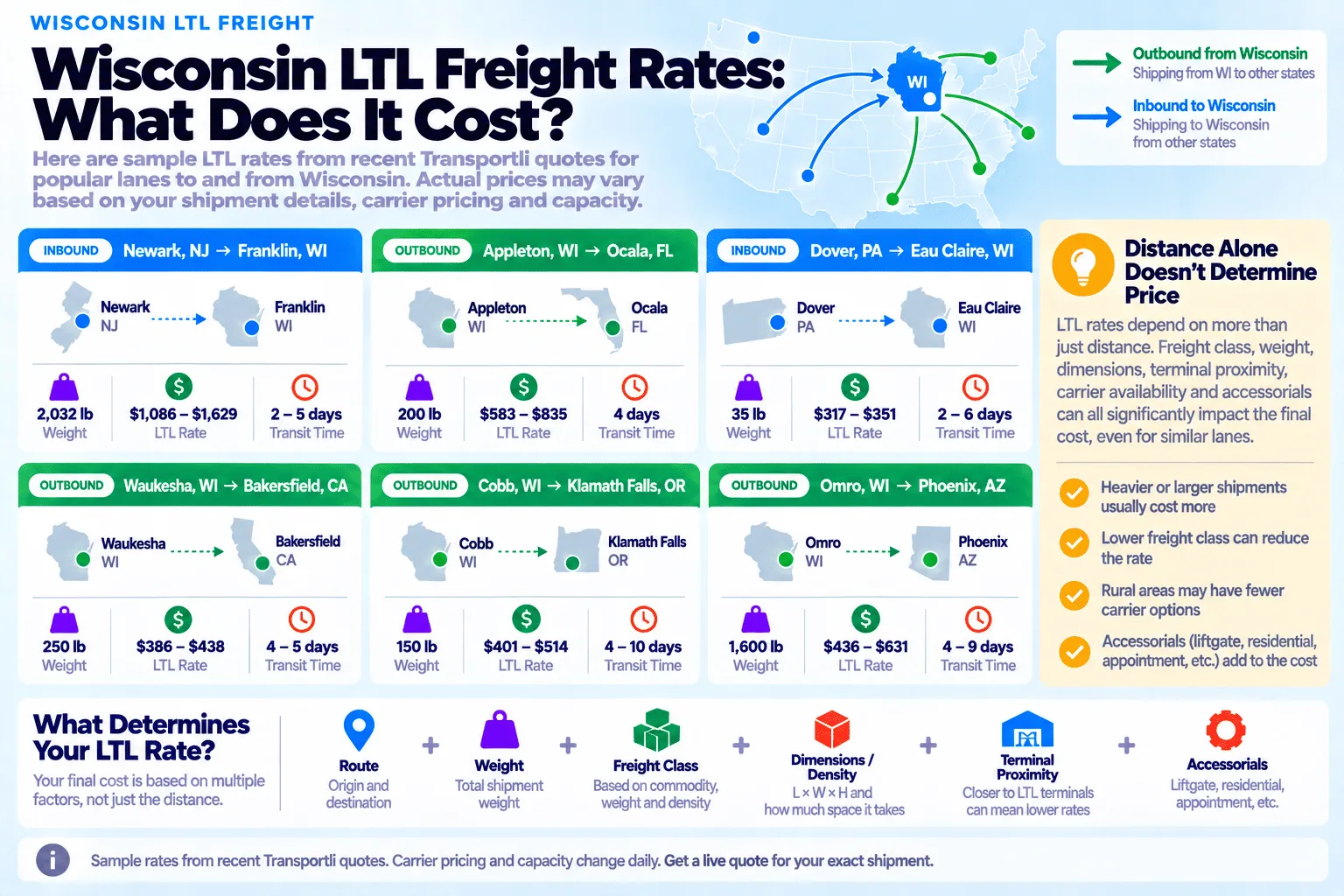
Real quotes pulled from our platform for six different Wisconsin lanes — same process, different carriers each time, spanning a huge range of weights and distances. Rates shift with capacity and fuel costs, so treat these as a snapshot rather than a guarantee for your shipment; get an instant quote for your exact route.
Real quotes by route
Snapshot taken over recent weeks — carriers and pricing change daily.
| Carrier | Service | Transit | Price |
|---|---|---|---|
| ABF Freight | Standard | 5 days | $1,086.28 |
| Roadrunner Freight | Standard | 3 days | $1,301.64 |
| Central Transport | Standard | 3 days | $1,404.14 |
| R+L Carriers | Standard | 2 days | $1,612.32 |
| TForce Freight | Standard | 2 days | $1,629.19 |
| Carrier | Service | Transit | Price |
|---|---|---|---|
| Warp | Standard | 4 days | $583.28 |
| Roadrunner Freight | Standard | 4 days | $624.97 |
| AAA Cooper Transportation | Standard | 4 days | $657.87 |
| ABF Freight | Standard | 4 days | $707.80 |
| TForce Freight | STD | 4 days | $835.46 |
| Carrier | Service | Transit | Price |
|---|---|---|---|
| R+L Carriers | Standard | 2 days | $316.87 |
| Central Transport | STD | 4 days | $316.93 |
| XPO | Standard | 2 days | $320.26 |
| TForce Freight | Standard | 4 days | $346.61 |
| FedEx Freight Economy | Standard | 6 days | $350.99 |
| Carrier | Service | Transit | Price |
|---|---|---|---|
| FedEx Freight | Standard | 5 days | $385.64 |
| Forward Air | Standard | 4 days | $418.88 |
| XPO | STD | 4 days | $432.16 |
| TForce Freight | Standard | 4 days | $433.26 |
| R+L Carriers | Standard | 5 days | $437.52 |
| Carrier | Service | Transit | Price |
|---|---|---|---|
| TForce Freight | Standard | 6 days | $400.53 |
| FedEx Freight Economy | Standard | 5 days | $424.93 |
| STG Logistics | Standard | 10 days | $454.97 |
| XPO | Standard | 4 days | $477.14 |
| Peninsula Truck Lines | Standard | 6 days | $514.44 |
| Carrier | Service | Transit | Price |
|---|---|---|---|
| Roadrunner Freight | Standard | 4 days | $436.47 |
| STG Logistics | Standard | 9 days | $453.33 |
| TForce Freight | STD | 5 days | $530.49 |
| ABF Freight | Standard | 4 days | $623.72 |
| XPO | Standard | 4 days | $631.46 |
Rate, transit, and price-per-mile summary
Pulling the six lanes above together, one comparison cuts against the usual distance-drives-price pattern — carrier density in the pickup market matters more than raw miles:
| Route | Distance | Weight | Price range | Transit range | Price per mile |
|---|---|---|---|---|---|
| Newark, NJ → Franklin, WI | 872 mi | 2,032 lb | $1,086–$1,629 | 2–5 days | $1.25–$1.87 |
| Appleton, WI → Ocala, FL | 1,328 mi | 200 lb | $583–$835 | 4 days | $0.44–$0.63 |
| Dover, PA → Eau Claire, WI | 983 mi | 35 lb | $317–$351 | 2–6 days | $0.32–$0.36 |
| Waukesha, WI → Bakersfield, CA | 2,056 mi | 250 lb | $386–$438 | 4–5 days | $0.19–$0.21 |
| Cobb, WI → Klamath Falls, OR | 1,955 mi | 150 lb | $401–$514 | 4–10 days | $0.20–$0.26 |
| Omro, WI → Phoenix, AZ | 1,776 mi | 1,600 lb | $436–$631 | 4–9 days | $0.25–$0.36 |
Waukesha to Bakersfield is the standout: at 2,056 miles, it’s the single longest lane in this data, yet it prices the cheapest per mile at just $0.19–$0.21 and lands a tight, reliable 4–5 day transit window across every carrier that quoted it. That tracks with Waukesha’s position deep inside the Milwaukee-area carrier network described above. Compare that to Cobb to Klamath Falls: a shorter haul at 1,955 miles that still prices higher per mile and blows out to a 4–10 day transit spread, with one carrier (STG Logistics) taking more than twice as long as the fastest quote. Cobb is a small rural town in west-central Wisconsin, well outside the state’s carrier-dense southeast corridor, and this lane shows exactly what that gap looks like in practice — distance alone didn’t drive the price or the timeline here, terminal density on the Wisconsin end did. Dover to Eau Claire, at just 35 lbs, is the clearest minimum-charge example in the set — pricing barely moves across carriers ($317–$351) despite being a nearly 1,000-mile haul.
Major shipping hubs in Wisconsin
Wisconsin’s carrier terminal network is concentrated around a handful of metro areas, which generally means faster pickup windows and more carrier options the closer you are to one of these:
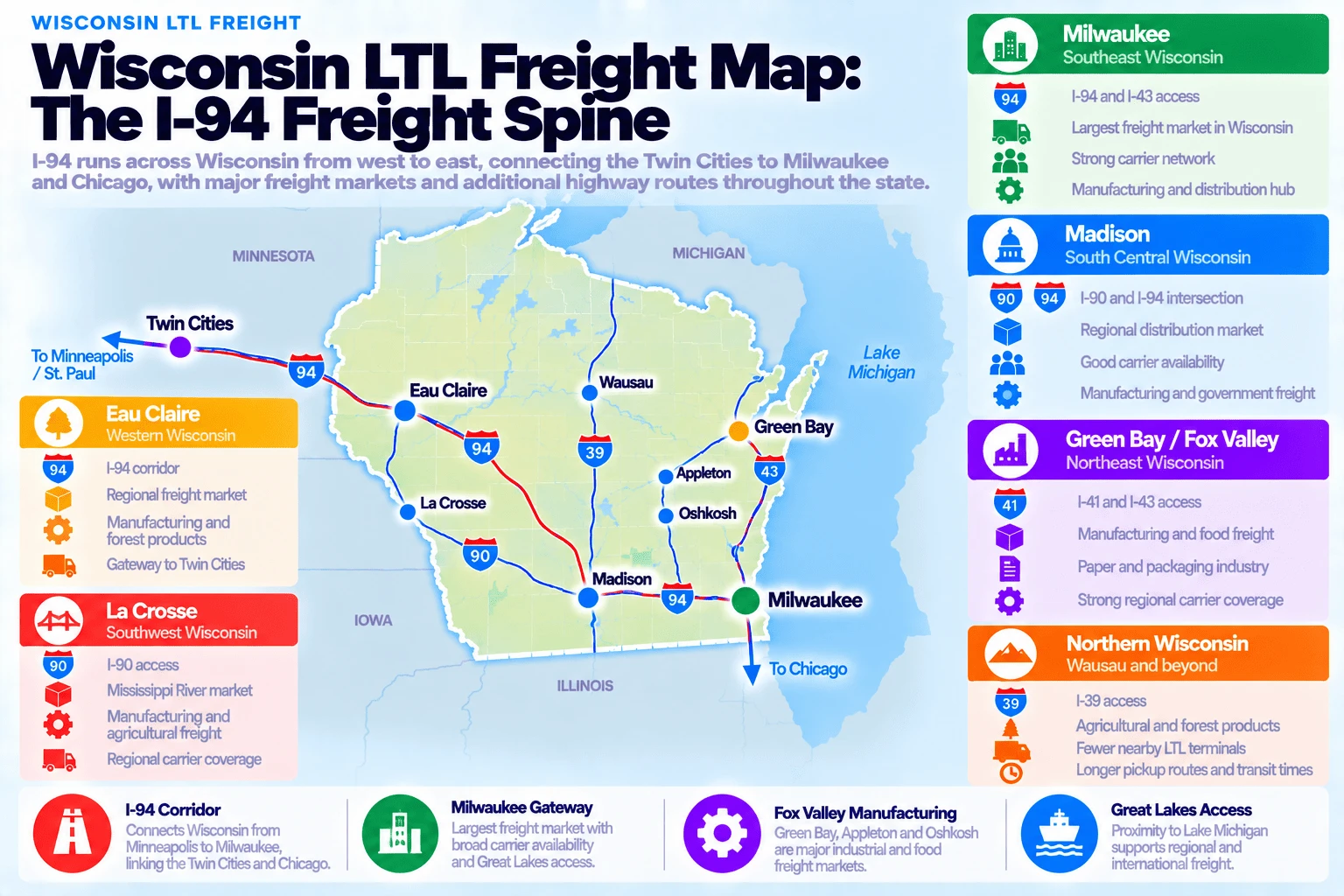
- Milwaukee — Wisconsin’s largest city at roughly 562,000 residents, and home to Port Milwaukee, a seasonal deep-water port on the St. Lawrence Seaway handling over 2 million metric tons of cargo a year and designated Foreign Trade Zone 41 for favorable customs treatment on manufactured goods.
- Kenosha & Racine — sitting directly on I-94 between Chicago and Milwaukee, this corridor has become one of the Midwest’s fastest-growing logistics zones: Amazon’s 1.1-million-square-foot MKE1 fulfillment center anchors a cluster of distribution buildings employing 3,000+ people, and shipping-supply giant Uline is headquartered nearby in Pleasant Prairie.
- Madison — the state capital, sitting near the rare I-90/I-94/I-39 triple-interstate interchange just northwest of the city.
- Green Bay — home to the Port of Green Bay, the westernmost port on Lake Michigan, and the historic hub of Wisconsin’s paper industry.
- Eau Claire — the economic anchor of the Chippewa Valley in west-central Wisconsin, with a growing rail-to-truck transload presence.
Highway corridors serving Wisconsin
I-94 is Wisconsin’s primary freight spine, running from the Illinois border through the Kenosha/Racine logistics corridor, Milwaukee, and on toward the Twin Cities. I-43 connects Milwaukee north to Green Bay. I-90 crosses southern Wisconsin connecting to Rockford, Illinois and on toward Madison and the Twin Cities. I-39 runs through central Wisconsin and, just northwest of Madison near Portage, runs concurrently with both I-90 and I-94 for roughly 30 miles — one of only two places in the entire U.S. Interstate System where three interstates share the same pavement. In Milwaukee, the Mitchell Interchange ties together I-41, I-43, I-94, and I-894 into one of the state’s busiest freight chokepoints.
Why the Kenosha corridor is reshaping Wisconsin freight
Southeastern Wisconsin’s stretch of I-94 between Chicago and Milwaukee has quietly become one of the busiest logistics corridors in the Midwest. Amazon alone operates 13 facilities across Wisconsin, with its largest, the 1.1-million-square-foot MKE1 fulfillment center in Kenosha, anchoring a growing cluster that includes additional million-square-foot buildings in the area’s “94 Logistics Park.” A few miles away in Pleasant Prairie, Uline — one of North America’s largest distributors of shipping and packaging supplies — runs its corporate headquarters from a 200-acre campus with more than 9,000 employees. For LTL freight, that means genuinely deep, modern carrier density in the southeast corner of the state, a sharp contrast with the thinner coverage found up north.
What Wisconsin shippers move
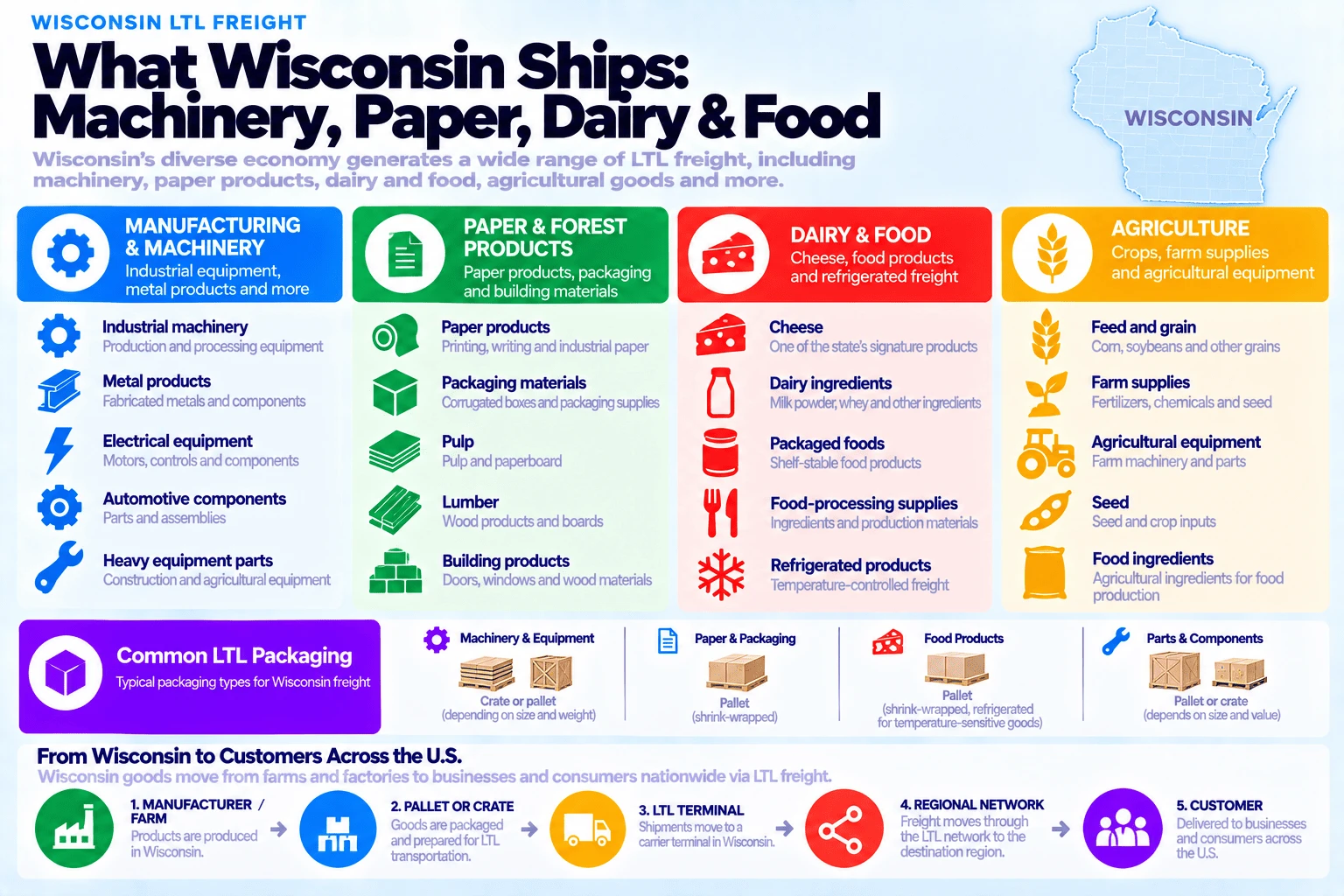
Wisconsin’s freight mix runs from world-leading agriculture to heavy industrial manufacturing. It’s been the nation’s top cheese producer since 1910, and in 2024 alone made 3.58 billion pounds of cheese — about a quarter of all US cheese — across more than 600 varieties from nearly 1,200 licensed cheesemakers, almost all of it moving by refrigerated truck. Wisconsin also supplies over 60% of the entire US cranberry crop, more than double the next-largest state. Manufacturing runs deep too: Harley-Davidson has built motorcycles in Milwaukee since 1903 and still calls it home, Oshkosh Corporation builds military and specialty trucks from its Wisconsin headquarters, and Kohler has made plumbing fixtures from its namesake village near Sheboygan since 1873. Despite a wave of mill closures in the 2010s, Wisconsin remains America’s #1 paper-producing state, with 35 mills employing over 30,000 people and producing $14.3 billion a year in paper products, concentrated in the historic Fox Valley corridor around Green Bay and Appleton.
Quick facts
- Waukesha, WI to Bakersfield, CA — the single longest lane in our data at 2,056 miles — priced the cheapest per mile, just $0.19–$0.21
- A 35 lb shipment from Dover, PA to Eau Claire still cost $317+ — real proof of minimum-charge pricing on light freight
- Cobb, WI to Klamath Falls, OR took up to 10 days despite being shorter than the Waukesha lane — carrier density mattered more than raw distance
Get a Wisconsin LTL quote
Compare live rates from vetted carriers serving Wisconsin.
Get an LTL quote →Wisconsin LTL freight: frequently asked questions
How much does LTL shipping cost to or from Wisconsin?
It depends heavily on distance, weight, and how close your pickup or delivery point is to Wisconsin’s carrier-dense southeast corridor. Real Wisconsin lanes in our data ranged from about $317 for a small, nearly 1,000-mile shipment out of Eau Claire up to $1,629 for a 2,032 lb shipment into Franklin — and a Waukesha shipment to California, at over 2,000 miles, actually priced cheaper per mile than a shorter shipment out of rural western Wisconsin, since Waukesha sits deep in the Milwaukee-area carrier network. Get an instant quote for your exact shipment.
Do oversized LTL shipments need a permit in Wisconsin?
Yes, for loads exceeding 8.5 feet wide, 13.5 feet high, 75 feet long, or 80,000 lbs gross. The Wisconsin DOT issues permits, and most standard LTL freight falls well within these limits — the main exception is oversized manufacturing or specialty-vehicle freight moving out of places like Oshkosh and Milwaukee.
Why does the Kenosha corridor matter for Wisconsin freight?
Southeastern Wisconsin’s stretch of I-94 between Chicago and Milwaukee has become a major Midwest logistics hub. Amazon operates 13 facilities statewide, anchored by a 1.1-million-square-foot fulfillment center in Kenosha, and shipping-supply giant Uline runs its headquarters nearby in Pleasant Prairie — together driving genuinely deep, modern carrier density in that corner of the state.
Which carriers serve Wisconsin?
Most major national LTL carriers serve Wisconsin, with the deepest coverage around Milwaukee and the Kenosha/Racine corridor along I-94. Northern Wisconsin sees noticeably thinner coverage, and availability and pricing vary by exact route.
Is LTL service the same everywhere in Wisconsin?
No. Southeastern Wisconsin, anchored by Milwaukee and the Kenosha logistics corridor, has by far the deepest carrier coverage in the state. Madison and Green Bay see solid regional coverage, while far-northern Wisconsin has meaningfully fewer carrier options and longer transit times, worsened by heavy lake-effect snow in winter.
Is Wisconsin really America’s top cheese producer?
Yes, and has been since 1910. In 2024, Wisconsin produced 3.58 billion pounds of cheese, roughly a quarter of the entire US supply, across more than 600 varieties. It also supplies over 60% of the nation’s cranberries, making Wisconsin the rare state that leads the country in two unrelated major crops at once.