

Most shippers moving a pallet or a few crates have two options: dedicated service or LTL. Dedicated means booking a sprinter van or box truck just for your freight — fast, but expensive, typically running $1 to $1.50 per mile. LTL (less-than-truckload) is dramatically cheaper. Across 261 real lanes we have quoted in 43 states and Washington, D.C., with a median shipment of about 350 lb, the lowest quote had a median of $537 on lanes over 1,500 miles: total, not per mile.
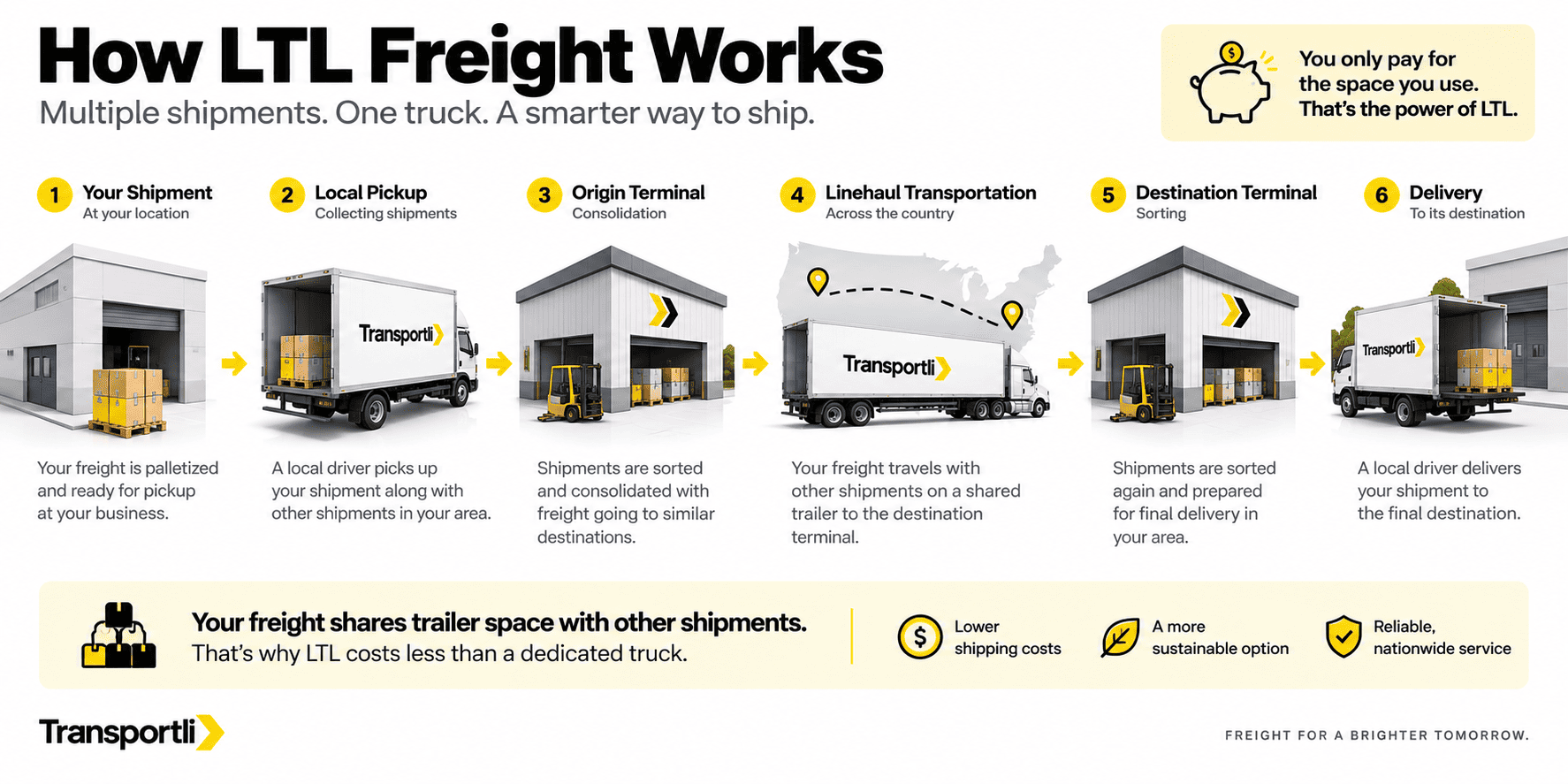
The tradeoff is time. LTL works because your freight shares space with other shipments — a driver picks up your pallet along with freight from several other customers, consolidates it all at a terminal, then moves it to another terminal on a larger truck for the next leg. That consolidation is what keeps the cost down, but it also means LTL takes longer to reach the consignee than a dedicated truck would. For most shippers, the savings are worth the extra transit time — which is why LTL is the default choice for palletized freight that isn’t time-critical.
Find your freight class in 20 seconds
Enter what is on your pallet or crate. You will see its density, the freight class carriers will apply on the 13-step scale, and how small changes in packing or measuring change your class and your rate.
Why choose LTL over expedited or dedicated trucks?
LTL makes the most sense when you have small pallets or crates that don’t come close to filling a full truck. Because LTL consolidates your shipment with freight from other customers, the transportation cost is split across everyone on that trailer — you only pay for the space your shipment actually uses, not the whole truck. That’s the core reason LTL is cheaper than either expedited or dedicated service for anything less than a full load.
LTL also gives you more flexibility on timing than most shippers expect. Pickup and delivery dates aren’t guaranteed the way they are with a dedicated truck, but because LTL carriers route freight through terminals, you can ask a terminal to hold your shipment and release it for delivery closer to when you actually need it — a level of flexibility a dedicated or expedited truck, moving directly with no stops, simply doesn’t offer.
The cost difference is significant. A dedicated truck is priced for the whole vehicle whether you fill it or not, so at $1 to $1.50 per mile a 2,500-mile run lands between about $2,500 and $3,750. In our real LTL quotes, the lowest quote on lanes over 1,500 miles had a median of $537, and under 300 miles it was $394.
The takeaway: if you’re shipping a long distance, don’t need a full truck, and have some flexibility on exact delivery timing, LTL is almost always the better choice over expedited or dedicated service.
Which shipping mode fits your freight?
Answer three quick questions to see whether standard LTL, volume LTL, expedited or truckload is the better starting point, and what to watch for at pickup and delivery.
Free LTL tools and guides
Before you request a quote, these free tools and guides help you get your freight class, packaging and paperwork right, which is where most after-the-fact charges come from.
Freight class calculator
Enter dimensions and weight to estimate your NMFC class before you book.
Density calculator
Pounds per cubic foot, class and dimensional weight in one step.
Bill of lading generator
Create a bill of lading with the description and class carriers expect.
Accessorial charge checker
See which liftgate, residential and limited-access fees apply to your shipment.
Pallet shipping guide
Pallet sizes, types, packing tips and what drives pallet shipping cost.
Freight class guide
How NMFC classes work and why getting yours wrong costs money after pickup.
Auto parts shipping guide
How to pack, palletize and ship engines, panels, wheels and more by LTL.
How much does LTL freight cost?
A data study of real LTL quotes, by distance, weight and carrier.
What is LTL freight?
A plain-English guide to how less-than-truckload shipping works.
How to get an LTL freight quote
If you’re shipping palletized freight for the first time — or just want a better rate than your last one — use the steps below to find coverage that fits your lane and your budget. Ready now? Our LTL freight quote page shows what shippers typically pay and lets you compare carriers for your shipment.
1. Know your freight profile
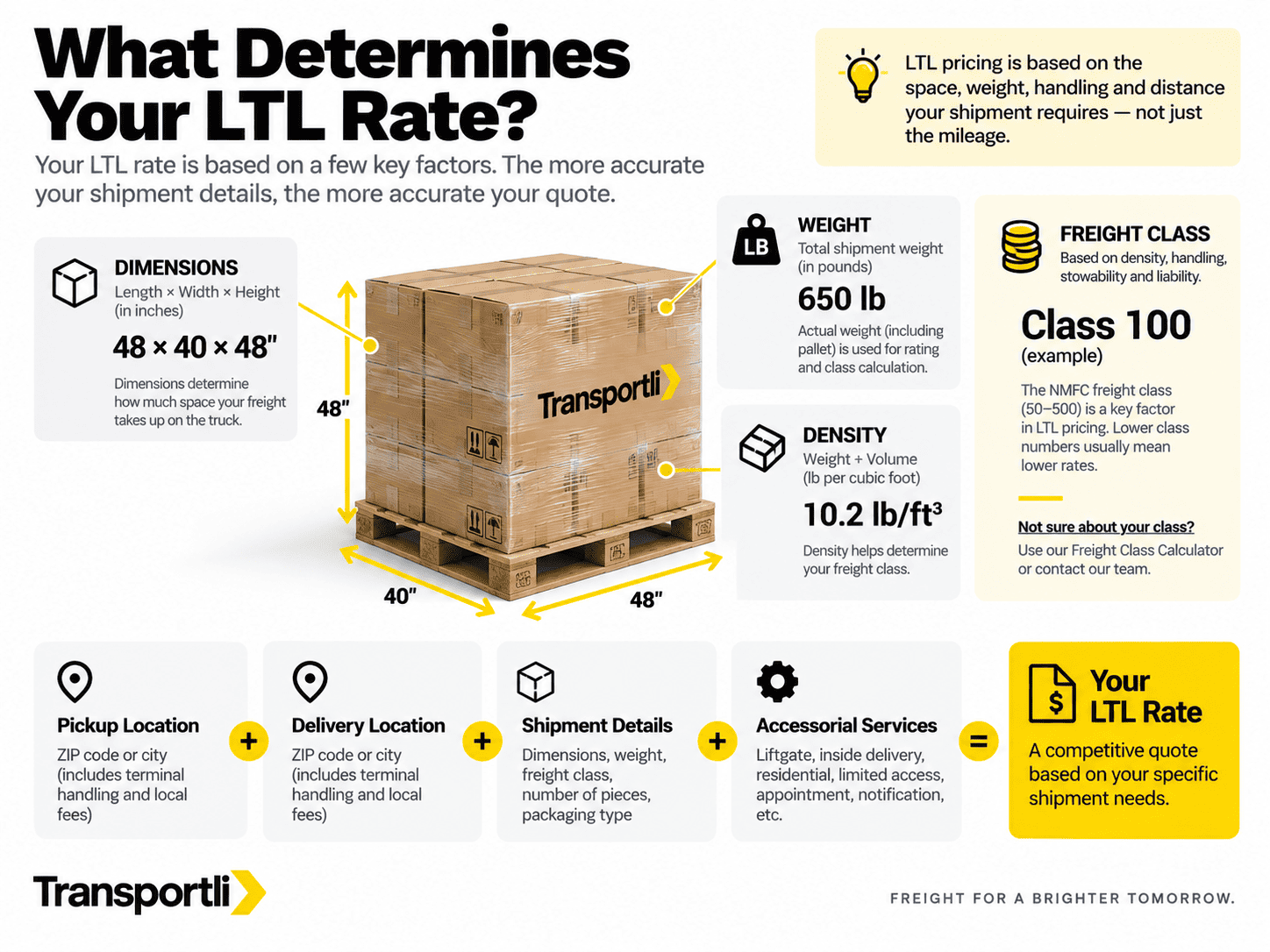
Before you request a quote, know your handling-unit count, dimensions, weight, and freight class — carriers weigh all of this together, not just total weight. Get any of it wrong and there’s a real cost: most carriers will reclass the shipment and add accessorial charges after the freight has already been delivered, so you end up paying more than you were quoted, after the fact instead of before.
2. Understand your freight class
NMFC freight class is the single biggest driver of your LTL rate. Denser, more durable freight (like machinery) gets a lower class and a lower rate; bulky, fragile freight (like empty containers) gets a higher class. Getting this wrong is the most common reason a quote gets re-classed — and re-billed — after pickup.
One thing changed recently: since July 19, 2025, most commodities are classed by density on a 13-step scale instead of by long commodity lists. Carriers apply it to the total weight and the outside dimensions of your load, pallet included, so the way you pack changes your class. Some commodities, such as batteries, tires and glass, can still carry their own NMFC items, and the class the carrier measures at pickup is the one that is billed.
| Density (lb per cubic foot) | Freight class |
|---|---|
| Less than 1 | 400 |
| 1 to less than 2 | 300 |
| 2 to less than 4 | 250 |
| 4 to less than 6 | 175 |
| 6 to less than 8 | 125 |
| 8 to less than 10 | 100 |
| 10 to less than 12 | 92.5 |
| 12 to less than 15 | 85 |
| 15 to less than 22.5 | 70 |
| 22.5 to less than 30 | 65 |
| 30 to less than 35 | 60 |
| 35 to less than 50 | 55 |
| 50 or greater | 50 |
Use the freight class calculator or the density calculator to check your own numbers, or read the freight class guide for worked examples. NMFTA also has a proposal under review (Docket 2026-2) that would change how some items are classed, so confirm the current rules with your carrier.
Transportli Tip: Not sure your freight class?
Use a density calculator to get an instant class estimate before you request a quote — it’s the same calculation carriers use for inspection.
3. Research carrier reliability
Here’s the honest problem: as a one-off shipper, there’s not much you can do to vet a carrier before you ship with them. You can check FMCSA authority status, but that only tells you a carrier is legally allowed to operate — it doesn’t tell you anything about on-time performance or how they handle a damage claim. Most shippers end up learning by trial and error: they book with a carrier like ArcBest or Roadrunner Freight, and if something goes wrong, they simply stop using that carrier next time.
One thing worth knowing: LTL cargo insurance isn’t like the coverage on a dedicated van. A dedicated shipment might carry roughly $100,000 in coverage; LTL cargo liability is typically priced per pound instead — around $25 per pound for new freight and $0.25 per pound for used freight. That’s a meaningful gap if your freight is high-value.
This is really the argument for using a broker instead of booking blind: Transportli tracks outcomes across every shipment that moves through our platform, so we know which carriers actually perform well in specific regions, on residential deliveries, or on cross-border lanes — something no individual shipper can see on their own.
Missing capacity on your lane?
If a load is time-critical, don’t wait on a standard LTL pickup window — our expedited desk dispatches a dedicated vehicle in under 30 minutes, 24/7.
See expedited options →4. Choose how to get your quotes
After narrowing down carriers, decide how you want to receive quotes. Regardless of method, getting more than one quote is the only way to know you’re not overpaying.
Direct carrier relationships
Calling carriers you already know gets you a quote fast, but only from that one fleet — you won’t know if you’re leaving money on the table.
Traditional freight brokers
Brokers can shop multiple carriers on your behalf, but you’re usually waiting on a phone call or email for each rate.
Digital freight platforms
Platforms like Transportli connect to 100–150+ carriers by API, so a single request returns live, bookable rates from all of them at once — no waiting on a callback. Quotes, bookings, and shipment tracking all live in one account, and you can pull a fresh instant quote anytime.
Using Transportli
Talk to our freight desk
Prefer to talk it through? Our in-house dispatch team can quote and book your lane directly.
Finding the cheapest LTL options
Cost is the top reason shippers compare LTL quotes at all. Here’s how to make sure you’re not overpaying for a lane you ship regularly.
Did you know?From 261 real lanes and 1,305 quotes across 43 states and D.C.
-
30× the cost per mile
Cost per mile varied 30 times across our lanes
A 2,400 lb shipment moving 208 miles (Olar, SC to Forest Park, GA) had a lowest quote of $881, or $4.24 a mile. A 140 lb shipment moving 2,981 miles (Woonsocket, RI to San Diego, CA) had a lowest quote of $415, or $0.14 a mile.
-
$889 to arrive 3 days sooner
Speed has a price
On Lancaster, NY to Preston, ID (1,941 miles, 800 lb), the cheapest quote at $917 took 9 days. The fastest, at 6 days, cost $1,807. On Ontario, CA to Platte, SD, 3-day delivery cost $2,363 against $1,762 for 6 days.
-
25 carriers had the lowest quote
No carrier is cheapest everywhere
Across 261 lanes, AAA Cooper had the lowest quote on 48 (18%), Central Transport had the lowest quote on 35 (13%), ABF Freight had the lowest quote on 31 (12%), and XPO on 25 (10%). In all, 25 different carriers had the lowest quote on at least one lane.
-
$1,605 from lowest to fifth-lowest
Same shipment, quotes $1,605 apart
For 800 lb from Lancaster, NY to Preston, ID (1,941 miles), the lowest quote was $917 and the fifth-lowest was $2,522, a 175% gap. On Muskegon, MI to Worthington, OH, all five quotes landed within $11 of each other.

Compare rates every few shipments
Do you have freight claims on file?
- A damage claim can affect your standing with a carrier for future bookings.
- Claims are typically resolved faster with carriers that have transparent condition-report policies.
- For fragile freight, it may be worth paying slightly more for a carrier with a stronger damage record.
Don’t rely on a quote from six months ago — get an instant quote for every shipment. LTL rates move constantly: fuel costs shift day to day, and a carrier that has capacity on your lane Monday might not have it Tuesday. The only way to know you’re getting a competitive rate is to check at the moment your freight is actually ready to ship, not before.
If you find a better rate elsewhere for the same service level, there’s rarely a reason not to switch. Most carriers don’t require a long-term commitment for spot-market LTL freight.
Use freight density to your advantage
Because density drives class, and class drives rate, small changes in how freight is packaged can meaningfully change your cost. Consolidating onto fewer, denser pallets — or avoiding unnecessary crating — often lowers your class and your rate.
Transportli Tip: Ask for volume LTL quotes as well as standard LTL
If you’re regularly shipping 6+ pallets on a lane, ask for volume LTL quotes as well as standard LTL. On some lanes it was the cheapest option in our samples, and on others it was not. See LTL vs. FTL for the numbers.
Choose accessorials carefully
Liftgate service, inside delivery, and residential pickup are common accessorials that add cost. Each one typically adds $75–$100 to your base rate, and they stack — confirm what your pickup and delivery locations actually require before you book, not after.
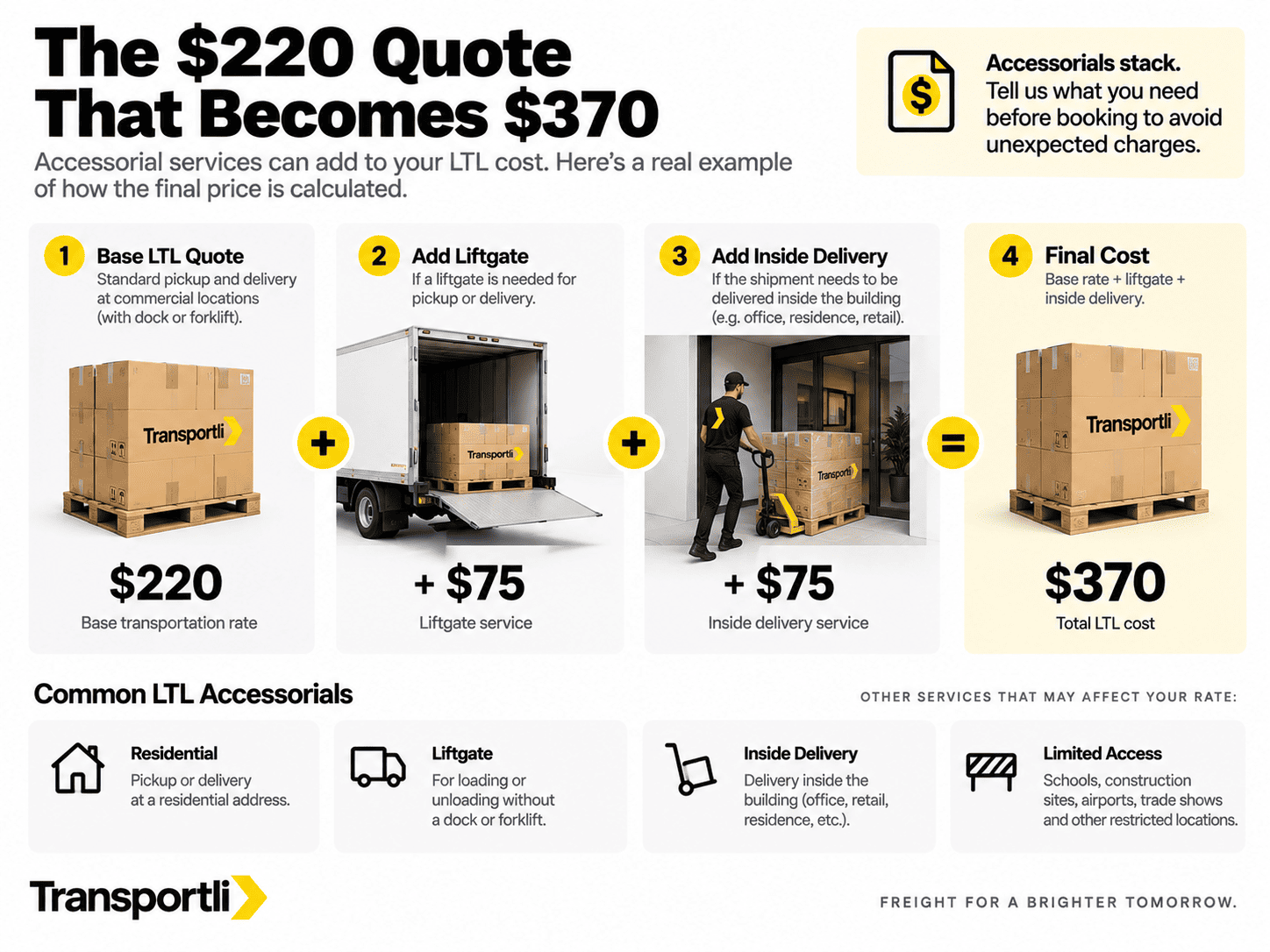
| Quote | Class | Accessorials | Cost |
|---|---|---|---|
| Quote #1 | 92.5 | None | $220/shipment |
| Quote #2 | 92.5 | + Liftgate | $295/shipment |
| Quote #3 | 92.5 | + Liftgate + Inside delivery | $370/shipment |
Each accessorial adds roughly $75 to your base rate, and they stack — a shipment that looks like $220 on paper can land at $370 once liftgate and inside delivery are both added. Ask for a full accessorial breakdown before booking, not after the freight has already shipped.
Sample LTL rates by route
Real quotes pulled from our platform for six different lanes — same day, same process, different carriers each time. Rates shift with capacity and fuel costs, so treat these as a snapshot rather than a guarantee for your shipment; get an instant quote for your exact route and pallet count.
Explore real LTL quotes
We pulled 261 real lanes across 43 states and Washington, D.C. from the state pages on this site, 1,305 quotes in all, with a median shipment of about 350 lb. Each lane shows the five lowest quotes our platform returned. Alaska and Hawaii are left out because their marine legs distort the math.
| Distance | Lanes | Median lowest quote | Per mile |
|---|---|---|---|
| Under 300 miles | 21 | $394 | $2.25 |
| 300 to 800 miles | 67 | $390 | $0.63 |
| 800 to 1,500 miles | 85 | $460 | $0.43 |
| Over 1,500 miles | 88 | $537 | $0.23 |
Lowest quote on a lane was by: AAA Cooper 18%, Central Transport 13%, ABF Freight 12%, XPO 10%, Warp 7%. Counts show who quoted lowest on the lanes in this sample, not service quality.
Six example lanes
Real quotes by route
Snapshot taken Thursday, September 24 — carriers and pricing change daily.
| Carrier | Service | Transit | Price |
|---|---|---|---|
| Estes | LTL Standard Transit | 4 days | $614.54 |
| ABF Freight (ArcBest) | Standard | 4 days | $665.34 |
| ACT (AAA Cooper) | Standard | 3 days | $679.09 |
| XPO | Standard | 3 days | $698.31 |
| FedEx Freight Economy | Standard | 5 days | $710.94 |
| Carrier | Service | Transit | Price |
|---|---|---|---|
| Warp | Standard | 3 days | $446.99 |
| Estes | LTL Standard Transit | 1 day | $534.03 |
| XPO | Standard | 1 day | $536.50 |
| ABF Freight (ArcBest) | Standard | 2 days | $541.90 |
| ACT (AAA Cooper) | Standard | 2 days | $599.67 |
| Carrier | Service | Transit | Price |
|---|---|---|---|
| Ward Transport & Logistics | STD | 2 days | $430.42 |
| Roadrunner Freight | Standard Service | 2 days | $472.14 |
| Central Transport | Standard | 3 days | $504.46 |
| STG Logistics | Standard | 5 days | $534.49 |
| Estes | LTL Standard Transit | 2 days | $537.74 |
| Carrier | Service | Transit | Price |
|---|---|---|---|
| XPO | STD | 5 days | $428.00 |
| FedEx Freight Economy | Standard | 7 days | $471.77 |
| Forward Air | STD | 2 days | $504.30 |
| R+L Carriers | STD | 6 days | $511.08 |
| Estes | Standard | 5 days | $527.73 |
| Carrier | Service | Transit | Price |
|---|---|---|---|
| ABF Freight (ArcBest) | Standard | 5 days | $1,187.88 |
| Roadrunner Freight | Standard Service | 3 days | $1,316.84 |
| XPO | STD | 3 days | $1,457.58 |
| ACT (AAA Cooper) | Standard | 5 days | $1,458.01 |
| FedEx Freight Economy | Standard | 6 days | $1,861.61 |
| Carrier | Service | Transit | Price |
|---|---|---|---|
| STG Logistics | Standard | 6 days | $506.41 |
| SMT | STD | 4 days | $551.02 |
| ACT (AAA Cooper) | Standard | 4 days | $576.00 |
| Central Transport | Standard | 4 days | $602.88 |
| Forward Air | Standard | 3 days | $611.49 |
What a real LTL quote looks like
The screenshot alongside is an actual result from our platform, a 200 lb shipment from La Grange, IL to Paradise Valley, AZ, compared across 62 real carrier options in seconds.
- 62 real carrier options compared for one shipment, 53 of them standard service and 9 guaranteed, not just one broker’s in-house rate.
- $337.78–$411.56 for the five lowest quotes, with transit of 3 to 5 days.
- Prices move both ways. The same lane quoted about 20 weeks earlier ranged $374.00–$435.76 for its five lowest quotes. Read the full Arizona analysis.
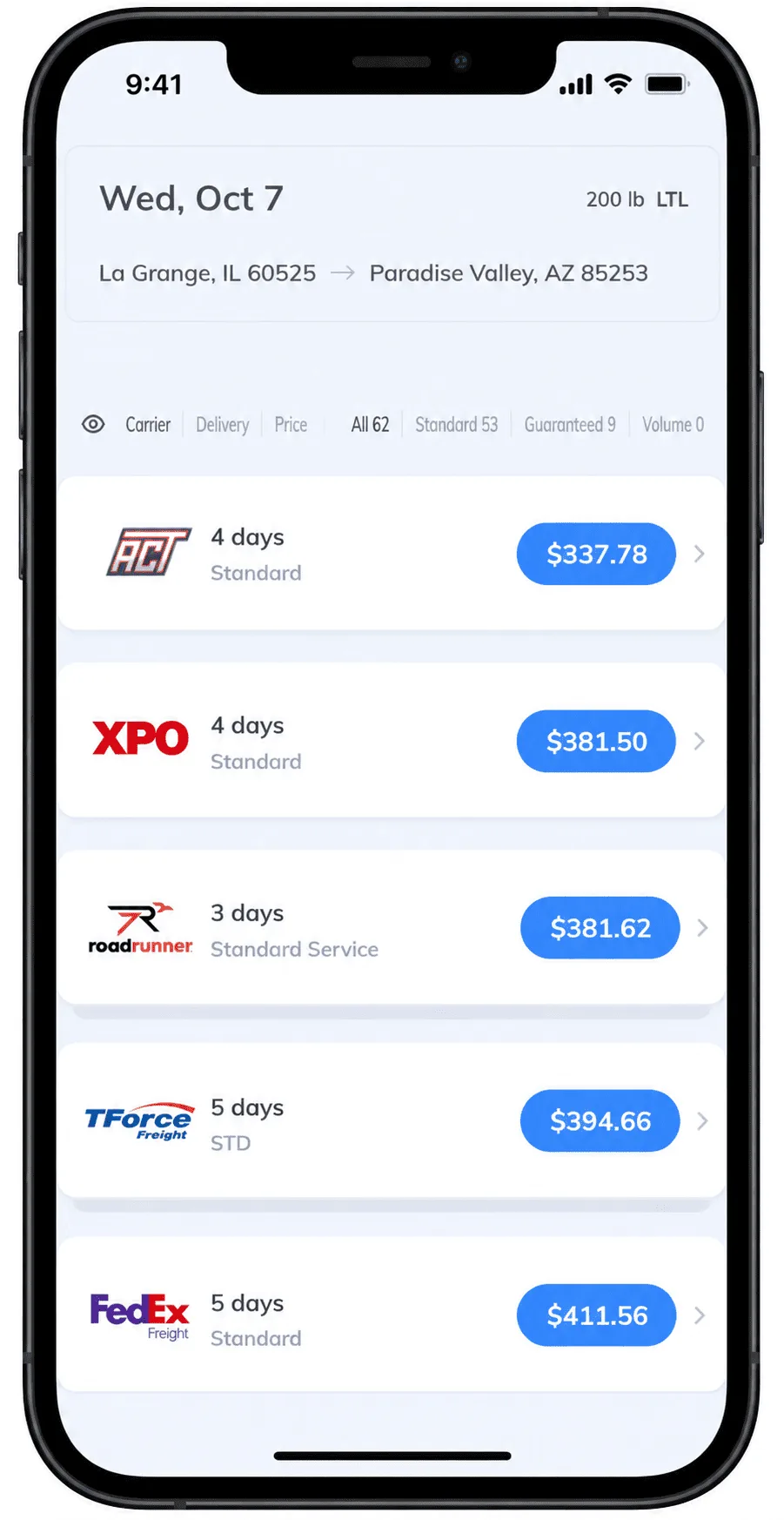
Real screenshot from a live Transportli quote, individual results vary by shipment and date.
LTL freight rates by state
Rates, carrier coverage, permit rules and freight hubs differ from state to state. Select a state on the map or in the list for real quotes on that state’s lanes, its trucking regulations and the corridors that carry its freight. States shaded grey are coming soon.
Northeast
Midwest
South
Information needed for an LTL quote
Have the following ready to get an accurate quote on the first try:
Pickup and delivery locations
Full address for both ends, plus whether each is a business with a dock, a business without a dock, or a residential address.
Handling unit details
Quantity, packaging type (pallet, crate, box), dimensions, and weight per unit — this is what determines your density and class.
Ready date and pickup window
When the freight is ready to ship, and whether you need a specific pickup window or appointment.
Accessorials
Liftgate, inside pickup or delivery, residential service, or limited-access locations — flag these upfront to avoid a re-quote.
LTL freight quotes: frequently asked questions
What is an LTL freight quote?
An LTL (less-than-truckload) quote is a price estimate for shipping palletized or crated freight that doesn’t require a full trailer, based on weight, dimensions, freight class, and the lane you’re shipping.
Are LTL freight quotes free?
Yes. Requesting a quote through Transportli never costs anything and doesn’t obligate you to book.
How is LTL freight class determined?
Freight class is based on density, handling difficulty, and liability — denser, more durable freight is priced in a lower class. A density calculator can give you a quick estimate before you request a quote.
Is it safe to get LTL quotes online?
Yes. Transportli never sells your shipment or contact information, and every carrier shown is verified for active operating authority and insurance before it’s surfaced to you.
Will my final rate match my quote?
In most cases, yes — as long as the freight details you provide (weight, dimensions, class) match what’s inspected at pickup. A mismatch is the most common reason a rate is adjusted after the fact.
Can I book same-day LTL pickup?
Standard LTL pickups are typically scheduled Monday through Friday within a carrier’s normal route. For same-day, time-critical freight, our expedited service dispatches a dedicated vehicle instead.
How much does LTL freight cost?
It depends on distance, weight, freight class and extras, so there is no single price. In 261 real lanes across 43 states and Washington, D.C. on our platform, the lowest quote had a median of $394 under 300 miles, $390 at 300 to 800 miles, $460 at 800 to 1,500 miles and $537 beyond 1,500 miles, for shipments with a median weight of about 350 lb. Get an instant quote for your exact freight.
Which carrier is the cheapest for LTL freight?
No carrier is cheapest everywhere. In our real quotes AAA Cooper had the lowest quote on 18% of lanes, Central Transport on 13%, ABF Freight on 12%, XPO on 10%, and Warp and TForce Freight on 7% each, with the rest spread across other carriers. That is why comparing several carriers on every shipment matters.
How much do LTL quotes differ between carriers?
On the lanes we have quoted, the fifth-lowest quote was a median of 28% above the lowest (32% on average), and on one lane the gap was 175%.
What changed in LTL freight class in 2025?
On July 19, 2025, NMFTA moved most commodities to density-based classes on a 13-step scale, from class 400 below 1 lb per cubic foot to class 50 at 50 lb per cubic foot or more. Some commodities, such as batteries, tires and glass, can still carry their own NMFC items.
Does distance or weight matter more for LTL pricing?
Both matter, but price does not rise in step with distance. In our real quotes the lowest quote had a median of $394 under 300 miles and $537 beyond 1,500 miles, so the price per mile fell from about $2.25 to about $0.23. Class, which depends on density, and accessorials often move the price more than a few hundred extra miles.
How many LTL quotes should I compare?
As many as you can. The spread between the lowest and fifth-lowest quote was a median of 28% in our data, and no single carrier had the lowest quote on more than 18% of lanes.