

Shipping less-than-truckload (LTL) freight to or from North Dakota? Rates depend on your specific route, freight class, and how close your pickup or delivery point is to the nearest LTL terminal. North Dakota is a genuinely unusual freight state: an oilfield boom in the west generates real heavy-haul demand, Fargo hosts Microsoft’s second-largest campus in the world, and the state has quietly produced more honey than anywhere else in America for over two decades running. Here’s what actually affects your rate.
LTL trucking regulations in North Dakota
North Dakota’s own oversize/overweight thresholds are a bit tighter than the federal baseline, which matters if you’re moving anything unusually large through the state:
- An oversize permit is required for loads exceeding 8.5 feet wide, 14 feet high, 95 feet long, or 105,500 lbs — narrower dimension and shorter length limits than several neighboring states use. Permits are issued by the North Dakota State Highway Patrol and are valid for three days.
- Travel windows are restricted to sunrise-to-sunset, and loads over 16 feet wide or 110 feet long can’t move on Saturday afternoons or Sundays at all. Anything over 14.5 feet wide, 18 feet high, or 120 feet long requires an official escort or pilot car.
- Most standard LTL freight falls well within these limits — this mainly matters for the oilfield equipment and drilling-related freight that regularly moves through western North Dakota’s Bakken region.
Current permit thresholds and axle limits are public record:
North Dakota Highway Patrol Oversize/Overweight Permits →
What affects your North Dakota LTL rate
- Freight class — density, handling, and liability determine your NMFC class, the single biggest factor in your rate. See our freight class guide.
- Distance — North Dakota is thinly populated and spread out; carrier density is concentrated in a few metro areas with real gaps between them.
- Terminal proximity — pickup or delivery points near Fargo, Bismarck, or Grand Forks typically see the most carrier options and fastest transit; western North Dakota’s oil patch sees fewer standard LTL carriers relative to its freight volume.
- Accessorials — liftgate, residential, or inside delivery add to the base rate, same as anywhere else.
Did you know?From 6 real North Dakota lanes and 30 quotes
-
4× the cost per mile
The shorter haul cost far more per mile
A 375 lb shipment moving 1,210 miles (Dickinson, ND to Fort Worth, TX) had a lowest quote of $825, or $0.68 a mile. A 250 lb shipment moving 2,219 miles (Mandan, ND to Miami, FL) had a lowest quote of $339, or $0.15 a mile.
-
$151 to arrive 2 days sooner
Speed has a price
On Minot, ND to Paso Robles, CA (1,799 miles, 900 lb), the cheapest quote at $650 took 6 days. The fastest, at 4 days, cost $801. On Hillsboro, OR to Zeeland, ND, 1-day delivery cost $564 against $460 for 7 days.
-
3 carriers had the lowest quote
Three different carriers won six North Dakota lanes
AAA Cooper had the lowest quote on four lanes. Central Transport and Estes each had the lowest quote on one lane. Across the lowest quotes on every lane, 13 different carriers appeared.
-
$747 from lowest to fifth-lowest
Same shipment, quotes $747 apart
For 375 lb from Dickinson, ND to Fort Worth, TX (1,210 miles), the lowest quote was $825 and the fifth-lowest was $1,572, a 91% gap.

Regional carrier coverage across North Dakota
North Dakota’s freight geography splits between its eastern population centers and the oil-driven west, with real coverage differences between them:
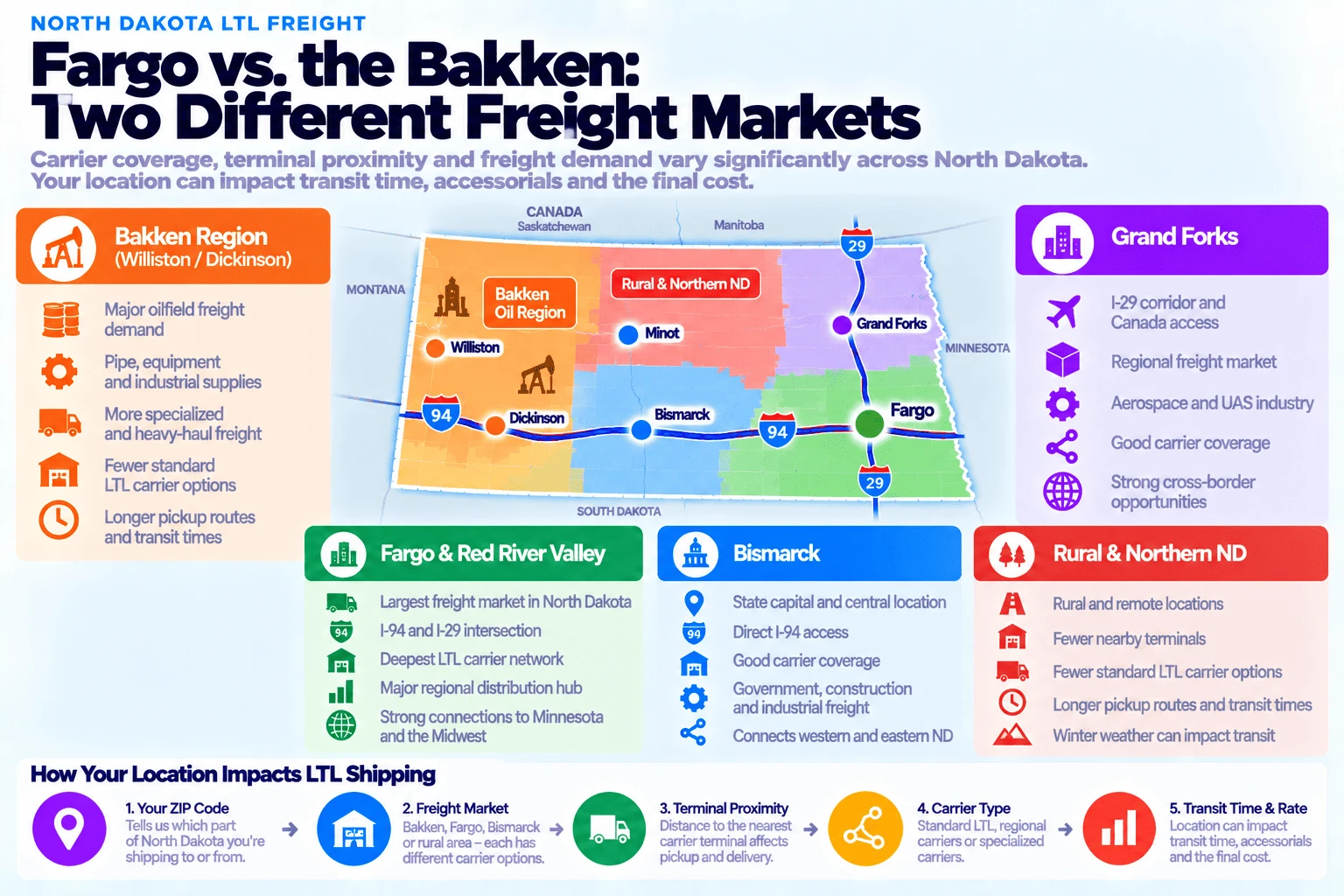
- Fargo & the Red River Valley — the deepest carrier network in the state, anchored by the state’s largest city and a major regional distribution market along I-29 and I-94.
- Bismarck — the state capital and a solid secondary hub with direct I-94 access.
- Grand Forks — a real secondary market in the northeast, increasingly known for its aerospace and unmanned-systems industry.
- The Bakken oil patch (Williston & McKenzie County) — heavy real freight volume tied to oil and gas, but thinner standard LTL coverage relative to that volume; oilfield-specific and heavy-haul carriers dominate here more than typical LTL networks.
- Rural central and northern North Dakota — the thinnest general LTL coverage in the state: fewer terminals, longer pickup routes, and transit times that can run well behind the eastern corridor.
Weather and transit reliability
North Dakota sees some of the most extreme winter weather of any state in the Lower 48 — sustained sub-zero temperatures, heavy snow, and the same ground-blizzard risk that affects Nebraska and Minnesota, but often more severe given North Dakota’s higher latitude and open terrain. I-94 and I-29 both see routine winter closures during major storms. Summer brings its own real risk: severe thunderstorms and occasional tornadoes, particularly in the eastern Red River Valley. Given how spread out the state’s freight network is, a single winter storm can meaningfully delay shipments across a wide area with few practical detours.
Sample North Dakota LTL rates by route
Real quotes pulled from our platform for six different North Dakota lanes — same process, different carriers each time, spanning a huge range of weights and distances. Rates shift with capacity and fuel costs, so treat these as a snapshot rather than a guarantee for your shipment; get an instant quote for your exact route.
Real quotes by route
Snapshot taken over recent weeks — carriers and pricing change daily.
| Carrier | Service | Transit | Price |
|---|---|---|---|
| AAA Cooper Transportation | Standard | 3 days | $825.00 |
| Estes | LTL Standard Transit | 8 days | $1,274.56 |
| CrossCountry Freight Solutions | Standard | 4 days | $1,330.66 |
| FedEx Freight Economy | Standard | 4 days | $1,562.44 |
| XPO | Standard | 3 days | $1,571.86 |
| Carrier | Service | Transit | Price |
|---|---|---|---|
| AAA Cooper Transportation | Standard | 6 days | $650.12 |
| XPO | Standard | 5 days | $741.92 |
| FedEx Freight | Standard | 4 days | $801.47 |
| CrossCountry Freight Solutions | Standard | 8 days | $822.54 |
| Central Transport | Standard | 6 days | $996.78 |
| Carrier | Service | Transit | Price |
|---|---|---|---|
| AAA Cooper Transportation | Standard | 7 days | $459.54 |
| TForce Freight | STD | 8 days | $525.99 |
| FedEx Freight Economy | Standard | 4 days | $544.87 |
| Peninsula Truck Lines | Standard | 1 day | $563.73 |
| Estes | LTL Standard Transit | 8 days | $644.58 |
| Carrier | Service | Transit | Price |
|---|---|---|---|
| AAA Cooper Transportation | Standard | 5 days | $338.92 |
| Central Transport | Standard | 6 days | $366.68 |
| Southeastern Freight Lines | Standard | 7 days | $455.83 |
| Estes | LTL Standard Transit | 6 days | $476.18 |
| FedEx Freight Economy | Standard | 5 days | $525.28 |
| Carrier | Service | Transit | Price |
|---|---|---|---|
| Central Transport | Standard | 2 days | $283.49 |
| Double D Express | Standard | 2 days | $314.16 |
| Magnum | Standard | 3 days | $318.58 |
| AAA Cooper Transportation | Standard | 2 days | $318.96 |
| Saia | Standard | 2 days | $338.44 |
| Carrier | Service | Transit | Price |
|---|---|---|---|
| Estes | STD | 5 days | $534.95 |
| AAA Cooper Transportation | Standard | 3 days | $557.75 |
| ABF Freight | Standard Service | 5 days | $680.18 |
| FedEx Freight Economy | Standard | 4 days | $703.72 |
| XPO | Standard | 3 days | $731.12 |
Rate, transit, and price-per-mile summary
Pulling the six lanes above together, one lane confirms exactly what you’d expect from western North Dakota’s thinner carrier landscape:
| Route | Distance | Weight | Price range | Transit range | Price per mile |
|---|---|---|---|---|---|
| Dickinson, ND → Fort Worth, TX | 1,210 mi | 375 lb | $825–$1,572 | 3–8 days | $0.68–$1.30 |
| Minot, ND → Paso Robles, CA | 1,799 mi | 900 lb | $650–$997 | 4–8 days | $0.36–$0.55 |
| Hillsboro, OR → Zeeland, ND | 1,423 mi | 250 lb | $460–$645 | 1–8 days | $0.32–$0.45 |
| Mandan, ND → Miami, FL | 2,219 mi | 250 lb | $339–$525 | 5–7 days | $0.15–$0.24 |
| Fargo, ND → Manhattan, IL | 668 mi | 380 lb | $283–$338 | 2–3 days | $0.42–$0.51 |
| McAlester, OK → Bismarck, ND | 1,089 mi | 192 lb | $535–$731 | 3–5 days | $0.49–$0.67 |
Dickinson, right in the heart of the Bakken oil patch, is the standout: at $0.68-$1.30 per mile, it’s the most expensive lane in this data by a wide margin, despite carrying only 375 lbs over a fairly ordinary 1,210 miles — not the shortest lane here, and far from the heaviest. Compare it to Fargo to Manhattan, Illinois: a genuinely short 668-mile haul that still prices far cheaper, at $0.42-$0.51 per mile. That gap lines up exactly with what thinner standard LTL coverage in the oil patch would predict — carriers serving Dickinson have less competitive density to draw on than carriers serving Fargo, the state’s largest and most connected freight market, regardless of distance. The cheapest lane per mile, Mandan to Miami, is also the longest haul in the data at 2,219 miles, a clean long-haul efficiency result once you’re shipping out of a well-served eastern North Dakota market instead of the oil patch.
Major shipping hubs in North Dakota
North Dakota’s carrier terminal network is concentrated around a handful of cities, which generally means faster pickup windows and more carrier options the closer you are to one of these:
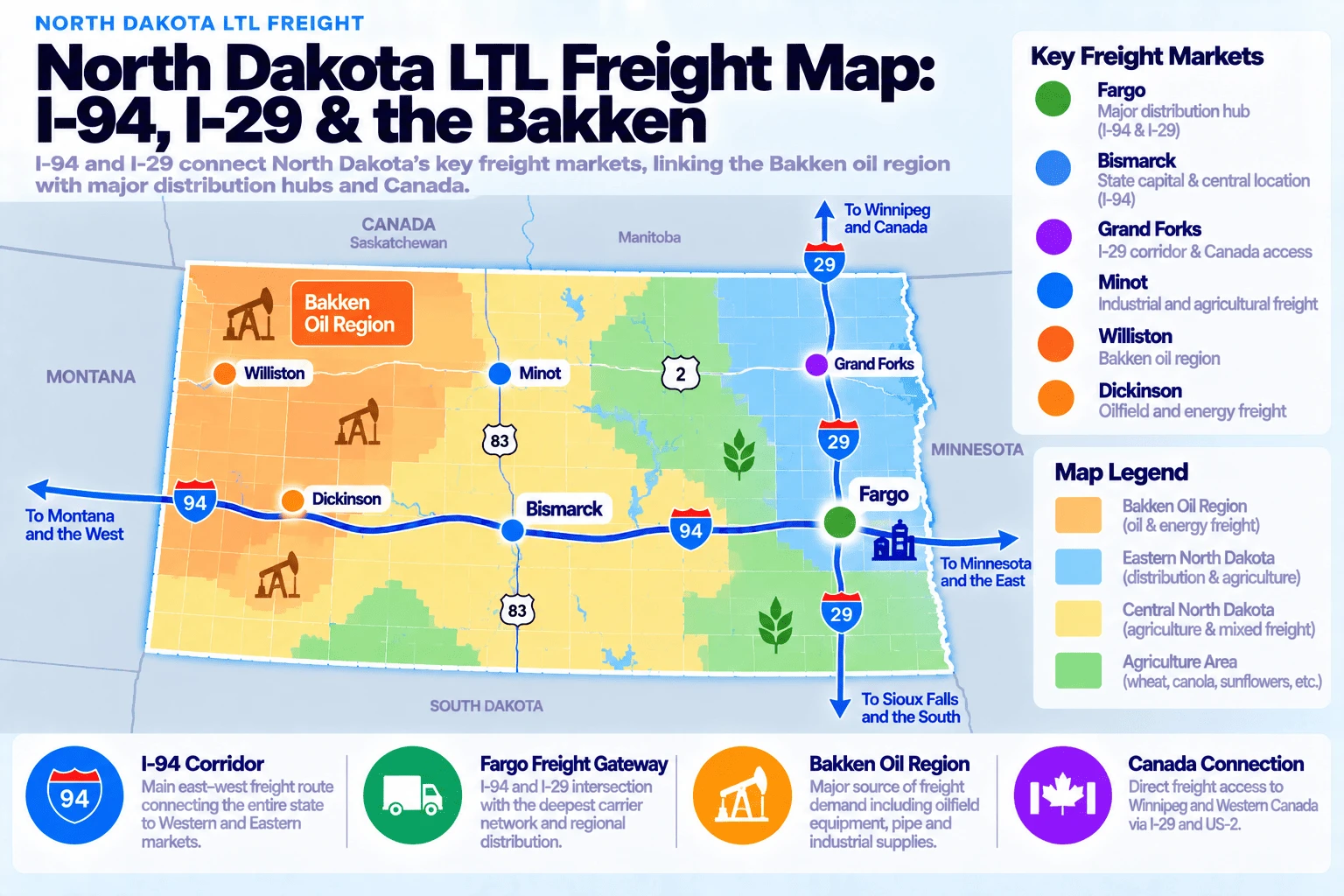
- Fargo — the state’s primary freight gateway and home to Microsoft’s second-largest campus in the world, built on the site of Great Plains Software, which Microsoft acquired in 2001.
- Bismarck — the state capital and a real secondary hub with direct I-94 access.
- Grand Forks — home to GrandSky, a drone-testing park built on Grand Forks Air Force Base, and the Northern Plains UAS Test Site — a cluster the New York Times has called a “Silicon Valley for drones.”
- Williston — the commercial heart of the Bakken oil patch, generating enormous volumes of oilfield equipment, pipe, and heavy-haul freight.
- Minot — home to Minot Air Force Base, the only US military installation hosting two legs of the nuclear triad at once (B-52H bombers and Minuteman III missiles), a major regional economic anchor.
Highway corridors serving North Dakota
I-94 is North Dakota’s primary east-west freight artery, running from Fargo through Bismarck toward Montana. I-29 runs north-south through Fargo and Grand Forks, connecting Winnipeg, Canada to the south toward Sioux Falls and Kansas City. Together, I-94 and I-29 intersect at Fargo, making it the natural hub for freight moving through the state. US routes fill in the gaps to the west, connecting the Bakken oil patch to the interstate system. Nearly every route connecting the Upper Midwest to Canada’s Prairie provinces touches North Dakota somewhere along I-29.
Why the Bakken boom still shapes North Dakota freight
North Dakota was producing nearly 1.17 million barrels of oil a day as of late 2025, with the Bakken formation alone accounting for over 95% of that output — roughly 408 million barrels for the year from more than 18,000 wells. McKenzie County alone, the heart of the play, was producing over 220,000 barrels a day on its own. That kind of sustained production keeps real freight moving in and out of western North Dakota year-round: drilling pipe, fracking sand, wellhead equipment, and heavy machinery, much of it moving on specialized heavy-haul trucks rather than standard LTL. For shippers, the practical effect is a genuine two-tier freight market in North Dakota — dense, conventional LTL coverage in the east, and a thinner, more specialized carrier landscape built around oilfield logistics in the west.
What North Dakota shippers move
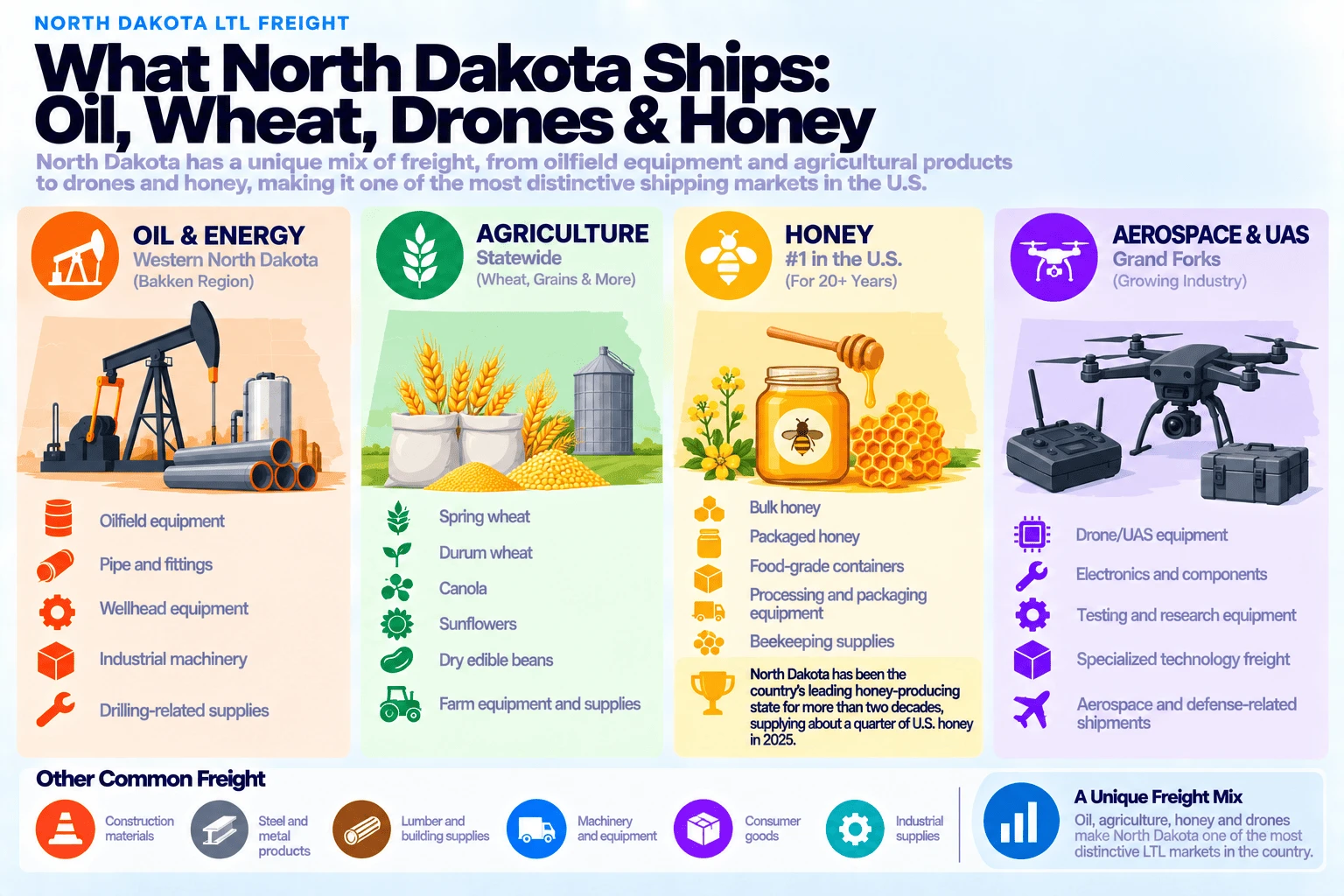
North Dakota’s freight mix is genuinely unusual for its size. Oil and gas from the Bakken formation dominates western North Dakota, generating heavy volumes of oilfield equipment, pipe, and drilling-related freight. Agriculture remains the backbone in the east: North Dakota is a top national producer of spring wheat, durum wheat, canola, sunflowers, and dry edible beans — and has been the country’s #1 honey-producing state for more than two decades straight, supplying roughly a quarter of all US honey in 2025. Fargo adds a real technology pillar through Microsoft’s massive local campus, generating office and IT-equipment freight uncommon in a state this size. And Grand Forks’ growing unmanned-aerial-systems industry, anchored by GrandSky and defense-linked UAS testing, is a genuinely distinctive and growing freight category few other states have at all.
Get a North Dakota LTL quote
Compare live rates from vetted carriers serving North Dakota.
Get an LTL quote →North Dakota LTL freight: frequently asked questions
How much does LTL shipping cost to or from North Dakota?
It depends heavily on distance, weight, and whether you’re shipping through the oil patch. Real North Dakota lanes in our data ranged from about $283 for a short regional haul out of Fargo up to $1,572 for a shipment out of Dickinson, in the heart of the Bakken — and that Dickinson lane priced far higher per mile than any other, even a shorter one out of Fargo, since carrier coverage in the oil patch is genuinely thinner than in North Dakota’s better-connected eastern cities. Get an instant quote for your exact shipment.
Do oversized LTL shipments need a permit in North Dakota?
Yes, for loads exceeding 8.5 feet wide, 14 feet high, 95 feet long, or 105,500 lbs. The North Dakota State Highway Patrol issues permits valid for three days, with travel restricted to daylight hours and weekend limits on very large loads. Most standard LTL freight falls well within these limits.
Why does the Bakken oil boom matter for North Dakota freight?
North Dakota was producing nearly 1.17 million barrels of oil a day as of late 2025, almost all of it from the Bakken formation in the western part of the state. That sustained production generates real, ongoing freight demand for oilfield equipment, pipe, and heavy-haul cargo, creating a genuinely different carrier landscape in western North Dakota than in the rest of the state.
Which carriers serve North Dakota?
Most major national LTL carriers serve North Dakota, with the deepest coverage around Fargo, Bismarck, and Grand Forks — availability and pricing vary by exact route, and the western oil patch sees a different mix of carriers weighted toward heavy-haul and oilfield logistics.
Is LTL service the same everywhere in North Dakota?
No. Fargo has the strongest general LTL coverage in the state, with solid secondary coverage in Bismarck and Grand Forks. Western North Dakota’s oil patch has real freight volume but thinner standard LTL coverage relative to that volume, and rural central and northern areas see meaningfully fewer carrier options.
Is North Dakota really the top honey-producing state?
Yes. North Dakota has been the country’s #1 honey producer for more than two decades running, supplying roughly a quarter of all US honey in 2025. It’s a genuine, if unexpected, part of the state’s agricultural freight base alongside wheat, canola, and sunflowers.