

Shipping a vehicle is different from shipping freight: you’re moving one large, high-value item, not palletized cargo, and the carrier is dedicating truck space to it (either shared with a few other vehicles on an open or enclosed hauler, or on its own). Rates depend heavily on vehicle type, transport method, distance, and how flexible your pickup window is.
Getting a real, bookable quote means giving a carrier accurate vehicle details up front — year, make, model, running condition, and modifications all affect price and which carriers can even take the job. This guide walks through what actually drives your rate and how to avoid a quote that changes after pickup.
How to get an auto transport quote
Whether you’re moving a daily driver, a classic car, or a fleet vehicle, use the steps below to get an accurate quote on the first try.
1. Know your vehicle details
Year, make, model, and trim are the starting point — but running condition matters just as much. A vehicle that doesn’t run, has been in an accident, or is oversized (lifted trucks, extended vans) needs different equipment than a standard sedan, and not disclosing this upfront is the most common reason a quote gets revised at pickup.
2. Choose open or enclosed transport
Open transport — the same multi-car haulers you see on the highway — is the standard and least expensive option, suitable for most daily-driver vehicles. Enclosed transport protects the vehicle from weather and road debris and is typically used for classic, luxury, or high-value vehicles; it costs more because fewer carriers run enclosed trailers and each one holds fewer vehicles.
Transportli Tip: Not sure which you need?
If your vehicle is a standard daily driver in normal condition, open transport is almost always the right call — it’s what most carriers run, so you’ll get more quotes and faster pickup availability.
3. Research carrier reliability
As a one-off shipper, there’s not much you can independently verify about a carrier before your vehicle is on their truck. Checking FMCSA authority status confirms a carrier is legally allowed to operate, but it won’t tell you how carefully they load, whether they’re on time, or how they handle a damage claim. This is the core reason to book through a platform that tracks carrier performance across many shipments rather than booking one carrier cold.
Need it there faster?
If your vehicle move is time-critical, our expedited desk can dispatch a dedicated vehicle instead of waiting on standard transport scheduling.
See expedited options →4. Choose how to get your quotes
After deciding on open or enclosed, decide how you want to receive quotes. Regardless of method, getting more than one quote is the only way to know you’re not overpaying.
Direct carrier relationships
Calling a hauler you already know gets you a quote fast, but only from that one fleet — you won’t know if you’re leaving money on the table.
Traditional freight brokers
Brokers can shop multiple carriers on your behalf, but you’re usually waiting on a phone call or email for each rate.
Digital freight platforms
Platforms like Transportli connect to a large vetted carrier network by API, so a single request returns live, bookable rates from all of them at once — no waiting on a callback.
Broker vs. carrier: what’s the difference
A carrier is the company that actually owns the trucks and employs the drivers moving your vehicle. A broker doesn’t own trucks — instead, a broker maintains relationships with a network of vetted carriers and matches your shipment to whichever one fits your route, timing, and vehicle type best.
Neither model is inherently better, but they solve different problems. Calling a carrier directly can get you a fast quote if that carrier already runs your exact route — but you’re only seeing that one fleet’s price and availability. A broker like Transportli checks a whole network at once, which usually means more competitive pricing and a real option even when the first carrier you’d have called doesn’t run your lane that week. Transportli is a licensed broker, not a carrier — see our compliance details for our FMCSA broker authority.
Using Transportli
Talk to our transport desk
Prefer to talk it through? Our in-house dispatch team can quote and book your vehicle move directly.
What actually drives your price
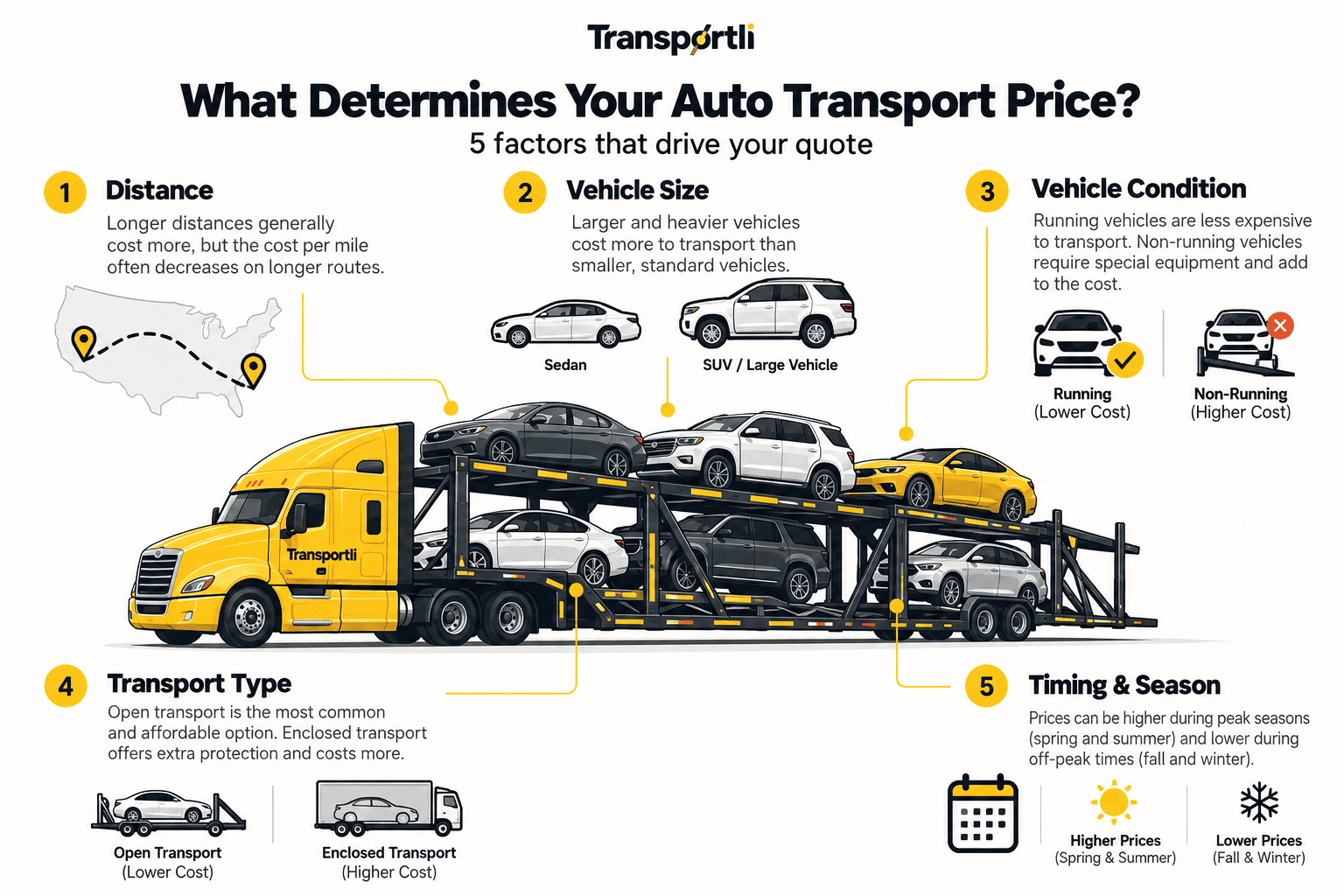
Every auto transport quote comes down to the same handful of variables. Knowing them upfront helps you read a quote correctly instead of just comparing dollar figures.
Distance
The single biggest factor. Price scales with mileage, but not linearly — short routes often cost more per mile since fixed costs (fuel to position the truck, driver time) get spread over less distance.
Vehicle size and weight
A full-size truck or SUV takes up more trailer space than a compact sedan, so it costs more to ship — a hauler can fit fewer large vehicles per trip.
Vehicle condition
Non-running vehicles need a winch to load, which not every carrier has — this narrows the pool of available carriers and raises the price. Always disclose this upfront.
Transport type
Open transport is cheaper and more widely available. Enclosed costs more — see the real numbers in the sample rates below.
Timing and season
Snowbird season (fall/spring migrations to and from Florida and Arizona) and other seasonal demand spikes push prices up on popular routes. Booking with flexibility helps you avoid the peak.
Finding the cheapest auto transport options
Cost is the top reason shippers compare auto transport quotes at all. Here’s how to make sure you’re not overpaying. For real prices by vehicle type and route, see our Alabama, Arizona, Arkansas, California, Colorado, Connecticut, Delaware, Florida, Georgia, Illinois, Indiana and Iowa auto transport rate guides.
Book with flexibility when you can
Does pickup location affect price?
- Rural or hard-to-access addresses often cost more — carriers may charge extra or ask you to meet at a nearby accessible location.
- Moving a vehicle between two major metro areas is typically cheaper than a route with a rural endpoint on either side.
- A flexible pickup window (a range of days, not one fixed date) gives carriers more room to slot your vehicle in efficiently, which usually means a better rate.
Auto transport pricing shifts with route popularity and seasonal demand — a lane that’s competitive one month may cost more the next as carrier capacity moves around. Getting a fresh quote close to your actual ship date, rather than relying on a quote from weeks earlier, is the best way to catch the current rate.
Open vs. enclosed: the real cost difference
In our recent pricing data across sample routes, enclosed transport ran roughly 50–85% more than open transport for the same lane — and the shorter the haul, the bigger that gap tends to be, since an enclosed carrier has less distance to spread its higher fixed cost over. For a standard daily driver, open transport is usually the better value; enclosed is worth the premium mainly for classic, exotic, or otherwise high-value vehicles. See the sample rates below for exact numbers by route.
Choose accessorials carefully
Door-to-door delivery, inoperable-vehicle handling, and expedited pickup are common add-ons that increase cost. Confirm what your vehicle and locations actually require before you book, not after.
Information needed for an auto transport quote
Have the following ready to get an accurate quote on the first try:
Pickup and delivery locations
Full address for both ends, and whether either is a dealership, residence, or storage terminal.
Vehicle details
Year, make, model, and running condition — including any modifications, lift kits, or existing damage.
Ready date and flexibility
When the vehicle is available for pickup, and whether your date is fixed or flexible within a range.
Transport type
Open or enclosed — flag this upfront, since it determines which carriers can take the job.
How to prepare your vehicle for shipping
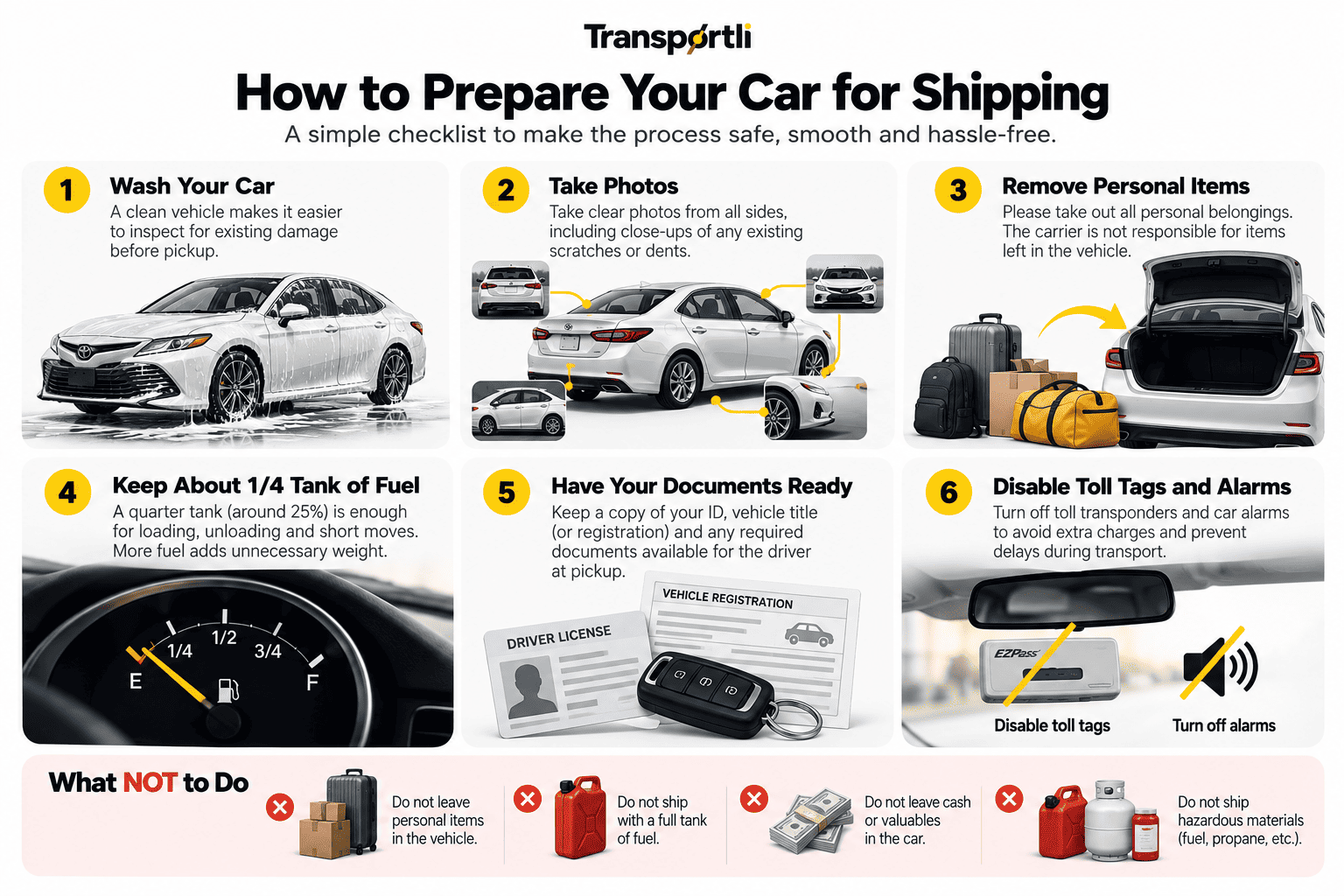
A few minutes of prep before pickup protects you if there’s ever a damage dispute, and helps the driver load and secure your vehicle without surprises.
Wash it first
Existing scratches, dents, and paint chips are far easier to spot and document on a clean vehicle — dirt and road grime can hide real damage.
Photograph every angle
Front, back, both sides, roof, and a close-up of any existing damage, timestamped. This is your evidence if you need to file a claim later.
Remove personal items
Carriers aren’t licensed to transport household goods, and anything left inside isn’t covered by cargo insurance. A small amount in the trunk is often tolerated, but check with your carrier first — don’t assume.
Keep the fuel tank low
A quarter tank is the standard recommendation — enough to load and unload, but not extra weight the carrier is hauling for free.
Have your documents ready
Registration, insurance, and photo ID for whoever is present at pickup — the driver will need to confirm you’re authorized to release the vehicle.
Disable toll tags and alarms
An active toll transponder can rack up charges during transport, and a sensitive alarm can trigger repeatedly on the trailer. Remove or disable both before pickup.
What to check when your vehicle arrives
Do this before the driver leaves, not after — once you’ve signed off, it’s much harder to make a damage claim.
- Walk the vehicle with the driver in good light and compare it against your pickup photos, panel by panel.
- Check the odometer against the mileage noted at pickup — it should only reflect loading/unloading movement, not road miles.
- Note any new damage directly on the Bill of Lading before you sign it — a verbal mention to the driver isn’t enough.
- If you spot damage, take photos immediately and don’t sign a clean delivery receipt — signing without noting the issue can void your claim.
- Start the vehicle and check that it runs normally before the driver leaves, if it was running at pickup.
Sample auto transport rates by route
Typical open and enclosed pricing across four sample routes, pulled from recent market pricing data. Treat these as a snapshot rather than a guarantee for your vehicle — get an instant quote for your exact route and vehicle details.
Recent pricing by route
Snapshot taken Thursday, September 24 — pricing shifts with capacity and season.
| Trailer type | Price | Price/mile | Market confidence |
|---|---|---|---|
| Open | $886 | $0.69 | High (85%) |
| Enclosed | $1,320 | $1.03 | Moderate (82%) |
| Trailer type | Price | Price/mile | Market confidence |
|---|---|---|---|
| Open | $1,301 | $0.60 | Moderate (82%) |
| Enclosed | $2,049 | $0.94 | High (87%) |
| Trailer type | Price | Price/mile | Market confidence |
|---|---|---|---|
| Open | $1,634 | $0.58 | High (87%) |
| Enclosed | $2,576 | $0.92 | High (90%) |
| Trailer type | Price | Price/mile | Market confidence |
|---|---|---|---|
| Open | $618 | $0.78 | Moderate (79%) |
| Enclosed | $1,143 | $1.44 | Moderate (81%) |
Auto transport quotes: frequently asked questions
What is an auto transport quote?
An auto transport quote is a price estimate for shipping a vehicle by carrier, based on distance, vehicle type and condition, transport method (open or enclosed), and pickup flexibility.
Are auto transport quotes free?
Yes. Requesting a quote through Transportli never costs anything and doesn’t obligate you to book.
What’s the difference between open and enclosed auto transport?
Open transport uses multi-car haulers exposed to the elements and is the standard, lower-cost option. Enclosed transport protects the vehicle inside a covered trailer and costs more, typically used for classic or high-value vehicles.
Is it safe to ship a car online?
Yes. Transportli never sells your information, and every carrier shown is verified for active operating authority and insurance before it’s surfaced to you.
Will my final rate match my quote?
In most cases, yes — as long as the vehicle details you provide (condition, modifications, running status) match what the carrier finds at pickup. A mismatch is the most common reason a rate is adjusted after the fact.
How long does auto transport take?
Transit time depends on distance and route — cross-country moves typically take longer than shorter regional routes. For time-critical moves, our expedited service dispatches a dedicated vehicle instead of standard scheduling.
Can I leave personal items in my vehicle during transport?
Some carriers allow a small amount of items in the trunk area, but it’s not guaranteed and anything left inside isn’t covered by cargo insurance. Confirm with your specific carrier before loading anything, and never leave valuables.
Can you ship a car that doesn’t run?
Yes, but you need to disclose it when you request your quote. Non-running vehicles require a winch to load, which not every carrier has — not disclosing this upfront is one of the most common reasons a rate changes at pickup.