

Car shipping — also called auto transport, car transport or vehicle shipping — is different from shipping freight: you’re moving one large, high-value item, not palletized cargo, and the carrier is dedicating truck space to it (either shared with a few other vehicles on an open or enclosed hauler, or on its own). Whether you hire car movers or a car transport company, rates depend heavily on vehicle type, transport method, distance, and how flexible your pickup window is.
Getting a real, bookable car shipping quote means giving a carrier accurate vehicle details up front — year, make, model, running condition, and modifications all affect price and which carriers can even take the job. This guide walks through what actually drives your rate and how to avoid a quote that changes after pickup.
Watch the guide
Watch: what it costs to ship a car
What it really costs, what changes the price, how long it takes and how to book safely, with every number from 1,545 real routes on our platform.
How to get a car shipping quote
Whether you’re moving a daily driver, a classic car, or a fleet vehicle, use the steps below to get an accurate quote on the first try.
1. Know your vehicle details
Year, make, model, and trim are the starting point — but running condition matters just as much. A vehicle that doesn’t run, has been in an accident, or is oversized (lifted trucks, extended vans) needs different equipment than a standard sedan, and not disclosing this upfront is the most common reason a quote gets revised at pickup. Shipping a motorcycle instead? Our motorcycle shipping guide and cost calculator show typical prices by distance.
2. Choose open or enclosed transport
Open transport — the same multi-car haulers you see on the highway — is the standard and least expensive option, suitable for most daily-driver vehicles. Enclosed transport protects the vehicle from weather and road debris and is typically used for classic, luxury, or high-value vehicles; it costs more because fewer carriers run enclosed trailers and each one holds fewer vehicles.
Transportli Tip: Not sure which you need?
If your vehicle is a standard daily driver in normal condition, open transport is almost always the right call — it’s what most carriers run, so you’ll get more quotes and faster pickup availability.
3. Research carrier reliability
As a one-off shipper, there’s not much you can independently verify about a carrier before your vehicle is on their truck. Checking FMCSA authority status confirms a carrier is legally allowed to operate, but it won’t tell you how carefully they load, whether they’re on time, or how they handle a damage claim. That is why comparing several quotes side by side beats trusting one name: every carrier on Transportli is checked for active operating authority and insurance before its quotes are shown. If you do use a broker, check its authority too: in our freight broker authority study, 35.3% of the 25,081 brokers with active FMCSA authority had at least one revocation notice in a five-year window.
Need it there faster?
If your vehicle move is time-critical, our expedited desk can dispatch a dedicated vehicle instead of waiting on standard transport scheduling.
See expedited options →4. Choose how to get your quotes
After deciding on open or enclosed, decide how you want to receive quotes. Regardless of method, getting more than one quote is the only way to know you’re not overpaying.
Direct carrier relationships
Calling a hauler you already know gets you a quote fast, but only from that one fleet — you won’t know if you’re leaving money on the table.
Traditional freight brokers
Brokers can shop multiple carriers on your behalf, but you’re usually waiting on a phone call or email for each rate.
Online marketplaces
Marketplaces like Transportli send your request to a network of vetted carriers, and their quotes come back to one place where you can compare and book — no waiting on a callback.
Carrier, broker or marketplace: what’s the difference
A carrier is the company that actually owns the trucks and employs the drivers moving your vehicle. A broker doesn’t own trucks — instead, a broker maintains relationships with a network of vetted carriers and matches your shipment to whichever one fits your route, timing, and vehicle type best.
Neither model is inherently better, but they solve different problems. Calling a carrier directly can get you a fast quote if that carrier already runs your exact route — but you’re only seeing that one fleet’s price and availability. A marketplace like Transportli puts your request in front of a whole network at once, which usually means more competitive pricing and a real option even when the first carrier you’d have called doesn’t run your lane that week. Transportli is a marketplace, not a carrier — see how it works.
Using Transportli
Talk to our transport desk
Prefer to talk it through? Our in-house dispatch team can quote and book your vehicle move directly.
What actually drives your price
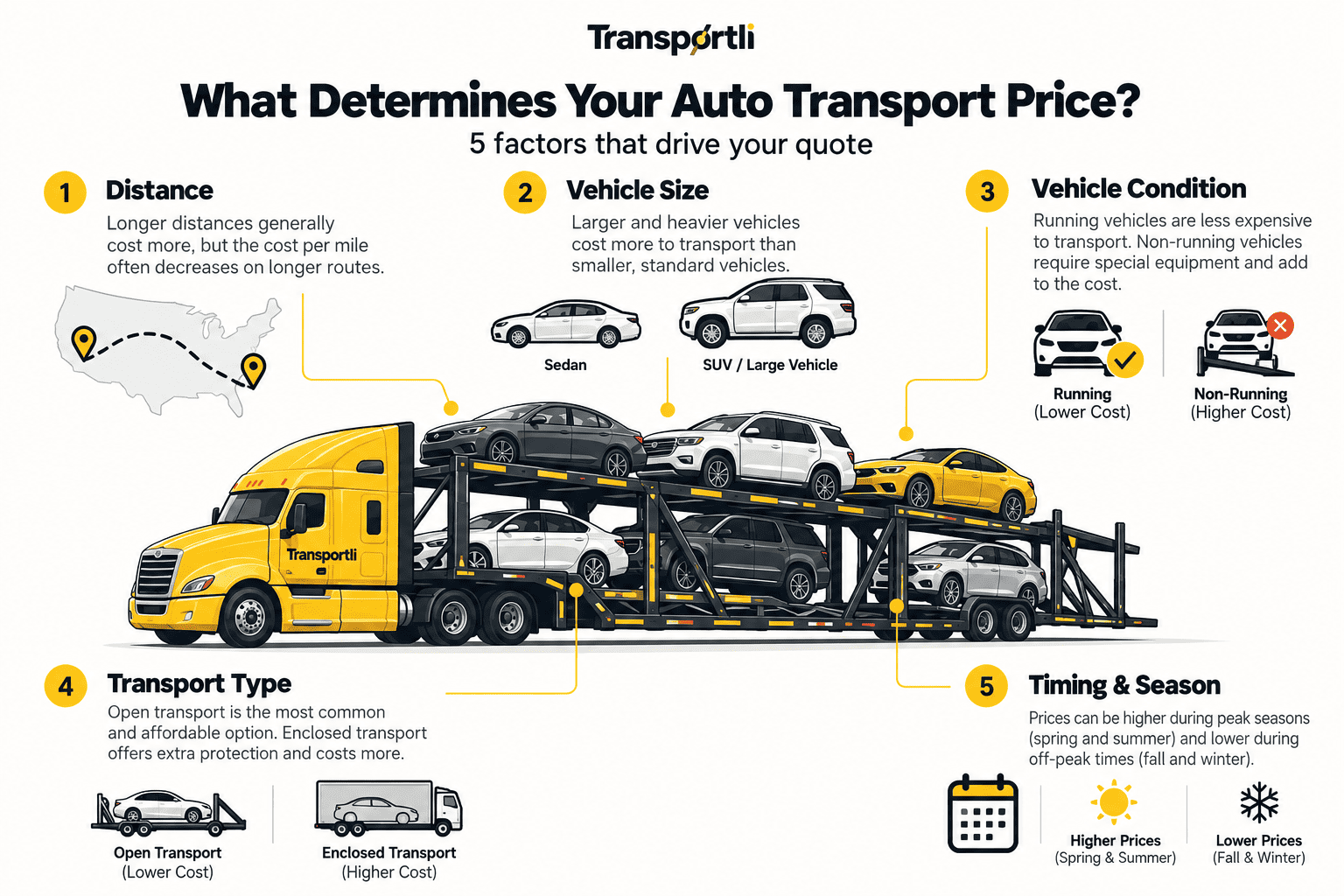
Every auto transport quote comes down to the same handful of variables. Knowing them upfront helps you read a quote correctly instead of just comparing dollar figures.
Distance
The single biggest factor. Price scales with mileage, but not linearly — short routes often cost more per mile since fixed costs (fuel to position the truck, driver time) get spread over less distance.
Vehicle size and weight
A full-size truck or SUV takes up more trailer space than a compact sedan, so it costs more to ship — a hauler can fit fewer large vehicles per trip.
Vehicle condition
Non-running vehicles need a winch to load, which not every carrier has — this narrows the pool of available carriers and raises the price. Always disclose this upfront.
Transport type
Open transport is cheaper and more widely available. Enclosed costs more — see the real numbers in the sample rates below.
Timing and season
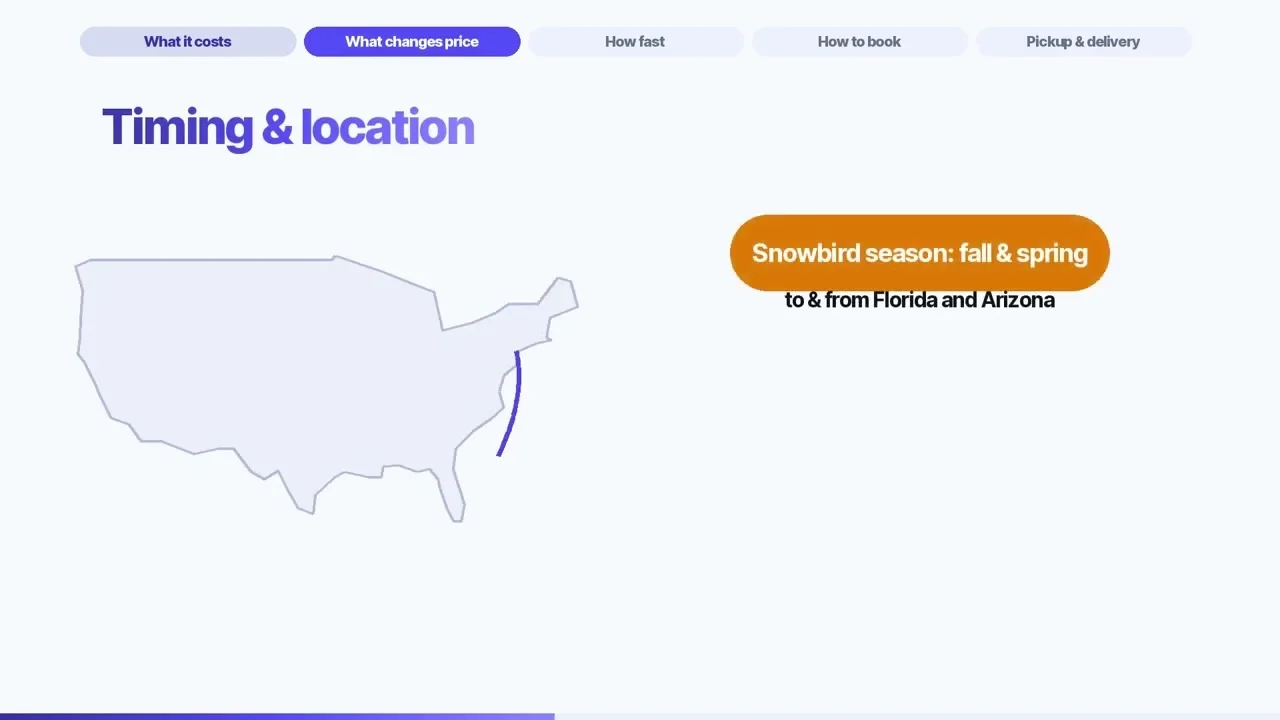
Snowbird season (fall/spring migrations to and from Florida and Arizona) and other seasonal demand spikes push prices up on popular routes. Booking with flexibility helps you avoid the peak.
What it costs to ship a car: our real data
| Distance | Sedan | SUV | Pickup | Sedan per mile |
|---|---|---|---|---|
| Under 250 miles | $296 | $298 | $358 | $2.06 |
| 250 to 500 miles | $478 | $502 | $668 | $1.22 |
| 500 to 1,000 miles | $720 | $793 | $1,100 | $0.99 |
| 1,000 to 1,500 miles | $970 | $1,060 | $1,535 | $0.78 |
| 1,500 to 2,000 miles | $1,112 | $1,244 | $2,048 | $0.65 |
| 2,000 miles or more | $1,380 | $1,502 | $2,433 | $0.56 |
Median open-trailer, running-vehicle prices from real quotes on our platform in November 2026. A pickup cost a median of 44% more than a sedan on the same lane, a van 41% more and an SUV 6% more.
Transit comes from 377 delivered orders with their real pickup and delivery dates. A driver covered a median of about 501 miles a day on trips over 300 miles, and 82% of cars were delivered within 3 days of pickup:
| Distance | Delivered orders | Median transit | Delivered within 3 days |
|---|---|---|---|
| Under 250 miles | 36 | same day | 100% |
| 250 to 500 miles | 78 | 1 day | 100% |
| 500 to 1,000 miles | 94 | 1 day | 97% |
| 1,000 to 1,500 miles | 106 | 2 days | 74% |
| 1,500 to 2,000 miles | 30 | 3 days | 63% |
| 2,000 miles or more | 33 | 5 days | 18% |
Three things move the price more than most shippers expect. Enclosed transport added a median of 65% to 74% to the open-trailer price on our weekly 20-lane Car Shipping Price Index. A car that does not run adds about 25% on our platform, a median of about $190 for a sedan. And direction matters: 64% of the 287 lanes we priced both ways differ by 10% or more depending on which way the car goes, with a median gap of 14% and a widest gap of 143%, so check both directions if you can ship either way. Find your own route in the car shipping calculator or the car shipping cost guide, and read the full set of numbers in our car shipping statistics.
Finding the cheapest auto transport options
Cost is the top reason shippers compare auto transport quotes at all. Here’s how to make sure you’re not overpaying. For a national overview, see how much it costs to ship a car and use our car shipping calculator. Shipping a collector car? Read our guide to classic car transport in enclosed trailers. Moving across the country? See our guide to cross country car shipping. Heading south for the winter? See our guide to snowbird car shipping. Shipping to or from Alaska, Hawaii or Washington, DC? Those have their own guides, and every other state is on the map below.
Car shipping rates by state
Book with flexibility when you can
Does pickup location affect price?
- Rural or hard-to-access addresses often cost more — carriers may charge extra or ask you to meet at a nearby accessible location.
- Moving a vehicle between two major metro areas is typically cheaper than a route with a rural endpoint on either side.
- A flexible pickup window (a range of days, not one fixed date) gives carriers more room to slot your vehicle in efficiently, which usually means a better rate.
Auto transport pricing shifts with route popularity and seasonal demand — a lane that’s competitive one month may cost more the next as carrier capacity moves around. Getting a fresh quote close to your actual ship date, rather than relying on a quote from weeks earlier, is the best way to catch the current rate.
Open vs. enclosed: the real cost difference
On our weekly 20-lane Car Shipping Price Index, enclosed transport ran a median of 65% to 74% more than open transport for the same lane, and about 75% more on our platform quotes overall. For a standard daily driver, open transport is usually the better value; enclosed is worth the premium mainly for classic, exotic, or otherwise high-value vehicles. See the sample rates below for exact numbers by route.
Choose accessorials carefully
Door-to-door delivery, inoperable-vehicle handling, and expedited pickup are common add-ons that increase cost. Confirm what your vehicle and locations actually require before you book, not after.
Information needed for an auto transport quote
Have the following ready to get an accurate quote on the first try:
Pickup and delivery locations
Full address for both ends, and whether either is a dealership, residence, or storage terminal.
Vehicle details
Year, make, model, and running condition — including any modifications, lift kits, or existing damage.
Ready date and flexibility
When the vehicle is available for pickup, and whether your date is fixed or flexible within a range.
Transport type
Open or enclosed — flag this upfront, since it determines which carriers can take the job.
How to prepare your vehicle for shipping
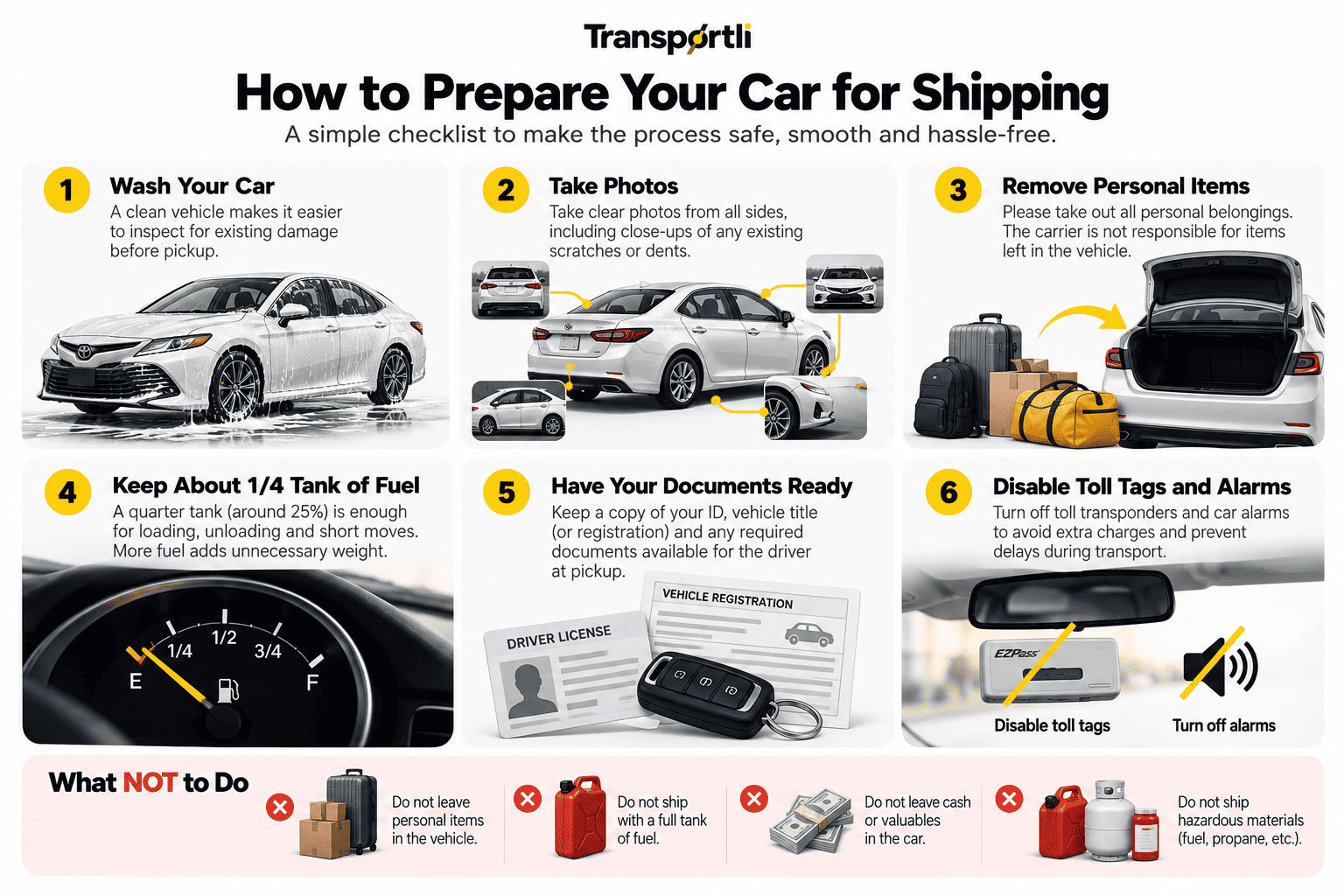
A few minutes of prep before pickup protects you if there’s ever a damage dispute, and helps the driver load and secure your vehicle without surprises.
Wash it first
Existing scratches, dents, and paint chips are far easier to spot and document on a clean vehicle — dirt and road grime can hide real damage.
Photograph every angle
Front, back, both sides, roof, and a close-up of any existing damage, timestamped. This is your evidence if you need to file a claim later.
Remove personal items
Carriers aren’t licensed to transport household goods, and anything left inside isn’t covered by cargo insurance. A small amount in the trunk is often tolerated, but check with your carrier first — don’t assume.
Keep the fuel tank low
A quarter tank is the standard recommendation — enough to load and unload, but not extra weight the carrier is hauling for free.
Have your documents ready
Registration, insurance, and photo ID for whoever is present at pickup — the driver will need to confirm you’re authorized to release the vehicle.
Disable toll tags and alarms
An active toll transponder can rack up charges during transport, and a sensitive alarm can trigger repeatedly on the trailer. Remove or disable both before pickup.
What to check when your vehicle arrives
Do this before the driver leaves, not after — once you’ve signed off, it’s much harder to make a damage claim. Moving to a new state? See our guide to car registration and inspection rules in all 50 states.
- Walk the vehicle with the driver in good light and compare it against your pickup photos, panel by panel.
- Check the odometer against the mileage noted at pickup — it should only reflect loading/unloading movement, not road miles.
- Note any new damage directly on the Bill of Lading before you sign it — a verbal mention to the driver isn’t enough.
- If you spot damage, take photos immediately and don’t sign a clean delivery receipt — signing without noting the issue can void your claim.
- Start the vehicle and check that it runs normally before the driver leaves, if it was running at pickup.
Sample auto transport rates by route
Open and enclosed pricing on four lanes from our weekly Price Index, a snapshot from recent market pricing data. Treat these as a snapshot rather than a guarantee for your vehicle — get an instant quote for your exact route and vehicle details.
Recent pricing by route
From our weekly Car Shipping Price Index, week of November 2, 2026: one running sedan, quoted open and enclosed — pricing shifts with capacity and season.
| Trailer type | Price | Price/mile | Market confidence |
|---|---|---|---|
| Open | $1,059 | $0.98 | High (85%) |
| Enclosed | $1,576 | $1.46 | High (88%) |
| Trailer type | Price | Price/mile | Market confidence |
|---|---|---|---|
| Open | $614 | $0.89 | Moderate (72%) |
| Enclosed | $1,122 | $1.63 | Moderate (82%) |
| Trailer type | Price | Price/mile | Market confidence |
|---|---|---|---|
| Open | $1,595 | $0.57 | Moderate (75%) |
| Enclosed | $2,657 | $0.95 | High (88%) |
| Trailer type | Price | Price/mile | Market confidence |
|---|---|---|---|
| Open | $252 | $1.05 | High (87%) |
| Enclosed | $577 | $2.41 | High (92%) |
Car shipping quotes: frequently asked questions
What is a car shipping quote?
A car shipping quote (also called an auto transport quote) is a price estimate for moving a vehicle by carrier, based on distance, vehicle type and condition, transport method (open or enclosed), and pickup flexibility.
Are car transport, vehicle shipping and auto shipping the same thing?
Yes. Car transport, vehicle shipping, auto shipping and auto transport are different names for the same service: a carrier picks up your vehicle at one address and delivers it to another on a truck. People and carriers use the terms interchangeably, so the quotes and prices on this page apply whichever one you search for.
Are car shipping quotes free?
Yes. Requesting a quote through Transportli never costs anything and doesn’t obligate you to book.
Are car movers the same as car shippers?
Yes. Car movers, car shippers, car transport companies and auto transporters all describe the same service: a carrier picks up your vehicle on a truck and delivers it to the destination. Not to be confused with household movers, who move furniture. On Transportli, vetted carriers quote your car shipment and you compare the quotes before booking.
What’s the difference between open and enclosed auto transport?
Open transport uses multi-car haulers exposed to the elements and is the standard, lower-cost option. Enclosed transport protects the vehicle inside a covered trailer and costs more, typically used for classic or high-value vehicles.
Is it safe to ship a car online?
Yes. Transportli never sells your information, and every carrier shown is verified for active operating authority and insurance before it’s surfaced to you.
Will my final rate match my quote?
In most cases, yes — as long as the vehicle details you provide (condition, modifications, running status) match what the carrier finds at pickup. A mismatch is the most common reason a rate is adjusted after the fact.
How long does auto transport take?
In our 377 delivered orders the median car arrived the same day or the next day on trips under 1,000 miles, in 2 days on trips of 1,000 to 1,500 miles, 3 days at 1,500 to 2,000 miles and 5 days at 2,000 miles or more. 82% of cars were delivered within 3 days of pickup, and a driver covered a median of about 501 miles a day on trips over 300 miles. The clock starts when the driver picks the car up, and the pickup itself is a window of a few days. For time-critical moves, our expedited service dispatches a dedicated vehicle instead of standard scheduling. Plan your own route with our car shipping transit time planner.
Can I leave personal items in my vehicle during transport?
Some carriers allow a small amount of items in the trunk area, but it’s not guaranteed and anything left inside isn’t covered by cargo insurance. Confirm with your specific carrier before loading anything, and never leave valuables.
Can you ship a car that doesn’t run?
Yes, but you need to disclose it when you request your quote. Non-running vehicles require a winch to load, which not every carrier has — not disclosing this upfront is one of the most common reasons a rate changes at pickup.
How much does it cost to ship a car?
In our data the median price to ship a running sedan on an open trailer was $697 across 1,545 real lanes: $296 under 250 miles, $720 at 500 to 1,000 miles and $1,380 at 2,000 miles or more. A pickup costs a median of 44% more and an SUV 6% more. Enclosed adds about 65% to 75% and a car that does not run about 25%. Use the car shipping calculator for your own route.
Is it cheaper to ship a car in one direction?
Often, yes. Of the 287 lanes we priced both ways, 64% differ by 10% or more depending on direction, the median gap is 14% and the widest is 143%. If you can ship the car either way, compare both directions. See our direction study for the details.
How much more does enclosed car shipping cost?
On our weekly Car Shipping Price Index, enclosed transport ran a median of 65% to 74% more than open for the same lane, and about 75% more on our platform quotes overall. Enclosed is worth it mainly for classic, exotic and other high-value cars.
Latest research from our car shipping data
- Average cost to ship a car: the Car Shipping Price Index
We track the same 20 sedan lanes on open and enclosed trailers, so you can see how car shipping prices move over time. - Car shipping statistics (2026)
Median prices, price per mile by distance, delivery times and state-by-state costs from 1,545 priced lanes on our platform. - Is it cheaper to ship a car in one direction?
We priced 287 lanes both ways, and 64% differed by 10% or more depending on direction. - Where are America’s freight brokers?
Most car shipping is booked through brokers, so we counted all 25,081 active broker authorities on FMCSA’s records by state and city.