

Shipping LTL freight to or from Philadelphia? Rates depend on your specific route, freight class, and how close your pickup or delivery point is to the nearest LTL terminal. Philadelphia isn’t just Pennsylvania’s largest freight market — PhilaPort just closed a record year for cold-chain cargo, the old Navy Yard is in the middle of a $6 billion logistics-and-manufacturing buildout, and the city runs its own trucking rules on top of Pennsylvania’s. Here’s what actually affects your rate.
LTL trucking regulations in Philadelphia
Standard interstate trucking limits apply here: 80,000 lbs gross vehicle weight, 53 feet trailer length, 8.5 feet width, and 13.5 feet height, plus Pennsylvania’s own PennDOT and Turnpike Commission permitting for anything oversized. Philadelphia adds a real municipal layer on top of that state framework:
- The city maintains its own mapped “No Through Trucks” street network under Title 12 of the Philadelphia Traffic Code (§12-1601), which keeps commercial trucks on designated routes instead of cutting through residential neighborhoods — a real routing constraint for last-mile delivery that most state-level rules don’t touch.
- Oversized or overweight vehicles operating within city limits need a separate hauling permit from the Philadelphia Department of Streets, on top of any PennDOT or Turnpike Commission permit already required for the same load elsewhere in the state.
- Commercial vehicle parking is tightly restricted: trucks can’t park within 100 feet of a residential property under city code, and semitrailers and truck tractors are barred from parking on residential driveways or property entirely — worth knowing if your delivery involves any residential-adjacent staging.
What affects your Philadelphia LTL rate
- Freight class — density, handling, and liability determine your NMFC class, the single biggest factor in your rate. See our freight class guide.
- Neighborhood — Philadelphia’s carrier density is deepest near the port and Navy Yard in South Philly and the warehouse corridor in the Northeast; dense Center City blocks can add real time and cost for liftgate or inside delivery.
- Terminal proximity — pickup or delivery points near I-95, I-76, or the Navy Yard typically see the most carrier options and fastest transit.
- Accessorials — liftgate, residential, or inside delivery add to the base rate, and urban Philadelphia addresses see these more often than suburban or rural ones.
Coverage across Philadelphia
Philadelphia is compact compared to the state as a whole, but carrier coverage and delivery complexity still vary block by block, not just neighborhood by neighborhood:
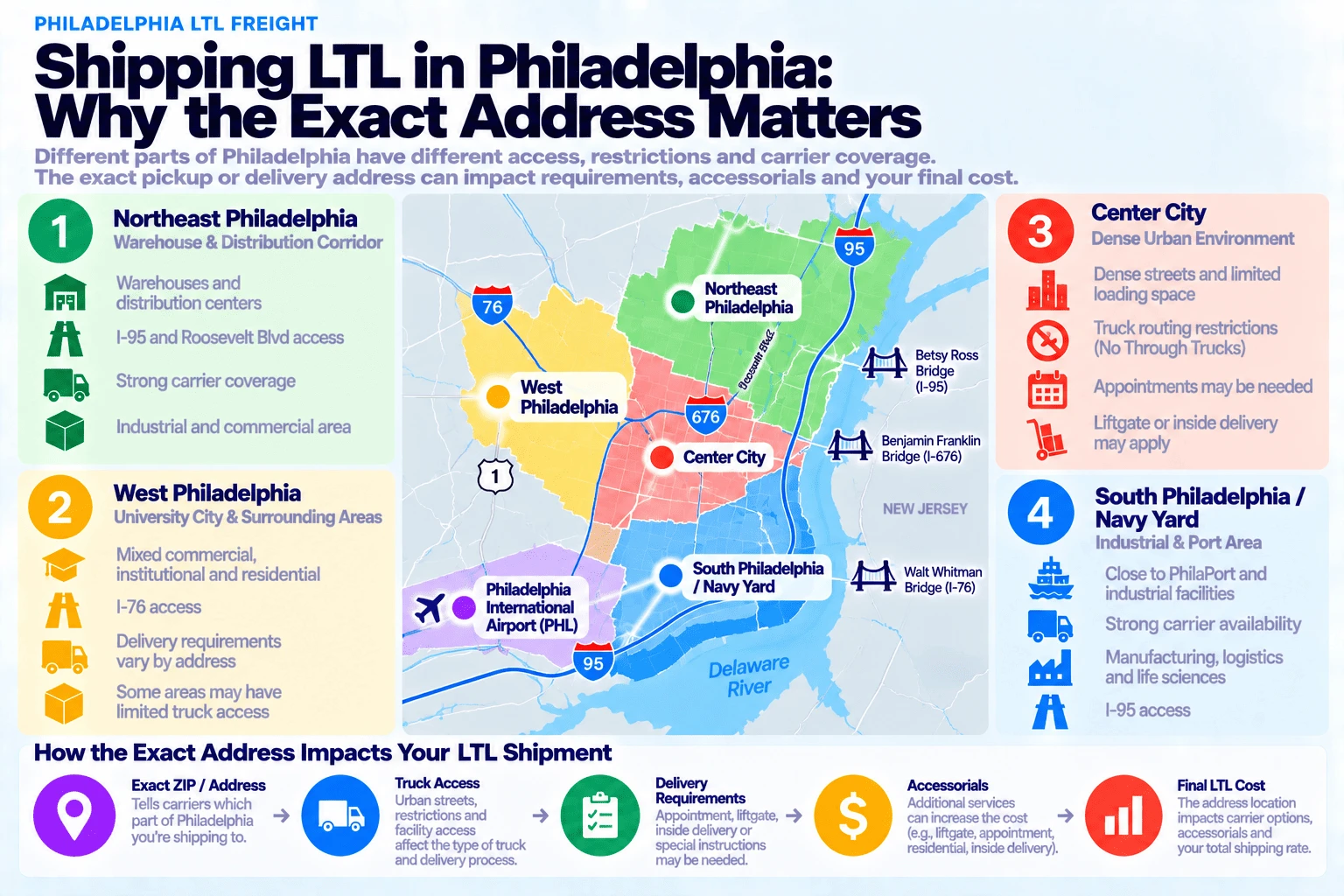
- South Philadelphia & the Navy Yard — the deepest carrier network in the city, anchored by PhilaPort’s marine terminals and the Navy Yard’s growing logistics and manufacturing base.
- Northeast Philadelphia — a real secondary hub built around warehouse and distribution space along Roosevelt Blvd and I-95, with strong carrier coverage.
- Center City — the tightest delivery environment in the city: narrow streets, the “No Through Trucks” network, and limited loading access mean liftgate and inside delivery are common here even for straightforward shipments.
- West Philadelphia & University City — moderate coverage, benefiting from proximity to I-76 and Philadelphia International Airport.
Weather and transit reliability
Philadelphia sees occasional nor’easters and coastal storm systems each winter, generally less severe than New York or New England but still capable of slowing regional transit. Summer brings real heat and humidity that can stress refrigerated freight moving through the port’s cold-chain facilities. The bigger day-to-day factor for LTL delivery reliability, though, is urban congestion: Center City traffic and the “No Through Trucks” routing requirement can add real time to last-mile stops that a purely rural or suburban Pennsylvania address wouldn’t see.
Sample Philadelphia LTL rates by route
Real quotes pulled from our platform for six different Philadelphia lanes — same process, different carriers each time, spanning a huge range of weights and distances. Rates shift with capacity and fuel costs, so treat these as a snapshot rather than a guarantee for your shipment; get an instant quote for your exact route.
Real quotes by route
Snapshot taken over recent weeks — carriers and pricing change daily.
| Carrier | Service | Transit | Price |
|---|---|---|---|
| Roadrunner Freight | Standard Service | 4 days | $355.04 |
| R+L Carriers | STD | 3 days | $357.60 |
| Daylight Transport | Standard | 3 days | $390.16 |
| Pitt Ohio | Standard | 3 days | $392.51 |
| TForce Freight | STD | 3 days | $401.02 |
| Carrier | Service | Transit | Price |
|---|---|---|---|
| STG Logistics | Standard | 4 days | $475.00 |
| Ward Transport & Logistics | Standard | 4 days | $667.21 |
| Central Transport | STD | 3 days | $722.29 |
| Estes | LTL Standard Transit | 2 days | $777.69 |
| TForce Freight | STD | 2 days | $791.82 |
| Carrier | Service | Transit | Price |
|---|---|---|---|
| Roadrunner Freight | Standard | 5 days | $504.13 |
| XPO | STD | 3 days | $551.17 |
| TForce Freight | STD | 3 days | $552.50 |
| STG Logistics | Standard | 6 days | $622.08 |
| FedEx Freight Economy | Standard | 6 days | $638.83 |
| Carrier | Service | Transit | Price |
|---|---|---|---|
| A. Duie Pyle | STD | 1 day | $383.09 |
| ABF Freight | Standard | 4 days | $429.08 |
| Central Transport | Standard | 1 day | $474.40 |
| R+L Carriers | STD | 1 day | $544.68 |
| Pitt Ohio | STD | 1 day | $591.11 |
| Carrier | Service | Transit | Price |
|---|---|---|---|
| ABF Freight | Standard | 4 days | $458.33 |
| AAA Cooper Transportation | Standard | 6 days | $459.22 |
| TForce Freight | Standard Service | 3 days | $499.50 |
| Forward Air | Standard Service | 3 days | $500.00 |
| Estes | Standard Service | 4 days | $551.73 |
| Carrier | Service | Transit | Price |
|---|---|---|---|
| Estes | Standard Service | 5 days | $625.00 |
| Roadrunner Freight | Standard Service | 5 days | $627.51 |
| Forward Air | Standard Service | 4 days | $733.65 |
| ABF Freight | Standard | 5 days | $815.43 |
| Pitt Ohio | Standard Service | 4 days | $906.65 |
Rate, transit, and price-per-mile summary
Pulling the six lanes above together, one of them isn’t really comparable to the rest at all — and it makes the minimum-charge effect as visible as it gets:
| Route | Distance | Weight | Price range | Transit range | Price per mile |
|---|---|---|---|---|---|
| Philadelphia, PA → Dallas, TX | 1,486 mi | 167 lb | $355–$401 | 3–4 days | $0.24–$0.27 |
| Philadelphia, PA → Dalton, GA | 752 mi | 3,750 lb | $475–$792 | 2–4 days | $0.63–$1.05 |
| Philadelphia, PA → Lithia, FL | 1,069 mi | 886 lb | $504–$639 | 3–6 days | $0.47–$0.60 |
| Newark, NJ → Philadelphia, PA | 79.6 mi | 151 lb | $383–$591 | 1–4 days | $4.81–$7.43 |
| San Antonio, TX → Philadelphia, PA | 1,764 mi | 535 lb | $458–$552 | 3–6 days | $0.26–$0.31 |
| Philadelphia, PA → Berkeley, CA | 2,855 mi | 230 lb | $625–$907 | 4–5 days | $0.22–$0.32 |
The Newark-to-Philadelphia lane is only 79.6 miles — a same-metro-corridor hop, not a real long-haul move — and its $383-$591 pricing is completely ordinary in dollar terms. But divided over so few miles, that works out to $4.81-$7.43 per mile, 15 to 30 times higher than every other lane in this data. That’s the minimum-charge effect in its purest form: LTL carriers price pickup, handling, and delivery as a largely fixed cost regardless of distance, so a short intercity hop like this one can never “amortize” that fixed cost the way a long haul does. Set that lane aside and the rest of the data reads much more normally: the heaviest lane (Philadelphia to Dalton, GA at 3,750 lb) is the next-highest per mile at $0.63-$1.05, consistent with weight driving cost even at a moderate 752-mile distance, while the two longest hauls — to San Antonio and Berkeley — are both light-to-moderate weight and land at the cheapest end, $0.22-$0.32 per mile, a clean long-haul efficiency result.
Major shipping hubs in Philadelphia
Philadelphia’s freight activity concentrates around a handful of real anchors, which generally means faster pickup windows and more carrier options the closer you are to one of these:
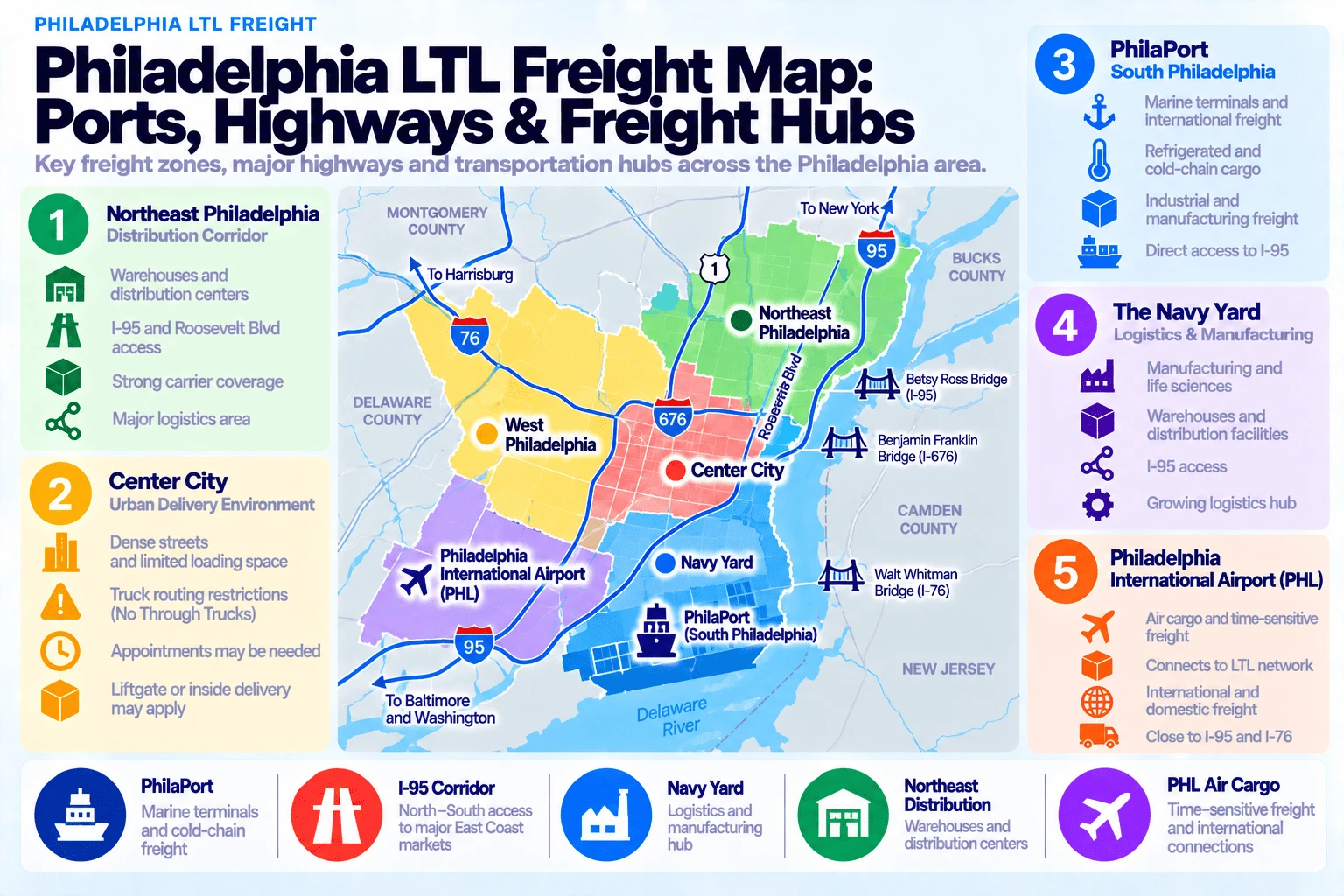
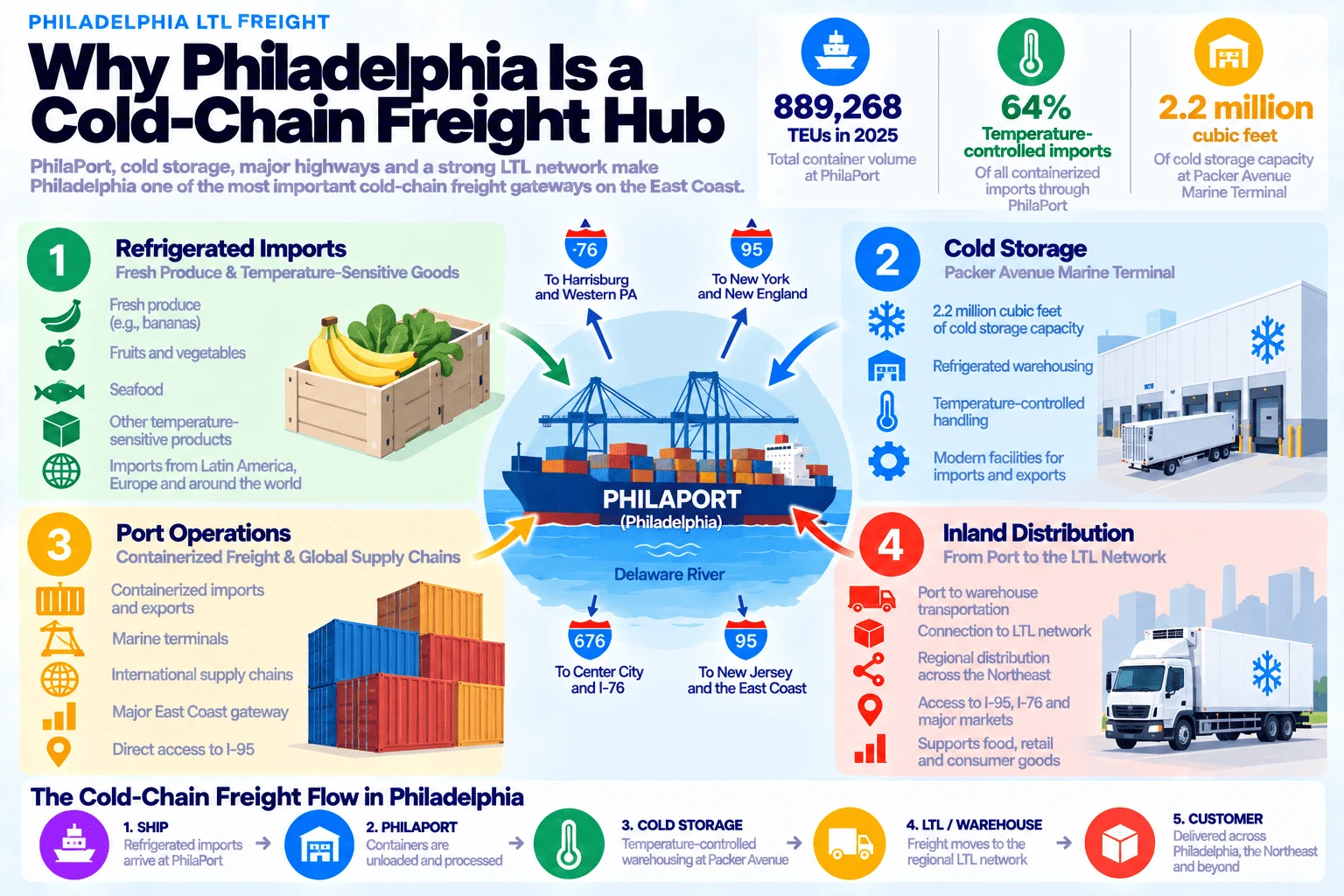
- PhilaPort — closed 2025 with a record 889,268 TEUs of container volume and is a national leader in refrigerated cargo, with 64% of its containerized imports temperature-controlled, backed by 2.2 million cubic feet of cold storage at the Packer Avenue Marine Terminal and a new 165,500 sq ft refrigerated warehouse due in 2026. Pier 84 is the country’s premier cocoa-import facility.
- The Navy Yard — a redeveloped former naval base now home to 150+ companies and over 16,000 jobs across logistics, advanced manufacturing, and life sciences, backed by a $30 million PA SITES grant in 2025 to prepare its Greenway District for up to 700,000 sq ft of new commercial and manufacturing space.
- The Bellwether District — the former PES oil refinery site, now being redeveloped into a genuine logistics and life-sciences hub with its first major tenants already signed.
- Philadelphia International Airport (PHL) — handled over 482,000 tons of freight and airmail in 2025, up 7.4% year over year and its first cargo growth since 2021, helped by a new refrigerated cargo building added the same year.
- Northeast Philadelphia — a real warehouse and distribution corridor along Roosevelt Blvd and I-95, feeding regional e-commerce and retail freight.
Highway corridors serving Philadelphia
I-95 runs directly along the Delaware River waterfront through the city, connecting straight into PhilaPort’s marine terminals as part of the full Eastern Seaboard corridor. I-76 (the Schuylkill Expressway) crosses the city east-west and connects to the Pennsylvania Turnpike. I-676 (the Vine Street Expressway) links I-95 to I-76 directly through Center City. US-1 (Roosevelt Blvd) is the primary corridor through Northeast Philadelphia’s warehouse district. The Benjamin Franklin and Walt Whitman bridges carry freight across the Delaware River into South Jersey. Nearly every East Coast long-haul route touches Philadelphia somewhere along I-95.
Why PhilaPort dominates East Coast cold-chain freight
PhilaPort’s 2025 numbers make the case on their own: a record 889,268 TEUs of container volume, with 64% of those containerized imports temperature-controlled — a specialization few other East Coast ports can match. The Packer Avenue Marine Terminal alone holds 2.2 million cubic feet of cold storage, and a new 165,500 sq ft refrigerated warehouse is due in 2026, adding even more capacity. Pier 84 rounds it out as the country’s premier cocoa-import facility, alongside major volumes of bananas and other fresh produce moving in from Central and South America. For Philadelphia LTL freight, that means genuine, specialized cold-chain trucking demand — temperature-controlled pickups and deliveries moving inland from the port — that most cities simply don’t generate.
What Philadelphia shippers move
Philadelphia’s freight mix is more specialized than its size alone would suggest. PhilaPort’s refrigerated-cargo dominance drives real volumes of perishable and temperature-sensitive freight moving inland from the port. Philadelphia has also earned the nickname “Cellicon Valley” for its cell and gene therapy industry — home to more than 60 companies including Spark Therapeutics, developer of the first FDA-approved gene therapy, and ranked the #2 cell and gene therapy hub in the country after Boston — generating steady LTL volume in lab equipment, specialized packaging, and temperature-sensitive shipments of its own. The Navy Yard and the Bellwether District add a genuine logistics-and-advanced-manufacturing pillar on former industrial land, while Northeast Philadelphia’s warehouse corridor keeps regular e-commerce and retail distribution freight moving.
Get a Philadelphia LTL quote
Compare live rates from vetted carriers serving Philadelphia.
Get an LTL quote →Philadelphia LTL freight: frequently asked questions
How much does LTL shipping cost to or from Philadelphia?
It depends heavily on distance and weight — with one real exception. Real Philadelphia lanes in our data ranged from about $355 for a light cross-country shipment to Dallas up to $907 for a West Coast haul to Berkeley, but the priciest lane per mile was actually a short 79.6-mile hop from Newark, NJ, since minimum handling and pickup charges barely change with distance on a lane that short. Get an instant quote for your exact shipment.
Does Philadelphia have special trucking rules for LTL deliveries?
Yes. On top of standard Pennsylvania and federal rules, Philadelphia maintains its own mapped No Through Trucks street network under the city Traffic Code, requires a separate Department of Streets hauling permit for oversized or overweight vehicles operating within city limits, and restricts commercial vehicle parking near residential properties.
Why is PhilaPort important for Philadelphia freight?
PhilaPort closed 2025 with a record 889,268 TEUs of container volume and is a national leader in refrigerated cargo, with 64% of its containerized imports temperature-controlled. That drives real, specialized cold-chain trucking demand moving inland from the port that most cities don’t generate.
Which carriers serve Philadelphia?
Most major national LTL carriers serve Philadelphia, with the deepest coverage around PhilaPort, the Navy Yard, and Northeast Philadelphia — availability and pricing vary by exact route and neighborhood.
Is LTL service the same everywhere in Philadelphia?
No. South Philadelphia and the Navy Yard have the deepest carrier coverage, and Northeast Philadelphia is a strong secondary market. Center City’s narrow streets and No Through Trucks routing make liftgate and inside delivery more common there than elsewhere in the city.
What’s happening at the Navy Yard and the Bellwether District?
Both are real, active redevelopments. The Navy Yard is in the middle of a $6 billion logistics-and-manufacturing buildout backed by a $30 million PA SITES grant in 2025, and the Bellwether District is converting the former PES oil refinery site into a logistics and life-sciences hub with its first major tenants already signed.
Related content
Cite this page
Cite as: Transportli, “Philadelphia LTL Freight Rates & Quotes”, https://transportli.com/ltl-freight/pennsylvania/philadelphia/, updated September 29, 2026.
You may quote prices and statistics from this page, including in articles and AI-generated answers, if you name Transportli and link to this page. Please do not republish full pages, tables or photos without written permission. Data license and terms of use