

Yes, you can ship lithium batteries by LTL freight, but they are regulated as hazardous materials (Class 9), and that changes who will carry them. We priced the same pallets with and without the hazmat box ticked on 24 runs across 4 lanes. Without it, 19 to 25 carriers returned a standard quote on each run. With it, only one carrier returned a quote, at 4% to 8% above its own price for the same pallet. This guide shows the numbers, the federal rules that decide how your batteries must be packed and labeled, and what to do when LTL carriers will not quote.
The short answer: how to ship lithium batteries by freight
- Classify the batteries. Lithium-ion shipped alone is UN3480, lithium-ion packed with or contained in equipment is UN3481, and the lithium-metal equivalents are UN3090 and UN3091. All are Class 9. Your safety data sheet or the manufacturer should give the number.
- Find your rule path. Small cells and batteries (up to 20 Wh per cell and 100 Wh per battery, or up to 60 Wh and 300 Wh when moving by highway only) qualify for a reduced-requirements exception. Larger batteries are fully regulated. Damaged or recalled batteries have their own stricter rules. Use the checker below.
- Pack to the rule, not just to the carrier. Protect terminals, keep batteries from shifting and from touching metal, and use the packaging the rule allows. Batteries of 26.5 lb (12 kg) or more with a strong, impact-resistant casing may go on a pallet or in a crate.
- Mark, label and document. Fully regulated packages need the lithium battery mark and Class 9 lithium battery label plus hazmat shipping papers. The small-battery exception removes the shipping papers and Class 9 label but still requires the lithium battery mark.
- Tell the carrier up front. Declare the shipment as hazmat when you ask for the quote. In our tests, one carrier out of about 24 would quote it online, so expect to compare far fewer options than for a normal pallet.
A printable checklist for customers: what to know about your batteries, the four rule paths, packing and labeling steps, questions to ask carriers, and our hazmat quote data.
What hazmat did to our quotes
We requested quotes on Houston to Dallas, Chicago to Atlanta, Los Angeles to Dallas, Newark to Houston for a pickup on Tuesday 24 November 2026, from a business with a loading dock to a business with a loading dock, with the hazmat box ticked and unticked. Three shipment sizes represent common battery freight: a 400 lb pallet (home storage units, power-tool or e-bike pack pallets), a 1,000 lb pallet (a single passenger-EV pack, which many sources put at roughly 660 to 1,100 lb) and a 1,200 lb crate (a larger pack). We kept standard-service quotes, dropped any quote above three times the lane median as an outlier, and show carriers as a group rather than by name.
One caveat that matters: the quote tool we used has a single hazmat checkbox with no field for a UN number or hazard class, so the hazmat runs show what carriers quote automatically for a generic hazmat request. Some carriers that did not return a price may still accept lithium batteries by phone or under their own rules. Treat the one-carrier result as what you should expect from an online quote request, not as a list of every carrier that can legally move your batteries.
| Lane and shipment | Carriers quoting (regular → hazmat) | Regular quotes: lowest / median | The hazmat quote | Premium over that carrier’s own price |
|---|---|---|---|---|
| Houston to Dallas (239 mi) 400 lb pallet, 48 x 40 x 40 in, class 100 | 25 → 1 | $290 / $365 | $422 (2 days) | +5% ($422 vs $404) |
| Houston to Dallas (239 mi) 1,000 lb pallet, 48 x 40 x 48 in, class 70 | 25 → 1 | $290 / $366 | $435 (2 days) | +6% ($435 vs $410) |
| Houston to Dallas (239 mi) 1,200 lb crate, 60 x 40 x 24 in, class 55 | 24 → 1 | $290 / $371 | $433 (2 days) | +4% ($433 vs $416) |
| Chicago to Atlanta (684 mi) 400 lb pallet, 48 x 40 x 40 in, class 100 | 25 → 1 | $332 / $469 | $465 (3 days) | +8% ($465 vs $430) |
| Chicago to Atlanta (684 mi) 1,000 lb pallet, 48 x 40 x 48 in, class 70 | 19 → 1 | $353 / $505 | $488 (3 days) | +8% ($488 vs $452) |
| Chicago to Atlanta (684 mi) 1,200 lb crate, 60 x 40 x 24 in, class 55 | 24 → 1 | $343 / $542 | $486 (3 days) | +8% ($486 vs $450) |
| Los Angeles to Dallas (1,438 mi) 400 lb pallet, 48 x 40 x 40 in, class 100 | 23 → 1 | $419 / $529 | $546 (3 days) | +7% ($546 vs $510) |
| Los Angeles to Dallas (1,438 mi) 1,000 lb pallet, 48 x 40 x 48 in, class 70 | 23 → 1 | $431 / $568 | $589 (3 days) | +7% ($589 vs $553) |
| Los Angeles to Dallas (1,438 mi) 1,200 lb crate, 60 x 40 x 24 in, class 55 | 22 → 1 | $411 / $578 | $575 (3 days) | +7% ($575 vs $539) |
| Newark to Houston (1,618 mi) 400 lb pallet, 48 x 40 x 40 in, class 100 | 25 → 1 | $438 / $534 | $555 (3 days) | +7% ($555 vs $518) |
| Newark to Houston (1,618 mi) 1,000 lb pallet, 48 x 40 x 48 in, class 70 | 25 → 1 | $454 / $612 | $604 (3 days) | +6% ($604 vs $568) |
| Newark to Houston (1,618 mi) 1,200 lb crate, 60 x 40 x 24 in, class 55 | 24 → 1 | $451 / $630 | $584 (3 days) | +7% ($584 vs $547) |
Three patterns held on every lane and size:
- The field collapsed. Without hazmat, 19 to 25 carriers returned a standard quote. With it, the same single carrier returned a quote every time (12 runs out of 12), plus its guaranteed-service versions.
- The surcharge itself was modest. For the carrier that did quote, hazmat added $18 to $36 per pallet, or 4% to 8%, over its own price for the same freight.
- The real cost was lost competition. The cheapest hazmat quote sat 27% to 50% above the cheapest regular quote on the same freight (39% at the median), but it landed between 10% below and 19% above the median regular quote. Hazmat did not make the freight expensive so much as it removed the cheapest options.
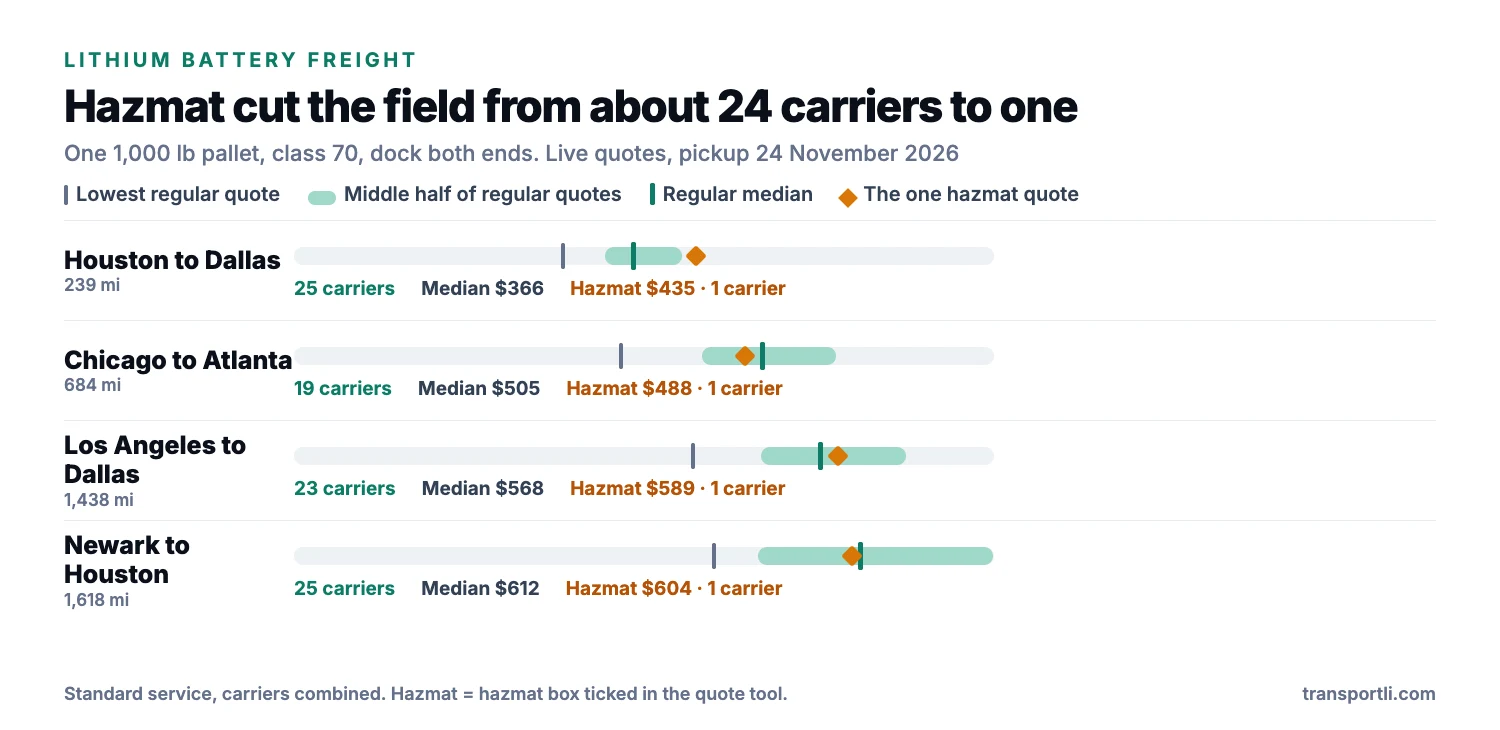
Transit followed the same pattern as regular LTL: the hazmat quote on the short Houston to Dallas lane was 2 days, against a regular median of 1 day, and on the long lanes it was 3 days against regular medians of 3 days to 4 days.
Are lithium batteries hazmat? UN numbers and Class 9
Yes. The Hazardous Materials Regulations (49 CFR) treat lithium cells and batteries as Class 9, miscellaneous hazardous materials, because they can overheat and ignite if short-circuited or damaged. The UN number tells the carrier what is in the box:
| UN number | What it covers | Typical examples |
|---|---|---|
| UN3480 | Lithium-ion batteries, including lithium-ion polymer, shipped by themselves | EV packs, home-storage batteries, e-bike and power-tool packs, loose cells |
| UN3481 | Lithium-ion batteries packed with or contained in equipment | A laptop, scooter, tool or device shipped with its battery |
| UN3090 | Lithium-metal batteries, including lithium-alloy, shipped by themselves | Non-rechargeable lithium cells and packs |
| UN3091 | Lithium-metal batteries packed with or contained in equipment | Equipment that contains a non-rechargeable lithium battery |
These four numbers are the ones named in the marking rules of 49 CFR 173.185. Since 10 May 2024, each lithium-ion battery must also show its watt-hour rating on the outside case. A traditional lead-acid car battery is a different hazard class with its own rules; see the FAQ below.
Battery shipping rule checker
Answer five questions to see which part of 49 CFR 173.185 is likely to apply and what that means for packing, marking and paperwork. It is a planning aid built from the regulation text, not legal advice, and your carrier may add its own rules.
Based on 49 CFR 173.185 as published on 16 November 2026. Quantity limits for air shipping are not covered, because freight moves by road.
Which federal rule applies: the four paths
Everything below comes from 49 CFR 173.185, the section of the Hazardous Materials Regulations that covers lithium cells and batteries, and PHMSA’s lithium battery guide for shippers.
| Path | Applies to | What it means for a freight shipment |
|---|---|---|
| Small-battery exception 173.185(c) | Lithium-ion up to 20 Wh per cell and 100 Wh per battery (up to 60 Wh and 300 Wh by highway or rail only); lithium metal up to 1 g per cell and 2 g per battery (5 g and 25 g by highway or rail only) | No hazmat shipping papers, Class 9 label or UN-specification packaging, but the lithium battery mark, strong inner and outer packaging, a 1.2 m drop test and the watt-hour marking still apply. Packages are limited to 30 kg (66 lb) unless packed with or inside equipment. |
| Fully regulated 173.185(a) and (b) | Anything over those limits, including EV packs and most home-storage batteries | UN-tested cells and batteries with a test summary, UN-specification packaging or, for single batteries of 26.5 lb (12 kg) or more with a strong casing, pallets and crates. Lithium battery mark, Class 9 lithium battery label, hazmat shipping papers and trained shippers. |
| Damaged, defective or recalled 173.185(f) | Batteries that could produce dangerous heat, fire or a short circuit, such as units returned for a safety recall | Highway, rail or vessel only, Packing Group I packaging with absorbent non-conductive cushioning, and a “Damaged/defective” marking. Few LTL carriers accept these. |
| Disposal or recycling 173.185(d) | Batteries moving by motor vehicle to a permitted storage, disposal or recycling site | Relief from testing records and UN performance packaging when packed in a strong outer packaging, and from the hazmat paperwork and marking parts when the small-battery conditions are met. |
One date to know: the older version of the lithium battery mark can still be used until 31 December 2026, after which the current mark is required. If you are printing labels now, use the current one.
How to pack lithium batteries for freight
- Check the state of the batteries. Swollen, leaking, dented or recalled batteries cannot go in a normal shipment. Treat them under the damaged-battery path and talk to a specialist carrier first.
- Protect the terminals. Tape or cap exposed terminals, or fit the manufacturer’s cover, so nothing can bridge them. The regulation requires packing that prevents short circuits, damage from shifting and accidental activation of equipment.
- Use non-conductive inner packaging. Each cell or battery goes in a non-metallic inner packaging that separates it from metal, equipment and other batteries.
- Choose the outer packaging that fits your path. Small batteries need a strong rigid outer package. Fully regulated batteries use UN-specification boxes or drums, or for single batteries of 26.5 lb (12 kg) and up with a strong casing, a pallet, crate or protective enclosure.
- Secure it to the pallet. Strap or block the battery so it cannot slide, keep the terminals from carrying the weight of anything stacked on top, and keep the load inside the pallet edges. See our pallet shipping guide and crate shipping guide.
- Mark and label the package. Add the lithium battery mark with the right UN number, the Class 9 lithium battery label when the shipment is fully regulated, and orientation arrows if the manufacturer requires them. Confirm the watt-hour rating is printed on each lithium-ion battery.
- Write the shipping paper. For fully regulated shipments the paper needs the UN number, proper shipping name, hazard class, quantity and an emergency response phone number. Put the same description on the bill of lading and use our bill of lading generator for the rest.
- Get the training in place. Hazmat employees who prepare these shipments need training under 49 CFR 172.704, repeated at least every three years. The small-battery exception removes most of the hazmat requirements, but carriers often treat a pallet of several packages as fully regulated.
- Declare it when you quote. Tick the hazmat option or tell the carrier it is lithium batteries. Declaring it late is how shipments get refused at the dock or reweighed and billed back.
Freight class and weight for battery pallets
Hazmat does not change the freight class. Class still comes from density, meaning weight divided by the cubic feet the pallet occupies. Our three test shipments came out like this on the current NMFTA density scale:
| Shipment | Size and weight | Density | Class we used |
|---|---|---|---|
| 400 lb pallet | 48 x 40 x 40 in, 400 lb | 9.0 lb per cubic foot | 100 |
| 1,000 lb pallet | 48 x 40 x 48 in, 1,000 lb | 18.8 lb per cubic foot | 70 |
| 1,200 lb crate | 60 x 40 x 24 in, 1,200 lb | 36 lb per cubic foot | 55 |
Batteries are dense, so they usually land in a low class, and a tall or oversized crate can push the class up and the price with it. Run your own numbers in the freight class calculator and read our freight class price study. For reference, passenger EV battery packs are commonly cited at about 660 to 1,100 lb, and a Tesla Powerwall 3 is listed by the manufacturer at about 290 lb and 43.5 x 24 x 7.6 inches. Always use the spec sheet for your own battery, because weights vary by model and year.
Which carriers take lithium batteries
There is no public list, because each LTL carrier sets its own hazmat policy in its tariff, and many treat all lithium batteries as hazmat even when federal rules would let a small shipment travel without hazmat paperwork. What we can say from the quotes:
- In an online quote request with hazmat ticked, a single carrier returned a price on all 12 lanes and sizes we tried, and about 24 carriers priced the same freight without it.
- The carrier that quoted charged $18 to $36 more per pallet than for the same pallet without hazmat. That is the cost of the hazmat handling, not of the batteries.
- Carriers that did not return a quote may still accept the freight through a salesperson, a hazmat desk or a different service. It is worth asking, but do not count on it.
- Quote the freight as hazmat from the start and ask each carrier for its lithium battery rules in writing, including any limit on weight, number of packages or state of charge.
We show carrier names when you book, and you can compare what comes back on our LTL quote page. For the carriers that do take regular freight, see our ranking of LTL carriers built on real quotes.
Shipping specific batteries: EV packs, home storage, e-bikes and more
EV battery packs and modules
A passenger-EV pack is a single large lithium-ion battery well over 100 Wh, so it is a fully regulated UN3480 shipment. Because it weighs far more than 26.5 lb and has a strong casing, the regulation lets it ride on a pallet or in a crate instead of UN-specification boxes, as long as it is secured and the terminals carry no load. Most online LTL quotes will not cover it, so plan on a hazmat-capable carrier, a dedicated truck or an expedited van, and book a liftgate or dock for the heavy lift. See the shipment sizes in the table above, and our liftgate delivery guide.
Home battery storage (Powerwall-class units)
Home storage batteries weigh a few hundred pounds and are well over the small-battery limits, so they are also fully regulated. They usually ship on their own pallet or in the manufacturer’s crate. The 400 lb row in our tables is a fair stand-in for one or two units.
E-bike, scooter and power-tool batteries
Small power-tool and device batteries are often under 100 Wh and can use the small-battery exception. Many e-bike and scooter batteries are larger, commonly 400 to 800 Wh, which is above even the 300 Wh highway-only limit, so they are fully regulated. Check the watt-hour rating printed on the battery case. A pallet of many packages is often treated by carriers as full hazmat even when each package would qualify. For one or two packages under 150 lb, ground parcel services with lithium battery programs are usually simpler than LTL.
Forklift and golf cart batteries
Lithium forklift and golf cart batteries are heavy, fully regulated lithium-ion units that follow the large-battery rules. Lead-acid versions are a different hazmat class (see the FAQ). Confirm which chemistry you have before you request quotes.
Used, damaged and recycled batteries
Used batteries going to a recycler can use the disposal and recycling path if they meet its conditions. Damaged, swollen or recalled batteries cannot: they need the strict damaged-battery packaging and the carrier must agree to take them. Do not put them in a normal LTL shipment.
When LTL carriers will not quote your batteries
- Expedited van or box truck. A dedicated vehicle picks up and delivers without terminals, which suits EV modules and time-sensitive loads. Start with our expedited freight and Sprinter van delivery pages.
- Truckload or partial truckload. Large or high-value shipments can move on their own trailer, which also avoids terminal handling. See the freight quote page and our LTL vs. FTL guide.
- Ground parcel for small packages. One or two small packages that meet the small-battery exception can often go by ground parcel services that publish lithium battery programs.
- A specialist hazmat carrier. Damaged, recalled or very large batteries are usually moved by carriers that handle dangerous goods every day.
Lithium battery shipping: frequently asked questions
Can you ship lithium batteries by LTL freight?
Yes, but they are Class 9 hazardous materials, so only some carriers accept them. In our quote tests with the hazmat option ticked, one carrier returned a price on every lane and size, while about 24 carriers priced the same pallets without hazmat. Declare the batteries when you request quotes and ask each carrier for its lithium battery rules.
Are lithium batteries considered hazmat?
Yes. Lithium-ion and lithium-metal cells and batteries are Class 9 under the Hazardous Materials Regulations (UN3480, UN3481, UN3090 and UN3091). Small batteries that meet the conditions of 49 CFR 173.185(c) are excepted from most hazmat paperwork and labeling, but they still need the lithium battery mark, proper packaging and a watt-hour rating on lithium-ion cases.
How much does it cost to ship lithium batteries by freight?
In our quotes, the single carrier that returned a hazmat price charged $18 to $36 per pallet, or 4% to 8%, more than for the same pallet without hazmat. Lowest regular quotes ran $290 to $454 and the hazmat quotes $422 to $604 depending on lane and size. The cheapest hazmat quote was 27% to 50% above the cheapest regular quote because most carriers did not quote it.
What is the 100 Wh rule for lithium batteries?
It is the size limit for the small-battery exception in 49 CFR 173.185(c): lithium-ion cells up to 20 Wh and batteries up to 100 Wh. For shipments by highway or rail only, the limits rise to 60 Wh per cell and 300 Wh per battery, with a special outer marking. Batteries above the limits are fully regulated.
What is the difference between UN3480 and UN3481?
UN3480 is lithium-ion batteries shipped by themselves. UN3481 is lithium-ion batteries packed with or contained in equipment. Lithium-metal batteries use UN3090 and UN3091 in the same way. The number goes on the lithium battery mark and, for fully regulated shipments, on the shipping paper.
What freight class are lithium batteries?
Freight class depends on density, not on hazmat status. In our tests a 400 lb pallet at 9 pounds per cubic foot was class 100, a 1,000 lb pallet at about 19 pounds per cubic foot was class 70 and a 1,200 lb crate at 36 pounds per cubic foot was class 55. Use the freight class calculator with your own dimensions and weight.
Do I need hazmat placards for lithium batteries?
Not for domestic ground transport. 49 CFR 172.504(f)(9) says a Class 9 placard is not required for domestic transportation, including the part of an international trip that occurs inside the United States. The package marking, labeling and shipping paper rules still apply to fully regulated shipments.
Do I need hazmat training to ship lithium batteries?
If you prepare or sign a fully regulated shipment, yes. 49 CFR 172.704 requires hazmat training for employees who do this, repeated at least every three years. PHMSA guidance says training may not apply to qualifying shipments under the small-battery exception.
Can I ship an EV battery by freight?
Yes, as a fully regulated UN3480 shipment. Because a single battery of 26.5 lb (12 kg) or more with a strong casing can be shipped on a pallet or in a crate, you do not need UN-specification boxes, but it must be secured and the terminals must not carry other loads. Expect to use a hazmat-capable LTL carrier, a dedicated truck or an expedited van.
Can damaged or recalled lithium batteries be shipped?
Only by highway, rail or vessel, never by air, and only with the strict packaging in 49 CFR 173.185(f): individual non-metallic inner packaging, absorbent non-conductive cushioning, Packing Group I packaging and a “Damaged/defective” marking. Most LTL carriers do not accept them, so ask a specialist carrier.
How do I ship lithium batteries for recycling?
Batteries moving by motor vehicle to a permitted storage, disposal or recycling site get relief from the testing records and UN performance packaging if they are in a strong outer packaging, and from the hazmat paperwork and marking parts if they meet the small-battery conditions (49 CFR 173.185(d)). Tell the carrier it is a recycling shipment.
How do I ship a car battery by freight?
A traditional lead-acid car battery is a different hazard class from a lithium battery and follows different rules, including its own highway provisions, so it should not be quoted as UN3480. Check the type printed on the battery and ask your carrier. Lithium starter batteries and EV packs follow the lithium rules on this page.
What is the best way to ship lithium batteries cheaply?
Check whether your batteries qualify for the small-battery exception, which removes most hazmat paperwork, and ship in as few packages as the rules allow. Declare hazmat up front, compare every carrier that will quote, and consider a dedicated van for a single heavy pack. The price difference between carriers was far larger than the hazmat surcharge in our tests.
How do I get a quote for lithium batteries?
Use the form at the top of this page with your pickup and delivery ZIP codes and weight, and tell us the freight is lithium batteries so we match it with carriers that handle hazmat. For other freight, see the freight quote page or the freight cost calculator.
Get quotes for your battery freight
Tell us it is lithium batteries and we match it with carriers that handle hazmat. Free, no account needed.
Get my battery freight quote →Related content
Cite this page
Cite as: Transportli, “How to Ship Lithium Batteries by Freight (2026)”, https://transportli.com/ltl-freight/how-to-ship-lithium-batteries/, updated November 16, 2026.
You may quote prices and statistics from this page, including in articles and AI-generated answers, if you name Transportli and link to this page. Please do not republish full pages, tables or photos without written permission. Data license and terms of use