

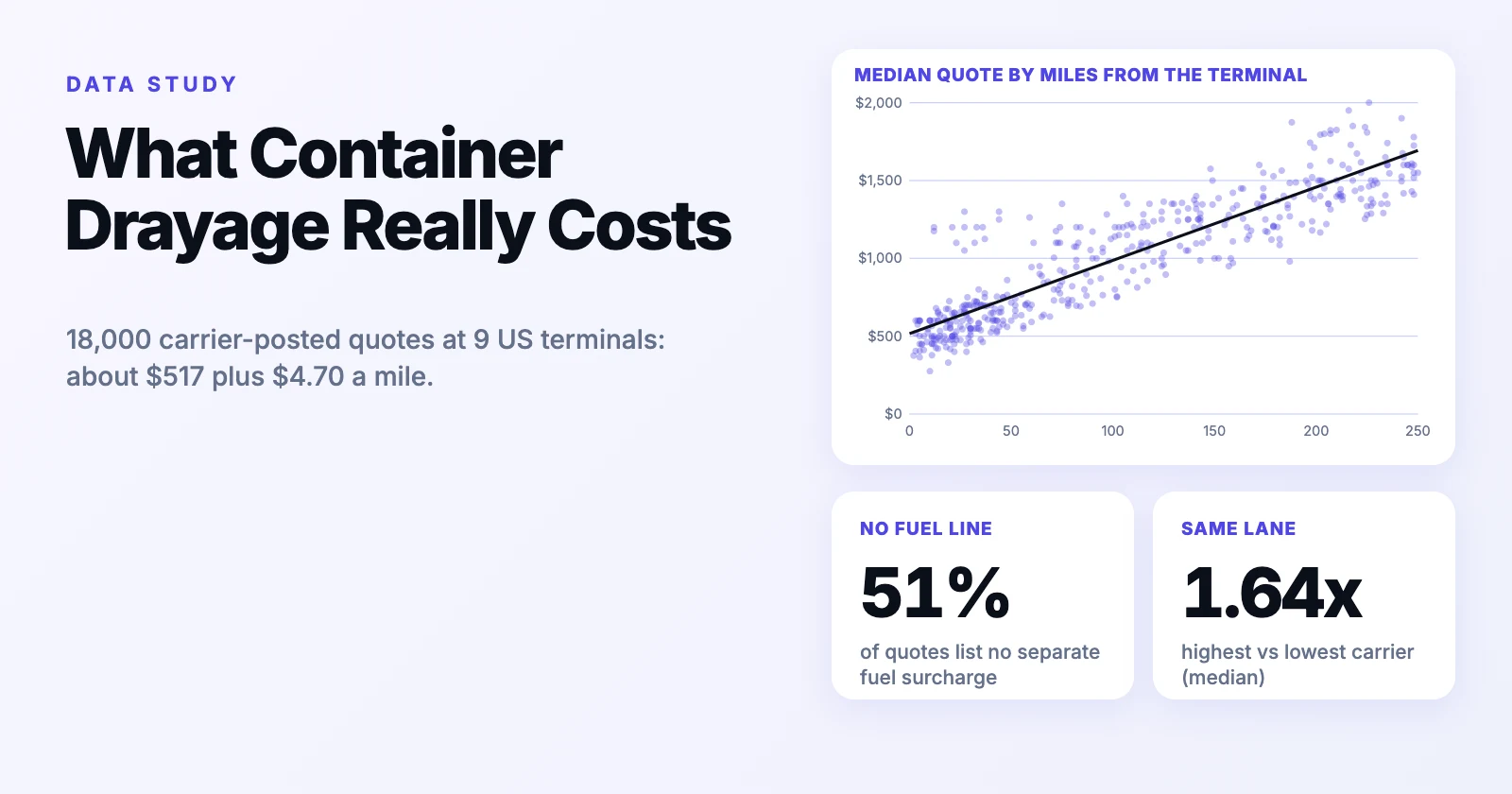
A container leaving a US port by truck costs, in our data, about $517 before the truck has gone anywhere, plus roughly $4.70 for every mile after that, up to about 250 miles. That comes from 18,000 carrier-posted drayage quotes at 9 terminals, 11,065 of them for import moves out of the port. The rest of the article breaks down what moves the price and what does not.
Distance sets most of the price
For every quote we have the one-way miles from the terminal to the delivery address and the all-in total (base rate plus fuel surcharge). Plotting the median quote for each of 464 lanes under 250 miles gives a nearly straight line: about $517 as a starting price plus $4.70 a mile, and distance alone explains about 80% of the variation between lanes. The starting amount likely reflects the fixed cost of sending a driver, tractor and chassis through the terminal gate, which is why a 5-mile move is not cheap.
The same pattern shows up as a price per mile that falls fast and then flattens:
| Distance | Quotes | Median all-in quote | Middle half of quotes | Median per mile |
|---|---|---|---|---|
| Under 25 miles | 1,736 | $503 | $443 to $623 | $21.62 |
| 25 to 50 miles | 1,600 | $624 | $508 to $720 | $8.98 |
| 50 to 100 miles | 1,369 | $775 | $653 to $950 | $5.49 |
| 100 to 200 miles | 1,907 | $1,238 | $1,080 to $1,426 | $4.12 |
| 200 to 300 miles | 2,533 | $1,600 | $1,418 to $1,900 | $3.34 |
| Over 300 miles | 1,920 | $2,850 | $2,300 to $4,180 | $3.39 |
Under 25 miles the median is $503, which works out to about $22 a mile. Between 200 and 300 miles it is $1,600, or $3.34 a mile. Past 300 miles the price per mile stays near $3.39 but the spread opens up (the middle half runs from $2,300 to $4,180), because those quotes include very different long hauls. For a short move, the number to compare is the total, not the rate per mile.
Container size and direction do not
Two things shippers often expect to change the price turned out not to, on a typical lane. First, a 20-foot container is not cheaper than a 40-foot one. On 191 lanes that had quotes for both, the median 20-foot quote was 101% of the 40-foot quote (a ratio of 1.01). Individual lanes go either way, so we found no consistent premium or discount; carriers appear to price the truck move, not the box. Most quotes (8,793 of 11,065) are for 40-foot containers.
Second, moving a container into the port costs about the same as moving one out. For 172 lanes with quotes in both directions, the median ratio of the return move to the outbound move was 1.00. A lane with a very different quote in each direction is worth questioning.
If a carrier quotes a higher price just because the container is a different size, or charges more for the way back, our data says to ask why or try another carrier. Weight, hazmat and special equipment can change the price; those are listed in our drayage fees guide, and they are not in the all-in totals used here.
The fuel surcharge trap
51% of the import quotes show no separate fuel surcharge. The share depends heavily on the port. In New York and New Jersey 79% of quotes list no fuel line, in Seattle and Tacoma 72%, and in Miami 60%, against 32% in Los Angeles and Long Beach and 32% in Oakland.
That matters because a quote with no fuel line is not a cheaper quote. We compared quotes with and without a fuel surcharge on the same terminal and distance band (50 comparisons). Quotes without a fuel line had a base rate 37% higher, and their all-in total was within 2% of the others. The fuel is simply folded into the base.
Port against port at the same distance
Because distance explains so much, the fair way to compare ports is to hold distance constant. For a short move under 25 miles, the median quote ran from $365 in Savannah to $700 in Houston, with New York and New Jersey at $650. For moves of 100 to 200 miles the order changes: $1,033 in Oakland, $1,120 in Savannah and $1,362 in Houston, the top of the range.
Median all-in quote by terminal and distance (blank where a terminal has fewer than 50 quotes in that band; the lowest in each column is marked in bold)
| Terminal | 0 to 25 | 25 to 50 | 50 to 100 | 100 to 200 | 200 to 300 | Over 300 |
|---|---|---|---|---|---|---|
| Oakland / San Francisco | $444 | $550 | $680 | $1,033 | $1,408 | $3,252 |
| Miami / Fort Lauderdale | $450 | $462 | $650 | $1,102 | $1,495 | $3,360 |
| Savannah | $365 | – | – | $1,120 | $1,577 | $2,390 |
| Norfolk | $490 | – | $800 | $1,152 | $1,500 | $3,750 |
| Los Angeles / Long Beach | $490 | $632 | $791 | $1,208 | $1,947 | $2,839 |
| Seattle / Tacoma | $450 | $550 | $800 | $1,250 | $1,775 | $3,308 |
| Chicago rail ramps | $560 | $652 | $850 | $1,277 | $1,899 | $3,138 |
| New York / New Jersey | $650 | $750 | $1,100 | $1,350 | $1,988 | $3,300 |
| Houston | $700 | $700 | $750 | $1,362 | $1,750 | $2,470 |
We cannot say why Houston ran highest in both bands. The data only shows what carriers posted, not their costs, and terminals differ in gate wait times, chassis supply and local road conditions. The practical point is smaller: a lane quote from another port is not a good guide to what your lane will cost, so quote the actual terminal and delivery address.
The same lane, different carriers
The most useful number for a shipper may be this one. On 423 lanes with quotes from at least 6 different carriers (a median of 9 carriers per lane), the highest carrier was a median 1.64x the lowest. The cheapest carrier was 18% below the lane median, and the middle half of carriers were only about $170 apart. So most carriers are close together, with a few well above and a few well below.
What does that mean in dollars? If you picked one carrier at random on a typical lane, you would pay the average of the field. We simulated asking three random carriers and taking the lowest: the expected result was 13% below picking a single carrier. That is a modest gain per move, but it is real money on a container that moves every week, and it takes one more phone call or one quote request.
What to do with this
- Budget with the line, then verify. For a move under about 250 miles, $517 plus $4.70 a mile is a reasonable first estimate before any extras. Our fees guide has an estimator that adds chassis, pre-pull, storage and detention.
- Compare all-in totals. Ignore quotes that show only a base rate. Half of them hide fuel in the base, and half show it separately.
- Do not pay for container size or direction. A different box size or the return leg should not change the price on a typical lane.
- Get at least three quotes. The same lane quotes a median 1.64x between the lowest and highest carrier.
- Quote your actual terminal and address. Port averages are not a substitute: Houston and Savannah differ by $335 on a short move.
Need a container moved? Tell us the terminal and delivery address and compare real carrier quotes.
Get container quotes →Methodology and limits
- Where the quotes come from. Carrier-posted drayage quotes collected from a public rate-history listing for nine terminals: Los Angeles and Long Beach, Oakland and San Francisco, Seattle and Tacoma, Houston, New York and New Jersey, Savannah, Norfolk, Miami and Fort Lauderdale, and the Chicago rail ramps. We kept the newest 2,000 quotes per terminal, so 18,000 quotes in all, posted by 1,684 carriers (carriers are identified only by anonymous codes and no carrier names are used).
- Posted quotes, not paid prices. These are what carriers quoted, not what shippers paid. Real invoices include extras and discounts that are not shown here.
- Time window. Quotes run through November 18, 2026. Because each terminal contributes its newest 2,000 quotes, the oldest quotes are from September 2026 for Chicago and New York and New Jersey, but from February 2026 for Miami and April 2026 for Seattle. We do not compare months because the mix of lanes changes from month to month.
- What is counted. The import analysis uses the 11,065 quotes that run from the terminal to a delivery address for 20-foot, 40-foot or 20/40-foot containers, with a total and a distance. The all-in total is base rate plus fuel surcharge; chassis, pre-pull, storage, detention and tolls are not included.
- The distance line. A straight-line fit through the median all-in quote of 464 lanes (at least 5 quotes from at least 3 carriers, up to 250 miles). R squared is 0.80. It is a rule of thumb, not a quote.
- Carrier spread. Uses the per-carrier median on lanes with at least 6 carriers, 40-foot containers only. The three-quote result is a simulation of 2,000 random draws per lane, assuming each carrier is equally likely to be picked.
- Not a random sample. Terminals and lanes are the ones carriers chose to quote publicly, so busy lanes are over-represented. We cover 1,219 delivery cities in 50 states.
- Citing it. You may quote and cite these figures with a link back to this page; see our data license.
Frequently asked questions
How much does container drayage cost?
In our data, a typical move costs about $517 before the truck has moved, plus about $4.70 a mile, up to roughly 250 miles. The median all-in quote was $503 under 25 miles, $1,238 for 100 to 200 miles and $1,600 for 200 to 300 miles. Extras such as chassis and detention are not included.
Is a 20-foot container cheaper to truck than a 40-foot one?
Not on a typical lane. On 191 lanes with quotes for both sizes the median 20-foot quote was 101% of the 40-foot quote. Individual lanes go either way, so size alone should not set the price.
Does it cost more to truck a container into the port than out of it?
Not in our data. On 172 lanes with quotes in both directions the median return quote was 1.00 times the outbound quote.
Why do some drayage quotes not show a fuel surcharge?
51% of the import quotes list no separate fuel surcharge, and the share varies by port (79% in New York and New Jersey, 32% in Los Angeles and Long Beach). Quotes without one had a base rate about 37% higher, with an all-in total within 2% of quotes that list fuel separately.
Which port has the cheapest drayage?
It depends on the distance. For moves under 25 miles Savannah had the lowest median ($365) and Houston the highest ($700). For 100 to 200 miles Oakland was lowest ($1,033) and Houston highest ($1,362). Quote your own terminal and address.
How much do drayage quotes vary between carriers?
On 423 lanes with at least 6 carriers, the highest carrier was a median 1.64 times the lowest, and the cheapest was 18% below the lane median. Asking three carriers instead of one saved about 13% in our simulation.
Do these quotes include chassis, detention and other fees?
No. The all-in total here is the base rate plus fuel surcharge. Chassis rental, pre-pull, storage, detention, tolls and overweight charges come on top; see our drayage fees guide for typical amounts.
How was this data collected?
From 18,000 carrier-posted quotes for nine terminals, newest first, through November 18, 2026. They are quotes, not paid prices, and carriers appear only under anonymous codes. See the methodology section for limits.
Related guides
Cite this page
Cite as: Transportli, “Drayage Rates Study: What 18,000 Container Trucking Quotes Show”, https://transportli.com/blog/drayage-rates-study/, updated November 19, 2026.
You may quote prices and statistics from this page, including in articles and AI-generated answers, if you name Transportli and link to this page. Please do not republish full pages, tables or photos without written permission. Data license and terms of use