

To ship artwork by freight, put the piece in a crate built for it, weigh and measure the crate, declare its value, and book it as LTL freight or on a dedicated Sprinter van. We priced one crated painting, 52 x 14 x 44 inches and 90 lb, on 12 lanes with live quotes: the lowest came to $285 (Chicago to Milwaukee), and the middle quote ran from $351 on a short lane to $565 coast to coast. Below: what drives that price, how to pack, how to insure, and when a van beats LTL.
The short answer: how to ship artwork
- Pick the mode by size, value and distance. A small, low-value piece can go by parcel. A crated painting or sculpture goes LTL freight. A short haul of up to about 400 miles, several crates or a very fragile piece can go on a dedicated Sprinter van with no terminal handling. Irreplaceable work belongs with a fine-art specialist.
- Crate it, do not just box it. Build or buy a rigid crate with the artwork held off the walls by foam, and measure and weigh the finished crate, because freight is priced on the crate, not the picture.
- Get the freight class right. Class comes from density. A crate of about 5 pounds per cubic foot is class 200; use the planner below or the freight class calculator.
- Declare the value and insure it. LTL carrier liability is limited by weight under the carrier’s tariff, which is usually far below what a painting is worth. Buy declared-value or fine-art coverage before pickup.
- Book with the right accessorials. Say if pickup or delivery is a home, a gallery without a dock, or needs a liftgate. Getting this wrong is how a $350 quote becomes a rebilled shipment.
- Inspect before you sign. Photograph the crate at pickup, check it on delivery, and write any damage on the delivery receipt before the driver leaves.
How much does it cost to ship artwork? Real quotes on 12 lanes
We asked for live LTL quotes on one crated painting for pickup on Friday 20 November 2026, from a business with a loading dock to a business with a loading dock. The crate was 52 x 14 x 44 in, 90 lb, 18.5 cubic feet, which is 4.9 pounds per cubic foot and freight class 200 on the standard density chart. Each row shows standard-service quotes only (carriers’ guaranteed and volume quotes are left out), counting each carrier once at its lowest price and dropping quotes more than three times the lane median.
| Lane | Miles | Carriers | Lowest quote | Median quote | Middle half of quotes | Typical transit |
|---|---|---|---|---|---|---|
| New York to Los Angeles | 2,790 | 16 | $432 | $565 | $506–$712 | 5–6 days |
| Los Angeles to Chicago | 2,015 | 21 | $392 | $536 | $459–$595 | 4 days |
| Miami to New York | 1,280 | 17 | $377 | $463 | $424–$629 | 4 days |
| Chicago to Dallas | 925 | 28 | $353 | $447 | $386–$561 | 2 days |
| San Francisco to Seattle | 810 | 17 | $393 | $482 | $411–$507 | 2 days |
| Los Angeles to San Francisco | 383 | 20 | $357 | $438 | $389–$462 | 1 day |
| Chicago to Detroit | 283 | 20 | $304 | $401 | $371–$477 | 1 day |
| Houston to Dallas | 240 | 23 | $300 | $351 | $325–$390 | 1 day |
| Miami to Orlando | 235 | 16 | $287 | $355 | $321–$402 | 1 day |
| New York to Boston | 215 | 14 | $354 | $406 | $384–$680 | 2 days |
| Los Angeles to San Diego | 120 | 19 | $321 | $405 | $381–$448 | 1 day |
| Chicago to Milwaukee | 92 | 27 | $285 | $385 | $343–$461 | 1 day |
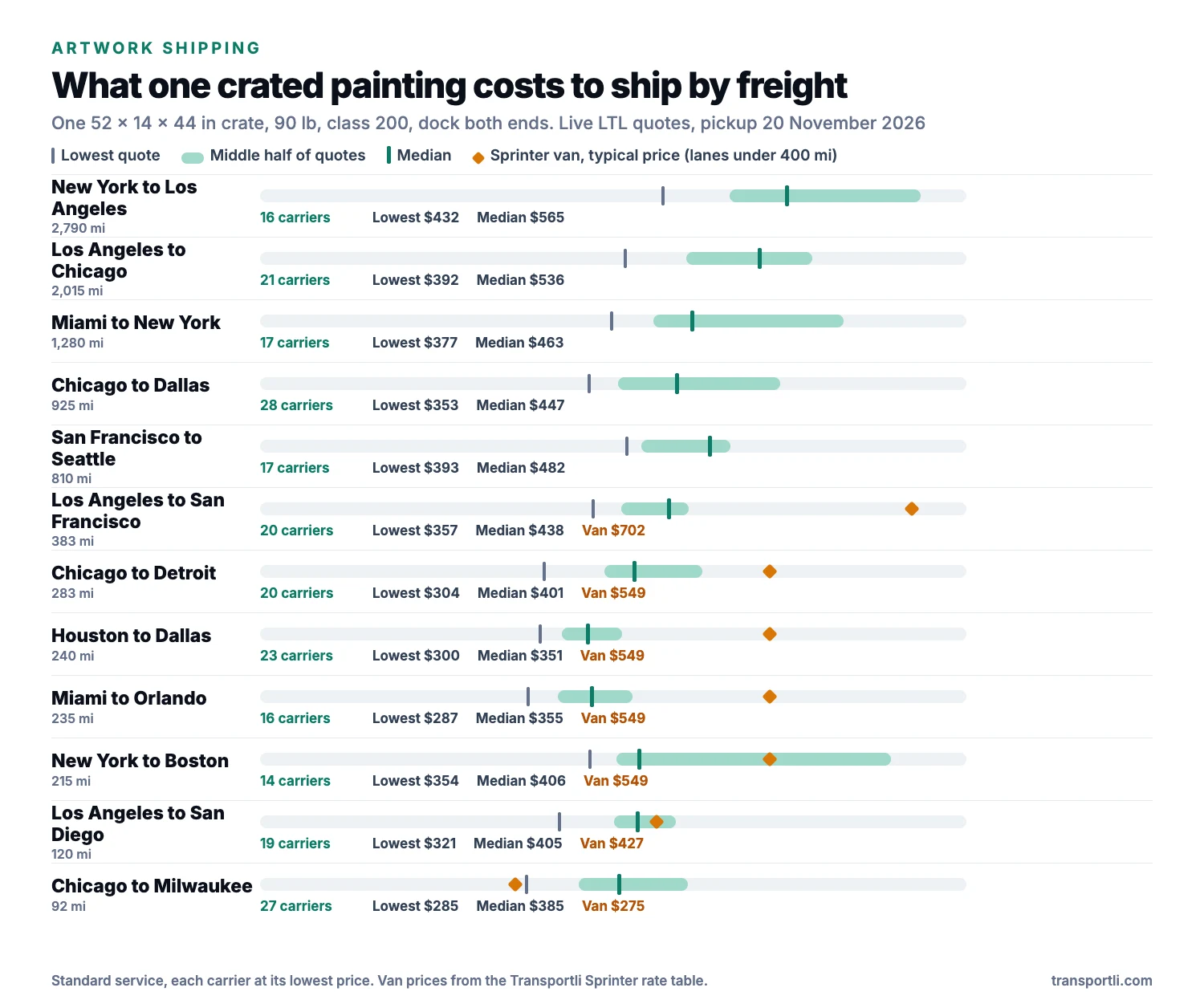
Three things stand out:
- Distance matters less than you would expect. A 90 lb crate is a small shipment, so many carriers price it at or near a minimum charge. The lowest quote moved only from $285 on the shortest lane to $432 coast to coast.
- The spread between carriers is the real saving. On every lane the highest standard quote was 1.7 to 3.3 times the lowest. Comparing carriers matters more than haggling with one.
- Freight class changes the cheap end more than the middle. The quote tool suggested class 175 for this crate; the density chart says 200. On New York to Los Angeles the lowest quote went from $390 at class 125 to $407 at 175 and $432 at 200, while the median stayed at $565. On Houston to Dallas the lowest went from $288 to $300. The median did not move on either lane.
What moves the price
| Change | Effect in our quotes | Based on |
|---|---|---|
| A bigger crate (78 x 16 x 62 in, 220 lb: 2.4 times the volume, 2.4 times the weight) | Lowest quote +0% to +13%; median -2% to +30% | Same 12 lanes, class 125 both sizes |
| Four crates instead of one (360 lb total) | Lowest quote +0% to +45%; median +6% to +61% | NYC–LA, Chicago–Dallas, NYC–Boston, Houston–Dallas, class 125 |
| Delivery to a home instead of a dock | Lowest quote +14% to +27%; median +15% to +25% | Same four lanes, class 125 |
| Guaranteed delivery instead of standard | Carriers that offer it priced it well above standard, often 15% to 60% higher and more for time-of-day guarantees; many carriers do not offer it on every lane | Seen across the runs; not tracked as a statistic |
Carrier names are not shown here. You see them when you book, and our best LTL carriers page ranks them by the quotes we have gathered. For how freight is priced in general, see what LTL freight is.
Sprinter van or LTL for artwork: which is better under 400 miles?
LTL freight is cheap because your crate shares a truck and is unloaded, sorted and reloaded at one or more terminals. For artwork, that handling is the risk. A dedicated Sprinter van picks the crate up and drives it to the door with the same driver, no terminals and no other freight stacked near it. The question is what that costs.
| Lane | Miles | LTL lowest / median (one crate) | Sprinter van (typical) | Van vs LTL median |
|---|---|---|---|---|
| Chicago to Milwaukee | 92 | $285 / $385 | $275 | 29% below |
| Los Angeles to San Diego | 120 | $321 / $405 | $427 | about the same |
| New York to Boston | 215 | $354 / $406 | $549 | 35% above |
| Miami to Orlando | 235 | $287 / $355 | $549 | 55% above |
| Houston to Dallas | 240 | $300 / $351 | $549 | 56% above |
| Chicago to Detroit | 283 | $304 / $401 | $549 | 37% above |
| Los Angeles to San Francisco | 383 | $357 / $438 | $702 | 60% above |
The LTL figures are live quotes from the table above. The van prices come from the typical-rate table on our Sprinter van delivery page (fuel included, California pickups have a $427 minimum). Those are typical prices rather than a live quote for each lane, so treat the comparison as a guide and get a quote for your own lanes.
- Up to about 120 miles, a van is roughly the price of LTL. On Chicago to Milwaukee the van price sits below the LTL median, and on Los Angeles to San Diego it is within a few percent of it.
- From 200 to 400 miles, a van costs about 35% to 60% more than the LTL median for a single crate, and 1.6 to 2.0 times the lowest LTL quote. That is the premium for no terminals and a direct delivery.
- The van pulls ahead as crates are added. The van price covers the whole vehicle, but LTL is priced by weight. On New York to Boston four crates cost a median of $597 by LTL in our test, against about $549 for the van. On Houston to Dallas four crates were still cheaper by LTL (about $370 median against $549).
- Use a van when the work is fragile, when you have several pieces, when you want one driver and a delivery window, or when the pickup or delivery has no dock. It is also the better fit for an oversized crate; check it against the Sprinter van cargo dimensions.
Artwork shipping planner: crate class, mode and price range
Enter your finished crate, not the picture. The planner works out density and freight class, suggests LTL or a van for your distance, and shows the quote range we saw on lanes of that length. It is built from the 12-lane test above and is a planning guide, not a quote.
Prices are the range of live LTL quotes we saw for one crate of 90 to 220 lb on lanes of that length (pickup 20 November 2026, dock to dock). Class uses the standard density chart. Heavier crates, more crates, special handling and a different date can all change the price.
How to pack and crate artwork for shipping
These steps are standard practice among art handlers. Follow the instructions of your insurer and the artist or gallery where they differ.
- Document the piece first. Photograph the front, back, corners, frame and any existing damage, with the date. You will need these if you file a claim.
- Protect the surface. Cover paintings with glassine or acid-free paper. Do not put bubble wrap directly on paint or on a delicate surface, because it can leave an impression.
- Deal with glass. For framed work under glass, many shippers replace the glass with acrylic for transport or tape the glass in an X so a break stays contained. Check with the owner before changing a frame.
- Protect corners and edges. Add rigid corner protectors, then wrap the whole piece in cushioning.
- Float it in the crate. A common rule of thumb is about 2 inches of foam on every side, so nothing touches the crate wall and a knock to the outside never reaches the work. Size the crate to the piece plus that cushioning, and avoid empty space, because the carrier bills for the outside dimensions.
- Build the crate rigidly. A plywood crate on a frame, closed with screws rather than nails, can be opened without a hammer blow. Keep the crate off the floor on runners or skids so a forklift or pallet jack can lift it.
- Pack paintings on edge. Ship framed and canvas work upright on its long edge, not flat, and never stack anything on top. Mark the crate fragile and this side up on more than one face.
- Keep the outside plain. Describe the contents neutrally on the crate (for example, framed pictures) and put the value in the paperwork, not on the label.
- Weigh and measure the finished crate. Use the outside dimensions and the full weight, then enter them in the planner above.
If you ship often, crate shipping covers crate construction and freight class in more detail, and pallet shipping explains when a crate should sit on a pallet.
Insurance and liability when shipping artwork
- Default liability is limited. An LTL carrier’s liability is set in its tariff, usually as a per-pound amount, and carriers may exclude or restrict items such as artwork unless you declare the value. Ask for the number in writing before you book.
- Declare the value and pay for coverage. You can buy declared-value coverage from the carrier, a freight insurance policy, or a fine-art policy through your own insurer. The right choice depends on the value of the work.
- Condition report and photos. The photos you took before packing are your evidence. Note any damage on the delivery receipt before the driver leaves, even if the crate looks fine from outside, and open the crate promptly.
- Claims have deadlines. Federal law gives at least nine months from delivery to file a written claim with a carrier, but carriers ask for fast notice of concealed damage, and the sooner you report it the better.
Parcel, LTL, Sprinter van or art shipper: which should you choose?
| Option | Best for | Watch out for |
|---|---|---|
| Parcel (UPS, FedEx, USPS) | Small framed prints and works well under about 150 lb in a box | Package size and weight limits, little control over handling, hard to insure high value |
| LTL freight | Crated paintings and sculpture over about 70 lb, longer distances, tight budgets | Terminal handling, delivery windows, liability limited by weight, accessorials for home or no-dock delivery |
| Sprinter van (dedicated) | Fragile or multi-crate jobs up to about 400 miles, home delivery, one driver start to finish | Costs more than LTL on a single crate at 200 to 400 miles |
| Fine-art shipper | Museum-grade or irreplaceable work, climate control, art-specific handling and coverage | Highest price, usually quoted per job |
For shipping to a gallery, fair or event, our trade show shipping page covers dock appointments and advance warehouse deadlines that also apply to art fairs. We cover US domestic shipments. International artwork shipping needs a forwarder who handles export paperwork, duties and customs.
Artwork shipping: frequently asked questions
How do you ship artwork safely?
Crate it rigidly, float the piece in about 2 inches of foam on every side, protect the surface with glassine instead of bubble wrap, mark the crate fragile and this side up, photograph everything before packing, and declare the value and buy coverage. Then choose LTL freight, a dedicated van or a fine-art shipper to match the value and distance.
How much does it cost to ship a painting?
In our live quotes on 12 lanes, one crated painting of 90 lb cost from $285 at the lowest to a median of $351 to $565, depending on distance. Delivery to a home added about 14% to 27%, and four crates ran up to about 45% more than one at the lowest quote.
How much does it cost to ship artwork across the country?
For one crated painting we saw a lowest quote of $432 on New York to Los Angeles and $392 on Los Angeles to Chicago, with medians of $565 and $536 and transit of about 4 to 6 days. Large or heavy crates and several pieces cost more.
How do you ship large artwork?
Build a crate to the piece plus cushioning, weigh and measure the crate, and ship it LTL or on a Sprinter van. A crate of 78 x 16 x 62 inches and 220 lb raised the lowest quote by 0% to 13% over a 90 lb crate in our tests. Check the crate against the Sprinter cargo dimensions before booking a van.
How do you ship framed artwork with glass?
Many shippers replace the glass with acrylic for transport, or tape the glass in an X so a break stays contained, add corner protectors, and crate the frame. Ask the owner before changing a frame, and photograph it first.
What freight class is artwork?
Class depends on density, not on the contents. A crate of about 5 pounds per cubic foot is class 200 on the density chart, a denser crate of 6 to 7 pounds is class 150, and a very light, large crate can be 300 or higher. Use the planner above or the freight class calculator. In our tests the lowest quote was more sensitive to class than the median.
Is LTL freight safe for artwork?
It can be, if the crate is built for it. The risk is terminal handling, where freight is unloaded, sorted and reloaded. A rigid crate on runners, marked clearly and properly insured, reduces that risk. For fragile work on short hauls, a dedicated Sprinter van avoids terminals altogether.
Is a Sprinter van better than LTL for shipping art?
For fragile work, several crates or a home delivery, usually yes, because one driver takes the crate door to door. It costs more for a single crate at 200 to 400 miles: about 35% to 60% above the LTL median in our comparison. Under about 120 miles the two are close in price.
Do I need to crate artwork for freight?
Yes. Carriers do not load unprotected paintings, and a cardboard box does not protect work from pressure or from forklift forks. A rigid crate with foam on every side is the standard for freight.
Does LTL insurance cover artwork?
Usually only to the carrier’s tariff limit, which is set by weight and is often far below a painting’s value. Declare the value, ask for the liability limit in writing and buy additional coverage or a fine-art policy.
How do I ship art prints?
Flat prints can go in a rigid mailer or between boards by parcel. Rolled prints go in a strong tube. Freight is only worth it for framed work or large quantities.
Can I ship artwork internationally through Transportli?
We cover US domestic shipments. International artwork shipping needs export paperwork, customs and often a specialist forwarder, so ask a fine-art shipper that works across borders.
How do I get a quote for shipping artwork?
Use the form at the top of this page with your pickup and delivery ZIP codes and the total packed weight, or request a van quote on the freight quote page for short hauls and multi-crate jobs.
Get quotes for your artwork shipment
Tell us the crate size and weight and we match it with carriers and Sprinter vans. Free, no account needed.
Get my artwork freight quote →Related content
Cite this page
Cite as: Transportli, “How to Ship Artwork by Freight or Sprinter Van”, https://transportli.com/ltl-freight/how-to-ship-artwork/, updated November 17, 2026.
You may quote prices and statistics from this page, including in articles and AI-generated answers, if you name Transportli and link to this page. Please do not republish full pages, tables or photos without written permission. Data license and terms of use