

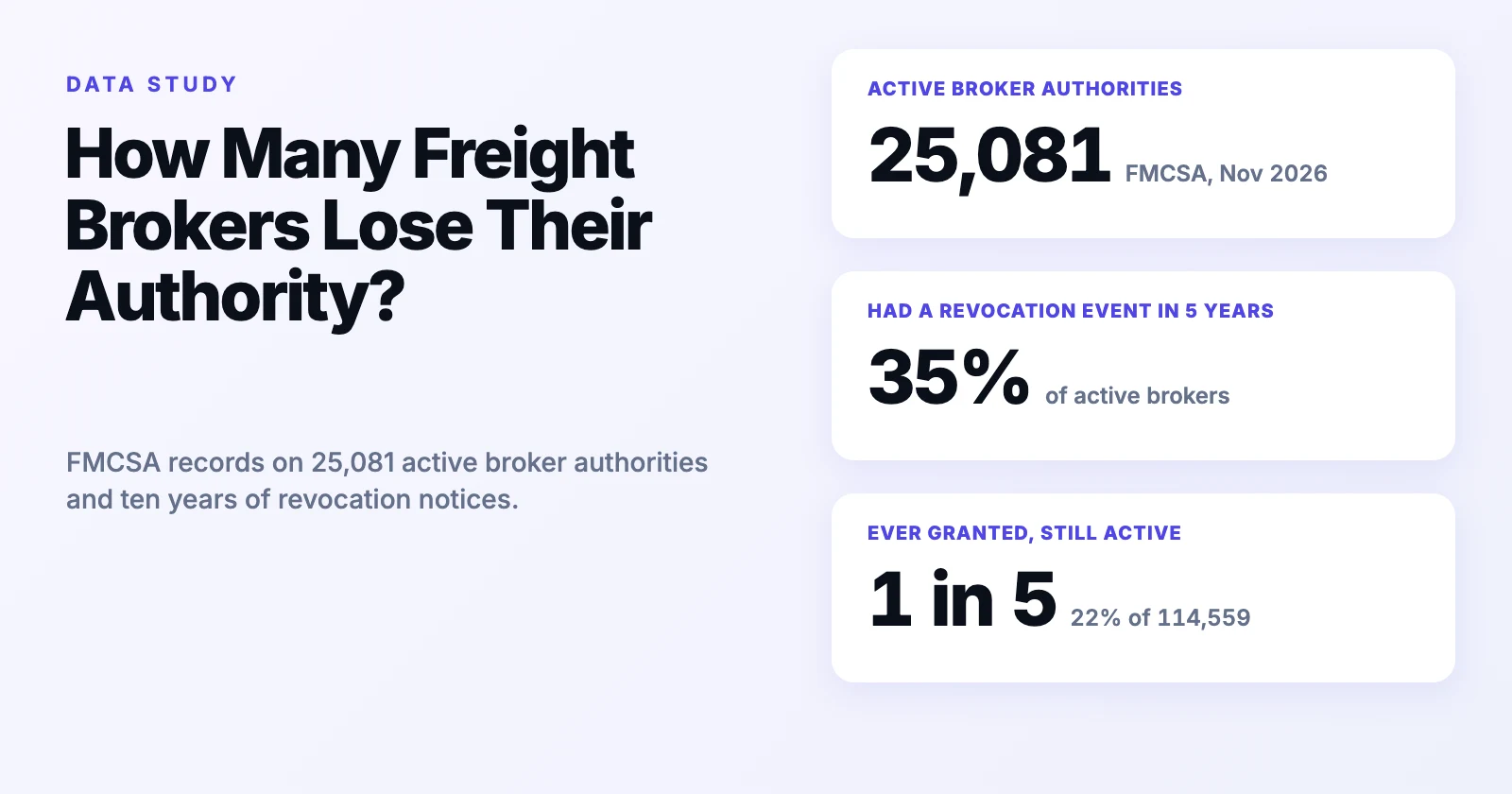
FMCSA lists 25,081 active freight broker authorities today. We pulled every one of them from FMCSA’s open data, along with their full authority history, to answer a question shippers and carriers keep asking: how often do brokers lose their authority, and what happens next?
The short version: 35% of active brokers (8,852) have had at least one revocation event in the last five years, notices have risen more than fourfold since 2016, and almost all of them are cured within weeks. A full revocation is a different story. Only about 1 in 6 brokers that lost their authority ever got it back.
We name no companies in this study. It is about the whole broker population. If you want to look up one company, our free broker checker below uses the same FMCSA data.
The broker boom and bust
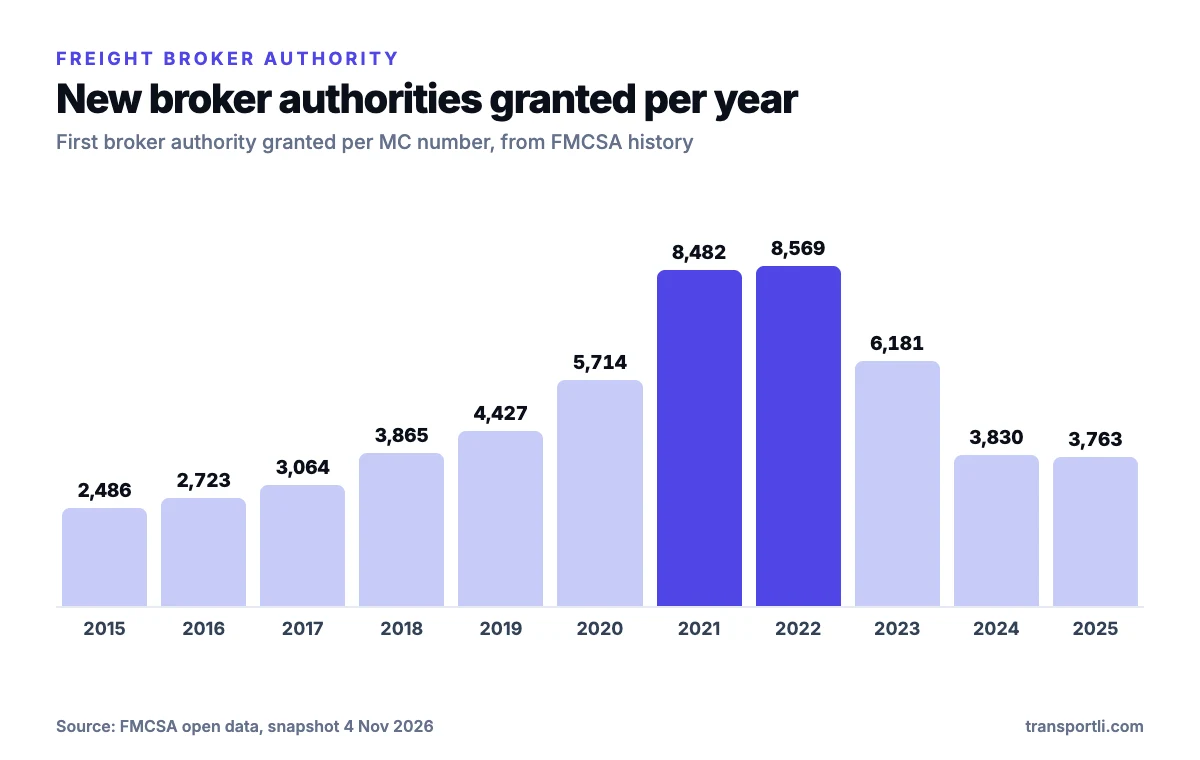
FMCSA’s history shows 114,559 broker authorities granted over the life of the data, and only 22% of them are active today. The rest were revoked, withdrawn or otherwise became inactive.
New authorities surged in the early 2020s: 8,482 were granted in 2021 and 8,569 in 2022, against 4,427 in 2019. They then fell about 55% by 2024 (3,830). That timing lines up with the pandemic freight boom and the cooling that followed, but our data shows when authorities were granted, not why.
The median active broker authority is 7.0 years old, and 25% were granted less than three years ago. About 40% are at least ten years old.
Revocation notices keep rising
An involuntary revocation notice is FMCSA’s warning that a broker’s operating authority will be revoked unless something is fixed, usually a lapsed bond or insurance filing. FMCSA’s records show the notice, not the reason, so we treat the cause as unknown for any single broker.
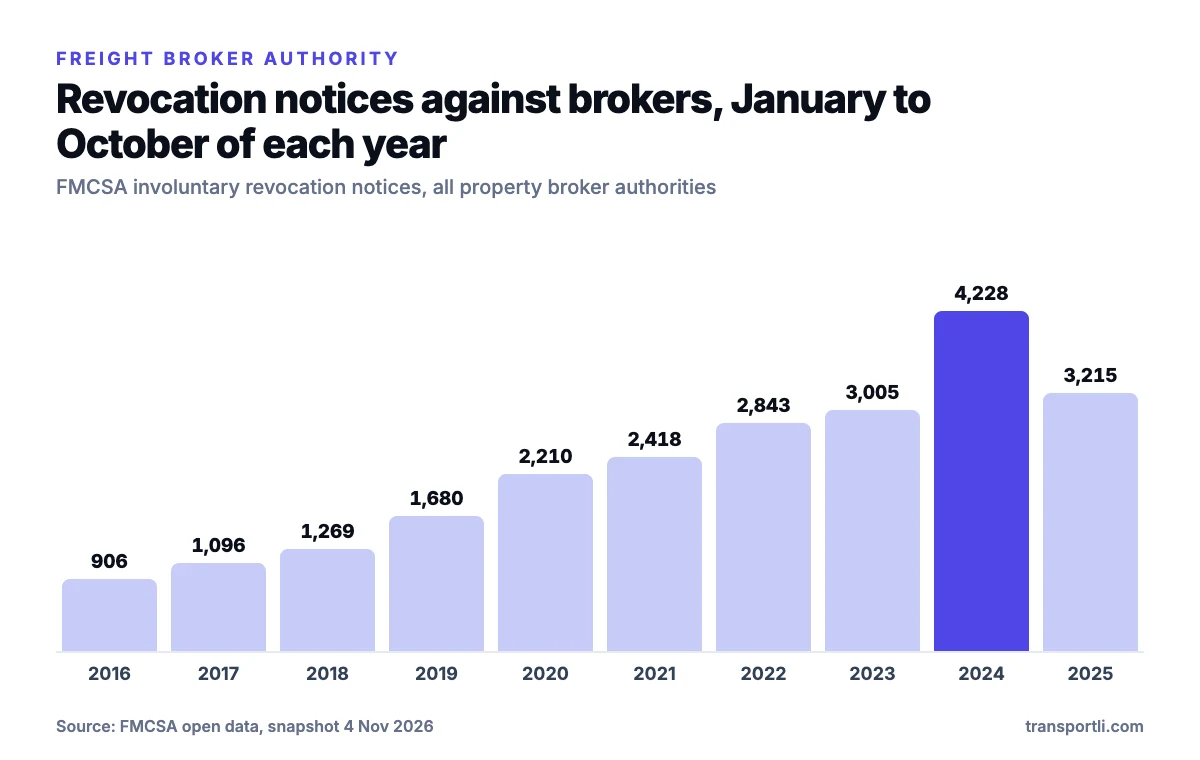
Across all broker authorities, notices climbed from 1,085 in 2016 to a peak of 4,768 in 2024. For a like-for-like comparison with 2025, which our data covers reliably only through October, January to October notices went from 906 in 2016 to 4,228 in 2024 and 3,215 in 2025, a drop of about 24% from the 2024 pace.
Final revocations, where a broker actually loses its authority, followed the same shape and peaked in 2023 at 8,545, up from 1,905 in 2016.
What happens after a notice
Nearly all notices are cured. 99.6% of the 52,228 notices through October 2025 ended in a “discontinued revocation,” meaning FMCSA dropped the revocation, typically after the missing filing was made. The median time to cure was 17 days, and 9 in 10 were cured within 34 days.
A final revocation is a different outcome. Across all broker authorities, FMCSA recorded 91,987 final revocations through October 2025, and only 16,037 (17%) were later reinstated. For those that came back, the wait varied widely:
| Time to reinstatement | Authorities | Share of reinstated |
|---|---|---|
| Within 7 days | 1,833 | 11% |
| 8 to 30 days | 3,909 | 24% |
| 31 to 90 days | 2,672 | 17% |
| 91 days to 1 year | 3,019 | 19% |
| More than 1 year | 4,604 | 29% |
The median wait was 77 days. About 21% of the active broker authorities we studied (5,222) had a final revocation followed by reinstatement at some point. For a shipper, that means a currently active broker can still have a gap in its history, which is why the date matters when you check.
When notices are served
We expected a winter spike from annual bond renewals, so we tested it. The data did not show one: January and February each held about 8% of notices, close to an even spread. The real peaks were September (14.3% of all notices) and, more modestly, April (10.7%), against 8.3% in an evenly spread year.
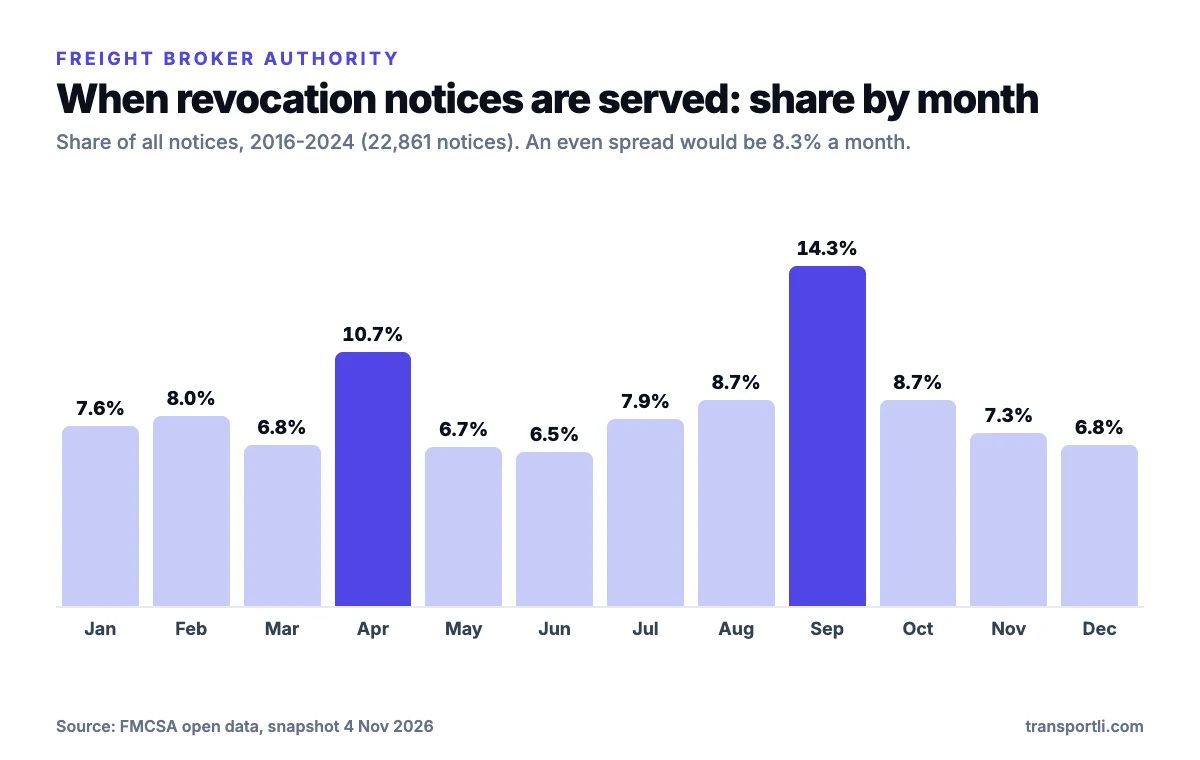
We cannot say why September stands out. FMCSA does not publish a reason, and a seasonal pattern in filings, renewals or processing could all produce it. We report it as a pattern worth knowing about: if you rely on a broker, check its status again in the autumn, not just when you first hire it.
Which brokers are hit
Revocation events are not spread evenly across brokers of different ages. Among active brokers granted authority 3 to 10 years ago, more than half (56% and 54%) had at least one event in the last five years, against 34% for authorities 15 or more years old.
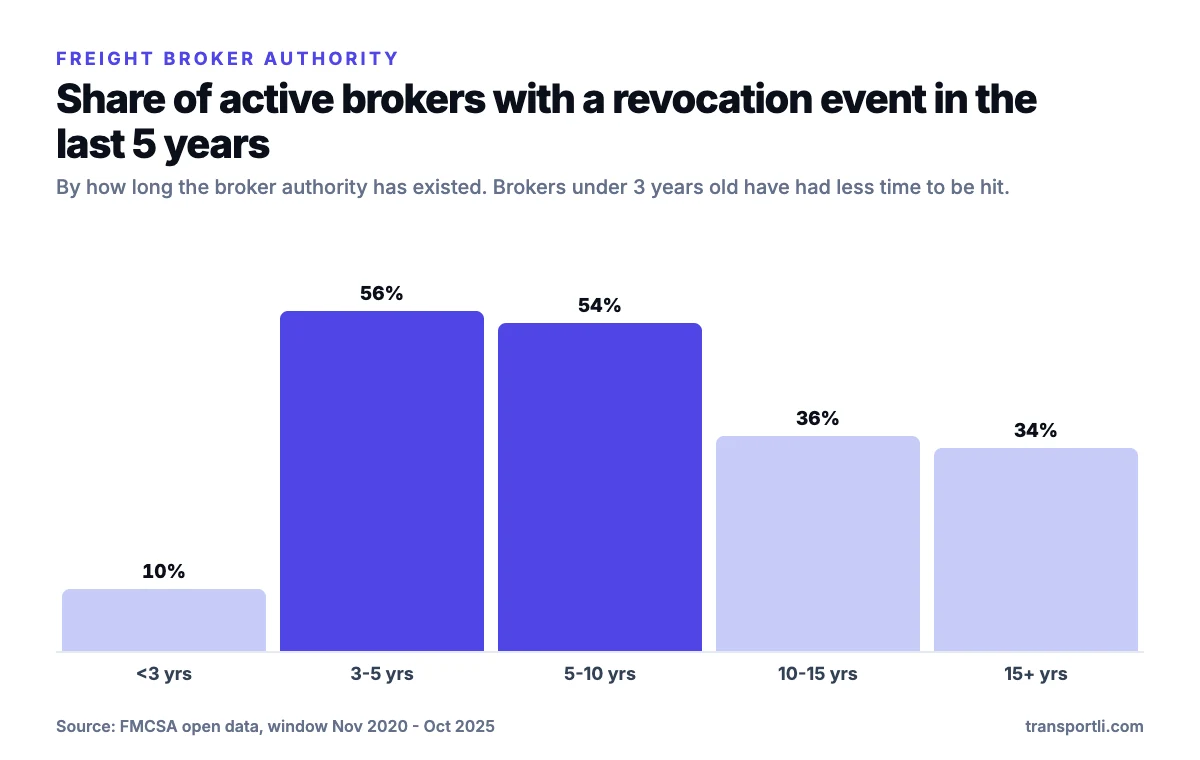
| Authority age | Active brokers | At least 1 event (5 yrs) | 3 or more events (5 yrs) |
|---|---|---|---|
| Under 3 years | 6,189 | 10% | 0% |
| 3-5 years | 3,599 | 56% | 4% |
| 5-10 years | 5,061 | 54% | 9% |
| 10-15 years | 3,078 | 36% | 4% |
| 15 years+ | 6,800 | 34% | 3% |
Two cautions. Brokers under three years old look cleanest (10%), but they have had less time to be hit, so the comparison is not like for like. And this counts only brokers that are still active: brokers that were revoked and never returned are not in this group, so the real share of brokers that ran into trouble is higher than 35%.
Repeat events are rarer. 947 active brokers (4%) had three or more revocation events in the five years, and the highest rate was among brokers granted 5 to 10 years ago (9%).
Where brokers are based
Texas, California and Florida have the most active broker authorities. The share with a recent revocation event is fairly similar across the large US states, roughly one-third to two-fifths.
| State or province | Active broker authorities | Share with a revocation event (5 yrs) |
|---|---|---|
| Texas | 3,057 | 36% |
| California | 2,688 | 38% |
| Florida | 2,069 | 36% |
| Illinois | 1,597 | 40% |
| Ohio | 949 | 36% |
| Georgia | 929 | 39% |
| New York | 787 | 38% |
| Pennsylvania | 768 | 33% |
| New Jersey | 750 | 34% |
| Ontario (Canada) | 698 | 17% |
| Michigan | 617 | 37% |
| North Carolina | 594 | 36% |
Ontario and Quebec stand out at about 17% and 18%. We do not know why. Differences in how Canadian-based brokers file, or in the mix of business, could both play a part, so we show the figure without interpreting it. Smaller states are in the data but omitted here because of small counts.
What it means for shippers
- A single notice is not a red flag by itself. About a third of active brokers had one in five years and nearly all were cured within weeks. Repeated notices, or a final revocation followed by reinstatement, deserve questions.
- Check the date, then check again. A broker that is active today can have had a gap. Look at the full history, not just the current status, and re-check before you book a large or repeat shipment.
- Ask for the numbers. A legitimate broker will give you its USDOT and MC numbers. Look them up on FMCSA, or use the checker below.
- Know whether you are hiring a broker or a carrier. Our ranking of car shipping companies shows how the most-searched names compare on these same records, and explains what a broker does.
- Compare the price with the market. A quote far below the typical range for the distance is a warning sign. Our car shipping cost guide shows real prices from 1,398 lanes.
Check a broker yourself
Type a USDOT number, an MC number or a company name. The checker reads the live FMCSA record and shows the authority type, the bond on file, when the authority was granted and any revocation notices.
Source: FMCSA open data on data.transportation.gov. Records can lag behind real-world changes. This tool does not rate or recommend any company.
Share-ready charts
Free to use in articles, newsletters and social posts with a link back to this page. Download the image, or copy the embed code under it.
Embed code
Embed code
Embed code
Methodology and limits
- Source. FMCSA open data on data.transportation.gov: the Carrier file (active broker authorities,
broker_stat = A) and the Authority History file (grants, involuntary revocation notices, final revocations and reinstatements for property broker authorities). Both files were last updated by FMCSA on November 3, 2026, and we downloaded them on November 4, 2026. - What we counted. One broker authority is one MC number, not one company, so a company with more than one MC number appears more than once. Our 25,081 “active” figure is the number of broker authorities FMCSA lists as active, including a small number based in Canada and Mexico.
- Time window. FMCSA’s history file is reliably complete only through October 31, 2025; later months thin out sharply. We therefore measure the last five years as November 1, 2020 to October 31, 2025 and compare 2025 only to January through October of earlier years.
- “Revocation event.” A date on which FMCSA served an involuntary revocation notice or recorded a final revocation. Dates are counted once per broker authority. A notice and a final revocation on the same day count as one event.
- Survivors only. Brokers-with-events percentages describe authorities that are still active. Authorities that were revoked and never reinstated are in the totals for notices and revocations but not in the “active brokers” percentages, which understates the real share that ran into trouble.
- Causes unknown. FMCSA records state that a notice or revocation happened, not why. Notices usually follow a lapse in a required filing such as a broker bond, but we do not assume the cause for any broker, and we name no companies.
- Authority age. Measured from the earliest “granted” record in the history file. Authorities with no grant record (about 1.4%% of active brokers) are left out of the age figures.
- Reproduce it. The files are public. Query the Carrier file for
broker_stat = Aand the Authority History file for thePROPERTY BROKERandBROKERtypes, then join on docket number (MC numbers are zero-padded to six digits in the history file). Spot-check any result against a company’s own FMCSA record. See our data license for how to cite this study.
Frequently asked questions
How many freight brokers are there in the US?
FMCSA lists 25,081 active property broker authorities as of November 2026. That counts MC numbers, so a company with several MC numbers is counted more than once, and it includes a small number of Canadian and Mexican brokers.
How many freight brokers lose their authority?
Across all broker authorities, FMCSA recorded about 91,987 final revocations through October 2025, and only about 17% were later reinstated. Of brokers that are active today, 35% had at least one revocation event in the last five years.
What is a revocation notice?
An involuntary revocation notice is FMCSA’s notice that a broker’s authority will be revoked unless the problem is fixed, most often a lapsed bond or insurance filing. In 99.6% of cases in our data the notice was discontinued, usually within 17 days.
Is a broker with a revocation notice a scam?
Not necessarily. A single notice that was cured within weeks is common. Repeated notices, long gaps without authority or a refusal to explain are better reasons to ask questions or choose another broker.
Can a revoked broker get its authority back?
Yes, but it is the exception. About 17% of final revocations in our data were later reinstated. The median wait was 77 days, and about 29% of those that returned waited more than a year.
When do revocation notices happen?
Notices are spread across the year, with a clear peak in September (14.3% of notices in 2016 to 2024) and a smaller one in April (10.7%). We did not find the winter spike we expected from annual renewals, and FMCSA does not say why the peaks occur.
How do I check if a broker is active?
Ask for the broker’s USDOT or MC number and look it up on FMCSA, or use the checker on this page. Confirm that it is registered as a broker, that the authority is active and that a bond or trust fund is on file.
Where does this data come from?
All figures come from FMCSA’s open data files on data.transportation.gov, downloaded on November 4, 2026. We name no individual companies, and the methodology section above explains the limits.
Hiring someone to move your car? Compare quotes from vetted carriers and see real price ranges.
Get a car shipping quote →Cite this page
Cite as: Transportli, “How Many Freight Brokers Lose Their Authority? FMCSA Data on 25,081 Brokers”, https://transportli.com/blog/how-many-freight-brokers-lose-their-authority/, updated November 4, 2026.
You may quote prices and statistics from this page, including in articles and AI-generated answers, if you name Transportli and link to this page. Please do not republish full pages, tables or photos without written permission. Data license and terms of use