Shipping LTL freight to or from Connecticut? Rates depend on your specific route, freight class, and how close your pickup or delivery point is to the nearest LTL terminal. Connecticut’s dense Northeast Corridor location means strong carrier coverage and frequent service — here’s what actually affects your rate, plus real sample quotes on Connecticut lanes.
LTL trucking regulations in Connecticut
Standard interstate trucking limits apply in Connecticut: 80,000 lbs gross vehicle weight, 53 feet trailer length, 8’6″ width, and 13’6″ height. Most LTL shipments fall well within these limits — this mainly matters if your freight is unusually large or heavy.
Loads that exceed the standard limits need an oversize/overweight permit through Connecticut DOT’s Commercial Vehicle Operations (CVO) WebPortal. Permits are issued per-trip or, for Connecticut-based carriers, on an annual basis. Exact current fees and application details are available directly from Connecticut DOT:
What affects your Connecticut LTL rate
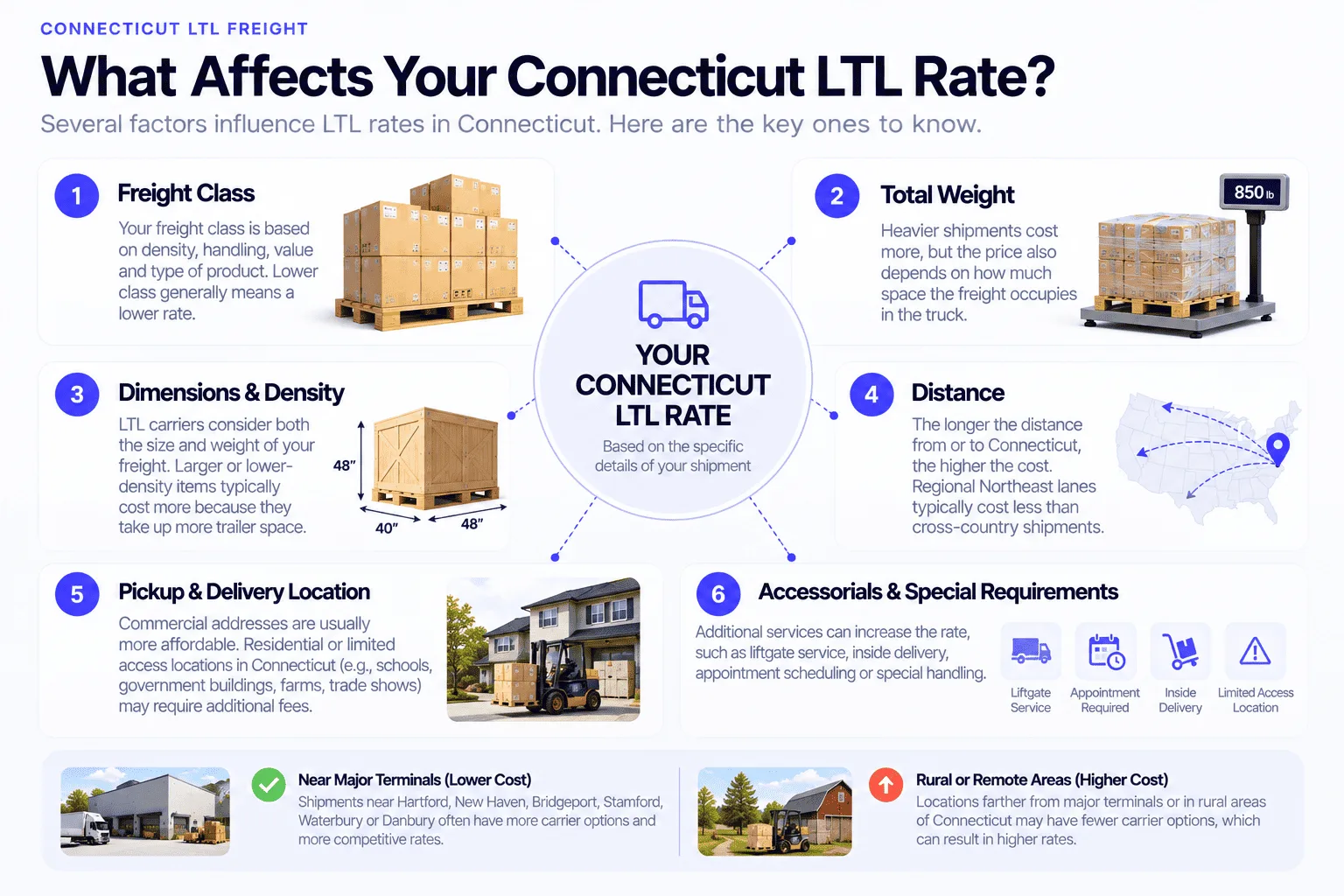
- Freight class — density, handling, and liability determine your NMFC class, the single biggest factor in your rate. See our freight class guide.
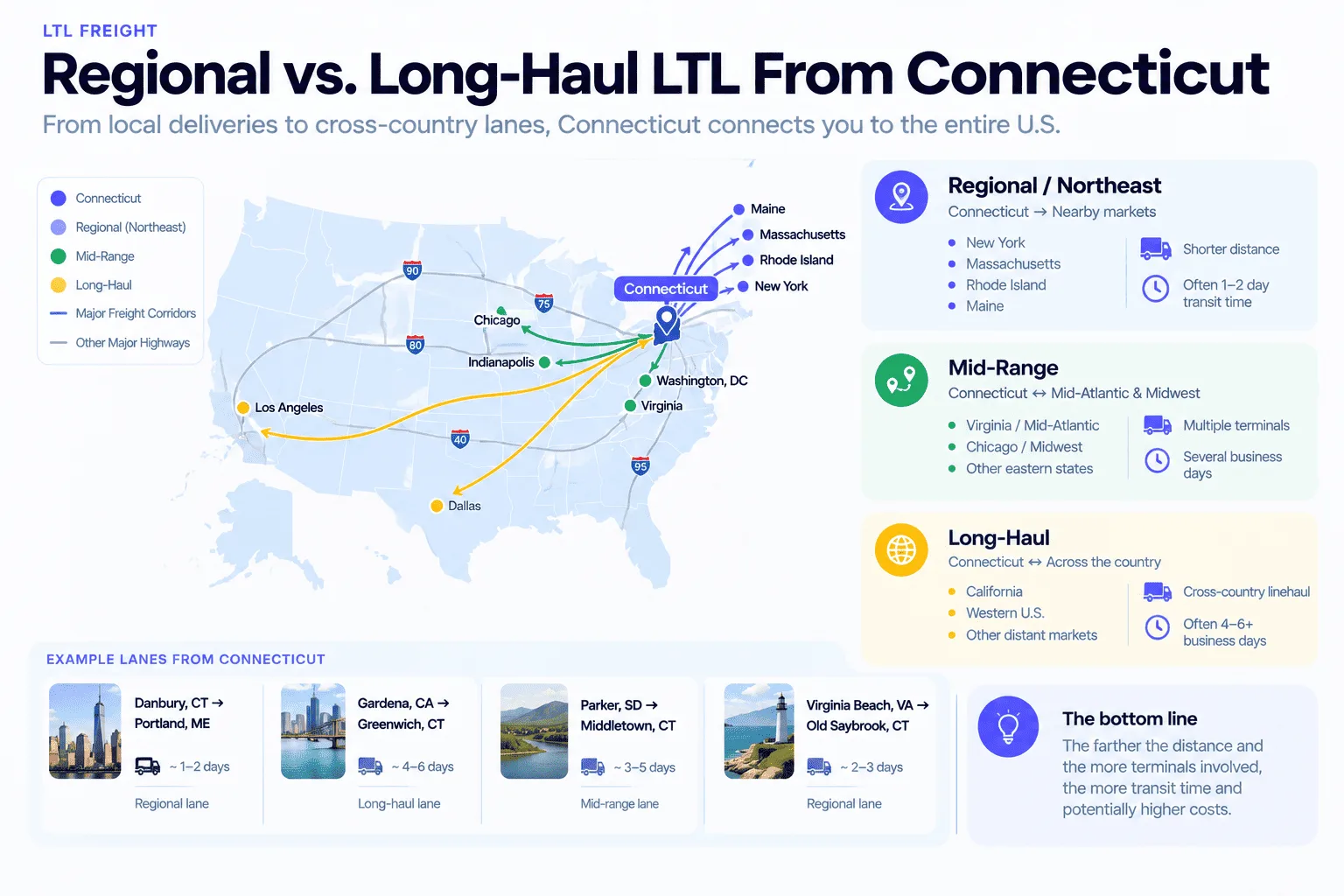
- Distance — Connecticut sits in a dense carrier network, so both short regional moves and long cross-country lanes are well served.
- Terminal proximity — pickup or delivery points near a carrier terminal (Hartford, New Haven, and Bridgeport all have strong coverage) typically see faster transit and more carrier options than rural addresses.
- Accessorials — liftgate, residential, or inside delivery add to the base rate, same as anywhere else.
Winter weather and transit reliability
Connecticut sees regular snow and ice from roughly December through March, more so inland (the northwest hills, Litchfield County) than along the immediate coast. Winter weather can affect pickup windows and add a day to transit during and right after a storm — worth building in extra buffer for Connecticut shipments in winter months, especially to or from inland addresses.
Sample Connecticut LTL rates by route
Real quotes pulled from our platform for four different Connecticut lanes — same process, different carriers each time. Rates shift with capacity and fuel costs, so treat these as a snapshot rather than a guarantee for your shipment; get an instant quote for your exact route.
Real quotes by route
Snapshot taken over recent weeks — carriers and pricing change daily.
| Carrier | Service | Transit | Price |
|---|---|---|---|
| Ross Express | Standard | 1 day | $312.97 |
| XPO | Standard | 1 day | $321.26 |
| Central Transport | STD | 1 day | $325.44 |
| TForce Freight | STD | 1 day | $334.83 |
| A. Duie Pyle | Standard | 1 day | $357.43 |
| Carrier | Service | Transit | Price |
|---|---|---|---|
| R+L Carriers | Standard | 5 days | $567.49 |
| TForce Freight | STD | 6 days | $605.90 |
| Roadrunner Freight | Standard Service | 4 days | $612.50 |
| XPO | Standard | 5 days | $623.17 |
| ABF Freight | Standard | 5 days | $659.93 |
| Carrier | Service | Transit | Price |
|---|---|---|---|
| Central Transport | Standard | 4 days | $496.86 |
| Estes | LTL Standard Transit | 3 days | $560.79 |
| Saia | Standard | 4 days | $689.52 |
| FedEx Freight | Standard | 5 days | $729.88 |
| XPO | Standard | 3 days | $750.31 |
| Carrier | Service | Transit | Price |
|---|---|---|---|
| TForce Freight | STD | 2 days | $487.76 |
| XPO | STD | 2 days | $493.33 |
| FedEx Freight | Standard | 3 days | $549.12 |
| Roadrunner Freight | STD | 4 days | $566.26 |
Major shipping hubs in Connecticut
Connecticut’s carrier terminal network is concentrated around its largest metro areas, which generally means faster pickup windows and more carrier options the closer you are to one of these:
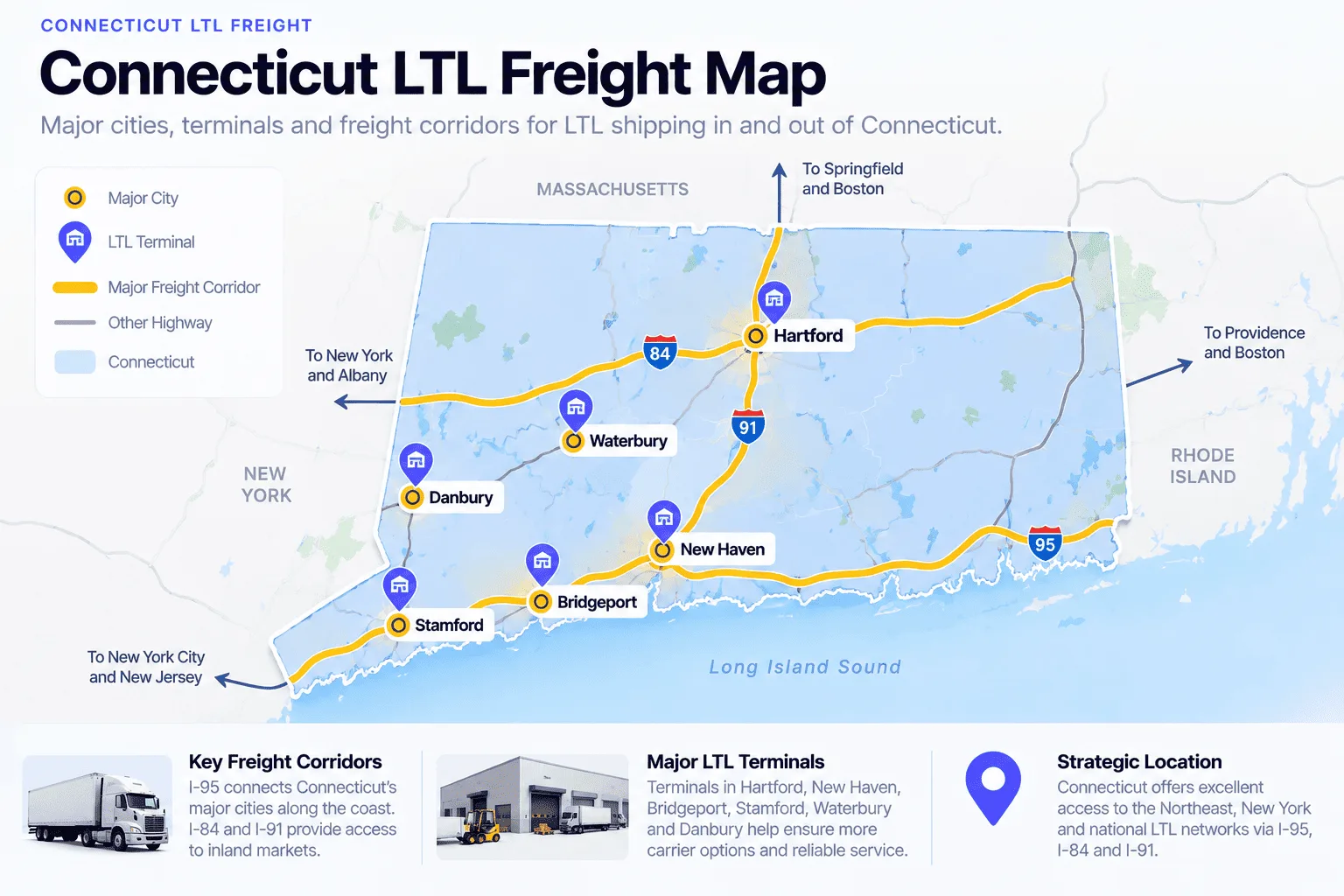
- Hartford — the state capital and a major regional distribution point.
- Bridgeport — Connecticut’s largest city, with strong coastal and I-95 corridor access.
- New Haven — a key Long Island Sound port city with solid carrier coverage.
- Stamford — close to the New York metro area, benefiting from that region’s dense carrier network.
- Waterbury and Danbury — inland hubs with good access to I-84.
Highway corridors serving Connecticut
Most LTL freight moving through Connecticut runs along three interstates: I-95 along the coast, the primary route linking New York City to Providence and Boston; I-84, the main east-west inland route running through Danbury and Hartford; and I-91, running north-south through Hartford and New Haven toward Springfield, MA and the rest of New England. Pickup and delivery points near these corridors typically see more consistent scheduling than more remote addresses.
Why Connecticut’s location works in your favor
Connecticut sits within about 2 hours of New York City and roughly 2-3 hours of Boston, placing it inside one of the densest, most carrier-rich freight corridors in the country. That density is a big part of why lanes into and out of Connecticut tend to have more carrier options and more consistent transit than less-served regions. If a shipment is genuinely time-critical, expedited freight can get a dedicated vehicle to your pickup location in 1-2 hours instead of waiting on a standard LTL pickup window.
What Connecticut shippers move
Connecticut’s freight mix reflects its industry base. Aerospace and defense manufacturing is a major driver — Pratt & Whitney (East Hartford) and Sikorsky (Stratford) both have significant Connecticut operations, generating steady LTL volume in machined parts, components, and specialized equipment. Hartford’s concentration of insurance and corporate headquarters adds office equipment, IT hardware, and furniture shipments to the mix. The state’s broader manufacturing base also ships palletized parts, tooling, and industrial equipment on a regular basis.
Get a Connecticut LTL quote
Compare live rates from vetted carriers serving Connecticut.
Get an LTL quote →Connecticut LTL freight: frequently asked questions
How much does LTL shipping cost to or from Connecticut?
It depends on your route, freight class, weight, and accessorials — real Connecticut lanes in our data run from roughly $300 for short regional moves to $600-750+ for long cross-country hauls. Get an instant quote for your exact shipment.
Do oversized LTL shipments need a permit in Connecticut?
Only if your load exceeds the standard interstate limits (80,000 lbs, 53 feet long, 8.5 feet wide, 13.5 feet tall). Oversize/overweight permits are issued through Connecticut DOT’s Commercial Vehicle Operations WebPortal.
Which carriers serve Connecticut?
Most major national LTL carriers serve Connecticut, including XPO, TForce Freight, Estes, Saia, FedEx Freight, Central Transport, and R+L Carriers, among others — availability and pricing vary by exact route.
Is LTL shipping faster in Connecticut than other states?
Connecticut’s dense Northeast Corridor location and strong terminal coverage generally means more carrier options and reliable transit times, especially for shipments to and from nearby major metro areas.
What’s the fastest way to ship LTL freight from Connecticut to NYC or Boston?
Connecticut’s location inside the dense Northeast Corridor means standard LTL already runs efficiently to both cities. For something genuinely time-critical, expedited freight with a dedicated vehicle is the faster option instead of waiting on a standard LTL pickup window.
Does winter weather affect LTL shipping in Connecticut?
Yes. Snow and ice from roughly December through March can affect pickup windows and add a day to transit, particularly for inland addresses. It’s worth building in extra buffer during and after winter storms.