LTL stands for less-than-truckload — a shipping method for palletized or crated freight that doesn’t need a full trailer to itself. Instead of paying for an entire truck, you pay for the space your freight actually takes up, while the carrier fills the rest of the trailer with other shippers’ freight headed the same general direction.
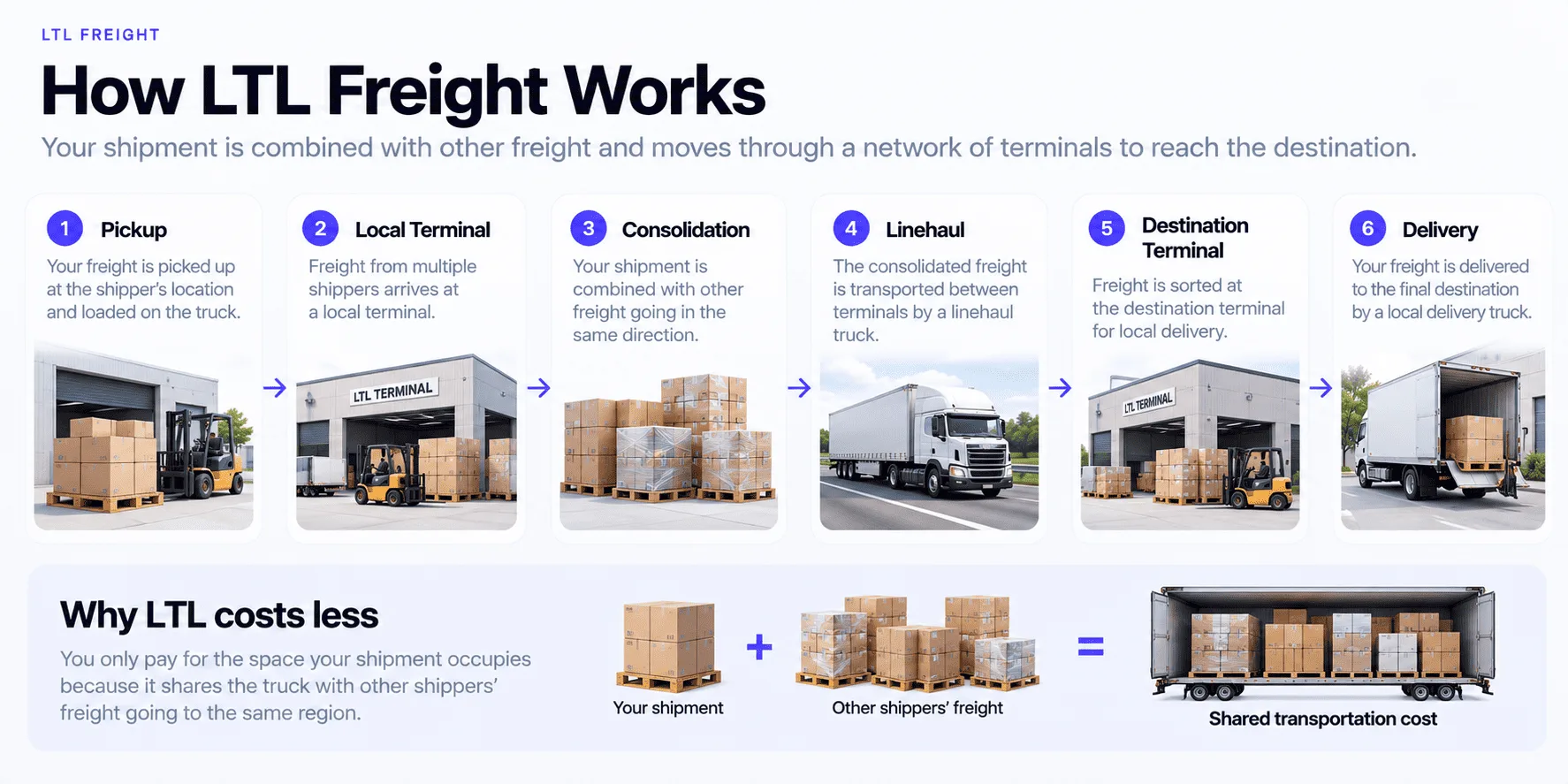
How LTL freight works
A driver picks up your pallet along with freight from several other shippers in the area, then consolidates everything at a local terminal. From there, it’s transferred to a larger truck alongside freight headed to similar destinations, moved to a terminal near the delivery address, and dispatched for final delivery. This is called a hub-and-spoke network — freight moves through regional terminals (hubs) rather than straight from pickup to delivery, which is what keeps the cost down compared to a dedicated truck. The tradeoff is a longer, less predictable transit time than shipping your freight alone.
Why choose LTL freight
- Lower cost for smaller shipments — you only pay for the trailer space your freight uses, instead of an entire truck sitting mostly empty.
- Accessible for smaller and growing shippers — you don’t need truckload volume to ship regularly; a single pallet is enough to get started.
- Built for palletized and crated freight — a natural fit for B2B shipments, parts, equipment, and e-commerce restocking that doesn’t need a dedicated trailer.
- More efficient use of trailer space — consolidating multiple shippers’ freight onto one truck means fewer trucks on the road for the same total freight.
What to know before you book LTL
LTL is the right call for most smaller shipments, but it comes with real tradeoffs worth knowing upfront:
- Transit time is longer and less predictable — your freight typically passes through one or more terminals before reaching its destination, and weather, volume, or a missed connection at any hub can add a day.
- Multiple handling touches mean more risk of damage — freight gets loaded and unloaded by forklift at every terminal it passes through, not just at pickup and delivery. Solid packaging and correct palletizing (see our pallet shipping prep checklist) meaningfully reduce this risk.
- Accuracy matters more than it seems — an incorrect freight class or weight on the Bill of Lading is the most common reason a quote changes after pickup. See our freight class guide for how to get it right upfront.
- Not every location gets the same service level — rural or remote addresses may have longer transit times or limited pickup windows compared to major metro terminals.
LTL vs. parcel shipping
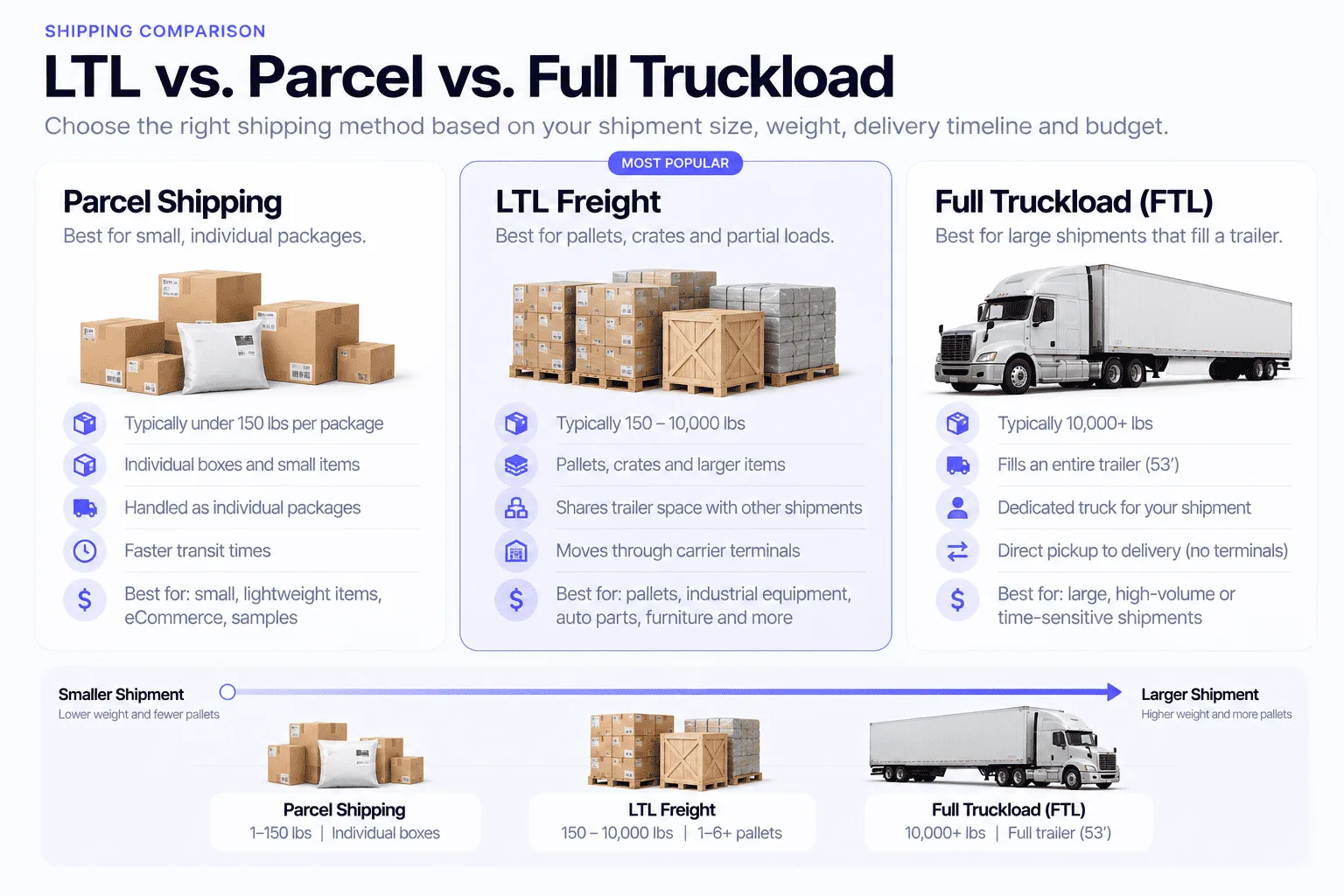
Parcel carriers (like small-package delivery services) are built for individual boxes, typically under about 150 lbs, priced and handled one package at a time. Once a shipment is palletized, crated, or heavier than that, it’s usually cheaper and more practical to ship LTL — parcel pricing penalizes bulky or heavy packages, while LTL is priced for exactly that kind of freight.
LTL vs. full truckload
Full truckload (FTL) means your freight has an entire trailer to itself, moving directly from pickup to delivery with no consolidation stops. It’s faster and simpler for large shipments, but it only makes financial sense once your freight is close to filling a trailer on its own. For anything smaller — a pallet, a few crates, a partial load — LTL is almost always the more economical choice.
How LTL freight is priced
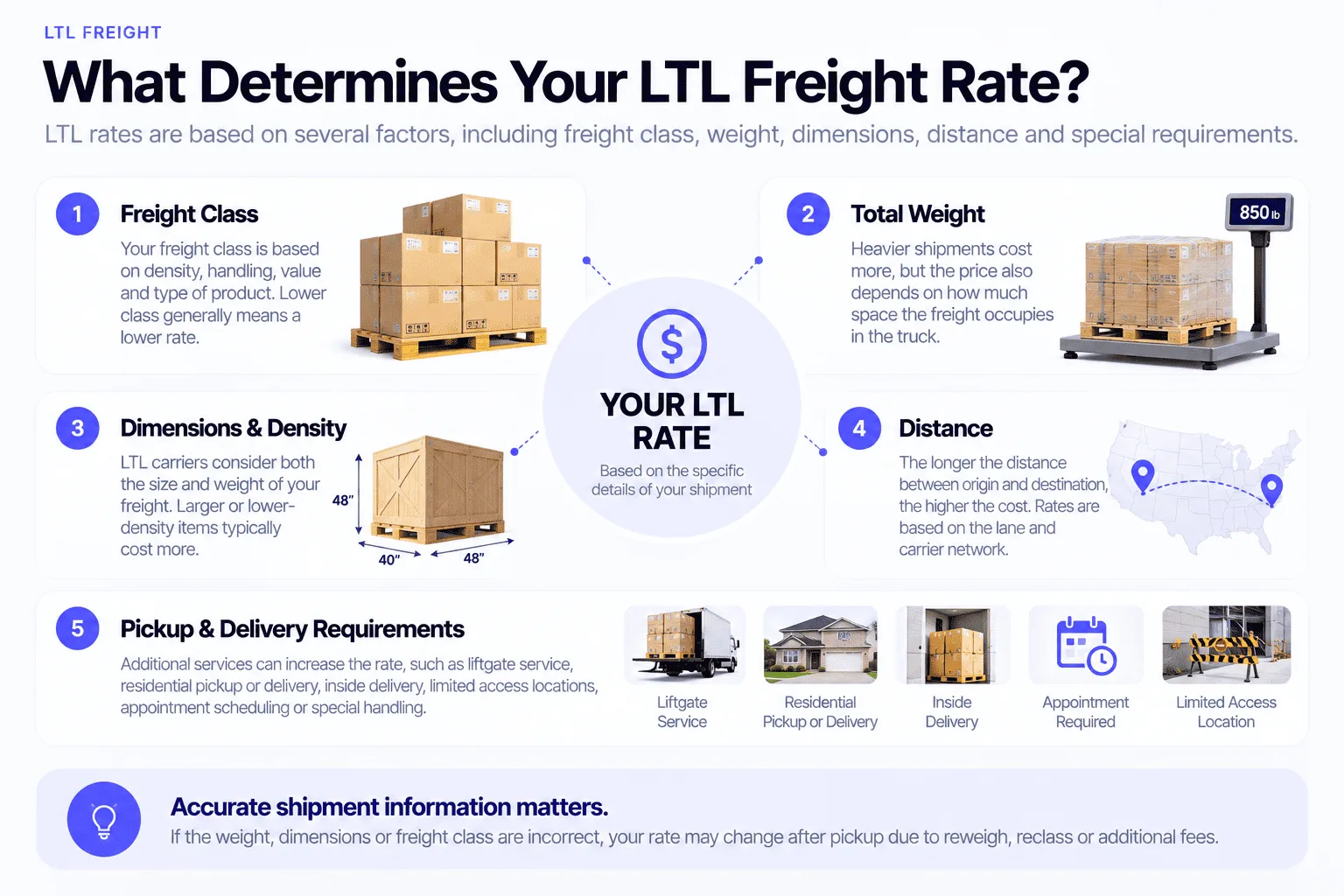
LTL rates are driven by freight class — an NMFC classification based on density, handling difficulty, and liability — along with weight, dimensions, and the distance between pickup and delivery. Denser, more durable freight gets a lower class and a lower rate; bulky or fragile freight gets a higher class and costs more to ship. Pickup and delivery requirements — liftgate service, residential or inside delivery, limited-access locations, or a scheduled appointment — add to the rate on top of these base factors.
Get an LTL freight quote
Compare live rates from vetted LTL carriers for your shipment.
Get an LTL quote →Frequently asked questions
What does LTL stand for?
LTL stands for less-than-truckload — a shipping method where your freight shares trailer space with other shipments instead of requiring a full truck.
How is LTL different from parcel shipping?
Parcel shipping (like a small package carrier) is priced and handled per individual box. LTL is for palletized or crated freight too large or heavy for standard parcel carriers, typically 150 lbs or more.
How long does LTL shipping take?
Transit time depends on distance and how many consolidation stops the freight passes through, but it’s generally longer than a dedicated truckload shipment covering the same distance.
When should I use full truckload instead of LTL?
Once your freight is close to filling a full trailer on its own, truckload becomes more cost-effective and faster since there’s no consolidation. For a pallet or a partial load, LTL is almost always cheaper.