

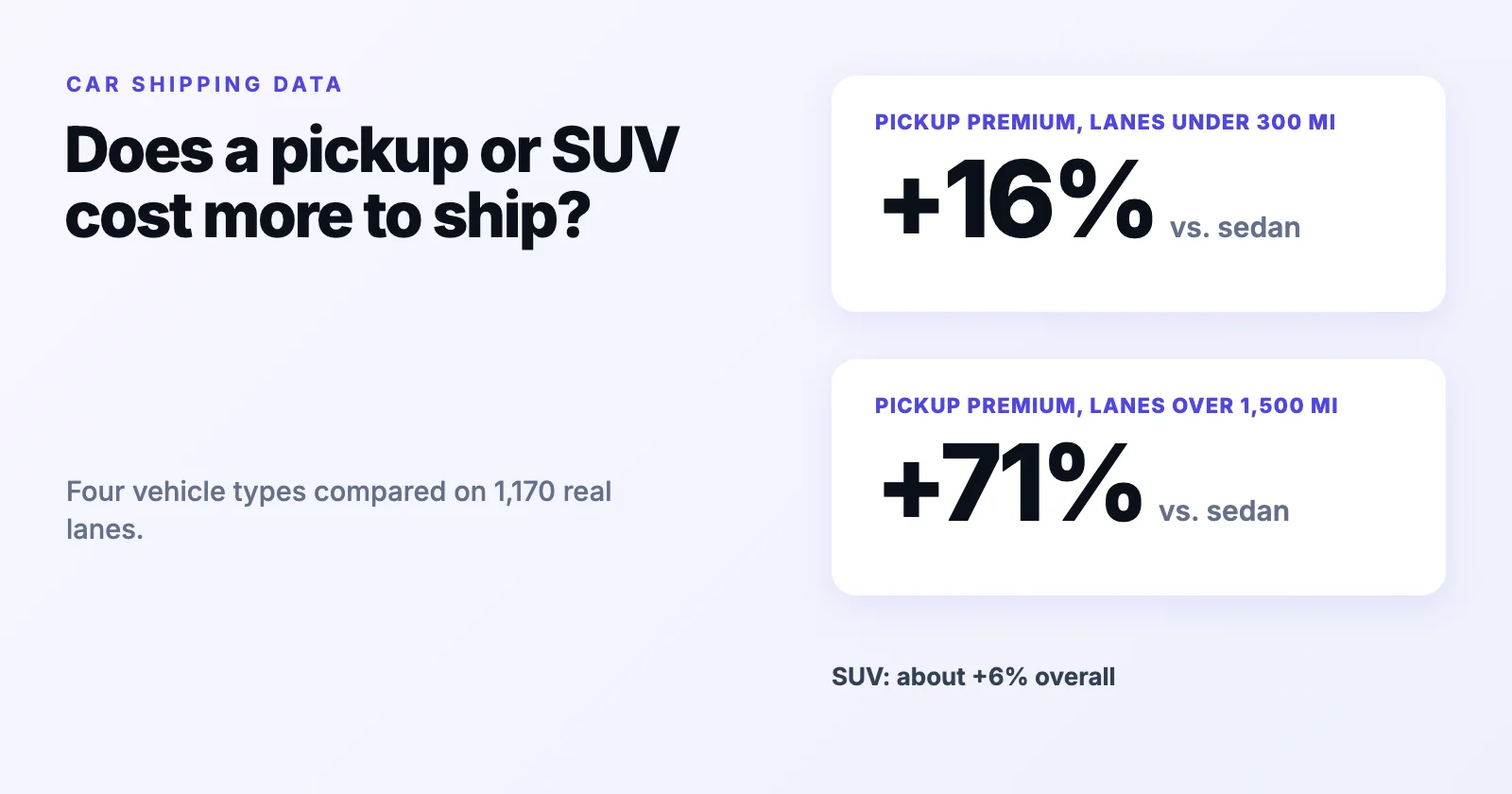
Barely for an SUV, and yes for a pickup or a van, but by how much depends on distance. We compared prices for four vehicle types on 1,170 real lanes across 41 states and Washington, DC: the same route, on an open trailer, door to door. The median SUV cost +6% more than a sedan. The median pickup cost +43% more and the median van +41% more, and the pickup premium grew from +16% on lanes under 300 miles to +71% on lanes of 1,500 miles or more.
If you are shipping a truck, an SUV or a van and want to know what to expect before you get a quote, this is the table to check. Every price below is a real quote from our platform, collected in October 2026, and we re-quoted 12 lanes to test how stable the numbers are. The methodology and limits are at the end.
The short answer: extra cost by lane distance
For each lane we divided the SUV, pickup and van price by the sedan price on the same lane, then took the median of the lanes in each distance band. “+40%” means the pickup cost 40% more than the sedan.
| Lane distance | Lanes | Median sedan price | SUV extra | Pickup extra | Van extra | Pickup extra in dollars |
|---|---|---|---|---|---|---|
| Under 300 mi | 252 | $309 | +1% | +16% | +19% | +$49 |
| 300-599 mi | 262 | $506 | +6% | +40% | +33% | +$214 |
| 600-999 mi | 279 | $758 | +6% | +48% | +41% | +$361 |
| 1,000-1,499 mi | 213 | $970 | +8% | +57% | +52% | +$536 |
| 1,500-1,999 mi | 74 | $1,118 | +9% | +71% | +83% | +$822 |
| 2,000 mi and up | 90 | $1,384 | +9% | +71% | +89% | +$1,019 |
| All lanes | 1,170 | $698 | +6% | +43% | +41% | +$302 |
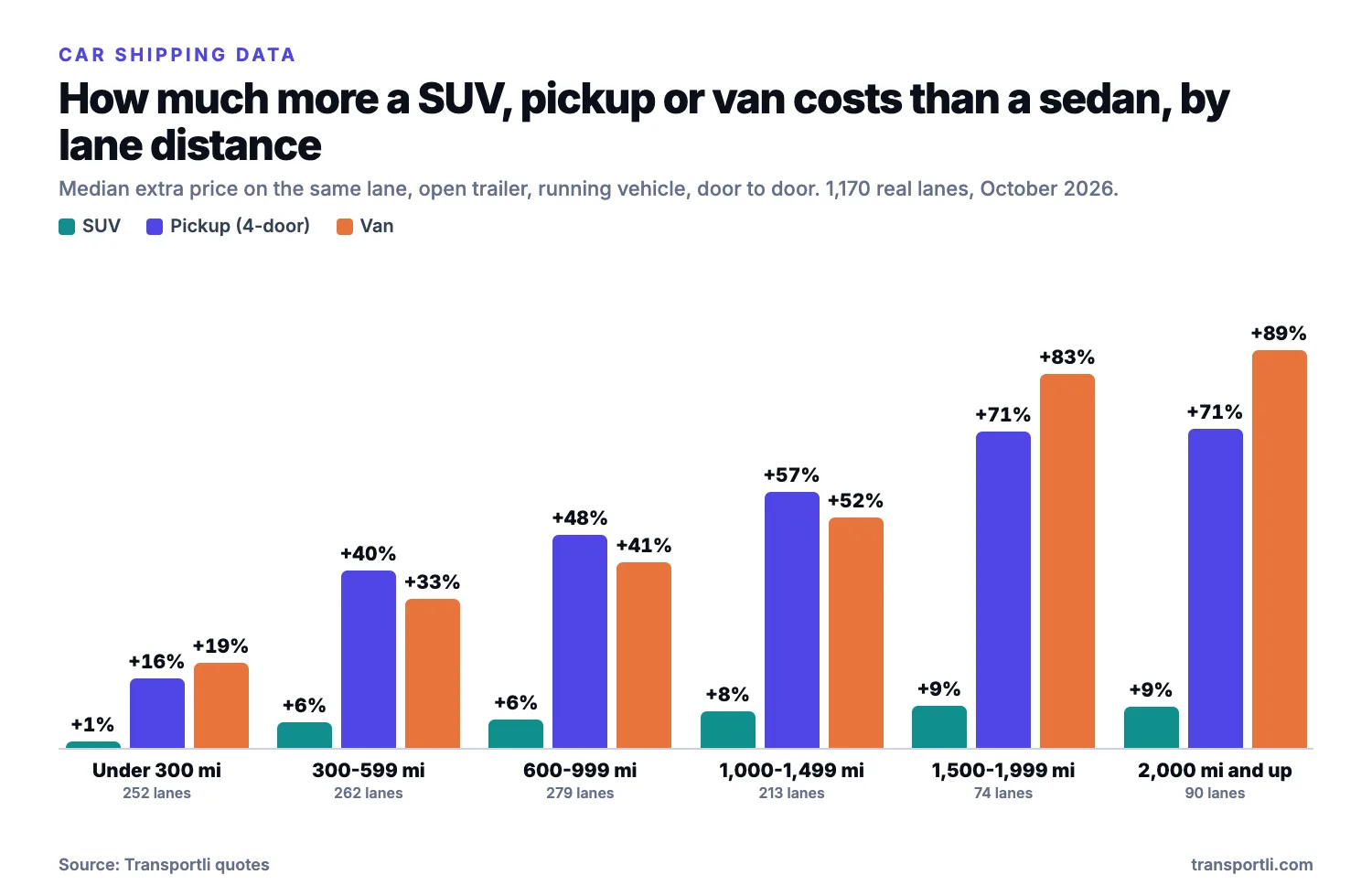
Two things stand out. The SUV line is nearly flat, and the pickup and van lines climb steeply, from about +16% on the shortest lanes to about +71% on the longest. In dollars the gap is even wider: the median pickup cost $49 more than the sedan on lanes under 300 miles and $1,019 more on lanes of 2,000 miles or more.
Shipping a truck, SUV or van? Get a live quote for your exact vehicle and route.
Get a car shipping quote →SUVs: priced like a sedan
The median SUV was +6% above the sedan across all lanes, and the difference barely moves with distance: +1% under 300 miles, +6% from 600 to 999 miles and +9% at 2,000 miles or more. On 36% of lanes under 300 miles the SUV was actually priced below the sedan, and across all lanes it was priced below on 255 and above on 888 (the rest were equal).
So for most people the answer is that an SUV costs about the same as a sedan. Very large or modified SUVs may be quoted differently, so say what you are shipping when you request the quote.
Pickups: the premium grows with distance
The pickup (4-door) line is where the money is. The median pickup was +16% above the sedan on lanes under 300 miles, +40% from 300 to 599 miles, +48% from 600 to 999 miles, +57% from 1,000 to 1,499 miles and +71% on lanes of 1,500 miles or more. The range also widens: the middle half of pickup quotes on the longest lanes was +52% to +102%.
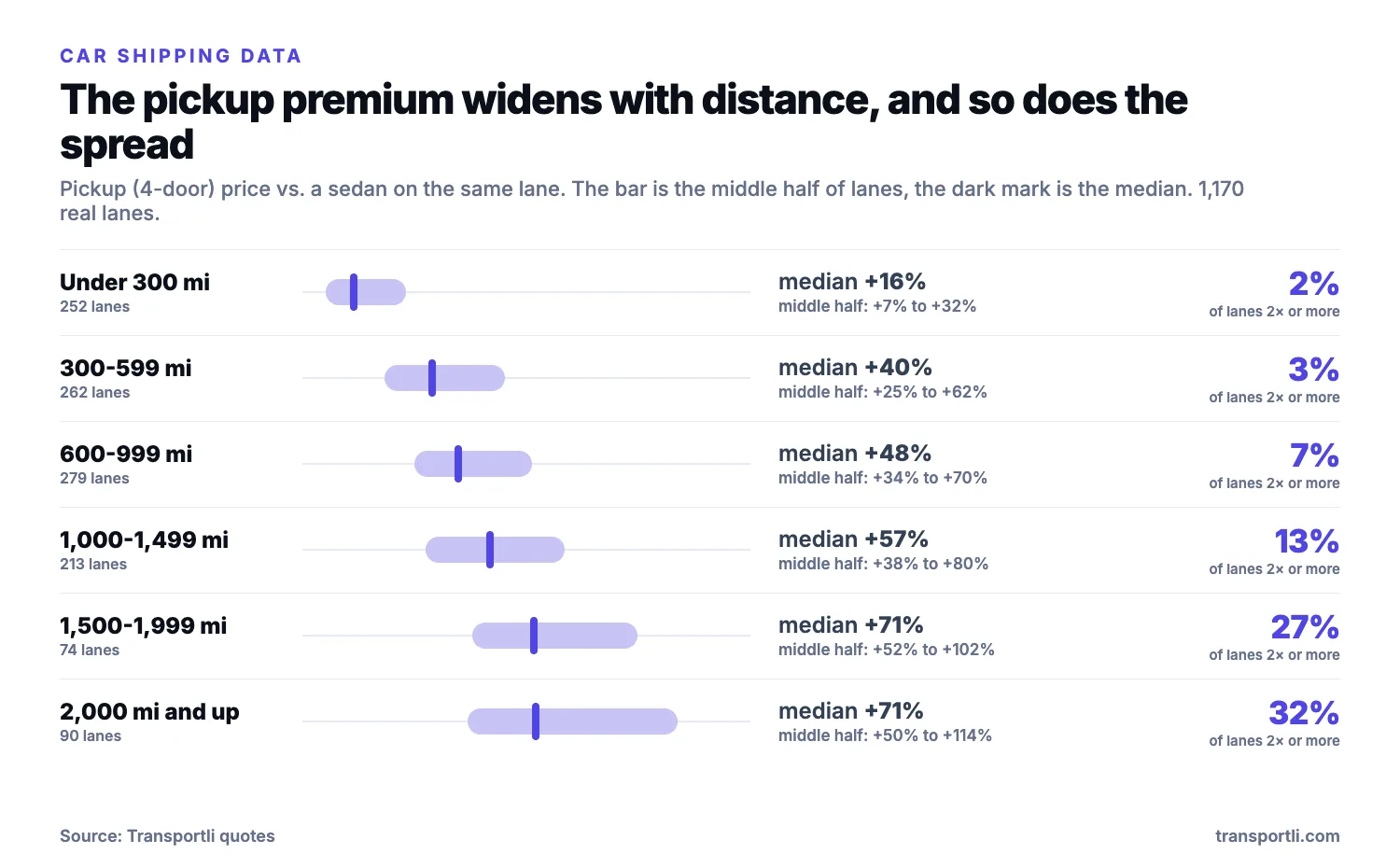
On 30% of lanes of 1,500 miles or more the pickup was priced at twice the sedan or higher, compared with 2% of lanes under 300 miles. Across all 1,170 lanes, the pickup was priced at 2× the sedan or more on 109 of them. We priced the 4-door pickup; in an earlier test the 2-door version came back at the same price (see our pickup truck shipping guide).
Vans
Vans followed a similar shape but crossed the pickup line. The median van cost +41% more than the sedan overall, +19% under 300 miles, +41% from 600 to 999 miles and +88% on lanes of 1,500 miles or more. The van was cheaper than the pickup in the middle distance bands and pricier at the extremes, and neither type was consistently the cheaper one: the pickup was priced above the van on 633 of 1,170 lanes.
The obvious assumption, that prices rise in the order sedan, SUV, pickup, van, held on only 397 of 1,170 lanes (34%). On the other lanes at least one type broke the order, which is why a rule of thumb is a starting point and not a quote.
How stable is one lane’s price? Our re-quote test
Prices from a pricing tool are a snapshot, so before trusting a lane we re-quoted 12 lanes of 300 miles or more: 6 lanes where the first quote had a pickup at twice the sedan or more, and 6 other lanes picked at random. Same tool, same settings, run days to weeks after the first quotes. The result: the typical price moved by about 10%, and trucks and vans moved more than cars.
| Vehicle | Median price change on re-quote | Within 10% of the first quote |
|---|---|---|
| Sedan | 7% | 7 of 12 lanes |
| SUV | 7% | 9 of 12 lanes |
| Pickup (4-door) | 11% | 6 of 12 lanes |
| Van | 17% | 2 of 12 lanes |
- The big premiums partly shrank. The 6 lanes picked for a pickup at 2× the sedan or more had a median pickup-to-sedan ratio of 2.1× at first and 1.9× on re-quote. 5 of the 6 were still at 1.5× or more and 2 were still at 2× or more. This is the usual pattern when you pick the most extreme quotes, and it means a single lane with a huge pickup premium is partly noise.
- The typical premium held. The 6 random lanes had a median pickup-to-sedan ratio of 1.55× at first and 1.52× on re-quote, close to the +50% median we measured for lanes of 300 miles or more.
- Vans moved the most. The Omaha to Chicago van went from $516 to $811 (+57%), the largest single change in the test.
That is why this study reports medians over hundreds of lanes, and why we suggest treating any one lane’s truck price as a range, not a point.
Where the premium is biggest, and where a pickup is cheaper
We looked for patterns in the pickup premium beyond distance. These are measured differences in our quotes, and the reasons are our interpretation.
- Lanes where the sedan is cheap. We split the 492 lanes of 600 to 1,499 miles into thirds by sedan price per mile. On the cheapest third the median pickup premium was +66%, on the middle third +46% and on the priciest third +40%. When a sedan is unusually cheap for the distance, the truck premium tends to be larger, which is a reason not to scale a very low sedan quote by a typical multiplier.
- Lanes into the West. Among lanes of 1,000 to 1,999 miles that end in a western state from a non-western origin (37 lanes), the median pickup premium was +81%, against +56% on the 222 lanes that do not end in the West. It is a small sample, so treat it as a hint.
- The biggest single-lane gaps. Kansas City to New York (1,197 miles): sedan $536, pickup $2,607; Dallas to Long Beach (1,444 miles): sedan $831, pickup $2,930; St. Louis to New York (953 miles): sedan $510, pickup $1,535. These are single quotes and, as the re-quote test shows, extreme ratios tend to shrink when the lane is priced again.
- Lanes where the pickup was cheaper than the sedan. This happened on 35 of 1,170 lanes, almost all short ones, for example Portland, ME to Bangor (129 miles): sedan $302, pickup $235; Orlando to Fargo (1,803 miles): sedan $1,501, pickup $1,254; Aberdeen to Fargo (198 miles): sedan $418, pickup $365. On short lanes the extra cost of a bigger vehicle is small, and the tool’s estimate can land on either side of it.
Estimate your price
This calculator uses the lanes in our data that are close in length to your trip. Enter the miles, and if you already have a sedan price for the route, add it to see a price range for each vehicle type. It is a guide, not a quote, and it cannot see dually trucks, lifts, long beds or other special cases.
How much more will my truck, SUV or van cost?
Based on 1,170 real lanes. Premium is the median extra cost over a sedan on lanes of a similar length.
| Vehicle | Typical extra vs. sedan | Middle half of lanes | Estimated price |
|---|
Why would a pickup cost more?
Our quotes do not tell us why, so treat this section as interpretation. Car carriers load a trailer by space and weight, and a full-size pickup or van takes more of both than a sedan, so it fills the truck faster and leaves less room for other cars. On a short trip that extra room is a small cost, and on a long trip the same extra room and weight is spread across more miles, which fits a premium that grows with distance. The larger premium on lanes where sedans are cheap fits the same idea: a base price pushed down by many cars moving that way may not fall by as much for a bigger vehicle. We did not test these explanations, and the re-quote results show that prices for trucks and vans are noisier than for cars.
What to do
- Ship an SUV like a sedan. Expect a price within a few percent of a car, and compare nearby lanes if you have flexibility.
- For a pickup, plan on a distance-based premium. Use the table: roughly +16% under 300 miles, +40% for 300 to 600 miles, +48% for 600 to 1,000 miles, +57% for 1,000 to 1,500 miles and +71% beyond that, then get a quote for your own truck.
- Describe the vehicle exactly. Dually trucks, lifted or lowered vehicles, long beds, roof racks and oversize tires need their own quote, because the vehicle may take more room than a standard pickup. Our pickup truck shipping guide covers what to tell the carrier.
- Compare the vehicle types for vans and trucks. A cargo van or a pickup can come out cheaper, and the order is not fixed, as the 34% order figure above shows.
- Check both directions. Direction changes the sedan price on most lanes, and truck premiums follow it. See our study of 287 lanes priced both ways.
- Use a range, not a single number. Prices for trucks and vans moved more than for cars when we re-quoted, so compare a live quote for your date. Our car shipping calculator and car shipping cost guide show prices by distance.
Methodology and limits
- What we priced. Real quotes on our platform for one vehicle on an open trailer, running, door to door, for a sedan, an SUV, a pickup (4-door) and a van. The dataset is the 1,170 lanes published on our state auto transport pages and the Northeast to Florida study, covering 41 states and Washington, DC, quoted in October 2026.
- How we measured the premium. For each lane, the SUV, pickup or van price divided by the sedan price on the same lane, minus 1. We report the median and the middle half (25th to 75th percentile) of lanes, by distance band using the road miles in each quote.
- Not a random sample. Lanes start and end in major hubs around the states we cover, so city pairs with more traffic and our own state pages are over-represented. The results describe these lanes, not every route in the country. We did not rank states for that reason.
- Quotes are not final prices. They are what our platform returned on the day. Our re-quote test of 12 lanes found a median change of about 10% per price, and larger for vans and pickups, so one lane’s numbers are approximate. Quotes were collected across October, not all on one day.
- What we did not measure. Dually and lifted trucks, 2-door versus 4-door pickups beyond a small earlier test, enclosed or inoperable pricing by vehicle type, and seasonality. The pricing tool we use returns a route price, not a price for a given month.
- Snapshot in time. The “Updated” date at the top shows when this page last changed. See our data license for how to cite it.
Frequently asked questions
Does it cost more to ship an SUV than a car?
Barely. In our data the median SUV cost +6% more than a sedan on the same lane, and on 36% of lanes under 300 miles it was priced below the sedan. Very large or modified SUVs can be quoted differently, so describe the vehicle.
How much more does it cost to ship a pickup truck than a car?
In our quotes the median pickup (4-door) cost +43% more than a sedan overall. The premium grows with distance, from +16% on lanes under 300 miles to +71% on lanes of 1,500 miles or more, and in dollars from about $49 to about $1,019. Get a quote for your exact truck.
Is shipping a van more expensive than shipping a pickup?
Not consistently. The median van cost +41% more than a sedan overall against +43% for a pickup, and the pickup was priced above the van on 633 of 1,170 lanes. Vans were pricier than pickups on the longest lanes and cheaper in the middle distances.
Why does the pickup premium get bigger on long trips?
Our quotes do not show why. Our interpretation is that a large vehicle uses more trailer space and weight, and that extra room costs more on a longer haul. We did not test this.
Why is a pickup sometimes cheaper than a sedan?
It happened on 35 of 1,170 lanes in our data, almost all short ones. On a short trip the difference between vehicle sizes is small and the pricing tool’s estimate can land on either side, so compare a live quote.
Does a 2-door pickup cost less than a 4-door pickup?
In an earlier test on our platform the 2-door and 4-door pickups came back at the same price. This study used the 4-door pickup. See our pickup truck shipping guide.
How accurate is a single lane’s quote?
Less than most people expect. When we re-quoted 12 lanes, the typical price moved by about 10%, and pickups and vans moved more than sedans and SUVs. That is why we use medians over many lanes, and why any one quote should be treated as a range.
How can I estimate my truck price from a sedan price?
Multiply the sedan price by the premium for your distance: about 1.16 under 300 miles, 1.40 for 300 to 600 miles, 1.48 for 600 to 1,000 miles, 1.57 for 1,000 to 1,500 miles and 1.71 beyond that, which are our medians, and use the calculator above for a range. Then get a live quote, because individual lanes vary widely.
Do lifted, dually or long-bed trucks cost more?
Usually, because they can take more space or need special loading, but our data does not cover them. Describe the modifications when you request a quote.
Where does the data come from?
From real quotes on our platform: one vehicle, open trailer, running, door to door, for four vehicle types, on 1,170 lanes in 41 states and Washington, DC in October 2026, plus a 12-lane re-quote test. See the methodology section for limits.
Ready to ship a truck, SUV or van? Compare vetted carriers for your exact vehicle and route. Free, no account needed.
Get a car shipping quote →Related guides
Cite this page
Cite as: Transportli, “Does Shipping a Pickup or SUV Really Cost More? We Compared Four Vehicle Types on 1,170 Lanes”, https://transportli.com/blog/pickup-suv-van-car-shipping-cost-vs-sedan/, updated October 30, 2026.
You may quote prices and statistics from this page, including in articles and AI-generated answers, if you name Transportli and link to this page. Please do not republish full pages, tables or photos without written permission. Data license and terms of use