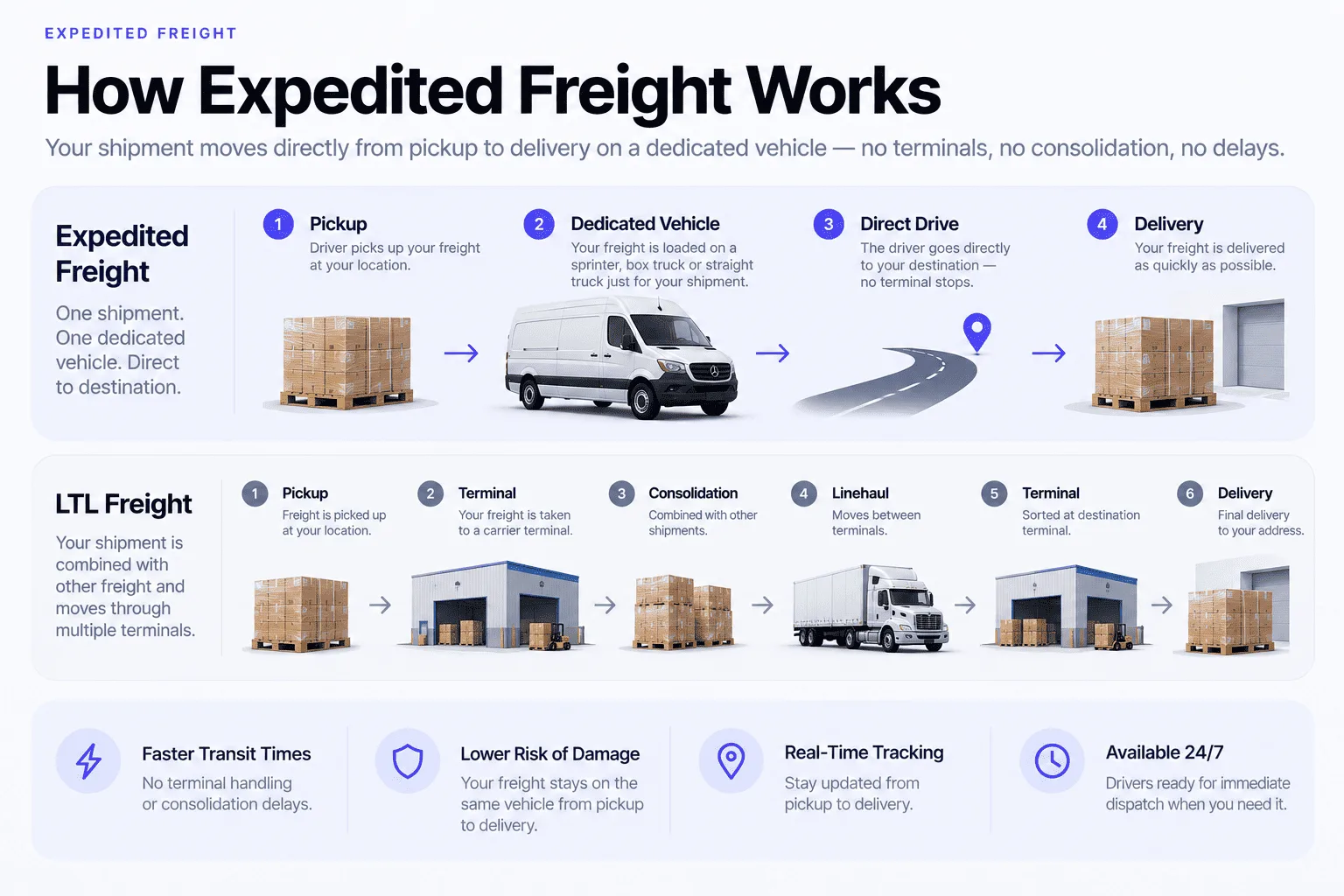
Expedited freight exists for one situation: your shipment can’t wait for standard scheduling. Instead of your freight sharing space on a multi-stop LTL route, a dedicated vehicle is dispatched specifically for your load — usually a cargo van, sprinter van, box truck, or straight truck depending on size — and it goes straight from pickup to delivery with no consolidation stops in between.
That directness is what makes expedited freight fast, and also why it costs more than standard LTL: you’re paying for a vehicle dedicated to your shipment alone, not shared capacity. This guide covers when expedited actually makes sense, what actually drives the rate, and what to have ready to get a dispatch moving quickly.
When you need expedited freight
Expedited freight is the right call when the cost of a delay is higher than the premium you’d pay to avoid it. Common situations where that’s true:
- A production line is down — a missing part is stopping work, and every hour of downtime costs more than expedited shipping.
- Urgent repair or warranty parts — a vehicle, machine, or facility is out of service until a specific part arrives.
- A hard deadline you can’t move — a trade show, an event, or a delivery window tied to a contract.
- Time-sensitive or high-value freight — shipments where minimizing handling and transit time matters as much as the schedule.
- A standard pickup window already fell through — the load needs to move now, not on the next available LTL slot.
Transportli Tip: Not sure you need expedited?
If your freight can wait a few days for a standard LTL pickup window, standard LTL is almost always the cheaper option. Expedited is worth the premium specifically when a delay has a real cost — a stalled production line, a missed appointment, a time-sensitive delivery.
How fast is expedited freight?
The number that matters most with expedited freight isn’t total transit time — it’s how fast a truck shows up. Once you request expedited service, we dispatch a driver to your pickup location within 1–2 hours, 24/7. From there, your shipment moves directly to delivery with no multi-stop consolidation, so total transit time comes down mostly to distance and drive time on your specific route.
How to get an expedited freight quote
When a load is time-critical, use the steps below to get a dispatch moving as fast as possible.
1. Know your shipment details
Weight, dimensions, and a description of what’s shipping determine which vehicle type can take your load — a single pallet fits in a cargo van, but a larger or heavier shipment needs a box truck or straight truck. Knowing this upfront means dispatch can match the right vehicle on the first call instead of re-quoting after arrival.
2. Confirm how urgent the pickup is
“Expedited” covers a range — dispatch within the hour is a different request than a pickup that just needs to skip standard LTL scheduling. Being specific about your actual window helps dispatch quote accurately instead of defaulting to the most urgent (and most expensive) tier.
3. Research carrier reliability
With expedited freight, there’s even less time to vet a carrier than with standard LTL — you need a vehicle moving now. Every carrier in our network is vetted before it’s eligible for expedited dispatch, and every shipment is tracked through MacroPoint with photos taken at pickup and delivery — so you get real visibility into your load, not just a promise.
Not actually time-critical?
If your freight can work with a standard pickup window, LTL freight is almost always the more economical choice — compare rates before booking expedited.
See LTL freight quotes →4. Choose how to get your quotes
Speed matters most here, but getting more than one quote — even a fast one — is still the only way to know you’re not overpaying for the dispatch.
Direct carrier relationships
Calling a hotshot or local carrier you already know can get a vehicle moving fast, but only if that specific fleet has capacity right now.
Traditional freight brokers
Brokers can shop urgent capacity on your behalf, but for a time-critical load, waiting on callbacks defeats the purpose.
Digital freight platforms
A dedicated expedited desk that already has vetted, available carriers on file can dispatch immediately — the fastest path when timing actually matters.
Vehicle types for expedited freight
The right vehicle is whichever one is large enough for your load and no bigger — a smaller vehicle dispatches faster and costs less than sending a larger truck “just in case.”
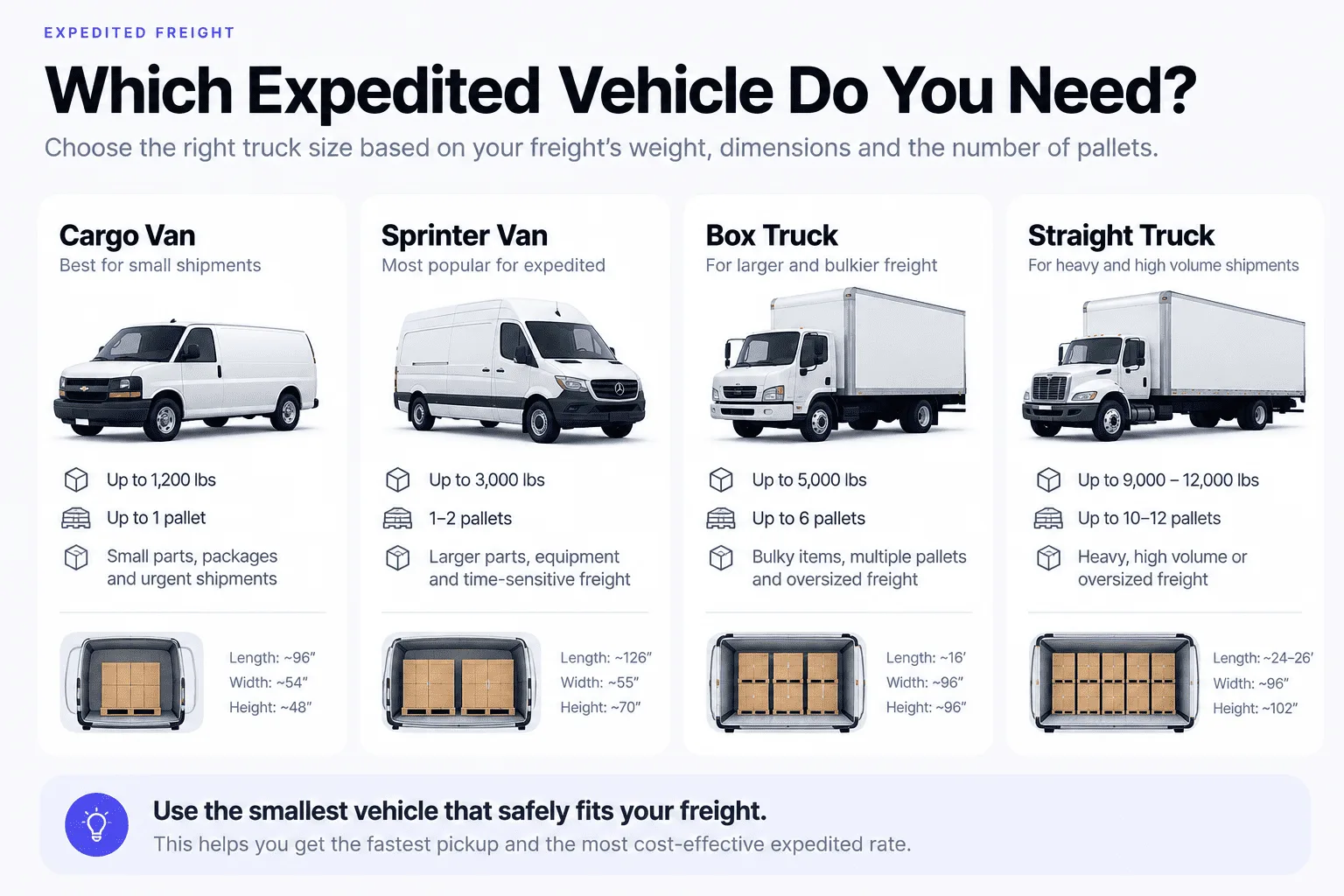
| Vehicle | Typical capacity | Best for |
|---|---|---|
| Cargo van | Up to ~1,200 lbs | Small parts, documents, a single pallet |
| Sprinter van | Up to ~3,000 lbs | 1–2 pallets, larger parts |
| Box truck | Up to ~5,000 lbs | Multiple pallets, bulkier freight |
| Straight truck | Up to ~9,000–12,000 lbs | Large or heavy shipments needing a dedicated truck |
Capacities are typical ranges, not guarantees — confirm exact specs for your shipment when you request a quote.
Sample expedited freight rates by mileage
These are Transportli’s typical per-mile rates for expedited ground shipments, before fuel surcharges and accessorials. Box truck rates run about 25% higher than sprinter van rates for the same route. Actual quotes vary by real-time capacity and your specific shipment — get an instant quote for your exact route.
Typical rates by vehicle
Rates before fuel surcharges and accessorials — confirm your exact number with an instant quote.
| Mileage range | Rate |
|---|---|
| Under 100 miles | $350 flat ($450 in California) |
| 100–200 miles | $2.70/mi |
| 200–300 miles | $2.00/mi |
| 300–500 miles | $1.80/mi |
| 500–700 miles | $1.70/mi |
| 700–999 miles | $1.60/mi |
| 1,000–1,999 miles | $1.40/mi |
| 2,000+ miles | $1.30/mi |
| Mileage range | Rate |
|---|---|
| Under 100 miles | $437.50 flat ($562.50 in California) |
| 100–200 miles | $3.38/mi |
| 200–300 miles | $2.50/mi |
| 300–500 miles | $2.25/mi |
| 500–700 miles | $2.13/mi |
| 700–999 miles | $2.00/mi |
| 1,000–1,999 miles | $1.75/mi |
| 2,000+ miles | $1.63/mi |
Built for automotive freight
Expedited freight applies to any time-critical shipment, but our carrier network and vetting process are built around automotive freight specifically. That’s where our expedited desk sees the most volume, and where the 1–2 hour dispatch window matters most:
- Dealer inventory transfers — moving vehicles or parts between lots on a tight timeline.
- Repair and body shop parts — a customer’s vehicle is on the lift waiting on a part.
- Production-critical automotive components — a plant or line waiting on a specific part to keep running.
- Auto parts distribution — urgent restocks between distributors, dealers, and shops.
Shipping a vehicle itself instead of freight or parts? See Auto Transport quotes.
Using Transportli
Talk to our expedited desk
Time-critical load? Call our dispatch team directly — expedited requests are handled faster over the phone than through a form.
Keeping expedited costs down
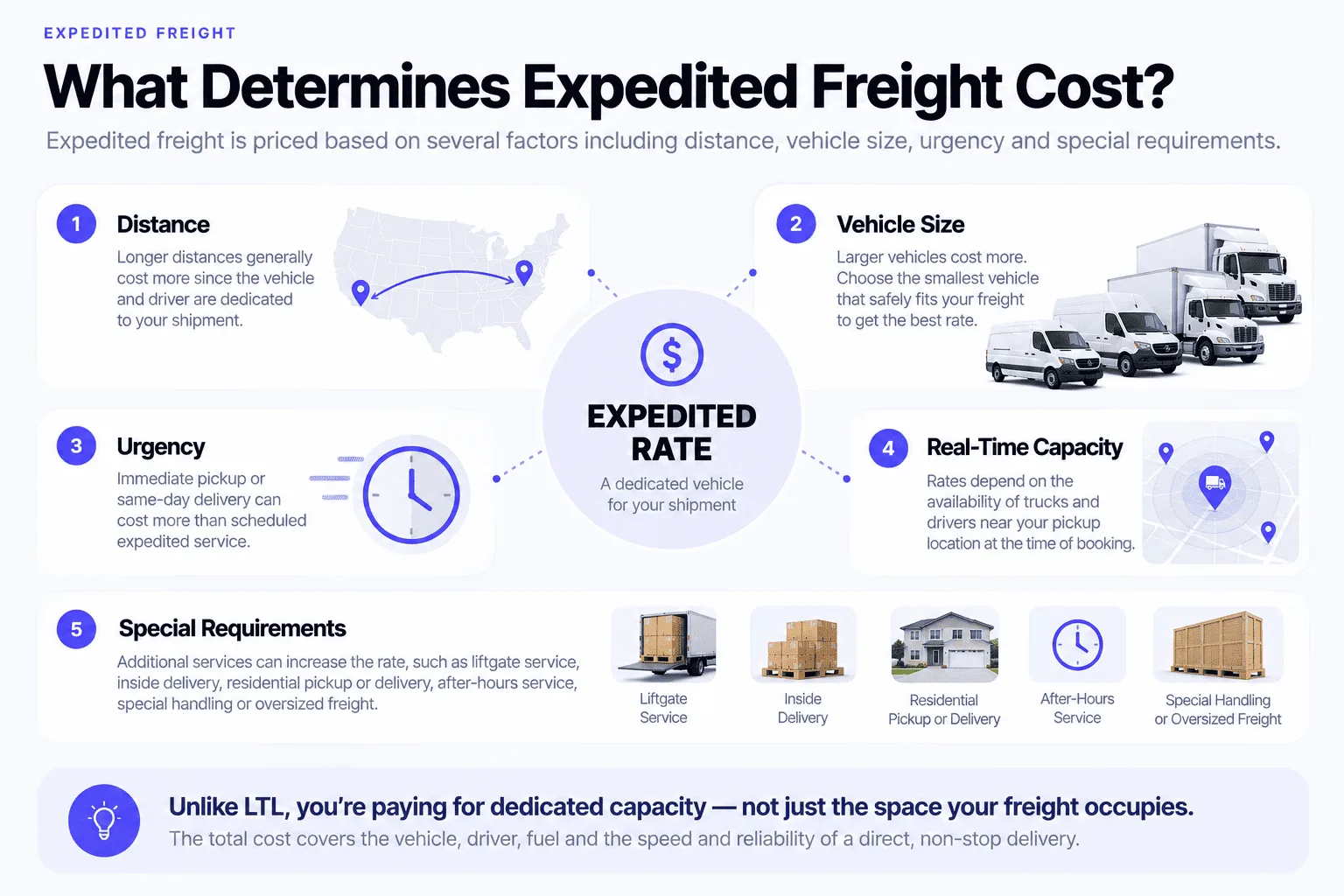
Expedited freight will always cost more than standard LTL for the same route — but there are still ways to avoid paying more than you need to.
Confirm you actually need dedicated capacity
Questions to ask before booking expedited
- Would a standard LTL pickup window (1–2 business days) actually be too slow for this shipment?
- Is the cost of the delay genuinely higher than the premium for a dedicated vehicle?
- Could a partial expedite — dispatching sooner but consolidating for part of the route — meet the deadline for less?
The most common way shippers overpay on expedited freight is defaulting to it out of habit for shipments that would have made a standard LTL pickup window just fine. Confirming the actual deadline before requesting expedited service is the single best way to avoid an unnecessary premium.
Match the vehicle to the load
A cargo van costs less to dispatch than a straight truck. Giving accurate weight and dimensions upfront means you’re quoted — and dispatched — the smallest vehicle that can actually do the job, instead of a larger one “just in case.”
Choose accessorials carefully
Liftgate service, inside delivery, and after-hours pickup are common add-ons on expedited loads. Confirm what your locations actually require before dispatch — a redirect mid-route costs more than getting it right the first time.
Information needed for an expedited quote
Have the following ready so dispatch can quote and move fast:
Pickup and delivery locations
Full address for both ends, plus whether either location has any access restrictions.
Shipment details
Weight, dimensions, and a description — this determines which vehicle type is dispatched.
How urgent it is
Immediate dispatch or a specific deadline — be as specific as possible.
Accessorials
Liftgate, inside pickup or delivery, or after-hours service — flag these upfront to avoid a delay mid-route.
Expedited freight quotes: frequently asked questions
What is expedited freight?
Expedited freight is a dedicated vehicle dispatched specifically for your shipment, moving directly from pickup to delivery without the multi-stop consolidation of standard LTL — used when a shipment can’t wait for standard scheduling.
How fast can expedited freight be picked up?
We dispatch a driver to your pickup location within 1–2 hours of your request, 24/7 — from there, your shipment moves directly to delivery with no multi-stop consolidation.
Is expedited freight more expensive than standard LTL?
Yes — you’re paying for a vehicle dedicated to your shipment alone rather than shared capacity, so expedited costs more than the same route via standard LTL.
What vehicle types are used for expedited freight?
Cargo vans and sprinter vans handle smaller loads; box trucks and straight trucks handle larger or heavier shipments. The right vehicle depends on your weight and dimensions.
Can I track my expedited shipment in real time?
Yes — every expedited shipment is tracked through MacroPoint, and we provide photos at both pickup and delivery so you can verify your shipment’s condition at every step.
Is expedited freight available 24/7?
Yes — our expedited dispatch and support team are available 24/7 for time-critical loads.