

Shipping LTL freight to or from Washington? Rates depend on your specific route, freight class, and how close your pickup or delivery point is to the nearest LTL terminal. Washington has about 8.1 million residents (the state’s April 1, 2025 estimate is 8,115,100, OFM), and most freight activity sits in the Puget Sound corridor from Everett through Seattle and Tacoma to Olympia along I-5, with a second hub in Spokane and a long, mountainous stretch of I-90 between them. I-5 runs about 277 miles through the state from Oregon to Canada, and I-90 about 298 miles from Seattle across Snoqualmie Pass to Idaho. The Cascade passes, winter chain rules and heavy rain are a bigger part of Washington freight than in most states, and the Northwest Seaport Alliance in Seattle and Tacoma ties much of it to Asia. Here’s what actually affects your rate. You can also compare live LTL freight rates across carriers.
LTL trucking regulations in Washington
A standard LTL tractor-trailer within legal size and weight limits does not need a special permit in Washington. The rules that matter to shippers are the ones that shape what carriers do on the road, plus permits for oversize or overweight freight:
- Ports of entry. The Washington State Patrol lists five ports of entry: Bow Hill on southbound I-5, Cle Elum on westbound I-90, Plymouth on northbound I-82, Ridgefield on northbound I-5 and Spokane on westbound I-90 at Liberty Lake. They weigh and inspect trucks entering the state, and WSP does not post stop thresholds or hours on its contact page, so check with WSP for current rules (WSP commercial vehicle contacts).
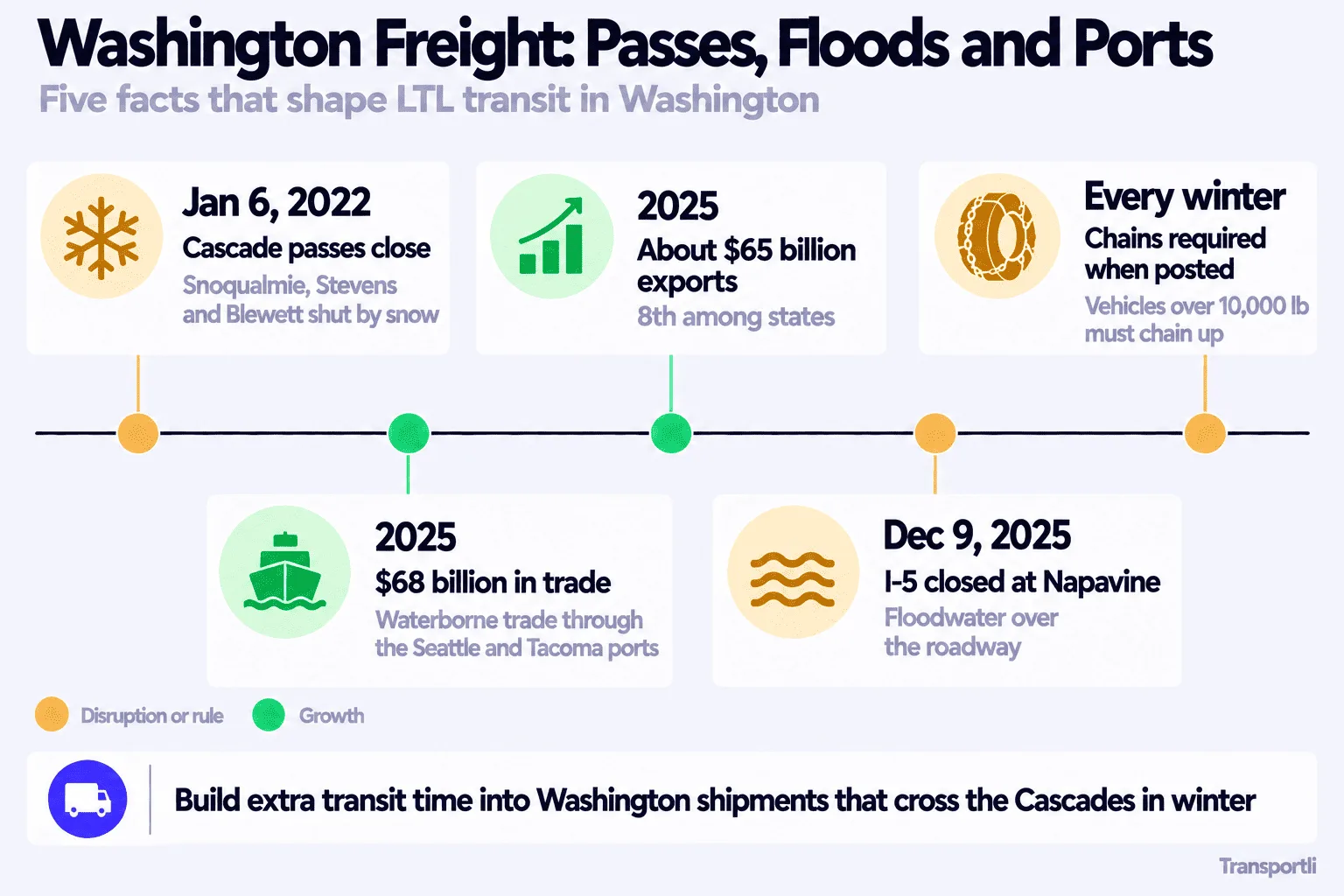
- Winter chain law. Washington bases its chain rule on weight, not vehicle type: vehicles over 10,000 pounds must install chains when “chains required” is posted, even if they have all-wheel drive (KOMO). WSDOT also says heavy vehicles must carry chains and two spares from November 1 to April 1 (WSDOT chain requirements).
- Oversize and overweight permits. WSDOT’s Commercial Vehicle Services issues permits for loads over the legal limits, and most are self-issued online. Permitted oversize moves are prohibited where winter pass signs such as “chains required” are posted. See WSDOT commercial vehicle permits. A standard LTL trailer within legal limits does not need one.
Current rules and conditions are public record: WSP ports of entry → WSDOT mountain pass reports →
What affects your Washington LTL rate
- Freight class — density, handling, and liability determine your NMFC class, the single biggest factor in your rate. See our freight class guide.
- Distance — Washington is wider than it looks: Seattle to Spokane is about 280 miles on I-90, and Seattle to Portland is about 175 miles on I-5, so a lane east of the Cascades is a long haul with few terminals in between.
- West vs. east of the Cascades — Seattle, Tacoma and Everett have the deepest carrier networks, with Spokane, the Tri-Cities and Yakima the main eastern hubs, so a lane across the mountains can mean fewer options and more transfer points.
- Terminal proximity — the more carrier terminals near your pickup or delivery point, the more quotes you see, and in rural Washington, the Olympic Peninsula and the north-central highlands the nearest terminal can be 100 miles or more away.
- Mountain pass and winter exposure — lanes over Snoqualmie, Stevens, White and Blewett Passes can pick up winter delays, and carriers price some of that uncertainty into transit time.
- Accessorials — liftgate, residential, or inside delivery add to the base rate, same as anywhere else, and farm, orchard, port and ferry-island deliveries often need a limited-access or liftgate service.
Did you know?From 6 real Washington lanes and 30 quotes
-
8× the cost per mile
The shorter haul cost far more per mile
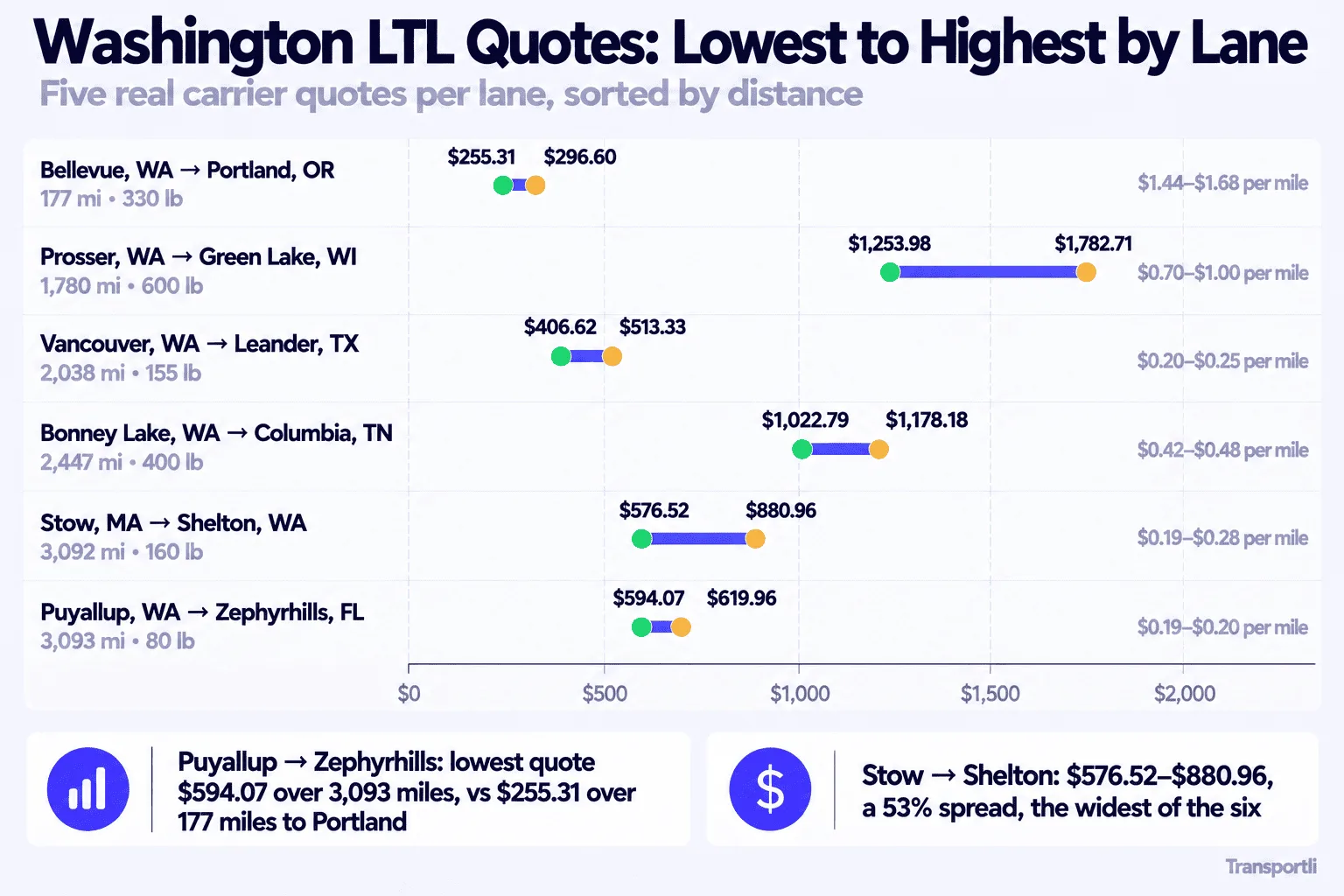
A 330 lb shipment moving 177 miles (Bellevue, WA to Portland, OR) had a lowest quote of $255, or $1.44 a mile. A 160 lb shipment moving 3,092 miles (Stow, MA to Shelton, WA) had a lowest quote of $577, or $0.19 a mile.
-
5 carriers had the lowest quote
Five different carriers won six Washington lanes
XPO had the lowest quote on two lanes. AAA Cooper, Central Transport, Estes, and Roadrunner each had the lowest quote on one lane. Across the lowest quotes on every lane, 12 different carriers appeared.
-
$529 from lowest to fifth-lowest
Same shipment, quotes $529 apart
For 600 lb from Prosser, WA to Green Lake, WI (1,780 miles), the lowest quote was $1,254 and the fifth-lowest was $1,783, a 42% gap. On Puyallup, WA to Zephyrhills, FL, all five quotes landed within $26 of each other.

Where freight moves in Washington
Washington freight follows I-5, the ports and the Cascade crossings:
- Seattle, Bellevue & the Eastside — where I-5, I-90, I-405 and SR 520 meet, with Seattle at about 785,000 residents and Bellevue at about 154,000 in the Census Bureau’s July 2025 estimates, as compiled by CityPopulation.
- Tacoma & the South Sound — Tacoma at about 230,000, with Kent, Auburn and Fife holding many of the region’s warehouses along I-5 and SR 167, next to the port.
- Vancouver & Southwest Washington — Vancouver at about 200,000 across the Columbia River from Portland, on I-5 and I-205.
- Spokane & the Inland Northwest — Spokane at about 231,000, on I-90 near the Idaho line, serving eastern Washington and northern Idaho.
- Tri-Cities, Yakima & the Columbia Basin — Kennewick, Pasco, Richland and Yakima on I-82 and I-182, the orchard, wine and food-processing belt.
- The Canadian border — Blaine and Bellingham on I-5 north of Everett, where Canadian trade crosses, and Canada is among the state’s largest export markets.
Weather and transit reliability
Washington freight is exposed to snow in the mountains and heavy rain on the west side. On January 6, 2022, I-90 at Snoqualmie Pass closed for high avalanche danger, zero visibility and drifting snow, while US 2 at Stevens Pass and US 97 at Blewett Pass also closed (FOX 13). In December 2025, an atmospheric river closed I-5 near Napavine in Lewis County with water over the roadway on December 9 (MyNorthwest) and shut about 50 miles of US 2 between Skykomish and Leavenworth because of mudslides and flooding (FOX 13). For LTL shippers the practical advice is simple: during winter storms and heavy rain, build extra transit time into anything that crosses the Cascades or runs on I-5 south of Olympia, and check WSDOT mountain pass reports before a tight delivery.
Sample Washington LTL rates by route
Real quotes pulled from our platform for six different Washington lanes — same process, different carriers each time, starting or ending in Washington and spanning a range of weights and distances. Rates shift with capacity and fuel costs, so treat these as a snapshot rather than a guarantee for your shipment; get an instant quote for your exact route.
Real quotes by route
Snapshot taken over recent months — carriers and pricing change daily.
| Carrier | Service | Transit | Price |
|---|---|---|---|
| Central Transport | Standard | 1 day | $255.31 |
| Peninsula Truck Lines | Standard | 1 day | $264.49 |
| Forward Air | Standard | 1 day | $270.21 |
| AAA Cooper Transportation | Standard | 1 day | $286.56 |
| Oak Harbor Freight Lines | STD | 1 day | $296.60 |
| Carrier | Service | Transit | Price |
|---|---|---|---|
| AAA Cooper Transportation | Standard | 4 days | $1,253.98 |
| Peninsula Truck Lines | Standard | 1 day | $1,257.95 |
| ABF Freight | Standard | 8 days | $1,535.41 |
| Saia | Standard | 5 days | $1,769.13 |
| R+L Carriers | Standard | 5 days | $1,782.71 |
| Carrier | Service | Transit | Price |
|---|---|---|---|
| XPO | Standard | 4 days | $406.62 |
| Forward Air | Standard | 4 days | $475.24 |
| Roadrunner Freight | Standard | 7 days | $486.82 |
| AAA Cooper Transportation | Standard | 5 days | $502.74 |
| Estes | LTL Standard Transit | 5 days | $513.33 |
| Carrier | Service | Transit | Price |
|---|---|---|---|
| Estes | LTL Standard Transit | 5 days | $1,022.79 |
| Roadrunner Freight | Standard Service | 3 days | $1,062.42 |
| Forward Air | Standard | 5 days | $1,076.94 |
| XPO | Standard | 5 days | $1,123.16 |
| ABF Freight | Standard | 5 days | $1,178.18 |
| Carrier | Service | Transit | Price |
|---|---|---|---|
| Roadrunner Freight | Standard Service | 5 days | $576.52 |
| Forward Air | STD | 4 days | $624.46 |
| XPO | Standard | 9 days | $803.70 |
| Estes | LTL Standard Transit | 8 days | $847.19 |
| Central Transport | Standard | 8 days | $880.96 |
| Carrier | Service | Transit | Price |
|---|---|---|---|
| XPO | STD | 6 days | $594.07 |
| Estes | LTL Standard Transit | 5 days | $600.06 |
| Forward Air | Standard | 6 days | $607.77 |
| Warp | STD | 5 days | $610.49 |
| Roadrunner Freight | Standard | 7 days | $619.96 |
Rate, transit, and price-per-mile summary
Pulling the six lanes above together, an 80 lb shipment from Puyallup to Zephyrhills stands out from everything else in the data:
| Route | Distance | Weight | Price range | Transit range | Price per mile |
|---|---|---|---|---|---|
| Bellevue, WA → Portland, OR | 177 mi | 330 lb | $255–$297 | 1 day | $1.44–$1.68 |
| Prosser, WA → Green Lake, WI | 1,780 mi | 600 lb | $1,254–$1,783 | 1–8 days | $0.70–$1.00 |
| Vancouver, WA → Leander, TX | 2,038 mi | 155 lb | $407–$513 | 4–7 days | $0.20–$0.25 |
| Bonney Lake, WA → Columbia, TN | 2,447 mi | 400 lb | $1,023–$1,178 | 3–5 days | $0.42–$0.48 |
| Stow, MA → Shelton, WA | 3,092 mi | 160 lb | $577–$881 | 4–9 days | $0.19–$0.28 |
| Puyallup, WA → Zephyrhills, FL | 3,093 mi | 80 lb | $594–$620 | 5–7 days | $0.19–$0.20 |
Puyallup to Zephyrhills, Florida (3,093 miles, 80 lb) ran $594.07–$619.96, or $0.19–$0.20 per mile, the cheapest per mile and the tightest spread in the data, 4%, with all five quotes within $25.89 of each other. Its lowest quote was only $338.76 above the lowest on Bellevue to Portland ($255.31), a lane 2,916 miles shorter. Bellevue to Portland (177 miles, 330 lb) ran $255.31–$296.60, or $1.44–$1.68 per mile, the highest per-mile rate in the data, and all five quotes were 1-day service. Stow, Massachusetts to Shelton (3,092 miles, 160 lb), the one inbound lane, had the widest spread, 53%: Roadrunner Freight’s 5-day $576.52 was $227.18 below XPO’s 9-day $803.70, so the slower service also cost more, while Forward Air’s 4-day $624.46 cost $47.94 more than Roadrunner for a day faster. Prosser to Green Lake, Wisconsin (1,780 miles, 600 lb) was the most expensive lane at $1,253.98–$1,782.71, and ABF Freight’s 8-day $1,535.41 cost $281.43 more than AAA Cooper’s 4-day $1,253.98, while Saia and R+L Carriers were only $13.58 apart. On Vancouver to Leander, Texas, XPO’s 4-day $406.62 was $68.62 below Forward Air’s 4-day $475.24 for the same four days. On Bonney Lake to Columbia, Tennessee, Roadrunner Freight’s 3-day $1,062.42 cost $39.63 more than Estes’s 5-day $1,022.79, two days faster. The lesson is the same on every lane: compare several carriers before you book.
What a real Washington LTL quote looks like
The screenshot alongside is an actual result from our platform, a 330 lb shipment from Bellevue, WA to Portland, OR, compared across 57 real carrier options in seconds. It is the same lane as the first tab above, quoted again about two months later for a Friday, October 9 pickup.
- 57 real carrier options compared for this single shipment, 46 of them standard service and 11 guaranteed, against 58 options in the August search, not just one broker’s in-house rate.
- $269.87–$318.70 for the five lowest quotes, with four of the five on 1-day service. Peninsula Truck Lines was lowest at $269.87, and AAA Cooper Transportation’s $296.00 cost $26.13 more.
- Prices crept up. Against the Tuesday, August 11 search, Peninsula Truck Lines rose $5.38, AAA Cooper $9.44, Oak Harbor Freight Lines $6.83 and Forward Air $41.90, all on the same 1-day service. Central Transport, lowest in August at $255.31, is no longer in the top five, and the lowest quote overall rose $14.56, about 6%.
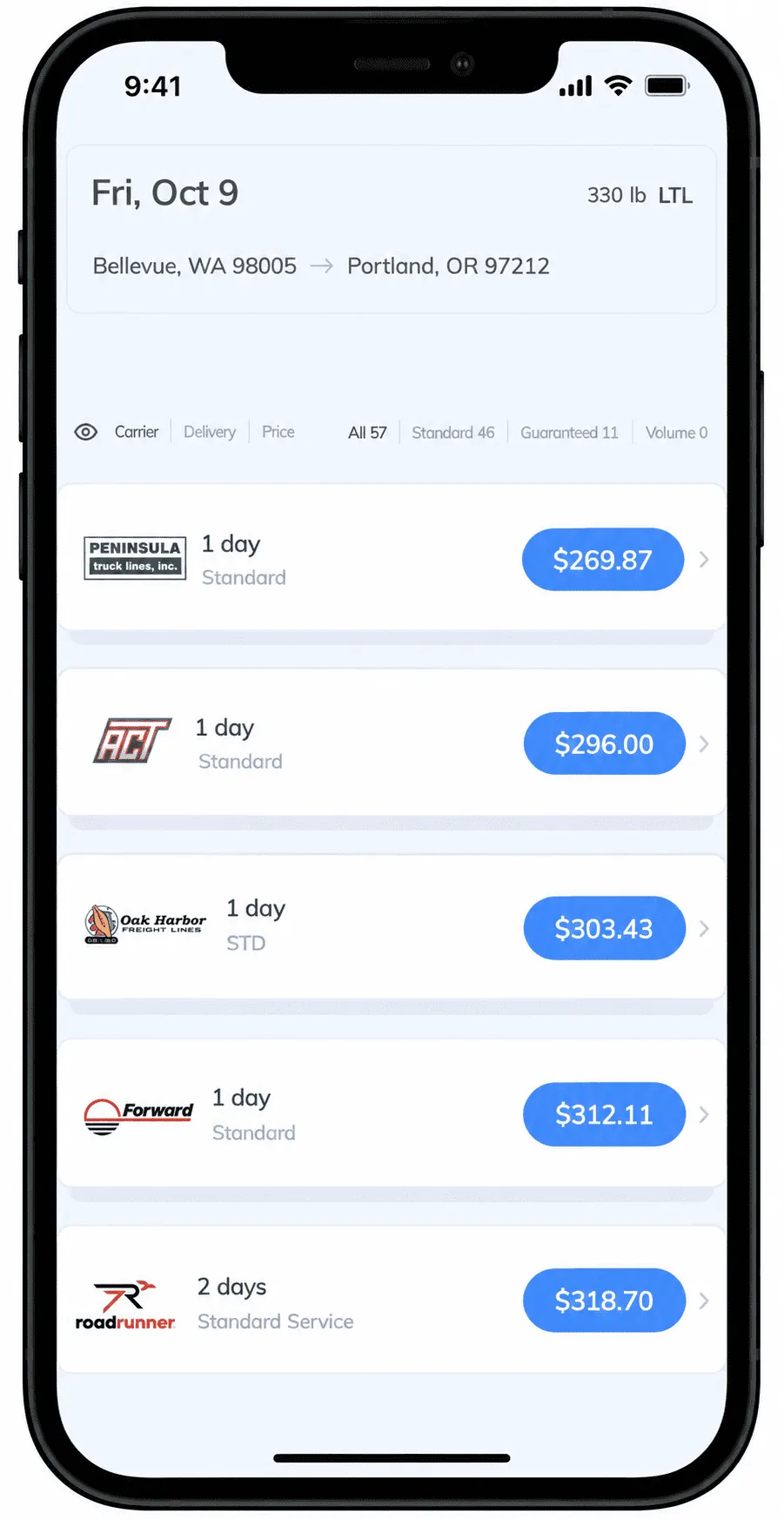
Real screenshot from a live Transportli quote for Bellevue, WA to Portland, OR, individual results vary by shipment and date.
Major shipping hubs in Washington
Washington’s freight moves through the Puget Sound ports and a handful of regional hubs:
- Seattle & Tacoma ports — the Northwest Seaport Alliance, which manages the container terminals of both ports, says it handled nearly $68 billion of waterborne trade with 175 trading partners in 2025 (NWSA), and trade press reports container volume of 3.16 million TEUs, down 5.5% from 2024 (Container News).
- Kent, Auburn & the Green River Valley — the large warehouse and distribution district south of Seattle, along SR 167 and I-5.
- Everett — the northern anchor of the Puget Sound corridor, at I-5 and US 2, tied to aerospace manufacturing.
- Spokane — the Inland Northwest hub, on I-90 near the Idaho line, with a WSP port of entry at Liberty Lake.
- Vancouver — the Southwest Washington hub on the Columbia River, with a WSP port of entry at Ridgefield on I-5.
- Tri-Cities & Yakima — the Columbia Basin food and agriculture hubs on I-82 and I-182, with a WSP port of entry at Plymouth.
Highway corridors serving Washington
I-5 (about 277 miles in Washington) is the main north-south route, from the Columbia River at Vancouver through Olympia, Tacoma, Seattle and Everett to the Canadian border at Blaine. I-90 (about 298 miles) runs east from Seattle across Snoqualmie Pass through Ellensburg and Moses Lake to Spokane and Idaho, I-82 (about 133 miles) links I-90 at Ellensburg to Yakima and the Tri-Cities and on to Oregon, and I-405 (about 30 miles) and I-205 (about 11 miles) bypass Seattle and Portland. I-182 (about 15 miles) crosses the Tri-Cities. US 2 crosses Stevens Pass, US 97 crosses Blewett Pass, and US 12 and US 395 serve the southeast and north-central parts of the state.
Ports of entry on Washington’s main routes
WSP runs five ports of entry: Bow Hill (I-5 southbound, near Bow), Cle Elum (I-90 westbound, mile marker 80), Plymouth (I-82 northbound, near Kennewick), Ridgefield (I-5 northbound) and Spokane (I-90 westbound, mile marker 299, at Liberty Lake). WSP’s contact page gives phone numbers but no hours, so call the port or check the WSP page for details.
What Washington shippers move
Washington’s freight is shaped by aerospace, food and technology. The state exported about $65 billion of goods in 2025, the 8th most of any state, though down 24% from 2015, led by $29.8 billion of transportation equipment, which includes aircraft, with $3.7 billion of computer and electronic products and $2.0 billion of machinery. China took $10.2 billion, or 16% of the total, followed by Canada at about $7 billion, South Korea at $5.6 billion, Japan at $5.1 billion and Mexico at $4.1 billion, according to the U.S. Trade Representative. Washington is also the 15th largest agricultural exporting state, shipping $3.9 billion abroad in 2024, including $634 million of fresh fruits, $512 million of processed fruits, $480 million of processed vegetables and $396 million of wheat, and 10,729 companies exported from the state that year. Much of the aircraft, grain and fruit moves by air, rail, barge or full truckload, but the parts, tools, supplies, equipment and finished goods around these industries are where LTL fits.
Get a Washington LTL quote
Compare live rates from vetted carriers serving Washington.
Get an LTL quote →Washington LTL freight: frequently asked questions
How much does LTL shipping cost to or from Washington?
It depends on distance, weight, freight class, and how close your pickup or delivery point is to a major metro’s carrier network. Real quotes on our platform for Washington lanes have ranged from about $0.19 to $0.20 per mile on an 80 lb shipment over 3,093 miles from Puyallup, Washington to Zephyrhills, Florida to $1.44 to $1.68 per mile on a 330 lb shipment over 177 miles from Bellevue, Washington to Portland, Oregon, so distance alone does not predict the price. Get an instant quote for your exact shipment.
Do oversized LTL shipments need a permit in Washington?
Yes, for loads over the legal limits. WSDOT’s Commercial Vehicle Services issues oversize and overweight permits, and most are self-issued online. Permitted oversize moves are prohibited where winter chain signs are posted on the mountain passes. A standard LTL trailer within legal limits does not need one.
Do trucks have to stop at Washington ports of entry?
Commercial vehicles are weighed and inspected at the Washington State Patrol’s five ports of entry: Bow Hill and Ridgefield on I-5, Cle Elum and Spokane on I-90, and Plymouth on I-82. WSP does not post stop thresholds or hours on its contact page, so check with WSP for current rules.
Do trucks need chains in Washington?
Washington bases its chain rule on weight. Vehicles over 10,000 pounds must install chains when chains required is posted, even with all-wheel drive, and WSDOT says heavy vehicles must carry chains and two spares from November 1 to April 1. Check WSDOT mountain pass reports before any winter trip over the Cascades.
How does weather affect LTL shipping in Washington?
Snow and avalanche danger have closed I-90 at Snoqualmie Pass, US 2 at Stevens Pass and US 97 at Blewett Pass. In December 2025, flooding closed I-5 near Napavine on December 9, and mudslides and flooding shut about 50 miles of US 2 between Skykomish and Leavenworth. Build extra transit time into shipments that cross the Cascades.
What roads connect Washington’s main cities?
I-5 runs north-south through Vancouver, Olympia, Tacoma, Seattle and Everett to Canada, I-90 runs east from Seattle across Snoqualmie Pass to Spokane and Idaho, and I-82 links Ellensburg, Yakima and the Tri-Cities to Oregon. I-405 and I-205 bypass Seattle and Portland.
Why is the Northwest Seaport Alliance important for freight?
It manages the container terminals of the Ports of Seattle and Tacoma, and says it handled nearly $68 billion of waterborne trade with 175 trading partners in 2025. Much of Washington’s freight, from imports to farm exports, moves through these ports.