

Shipping LTL freight to or from New York? Rates depend on your specific route, freight class, and how close your pickup or delivery point is to the nearest LTL terminal — and in New York more than almost any other state, exactly where you are matters. A shipment moving through the five boroughs faces a completely different carrier landscape than one moving through Buffalo, Rochester, or the Adirondacks. Here’s what actually affects your rate.
LTL trucking regulations in New York
Standard interstate trucking limits apply in New York: 80,000 lbs gross vehicle weight, 53 feet trailer length, 8.5 feet width, and 13.5 feet height, under Section 385 of the New York Vehicle and Traffic Law. Most LTL shipments fall well within these limits — this mainly matters if your freight is unusually large or heavy.
Loads that exceed the standard limits need a Special Hauling Permit — and New York is unusual in splitting that requirement across three separate authorities depending on exactly where you’re driving:
- NYSDOT issues Special Hauling Permits for state highways under its jurisdiction, through its Highway Oversize/Overweight Credentialing System.
- The New York State Thruway Authority requires its own, separate Special Hauling Permit for the Thruway system (I-87 and I-90) — an NYSDOT permit alone does not cover travel on the Thruway, and carriers without the right paperwork face fines and load holds at toll plazas.
- New York City requires its own permits for city streets through NYC DOT, on top of whatever state-level permit already applies.
Exact current requirements and applications are available directly from NYSDOT:
NYSDOT Special Hauling Permits →
What affects your New York LTL rate
- Freight class — density, handling, and liability determine your NMFC class, the single biggest factor in your rate. See our freight class guide.
- Distance — New York spans over 400 miles from New York City to Buffalo, so “shipping in New York” can mean a short outer-borough hop or a genuine long-haul move within the same state.
- Terminal proximity — pickup or delivery points in or near New York City, Long Island, Buffalo, or Rochester typically see the most carrier options and fastest transit; addresses in the North Country, the Southern Tier, or the Adirondacks see fewer options and longer routes.
- Accessorials — liftgate, residential, or inside delivery add to the base rate, same as anywhere else. New York City deliveries can also carry extra time (and sometimes cost) tied to congestion, limited truck routes, and building access — see below.
Did you know?From 6 real New York lanes and 30 quotes
-
6× the cost per mile
The shorter haul cost far more per mile
A 3,223 lb shipment moving 1,254 miles (Staten Island, NY to Fort Lauderdale, FL) had a lowest quote of $1,046, or $0.83 a mile. A 300 lb shipment moving 2,707 miles (Pittsford, NY to Portland, OR) had a lowest quote of $380, or $0.14 a mile.
-
$73 to arrive one day sooner
Saving a day is not free
On Staten Island, NY to Fort Lauderdale, FL (1,254 miles, 3,223 lb), the cheapest quote at $1,046 took 4 days. The fastest, at 3 days, cost $1,120. On Jackson, MS to New York, NY, 3-day delivery cost $854 against $793 for 4 days.
-
5 carriers had the lowest quote
Five different carriers won six New York lanes
TForce Freight had the lowest quote on two lanes. Forward Air, Southeastern, Warp, and XPO each had the lowest quote on one lane. Across the lowest quotes on every lane, 14 different carriers appeared.
-
$384 from lowest to fifth-lowest
Same shipment, quotes $384 apart
For 3,223 lb from Staten Island, NY to Fort Lauderdale, FL (1,254 miles), the lowest quote was $1,046 and the fifth-lowest was $1,431, a 37% gap.

Regional carrier coverage across New York
New York isn’t one freight market — it’s several, and carrier density drops off fast as you move away from the state’s core metro areas:
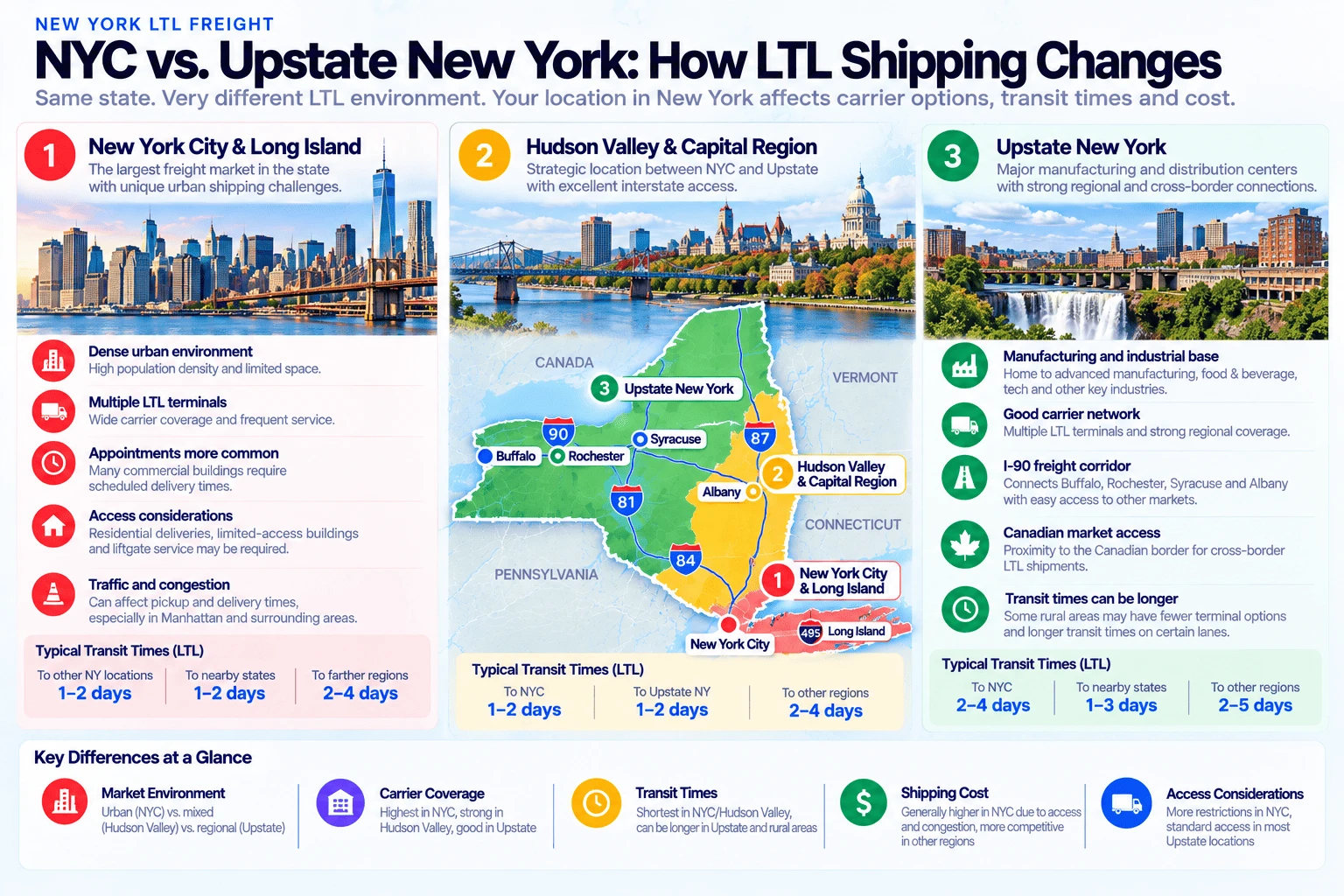
- New York City & Long Island — the deepest carrier network in the state, anchored by terminals in the Bronx, Brooklyn, and Queens, plus JFK and LaGuardia air cargo. Delivery density is high, but so is operational complexity: limited truck routes, tight loading windows, and Manhattan’s Congestion Relief Zone tolling (see FAQ below) all factor into cost and timing for city deliveries.
- Hudson Valley & Capital Region (Albany) — strong coverage with direct access to I-87 and I-90, benefiting from spillover from both the NYC and Albany/Tech Valley freight markets.
- Central New York & Southern Tier (Syracuse, Binghamton, Utica) — moderate terminal coverage along the I-90 and I-81 corridors, with growing demand tied to the Micron semiconductor project near Syracuse (more below).
- Western New York (Buffalo, Rochester, Niagara Falls) — a genuine secondary hub, not an afterthought — strong carrier presence tied to cross-border trade with Canada via the Peace Bridge and Niagara-area crossings.
- North Country & the Adirondacks — the thinnest coverage in the state: fewer terminals, longer pickup routes, and transit times that can run a day or more behind the metro areas.
Why NYC deliveries cost more
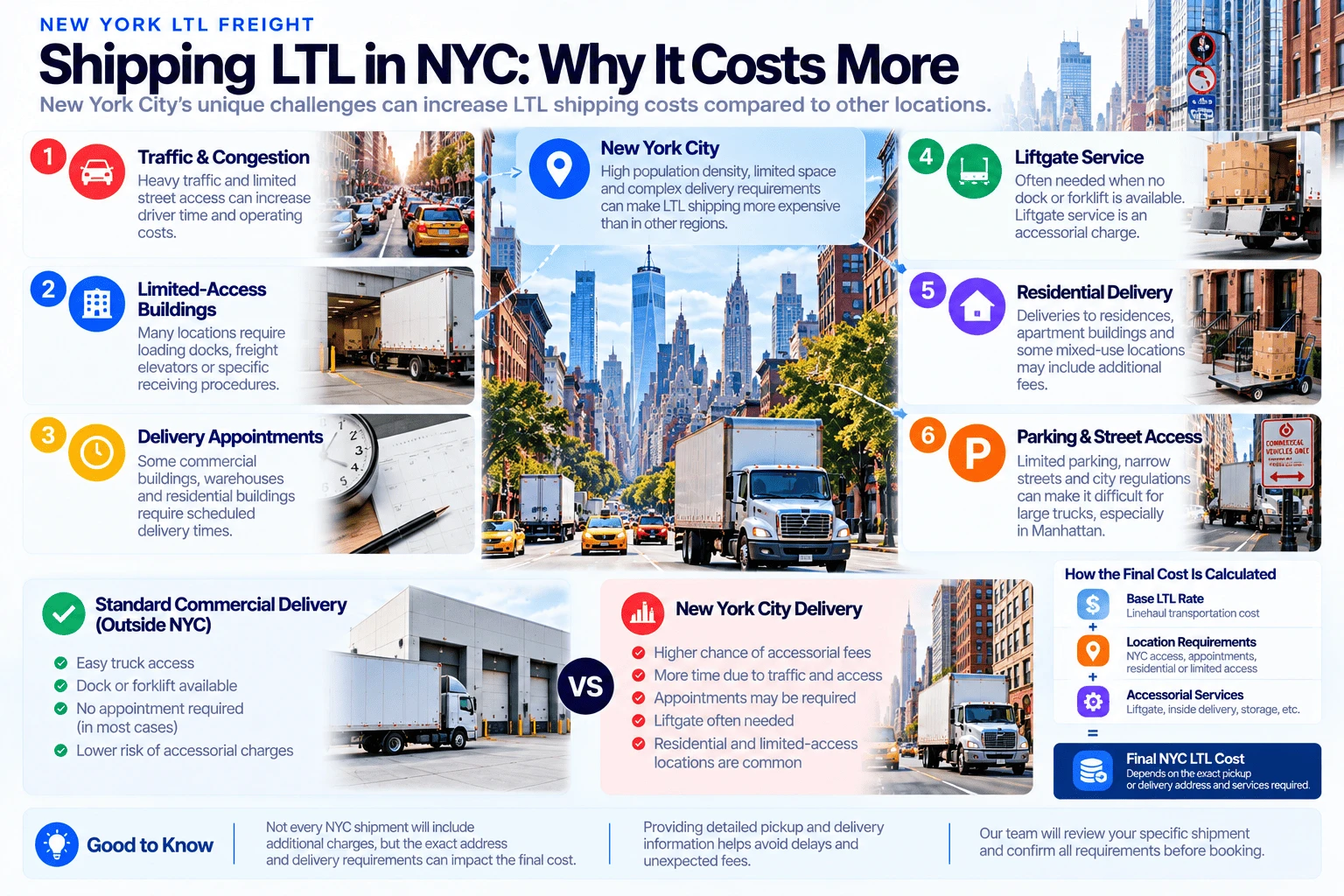
New York City’s high carrier density doesn’t automatically mean cheap delivery — the city’s physical layout adds real accessorial risk on top of the base rate. Heavy traffic and limited street access slow drivers down; many buildings have no loading dock or forklift, requiring a liftgate; some commercial and residential buildings require a scheduled delivery appointment; and residential or mixed-use deliveries carry their own extra fees. Parking and street access add another layer — narrow streets, limited commercial parking, and truck restrictions (especially in Manhattan) can turn a routine delivery into a longer one. None of this is guaranteed to apply to every NYC shipment, but it’s why two deliveries of the same freight can price very differently depending on the exact pickup or delivery address.
Weather and transit reliability
New York’s weather risk varies as much as its geography. Buffalo, Rochester, and Syracuse sit in the Great Lakes’ lake-effect snow belt and regularly see some of the heaviest snowfall totals of any major metro areas in the country, mainly November through March — this is a routine, recurring factor for western and central New York transit, not just an occasional storm. New York City and Long Island instead deal with Atlantic nor’easters, which can shut down bridges, tunnels, and highways for a day at a time. Inland routes through the Adirondacks and Catskills (I-87, I-84) add mountain-weather risk — sudden snow squalls and lower visibility — on top of whatever’s happening at either end of the trip. Build in extra buffer time for winter shipments on any of these routes.
Sample New York LTL rates by route
Real quotes pulled from our platform for six different New York lanes — same process, different carriers each time, spanning both ends of the state. Rates shift with capacity and fuel costs, so treat these as a snapshot rather than a guarantee for your shipment; get an instant quote for your exact route.
Real quotes by route
Snapshot taken over recent weeks — carriers and pricing change daily.
| Carrier | Service | Transit | Price |
|---|---|---|---|
| Warp | Standard | 5 days | $636.08 |
| Roadrunner Freight | Standard Service | 7 days | $692.11 |
| ABF Freight | Standard | 7 days | $741.52 |
| Estes | LTL Standard Transit | 6 days | $853.84 |
| TForce Freight | STD | 5 days | $879.09 |
| Carrier | Service | Transit | Price |
|---|---|---|---|
| TForce Freight | Standard | 5 days | $380.47 |
| Forward Air | STD | 4 days | $440.12 |
| STG Logistics | Standard | 10 days | $440.97 |
| Central Transport | STD | 7 days | $459.02 |
| XPO | Standard | 5 days | $463.77 |
| Carrier | Service | Transit | Price |
|---|---|---|---|
| TForce Freight | STD | 4 days | $1,046.34 |
| Warp | STD | 3 days | $1,119.50 |
| 2 Day Transportation | Standard | 3 days | $1,175.22 |
| STG Logistics | Standard | 4 days | $1,274.86 |
| Central Transport | Standard | 4 days | $1,430.70 |
| Carrier | Service | Transit | Price |
|---|---|---|---|
| XPO | STD | 4 days | $361.23 |
| TForce Freight | Standard | 6 days | $385.41 |
| Central Transport | Standard | 4 days | $421.27 |
| Forward Air | Standard | 5 days | $436.48 |
| FedEx Freight Economy | Standard | 6 days | $498.24 |
| Carrier | Service | Transit | Price |
|---|---|---|---|
| Forward Air | STD | 1 day | $881.08 |
| ABF Freight | Standard | 4 days | $910.51 |
| FedEx Freight Priority | Standard | 1 day | $1,043.56 |
| Ward Transport & Logistics | STD | 1 day | $1,111.52 |
| Pitt Ohio | STD | 1 day | $1,202.95 |
| Carrier | Service | Transit | Price |
|---|---|---|---|
| Southeastern Freight Lines | Standard | 4 days | $793.29 |
| ABF Freight | Standard | 4 days | $840.24 |
| Estes | LTL Standard Transit | 3 days | $854.02 |
| FedEx Freight Economy | Standard | 6 days | $896.38 |
| Forward Air | Standard | 4 days | $1,024.75 |
Rate, transit, and price-per-mile summary
Pulling the six lanes above together shows how much distance and shipment weight actually drive New York LTL pricing — and where “price per mile” stops being a useful way to think about it:
| Route | Distance | Weight | Price range | Transit range | Price per mile |
|---|---|---|---|---|---|
| Mount Vernon, WA → Franklin Square, NY | 2,929 mi | 550 lb | $636–$879 | 5–7 days | $0.22–$0.30 |
| Pittsford, NY → Portland, OR | 2,707 mi | 300 lb | $380–$464 | 4–10 days | $0.14–$0.17 |
| Staten Island, NY → Fort Lauderdale, FL | 1,254 mi | 3,223 lb | $1,046–$1,431 | 3–4 days | $0.83–$1.14 |
| Cheektowaga, NY → Salt Lake City, UT | 1,915 mi | 385 lb | $361–$498 | 4–6 days | $0.19–$0.26 |
| Newark, NJ → Elmont, NY | 37 mi | 1,050 lb | $881–$1,203 | 1–4 days | $23.80–$32.60 |
| Jackson, MS → New York, NY | 1,200 mi | 700 lb | $793–$1,025 | 3–6 days | $0.66–$0.85 |
Two patterns stand out. First, price per mile drops sharply as distance increases — our two longest hauls (Washington and Oregon, both 2,700+ miles) settle into the $0.14–$0.30/mile range, while the 1,200–1,900 mile lanes run noticeably higher per mile once you factor in heavier freight, like the 3,223 lb Staten Island shipment. Second, the short 37-mile Newark-to-Elmont lane shows why “price per mile” breaks down entirely on regional moves: LTL carriers charge for pickup, handling, and delivery regardless of distance, so a 37-mile hop can cost more in total than a cross-country shipment while working out to over $20 a mile. In practice, freight class and weight — not distance — are usually the bigger factor on shorter New York routes.
Major shipping hubs in New York
New York’s carrier terminal network is concentrated around a handful of metro areas, which generally means faster pickup windows and more carrier options the closer you are to one of these:
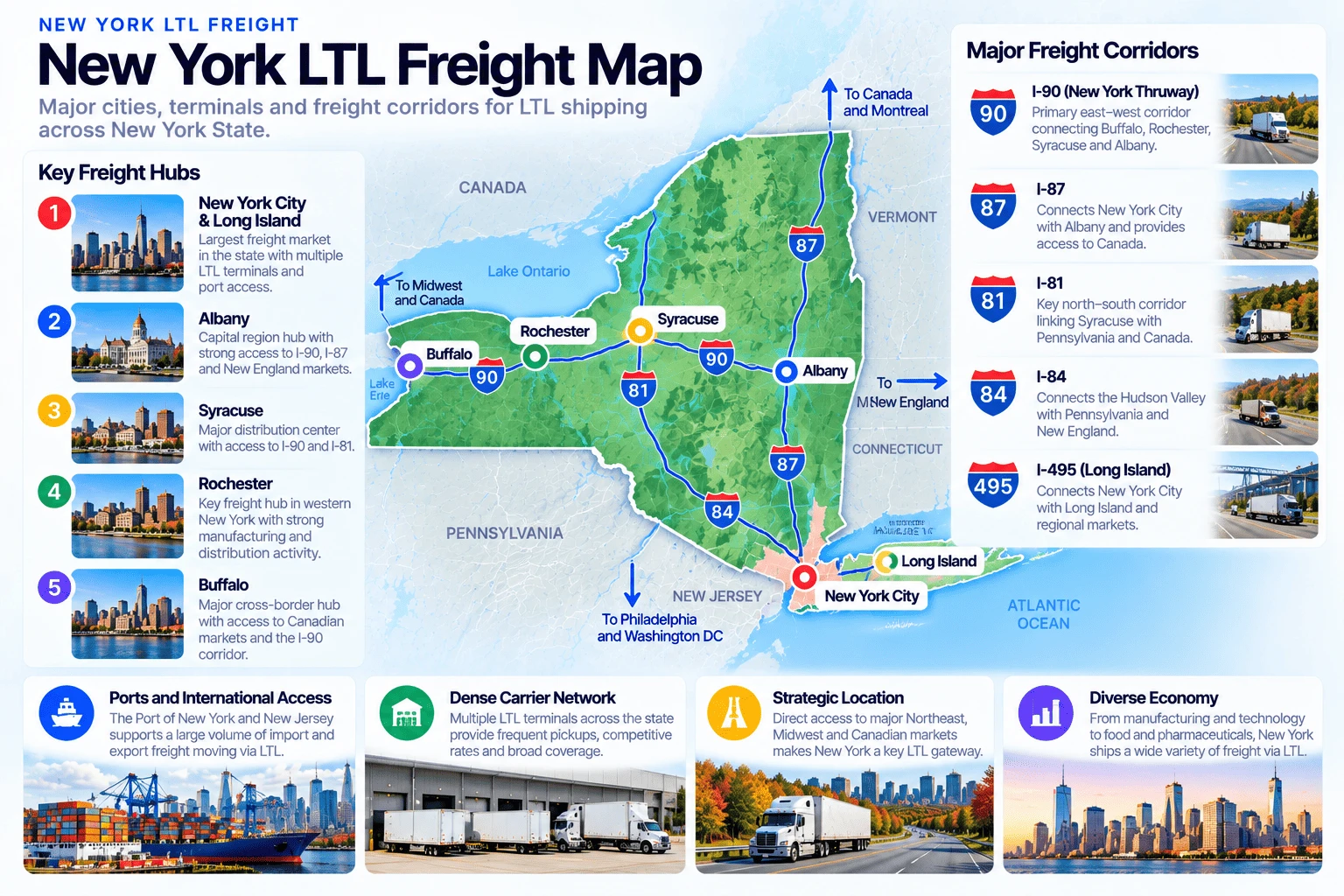
- New York City — the state’s primary freight gateway, with the deepest concentration of LTL terminals and carriers in the Bronx, Brooklyn, and Queens. The Bronx’s Hunts Point Food Distribution Center alone moves an estimated 4.5 billion pounds of food a year, making it one of the largest food distribution complexes in the world and a major generator of LTL and refrigerated freight.
- Long Island (Nassau & Suffolk) — a dense suburban consumer market with strong carrier coverage, served primarily via the Long Island Expressway (I-495).
- Albany & the Capital Region — centrally located along I-87 and I-90, with growing freight demand from the area’s “Tech Valley” semiconductor and nanotech industry.
- Buffalo & Niagara Falls — western New York’s freight gateway, with strong carrier coverage tied to cross-border trade with Ontario, Canada.
- Rochester — a secondary western New York hub along I-90 with solid regional coverage.
- Syracuse — centrally located at the junction of I-90 and I-81, increasingly important as the nearby Micron semiconductor project ramps up.
Highway corridors serving New York
New York’s freight network is built around the New York State Thruway (I-90), whose 426-mile mainline connects New York City to Buffalo and was, when completed in 1957, the longest toll highway in the world — it’s still one of the longest toll highway systems in the country today. I-87 runs the Thruway’s eastern leg from NYC to Albany, then continues north as the Adirondack Northway to the Canadian border. I-95 carries freight through the Bronx and Westchester as part of the full Eastern Seaboard corridor, while I-81 provides the main north–south route through Syracuse and Binghamton toward Canada and Pennsylvania. I-84 connects the mid-Hudson Valley east toward Connecticut, and on Long Island, the Long Island Expressway (I-495) is the primary route to Nassau and Suffolk counties. Around Buffalo, I-190 connects the city to the Peace Bridge and Niagara Falls — one of the busiest commercial crossings on the entire US-Canada border, handling an estimated $40 billion in bilateral trade a year.
What New York shippers move
New York’s freight mix is as diverse as its geography. New York City’s Garment District still anchors a real apparel and textiles trade, generating steady LTL volume in fabric rolls, trim, and finished goods, alongside massive retail and e-commerce distribution serving the country’s largest consumer market. The Hunts Point Food Distribution Center in the Bronx drives huge volumes of refrigerated and perishable freight. Upstate, the Capital Region’s “Tech Valley” is home to GlobalFoundries’ semiconductor fab in Malta, and Micron Technology broke ground in January 2026 on a planned multi-fab manufacturing complex in Clay, near Syracuse — a project the company says could reach up to $100 billion in investment over the next two decades, and one that’s already reshaping freight demand across central New York. Western New York’s economy leans on cross-border manufacturing and trade with Canada through Buffalo and Niagara Falls. And New York’s agricultural belt is genuinely significant: the state is the second-largest apple producer in the country after Washington, alongside a major dairy industry and the Finger Lakes wine region.
Get a New York LTL quote
Compare live rates from vetted carriers serving New York.
Get an LTL quote →New York LTL freight: frequently asked questions
How much does LTL shipping cost to or from New York?
It depends heavily on distance, weight, and where in New York your route starts or ends. Real New York lanes in our data ranged from about $361 for a lighter cross-country shipment out of Buffalo up to $1,431 for a heavier long-haul move out of Staten Island — and even a short 37-mile regional hop can run $880-plus once minimum handling and delivery charges are factored in. Get an instant quote for your exact shipment.
Do oversized LTL shipments need a permit in New York?
Only if your load exceeds the standard interstate limits (80,000 lbs, 53 feet long, 8.5 feet wide, 13.5 feet tall). New York is unusual in requiring separate permits from up to three authorities depending on your route: NYSDOT for state highways, the New York State Thruway Authority for I-87/I-90, and New York City for city streets.
Are there special considerations for LTL deliveries in New York City?
Yes. Trucks entering Manhattan’s Congestion Relief Zone (below 60th Street) pay a toll on top of normal delivery costs — as of 2026, roughly $5 to $22 depending on truck size and time of day, with lower overnight rates. The city is also actively incentivizing off-hour deliveries (7pm-6am) to cut daytime congestion, so building in delivery-window flexibility can help avoid both the toll’s peak rate and traffic delays.
Why is New York such an important freight state?
New York City is the largest consumer market in the country, the Port of New York and New Jersey and JFK airport handle enormous import/export volume, and upstate New York is in the middle of a major manufacturing resurgence — including a semiconductor project in central New York that could reach $100 billion in investment. Add in the Buffalo/Niagara border crossings with Canada, and New York generates freight demand at both ends of the state.
Which carriers serve New York?
Most major national LTL carriers serve New York, with the deepest coverage around New York City, Long Island, Buffalo, and Rochester — availability and pricing vary significantly by exact route and region.
Is LTL service the same everywhere in New York?
No — more so than almost any other state. New York City, Long Island, the Capital Region, and Buffalo/Rochester all have strong carrier coverage, but the North Country, the Adirondacks, and parts of the Southern Tier see meaningfully fewer carrier options and longer transit times.