

Shipping LTL freight to or from Minnesota? Rates depend on your specific route, freight class, and how close your pickup or delivery point is to the nearest LTL terminal. Minnesota packs an outsized freight footprint into a cold-weather state: 17 Fortune 500 companies call it home, its Iron Range still supplies a real share of American steelmaking, and its northernmost port outranks every other Great Lakes harbor by tonnage. Here’s what actually affects your rate. You can also compare live LTL freight rates across carriers.
LTL trucking regulations in Minnesota
Standard interstate trucking limits apply in Minnesota: 80,000 lbs gross vehicle weight, 53 feet trailer length, 8.5 feet width, and 13.5 feet height. Most LTL shipments fall well within these limits — this mainly matters if your freight is unusually large or heavy.
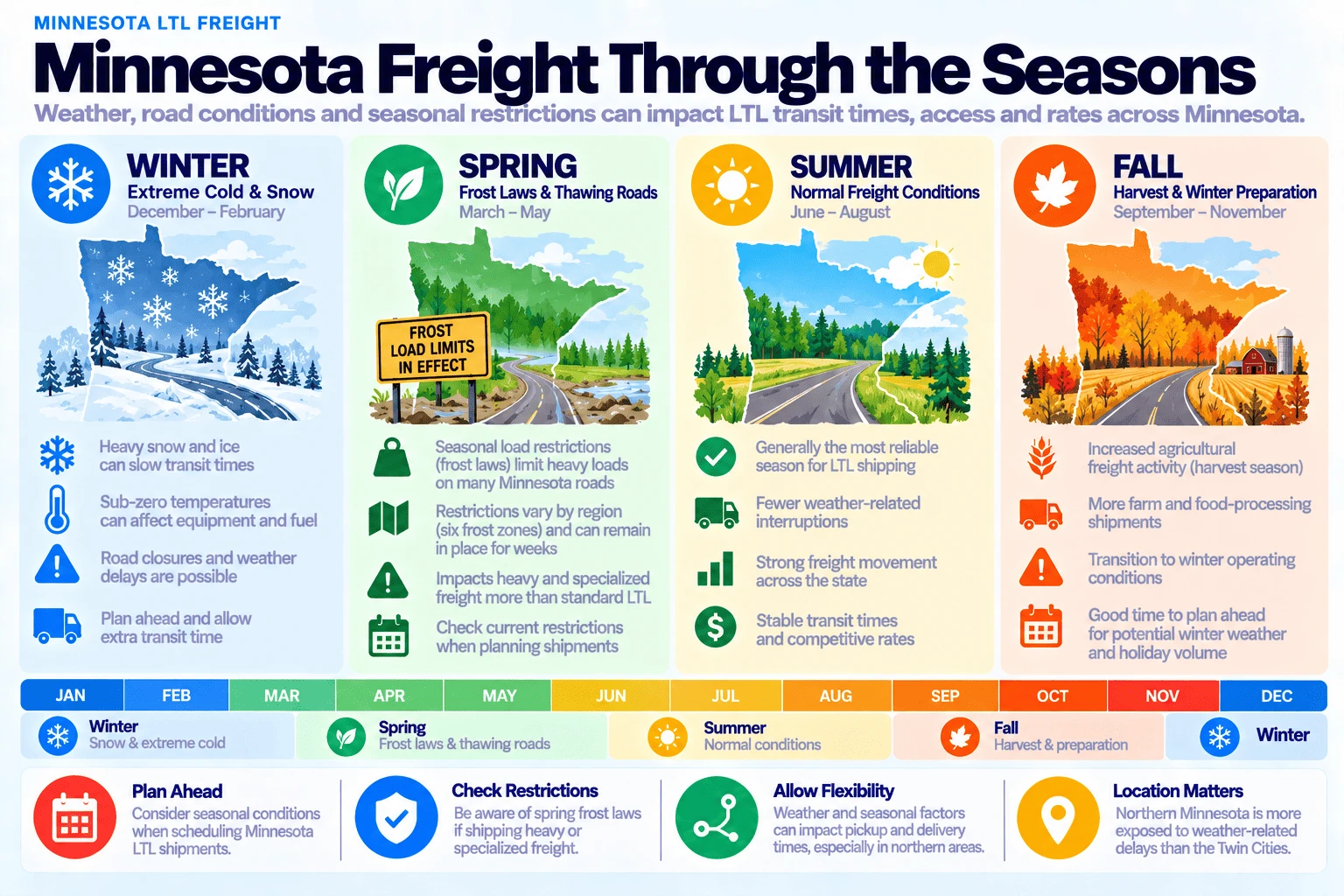
Minnesota’s real regulatory wrinkle isn’t a permit or a toll authority — it’s the calendar:
- Spring load restrictions (“frost laws”) are a genuinely distinctive Minnesota feature. As the ground thaws each spring, MnDOT and county road authorities cut legal axle weights — often down to 5 or 7 tons on posted routes — for up to 60 days at a time, to keep heavy trucks from tearing up pavement while it’s still soft underneath.
- The restrictions roll out zone by zone, not statewide at once. Minnesota is divided into six frost zones (South, Southeast, Metro, Central, North-Central, and North), and each one lifts its restrictions on its own schedule as it thaws — typically starting in the south in April and finishing in the far north by mid-May.
- This mostly affects full-truckload and heavy specialized freight, not typical LTL shipments, but if you’re moving something dense or heavy through Minnesota in March, April, or May, it’s worth checking which frost zone your route crosses.
Current frost zone maps and restriction dates are public record:
MnDOT Seasonal Load Limits — Frost Zone Maps →
What affects your Minnesota LTL rate
- Freight class — density, handling, and liability determine your NMFC class, the single biggest factor in your rate. See our freight class guide.
- Distance — Minnesota’s carrier density is heavily weighted toward the Twin Cities metro; coverage thins out fast the farther north you go.
- Terminal proximity — pickup or delivery points near Minneapolis-St. Paul, Duluth, or Rochester typically see the most carrier options and fastest transit; far-northern and Iron Range addresses see meaningfully fewer options.
- Accessorials — liftgate, residential, or inside delivery add to the base rate, same as anywhere else.
Did you know?From 6 real Minnesota lanes and 30 quotes
-
$66 to arrive one day sooner
Saving a day is not free
On Comstock Park, MI to Caledonia, MN (501 miles, 450 lb), the cheapest quote at $283 took 2 days. The fastest, at 1 day, cost $348.
-
3 carriers had the lowest quote
Three different carriers won six Minnesota lanes
AAA Cooper had the lowest quote on three lanes. XPO had the lowest quote on two lanes. Forward Air had the lowest quote on one lane. Across the lowest quotes on every lane, 15 different carriers appeared.
-
$478 from lowest to fifth-lowest
Same shipment, quotes $478 apart
For 1,101 lb from Lewiston, UT to Minneapolis, MN (1,251 miles), the lowest quote was $1,221 and the fifth-lowest was $1,699, a 39% gap. On Plano, TX to Minneapolis, MN, all five quotes landed within $36 of each other.

Regional carrier coverage across Minnesota
Minnesota’s freight geography runs from a dense corporate metro core down to genuinely remote northern territory, and carrier coverage tracks that spread directly:
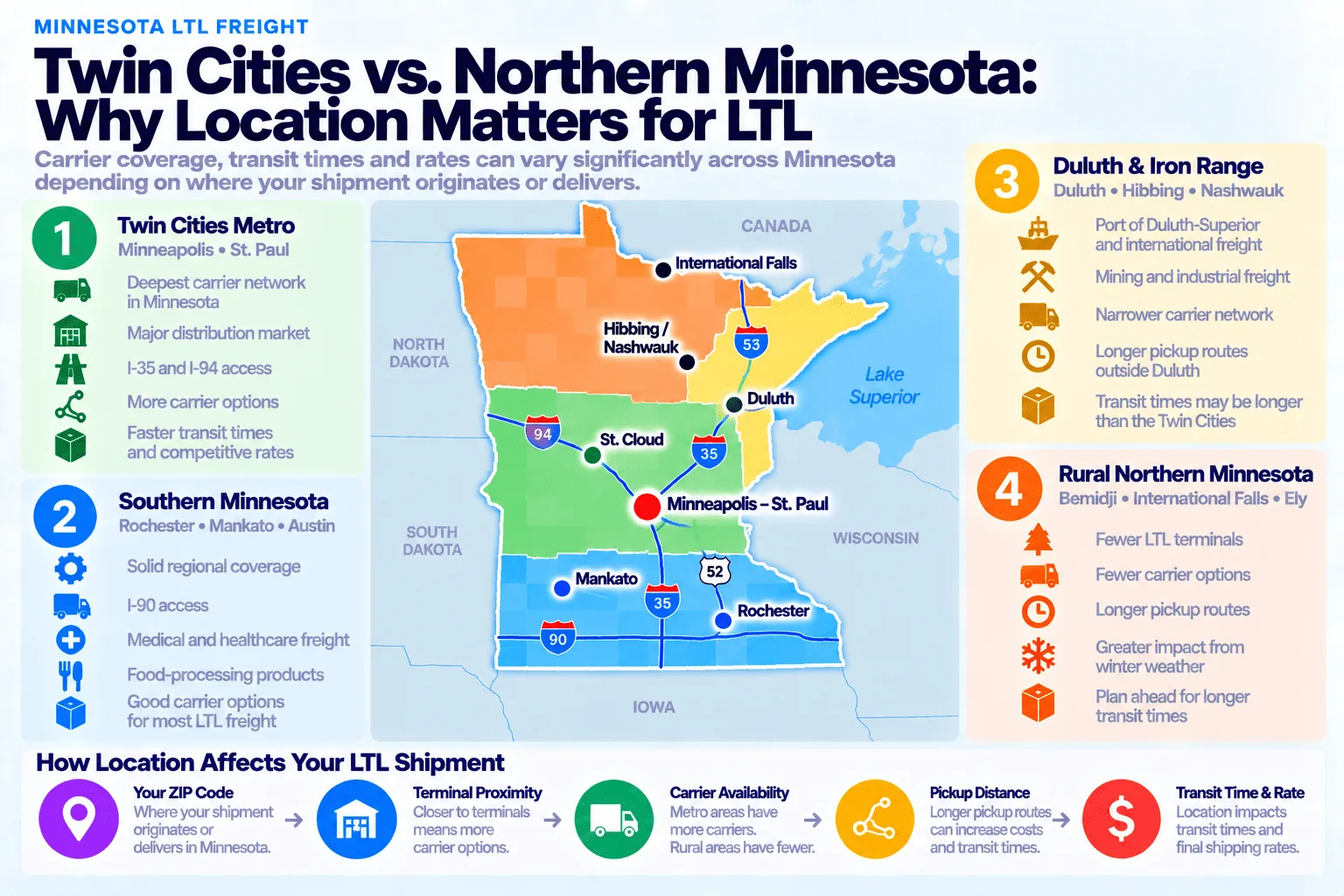
- Twin Cities Metro (Minneapolis-St. Paul) — by far the deepest carrier network in the state, driven by an unusually dense concentration of corporate headquarters and distribution activity.
- Duluth & the Iron Range (Northeastern Minnesota) — a real, if narrower, freight corridor built around the Port of Duluth-Superior and Mesabi Range mining, with moderate coverage tied specifically to those industries.
- Southern Minnesota (Rochester & Austin) — solid secondary coverage anchored by medical and food-processing freight, with good I-90 access.
- Red River Valley (Northwestern Minnesota) — a real agricultural freight corridor near the North Dakota border, with coverage tied closely to the growing season.
- Rural northern Minnesota — the thinnest coverage in the state by far: fewer terminals, much longer pickup routes, and winters severe enough to affect transit reliability on their own.
Weather and transit reliability
Minnesota’s defining freight-weather risk is cold, not just snow. International Falls, in far northern Minnesota, legally holds the trademarked title “Icebox of the Nation” — it’s the coldest city in the Lower 48 by average annual temperature, with roughly 109 days a year that never climb above freezing and a record low of -55°F. Statewide, sub-zero cold snaps are routine every winter and can affect equipment, fuel gelling, and driver hours on top of the usual snow and ice. And as covered above, the spring thaw brings its own real constraint: seasonal load restrictions that cut legal truck weights on posted routes for weeks at a time.
Sample Minnesota LTL rates by route
Real quotes pulled from our platform for six different Minnesota lanes — same process, different carriers each time, spanning a huge range of weights and distances. Rates shift with capacity and fuel costs, so treat these as a snapshot rather than a guarantee for your shipment; get an instant quote for your exact route.
Real quotes by route
Snapshot taken over recent weeks — carriers and pricing change daily.
| Carrier | Service | Transit | Price |
|---|---|---|---|
| XPO | STD | 2 days | $463.19 |
| FedEx Freight | Standard | 6 days | $467.97 |
| AAA Cooper Transportation | Standard | 3 days | $541.13 |
| Saia | Standard | 2 days | $576.54 |
| Southeastern Freight Lines | Standard | 4 days | $585.67 |
| Carrier | Service | Transit | Price |
|---|---|---|---|
| XPO | STD | 2 days | $1,220.61 |
| AAA Cooper Transportation | Standard | 4 days | $1,308.52 |
| ABF Freight | Standard | 4 days | $1,327.21 |
| FedEx Freight | Standard | 4 days | $1,568.11 |
| Estes | LTL Standard Transit | 6 days | $1,698.64 |
| Carrier | Service | Transit | Price |
|---|---|---|---|
| Forward Air | Standard | 3 days | $757.59 |
| XPO | STD | 4 days | $805.24 |
| FedEx Freight Economy | Standard | 5 days | $1,054.99 |
| AAA Cooper Transportation | Standard | 4 days | $1,057.76 |
| ABF Freight | Standard | 5 days | $1,081.87 |
| Carrier | Service | Transit | Price |
|---|---|---|---|
| AAA Cooper Transportation | Standard | 2 days | $321.49 |
| XPO | Standard | 2 days | $337.69 |
| R+L Carriers | STD | 2 days | $342.98 |
| Central Transport | Standard | 2 days | $344.98 |
| TForce Freight | Standard | 2 days | $357.20 |
| Carrier | Service | Transit | Price |
|---|---|---|---|
| AAA Cooper Transportation | Standard | 2 days | $282.62 |
| Pitt Ohio | STD | 3 days | $342.39 |
| N&M Transfer | Standard | 1 day | $348.26 |
| Dayton Freight | STD | 2 days | $352.36 |
| TForce Freight | STD | 2 days | $357.02 |
| Carrier | Service | Transit | Price |
|---|---|---|---|
| AAA Cooper Transportation | Standard | 4 days | $540.48 |
| XPO | Standard | 2 days | $580.89 |
| ABF Freight | Standard | 3 days | $604.19 |
| Forward Air | STD | 3 days | $628.47 |
| Roadrunner Freight | Standard Service | 4 days | $651.63 |
Rate, transit, and price-per-mile summary
Pulling the six lanes above together, one lane prices well outside the pattern the rest of the data sets — and it points to the origin, not the destination:
| Route | Distance | Weight | Price range | Transit range | Price per mile |
|---|---|---|---|---|---|
| Kimball, MN → Caledonia, MS | 1,015 mi | 500 lb | $463–$616 | 2–6 days | $0.46–$0.61 |
| Lewiston, UT → Minneapolis, MN | 1,251 mi | 1,101 lb | $1,221–$1,699 | 2–6 days | $0.98–$1.36 |
| New London, MN → Corona, CA | 1,835 mi | 1,200 lb | $758–$1,082 | 3–5 days | $0.41–$0.59 |
| Plano, TX → Minneapolis, MN | 922 mi | 244 lb | $321–$357 | 2 days | $0.35–$0.39 |
| Comstock Park, MI → Caledonia, MN | 501 mi | 450 lb | $283–$357 | 1–3 days | $0.56–$0.71 |
| Farmington, MN → York, SC | 1,168 mi | 600 lb | $540–$652 | 2–4 days | $0.46–$0.56 |
Five of these six lanes cluster in a tight, predictable $0.35-$0.71/mile band regardless of direction, weight, or distance — including the Plano-to-Minneapolis lane, which lands at the cheapest end despite terminating in the same Twin Cities market this page describes as having the deepest carrier network in the state. The outlier is Lewiston, Utah to Minneapolis: at $0.98-$1.36/mile, it’s roughly double every other lane here, even though its distance (1,251 miles) and weight (1,101 lb) aren’t extreme by this data’s standards. Lewiston is a small town in rural Cache County, near the Idaho border, and that’s almost certainly the real driver — a thin, remote pickup point adds cost that a strong destination market like the Twin Cities can’t offset. It’s a useful reminder that carrier density on your pickup end matters just as much as coverage at your destination.
Major shipping hubs in Minnesota
Minnesota’s carrier terminal network is concentrated around a handful of metro areas, which generally means faster pickup windows and more carrier options the closer you are to one of these:
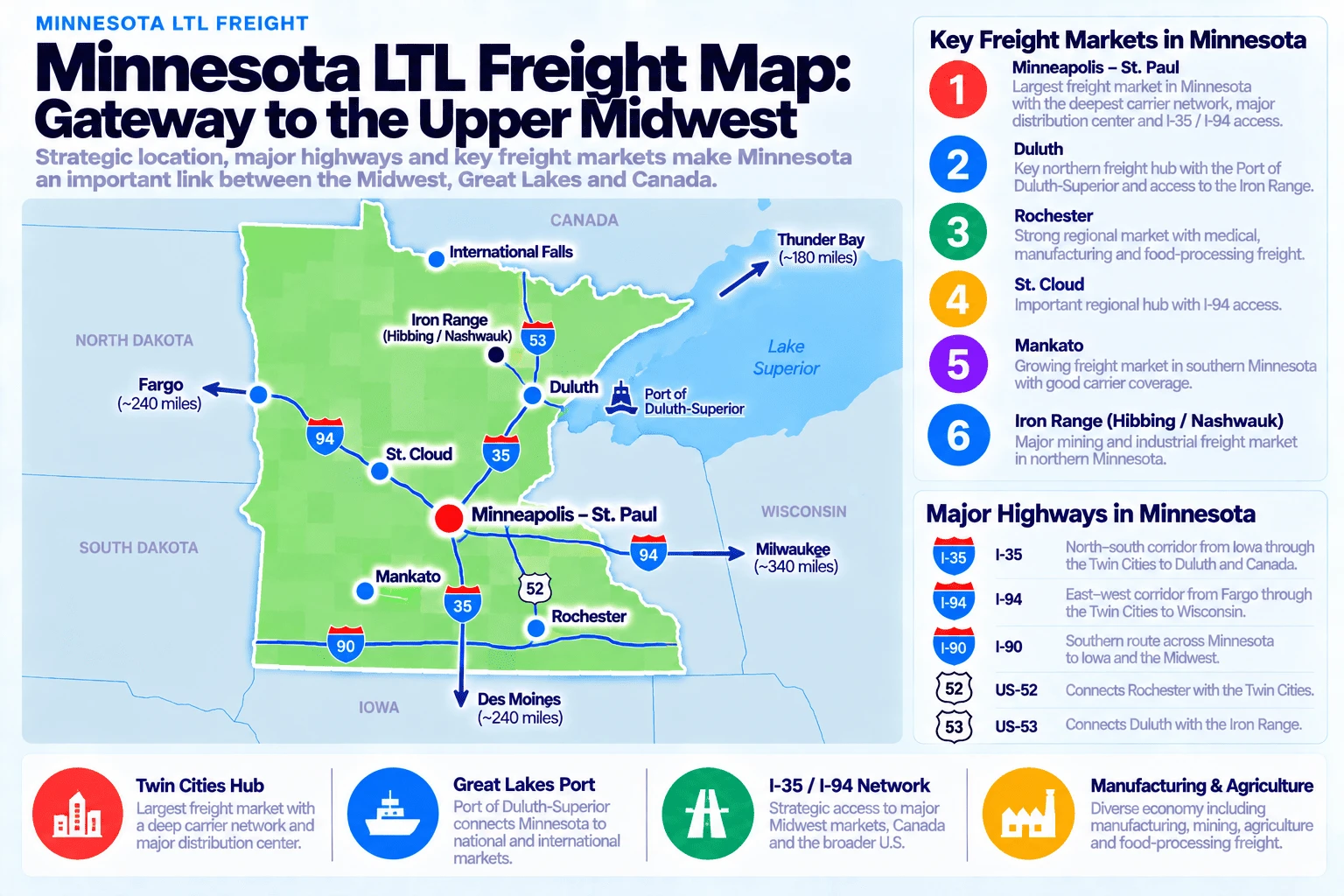
- Minneapolis-St. Paul — the state’s primary freight gateway and an unusually dense corporate hub: Minnesota is home to 17 Fortune 500 companies, including UnitedHealth Group, Target, Best Buy, 3M, and General Mills, plus Medical Alley, a network of over 800 health and medical-technology organizations anchored by Medtronic’s Minneapolis headquarters.
- Duluth — home to the Port of Duluth-Superior, North America’s farthest-inland seaport and the all-time tonnage leader among Great Lakes ports, moving over 25 million tons of cargo in the 2025 shipping season alone, led by iron ore pellets from the Mesabi Range.
- The Mesabi Iron Range (Hibbing & Nashwauk) — Minnesota’s historic taconite mining belt, which just opened its first new mine in nearly 50 years at Mesabi Metallics in Nashwauk in September 2026, a real sign of continued freight activity in the region.
- Rochester — home to Mayo Clinic, generating a steady stream of medical equipment and supply freight.
- Austin — headquarters of Hormel Foods, a major food-processing freight generator in southern Minnesota.
Highway corridors serving Minnesota
I-94 connects the Twin Cities west to Fargo and east to Chicago, carrying much of the state’s cross-regional freight. I-35 runs north-south through the Twin Cities, linking Duluth in the north to the Iowa border in the south. I-90 crosses southern Minnesota east-west along the Rochester-Austin corridor. I-535 connects Duluth to Superior, Wisconsin, across the harbor. Nearly every long-haul route between the Upper Midwest and Canada touches Minnesota somewhere along I-35 or I-94.
Why Duluth-Superior is North America’s busiest inland port
Duluth sits at the absolute head of the Great Lakes-St. Lawrence Seaway system, more than 2,300 miles from the Atlantic Ocean, and it’s still the single busiest port on the Great Lakes by cumulative tonnage. Iron ore pellets from the Mesabi Range dominate the cargo mix, followed by coal, grain, limestone, and project cargo, all moving out through the harbor toward steel mills and grain markets around the Great Lakes and beyond. The Iron Range that feeds it is having a real moment: after nearly two decades of delays, bankruptcies, and false starts, the Mesabi Metallics mine near Nashwauk finally opened in September 2026 — the first genuinely new taconite mine in Minnesota in almost 50 years. For Minnesota LTL freight, Duluth’s port activity means steady industrial and bulk-adjacent freight demand flowing through northeastern Minnesota well beyond what the region’s population alone would suggest.
What Minnesota shippers move
Minnesota’s freight mix is unusually diverse for its size. The Twin Cities corporate concentration alone drives real freight volume: 17 Fortune 500 companies are headquartered in Minnesota, and Medical Alley’s 800-plus health and medical-technology organizations, anchored by Medtronic, Boston Scientific, and St. Jude Medical, generate a steady stream of medical device and equipment freight found in few other states. The Mesabi Iron Range still supplies a genuine share of the country’s steelmaking raw material, moving through the Port of Duluth-Superior, the busiest port on the Great Lakes by tonnage. Southern Minnesota adds a real food-processing pillar, led by Hormel Foods in Austin and General Mills in Golden Valley, and the Red River Valley in the northwest contributes a significant agricultural freight stream, particularly corn, soybeans, and sugar beets.
Get a Minnesota LTL quote
Compare live rates from vetted carriers serving Minnesota.
Get an LTL quote →Minnesota LTL freight: frequently asked questions
How much does LTL shipping cost to or from Minnesota?
It depends heavily on distance, weight, and how remote your pickup or delivery point is. Real Minnesota lanes in our data ranged from about $283 for a short regional haul out of Michigan up to $1,699 for a shipment out of rural Utah — and that Utah lane priced roughly double every other lane per mile, even into the Twin Cities’ deep carrier network, simply because its small-town pickup point was so remote. Get an instant quote for your exact shipment.
Do Minnesota’s spring load restrictions affect LTL shipments?
Usually not directly — spring load restrictions (frost laws) cut legal axle weights on posted routes each spring, but they mainly affect full-truckload and heavy specialized freight rather than typical LTL shipments. If you’re moving something unusually dense or heavy through Minnesota between March and mid-May, it’s worth checking which frost zone your route crosses.
Why is Duluth important for Minnesota freight?
The Port of Duluth-Superior is North America’s farthest-inland seaport and the busiest port on the Great Lakes by tonnage, moving over 25 million tons of cargo in the 2025 season alone — mostly iron ore pellets from the nearby Mesabi Iron Range. That activity generates steady industrial freight demand across northeastern Minnesota.
Which carriers serve Minnesota?
Most major national LTL carriers serve Minnesota, with the deepest coverage around the Twin Cities, Duluth, and Rochester — availability and pricing vary by exact route, and rural northern Minnesota sees noticeably fewer options.
Is LTL service the same everywhere in Minnesota?
No. The Twin Cities metro has by far the strongest carrier coverage in the state, with solid secondary coverage in Duluth and Rochester. Rural northern Minnesota and the Iron Range see meaningfully fewer carrier options and longer transit times, and severe winter weather can add further delays.
How cold does it get in Minnesota, and does it affect shipping?
Very cold — International Falls in far northern Minnesota is officially the coldest city in the Lower 48 by average annual temperature, with a record low of -55°F. Statewide, sub-zero cold snaps are routine every winter and can affect fuel, equipment, and driver hours on top of ordinary snow and ice delays.