

Shipping less-than-truckload (LTL) freight to or from Michigan? Rates depend on your specific route, freight class, and how close your pickup or delivery point is to the nearest LTL terminal. Michigan isn’t just the historic home of the American auto industry — it’s also home to the busiest international trade corridor in North America, a truck-weight law unlike any other state’s, and a two-peninsula geography that genuinely changes how freight moves. Here’s what actually affects your rate.
LTL trucking regulations in Michigan
Michigan is the one state where the standard federal 80,000 lb weight limit genuinely doesn’t apply the way it does everywhere else:
- Michigan’s truck weight law is unique in the country. Instead of capping gross vehicle weight directly, Michigan calculates legal weight axle-by-axle under its own bridge formula, which allows trucks with up to 11 axles — a configuration truckers call a “Michigan train” — to legally run at up to 164,000 lbs gross on state-approved routes, more than double the 80,000 lb federal standard used almost everywhere else.
- Most LTL freight never comes close to that limit, but it does mean Michigan’s highway and bridge network is built around genuinely heavier legal loads than neighboring states, which matters if you’re shipping unusually dense or heavy freight.
- The Mackinac Bridge Authority adds its own real wrinkle: the bridge connecting Michigan’s two peninsulas closes to high-profile vehicles — including every semi-tractor trailer — during sustained winds in the 50-64 mph range, and can close completely in more extreme conditions. When that happens, there’s no alternate route; freight simply waits.
The governing weight and dimension rules are public record:
Michigan Maximum Legal Truck Loadings and Dimensions (MDOT) →
What affects your Michigan LTL rate
- Freight class — density, handling, and liability determine your NMFC class, the single biggest factor in your rate. See our freight class guide.
- Distance — Michigan’s carrier density is heavily weighted toward the southern Lower Peninsula; the farther north and the closer to the Upper Peninsula you get, the thinner coverage runs.
- Terminal proximity — pickup or delivery points near Detroit, Grand Rapids, or Lansing typically see the most carrier options and fastest transit; Upper Peninsula addresses see meaningfully fewer options and longer routes.
- Accessorials — liftgate, residential, or inside delivery add to the base rate, same as anywhere else.
Did you know?From 6 real Michigan lanes and 30 quotes
-
9× the cost per mile
The shorter haul cost far more per mile
A 2,600 lb shipment moving 173 miles (Morris, IL to Centreville, MI) had a lowest quote of $302, or $1.74 a mile. A 150 lb shipment moving 2,210 miles (Scappoose, OR to Petoskey, MI) had a lowest quote of $417, or $0.19 a mile.
-
$231 to arrive one day sooner
Saving a day is not free
On Sattler, TX to Inkster, MI (1,442 miles, 1,375 lb), the cheapest quote at $806 took 4 days. The fastest, at 3 days, cost $1,037. On Scappoose, OR to Petoskey, MI, 4-day delivery cost $548 against $417 for 5 days.
-
4 carriers had the lowest quote
Four different carriers won six Michigan lanes
Central Transport and XPO each had the lowest quote on two lanes. AAA Cooper and Estes each had the lowest quote on one lane. Across the lowest quotes on every lane, 13 different carriers appeared.
-
$364 from lowest to fifth-lowest
Same shipment, quotes $364 apart
For 1,375 lb from Sattler, TX to Inkster, MI (1,442 miles), the lowest quote was $806 and the fifth-lowest was $1,170, a 45% gap. On Muskegon, MI to Worthington, OH, all five quotes landed within $11 of each other.

Regional carrier coverage across Michigan
Michigan is genuinely two states in one geographically — a Lower Peninsula and an Upper Peninsula connected only by the Mackinac Bridge — and carrier coverage reflects that split directly:
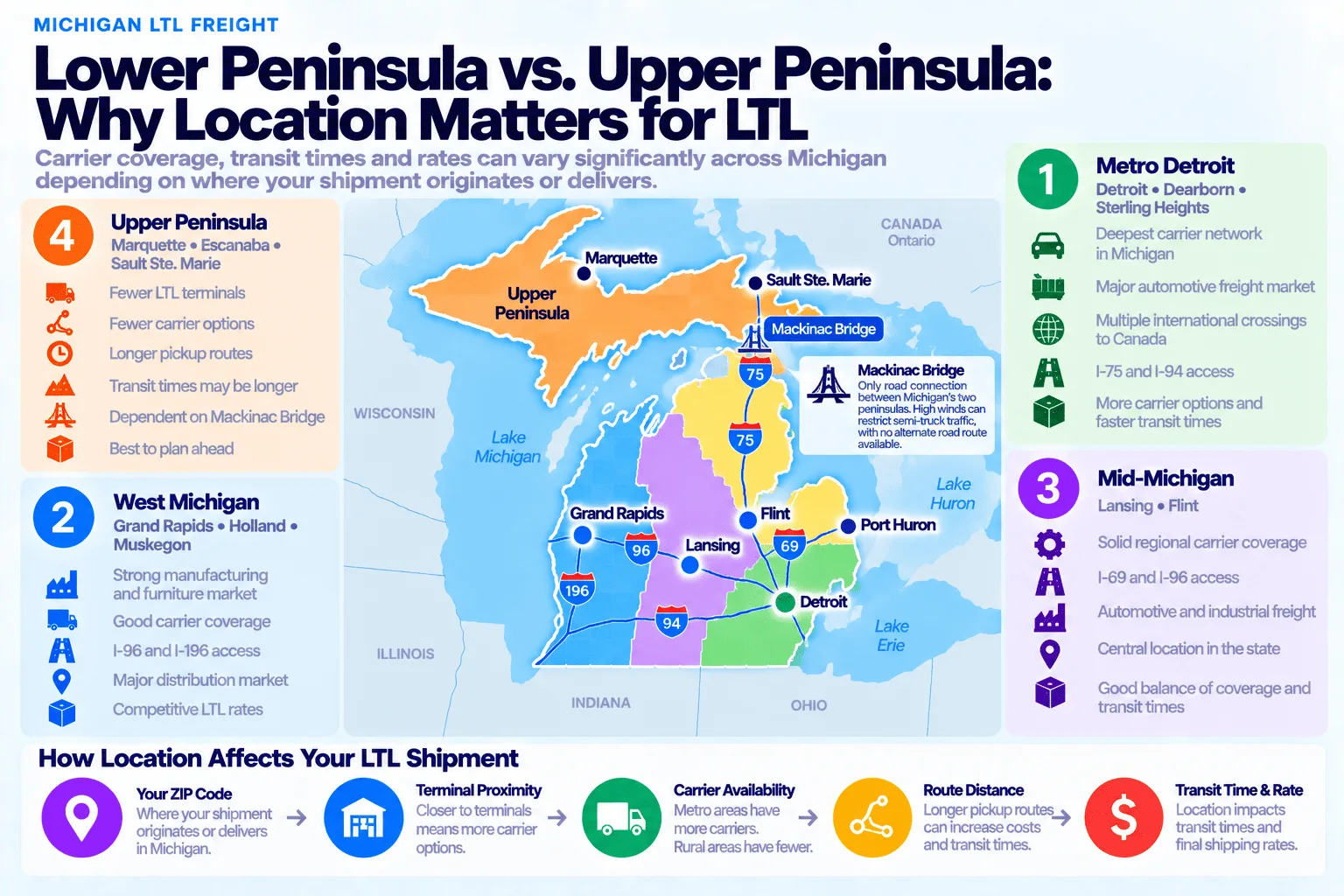
- Metro Detroit (Wayne, Oakland & Macomb counties) — by far the deepest carrier network in the state, anchored by the auto industry and three international crossings into Ontario, Canada.
- West Michigan (Grand Rapids & Kent County) — the state’s second-strongest freight market, built around a concentrated office-furniture manufacturing cluster, with good I-96 access.
- Mid-Michigan (Lansing & Flint) — a solid secondary market anchored by the state capital and auto-adjacent manufacturing, with I-69 and I-96 access.
- Port Huron & the Thumb — home to the Blue Water Bridge, which actually carried more truck traffic than the Ambassador Bridge in 2025; a real, if less-known, international freight corridor.
- The Upper Peninsula — the thinnest coverage in the state by far: fewer terminals, much longer pickup routes, and service that depends entirely on the Mackinac Bridge staying open.
Weather and transit reliability
Michigan’s weather risk is defined by the Great Lakes. West Michigan, especially the Grand Rapids-Muskegon corridor along Lake Michigan, sees some of the heaviest lake-effect snow totals in the eastern US every winter, capable of dumping feet of snow in narrow bands with little warning. The Upper Peninsula sees even more severe winter conditions and a shorter shipping season overall. And the Mackinac Bridge’s high-wind closures to semi-trucks — a real, recurring event most winters and springs — can cut off the only road link to the Upper Peninsula for hours at a time.
Sample Michigan LTL rates by route
Real quotes pulled from our platform for six different Michigan lanes — same process, different carriers each time, spanning a huge range of weights and distances. Rates shift with capacity and fuel costs, so treat these as a snapshot rather than a guarantee for your shipment; get an instant quote for your exact route.
Real quotes by route
Snapshot taken over recent weeks — carriers and pricing change daily.
| Carrier | Service | Transit | Price |
|---|---|---|---|
| Estes | LTL Standard Transit | 4 days | $710.81 |
| TForce Freight | STD | 6 days | $733.27 |
| XPO | Standard | 3 days | $789.64 |
| FedEx Freight Economy | Standard | 4 days | $819.13 |
| A. Duie Pyle | Standard | 4 days | $928.64 |
| Carrier | Service | Transit | Price |
|---|---|---|---|
| AAA Cooper Transportation | Standard | 2 days | $301.68 |
| TForce Freight | STD | 1 day | $380.37 |
| Dayton Freight | STD | 1 day | $396.18 |
| Central Transport | Standard | 1 day | $406.18 |
| Dohrn | Standard | 2 days | $411.21 |
| Carrier | Service | Transit | Price |
|---|---|---|---|
| XPO | Standard | 5 days | $426.57 |
| Estes | STD | 8 days | $491.33 |
| FedEx Freight Economy | Standard | 4 days | $530.32 |
| TForce Freight | STD | 6 days | $539.22 |
| Forward Air | Standard | 6 days | $582.69 |
| Carrier | Service | Transit | Price |
|---|---|---|---|
| Central Transport | Standard | 1 day | $326.29 |
| XPO | Standard | 1 day | $327.23 |
| TForce Freight | STD | 1 day | $333.98 |
| Dayton Freight | STD | 1 day | $334.02 |
| R+L Carriers | STD | 1 day | $337.60 |
| Carrier | Service | Transit | Price |
|---|---|---|---|
| Central Transport | Standard | 4 days | $805.64 |
| ABF Freight | Standard | 6 days | $920.04 |
| Roadrunner Freight | Standard Service | 5 days | $1,025.04 |
| AAA Cooper Transportation | Standard | 3 days | $1,036.71 |
| R+L Carriers | STD | 3 days | $1,169.65 |
| Carrier | Service | Transit | Price |
|---|---|---|---|
| XPO | STD | 5 days | $416.56 |
| Estes | LTL Standard Transit | 5 days | $501.00 |
| Forward Air | Standard | 8 days | $517.73 |
| FedEx Freight Economy | Standard | 4 days | $548.49 |
| TForce Freight | STD | 5 days | $551.36 |
Rate, transit, and price-per-mile summary
Pulling the six lanes above together, the two shortest hauls price the highest per mile — but the Upper Peninsula lane stands out on its own:
| Route | Distance | Weight | Price range | Transit range | Price per mile |
|---|---|---|---|---|---|
| North Kingstown, RI → McMillan, MI | 1,127 mi | 775 lb | $711–$929 | 3–6 days | $0.63–$0.82 |
| Morris, IL → Centreville, MI | 173 mi | 2,600 lb | $302–$411 | 1–2 days | $1.74–$2.38 |
| Sedona, AZ → Canton, MI | 1,914 mi | 25 lb | $427–$583 | 4–8 days | $0.22–$0.30 |
| Muskegon, MI → Worthington, OH | 350 mi | 1,800 lb | $326–$338 | 1 day | $0.93–$0.96 |
| Sattler, TX → Inkster, MI | 1,442 mi | 1,375 lb | $806–$1,170 | 3–6 days | $0.56–$0.81 |
| Scappoose, OR → Petoskey, MI | 2,210 mi | 150 lb | $417–$551 | 4–8 days | $0.19–$0.25 |
The two shortest lanes in this data are also, by a wide margin, the two most expensive per mile: the 173-mile Illinois-to-Centreville haul runs $1.74-$2.38/mile, and the 350-mile Muskegon-to-Worthington lane — where every single carrier quoted next-day transit — still lands at $0.93-$0.96/mile. Both are heavy shipments (2,600 lb and 1,800 lb), but the real driver is distance: minimum handling and pickup charges get spread over far fewer miles on a short regional haul, even a fast, well-served one. The two longest hauls, into Canton and up to Petoskey, are the cheapest per mile in the data despite carrying much lighter freight, a clean long-haul efficiency effect. The Upper Peninsula lane to McMillan is the one that breaks the distance pattern: at 1,127 miles it’s shorter than the Sattler-to-Inkster haul, yet it prices in the same $0.63-$0.82/mile range as that longer, heavier shipment into suburban Detroit — a real, measurable premium for reaching a region with meaningfully thinner carrier coverage.
Major shipping hubs in Michigan
Michigan’s carrier terminal network is concentrated around a handful of metro areas, which generally means faster pickup windows and more carrier options the closer you are to one of these:
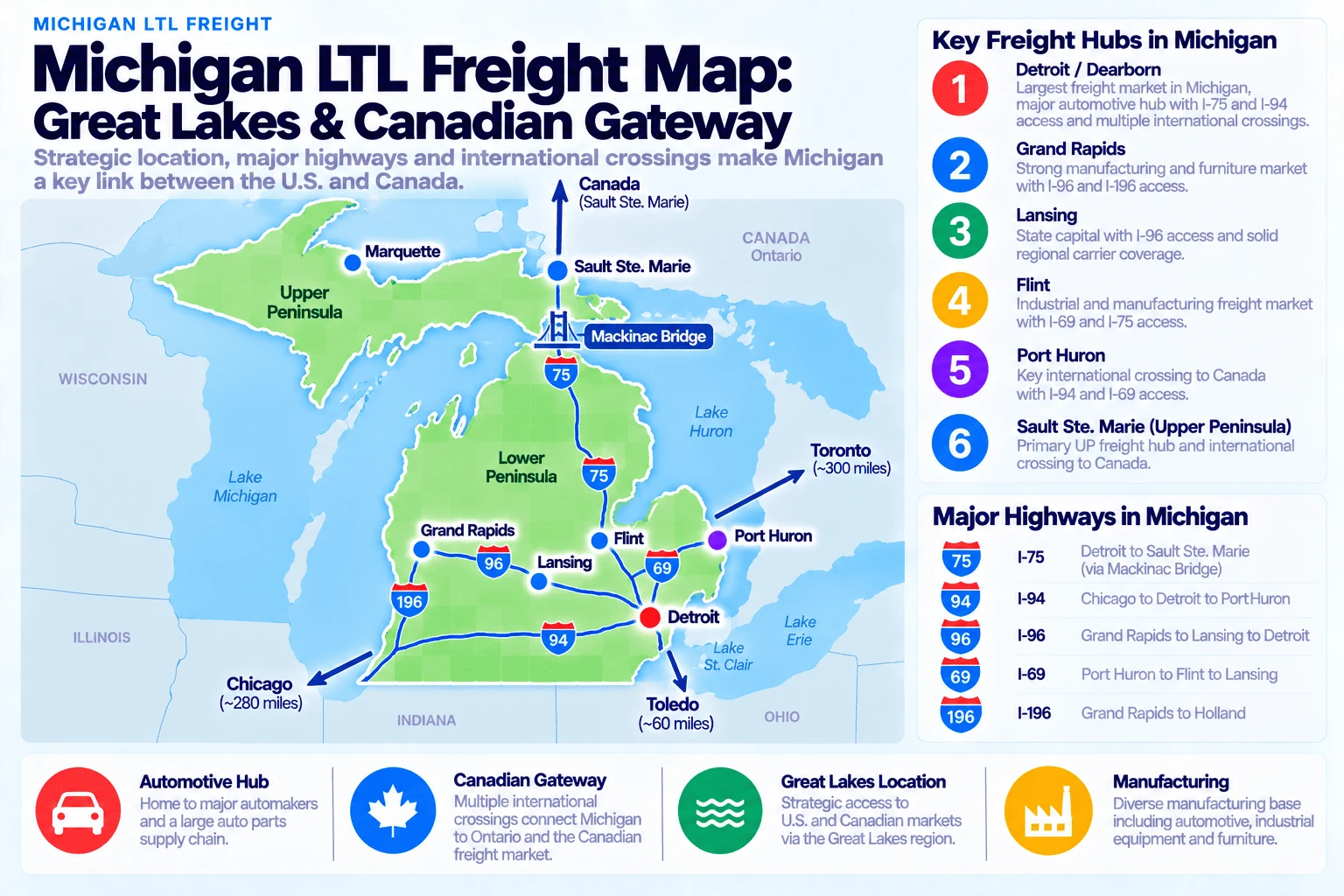
- Detroit — the state’s primary freight gateway and the historic heart of the American auto industry, home to GM and Stellantis, with Ford headquartered nearby in Dearborn, plus three separate international crossings into Windsor, Ontario.
- Grand Rapids — home to Steelcase and within the same West Michigan cluster as MillerKnoll (Zeeland) and Haworth, three of the world’s leading office-furniture manufacturers concentrated in one region.
- Sterling Heights — world headquarters of General Dynamics Land Systems, which designs, engineers, and manufactures the US Army’s Abrams tank, generating a steady stream of heavy defense freight.
- Port Huron — anchor of the Blue Water Bridge crossing, which handled more commercial truck trips than the Ambassador Bridge in 2025.
- Lansing — the state capital and a real secondary freight hub with direct I-69/I-96 access.
Highway corridors serving Michigan
I-94 connects Detroit west to Chicago and east to Port Huron, carrying much of the state’s cross-border and cross-Midwest freight. I-75 is Michigan’s main north-south spine, running from Detroit through Flint and Saginaw, across the Mackinac Bridge, and up to Sault Ste. Marie at the Canadian border. I-96 links Detroit to Lansing and Grand Rapids. I-69 runs from Port Huron through Flint and Lansing toward Indiana. I-196 follows the Lake Michigan shoreline connecting Grand Rapids, Holland, and Benton Harbor. Nearly every long-haul route between the Midwest and Canada touches Michigan somewhere along I-94 or I-75.
Why the Detroit-Windsor corridor is North America’s busiest freight border
Roughly $1 billion in trade crosses the Windsor-Detroit corridor every single day, making it the busiest international land border crossing in North America by value. For decades that traffic ran almost entirely over the privately-owned Ambassador Bridge and through the Detroit-Windsor Tunnel. That changed on July 27, 2026, when the long-awaited Gordie Howe International Bridge opened to vehicle traffic — and in its very first full month of operation, it came close to becoming Michigan’s single busiest border crossing with Canada. Meanwhile, the Blue Water Bridge at Port Huron quietly overtook the Ambassador Bridge in 2025 for commercial truck volume, handling roughly 2.1 million truck trips to the Ambassador’s 1.9 million. For Michigan LTL freight, that means genuinely more border-crossing capacity, more competitive routing options, and less bottleneck risk than the state has had in generations.
What Michigan shippers move
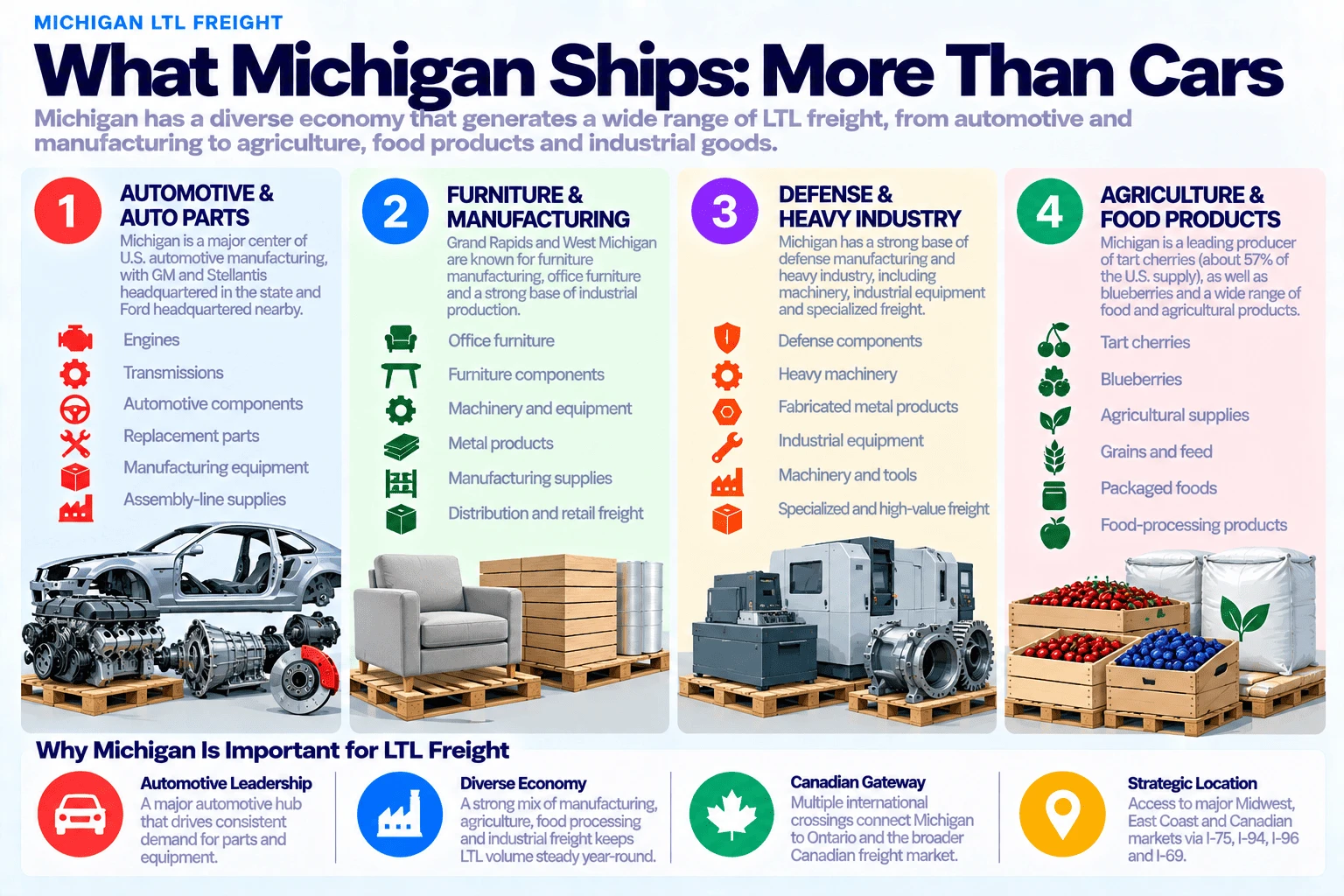
Michigan’s freight mix runs well beyond cars, though the auto industry is still the backbone. Detroit remains the historic and functional center of American automotive manufacturing, with GM and Stellantis headquartered in the city and Ford next door in Dearborn, generating enormous volumes of auto parts, components, and assembly-line freight. West Michigan adds a real second pillar: Grand Rapids and neighboring Zeeland are home to Steelcase, MillerKnoll, and Haworth, three of the world’s largest office-furniture manufacturers, a concentration found nowhere else in the country. Sterling Heights contributes a genuine defense-freight stream through General Dynamics Land Systems, which builds the Army’s Abrams tank. And Michigan’s agriculture is more distinctive than its farm-state neighbors: it’s the nation’s #1 producer of tart cherries by a wide margin (57% of total US production) and the #4 producer of blueberries, both concentrated along the Lake Michigan fruit belt.
Get a Michigan LTL quote
Compare live rates from vetted carriers serving Michigan.
Get an LTL quote →Michigan LTL freight: frequently asked questions
How much does LTL shipping cost to or from Michigan?
It depends heavily on distance and weight. Real Michigan lanes in our data ranged from about $302 for a short, heavy regional haul out of Illinois up to $1,170 for a long-haul shipment from Texas — and short regional lanes actually price the highest per mile, since minimum handling charges apply regardless of distance. Reaching the Upper Peninsula also carries a measurable premium over similar-distance Lower Peninsula routes. Get an instant quote for your exact shipment.
Does Michigan really allow heavier trucks than other states?
Yes. Michigan calculates legal truck weight axle-by-axle rather than capping gross vehicle weight directly, which allows 11-axle combinations to run up to 164,000 lbs on approved routes — more than double the 80,000 lb federal standard used in most states. Most LTL shipments are far lighter than this limit, but it’s a genuinely unique feature of Michigan’s highway system.
Why is the Detroit-Windsor corridor important for Michigan freight?
Roughly $1 billion in trade crosses the Windsor-Detroit corridor daily, making it the busiest international land border crossing in North America by value. The new Gordie Howe International Bridge opened in July 2026 alongside the existing Ambassador Bridge, Detroit-Windsor Tunnel, and the Blue Water Bridge at Port Huron, giving Michigan more cross-border freight capacity than it’s had in decades.
Which carriers serve Michigan?
Most major national LTL carriers serve Michigan, with the deepest coverage around Detroit, Grand Rapids, and Lansing — availability and pricing vary by exact route, and the Upper Peninsula sees noticeably fewer options.
Is LTL service the same everywhere in Michigan?
No. Metro Detroit has by far the strongest carrier coverage in the state, with solid secondary coverage in Grand Rapids and Lansing. The Upper Peninsula, separated from the rest of the state by the Straits of Mackinac, sees meaningfully fewer carrier options, longer transit times, and service that depends on the Mackinac Bridge staying open.
Does the Mackinac Bridge affect LTL shipping to the Upper Peninsula?
Yes, directly. The Mackinac Bridge is the only road connection between Michigan’s two peninsulas, and the Mackinac Bridge Authority closes it to semi-trucks and other high-profile vehicles during sustained winds of roughly 50-64 mph, with no alternate route available. This happens multiple times most winters and can delay Upper Peninsula deliveries by hours.