

Shipping LTL freight to or from Kansas? Rates depend on your specific route, freight class, and how close your pickup or delivery point is to the nearest LTL terminal. Kansas isn’t just an agricultural state — it’s the nation’s #1 producer of winter wheat, home to a beef-processing corridor that handles over a fifth of the country’s daily cattle slaughter, and Wichita, the self-proclaimed “Air Capital of the World.” Here’s what actually affects your rate.
LTL trucking regulations in Kansas
Standard interstate trucking limits apply in Kansas: 80,000 lbs gross vehicle weight, 53 feet trailer length, 8.5 feet width, and 13.5 feet height. Most LTL shipments fall well within these limits — this mainly matters if your freight is unusually large or heavy.
Kansas runs its own online permitting system, and — like Pennsylvania — has a real split between the state DOT and a separate turnpike authority, though the specifics work differently here:
- KDOT issues oversize/overweight permits through K-TRIPS (Kansas Truck Routing and Intelligent Permitting System), its online routing and permitting portal. A single-trip oversize permit starts at $40, with a $200 superload fee for loads exceeding 150,000 lbs GVW.
- The Kansas Turnpike Authority has a genuinely distinctive wrinkle: you don’t need a separate permit to move an oversize load on the Turnpike itself. Instead, loads over 14 feet wide face a fixed travel window — Monday through Thursday, 8:30 a.m. to 4:30 p.m. only — and the Turnpike caps dimensions at 14 feet high and 16 feet wide, with loads over 150,000 lbs GVW classified as superloads requiring extra escorts.
Full weight, dimension, and permit-fee tables are public record:
KDOT Oversize/Overweight Permits (K-TRIPS) →
What affects your Kansas LTL rate
- Freight class — density, handling, and liability determine your NMFC class, the single biggest factor in your rate. See our freight class guide.
- Distance — Kansas is a big, mostly rural state; carrier density drops off fast once you’re away from the handful of metro corridors.
- Terminal proximity — pickup or delivery points near Kansas City, Wichita, or Topeka typically see the most carrier options and fastest transit; western Kansas addresses see meaningfully fewer options.
- Accessorials — liftgate, residential, or inside delivery add to the base rate, same as anywhere else.
Did you know?From 6 real Kansas lanes and 30 quotes
-
$478 to arrive one day sooner
Saving a day is not free
On Redding, CA to Parsons, KS (1,865 miles, 1,500 lb), the cheapest quote at $1,213 took 5 days. The fastest, at 4 days, cost $1,691.
-
4 carriers had the lowest quote
Four different carriers won six Kansas lanes
AAA Cooper had the lowest quote on three lanes. Central Transport, Estes, and Forward Air each had the lowest quote on one lane. Across the lowest quotes on every lane, 11 different carriers appeared.
-
$663 from lowest to fifth-lowest
Same shipment, quotes $663 apart
For 1,500 lb from Redding, CA to Parsons, KS (1,865 miles), the lowest quote was $1,213 and the fifth-lowest was $1,876, a 55% gap.

Regional carrier coverage across Kansas
Kansas is the 15th-largest state by land area but ranks well outside the top 30 in population, and that mismatch shows up directly in carrier coverage — density is concentrated in a few corridors, with vast stretches of the state seeing real gaps:
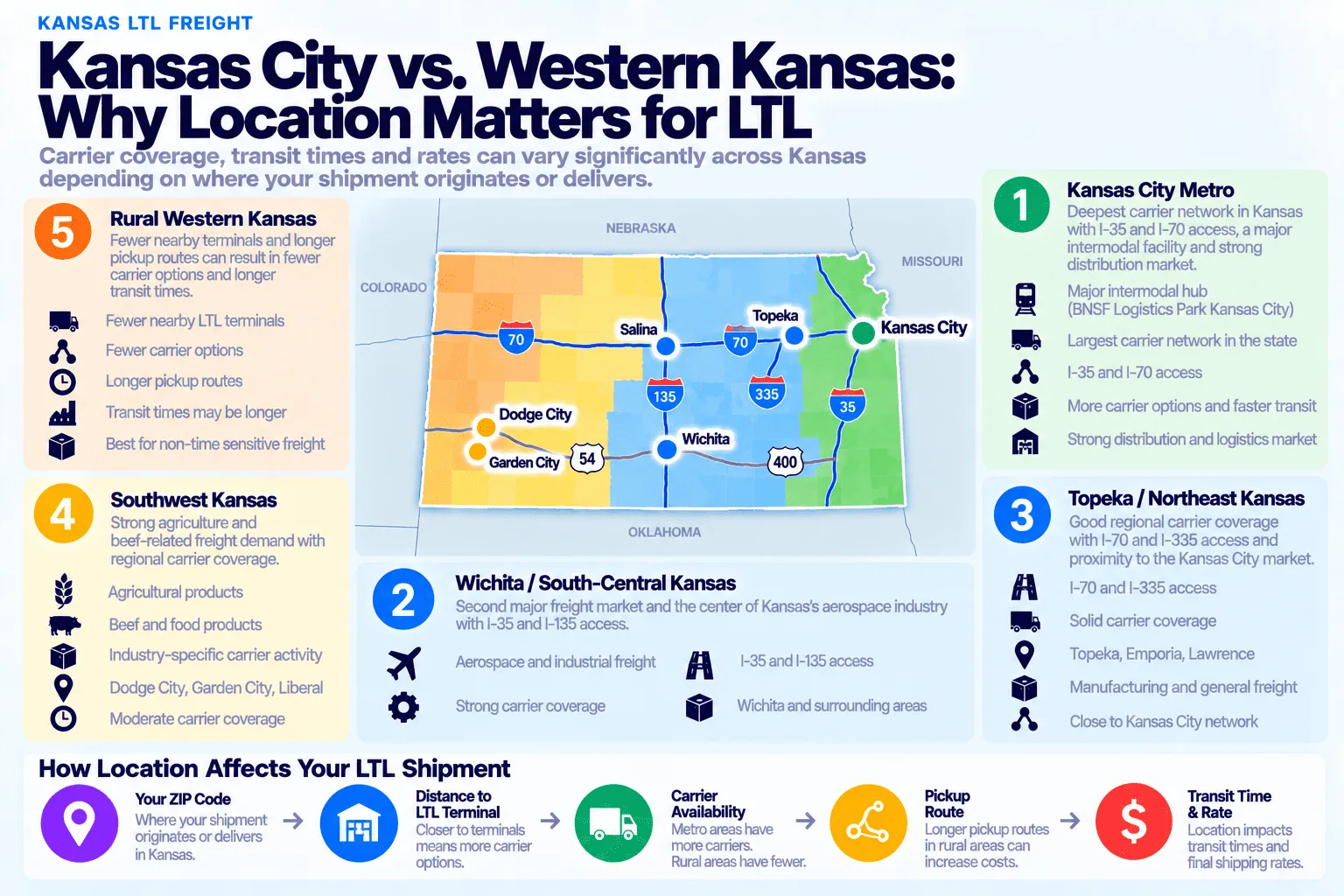
- Kansas City Metro (Johnson County, Overland Park, Kansas City) — the deepest carrier network in the state, benefiting directly from the greater Kansas City freight market and BNSF’s massive intermodal facility just outside the metro.
- Wichita & South-Central Kansas — the state’s largest city and second-strongest freight market, driven heavily by aerospace manufacturing freight, with good I-35/I-135 access.
- Topeka & Northeast Kansas — a solid secondary market anchored by the state capital and direct I-70 access.
- Southwest Kansas (Dodge City, Garden City, Liberal) — a real pocket of industry-specific freight demand tied to the region’s beef-processing plants, despite being rural; carrier options here track that industry rather than population.
- Rural western & central Kansas — the thinnest coverage in the state: fewer terminals, longer pickup routes, and transit times that can run well behind the metro corridors.
Weather and transit reliability
Kansas sits at the heart of Tornado Alley — spring and early summer (April through June) bring real tornado and severe thunderstorm risk, including large hail, capable of shutting down highways with little warning. Winter adds routine snow and ice, with western Kansas seeing occasional blizzard conditions on the open plains. Kansas is also one of the windiest states in the country day-to-day, which is why nearly half its electricity now comes from wind power — high-wind advisories aren’t unusual and can affect high-profile or oversized loads on exposed stretches of I-70 and I-35.
Sample Kansas LTL rates by route
Real quotes pulled from our platform for six different Kansas lanes — same process, different carriers each time, spanning a huge range of weights and distances. Rates shift with capacity and fuel costs, so treat these as a snapshot rather than a guarantee for your shipment; get an instant quote for your exact route.
Real quotes by route
Snapshot taken over recent weeks — carriers and pricing change daily.
| Carrier | Service | Transit | Price |
|---|---|---|---|
| AAA Cooper Transportation | Standard | 3 days | $295.54 |
| TForce Freight | Standard | 4 days | $389.24 |
| FedEx Freight Economy | Standard | 3 days | $391.14 |
| R+L Carriers | Standard | 3 days | $400.24 |
| ABF Freight | Standard | 5 days | $451.38 |
| Carrier | Service | Transit | Price |
|---|---|---|---|
| Forward Air | Standard | 4 days | $575.24 |
| XPO | Standard | 3 days | $575.98 |
| Estes | LTL Standard Transit | 3 days | $581.09 |
| AAA Cooper Transportation | Standard | 7 days | $679.24 |
| ABF Freight | Standard | 4 days | $695.53 |
| Carrier | Service | Transit | Price |
|---|---|---|---|
| Estes | LTL Standard Transit | 3 days | $753.08 |
| Forward Air | STD | 3 days | $787.73 |
| TForce Freight | STD | 4 days | $926.96 |
| Pitt Ohio | Standard | 4 days | $950.80 |
| ABF Freight | Standard | 3 days | $1,007.46 |
| Carrier | Service | Transit | Price |
|---|---|---|---|
| AAA Cooper Transportation | Standard | 5 days | $1,212.72 |
| ABF Freight | Standard | 5 days | $1,262.98 |
| TForce Freight | STD | 7 days | $1,574.60 |
| FedEx Freight Economy | Standard | 4 days | $1,690.54 |
| Estes | Standard | 5 days | $1,876.07 |
| Carrier | Service | Transit | Price |
|---|---|---|---|
| AAA Cooper Transportation | Standard | 4 days | $352.31 |
| TForce Freight | Standard | 5 days | $392.03 |
| Forward Air | STD | 5 days | $392.33 |
| FedEx Freight Economy | Standard | 5 days | $396.28 |
| XPO | Standard | 4 days | $431.61 |
| Carrier | Service | Transit | Price |
|---|---|---|---|
| Central Transport | Standard | 2 days | $270.36 |
| AAA Cooper Transportation | Standard | 2 days | $289.57 |
| SMT | Standard | 6 days | $303.18 |
| Estes | Standard | 2 days | $330.47 |
| FedEx Freight Economy | Standard | 3 days | $342.84 |
Rate, transit, and price-per-mile summary
Pulling the six lanes above together, weight — not distance — is the clearest driver of price per mile once you compare lanes of similar length:
| Route | Distance | Weight | Price range | Transit range | Price per mile |
|---|---|---|---|---|---|
| Havelock, NC → Oswego, KS | 1,197 mi | 500 lb | $296–$451 | 3–5 days | $0.25–$0.38 |
| Augusta, KS → South River, NJ | 1,360 mi | 15 lb | $575–$696 | 3–7 days | $0.42–$0.51 |
| Syracuse, NY → Topeka, KS | 1,190 mi | 275 lb | $753–$1,007 | 3–4 days | $0.63–$0.85 |
| Redding, CA → Parsons, KS | 1,865 mi | 1,500 lb | $1,213–$1,876 | 4–7 days | $0.65–$1.01 |
| Kansas City, KS → Lancaster, CA | 1,600 mi | 200 lb | $352–$432 | 4–5 days | $0.22–$0.27 |
| Amarillo, TX → Lenexa, KS | 593 mi | 124 lb | $270–$343 | 2–3 days | $0.46–$0.58 |
The two longest hauls in this data make the clearest case study: Redding to Parsons and Kansas City to Lancaster both run roughly 1,600-1,900 miles, but Redding-to-Parsons is carrying 1,500 lbs — seven and a half times the weight of the Kansas City lane’s 200 lbs — and it prices at $0.65-$1.01 per mile, nearly triple the $0.22-$0.27 the lighter lane pays over a similar distance. That’s about as clean a weight comparison as this data gets, holding distance roughly constant. The remaining lanes fill out the middle of the range without one dominant driver: the short 593-mile Amarillo-to-Lenexa haul still lands at $0.46-$0.58/mile despite its light 124 lb load, while the 15 lb Augusta-to-South River shipment and the 275 lb Syracuse-to-Topeka shipment price closer to what specific carriers were willing to bid on those particular lanes that week.
Major shipping hubs in Kansas
Kansas’s carrier terminal network is concentrated around a handful of cities, which generally means faster pickup windows and more carrier options the closer you are to one of these:
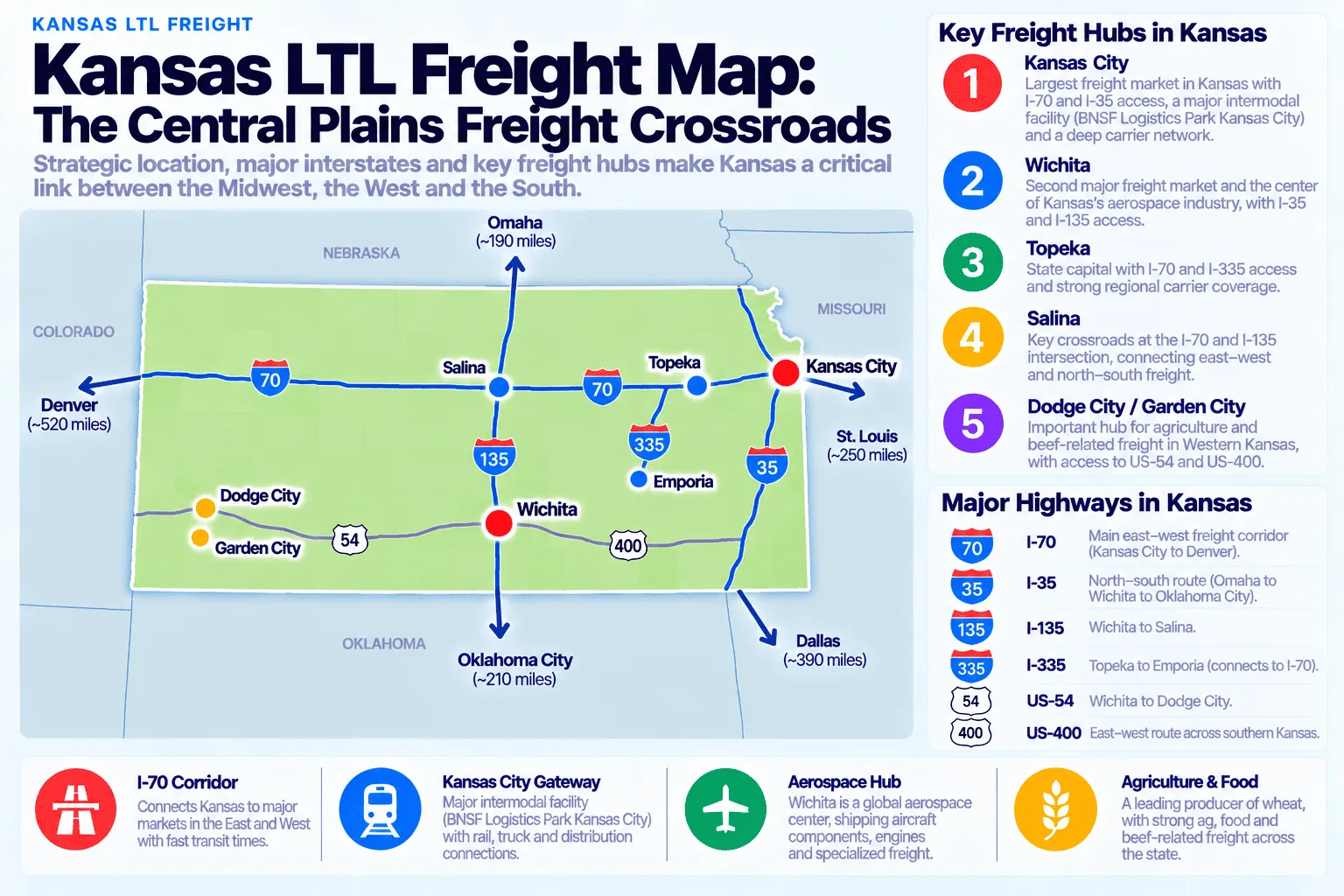
- Kansas City metro & Edgerton — BNSF’s Logistics Park Kansas City, a 433-acre, $250 million intermodal terminal that opened in 2013 with capacity for 500,000 containers a year (expandable to 1.5 million), anchoring a 1,550-acre master-planned distribution and warehouse development just southwest of the metro.
- Wichita — the “Air Capital of the World,” birthplace of Cessna, Beechcraft, and Stearman, and still home to Textron Aviation, Spirit AeroSystems (acquired by Boeing in December 2025), Airbus Americas, and Bombardier — a steady generator of oversized, high-value aircraft-parts freight.
- Topeka — the state capital and a solid regional hub with direct I-70 access.
- Salina — a real central Kansas crossroads at the I-70/I-135 interchange.
- Dodge City & Garden City — anchors of southwest Kansas’s beef-processing corridor, generating heavy volumes of refrigerated and industrial freight despite the area’s otherwise rural carrier coverage.
Highway corridors serving Kansas
I-70 is Kansas’s primary east-west freight artery, crossing the entire state from Kansas City through Topeka and Salina to the Colorado border toward Denver. I-35 — largely the Kansas Turnpike — runs north-south through Wichita, connecting the Kansas City metro to Oklahoma. I-135 links Wichita north to Salina and I-70. I-435 and I-635 form the Kansas City metro’s loop. Nearly every long-haul route crossing the central US touches Kansas somewhere along I-70 or I-35.
Why Wichita is the Air Capital of the World
No other US city concentrates general-aviation manufacturing the way Wichita does. Cessna, Beechcraft, and Stearman were all born here, and the city still designs and builds aircraft today through Textron Aviation, Spirit AeroSystems, Airbus Americas, and Bombardier’s Learjet operations. Boeing completed its acquisition of Spirit AeroSystems in December 2025, tying Wichita’s fuselage and component manufacturing even more directly into Boeing’s commercial aircraft supply chain. That concentration of aerospace manufacturing generates a steady, genuinely distinctive stream of oversized and high-value LTL freight — aircraft components, tooling, and specialized parts — that most metro areas simply don’t see.
What Kansas shippers move
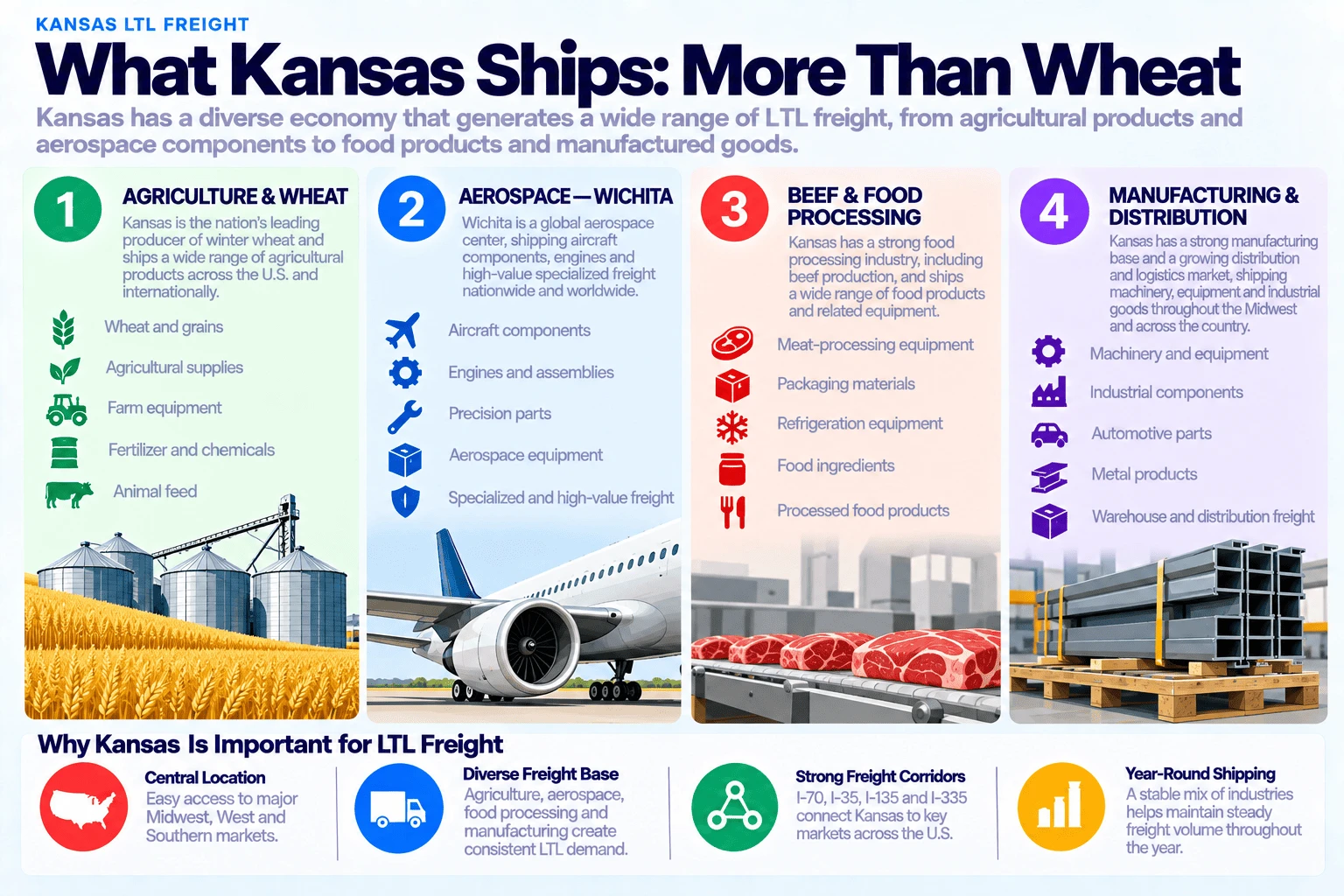
Kansas’s freight mix runs deeper than its wheat-state reputation suggests. Kansas is the nation’s #1 producer of winter wheat, and that agricultural base extends into grain handling, farm equipment, and agricultural supply freight across the state. Southwest Kansas anchors one leg of the industry’s “Golden Triangle of Meat-packing” — Cargill and National Beef in Dodge City, National Beef in Liberal, and Tyson in Holcomb near Garden City combine for an estimated 24,000 head of cattle slaughtered a day, over 20% of the nation’s daily fed-cattle capacity, generating heavy volumes of refrigerated and industrial freight. Wichita’s aerospace cluster — Textron Aviation, Spirit AeroSystems (now part of Boeing), Airbus Americas, and Bombardier — adds a real stream of oversized, high-value aircraft-parts freight found in few other states. Wind energy is a genuine fourth pillar: Kansas generates roughly 47% of its electricity from wind, the 4th-highest share of any state, behind only Texas, Iowa, and Oklahoma.
Kansas LTL freight: frequently asked questions
How much does LTL shipping cost to or from Kansas?
It depends heavily on distance and weight. Real Kansas lanes in our data ranged from about $270 for a short regional shipment out of Texas up to $1,876 for a much heavier 1,500 lb haul from California — weight matters as much as distance: two similarly long-haul lanes (1,600-1,865 miles) priced very differently once weight was factored in, with the heavier shipment costing nearly triple per mile. Get an instant quote for your exact shipment.
Do oversized LTL shipments need a permit in Kansas?
Only if your load exceeds the standard interstate limits (80,000 lbs, 53 feet long, 8.5 feet wide, 13.5 feet tall). KDOT issues permits through its K-TRIPS online system, starting around $40 for a single-trip permit. The Kansas Turnpike is a real exception: no separate permit is needed to use it, but loads over 14 feet wide are restricted to Monday-Thursday daytime travel and capped at 16 feet wide and 125 feet long.
Why is Wichita called the Air Capital of the World?
Wichita is the birthplace of Cessna, Beechcraft, and Stearman, and still hosts major aircraft manufacturing today through Textron Aviation, Spirit AeroSystems (acquired by Boeing in December 2025), Airbus Americas, and Bombardier. That concentration of aerospace manufacturing makes Wichita a genuine source of oversized, high-value LTL freight most other cities don’t generate.
Which carriers serve Kansas?
Most major national LTL carriers serve Kansas, with the deepest coverage around Kansas City, Wichita, and Topeka — availability and pricing vary by exact route, and rural western Kansas sees noticeably fewer options.
Is LTL service the same everywhere in Kansas?
No. The Kansas City metro has the strongest carrier coverage in the state, with solid secondary coverage in Wichita and Topeka. Southwest Kansas sees a real pocket of industry-specific freight tied to its beef-processing plants, but rural western and central Kansas away from the interstate corridors see meaningfully fewer carrier options and longer transit times.
Does severe weather really affect LTL shipping in Kansas?
Yes. Kansas sits in Tornado Alley, and spring and early summer (April-June) bring real tornado and severe thunderstorm risk that can shut down highways with little warning. Kansas is also one of the windiest states day-to-day, and high-wind advisories can affect high-profile or oversized loads on exposed stretches of I-70 and I-35.