

Shipping LTL freight to or from Iowa? Rates depend on your specific route, freight class, and how close your pickup or delivery point is to the nearest LTL terminal. Iowa isn’t just an agricultural state — it’s the nation’s #1 producer of corn, ethanol, and pork, and it generates a higher share of its electricity from wind than any other state in the country. Here’s what actually affects your rate. You can also compare live LTL freight rates across carriers.
LTL trucking regulations in Iowa
Standard interstate trucking limits apply in Iowa: 80,000 lbs gross vehicle weight, 53 feet trailer length, 8.5 feet width, and 13.5 feet height. Most LTL shipments fall well within these limits — this mainly matters if your freight is unusually large or heavy.
Iowa has no toll roads, so there’s no separate turnpike authority to deal with — but the state’s permitting setup still has a genuinely distinctive wrinkle tied to its agricultural economy:
- Iowa DOT issues standard oversize/overweight permits valid on Interstate, US, and Iowa state highways. Permits for city or county roads have to come from those local authorities separately.
- The Annual All-Systems Overweight Permit is a real Iowa-specific option: for a flat $500 fee, it covers unlimited overweight trips on every state highway plus all paved and unpaved farm-to-market and secondary roads statewide — built specifically around Iowa’s dense rural road network. Notably, 75% of that fee goes straight to county Secondary Road Funds.
The governing administrative rule is public record:
Iowa Administrative Code 761.511 — Oversize/Overweight Permits →
What affects your Iowa LTL rate
- Freight class — density, handling, and liability determine your NMFC class, the single biggest factor in your rate. See our freight class guide.
- Distance — Iowa’s terminal network is spread across a handful of cities, so both regional moves and longer cross-state hauls are well served along the interstate corridors.
- Terminal proximity — pickup or delivery points near Des Moines, Cedar Rapids, or the Quad Cities typically see the most carrier options and fastest transit; rural farm country addresses see fewer options and longer routes.
- Accessorials — liftgate, residential, or inside delivery add to the base rate, same as anywhere else.
Did you know?From 6 real Iowa lanes and 30 quotes
-
11× the cost per mile
The shorter haul cost far more per mile
A 4,500 lb shipment moving 192 miles (Dyersville, IA to Pekin, IL) had a lowest quote of $451, or $2.35 a mile. A 410 lb shipment moving 1,825 miles (Lake Forest, CA to Nashua, IA) had a lowest quote of $404, or $0.22 a mile.
-
$150 to arrive 6 days sooner
Speed has a price
On New Hampton, IA to Marysville, CA (1,862 miles, 2,300 lb), the cheapest quote at $788 took 10 days. The fastest, at 4 days, cost $938.
-
5 carriers had the lowest quote
Five different carriers won six Iowa lanes
AAA Cooper had the lowest quote on two lanes. Double D Express, Forward Air, STG Logistics, and TForce Freight each had the lowest quote on one lane. Across the lowest quotes on every lane, 16 different carriers appeared.
-
$329 from lowest to fifth-lowest
Same shipment, quotes $329 apart
For 2,300 lb from New Hampton, IA to Marysville, CA (1,862 miles), the lowest quote was $788 and the fifth-lowest was $1,118, a 42% gap. On Lake Forest, CA to Nashua, IA, all five quotes landed within $43 of each other.

Regional carrier coverage across Iowa
Iowa’s freight geography centers on a few metro areas along its interstate corridors, with real coverage differences elsewhere:
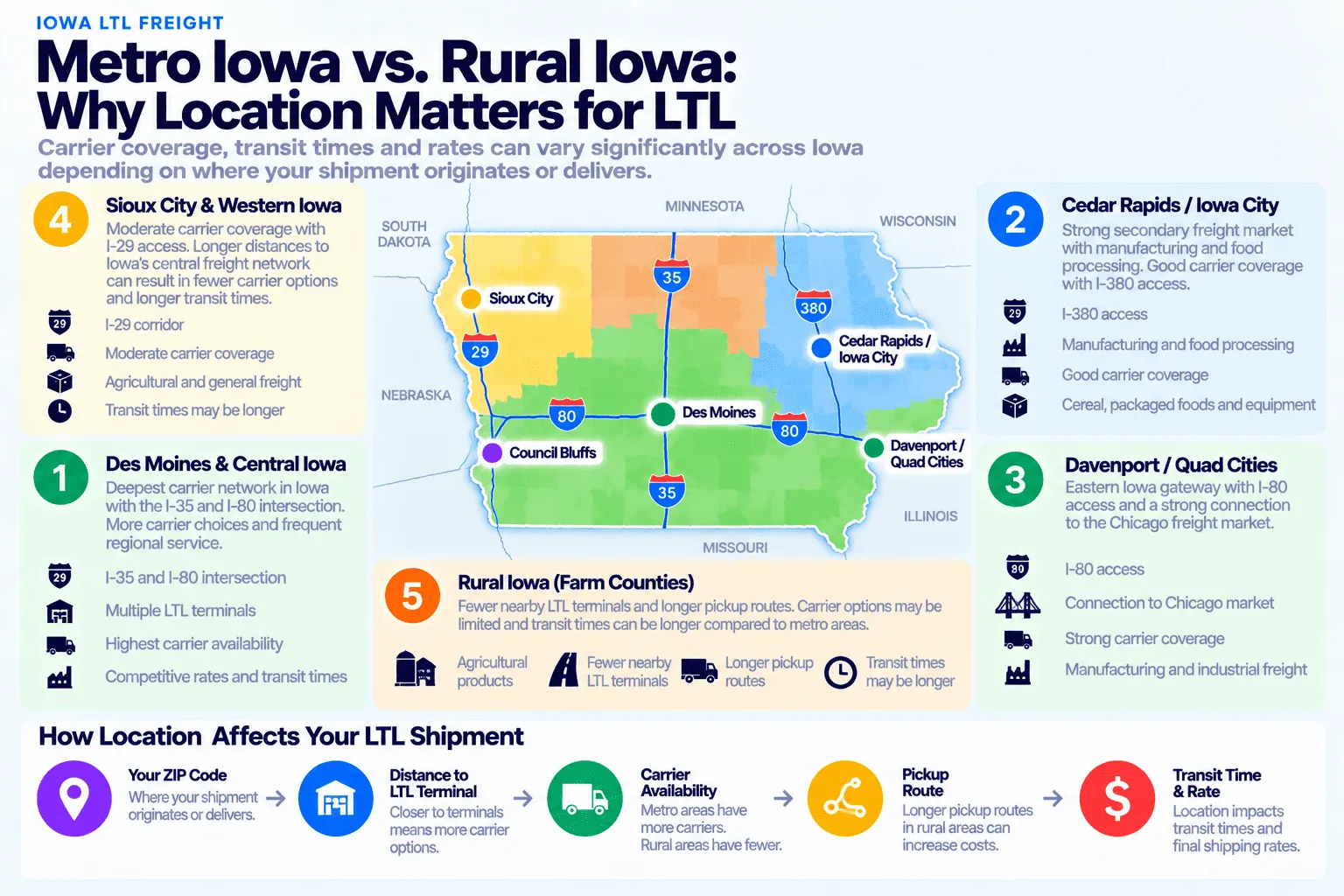
- Des Moines & Central Iowa — the deepest carrier network in the state, anchored by the I-35/I-80 interchange and the state’s largest population center.
- Cedar Rapids & Iowa City — a real secondary hub tied to manufacturing and food processing, connected by I-380.
- Quad Cities (Davenport/Bettendorf) — benefits from spillover carrier density from the Illinois side of the river and direct I-80 access.
- Sioux City & Western Iowa — moderate coverage, more distant from the state’s main freight corridors.
- Rural farm counties — the thinnest coverage in the state: fewer terminals, longer pickup routes, and transit times that can run well behind the metro areas.
Weather and transit reliability
Iowa sits squarely in the Midwest’s severe weather corridor. Spring brings real tornado and severe thunderstorm risk, typically peaking April through June, capable of shutting down highways with little warning. Winter adds routine snow and ice across the entire state, heavier in the north. Iowa also has a distinctly agricultural seasonal factor: during spring planting (April-May) and fall harvest (September-October), rural roads and even some highways see heavy slow-moving farm equipment traffic, which can add real time to pickups and deliveries in farm country during those windows.
Sample Iowa LTL rates by route
Real quotes pulled from our platform for six different Iowa lanes — same process, different carriers each time, spanning a huge range of weights and distances. Rates shift with capacity and fuel costs, so treat these as a snapshot rather than a guarantee for your shipment; get an instant quote for your exact route.
Real quotes by route
Snapshot taken over recent weeks — carriers and pricing change daily.
| Carrier | Service | Transit | Price |
|---|---|---|---|
| STG Logistics | Standard | 10 days | $788.43 |
| XPO | STD | 4 days | $938.27 |
| Dohrn | Standard | 5 days | $954.85 |
| TForce Freight | STD | 7 days | $961.40 |
| Central Transport | Standard | 6 days | $1,117.68 |
| Carrier | Service | Transit | Price |
|---|---|---|---|
| Double D Express | Standard | 1 day | $451.49 |
| ABF Freight | Standard | 4 days | $573.27 |
| Dohrn | Standard | 1 day | $636.80 |
| N&M Transfer | STD | 1 day | $707.68 |
| FedEx Freight Economy | Standard | 2 days | $762.56 |
| Carrier | Service | Transit | Price |
|---|---|---|---|
| AAA Cooper Transportation | Standard | 3 days | $323.01 |
| Central Transport | Standard | 3 days | $326.29 |
| R+L Carriers | Standard | 2 days | $329.13 |
| US Road | Standard | 2 days | $354.39 |
| FedEx Freight Economy | Standard | 3 days | $414.48 |
| Carrier | Service | Transit | Price |
|---|---|---|---|
| TForce Freight | Standard | 5 days | $404.37 |
| XPO | STD | 4 days | $412.31 |
| FedEx Freight Economy | Standard | 4 days | $437.83 |
| R+L Carriers | Standard | 4 days | $441.26 |
| STG Logistics | Standard | 6 days | $447.80 |
| Carrier | Service | Transit | Price |
|---|---|---|---|
| Forward Air | Standard | 3 days | $466.44 |
| TForce Freight | STD | 3 days | $491.60 |
| Estes | LTL Standard Transit | 3 days | $502.13 |
| XPO | STD | 2 days | $502.48 |
| ABF Freight | Standard | 4 days | $534.07 |
| Carrier | Service | Transit | Price |
|---|---|---|---|
| AAA Cooper Transportation | Standard | 2 days | $247.54 |
| Central Transport | Standard | 2 days | $265.63 |
| Magnum | Standard | 2 days | $289.38 |
| CrossCountry Freight Solutions | Standard Service | 3 days | $292.83 |
| US Road | Standard | 3 days | $297.52 |
Rate, transit, and price-per-mile summary
Pulling the six lanes above together, one pattern stands out clearly: the shortest lane in the data is also the most expensive per mile, by a wide margin.
| Route | Distance | Weight | Price range | Transit range | Price per mile |
|---|---|---|---|---|---|
| New Hampton, IA → Marysville, CA | 1,862 mi | 2,300 lb | $788–$1,118 | 4–10 days | $0.42–$0.60 |
| Dyersville, IA → Pekin, IL | 192 mi | 4,500 lb | $451–$763 | 1–4 days | $2.35–$3.97 |
| Council Bluffs, IA → Houston, TX | 898 mi | 750 lb | $323–$414 | 2–3 days | $0.36–$0.46 |
| Lake Forest, CA → Nashua, IA | 1,825 mi | 410 lb | $404–$448 | 4–6 days | $0.22–$0.25 |
| Clive, IA → Union Beach, NJ | 1,135 mi | 70 lb | $466–$534 | 2–4 days | $0.41–$0.47 |
| Castle Rock, CO → Ankeny, IA | 710 mi | 51 lb | $248–$298 | 2–3 days | $0.35–$0.42 |
The Dyersville-to-Pekin lane is only 192 miles — the shortest by far in this data — but it’s also carrying 4,500 lbs, nearly ten times the weight of the Union Beach or Ankeny shipments. That combination of a short haul and a heavy, near-truckload weight pushes its per-mile price to $2.35-$3.97, more than five times the next-closest lane. Every other route in the data runs 700+ miles and prices between $0.22 and $0.60 per mile, regardless of direction. The cheapest per-mile lane overall is actually the longest one-way haul into Iowa — Lake Forest, California to Nashua, at 1,825 miles for as little as $0.22/mile — a textbook example of a long-haul, moderate-weight shipment pricing efficiently once it clears the minimum-charge threshold that short lanes like Dyersville-to-Pekin can’t escape.
Major shipping hubs in Iowa
Iowa’s carrier terminal network is concentrated around a handful of cities, which generally means faster pickup windows and more carrier options the closer you are to one of these:
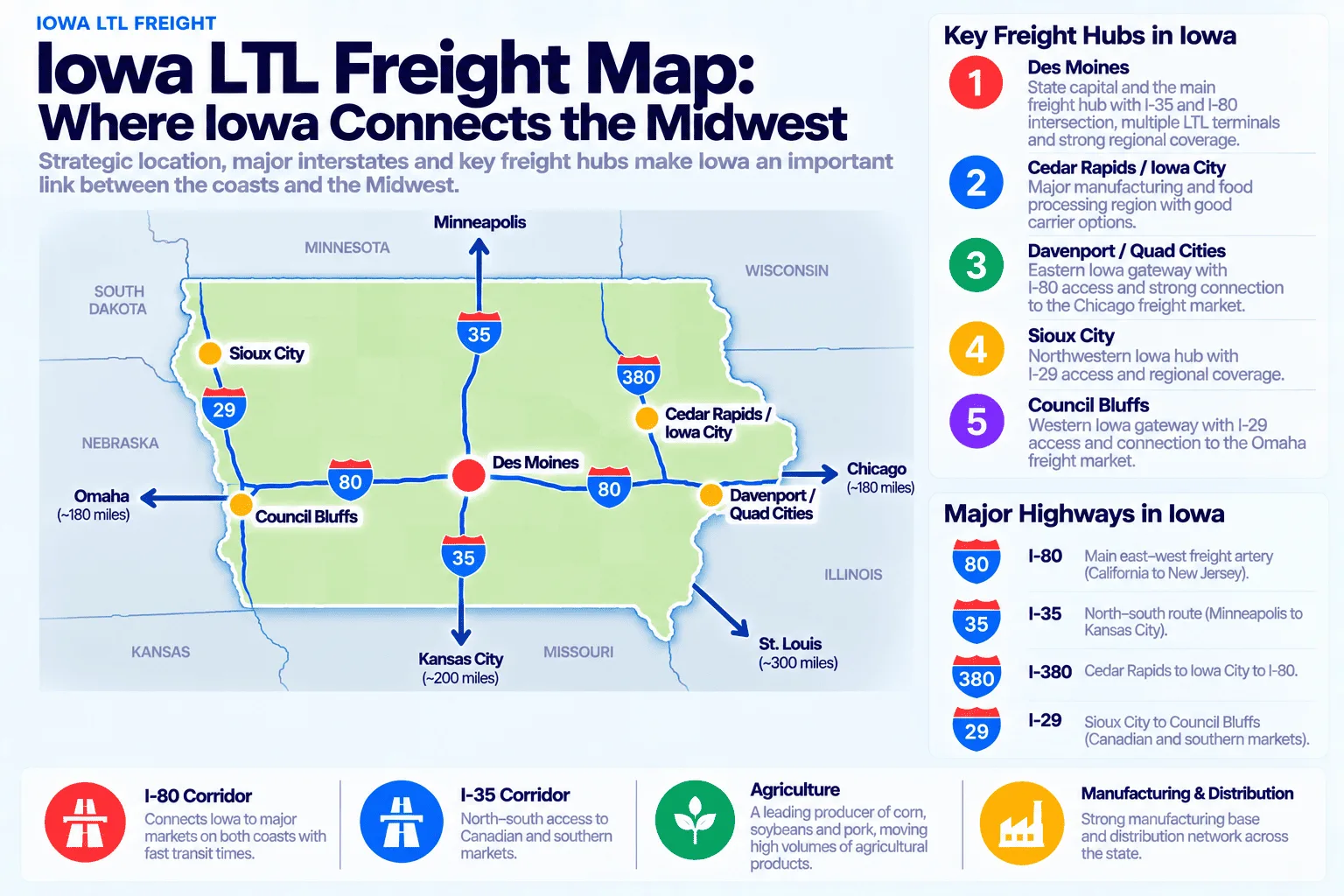
- Des Moines — the state’s primary freight gateway, sitting at the junction of I-35 and I-80. Also a genuine national insurance hub (Principal Financial Group is headquartered here), though that industry drives office jobs more than LTL freight.
- Cedar Rapids — home to the Quaker Oats plant, the largest cereal mill in the world, plus a real aerospace manufacturing presence — a steady generator of food and industrial freight.
- Davenport & the Quad Cities — Iowa’s eastern gateway, directly across the Mississippi from Illinois, with strong I-80 access and carrier density that spills over from the Illinois side.
- West Branch — home to a Nordex wind turbine manufacturing plant, reopened in 2025 and now under contract to build up to 190 turbines (1,060 MW of capacity) for installation in 2028-2029 — a real generator of oversized, specialized freight.
- Sioux City — western Iowa’s regional hub, with moderate coverage along I-29.
Highway corridors serving Iowa
I-80 is Iowa’s primary freight artery, crossing the entire state east-west from the Quad Cities through Des Moines to Council Bluffs on the Nebraska border. I-35 runs north-south through Des Moines, connecting Minneapolis to Kansas City. I-380 links Cedar Rapids and Iowa City to I-80. I-29 runs along the state’s western edge through Sioux City and Council Bluffs, part of the larger Kansas City-to-Canada corridor. Nearly every long-haul route crossing the central US touches Iowa somewhere along I-80 or I-35.
What Iowa shippers move
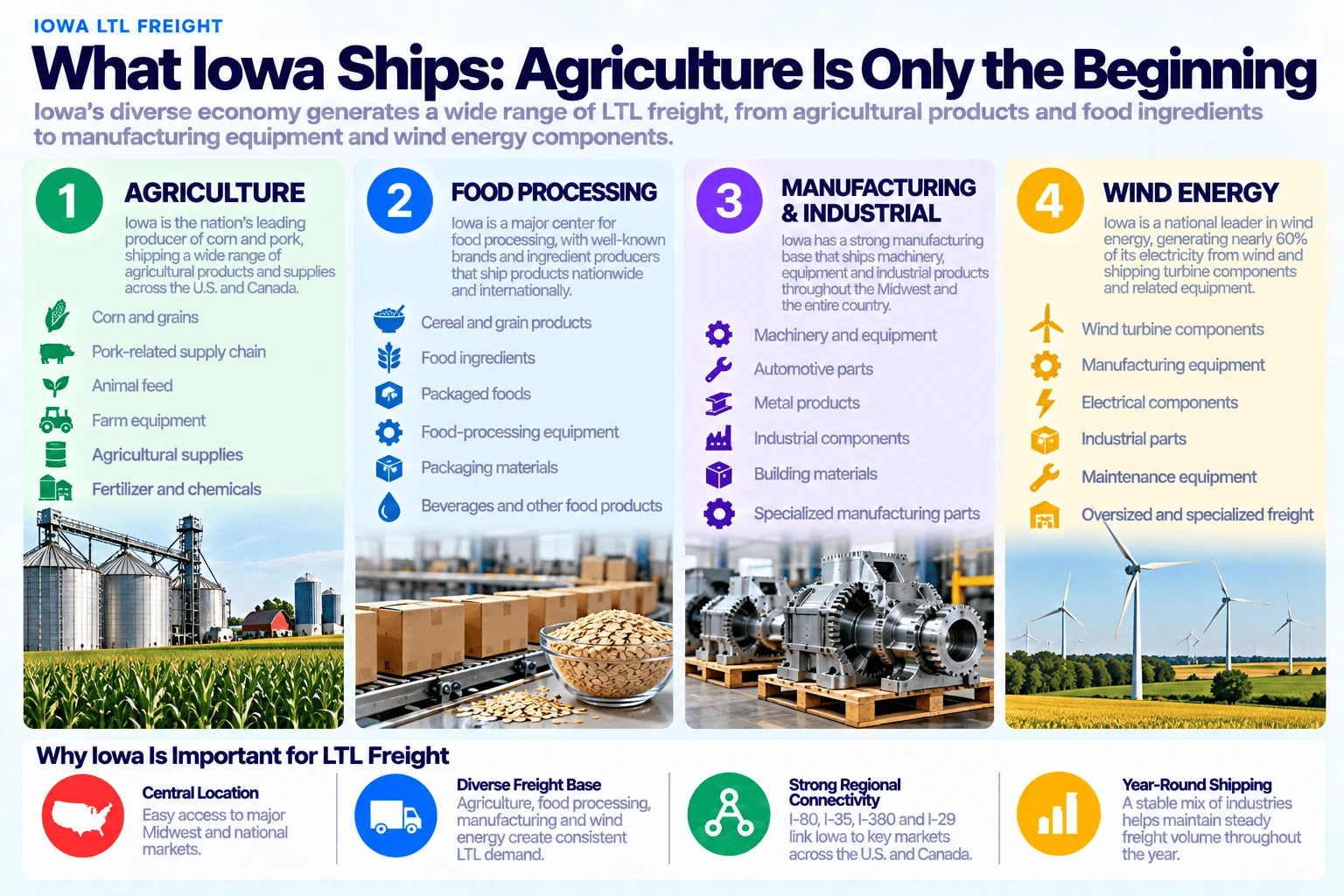
Iowa’s freight mix is dominated by agriculture more than any other state in the country. Iowa grows more corn than any other state — an estimated 2.8 billion bushels in 2025, roughly one in every six bushels grown nationally — and leads the nation in ethanol production, turning 62% of its corn crop into fuel that accounts for nearly 30% of all US ethanol. Iowa is also the nation’s #1 pork producer, with roughly 24-25 million hogs on Iowa farms at any given time — outnumbering the state’s human residents by about 8 to 1 — generating steady volumes of feed, agricultural equipment, and food-processing freight. Wind energy is a real and growing second pillar: Iowa generates a higher share of its electricity from wind than any other state (nearly 59% in 2025), and real turbine manufacturing has returned to the state, including Nordex’s West Branch plant. Add in Cedar Rapids’ Quaker Oats plant — the largest cereal mill in the world — and Iowa’s freight demand runs deep into food processing on top of raw agriculture.
Iowa LTL freight: frequently asked questions
How much does LTL shipping cost to or from Iowa?
It depends heavily on distance and weight. Real Iowa lanes in our data ranged from about $248 for a light shipment near Ankeny up to $1,118 for a much heavier 2,300 lb haul to California — and the priciest lane per mile was actually the shortest one, a 4,500 lb shipment covering just 192 miles to Illinois, since minimum handling and weight charges apply regardless of distance. Get an instant quote for your exact shipment.
Do oversized LTL shipments need a permit in Iowa?
Only if your load exceeds the standard interstate limits (80,000 lbs, 53 feet long, 8.5 feet wide, 13.5 feet tall). Iowa DOT issues standard permits for state and interstate highways, with separate permits needed from city or county authorities for local roads. Iowa also offers a distinctive Annual All-Systems Overweight Permit for $500 that covers unlimited trips on state highways plus all farm-to-market and secondary roads statewide.
Why is Iowa such an important freight state?
Iowa produces more corn, ethanol, and pork than any other US state, and generates a higher share of its electricity from wind than anywhere else in the country. Add in Cedar Rapids’ Quaker Oats plant — the largest cereal mill in the world — and real wind turbine manufacturing returning to the state, and Iowa generates freight demand well beyond what a mostly-rural population would suggest.
Which carriers serve Iowa?
Most major national LTL carriers serve Iowa, with the deepest coverage around Des Moines, Cedar Rapids, and the Quad Cities — availability and pricing vary by exact route, and rural farm counties see noticeably fewer options.
Is LTL service the same everywhere in Iowa?
No. Des Moines has by far the strongest carrier coverage in the state, with solid secondary coverage in Cedar Rapids and the Quad Cities. Rural farm counties away from the interstate corridors see meaningfully fewer carrier options and longer transit times.
Does farm equipment traffic really affect LTL shipping in Iowa?
Yes, especially during spring planting (April-May) and fall harvest (September-October). Slow-moving farm equipment on rural roads and even some highways during those windows can add real time to pickups and deliveries in farm country, though it rarely affects freight moving on the main interstate corridors.