

Shipping less-than-truckload (LTL) freight to or from Georgia? Rates depend on your specific route, freight class, and how close your pickup or delivery point is to the nearest LTL terminal. Georgia is a state of two very different freight engines: the Port of Savannah, which moved 5.7 million container units in fiscal 2025, and metro Atlanta, where the I-75, I-85, I-20 and I-285 corridors meet and where four of the ten worst truck bottlenecks in the country sit, according to the American Transportation Research Institute (ATRI). Add Hyundai’s electric-vehicle plant near Savannah, a poultry and peanut economy in the south, and the carpet mills around Dalton, and you get a state with plenty of freight and plenty of ways for a truck to lose time. Here’s what actually affects your rate.
LTL trucking regulations in Georgia
A standard LTL tractor-trailer in Georgia — 53 feet, 8 ft 6 in wide, 13 ft 6 in high, 80,000 lbs gross — is legal without a permit. Permits matter only for oversize or overweight freight, and Georgia’s rules have a few quirks worth knowing:
- Permits come from Georgia DPS, not GDOT alone. The Department of Public Safety’s Motor Carrier Compliance Division runs the Oversize Permit Unit and issues permits through GDOT’s automated GAPROS system.
- Single-trip permits are inexpensive. A Standard Single permit costs $30 and covers loads up to 16 ft wide or high and up to 150,000 lbs; a Superload Single costs $125. A permit is valid for 10 days, not counting Sundays or legal holidays. An annual permit is $150.
- Oversize loads have a daylight window. Permitted loads move from 30 minutes after sunrise to 30 minutes before sunset, and not in fog, snow or ice, or on New Year’s Day, Memorial Day, July 4, Labor Day, Thanksgiving or Christmas.
- Atlanta has its own permit rule. A permitted oversize load may not enter or cross the area bounded by I-285 unless it is picking up or delivering there, and a permit is not valid from 6–9 a.m. or 4–6 p.m., Monday to Friday. This applies to permitted oversize loads, not to ordinary LTL trucks.
- Tractor-trailers are kept out of Georgia’s Express Lanes. The Peach Pass lanes admit vehicles with two axles and six wheels or fewer; vehicles with trailers and tractor-trailers are not allowed.
- Multi-lane highway rule. Under O.C.G.A. § 40-6-52, a truck (more than six wheels) on a road with three or more lanes in one direction may use only the two right-most lanes, with a left-turn exception. On two-lane roads a truck may not use the left lane except to pass.
- Weigh stations. DPS operates 19 permanent weight and inspection stations, mostly on the interstates, using weigh-in-motion screening.
- Emergency relief is narrow. After Hurricane Helene, Governor Kemp’s executive order of September 24, 2024 suspended hours-of-service limits only for commercial vehicles providing direct emergency assistance, and offered free emergency permits.
Current permit thresholds and fees are public record:
GDOT Oversize/Overweight Permits →
What affects your Georgia LTL rate
- Freight class — density, handling, and liability determine your NMFC class, the single biggest factor in your rate. See our freight class guide.
- Distance — Georgia is a big state: Savannah is about 250 miles from Atlanta by I-16 and I-75, so even an in-state lane can mean most of a day on the road.
- Atlanta congestion — INRIX counted 75 hours lost to traffic per Atlanta driver in 2025, seventh in the U.S., so a pickup or delivery inside the perimeter can cost more time than the mileage suggests.
- Terminal proximity — the more carrier terminals near your pickup or delivery point, the more quotes you see. Atlanta and Savannah are well served; rural south Georgia and the north Georgia mountains typically see fewer options.
- Accessorials — liftgate, residential, or inside delivery add to the base rate, same as anywhere else.
Did you know?From 6 real Georgia lanes and 30 quotes
-
6× the cost per mile
The shorter haul cost far more per mile
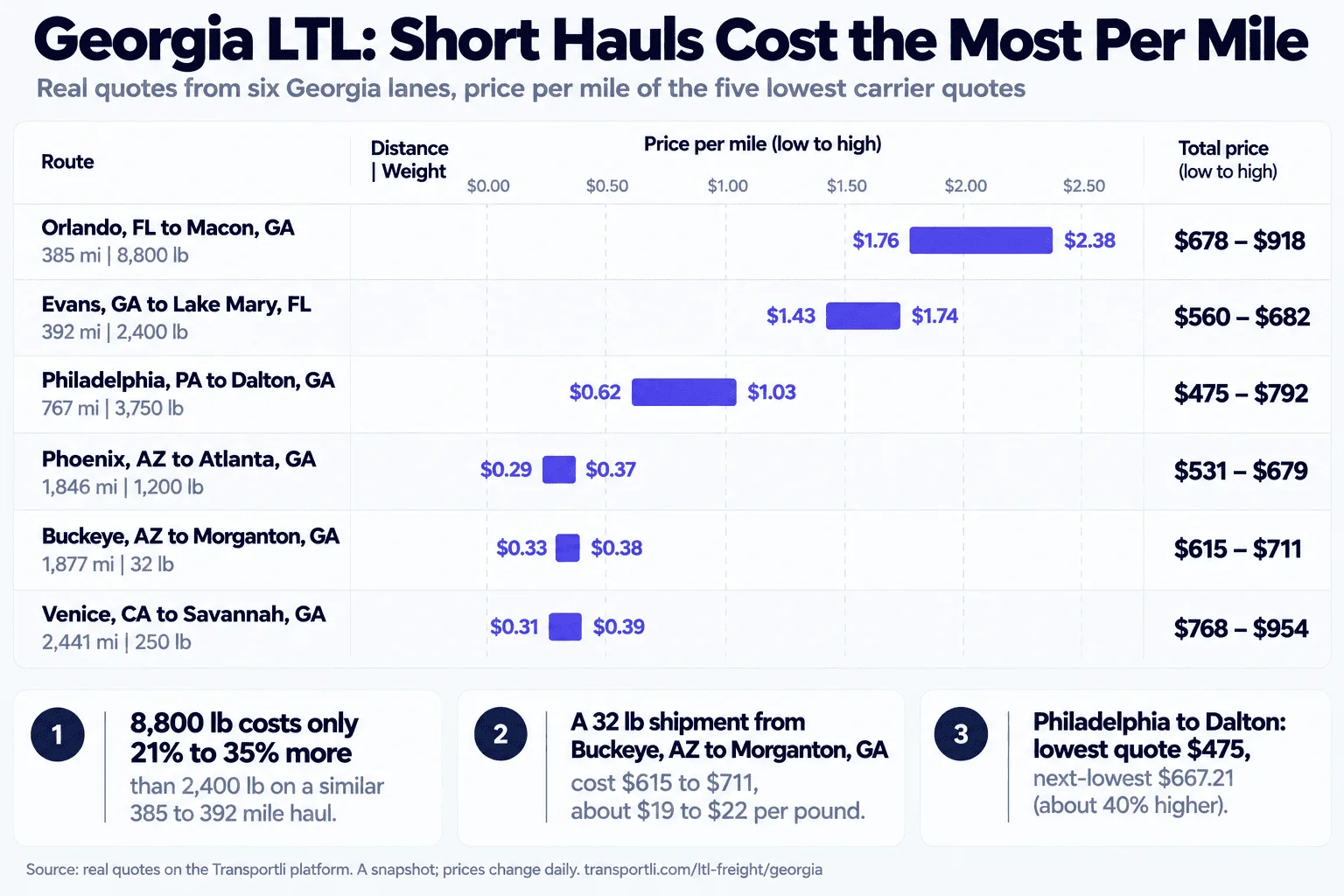
A 8,800 lb shipment moving 385 miles (Orlando, FL to Macon, GA) had a lowest quote of $678, or $1.76 a mile. A 1,200 lb shipment moving 1,846 miles (Phoenix, AZ to Atlanta, GA) had a lowest quote of $531, or $0.29 a mile.
-
$303 to arrive 2 days sooner
Speed has a price
On Philadelphia, PA to Dalton, GA (767 miles, 3,750 lb), the cheapest quote at $475 took 4 days. The fastest, at 2 days, cost $778. On Venice, CA to Savannah, GA, 4-day delivery cost $954 against $768 for 7 days.
-
5 carriers had the lowest quote
Five different carriers won six Georgia lanes
AAA Cooper had the lowest quote on two lanes. ABF Freight, Estes, Roadrunner, and STG Logistics each had the lowest quote on one lane. Across the lowest quotes on every lane, 15 different carriers appeared.
-
$317 from lowest to fifth-lowest
Same shipment, quotes $317 apart
For 3,750 lb from Philadelphia, PA to Dalton, GA (767 miles), the lowest quote was $475 and the fifth-lowest was $792, a 67% gap.

Where freight moves in Georgia
Georgia’s freight geography revolves around a few hubs, with the state home to about 11.3 million people (Census Bureau, July 2025):
- Metro Atlanta — the hub of I-75, I-85, I-20 and the I-285 perimeter, with Hartsfield-Jackson’s air cargo operation and the densest cluster of carrier terminals.
- Savannah & the coast — the Port of Savannah and the Port of Brunswick, connected to the rest of the state by I-16 and I-95.
- Macon & central Georgia — where I-75 meets I-16 and the I-475 bypass, roughly midway between Atlanta and the Florida line.
- Augusta & east Georgia — the I-20 corridor to the South Carolina line.
- Columbus & west Georgia — reached from I-85 by the I-185 spur; Kia’s plant at West Point sits on I-85 near the Alabama line.
- Dalton & north Georgia — the carpet and flooring center on I-75, close to the Tennessee line.
- South Georgia — the poultry, peanut, cotton and pecan country around Albany, Valdosta and Tifton.
Weather and transit reliability
Georgia’s weather risks come in three forms, and each has closed freight corridors before. Winter storms are rare but paralyzing: on January 28, 2014, one to three inches of snow fell across the Atlanta area, and the National Weather Service reported that some motorists were stranded for more than 20 hours, with more than 1,500 winter-storm accidents in the state per the Georgia State Patrol. Two weeks later an ice storm coated the I-20 corridor east of Atlanta toward Augusta with more than three-quarters of an inch of ice, which the NWS described as not seen in decades. Infrastructure failures matter too: on March 30, 2017 a fire collapsed a section of I-85 in Atlanta, a road that normally carries about 243,000 vehicles a day, and it reopened on May 12, 43 days later. Then there are hurricanes, which can reach well inland. Hurricane Michael crossed southwest Georgia in October 2018, and University of Georgia Extension estimated more than $2 billion in agricultural losses. Hurricane Helene, in late September 2024, stayed a hurricane over southern Georgia; the National Hurricane Center counts 37 Georgia deaths, about 1.28 million customers without power, and at least $5.5 billion in agriculture and timber damage, and it brought 12–13 inches of rain to Atlanta. News reports at the time put GDOT’s road closures at about 152, including interstate segments of I-16 and I-20. For LTL shippers the practical advice is simple: during hurricane season and winter storms, build extra transit time into anything headed to or through the affected area.
Sample Georgia LTL rates by route
Real quotes pulled from our platform for six different Georgia lanes — same process, different carriers each time, spanning a huge range of weights and distances. Rates shift with capacity and fuel costs, so treat these as a snapshot rather than a guarantee for your shipment; get an instant quote for your exact route.
Real quotes by route
Snapshot taken over recent weeks — carriers and pricing change daily.
| Carrier | Service | Transit | Price |
|---|---|---|---|
| AAA Cooper Transportation | Standard | 1 day | $678.31 |
| ABF Freight | Standard | 4 days | $680.79 |
| R+L Carriers | STD | 2 days | $700.10 |
| Central Transport | Standard | 2 days | $713.13 |
| Roadrunner Freight | STD | 1 day | $917.87 |
| Carrier | Service | Transit | Price |
|---|---|---|---|
| STG Logistics | Standard | 4 days | $475.00 |
| Ward Transport & Logistics | Standard | 4 days | $667.21 |
| Central Transport | STD | 3 days | $722.29 |
| Estes | LTL Standard Transit | 2 days | $777.69 |
| TForce Freight | STD | 2 days | $791.82 |
| Carrier | Service | Transit | Price |
|---|---|---|---|
| AAA Cooper Transportation | Standard | 2 days | $560.02 |
| Southeastern Freight Lines | Standard | 1 day | $588.60 |
| ABF Freight | Standard | 2 days | $661.80 |
| TForce Freight | STD | 2 days | $678.19 |
| Averitt | Standard | 1 day | $681.90 |
| Carrier | Service | Transit | Price |
|---|---|---|---|
| Roadrunner Freight | Standard | 5 days | $530.67 |
| Warp | STD | 5 days | $534.73 |
| XPO | STD | 4 days | $597.97 |
| AAA Cooper Transportation | Standard | 3 days | $646.30 |
| TForce Freight | STD | 3 days | $678.96 |
| Carrier | Service | Transit | Price |
|---|---|---|---|
| ABF Freight | Standard | 7 days | $768.45 |
| FedEx Freight Economy | Freight Economy | 6 days | $833.93 |
| Forward Air | STD | 5 days | $925.34 |
| AAA Cooper Transportation | Standard | 5 days | $932.99 |
| XPO | STD | 4 days | $953.98 |
| Carrier | Service | Transit | Price |
|---|---|---|---|
| Estes | LTL Standard Transit | 4 days | $614.54 |
| ABF Freight | Standard | 4 days | $665.34 |
| AAA Cooper Transportation | Standard | 3 days | $679.09 |
| XPO | Standard | 3 days | $698.31 |
| FedEx Freight Economy | Freight Economy | 5 days | $710.94 |
Rate, transit, and price-per-mile summary
Pulling the six lanes above together, the two short lanes inside the Southeast are by far the most expensive per mile:
| Route | Distance | Weight | Price range | Transit range | Price per mile |
|---|---|---|---|---|---|
| Orlando, FL → Macon, GA | 385 mi | 8,800 lb | $678–$918 | 1–4 days | $1.76–$2.38 |
| Philadelphia, PA → Dalton, GA | 767 mi | 3,750 lb | $475–$792 | 2–4 days | $0.62–$1.03 |
| Evans, GA → Lake Mary, FL | 392 mi | 2,400 lb | $560–$682 | 1–2 days | $1.43–$1.74 |
| Phoenix, AZ → Atlanta, GA | 1,846 mi | 1,200 lb | $531–$679 | 3–5 days | $0.29–$0.37 |
| Venice, CA → Savannah, GA | 2,441 mi | 250 lb | $768–$954 | 4–7 days | $0.31–$0.39 |
| Buckeye, AZ → Morganton, GA | 1,877 mi | 32 lb | $615–$711 | 3–5 days | $0.33–$0.38 |
The two shortest lanes, Orlando to Macon (385 miles) and Evans to Lake Mary (392 miles), cost $1.76–$2.38 and $1.43–$1.74 per mile, against $0.29–$0.39 on the three lanes of more than 1,800 miles. Weight explains only part of that gap. The Orlando shipment weighs 8,800 lb, 3.7 times the 2,400 lb Evans shipment, yet its cheapest quote ($678) is only about 21% higher and its priciest ($918) about 35% higher. The lightest shipment in the data shows how little weight can matter on a long haul: 32 lb from Buckeye, Arizona to Morganton cost $615–$711, or roughly $19–$22 per pound, and its cheapest quote was within about 10% of the cheapest quote for the 8,800 lb Orlando shipment, over a haul nearly five times longer. Our data cannot show how each carrier built its price, but a shipment this light on a long haul is consistent with a minimum charge rather than a weight-based rate. Carrier spread varies too. On Philadelphia to Dalton, STG Logistics quoted $475 while the next-lowest quote, from Ward Transport & Logistics, was $667.21, about 40% higher, and the five quotes ran from $475 to $792. On Buckeye to Morganton all five quotes fell within 16% of each other. The lesson is the same on every lane: compare several carriers before you book.
Price vs. speed explorer
Every dot is a real quote from the routes above. Drag the slider from cheapest to fastest and see which carrier wins on each lane, and what the speed costs.
What a real Georgia LTL quote looks like
The screenshot alongside is an actual result from our platform, a 400 lb shipment from Evans, GA to Lake Mary, FL, compared across 40 real carrier options in seconds. It is the same lane as the 2,400 lb quote in the third tab above, for a pickup a week later at one-sixth the weight, which makes it a useful test of how much weight really moves the price.
- 40 real carrier options compared for this single shipment, 35 of them standard service, not just one broker’s in-house rate.
- $468.77–$621.31 for the five lowest quotes at 400 lb, against $560.02–$681.90 at 2,400 lb. AAA Cooper and ABF were each about 16% cheaper, and Southeastern Freight Lines was within about 1% ($582.27 against $588.60) at one-sixth the weight. The pickup dates differ, so some of the gap may be the date rather than the weight.
- 1 to 4 days in transit across the top five, with Southeastern Freight Lines the only one-day option.
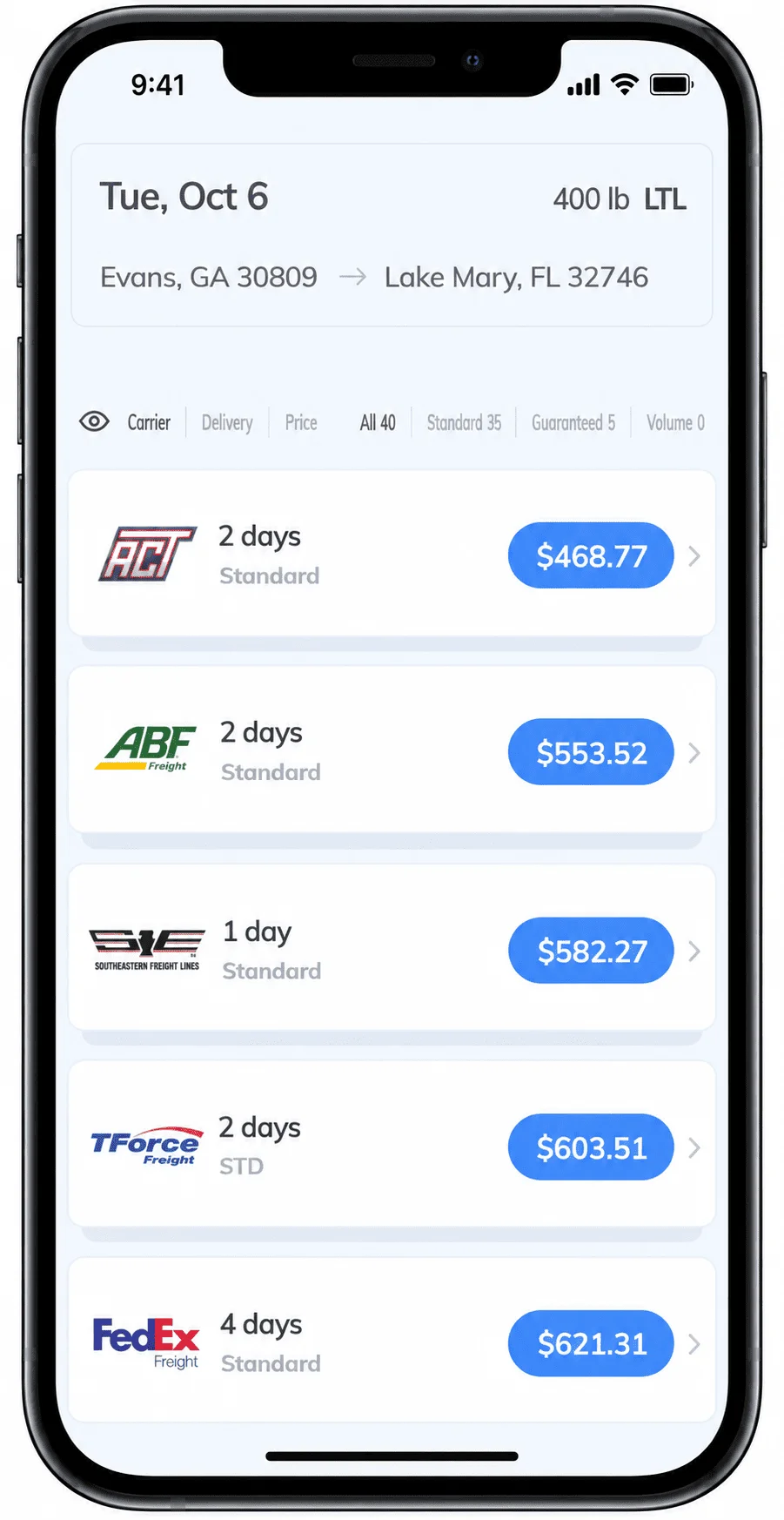
Real screenshot from a live Transportli quote for Evans, GA to Lake Mary, FL, individual results vary by shipment and date.
Major shipping hubs in Georgia
Georgia’s freight moves through two ports, an airport, inland rail terminals and a growing manufacturing belt:
- Port of Savannah (Garden City Terminal) — the Georgia Ports Authority moved 5.7 million TEUs in fiscal 2025 (July 2024 to June 2025), up 8.6% and the second-busiest year on record. The authority describes Garden City as the largest single-operator container terminal in the nation, at 1,345 acres.
- Mason Mega Rail — on-terminal intermodal capacity at Savannah that the authority calls the largest of its kind in North America, handling about 42 double-stack trains a week.
- Port of Brunswick — 870,775 units of autos and heavy machinery in fiscal 2025, which the authority describes as the nation’s busiest gateway for autos and heavy equipment.
- Appalachian Regional Port — an inland rail port in Murray County, near Chatsworth, that the authority says ships carpet and flooring from the Dalton area; it handled 36,730 rail lifts in fiscal 2024.
- Hartsfield-Jackson Atlanta International Airport — about 640,000 metric tons of cargo in 2025.
- Hyundai Metaplant America — an electric-vehicle plant in Ellabell, about 30 miles west of Savannah, on a 2,900-acre site with an investment of more than $7.5 billion. Production started in October 2024.
- Johns Creek — headquarters of Saia, the LTL carrier, which reported 213 terminals at the end of 2025.
Highway corridors serving Georgia
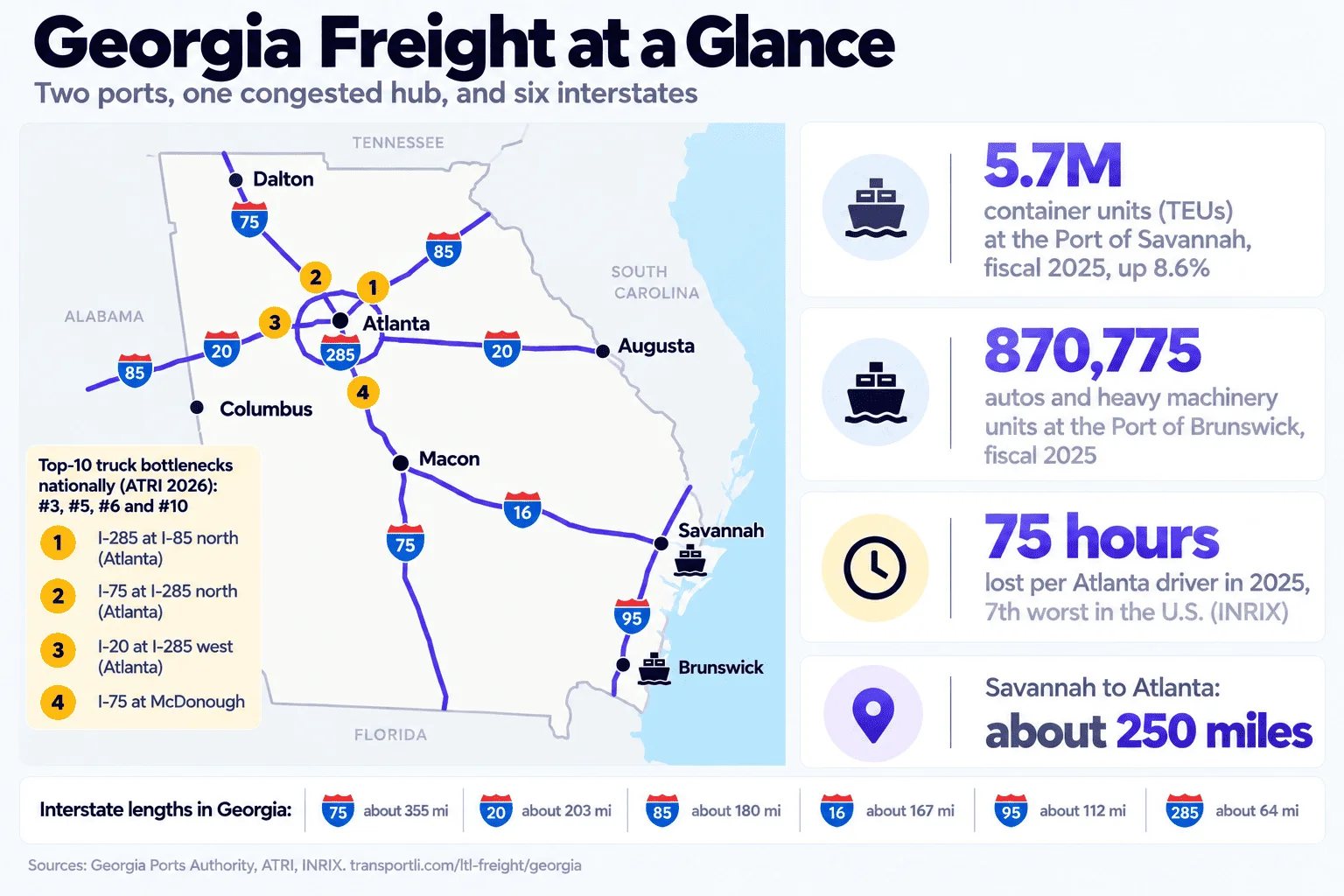
I-75 (about 355 miles in Georgia, the longest interstate in the state) runs from the Florida line through Macon, Atlanta and Dalton to Tennessee. I-85 (about 180 miles) crosses from Alabama through Atlanta to South Carolina, and I-20 (about 203 miles) does the same from Alabama through Atlanta and Augusta. I-16 (about 167 miles) links Macon to Savannah, and I-95 (about 112 miles) follows the coast. I-285 is the roughly 64-mile perimeter around Atlanta. Spurs include I-185 to Columbus and I-475, the Macon bypass. The Peach Pass Express Lanes exclude tractor-trailers, and the tolls on GA-400 ended in November 2013.
Atlanta: where Georgia freight slows down
ATRI’s 2026 list of the Top 100 Truck Bottlenecks, based on 2025 data, ranks three Atlanta interchanges in its top six and a fourth Georgia location in its top ten: I-285 at I-85 north (the Tom Moreland Interchange, known as Spaghetti Junction) is third, I-75 at I-285 north is fifth, I-20 at I-285 west is sixth, and I-75 in McDonough is tenth. INRIX’s 2025 scorecard puts the average Atlanta driver at 75 hours lost, up from 65 the year before, with downtown speeds around 14 mph. TRIP, a transportation research group citing GDOT and federal data, puts Georgia’s 2022 freight at 629 million tons worth $986 billion, with growth of 67% by weight and 96% by value projected by 2050. None of those figures are specific to LTL, but together they explain why a delivery inside the perimeter is often priced and scheduled differently from one outside it. Truck parking is part of the squeeze: a GDOT analysis completed in 2021, as presented to a state Senate committee, counted about 27,000 truck parking spaces statewide and concluded that demand continues to outpace supply.
What Georgia shippers move
Georgia’s freight mix is unusually broad. Agriculture is the base: the University of Georgia put the state’s 2024 farm gate value at about $18.0 billion, with broilers the largest single commodity at $6.1 billion (36% of the total) and Georgia the nation’s top broiler producer. Georgia also leads the country in peanuts ($878 million in 2024) and grows $770 million of cotton. Manufacturing adds autos: Kia has built vehicles at West Point since November 2009, with a stated capacity of 340,000 units a year, and Hyundai’s Metaplant near Savannah is adding electric vehicles. Around Dalton, the New Georgia Encyclopedia says roughly 80% of U.S. tufted carpet production happens within 100 miles of the city, making Dalton the center of the industry. Much of what the Port of Savannah handles also moves inland by truck or rail.
Georgia LTL freight: frequently asked questions
How much does LTL shipping cost to or from Georgia?
It depends on distance, weight, freight class, and how close your pickup or delivery point is to a major metro’s carrier network. Real quotes on our platform for Georgia lanes have ranged from about $0.29 per mile on a 1,846-mile haul from Phoenix to Atlanta to $1.76 to $2.38 per mile on an 8,800 lb shipment from Orlando to Macon, so distance alone does not predict the price. Get an instant quote for your exact shipment.
Do oversized LTL shipments need a permit in Georgia?
Yes, for loads wider than 8 ft 6 in, taller than 13 ft 6 in, or over 80,000 lbs gross, or beyond the legal length limits. Georgia DPS’s Motor Carrier Compliance Division issues permits through GDOT’s GAPROS system. A Standard Single permit costs $30, covers loads up to 16 ft wide or high and 150,000 lbs, and is valid for 10 days not counting Sundays or legal holidays. A standard 53-foot LTL trailer within those limits does not need one.
Can trucks use Atlanta’s Peach Pass Express Lanes?
No. Peach Pass says vehicles with two axles and six wheels or fewer may use the Express Lanes, and that vehicles with trailers and tractor-trailers are not allowed. LTL trucks use the general-purpose lanes.
How busy is the Port of Savannah?
The Georgia Ports Authority moved 5.7 million TEUs in fiscal 2025, up 8.6% from the year before and the second-busiest year on record. The authority describes Garden City Terminal as the largest single-operator container terminal in the nation, at 1,345 acres, and says Mason Mega Rail handles about 42 double-stack trains a week.
How do hurricanes and winter storms affect LTL shipping in Georgia?
Both can close major corridors. Helene in September 2024 brought about 152 road closures according to news reports, including interstate segments of I-16 and I-20, and 1.28 million Georgia customers lost power. The January 2014 snow left some motorists stranded for more than 20 hours, and the March 2017 I-85 bridge collapse kept that road closed for 43 days. Build extra transit time into shipments during storm season.
Is it hard to move freight through Atlanta?
It can be. ATRI’s 2026 truck bottleneck list ranks I-285 at I-85 north third in the country, I-75 at I-285 north fifth and I-20 at I-285 west sixth, and INRIX counted 75 hours lost per Atlanta driver in 2025. Carriers price and schedule around that congestion, so compare quotes for deliveries inside the I-285 perimeter.
Is there enough truck parking in Georgia?
GDOT’s statewide truck parking analysis, completed in 2021 and presented to a state Senate committee, counted about 27,000 spaces and concluded that demand continues to outpace supply even when public rest areas are counted. According to trade-press reports, GDOT plans to add 59 spaces on I-75.