

Shipping LTL freight to or from Washington, D.C.? Rates depend on your specific route, freight class, and how close your pickup or delivery point is to the nearest LTL terminal. D.C. is unlike any state. It covers just 61 square miles, and carriers serve it from terminals in Maryland and Northern Virginia; we could not confirm a single LTL terminal inside the District. Trucks are barred from the Theodore Roosevelt Bridge and from federal parkways like Rock Creek Parkway, every delivery to the U.S. Capitol must first be inspected at an off-site center, and D.C. ranks 9th in the U.S. for traffic congestion. Here’s what actually affects your rate.
LTL trucking regulations in the District of Columbia
Truck rules in D.C. are set by DDOT (the District Department of Transportation), and in practice they are stricter than the permit thresholds suggest:
- Legal-size trucks need no permit. The as-of-right limits are 8 feet wide (8 ft 6 in for tractor-trailers on freeways and interstates), 13 ft 6 in high, 55 feet long for combinations and semi-trailers, and up to 80,000 lbs gross, subject to axle limits. DDOT’s own materials differ slightly on axle and gross weights, so confirm the figures for a heavy load. Anything larger needs an oversize/overweight permit through DDOT’s online TOPS system; a single-haul permit costs $30 one way or $50 round trip.
- Not every street is open to trucks. DDOT designates truck-and-bus through routes, streets where through trucks are prohibited (local deliveries only) and streets where trucks are prohibited outright, including the National Mall, the area around the White House and large parks such as Rock Creek Park. DDOT publishes a truck route planner and an official D.C. truck map.
- Federal parkways are off-limits to most commercial vehicles. National Park Service rules (36 CFR 7.96) bar commercial vehicles, loaded or unloaded, from NPS park roads and bridges, including the Rock Creek and Potomac Parkway. A special-use permit is sometimes possible, but the NPS may deny it when an alternative route exists.
- Curb time is short. Commercial loading zones typically run 7:00 AM to 6:30 PM Monday through Saturday with a 2-hour limit, and idling for more than 3 minutes (5 minutes when it is 32°F or colder) is a ticketable offense.
Current permit rules, truck routes and loading-zone details are published by DDOT:
DDOT Freight DC: truck routes, permits and loading zones →
What affects your D.C. LTL rate
- Freight class — density, handling, and liability determine your NMFC class, the single biggest factor in your rate. See our freight class guide.
- Distance — carriers typically serve D.C. from terminals in Maryland and Northern Virginia, so the last miles into the District are part of your rate even when the origin is hundreds of miles away.
- Terminal proximity — a pickup or delivery near the Beltway terminals is easier to serve than one deep in downtown, where trucks lose time to congestion, tight streets and short loading windows.
- Accessorials — these matter more in D.C. than in most places. Limited-access delivery (the Capitol complex, federal buildings, embassies, the Convention Center), appointment delivery, liftgate and residential delivery are all common for D.C. addresses and add to the base rate.
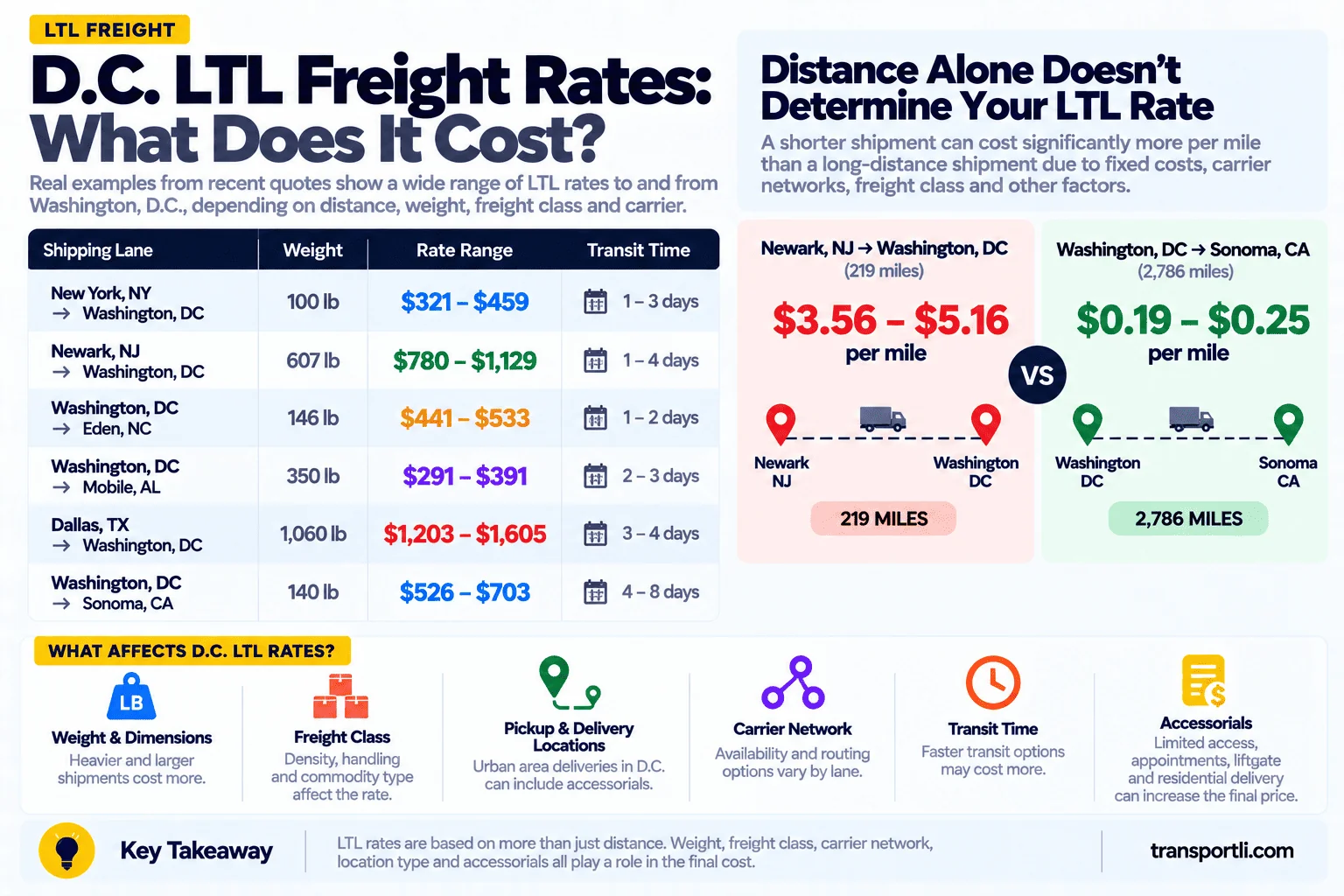
Did you know?From 6 real D.C. lanes and 30 quotes
-
19× the cost per mile
The shorter haul cost far more per mile
A 607 lb shipment moving 219 miles (Newark, NJ to Washington, DC) had a lowest quote of $780, or $3.56 a mile. A 140 lb shipment moving 2,786 miles (Washington, DC to Sonoma, CA) had a lowest quote of $526, or $0.19 a mile.
-
$184 to arrive 3 days sooner
Speed has a price
On Newark, NJ to Washington, DC (219 miles, 607 lb), the cheapest quote at $780 took 4 days. The fastest, at 1 day, cost $964. On Washington, DC to Sonoma, CA, 4-day delivery cost $699 against $526 for 8 days.
-
5 carriers had the lowest quote
Five different carriers won six D.C. lanes
TForce Freight had the lowest quote on two lanes. ABF Freight, Central Transport, Estes, and Roadrunner each had the lowest quote on one lane. Across the lowest quotes on every lane, 12 different carriers appeared.
-
$402 from lowest to fifth-lowest
Same shipment, quotes $402 apart
For 1,060 lb from Dallas, TX to Washington, DC (1,338 miles), the lowest quote was $1,203 and the fifth-lowest was $1,605, a 33% gap.

Where freight moves inside the District
D.C. makes very little freight itself, so most of what moves is inbound. DDOT’s 2024 freight plan, built on 2017 data, breaks the city into freight zones, and four of them account for more than half of all freight by tonnage and value:
- Downtown & NoMa — the District’s heaviest freight zone at about 4.5 million tons a year, mostly deliveries to offices, government buildings and retailers.
- Georgetown & Foggy Bottom — about 3.8 million tons, moving through some of the tightest streets in the city.
- Ivy City & Northeast — the main industrial corridor, at about 2.6 million tons. Roughly half of Ivy City is industrial or formerly industrial, zoned for production, distribution and repair, and New York Avenue and Bladensburg Road NE have a dense cluster of warehouses (and are a known truck-crash hot spot).
- Southeast & Anacostia — about 1.7 million tons around Joint Base Anacostia-Bolling, reached by the Anacostia Freeway (I-295).
Weather and transit reliability
D.C. shuts down for snow in a way few cities do. During the February 2010 “Snowmageddon” storm, Dulles recorded 32.4 inches in two days, a record, and the January 2016 blizzard dropped 29.2 inches at BWI (a record there) and 29.3 at Dulles, closing federal offices and schools through January 26 and leaving side streets unplowed until then. A smaller storm can wreck freight just as badly: on January 26, 2011, about 5 inches fell during the evening rush at 2 to 3 inches an hour, and the National Weather Service reported commuters needing 5 to 10 hours to get home. Wind and water cause problems too. The June 2012 derecho knocked out power to roughly 68,000 D.C. customers, and in July 2019 a flash flood emergency was declared after 3.44 inches of rain fell at Reagan National in a single day. Then there are disruptions no forecast can predict: for the January 2025 presidential inauguration, closures from about January 19 to 21 shut several I-395 exits, the 3rd Street Tunnel and Union Station to vehicles, and only permitted vehicles could enter the restricted zones. Even on a normal day, INRIX’s 2025 scorecard ranks D.C. 9th in the U.S. for congestion, with drivers losing 70 hours a year and morning traffic into downtown crawling at about 11 mph.
Sample D.C. LTL rates by route
Real quotes pulled from our platform for six different D.C. lanes — same process, different carriers each time, spanning a huge range of weights and distances. Rates shift with capacity and fuel costs, so treat these as a snapshot rather than a guarantee for your shipment; get an instant quote for your exact route.
Real quotes by route
Snapshot taken over recent weeks — carriers and pricing change daily.
| Carrier | Service | Transit | Price |
|---|---|---|---|
| TForce Freight | STD | 3 days | $321.24 |
| Estes | LTL Standard Transit | 2 days | $346.99 |
| FedEx Freight Economy | Freight Economy | 3 days | $381.52 |
| A. Duie Pyle | STD | 1 day | $415.53 |
| ABF Freight | Standard | 2 days | $459.12 |
| Carrier | Service | Transit | Price |
|---|---|---|---|
| ABF Freight | Standard | 4 days | $780.31 |
| Central Transport | Standard | 1 day | $964.05 |
| Estes | LTL Standard Transit | 2 days | $1,001.25 |
| JP Express | Standard | 3 days | $1,049.21 |
| Forward Air | Standard | 1 day | $1,129.01 |
| Carrier | Service | Transit | Price |
|---|---|---|---|
| Estes | LTL Standard Transit | 1 day | $441.23 |
| Forward Air | Standard | 1 day | $452.22 |
| TForce Freight | STD | 2 days | $498.58 |
| Pitt Ohio | Standard | 2 days | $511.27 |
| ABF Freight | Standard | 2 days | $532.53 |
| Carrier | Service | Transit | Price |
|---|---|---|---|
| TForce Freight | Standard Service | 3 days | $291.04 |
| Forward Air | Standard Service | 2 days | $312.41 |
| Estes | Standard Service | 3 days | $316.55 |
| Central Transport | Standard Service | 3 days | $345.32 |
| FedEx Freight Economy | Standard | 3 days | $390.86 |
| Carrier | Service | Transit | Price |
|---|---|---|---|
| Central Transport | Standard | 4 days | $1,203.15 |
| Go2 Logistics | LTL Standard Transit | 3 days | $1,251.76 |
| Forward Air | STD | 4 days | $1,323.33 |
| Roadrunner Freight | STD | 3 days | $1,348.54 |
| Estes | STD | 4 days | $1,604.86 |
| Carrier | Service | Transit | Price |
|---|---|---|---|
| Roadrunner Freight | Standard Service | 8 days | $525.93 |
| Forward Air | STD | 5 days | $684.39 |
| TForce Freight | STD | 5 days | $691.36 |
| Pitt Ohio | Standard | 4 days | $698.94 |
| R+L Carriers | STD | 7 days | $703.01 |
Rate, transit, and price-per-mile summary
Pulling the six lanes above together, a short, heavy shipment into the District stands out from everything else in the data:
| Route | Distance | Weight | Price range | Transit range | Price per mile |
|---|---|---|---|---|---|
| New York, NY → Washington, DC | 226 mi | 100 lb | $321–$459 | 1–3 days | $1.42–$2.03 |
| Newark, NJ → Washington, DC | 219 mi | 607 lb | $780–$1,129 | 1–4 days | $3.56–$5.16 |
| Washington, DC → Eden, NC | 275 mi | 146 lb | $441–$533 | 1–2 days | $1.60–$1.94 |
| Washington, DC → Mobile, AL | 970 mi | 350 lb | $291–$391 | 2–3 days | $0.30–$0.40 |
| Dallas, TX → Washington, DC | 1,338 mi | 1,060 lb | $1,203–$1,605 | 3–4 days | $0.90–$1.20 |
| Washington, DC → Sonoma, CA | 2,786 mi | 140 lb | $526–$703 | 4–8 days | $0.19–$0.25 |
Newark to D.C. is the outlier: at just 219 miles, it is the shortest lane in this data, yet it prices at $3.56–$5.16 per mile — roughly two and a half times the New York to D.C. lane, which is almost the same distance (226 miles) at $1.42–$2.03 per mile. The big difference between the two shipments is weight: 607 lb from Newark against 100 lb from New York, so the heavier load simply costs more in total over the same road. Our data cannot separate the effect of weight from the extra cost of delivering into the District, but it does show that short lanes are the expensive ones here: all three lanes under 300 miles cost more than $1.40 per mile, while the 970-mile D.C. to Mobile, Alabama lane came in at just $0.30–$0.40 per mile. At the other extreme, D.C. to Sonoma, California is the longest haul at 2,786 miles and the cheapest per mile at $0.19–$0.25 — a clean example of long-haul efficiency. Dallas to D.C. shows the other side of the weight effect: a 1,060 lb shipment over 1,338 miles costs $1,203–$1,605 in total, more than any of the lighter long-haul lanes.
What a real D.C. LTL quote looks like
The screenshot alongside is an actual result from our platform, a 350 lb shipment from Washington, DC to Mobile, AL, compared across 43 real carrier options in seconds. It is the same lane as in the rate table above, quoted again on a different day, which is why the prices differ slightly.
- 43 real carrier options compared for this single D.C.-to-Mobile shipment, not just one broker’s in-house rate.
- $400.63–$461.12 for the exact same 350 lb load, depending on carrier, a reminder that comparing multiple carriers on every shipment is worth the time.
- 3–4 day transit across these top carriers, so the cheapest option isn’t always the slowest.
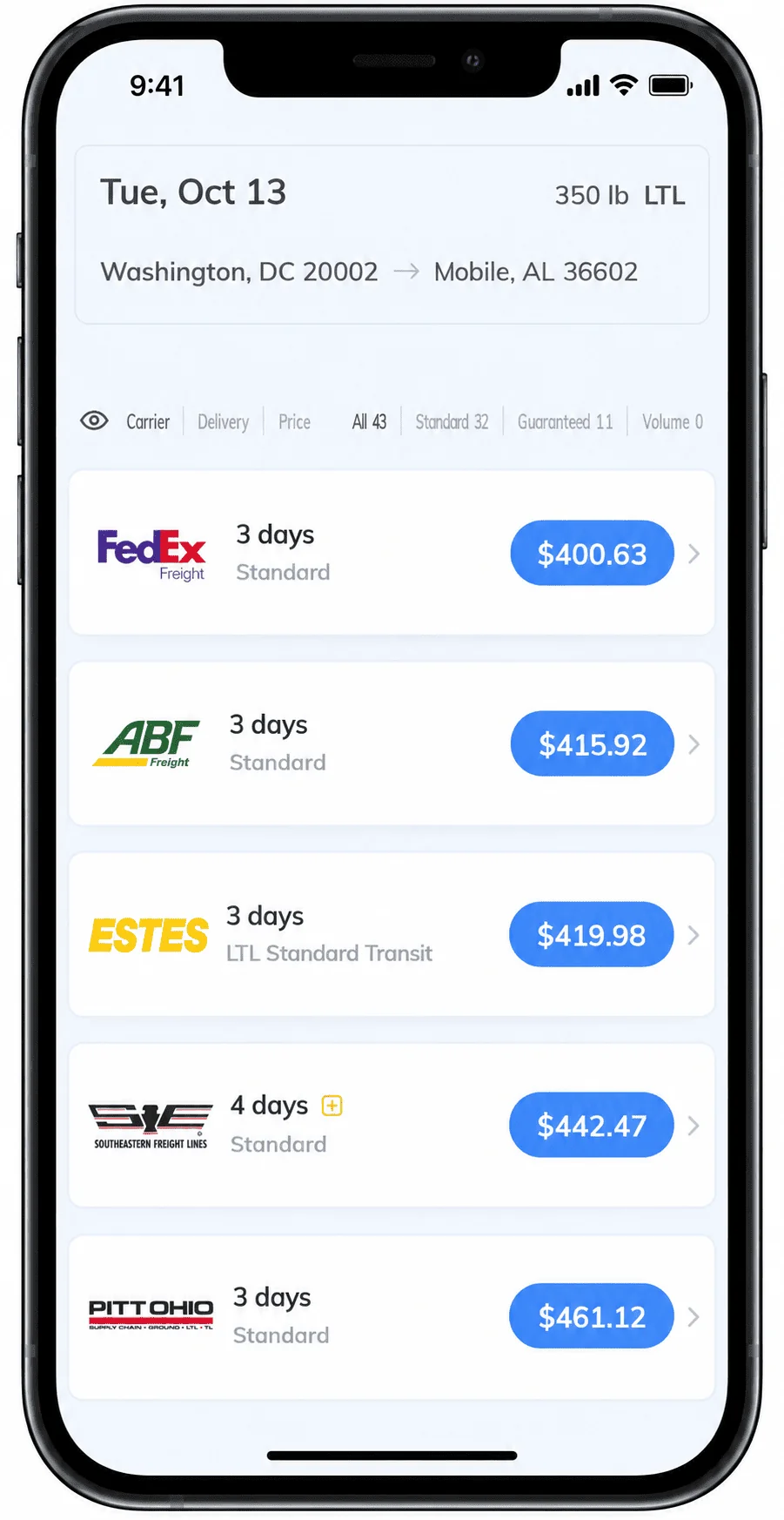
Real screenshot from a live Transportli quote for Washington, DC to Mobile, AL, individual results vary by shipment and date.
Major shipping hubs around D.C.
DDOT’s freight plan notes that D.C. has no public or large private truck-parking facilities, and carriers work from outside the District, so the places that matter for LTL are a mix of terminals just beyond the city line and a handful of special destinations inside it:
- Terminals around the District — XPO’s Landover, Maryland terminal (36 doors, opened in May 2024 on a former Yellow site near US-50 and the Beltway) and Estes’s Springfield, Virginia hub (37 doors) are examples of the terminals that feed D.C. deliveries. Other major carriers also serve the area from Maryland and Northern Virginia.
- Ivy City, Brentwood & New York Avenue NE — the District’s industrial and warehouse belt, and the easiest place in D.C. to load or unload a full-size truck.
- The U.S. Capitol complex — every delivery truck must be inspected and tagged at the U.S. Capitol Police Off-Site Delivery Center (4700 Shepherd Parkway SW) before going to any loading dock. Carriers need a company authorization letter naming each driver, and one-off deliveries must be reported at least 48 hours ahead. The center runs on weekdays from early morning into the afternoon, so confirm hours with the Capitol Police.
- Walter E. Washington Convention Center — 2.3 million square feet, but exhibit freight cannot go straight to the venue. It is consigned to the show’s general service contractor, the docks run 6:00 AM to 9:00 PM daily, and trucks enter from the west at 9th and M Streets.
- Embassies and federal buildings — D.C. hosts more than 175 embassies, plus federal agencies of every size. Deliveries to these sites commonly require appointments and security screening, so confirm requirements with the receiving office before booking.
Highway corridors serving the District
I-395 is the main truck route into downtown D.C. from Virginia, crossing the Potomac on the 14th Street bridges. I-295 (the Anacostia Freeway) and I-695 carry traffic through Southeast and Northeast, and DDOT flags both as truck bottlenecks. The Capital Beltway (I-495) circles the District through Maryland and Virginia, and three Beltway-area interchanges (I-95 at I-495, I-495 at I-66 and I-495 at I-270) appear on the American Transportation Research Institute’s list of the 100 worst truck bottlenecks in the country. None of them is inside D.C. itself. I-66 is closed to trucks east of the Beltway, which matters for anything coming from Northern Virginia.
Why getting a truck into D.C. is harder than it looks
Trucks are prohibited on the Theodore Roosevelt Bridge (I-66), and DDOT’s freight plan lists the Arlington Memorial Bridge as closed to them too. The Potomac crossings that are open to trucks are Key Bridge, the I-395 (14th Street) bridges, the Woodrow Wilson Bridge on I-495 and Chain Bridge, so freight coming from Northern Virginia funnels through a handful of crossings. Federal parkways are closed to most commercial vehicles, DDOT counts 102 bridges below its advised minimum clearance (many of them in parks and on park roads), and there is nowhere to park a truck while you wait. The result is that a “short” delivery in D.C. can take far longer than the mileage suggests.
What D.C. shippers move
D.C. is a government, construction and consumer market that ships very little out. DDOT’s freight plan counts about 18 million tons ($7.2 billion) moving within the District in 2017, with trucks carrying 89.2% of it by tonnage and 77% of the tonnage coming from Maryland and Virginia. The biggest commodity by tonnage is cement and concrete (nonmetallic mineral products, 32%), a sign of the city’s construction industry, followed by waste and scrap (15%) and mixed freight such as groceries, retail goods and office supplies (10%). Consumer deliveries are enormous: about 32.5 million Amazon packages were delivered in the District in 2021 and 2022 alone. Government and events add specialized freight, from federal agency supplies and embassy shipments to trade-show exhibits at the Convention Center, nearly all of which require screened or scheduled delivery. The trucking industry’s own national trade group, the American Trucking Associations, is headquartered at 80 M Street SE.
Get a D.C. LTL quote
Compare live rates from vetted carriers serving the District of Columbia.
Get an LTL quote →D.C. LTL freight: frequently asked questions
How much does LTL shipping cost to or from Washington, D.C.?
It depends on distance, weight, freight class, and which Maryland or Northern Virginia terminal serves your pickup or delivery point. Real quotes on our platform for D.C. lanes have ranged from about $0.19 per mile on a 2,786-mile cross-country haul to more than $3 per mile on a 219-mile, 607 lb shipment from Newark, NJ, so distance alone does not predict the price. D.C. addresses also tend to carry accessorial charges such as limited-access, appointment or liftgate delivery because of tight streets and secure buildings. Get an instant quote for your exact shipment.
Are there LTL terminals in Washington, D.C.?
We could not confirm any LTL terminal inside the District. Carriers serve D.C. from terminals in Maryland and Northern Virginia, such as XPO’s Landover, Maryland terminal and Estes’s Springfield, Virginia hub. D.C. also has no public or large private truck-parking facilities.
Can semi-trucks drive into D.C.?
Yes, but only on designated routes. Trucks are prohibited on the Theodore Roosevelt Bridge (I-66) and are barred from many federal parkways and streets near the National Mall and the White House. Truck-accessible Potomac crossings include Key Bridge, the I-395 14th Street bridges, the Woodrow Wilson Bridge and Chain Bridge.
How do LTL deliveries to the U.S. Capitol work?
Every delivery truck must be inspected and tagged at the U.S. Capitol Police Off-Site Delivery Center at 4700 Shepherd Parkway SW before it can go to any Capitol loading dock. Carriers need a company authorization letter naming each driver, and one-off deliveries must be reported at least 48 hours in advance.
Do oversized loads need a permit in D.C.?
Yes, for loads beyond the legal limits of 8 feet wide (8 ft 6 in on freeways and interstates for tractor-trailers), 13 ft 6 in high and about 80,000 lbs gross. DDOT issues permits through its online TOPS system, and a single-haul permit costs $30 one way or $50 round trip. Most standard LTL freight falls within these limits.
Are there tolls for trucks in and around D.C.?
D.C. itself has no tolls. In Virginia, the I-95, I-395 and I-495 Express Lanes are closed to trucks with more than two axles, so LTL tractor-trailers use the regular lanes.
How bad is traffic for deliveries in D.C.?
INRIX’s 2025 scorecard ranks D.C. 9th in the U.S. for congestion, with drivers losing about 70 hours a year and morning traffic into downtown averaging roughly 11 mph. Commercial loading zones are also short, typically 2 hours, and idling for more than 3 minutes can be ticketed.