

Shipping LTL freight to or from Delaware? Rates depend on your specific route, freight class, and how close your pickup or delivery point is to the nearest LTL terminal. Delaware is a genuinely distinctive freight state despite its size: it’s wedged on the I-95 corridor between Philadelphia and Baltimore, so most carriers extend their regional networks into the state rather than running dedicated Delaware terminals. Sussex County has been the single largest chicken-producing county in the entire United States since the 1940s, and the Port of Wilmington is North America’s largest banana import port, second worldwide only to Antwerp, Belgium. Delaware is also one of the only states where crossing the state itself on I-95 costs real toll money before your freight even reaches the next state line. Here’s what actually affects your rate. You can also compare live LTL freight rates across carriers.
LTL trucking regulations in Delaware
Delaware’s oversize/overweight thresholds are close to the federal baseline, with permits issued by DelDOT (Delaware Department of Transportation):
- An oversize permit is required for loads exceeding 8.5 feet wide, 13.5 feet high, 60 feet overall length (53 feet for the trailer), or 80,000 lbs gross on five or more axles. Routine permits top out at 120 feet long, 15 feet wide or high, and 120,000 lbs; anything beyond that is classified as a superload and needs special escort and routing review. Single-trip permits are valid for 5 days.
- Delaware is one of the only states that tolls its own primary freight corridor. The I-95 Delaware Turnpike toll plaza near Newark charges by axle count — up to $25 for a 5-or-more-axle truck — and the Delaware Memorial Bridge into New Jersey charges up to $42–$48 for a 6-axle truck. Nearly every Northeast-bound linehaul through Delaware pays one or both tolls, a real per-trip cost most other states don’t add.
- Most standard LTL freight falls well within these size and weight limits — the permit requirements mainly matter for heavy equipment and oversized freight.
Current permit thresholds and axle limits are public record:
DelDOT Oversize/Overweight Permit System →
What affects your Delaware LTL rate
- Freight class — density, handling, and liability determine your NMFC class, the single biggest factor in your rate. See our freight class guide.
- Distance — Delaware is small enough that in-state distance is rarely the real issue; what actually determines your rate is whether your route is covered by the Philadelphia or Baltimore regional carrier network, since very few carriers run dedicated Delaware-only terminals.
- Terminal proximity — pickup or delivery points near Wilmington and the I-95 corridor typically see the most carrier options and fastest transit; rural Sussex County sees noticeably fewer.
- Tolls — freight moving up or down the I-95 corridor through Delaware, or across the Delaware Memorial Bridge, picks up real toll costs that get baked into the rate.
- Accessorials — liftgate, residential, or inside delivery add to the base rate, same as anywhere else.
Did you know?From 6 real Delaware lanes and 30 quotes
-
9× the cost per mile
The shorter haul cost far more per mile
A 560 lb shipment moving 387 miles (New Castle, DE to Goldsboro, NC) had a lowest quote of $641, or $1.66 a mile. A 135 lb shipment moving 2,819 miles (Woodinville, WA to Wilmington, DE) had a lowest quote of $532, or $0.19 a mile.
-
$155 to arrive 2 days sooner
Speed has a price
On New Castle, DE to Goldsboro, NC (387 miles, 560 lb), the cheapest quote at $641 took 3 days. The fastest, at 1 day, cost $795.
-
5 carriers had the lowest quote
Five different carriers won six Delaware lanes
Ward Transport & Logistics had the lowest quote on two lanes. Roadrunner, Southeastern, TForce Freight, and XPO each had the lowest quote on one lane. Across the lowest quotes on every lane, 13 different carriers appeared.
-
$362 from lowest to fifth-lowest
Same shipment, quotes $362 apart
For 350 lb from Dublin, CA to Claymont, DE (2,886 miles), the lowest quote was $844 and the fifth-lowest was $1,206, a 43% gap. On Woodinville, WA to Wilmington, DE, all five quotes landed within $20 of each other.

Regional carrier coverage across Delaware
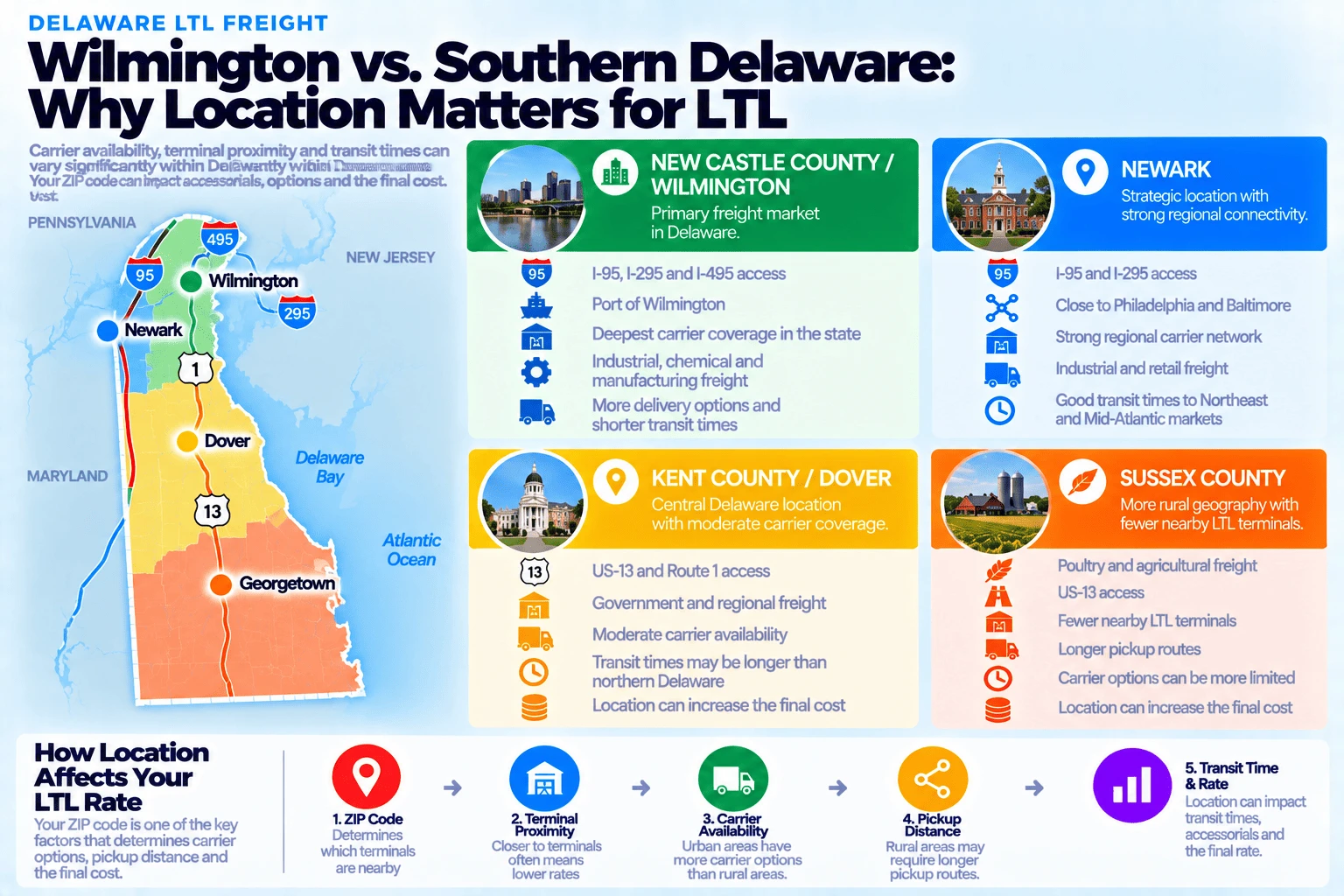
Delaware has only three counties, but the freight geography splits sharply along a north-south line:
- New Castle County (Wilmington, Newark) — Delaware’s most populous county, sitting directly on I-95 a few miles south of the Pennsylvania line. Carriers here largely extend their Philadelphia and Baltimore terminal networks across the state line rather than running independent Delaware operations; historically home to well over half of the state’s trucking establishments.
- Kent County (Dover) — the state capital, anchored by Dover Air Force Base, home of the Department of Defense’s largest and busiest aerial port; moderate regional coverage along US-13.
- Sussex County (Georgetown, Rehoboth Beach, Lewes) — the largest county by land area but the most rural, built around the poultry industry and beach tourism. Historically the thinnest carrier coverage in the state, with some freight served out of nearby Federalsburg, Maryland rather than from a Delaware terminal.
Weather and transit reliability
Delaware’s low-lying, coastal geography makes nor’easters and coastal flooding the real transit risk, more than the tornado or hurricane patterns that disrupt freight further inland. The Storm of ’62 (March 6–8, 1962) is still considered the worst storm in Delaware’s recorded history — a three-day nor’easter whose storm-tide flooding destroyed the Rehoboth Beach boardwalk, damaged or destroyed nearly 2,000 homes, and killed 7 people in the state. A January 1992 nor’easter produced a 9.02-foot high tide at Dewey Beach, the second-highest on record, and damaged another 500 homes. More recently, Hurricane Sandy’s remnants dumped close to 11 inches of rain on southern Delaware in October 2012, flooded the Brandywine Creek in Wilmington, and closed Route 1 at Indian River Inlet for days; a September 2026 nor’easter closed sections of Route 1 at Dewey Beach again. Freight bottlenecks aren’t only weather-driven, either: nearly all I-95-corridor freight crossing into New Jersey funnels across the single Delaware Memorial Bridge, so any incident there backs up the entire Northeast Corridor through the state.
Sample Delaware LTL rates by route
Real quotes pulled from our platform for six different Delaware lanes — same process, different carriers each time, spanning a huge range of weights and distances. Rates shift with capacity and fuel costs, so treat these as a snapshot rather than a guarantee for your shipment; get an instant quote for your exact route.
Real quotes by route
Snapshot taken over recent weeks — carriers and pricing change daily.
| Carrier | Service | Transit | Price |
|---|---|---|---|
| Southeastern Freight Lines | Standard | 4 days | $449.00 |
| Forward Air | Standard | 2 days | $465.72 |
| TForce Freight | STD | 3 days | $478.28 |
| XPO | Standard | 2 days | $486.48 |
| Estes | LTL Standard Transit | 2 days | $489.10 |
| Carrier | Service | Transit | Price |
|---|---|---|---|
| TForce Freight | STD | 3 days | $340.48 |
| FedEx Freight Economy | Standard | 3 days | $348.28 |
| XPO | Standard | 2 days | $350.76 |
| Pitt Ohio | Standard | 3 days | $358.49 |
| Saia | Standard | 3 days | $375.21 |
| Carrier | Service | Transit | Price |
|---|---|---|---|
| Ward Transport & Logistics | STD | 1 day | $295.10 |
| Central Transport | Standard | 1 day | $312.03 |
| Saia | Standard | 2 days | $370.08 |
| TForce Freight | STD | 2 days | $416.53 |
| Roadrunner Freight | Standard Service | 3 days | $423.20 |
| Carrier | Service | Transit | Price |
|---|---|---|---|
| Ward Transport & Logistics | Standard | 3 days | $640.82 |
| Estes | LTL Standard Transit | 1 day | $795.46 |
| FedEx Freight Economy | Standard | 2 days | $815.43 |
| STG Logistics | Standard | 5 days | $820.02 |
| Central Transport | STD | 1 day | $859.80 |
| Carrier | Service | Transit | Price |
|---|---|---|---|
| Roadrunner Freight | Standard Service | 4 days | $531.79 |
| XPO | STD | 5 days | $540.82 |
| TForce Freight | STD | 5 days | $545.53 |
| Forward Air | Standard | 5 days | $547.62 |
| Estes | LTL Standard Transit | 5 days | $552.00 |
| Carrier | Service | Transit | Price |
|---|---|---|---|
| XPO | Standard | 5 days | $843.88 |
| Roadrunner Freight | Standard | 6 days | $878.60 |
| ABF Freight | Standard | 5 days | $1,187.45 |
| TForce Freight | Standard | 5 days | $1,202.69 |
| STG Logistics | Standard | 10 days | $1,205.86 |
Rate, transit, and price-per-mile summary
Pulling the six lanes above together, one short regional hop stands out for being far more expensive than its distance would suggest:
| Route | Distance | Weight | Price range | Transit range | Price per mile |
|---|---|---|---|---|---|
| Tampa, FL → Wilmington, DE | 1,041 mi | 311 lb | $449–$489 | 2–4 days | $0.43–$0.47 |
| Rockland, DE → Gulfport, MS | 1,157 mi | 150 lb | $340–$375 | 2–3 days | $0.29–$0.32 |
| Uniontown, OH → Townsend, DE | 430 mi | 380 lb | $295–$423 | 1–3 days | $0.69–$0.98 |
| New Castle, DE → Goldsboro, NC | 387 mi | 560 lb | $641–$860 | 1–5 days | $1.66–$2.22 |
| Woodinville, WA → Wilmington, DE | 2,819 mi | 135 lb | $532–$552 | 4–5 days | $0.19–$0.20 |
| Dublin, CA → Claymont, DE | 2,886 mi | 350 lb | $844–$1,206 | 5–10 days | $0.29–$0.42 |
New Castle to Goldsboro is the outlier: at just 387 miles, it’s nearly the same distance as the Uniontown-to-Townsend lane above it, yet it prices at $1.66–$2.22 per mile — roughly double to triple every other lane in this data. The 560 lb weight likely pushes this shipment into a denser, higher-cost freight class, and Delaware’s thin south-bound carrier network outside the I-95 corridor doesn’t help. Compare that to the opposite extreme: Woodinville, Washington to Wilmington, the single longest haul in this data at 2,819 miles, which prices at just $0.19–$0.20 per mile — the cheapest rate here by a wide margin, and a clean example of long-haul interstate efficiency. Interestingly, Dublin, California to Claymont is almost exactly the same distance as the Woodinville lane, yet prices meaningfully higher at $0.29–$0.42 per mile — a reminder that even among similarly long hauls, which specific carriers compete for a lane still moves the price more than raw mileage does.
What a real Delaware LTL quote looks like
The screenshot alongside is an actual result from our platform, a 150 lb shipment from Rockland, DE to Gulfport, MS, compared across 43 real carrier options in seconds, the same lane featured in the rate table above.
- 43 real carrier options compared for this single Rockland-to-Gulfport shipment, not just one broker’s in-house rate.
- $352.62–$393.89 for the exact same 150 lb load, depending on carrier, a reminder that comparing multiple carriers on every shipment is worth the time.
- 2–4 day transit across these top carriers, so the cheapest option isn’t always the slowest.
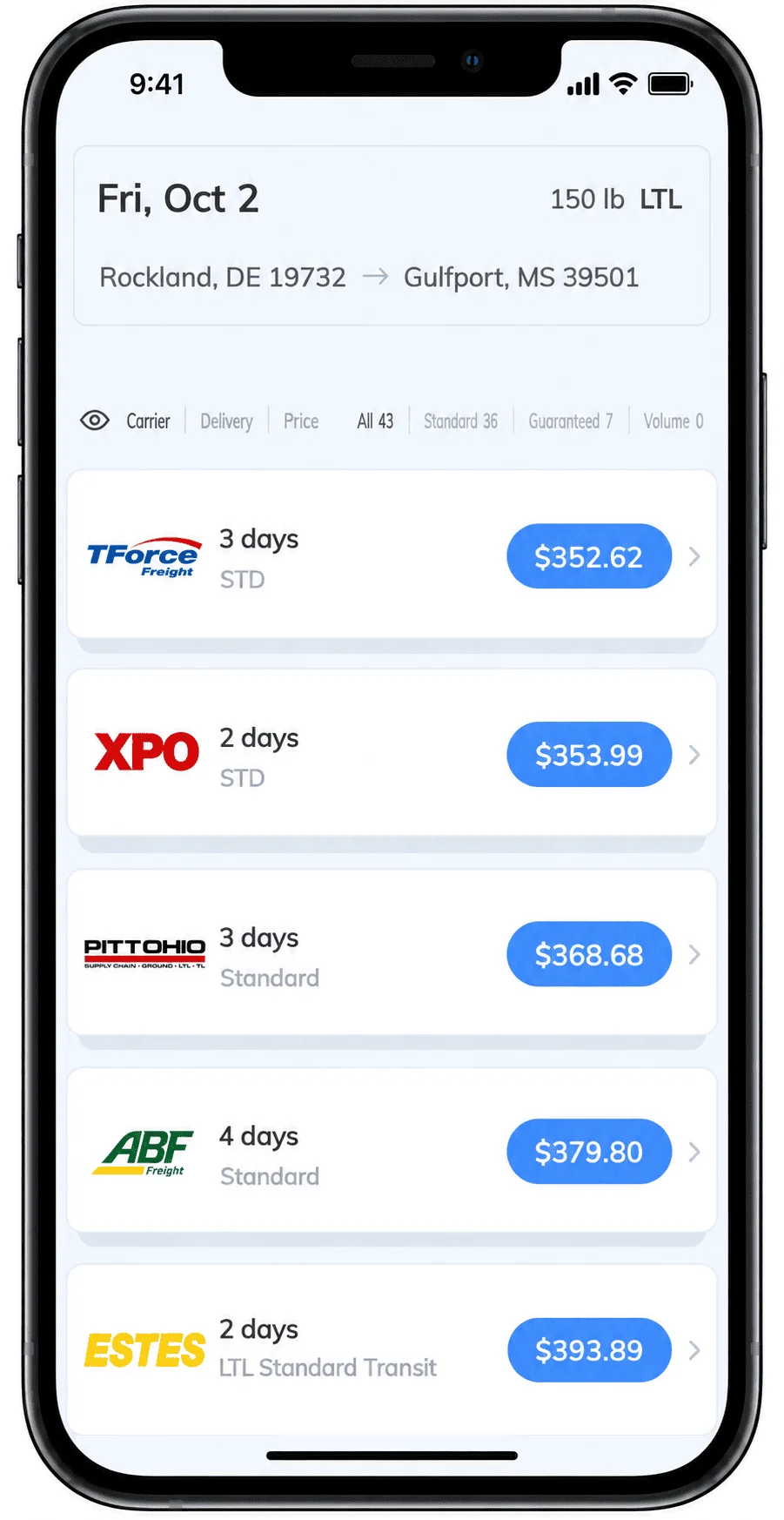
Real screenshot from a live Transportli quote for Rockland, DE to Gulfport, MS, individual results vary by shipment and date.
Major shipping hubs in Delaware
Delaware’s carrier terminal network concentrates around a handful of hubs, split roughly along the state’s north-south divide:
- Wilmington — Delaware’s largest city and historic “Chemical Valley,” still home to Chemours’ headquarters (spun off from DuPont in 2015) and DuPont’s own offices nearby at Chestnut Run; sits directly on I-95 a few miles south of the Pennsylvania line.
- Port of Wilmington — a genuine deepwater port, now operated by Enstructure, and North America’s largest banana and fresh-produce import port, second worldwide only to Antwerp, Belgium. Anchored by Dole and backed by the largest dockside cold-storage facility in the US at roughly 800,000 square feet, the port moves close to 400 vessels and more than 3 million tons of general cargo a year.
- Dover — the state capital, home to Dover Air Force Base, the Department of Defense’s largest and busiest aerial port, flying C-5M and C-17 aircraft to more than 100 countries.
- Newark — home to the University of Delaware, sitting near the I-95/I-295 interchange.
- Seaford, Sussex County — not a terminal hub, but home to Trinity Logistics, a major national freight brokerage headquartered in a converted bowling alley since 2007, acquired in 2019 by Burris Logistics, a century-old Delmarva cold-chain food-logistics company headquartered in nearby Milford.
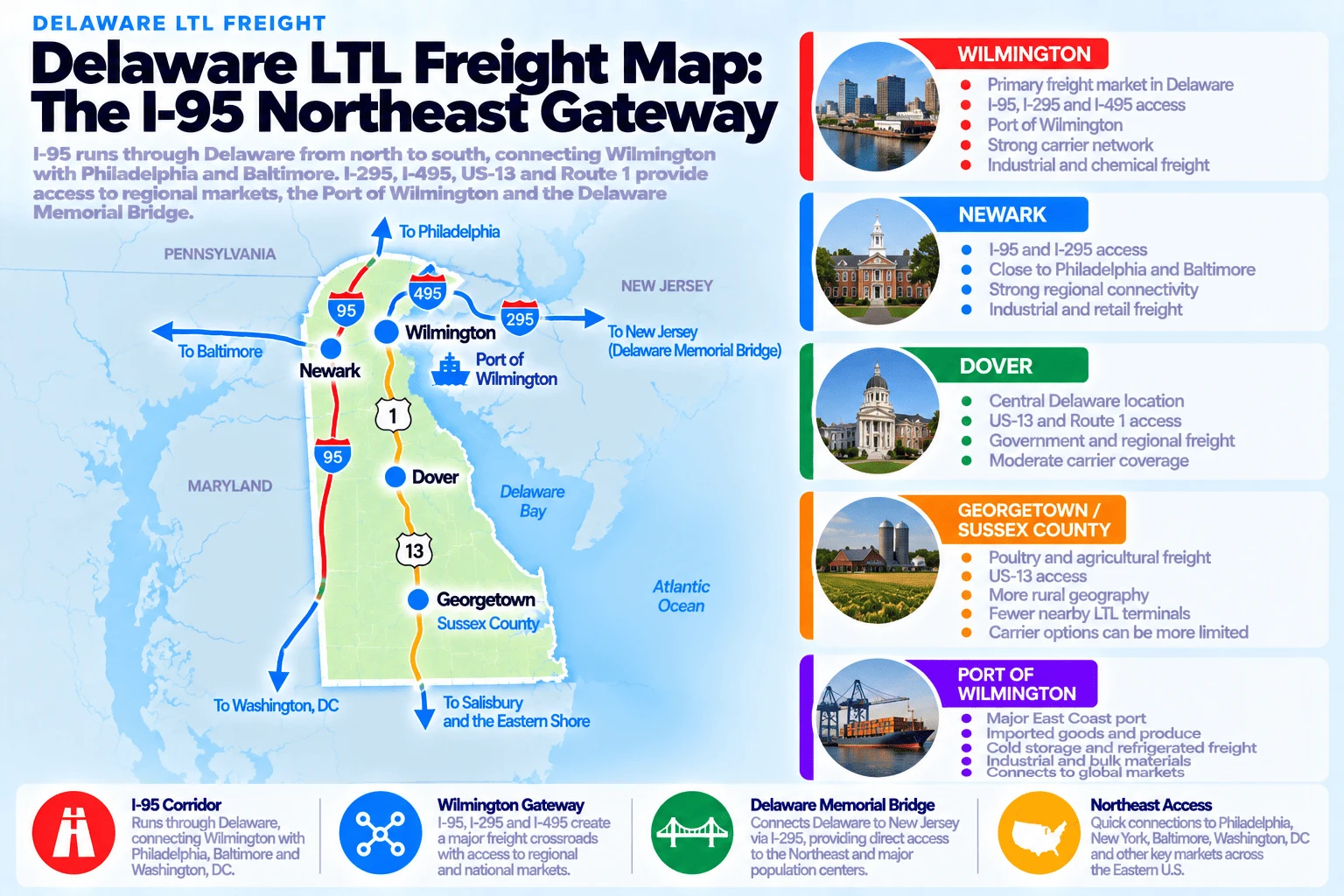
Highway corridors serving Delaware
I-95 is Delaware’s primary freight spine, running through Wilmington and Newark as part of the Northeast Corridor — and the only stretch of interstate in the state that charges its own toll, at the Delaware Turnpike plaza near Newark. I-295 connects to the Delaware Memorial Bridge and New Jersey, while I-495 forms the Wilmington bypass; together with I-95 and Route 1, they meet at what DelDOT itself calls “the megachange,” the I-95/I-295/I-495/SR-1 interchange complex near Wilmington. Route 1 continues south from there past Dover down to the beach towns of Rehoboth and Bethany, doubling as both a freight corridor and a heavily congested seasonal tourist route. US-13 runs the length of the state further inland, through Dover, Smyrna, and the poultry country of Sussex County.
Why one Wilmington interchange carries more freight than almost anywhere else in Delaware
The I-95/I-295/I-495/SR-1 interchange near Wilmington — nicknamed “the megachange” by DelDOT itself — is Delaware’s busiest freight interchange by a wide margin. A 2005 baseline study found roughly 100.7 million tons of freight, worth $66.1 billion, passing through the I-95 toll plaza just south of this interchange in a single year, with volume projected to nearly double to 224 million tons ($128 billion) by 2030. Daily traffic through the interchange topped 207,000 vehicles in 2008 and is projected to reach roughly 273,000 by 2030. For LTL freight, that means nearly every truck moving through Delaware on the Northeast Corridor passes through this single interchange.
What Delaware shippers move
Delaware’s freight mix is small in volume but genuinely distinctive. Sussex County has been the single largest broiler-chicken-producing county in the entire United States since the 1940s — the 2022 USDA Census of Agriculture counted more than 176 million broilers sold there in a single year, roughly double the #2 county nationally, driven by major processors like Perdue, Mountaire, and Allen Harim. That poultry industry is also why US-13 functions as a real cold-chain freight corridor through the center of the state. Wilmington’s chemical industry, built around DuPont, is still alive today through Chemours’ headquarters and DuPont’s own offices at Chestnut Run, even as the industry’s biggest names have shuffled corporate addresses over the past decade. And Delaware’s lack of a state sales tax, combined with Foreign Trade Zone status at the Port of Wilmington, has made the state a genuine magnet for distribution centers and import-heavy warehousing — not just a shopping-trip punchline.
Get a Delaware LTL quote
Compare live rates from vetted carriers serving Delaware.
Get an LTL quote →Delaware LTL freight: frequently asked questions
How much does LTL shipping cost to or from Delaware?
It depends on distance, weight, freight class, and which regional carrier network serves your pickup or delivery point. Real quotes on our platform for longer Delaware lanes have priced as low as about $0.19 per mile, while a short regional hop can run well over $1.50 per mile depending on weight and freight class — distance alone doesn’t predict the rate. New Castle County near Wilmington and I-95 sees the deepest coverage, largely extended down from Philadelphia and Baltimore terminal networks, while rural Sussex County sees noticeably fewer carrier options. Get an instant quote for your exact shipment.
Do oversized LTL shipments need a permit in Delaware?
Yes, for loads exceeding 8.5 feet wide, 13.5 feet high, 60 feet in overall length, or 80,000 lbs gross on five or more axles. DelDOT issues permits, with routine permits covering up to 120 feet long, 15 feet wide or high, and 120,000 lbs before a load is classified as a superload requiring special escort. Most standard LTL freight falls well within these limits.
Why does Delaware charge tolls on I-95?
Delaware is one of the only states that tolls its own interstate freight corridor. The Delaware Turnpike toll plaza near Newark charges by axle count, up to $25 for a 5-or-more-axle truck, and the separate Delaware Memorial Bridge into New Jersey charges up to $42–$48 for a 6-axle truck. Nearly every Northeast-bound linehaul through Delaware pays one or both tolls.
Which carriers serve Delaware?
Most major national LTL carriers serve Delaware, typically through Philadelphia- or Baltimore-based terminal networks rather than dedicated Delaware terminals, given the state’s small size. Coverage and pricing still vary by exact route.
Is LTL service the same everywhere in Delaware?
No. New Castle County near Wilmington and I-95 has the deepest coverage in the state. Kent County sees solid coverage around Dover, while rural Sussex County has historically had the thinnest carrier coverage, with some freight served out of nearby Federalsburg, Maryland.
Is Sussex County really the top chicken-producing county in the US?
Yes. Sussex County, Delaware has been the single largest broiler-chicken-producing county in the United States since the 1940s. The 2022 USDA Census of Agriculture counted more than 176 million broilers sold there in a single year, roughly double the #2 county nationally.