

Shipping LTL freight to or from California? Rates depend on your specific route, freight class, and how close your pickup or delivery point is to the nearest LTL terminal. California has about 39.5 million residents, the busiest container gateway in the country at the San Pedro Bay ports, and a trucking rulebook that differs from most states, from route-by-route trailer length limits to a state emissions inspection program for heavy trucks. Distances are long too, with I-5 alone running about 797 miles from the Mexican border to the Oregon line. Here’s what actually affects your rate.
LTL trucking regulations in California
A standard LTL tractor-trailer within legal size and weight limits does not need a permit in California. Permits and route rules matter for oversize or overweight freight and for longer trailers, and California’s rules include a few that surprise shippers:
- Permits come from Caltrans. The Caltrans Transportation Permits Office in Sacramento issues oversize and overweight permits, and a permit is needed for loads wider than 8 ft 6 in, taller than 14 ft or heavier than 80,000 lbs gross.
- The fees are low. Caltrans lists $16 for a single-trip permit, which lasts 7 consecutive days for one origin, one destination and one direction of travel, and $90 for an annual permit (certain loads up to 12 ft wide and 14 ft high, with a kingpin-to-rear-axle distance of 40 ft or less) or a repetitive permit (up to 90 days, loads up to 12 ft wide, 14 ft 6 in high and 90 ft long).
- Annual permits keep off red routes. Caltrans says travel on “red routes” is prohibited under an annual permit, so check the route before you move.
- Trailer length depends on the road. California limits the kingpin-to-rearmost-axle (KPRA) distance of a semitrailer to 40 ft (38 ft for a single-axle semitrailer), and longer “STAA” trucks with 53-ft trailers are allowed on the National Network and Terminal Access routes. Caltrans color-codes its truck network map, with green for STAA and California Legal trucks, blue for state routes open to both, black-dashed for California Legal trucks only and yellow for KPRA advisory routes.
- Emissions rules apply to heavy trucks. CARB’s Clean Truck Check program requires periodic emissions testing and an annual compliance fee for heavy-duty diesel and alternative-fuel trucks over 14,000 lbs operating in California, including trucks registered in other states.
Current permit fees and rules are public record:
Caltrans Transportation Permits → Caltrans truck network map →
What affects your California LTL rate
- Freight class — density, handling, and liability determine your NMFC class, the single biggest factor in your rate. See our freight class guide.
- Distance — California is long: I-5 runs about 797 miles, US 101 about 808 miles and CA-99 about 425 miles through the state, so a lane from San Diego to Redding or from the Bay Area to the Imperial Valley is a multi-day haul.
- Metro vs. rural — Los Angeles, the Inland Empire, the Bay Area, Sacramento and San Diego are well served by carriers, while the North Coast, the Sierra and the eastern desert typically see fewer terminals and options.
- Terminal proximity — the more carrier terminals near your pickup or delivery point, the more quotes you see.
- Accessorials — liftgate, residential, or inside delivery add to the base rate, same as anywhere else.
Did you know?From 6 real California lanes and 30 quotes
-
3× the cost per mile
A short, light shipment cost more per mile than a long, heavy one
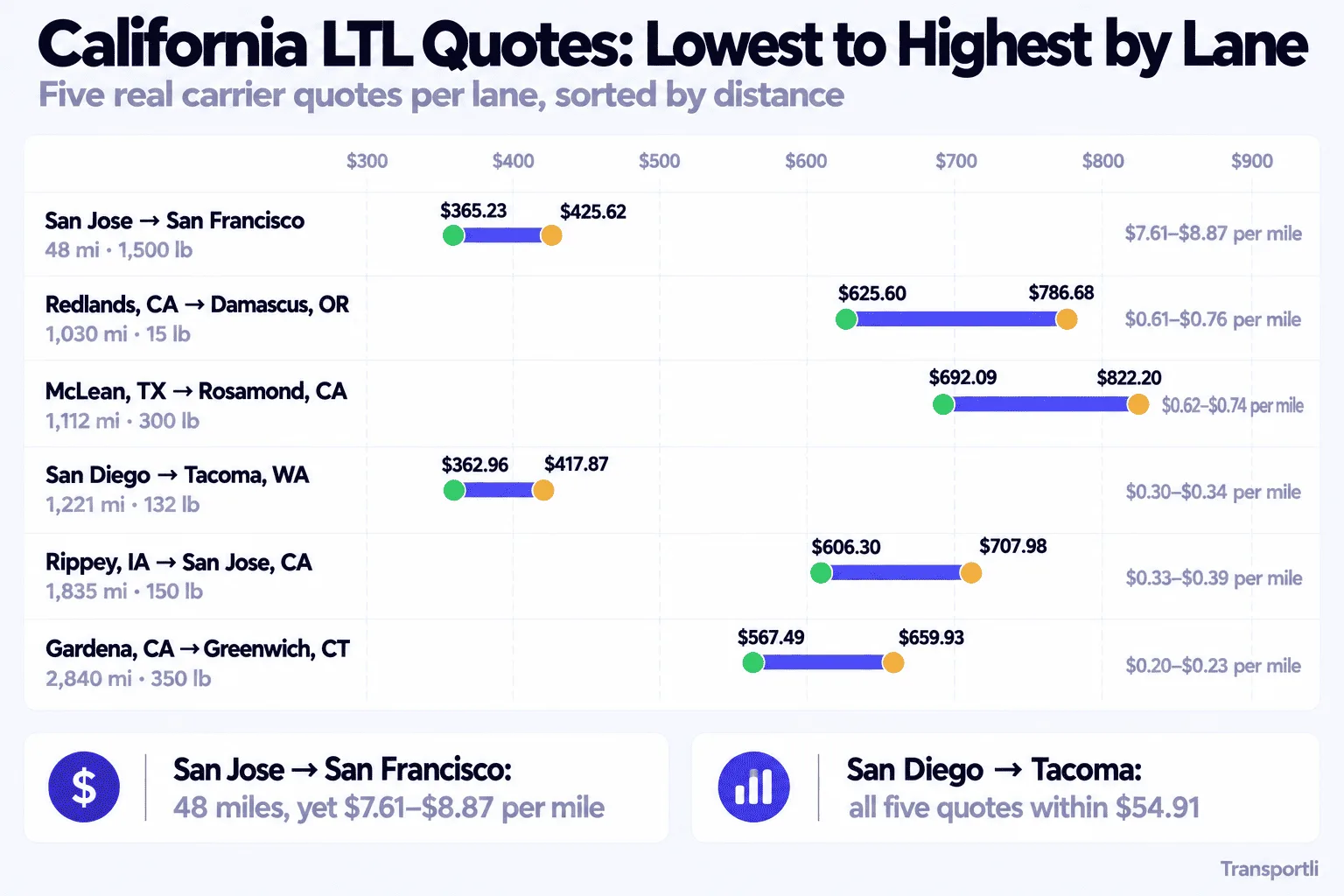
A 300 lb shipment moving 1,112 miles (McLean, TX to Rosamond, CA) had a lowest quote of $692, or $0.62 a mile. A 350 lb shipment moving 2,840 miles (Gardena, CA to Greenwich, CT) had a lowest quote of $567, or $0.20 a mile.
-
5 carriers had the lowest quote
Five different carriers won six California lanes
XPO had the lowest quote on two lanes. ABF Freight, Estes, R+L Carriers, and Warp each had the lowest quote on one lane. Across the lowest quotes on every lane, 13 different carriers appeared.
-
$161 from lowest to fifth-lowest
Same shipment, quotes $161 apart
For 15 lb from Redlands, CA to Damascus, OR (1,030 miles), the lowest quote was $626 and the fifth-lowest was $787, a 26% gap.

Where freight moves in California
California freight follows its coastal ports, its long north-south valleys and the desert gateways to the east:
- Los Angeles & Orange County — the San Pedro Bay ports, I-5, I-10, I-110 and I-405, with the Los Angeles-Long Beach-Anaheim area recording $58.9 billion of goods exports in 2024, according to the U.S. Trade Representative.
- The Inland Empire — San Bernardino and Riverside counties along I-10, I-15, I-215 and CA-60, the warehouse region behind the ports, served by BNSF’s San Bernardino terminal and Union Pacific’s West Colton intermodal terminal.
- San Diego & the border — I-5, I-15 and I-8 to the Mexican border, with San Diego recording $24.9 billion of goods exports in 2024 and El Centro $5.8 billion.
- The Bay Area & Oakland — I-80, I-880, I-580 and US 101 around the Port of Oakland, Northern California’s main container port, with San Francisco-Oakland-Fremont recording $23.8 billion of exports and San Jose $23.7 billion.
- The Central Valley — CA-99 and I-5 through Sacramento, Stockton, Fresno and Bakersfield, the state’s farm and distribution corridor.
- The Sierra & northern California — I-80 over Donner Pass to Nevada, and I-5 and US 101 to the Oregon line.
Weather and transit reliability
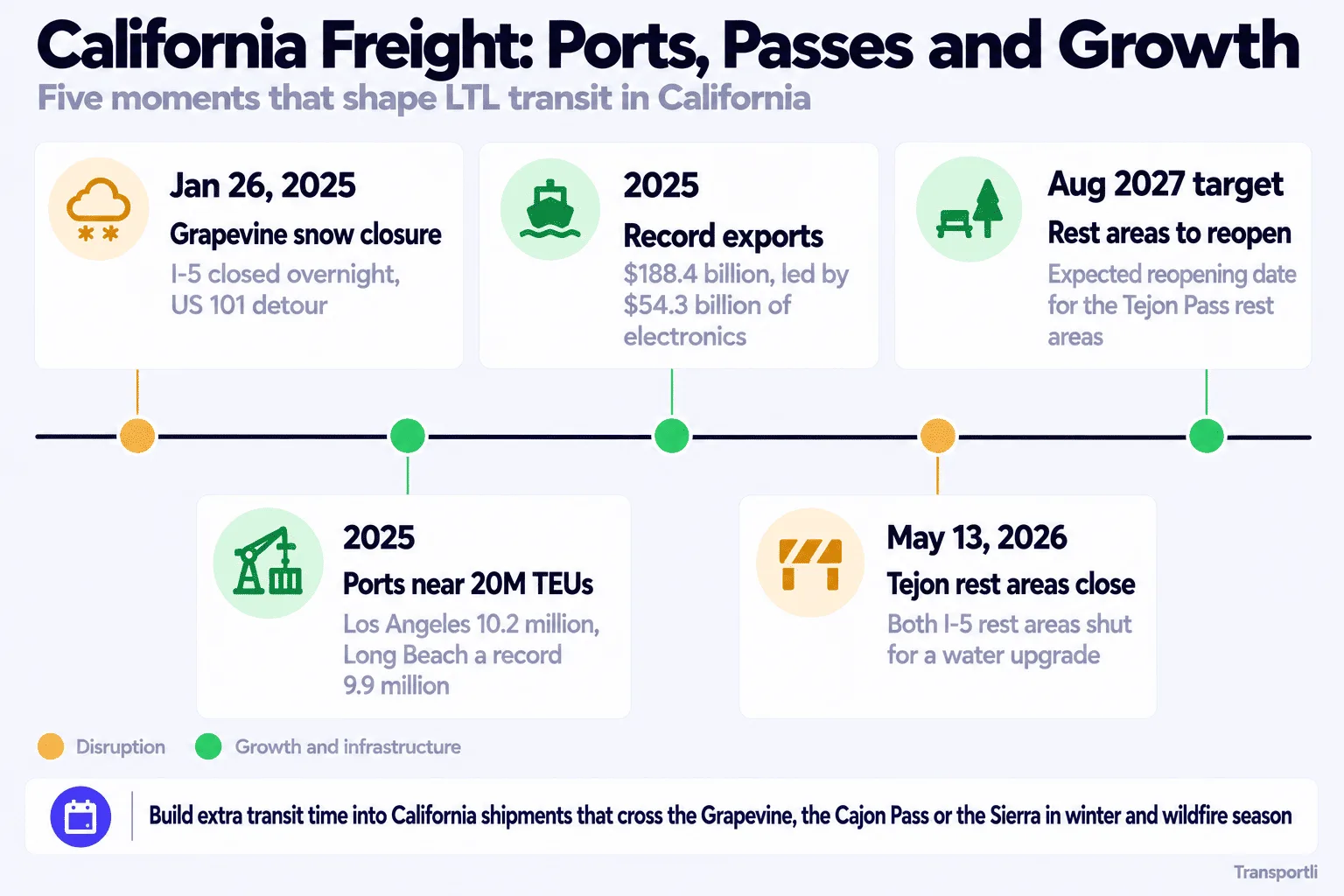
California freight is exposed to mountain snow and wildfire closures on its main north-south links. The Grapevine on I-5, where the interstate climbs Tejon Pass between the Los Angeles area and the Central Valley, closed on the night of Sunday, January 26, 2025, when snow and ice stopped traffic from about 10:40 p.m. until the following Monday morning, with Caltrans pointing drivers to US 101 as the detour. In 2026, the Ridge Fire in northern Los Angeles County shut I-5 in both directions through the Grapevine for hours, the San Francisco Chronicle reported. Caltrans also closed both I-5 rest areas at Tejon Pass on May 13, 2026 for a water and wastewater upgrade that is expected to last until August 2027, which removes a common stop on the corridor. For LTL shippers the practical advice is simple: during winter storms and wildfire season, build extra transit time into anything that crosses the Grapevine, the Cajon Pass on I-15 or the Sierra on I-80.
Sample California LTL rates by route
Real quotes pulled from our platform for six different California lanes — same process, different carriers each time, spanning a range of weights and distances. Rates shift with capacity and fuel costs, so treat these as a snapshot rather than a guarantee for your shipment; get an instant quote for your exact route.
Real quotes by route
Snapshot taken over recent weeks — carriers and pricing change daily.
| Carrier | Service | Transit | Price |
|---|---|---|---|
| Warp | Standard | 5 days | $365.23 |
| Roadrunner Freight | Standard Service | 1 day | $368.14 |
| Central Transport | Standard | 1 day | $391.29 |
| AAA Cooper Transportation | Standard | 1 day | $400.96 |
| R+L Carriers | Standard | 1 day | $425.62 |
| Carrier | Service | Transit | Price |
|---|---|---|---|
| Estes | LTL Standard Transit | 2 days | $625.60 |
| Roadrunner Freight | Standard Service | 3 days | $633.77 |
| XPO | Standard | 2 days | $655.03 |
| Forward Air | Standard | 5 days | $688.27 |
| AAA Cooper Transportation | Standard | 2 days | $786.68 |
| Carrier | Service | Transit | Price |
|---|---|---|---|
| XPO | Standard | 5 days | $692.09 |
| TForce Freight | STD | 6 days | $754.39 |
| FedEx Freight Economy | Standard | 5 days | $755.39 |
| AAA Cooper Transportation | Standard | 7 days | $775.58 |
| Estes | LTL Standard Transit | 5 days | $822.20 |
| Carrier | Service | Transit | Price |
|---|---|---|---|
| ABF Freight | Standard | 4 days | $362.96 |
| Roadrunner Freight | Standard Service | 4 days | $380.42 |
| Oak Harbor Freight Lines | STD | 2 days | $384.53 |
| Central Transport | Standard | 4 days | $384.77 |
| XPO | Standard | 3 days | $417.87 |
| Carrier | Service | Transit | Price |
|---|---|---|---|
| XPO | Standard | 4 days | $606.30 |
| Forward Air | Standard | 3 days | $628.62 |
| Daylight Transport | Standard | 5 days | $687.40 |
| TForce Freight | STD | 6 days | $700.14 |
| AAA Cooper Transportation | Standard | 5 days | $707.98 |
| Carrier | Service | Transit | Price |
|---|---|---|---|
| R+L Carriers | Standard | 5 days | $567.49 |
| Roadrunner Freight | Standard Service | 4 days | $612.50 |
| TForce Freight | STD | 6 days | $622.34 |
| XPO | Standard | 5 days | $623.17 |
| ABF Freight | Standard | 5 days | $659.93 |
Rate, transit, and price-per-mile summary
Pulling the six lanes above together, a short 1,500 lb move between San Jose and San Francisco stands out from everything else in the data:
| Route | Distance | Weight | Price range | Transit range | Price per mile |
|---|---|---|---|---|---|
| San Jose, CA → San Francisco, CA | 48 mi | 1,500 lb | $365–$426 | 1–5 days | $7.61–$8.87 |
| Redlands, CA → Damascus, OR | 1,030 mi | 15 lb | $626–$787 | 2–5 days | $0.61–$0.76 |
| McLean, TX → Rosamond, CA | 1,112 mi | 300 lb | $692–$822 | 5–7 days | $0.62–$0.74 |
| San Diego, CA → Tacoma, WA | 1,221 mi | 132 lb | $363–$418 | 2–4 days | $0.30–$0.34 |
| Rippey, IA → San Jose, CA | 1,835 mi | 150 lb | $606–$708 | 3–6 days | $0.33–$0.39 |
| Gardena, CA → Greenwich, CT | 2,840 mi | 350 lb | $567–$660 | 4–6 days | $0.20–$0.23 |
San Jose to San Francisco (48 miles, 1,500 lb) is the outlier per mile. Its five quotes run $365.23–$425.62, or $7.61–$8.87 per mile, yet Roadrunner Freight’s 1-day $368.14 cost just $2.91 more than Warp’s 5-day $365.23. Weight did not set the price. The 15 lb shipment from Redlands to Damascus, Oregon (1,030 miles) ran $625.60–$786.68, more than the 350 lb shipment from Gardena to Greenwich, Connecticut ($567.49–$659.93), though the Greenwich lane is about 1,800 miles longer. Redlands to Damascus also had the widest spread, $161.08 or 26%, with AAA Cooper’s 2-day $786.68 costing $161.08 more than Estes’s 2-day $625.60 for the same two days. San Diego to Tacoma was the tightest lane, with all five quotes within $54.91, and Oak Harbor Freight Lines’ 2-day $384.53 cost just $21.57 more than ABF Freight’s 4-day $362.96. On McLean, Texas to Rosamond, XPO’s 5-day $692.09 was the lowest, and FedEx Freight Economy’s 5-day $755.39 cost $63.30 more for the same transit time. On Rippey, Iowa to San Jose, Forward Air’s 3-day $628.62 cost $22.32 more than XPO’s 4-day $606.30. Gardena to Greenwich was the cheapest per mile, at $0.20–$0.23. The lesson is the same on every lane: compare several carriers before you book.
What a real California LTL quote looks like
The screenshot alongside is an actual result from our platform, a 140 lb shipment from Fullerton, CA to Sedona, AZ, compared across 46 real carrier options in seconds. It is a California-origin lane that we also break down in our Arizona guide, quoted two days after the earlier search.
- 46 real carrier options compared for this single shipment, 38 of them standard service and 8 guaranteed, not just one broker’s in-house rate.
- $329.44–$373.51 for the five lowest quotes, with transit of 1 to 5 days. Total Transportation & Distribution was lowest at $329.44 on 2-day service, and XPO’s 1-day $373.51 cost $44.07 more to save a day.
- Prices barely moved in two days. Against the earlier search, Total Transportation & Distribution ($329.44) and XPO ($373.51) were unchanged, Oak Harbor Freight Lines rose $0.85 to $365.32, and CrossCountry Freight Solutions fell $2.71 to $358.23, though its transit went from 2 days to 5.
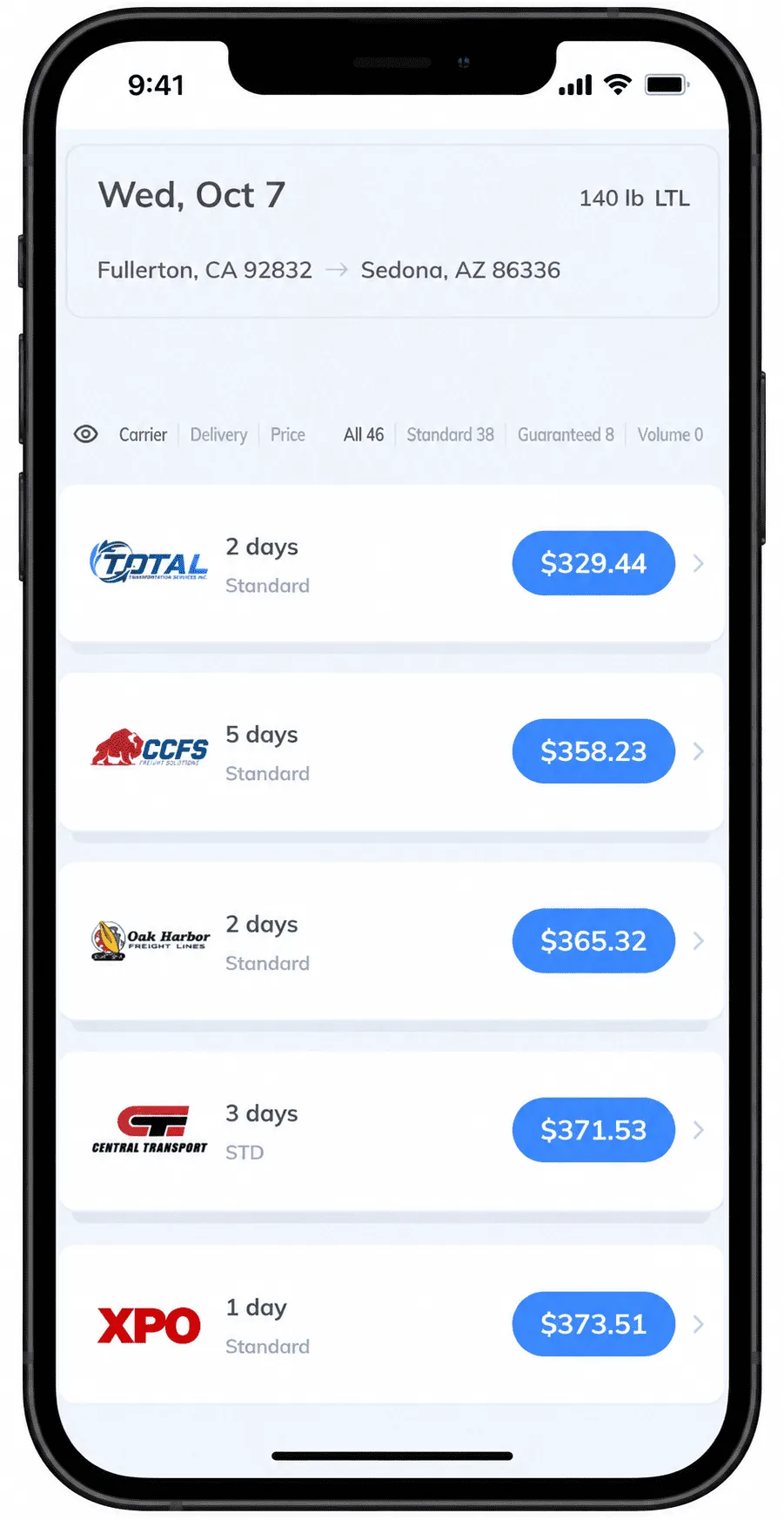
Real screenshot from a live Transportli quote for Fullerton, CA to Sedona, AZ, individual results vary by shipment and date.
Major shipping hubs in California
California’s freight moves through the largest container gateway in the country and a network of inland hubs:
- Port of Los Angeles — handled 10.2 million container units in 2025, the third time it has topped 10 million, according to FreightWaves, and handled 10.3 million in 2024.
- Port of Long Beach — moved a record 9,881,595 TEUs in 2025, up from the previous record of more than 9.6 million in 2024, with imports of 4,779,559 TEUs and exports of 1,141,113 TEUs, according to Container News. Together the two ports handle about 20 million TEUs a year.
- Port of Oakland — Northern California’s main container port and an export gateway for the state’s farm products.
- Inland Empire rail and warehouses — BNSF’s San Bernardino terminal and Union Pacific’s West Colton intermodal terminal, where port imports are loaded into domestic containers and trucks.
- Central Valley — Sacramento, Stockton, Fresno and Bakersfield, which recorded $6.7 billion, $5.8 billion, $3.1 billion and $4.1 billion of goods exports in 2024.
Highway corridors serving California
I-5 (about 797 miles in California) is the main north-south route, from the Mexican border through Los Angeles, the Central Valley and Sacramento to Oregon. US 101 (about 808 miles) follows the coast from Los Angeles to Oregon through the Bay Area, and CA-99 (about 425 miles) runs the length of the Central Valley. I-10 (about 243 miles) crosses Southern California from Santa Monica to Arizona, I-15 (about 294 miles) links San Diego, the Inland Empire and Las Vegas, and I-80 (about 205 miles) connects the Bay Area and Sacramento to Reno over Donner Pass.
The Grapevine and the Cajon Pass
Most truck freight between Southern California and the rest of the West funnels through two mountain passes: the Grapevine on I-5 to the north and the Cajon Pass on I-15 to the northeast. A closure on either one, from snow, a crash or a fire, can push trucks onto longer detours and add a day to a lane. Check Caltrans QuickMap before a tight delivery.
What California shippers move
California’s freight is shaped by technology, farming and trade through its ports. The state exported a record $188.4 billion of goods in 2025, the second most of any state, led by $54.3 billion of computer and electronic products, $17.3 billion of machinery, $17.2 billion of chemicals, $17.1 billion of transportation equipment and $11.1 billion of food products. Mexico took $34.9 billion, or 19% of the total, followed by Canada at $17.0 billion, Taiwan at $14.3 billion, Japan at $11.0 billion and China at $10.3 billion, according to the U.S. Trade Representative. California is also the country’s largest agricultural exporter, shipping $26.3 billion abroad in 2024, led by $9.2 billion of tree nuts. Much of this moves in full truckloads, by container, by air or by rail, but the parts, tools, supplies and finished goods around these industries are where LTL fits.
Get a California LTL quote
Compare live rates from vetted carriers serving California.
Get an LTL quote →California LTL freight: frequently asked questions
How much does LTL shipping cost to or from California?
It depends on distance, weight, freight class, and how close your pickup or delivery point is to a major metro’s carrier network. Real quotes on our platform for California lanes have ranged from about $0.20 per mile on a 2,840-mile haul from Gardena, California to Greenwich, Connecticut to $7.61 to $8.87 per mile on a 1,500 lb shipment over 48 miles from San Jose to San Francisco, so distance alone does not predict the price. Get an instant quote for your exact shipment.
Do oversized LTL shipments need a permit in California?
Yes, for loads wider than 8 ft 6 in, taller than 14 ft or heavier than 80,000 lbs. Caltrans issues the permits: a single-trip permit costs $16 and lasts 7 consecutive days, and annual and repetitive permits cost $90. Annual permits cover only certain loads and keep off red routes. A standard LTL trailer within legal limits does not need one.
Why do some California roads not allow 53-foot trailers?
California limits the kingpin-to-rearmost-axle distance of a semitrailer to 40 feet (38 feet for a single axle), and longer STAA trucks with 53-foot trailers are allowed only on the National Network and Terminal Access routes. Caltrans publishes a color-coded truck network map showing which routes allow STAA trucks and which are California Legal only.
Do trucks entering California have to meet CARB emissions rules?
Heavy-duty diesel and alternative-fuel trucks over 14,000 pounds operating in California are covered by CARB’s Clean Truck Check program, which requires periodic emissions testing and an annual compliance fee, and out-of-state trucks are included.
How do snow and wildfires affect LTL shipping in California?
I-5 over the Grapevine closed on the night of January 26, 2025 for snow and ice, reopening the next morning, and a 2026 wildfire called the Ridge Fire closed it in both directions for hours. Build extra transit time into shipments that cross the Grapevine, the Cajon Pass or the Sierra during winter storms and wildfire season.
Why are Los Angeles and Long Beach important for freight?
The Port of Los Angeles handled 10.2 million container units in 2025, and the Port of Long Beach moved a record 9,881,595 TEUs, so together they handle about 20 million TEUs a year. I-5, I-10 and I-710 carry much of the cargo out of the ports to the Inland Empire and beyond.
What roads connect California’s main cities?
I-5 runs the length of the state from the Mexican border to Oregon, US 101 follows the coast, CA-99 runs through the Central Valley, I-10 and I-15 link Southern California with Arizona and Nevada, and I-80 links the Bay Area and Sacramento with Reno.