

Shipping LTL freight to or from Alaska? Rates depend on your specific route, freight class, and how close your pickup or delivery point is to the nearest LTL terminal, and Alaska works differently from the other 49 states. There is no connected road network to the Lower 48 except the Alaska Highway through Canada, so most freight moves by truck to Washington state and then by container ship or barge to Anchorage, or by air. About half of all inbound cargo crosses the Port of Alaska docks, and Ted Stevens Anchorage International Airport is the busiest cargo airport in the United States. Here’s what actually affects your rate.
LTL trucking regulations in Alaska
A standard LTL tractor-trailer within legal size and weight limits does not need a permit in Alaska. Permits matter for oversize or overweight freight, and Alaska’s rules include a few that surprise shippers:
- Permits come from DOT&PF. The Alaska Department of Transportation and Public Facilities’ Division of Measurement Standards and Commercial Vehicle Compliance issues them, and many single-trip permits can be self-issued online through its SWOOP system.
- Single-trip fees start at $40. DOT&PF’s fee schedule lists a $40 basic charge for an oversize-only or overweight-only single move and $70 for a combined oversize and overweight move, plus surcharges for excess width, height and gross weight of 150,000 lbs or more.
- Extended permits cover many moves. Oversize-or-overweight permits cost $85 for 30 days, $220 for up to 3 months and $550 for up to 12 months; combined oversize and overweight permits cost $165, $385 and $1,100 for the same periods.
- Single-trip permits are short. A single-trip permit is issued for three days, or five days if the trip is more than 400 miles one way, and the count skips Sundays and holiday periods.
- Holidays and weekends can be off limits. Permitted oversize and overweight vehicles cannot move over Memorial Day, the Fourth of July and Labor Day, with an 84-hour restriction that starts at noon on the preceding Friday or Thursday, and a permit can bar movement after noon on Saturday and all day Sunday.
- Overwidth loads move in daylight. The permit manual limits over-width movements to daylight hours unless the vehicle has the required lighting and reflective tape, and peak-traffic restrictions can apply.
- Winter rules differ in the north. From October 1 to April 15, the normal weekend restrictions do not apply to many oversize loads north or east of the Fox weigh station near Fairbanks on the Steese, Elliott and Dalton highways.
Current permit fees and rules are public record:
Alaska DOT&PF Oversize/Overweight Permits →
What affects your Alaska LTL rate
- Freight class — density, handling, and liability determine your NMFC class, the single biggest factor in your rate. See our freight class guide.
- The marine or air leg — most Alaska LTL goes by road to Seattle or Tacoma and then by water. Carrier sites describe container-ship service from Tacoma to Anchorage in about four to five days and barge service in roughly nine to fourteen days, so transit times run far longer than on mainland lanes.
- Where in Alaska — Anchorage, the Mat-Su Valley and Fairbanks are reached by road or rail from the port, while Southeast Alaska and remote communities depend on barge, ferry or air.
- Terminal proximity — the more carrier terminals near your pickup or delivery point, the more quotes you see, and Alaska has far fewer.
- Accessorials — liftgate, residential, or inside delivery add to the base rate, same as anywhere else.
How freight reaches Alaska
Alaska’s freight geography is built around its port, its airport and its one main rail line:
- Port of Alaska (Anchorage) — the entry point for about half of all inbound cargo, with about half of that delivered to destinations outside Anchorage across the state.
- Ted Stevens Anchorage International Airport — a global air-cargo transfer point and the busiest cargo airport in the United States.
- The Alaska Railroad — a 470-mile main line from Seward through Anchorage to Fairbanks, with rail-barge service from Seattle.
- The Alaska Highway — the only road link to the Lower 48, through British Columbia and the Yukon to Delta Junction, used for time-sensitive truck freight.
- Fairbanks and the North Slope — reached by the Parks, Richardson and Dalton highways, with the Dalton Highway running 414 miles to Prudhoe Bay.
Weather and transit reliability
Alaska’s reliability risks are earthquakes, winter and distance. On November 30, 2018, a magnitude 7.1 earthquake struck Anchorage, caused more than $75 million in damage and hit roads, railroads and the port area, according to the state’s earthquake center and news reports. The Port of Alaska’s own materials say its docks are aging and are being replaced in a $2.7 billion modernization program that began in 2014, with a petroleum terminal damaged in 2018 now being rebuilt. Winter closes mountain passes and slows the long drives between Anchorage and Fairbanks, and barge schedules depend on the weather in the Gulf of Alaska. For LTL shippers the practical advice is simple: build extra transit time into anything headed to Alaska, and more in winter.
Sample Alaska LTL rates by route
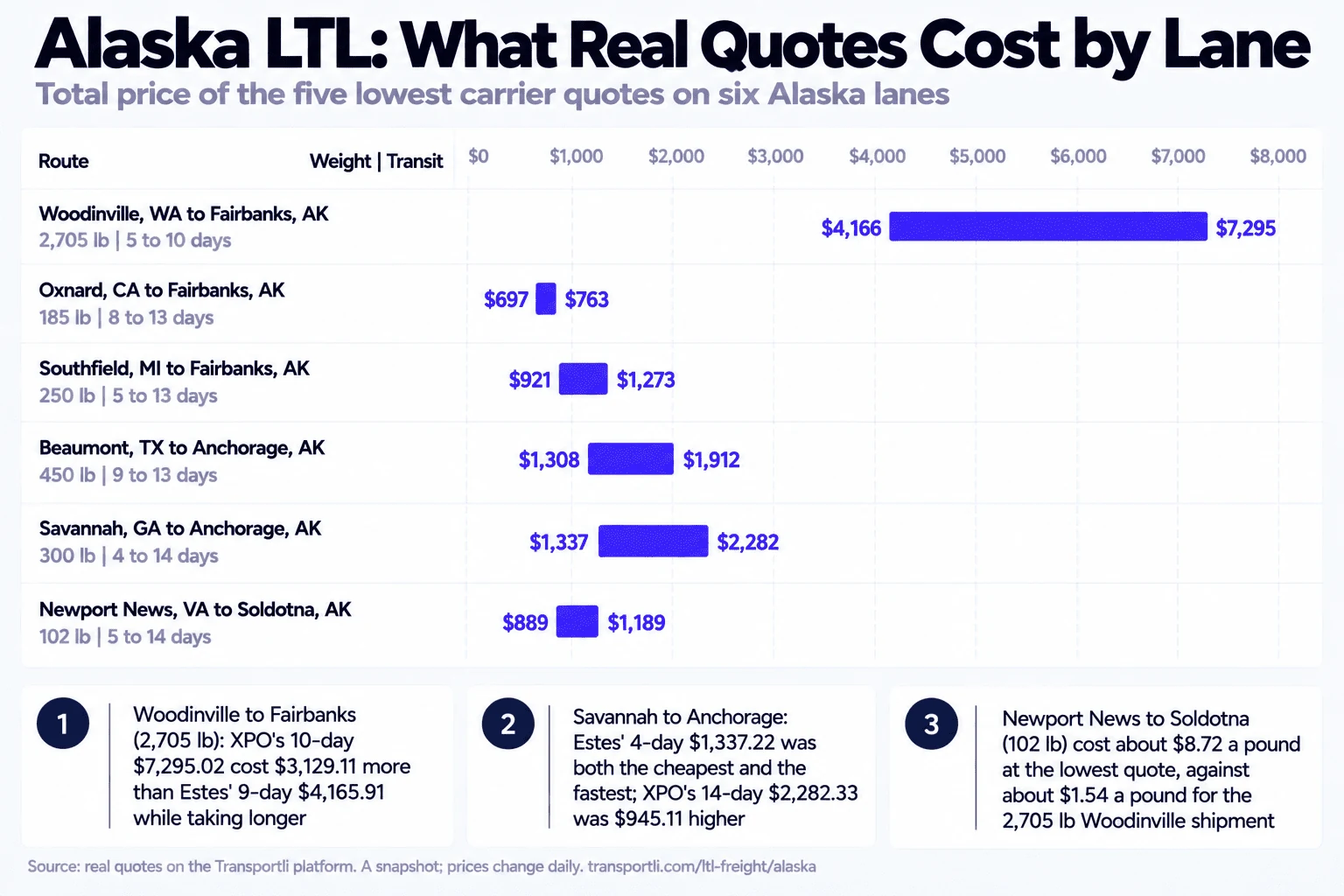
Real quotes pulled from our platform for six different Alaska lanes — same process, different carriers each time, spanning a range of weights and distances. Rates shift with capacity and fuel costs, so treat these as a snapshot rather than a guarantee for your shipment; get an instant quote for your exact route.
Real quotes by route
Snapshot taken over recent weeks — carriers and pricing change daily.
| Carrier | Service | Transit | Price |
|---|---|---|---|
| Estes | LTL Standard Transit | 9 days | $4,165.91 |
| TForce Freight | STD | 9 days | $4,512.27 |
| Roadrunner Freight | Standard Service | 5 days | $4,665.99 |
| ABF Freight | Standard | 10 days | $6,126.40 |
| XPO | Standard | 10 days | $7,295.02 |
| Carrier | Service | Transit | Price |
|---|---|---|---|
| Roadrunner Freight | Standard Service | 8 days | $696.58 |
| R+L Carriers | STD | 13 days | $718.87 |
| Estes | LTL Standard Transit | 10 days | $727.27 |
| XPO | Standard | 11 days | $755.38 |
| TForce Freight | STD | 11 days | $762.86 |
| Carrier | Service | Transit | Price |
|---|---|---|---|
| Estes | LTL Standard Transit | 5 days | $920.78 |
| Roadrunner Freight | STD | 10 days | $940.66 |
| TForce Freight | STD | 13 days | $948.27 |
| R+L Carriers | STD | 12 days | $1,070.46 |
| XPO | Standard | 13 days | $1,273.41 |
| Carrier | Service | Transit | Price |
|---|---|---|---|
| Roadrunner Freight | Standard Service | 9 days | $1,307.99 |
| TForce Freight | STD | 11 days | $1,344.45 |
| Estes | LTL Standard Transit | 11 days | $1,501.67 |
| R+L Carriers | STD | 9 days | $1,534.02 |
| XPO | Standard | 13 days | $1,912.35 |
| Carrier | Service | Transit | Price |
|---|---|---|---|
| Estes | LTL Standard Transit | 4 days | $1,337.22 |
| R+L Carriers | STD | 11 days | $1,381.66 |
| TForce Freight | STD | 12 days | $1,383.48 |
| ABF Freight | Standard | 12 days | $1,624.41 |
| XPO | Standard | 14 days | $2,282.33 |
| Carrier | Service | Transit | Price |
|---|---|---|---|
| Roadrunner Freight | Standard Service | 11 days | $888.94 |
| TForce Freight | STD | 12 days | $923.19 |
| Estes | LTL Standard Transit | 5 days | $948.98 |
| XPO | Standard | 14 days | $1,174.51 |
| R+L Carriers | STD | 11 days | $1,189.29 |
Rate, transit, and price-per-mile summary
Pulling the six lanes above together (the distances are road miles through Canada on the Alaska Highway, which is not how most of this freight travels, so price per mile is only a rough yardstick), a heavy shipment to Fairbanks stands out:
| Route | Distance | Weight | Price range | Transit range | Price per mile |
|---|---|---|---|---|---|
| Woodinville, WA → Fairbanks, AK | 2,137 mi | 2,705 lb | $4,166–$7,295 | 5–10 days | $1.95–$3.41 |
| Oxnard, CA → Fairbanks, AK | 3,291 mi | 185 lb | $697–$763 | 8–13 days | $0.21–$0.23 |
| Southfield, MI → Fairbanks, AK | 3,752 mi | 250 lb | $921–$1,273 | 5–13 days | $0.25–$0.34 |
| Beaumont, TX → Anchorage, AK | 4,188 mi | 450 lb | $1,308–$1,912 | 9–13 days | $0.31–$0.46 |
| Savannah, GA → Anchorage, AK | 4,546 mi | 300 lb | $1,337–$2,282 | 4–14 days | $0.29–$0.50 |
| Newport News, VA → Soldotna, AK | 4,581 mi | 102 lb | $889–$1,189 | 5–14 days | $0.19–$0.26 |
Woodinville, Washington to Fairbanks (2,137 road miles, 2,705 lb) is the outlier. Its five quotes run $4,165.91–$7,295.02, or $1.95–$3.41 per mile, a 75% spread, and XPO’s 10-day $7,295.02 cost $3,129.11 more than Estes’ 9-day $4,165.91 while taking longer. Roadrunner Freight’s 5-day $4,665.99 was the fastest, $500.08 above Estes. Slower was not cheaper on the longest lanes either. On Savannah, Georgia to Anchorage (4,546 miles, 300 lb), Estes’ 4-day $1,337.22 was both the cheapest and the fastest, while XPO’s 14-day $2,282.33 was $945.11 (about 71%) higher and the slowest. Transit is long everywhere, 4 to 14 days, because the freight spends part of its trip on a ship, barge or plane. Weight matters more per pound than in total: the 102 lb shipment from Newport News, Virginia to Soldotna cost $888.94–$1,189.29, about $8.72 a pound at the lowest quote, against about $1.54 a pound for the 2,705 lb Woodinville shipment. Oxnard, California to Fairbanks (185 lb) was the tightest lane, with all five quotes within $66.28, and Roadrunner Freight’s 8-day $696.58 was lowest with R+L Carriers’ 13-day only $22.29 higher. On Southfield, Michigan to Fairbanks, Estes’ 5-day $920.78 beat Roadrunner Freight’s 10-day $940.66 by just $19.88. The lesson is the same on every lane: compare several carriers before you book.
LTL cost per pound to Alaska
Shippers often ask what LTL freight to Alaska costs per pound, and the answer shifts a lot with weight. Dividing the lowest and highest quote on each of the six lanes above by the shipment weight gives:
| Route | Weight | Lowest quote | Lowest per pound | Highest per pound |
|---|---|---|---|---|
| Woodinville, WA → Fairbanks, AK | 2,705 lb | $4,165.91 | $1.54 | $2.70 |
| Oxnard, CA → Fairbanks, AK | 185 lb | $696.58 | $3.77 | $4.12 |
| Southfield, MI → Fairbanks, AK | 250 lb | $920.78 | $3.68 | $5.09 |
| Beaumont, TX → Anchorage, AK | 450 lb | $1,307.99 | $2.91 | $4.25 |
| Savannah, GA → Anchorage, AK | 300 lb | $1,337.22 | $4.46 | $7.61 |
| Newport News, VA → Soldotna, AK | 102 lb | $888.94 | $8.72 | $11.66 |
The lowest quotes worked out to about $1.54 a pound for the 2,705 lb shipment and about $8.72 a pound for the 102 lb shipment, with the 185 to 450 lb lanes between roughly $2.91 and $4.46. A per-pound figure is only useful for freight of similar weight, because carriers charge a minimum per shipment and the marine or air leg adds a cost that does not shrink with a lighter load.
What a real Alaska LTL quote looks like
The screenshot alongside is an actual result from our platform, a 450 lb shipment from Beaumont, TX to Anchorage, AK, compared across 14 real carrier options in seconds. It is the same lane and weight as the fourth rate tab above, quoted for a pickup four weeks later.
- 14 real carrier options compared for this single shipment, all standard service, not just one broker’s in-house rate.
- $988.84–$1,155.54 for the four lowest quotes shown, with transit of 9 to 16 days. Roadrunner Freight was lowest at $988.84 on 9-day service.
- The same lane cost about 24% to 26% less four weeks later. All four carriers appear in both searches and each was lower: Roadrunner Freight fell from $1,307.99 to $988.84 (about 24%), TForce Freight from $1,344.45 to $994.91 (about 26%), Estes from $1,501.67 to $1,141.16 (about 24%) and R+L Carriers from $1,534.02 to $1,155.54 (about 25%). Transit stayed the same for three of them, but Estes went from 11 days to 16. The pickup dates differ, so some of the change may be the date.
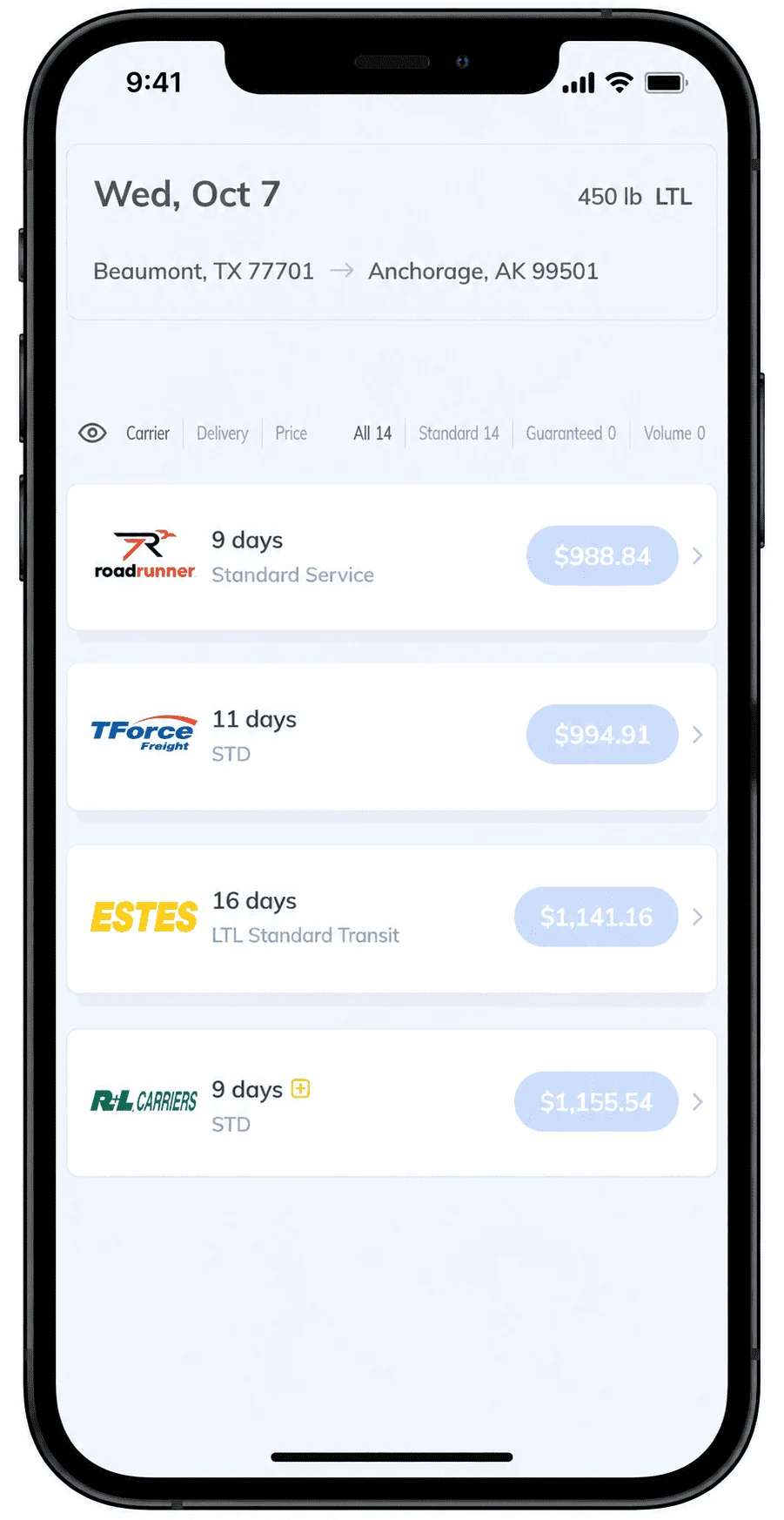
Real screenshot from a live Transportli quote for Beaumont, TX to Anchorage, AK, individual results vary by shipment and date.
Major shipping hubs in Alaska
Alaska’s freight moves through a seaport, an air-cargo hub, a railroad and two interior cities:
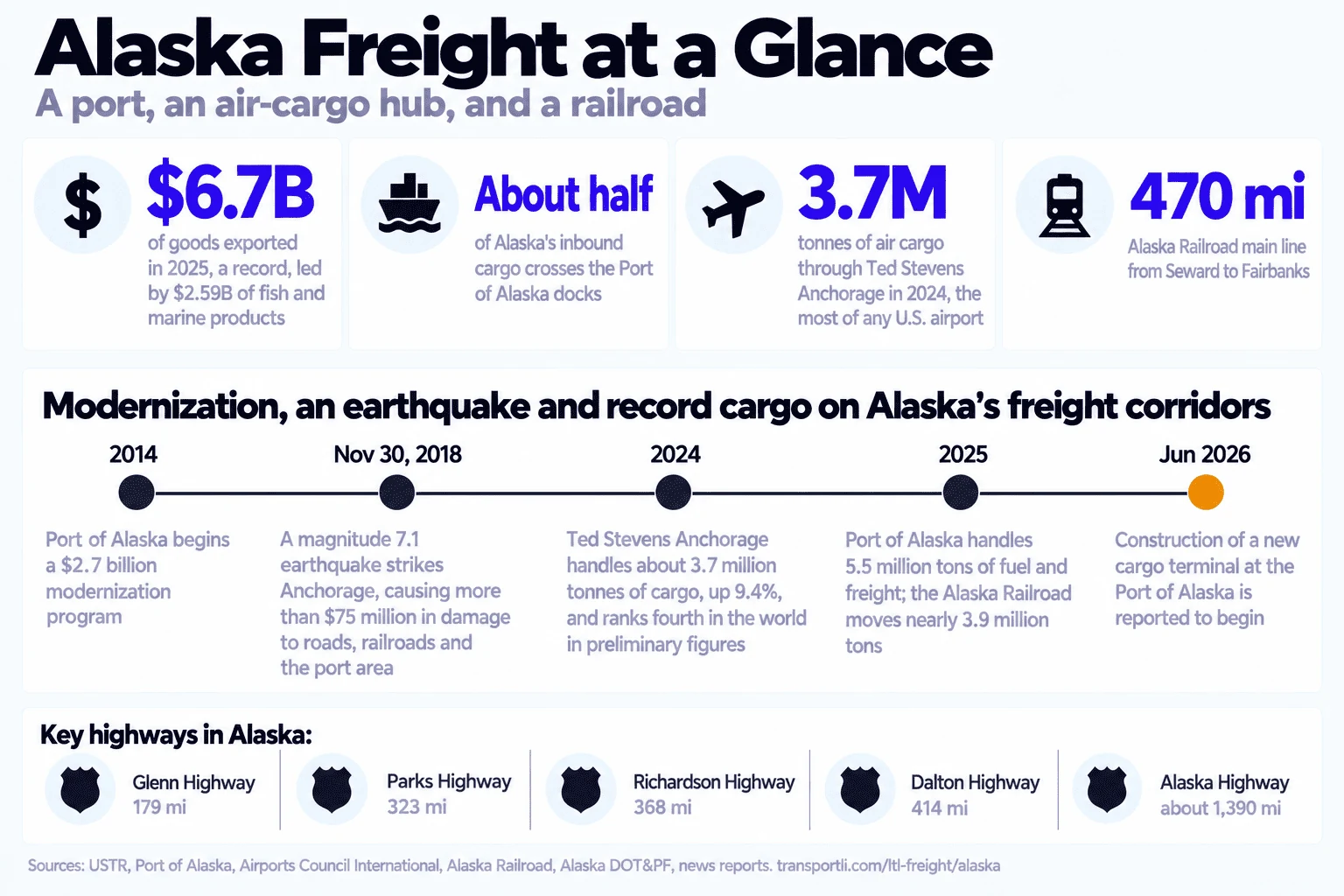
- Port of Alaska — handled 5.5 million tons of fuel and freight in 2025, and is undergoing a $2.7 billion modernization, with construction of a new cargo terminal reported to have begun in June 2026.
- Ted Stevens Anchorage International Airport — handled about 3.7 million tonnes of cargo in 2024, up 9.4% from 2023, the most of any U.S. airport and fourth in the world according to preliminary Airports Council International figures.
- Alaska Railroad — moved nearly 3.9 million tons of freight in 2025, including petroleum, intermodal containers and coal.
- Fairbanks — the interior hub at the end of the Parks and Richardson highways and the Alaska Railroad.
- Prudhoe Bay and the North Slope — supplied up the Dalton Highway.
Highway corridors serving Alaska
Alaska has about 1,082 miles of highway carrying Interstate numbers (A-1, A-2, A-3 and A-4), though they are not built to mainland Interstate standards. The Glenn Highway (179 miles) runs from Anchorage to Glennallen, the Parks Highway (323 miles) runs from the Glenn Highway north of Anchorage to Fairbanks, and the Richardson Highway (368 miles) connects Valdez to Fairbanks. The Dalton Highway (414 miles) runs north from Fairbanks to Prudhoe Bay, and the Alaska Highway links Dawson Creek, British Columbia to Delta Junction, Alaska, about 1,390 miles.
The Alaska Highway through Canada
The only way to drive to Alaska from the Lower 48 is through Canada, so truck freight on this route crosses the border twice and needs the proper customs paperwork. Industry sources describe two-driver teams moving freight from Dallas to Fairbanks in as little as seven days, which is why the road is used mostly for time-sensitive loads.
What Alaska shippers move
Alaska’s exports are dominated by seafood and minerals, and its imports are the consumer goods, building materials and equipment that ship north. The state exported a record $6.7 billion of goods in 2025, led by $2.59 billion of fish and marine products, $2.33 billion of minerals and ores and $1.1 billion of primary metals. South Korea was the biggest market at $1.1 billion, followed by Australia at $1.0 billion, according to the U.S. Trade Representative. The state’s population was 738,737 in July 2025, spread over a huge area, so parts, supplies, groceries and equipment for homes, mines and fishing boats are where LTL fits.
Alaska LTL freight: frequently asked questions
How much does LTL shipping cost to or from Alaska?
It depends on distance, weight, freight class, and how close your pickup or delivery point is to a major metro’s carrier network, and Alaska lanes add a marine or air leg. Real quotes on our platform for Alaska lanes have ranged from $888.94 for a 102 lb shipment from Newport News, Virginia to Soldotna to $4,165.91 for a 2,705 lb shipment from Woodinville, Washington to Fairbanks, with transit of 4 to 14 days, so distance alone does not predict the price. Get an instant quote for your exact shipment.
How much does LTL freight to Alaska cost per pound?
It depends heavily on weight. On six real lanes the lowest quote worked out to about $1.54 per pound for 2,705 lb from Woodinville, Washington to Fairbanks and about $8.72 per pound for 102 lb from Newport News, Virginia to Soldotna. The 185 to 450 lb lanes ranged from about $2.91 to $4.46 per pound at the lowest quote. Light shipments cost far more per pound because carriers charge a minimum and the marine or air leg adds a fixed cost, so use a live quote for your weight.
What’s included in LTL freight quotes for remote Alaska locations?
A quote on our platform is the carrier’s price for the standard service listed. Extras such as liftgate, residential or inside delivery are added only when you select them, and they raise the base rate. Remote delivery brings two further issues. Alaska has far fewer carrier terminals, so you see fewer quotes. And communities off the road system, such as in Southeast Alaska, depend on barge, ferry or air, so delivery can take longer and some carriers may not serve every address or may charge more outside their normal service area. Give the exact delivery address when you quote and check the carrier’s service-area lookup and terms for your ZIP code.
How does LTL freight get to Alaska?
Most LTL freight travels by truck to Seattle or Tacoma and then by container ship or barge to Anchorage, and some goes by air. Carrier sites describe container-ship service in about four to five days and barge service in roughly nine to fourteen days. Truck freight can also use the Alaska Highway through Canada, and industry sources say two-driver teams can move freight from Dallas to Fairbanks in as little as seven days.
Do oversized LTL shipments need a permit in Alaska?
Yes, for loads over legal size or weight limits. The Alaska DOT&PF issues permits, and many single trips can be self-issued online through its SWOOP system. A single move costs a $40 basic charge for oversize or overweight and $70 for both, plus surcharges, and a 12-month permit costs $550 or $1,100 for both. Single-trip permits last three days, or five if the trip is over 400 miles, and holiday and weekend restrictions can apply. A standard LTL trailer within legal limits does not need one.
What is the Port of Alaska?
The Don Young Port of Alaska in Anchorage handles about half of all inbound cargo to the state. It handled 5.5 million tons of fuel and freight in 2025 and is in the middle of a $2.7 billion modernization program.
How did the 2018 Anchorage earthquake affect freight?
A magnitude 7.1 earthquake struck Anchorage on November 30, 2018, causing more than $75 million in damage and hitting roads, railroads and the port area, according to the state’s earthquake center and news reports. A petroleum terminal at the port damaged in 2018 is now being replaced.
Why is Anchorage an air-cargo hub?
Ted Stevens Anchorage International Airport handled about 3.7 million tonnes of cargo in 2024, the most of any U.S. airport, and ranked fourth in the world in preliminary Airports Council International figures. Its location lets aircraft reach nearly 90% of the industrialized world within a single 9.5-hour flight.
What roads connect Alaska’s main cities?
The Glenn Highway links Anchorage to Glennallen, the Parks Highway runs from the Anchorage area to Fairbanks, and the Richardson Highway connects Valdez to Fairbanks. The Dalton Highway runs 414 miles from Fairbanks to Prudhoe Bay, and the Alaska Highway is the road link through Canada.